



Abstract
Objective
Online social support provides a way to positively influence depression sufferers. In the present study, we aim to analyze how social support in Chinese online depression communities is communicated through the lens of deliberate metaphor theory (DMT) to deepen the understanding of the under-researched complicated, emotionally laden, and culture-related concepts of this experience.
Methods
We collected data (n = 3546 comments) from the Warm Supporting section of the Depression Super Topic, a major Chinese online depression community on Weibo. The data were analyzed using a metaphorical analysis with the Metaphor Identification Procedure Vrije Universiteit and a thematic analysis.
Results
Our findings identify two themes: deliberate metaphors (DMs) of depression and DMs of social environment for depression sufferers. The former conceptualizes future expectations without depression (as rosy images; victorious battles; the beaten black dog); disorder (as subtle objects; subjective initiative events); depression sufferers (as valuable objects; important roles); and present life with depression (as optional events; spiritual practices; fragile objects). The latter conceptualizes social connection (as solid objects; nonessentials); individuals in the social environment (as energetic objects; vicious roles); and prejudice (as colored objects).
Conclusions
The findings suggest that DMs as important online social support resources, helping to express empathy and normalize depression with more common-sense, and non-judgmental concepts. Additionally, in DMs, Chinese netizens navigate the intricate intersection of medical and moral perspectives on depression and its recovery, leveraging both aspects to offer comprehensive social support. “Confucian-based” elements are embedded in culture-related social support expressions in DMs. In practice, our findings contribute to tailored and appropriate health interventions for depression.
Introduction
Depression, a common mental illness worldwide, has affected approximately 280 million people (3.8% of the global population), and in China, the number is nearly 50 million (3.7% of the country's population). 1 Although it is a pervasive health experience, numerous Chinese depression sufferers opt to mask their emotions in face-to-face communication to sidestep potential discrimination, which may result in delayed treatment, and even cause suicide. 2 With the spread of the internet, depression sufferers find a beneficial way to draw social support from strange netizens, 3 thus attracting increasing academic attention. However, existing research coping with online social support has focused on its management and effectiveness in reducing depressive symptoms. Online social support for depression sufferers are experiences involving complicated, 4 emotionally laden,5,6 and culture-related concepts. 7 Exploring concepts with these specific features has the potential to advance the understanding of online social support experiences and guide the development of more targeted therapeutic strategies. Despite this potential, existing literature has seldom conducted detailed analyses of these concepts in online social support in Chinese culture.
Based on that, in the current study, we draw upon deliberate metaphor theory (DMT) in the exploration. Metaphors are analytical tools to help communicate about the target conceptual domain (i.e. the underlying emotionally laden, complicated, and culture-related concepts) through the source conceptual domain (i.e. simpler or common phenomena).8–10 Deliberate metaphor (DM), an important part of contemporary metaphor theory, distinctive from non-deliberate metaphor (NDM), is recognized as metaphors “shift the perspective of the addressee from the local topic of a message to another conceptual domain from which that local topic is to be reviewed.” 11 For example, in “Depression is like a journey,” depression sufferers are directed to reinterpret their depression through the source domain of a journey and regard depression more positively as a normal part of daily life. Conversely, when people talk about the feelings of depression in the NDM of “My feelings became very heavy,” 12 they typically do not pay distinct attention to the source domain of “heavy things.” Therefore, compared with NDMs, DMs are more explicit resources to reflect emotional, complicated, and culture-related concepts and guide individuals to reconsider their conditions from an alternate and perhaps more optimistic perspective. 13 Previous studies have demonstrated the vital role of DMs in social support for patients in face-to-face medical consultations. 14 However, few focus on social support delivered through digital channels.
Objective of the study
The present study aims to conduct a deliberate metaphorical analysis of Chinese netizens’ comments on providing social support in online depression communities. By representing how the under-explored complicated, emotionally laden, and culture-related concepts in online social support are conveyed, this study targets at shedding light on online social support theory. These results also endeavor to extend current understanding within DMT by addressing its overlooked aspect of online social support. Consequently, by deepening the understanding of depression and its recovery in Chinese online social support contexts, our goal is to provide insights into effective supportive strategies for health practices for depression in Chinese and related cultures.
Literature review
Online social support and depression
Social support, related to comfort and assistance that individuals experience as a function of social relationships, 15 is positively linked to depression. It is utilized as an efficient resource by romantic partners, siblings, or even strangers to reassure depression sufferers.6,16 According to Beck and Alford, 17 depression manifests in various symptoms, including changes in activity level, mood alterations (e.g. loneliness), negative self-concept, regressive and self-punitive wishes (e.g. suicidal ideation), and vegetative changes. With the accessibility of the internet, a growing body of literature highlights that digital platforms offer a beneficial alternative to traditional face-to-face interactions for supporting depression sufferers.6,16,18–21 They have illustrated that online social support can effectively address emotional, psychological, and social well-being issues associated with depression. 22 Moreover, distinct from face-to-face social support, studies have identified that online counterparts can foster social integration with more online companionship.16,23 The anonymity of digital platforms creates a secure space for them to “express freely,” without the stigma often associate with in-personal communication. 5 Additionally, these digital platforms serve as beneficial forums for knowledge and experience exchange. 20 Therefore, online social support empowers depression sufferers, facilitating the development of a sense of self-determination.5,24
In addition to its benefits, scholars have explored various kinds of online social support in helping depression sufferers. According to Suhr 25 and Cutrona and Suhr, 26 there are five categories of elements that compose social support, including emotional (empathy, love), informational (advice, factual input), social network (a sense of belonging), tangible (offers to provide needed goods and services), and esteem (praise for one's skills, or intrinsic value) supports. Investigations into online social support for depression sufferers mainly revolve around these elements, with slight differences depending on diverse contexts.5,16,18,21,24 For example, Evans et al. 5 have noted that emotional, informational, and instrumental (tangible) social supports are vital resources for reassuring women experiencing postpartum depression online. Besides, Keating 16 and Yip 21 have included that emotional, companionship (social network), and informational social supports are dominant in online depression communities.
Furthermore, as an inherent communicative process, 16 academics have also examined the discursive features of online social support for depression sufferers. They have analyzed the sequential structure of the dynamic interactions in online social support, 21 summarized the employment characteristics of communication accommodation, self-referent words, and words expressing negative emotions in the provision of online social support. 27 These studies identify specific discursive features of online social support, providing valuable references for further analysis. However, online social support for depression sufferers, as experiences closely related to the understanding of depression and its recovery, 5 might express complex and conflicting concepts within their discourse. According to Conneely et al., 4 in online social media, depression sufferers are often perceived and encouraged as moral agents capable of actively contributing to their depression recovery. Nonetheless, a parallel yet contradictory medical viewpoint portrays depression as a severe disease, emphasizing that the responsibility for depression and its recovery lie with the ailment itself, consequently renouncing associated shame of depression sufferers. 4 This medical perspective also advocates for medication as a necessary part of their recovery plan. Besides, depression, a mental health condition, emotional expressions often manifest in social media interactions when individuals seek social support.5,6 Hence, these interactions also involve emotionally laden concepts in discursive practices. A fine-grained exploration of how these features of concepts are communicated in online social support can deepen the understanding of the ways supportive thoughts are conveyed and the nature of depression and its recovery in online social support contexts. However, existing investigations often neglect the in-depth discursive representation of online social support.
Moreover, online social support for depression sufferers is often culture-related.7,28 It exhibits specific features influenced by unique cultural background in Chinese contexts. For instance, Chinese netizens subtly convey online social support, sharing personal stories rather than explicitly expressing emotions, fostering community within depression support groups. 7 Unlike Westerners who often refrain from posting private messages online, Chinese prenatal and postnatal women consider online communities as safe spaces to share specific personal information, such as baby pictures, while offering social support. 28 These findings highlight the influence of Chinese culture on online social support, specifically at the behavioral levels. Nevertheless, the cultural beliefs and concepts embedded in online support behaviors have been largely overlooked. Examining these beliefs and concepts can significantly deepen our understanding of culture-related online social support behaviors and offer valuable insights for tailoring support management in Chinese cultures. Thus, a fine-grained exploration of these elements in Chinese contexts is warranted.
Deliberate metaphors, health, and depression
As pervasive phenomena in our everyday life, 8 metaphors have widely been used to explore complicated, emotionally laden, and culture-related health communication.10,29–31 This is due to their ability to aid individuals in articulating complex and emotional concepts in the target domains through simpler or more familiar phenomena in the source domains. 8 Additionally, as a means of expressing specific thinking patterns, metaphors contribute to reflecting cultural beliefs embedded in language. 31
Furthermore, the use of metaphors has been demonstrated to be beneficial for providing social support for patients with various health concerns.32–37 Skelton et al. 13 emphasize that there are generally two metaphor types employed in doctor–patient interactions. Doctors, on the one hand, deliberately use metaphors to achieve specific communicative effects, and on the other hand, employ metaphors built into human cognition that are unavoidable in everyday conversations. The former is deliberate metaphors (DMs), originally introduced by Steen in 2010 38 and further developed into the DMT in 2015. 39 DMs are metaphors used by producers to offer an alien or alternative perspective on an utterance topic. 40 In DMs, the addressee may need to shift their attention momentarily from the target domains of the utterance to the source domains that are evoked by the metaphor-related expressions. 41 The latter is non-deliberate metaphors (NDMs), referring to metaphors that are not used as metaphors in communication. They are metaphors that the recipient does not attend to the source domains. 40 Xu et al. 42 and Gibbs and Chen 43 have critiqued that speakers use DMs with concomitant careful consideration, and thus DMs are considered ornamental, and only employed by special people (e.g. poets) with highly conscious aims. DMT takes metaphor studies back to the ancient investigations that only focus on certain verbal metaphors rather than conceptual counterparts that try to explain the thinking patterns through metaphorical language. 43 Steen 44 has argued that DMT emphasizes “deliberateness” rather than “consciousness.” “Deliberateness” relates to the hearers or readers’ cross-domain mappings and the communicative effects but not conscious production procedures. 11 This implies that speakers are likely to be unconscious of using metaphors but create DMs and therefore DMT does not dismiss the unconscious aspects of cognition; rather, it represents an advancement of the two-dimensional metaphor theory by incorporating communicative aspects alongside language and thought. 45 These arguments have been proven by recent studies that DMs attract more of the audience's attention to the source domains and be more persuasive in communication. 41 Therefore, DMs, in online social support, emerge as a more explicit means of conveying complicated, emotionally laden, and culture-related concepts. Moreover, when comforting disease sufferers, DMs (e.g. depression is like a battle) can serve as more effective “perspective changers” 46 to assist patients in reconsidering their current conditions in the target domain (suffering from depression) through attractive source domains (battle with depression). Compared to NDMs, DMs may offer greater benefits for patients’ recovery.
In the field of mental health, DMs are also used by professionals to provide social support, enhance their therapeutic alliance with clients,14,39,47–49 and present the clients with alternative perspectives on challenging subjects in a more positive light. 14 For example, doctors deliberately use the “Therapy is like a journey” metaphor to provide social support and persuade patients to regard them as guides to help patients overcome obstacles. 50 They compare themselves to repairmen to fix depression sufferers’ bodies. 51 However, despite the relatively rich literature on DMs in supporting depression sufferers from professionals, the supportive DMs given by other groups, that is, online social communities, are still under-researched.
Obiechina 6 argues that digital channels provide important meeting places for depression sufferers to receive social support from their peers. It is likely that online communities also employ DMs to provide support but in distinct ways. In Evans et al.'s 5 analysis of online social support data for depression sufferers, naturally-occurring DMs are identified. For example, participants provide hope by expressing that depression is finite, stating that “there is a light at the end of the tunnel.” This metaphor encourages depression sufferers to reassess their circumstances, envisioning a brighter future achievable through their intentional efforts. 4 Additionally, the famous expression “no man is an island” by John Donne is employed to reassure depression sufferers that they are not alone and that a supportive community surrounds them. 52
Given the abovementioned benefits of online social support for depression sufferers and the potential of DMs in explaining and guiding individuals’ thinking, online communities’ DMs in comments with supportive elements are important resources of inquiry. In the present study, we attempt to explore Chinese netizens’ DMs in their comforting comments in online depression communities as a new look into online peers’ communicating about social support with the following research question:
RQ1: What types of DMs are employed by Chinese netizens in comments for providing social support in online depression communities? RQ2: How are these DMs used to communicate about supportive thoughts in comments in Chinese contexts?
Methodology
Design of the study
We employed a metaphorical analysis53,54 with the Metaphor Identification Procedure Vrije Universiteit (MIPVU) alongside thematic analysis to explore DMs in Chinese netizens’ comments to reassure depression sufferers. The choice of the metaphorical analysis stems from the authors’ philosophical stance, viewing metaphor as a suitable cognitive, linguistic, and communicative tool for reflecting complex, emotionally laden, and cultural-related concepts through familiar or simpler phenomena.8,31 Furthermore, the metaphorical analysis serves as a flexible framework for data collection, recognition, and analysis of DMs through the Metaphor Identification Procedure Vrije Universiteit (MIPVU). This approach facilitates researchers in consistently constructing and interpreting data within thematic analysis by highlighting contextual factors, interactions, and nuanced understanding. 55
Population
The study targeted the population comprising members of the “Warm Supporting” section within the “Depression Super Topic” on Weibo (an online public social media commonly considered as the Chinese version of Twitter). 56 This population was selected because the “Depression Super Topic” is a highly popular and representative online depression community in China, boasting over 300,000 fans and nearly 1,000,000 posts. 57 More importantly, the “Warm Supporting” section serves as a key and public platform for “depression sufferers” (Through pre-screening, we found that not all the individuals participating in the Chinese online community had medical certificates but also received support, therefore we name the whole group with quotation marks) to receive online social support and the data in this platform is public-accessible. Collecting data from the population in this section enables us to target more comments with supportive elements.
Sample size
Due to the site rules of Weibo and technical limitations of the sampling tool, the sample size of the present study is 5900 public-accessible comments from community members in the “Warm Supporting” section from 16 March 2023 to 1 July 2023.
Sample technique
A Python (3.9) spider program was utilized for automatically sampling public-accessible comments for “depression sufferers” in adherence to site rules and technical constraints.
Instrument for data collection
After collecting comments through the Python (3.9) programmed spider, we adopted Suhr's 25 definitions of social support elements (Concerning their elaboration and applicability in online social support for depression sufferers) as the criteria to further ensure that the selected comments contain supportive elements (emotional, informational, network, esteem, and tangible supportive elements).
Validity of the instrument/reliability of the instrument
To ensure the instrument's validity in the Chinese online contexts, two authors, through pre-screening, selected 20 examples with supportive elements in each category based on Suhr's definitions as expert models from the data collected in previous procedures. After that, two authors further familiarized the definitions as well as the selected examples, and separately read the whole set of comments line by line and coded them with yes/no to check whether the comments contained supportive elements. The results reached an agreement of 95%. The two authors then discussed the confusing and problematic cases until both sides reached a final agreement and excluded the comments with “no” responses coded by both sides. Finally, a total of 3546 comments with supportive elements were selected. Based on previous research using public-accessible anonymous comments to online depression-related posts,24,58 the consent statement and Ethical Committee approval were not necessarily needed in the present study. Moreover, we omitted sensitive and identifiable information in the analysis. 58
Method of data analysis
In the initial round, two authors independently conducted DM identification and description procedures. 40 First, read a comment each time to get a global idea. Second, applied the Metaphor Identification Procedure Vrije Universiteit (MIPVU) 59 to identify all metaphorical lexical units, labeled as MRWs (Metaphor Related Words). Third, looked at the MRW and determined whether the source domain of the MRW is part of the referential meaning of the utterance in which the MRW was used. (a) If “yes,” marked the MRW as potentially deliberate and proceeded to step 4. (b) If “no,” coded the MRW as non-deliberate and proceeded to the next comment. (c) In case of doubt, marked the MRW as potentially deliberate and added the code WIDLII (When In Doubt Leave It In). 59 Fourth, if the MRW was coded as potentially deliberate, described how the source domain of the MRW is part of the referential meaning of the utterance.
In the second round, we applied Owen's 55 criteria for thematic inclusion: (a) recurrence of the implicitly related concepts; (b) repetition of keywords, phrases or sentences; and (c) forcefulness of the underlining of words and phrases, the increased size of print or use of colored marks circling or otherwise focusing on passages in the written reports to establish the themes from the selected DMs.
To ensure the reliability of the coded results, we implemented multiple verification stages. 29 After the initial round, the two authors reviewed each other's coding results and reached a consensus on selected DMs. After the second round, constant comparative analysis 60 was employed to verify established themes. We reviewed each other's transcripts to check the data against the emergent themes. 29 To avoid experimenter bias, two researchers specializing in the interpretive investigation conducted expert checks. Using Miles and Huberman's 61 formula for Confidence = Consensus/(Consensus + Disagreement), we calculated an average reliability of 98% in the initial round and 95.8% in the second round. According to Miles and Huberman, a confidence level higher than 90% indicates reliability. 61 These procedures helped refine themes that initially received disagreement, enhancing the interpretation of social support provided by Chinese netizens in DMs.
Findings
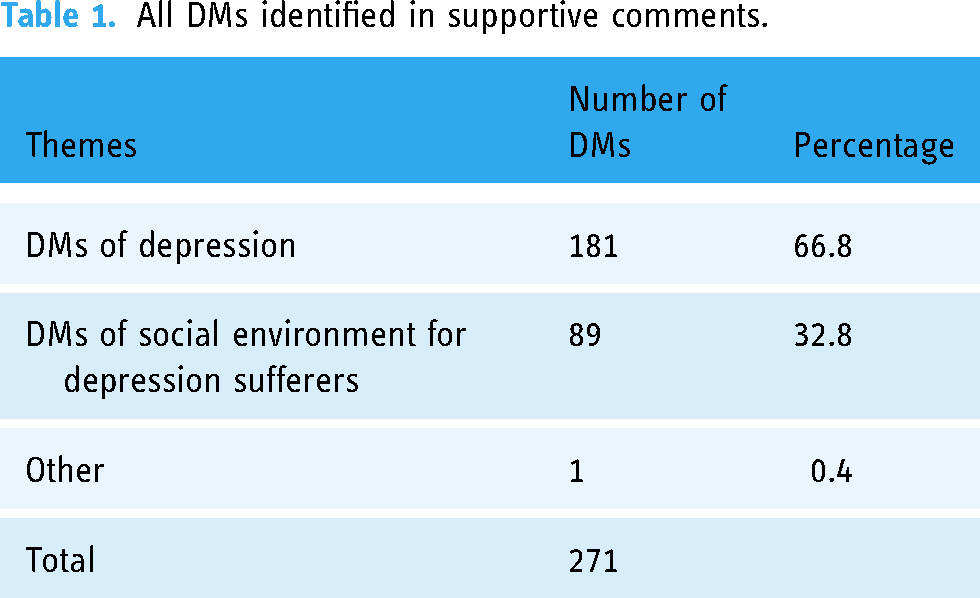
A total of 271 DMs were found, constituting 27.6% of the identified metaphorical expressions. Two broad themes emerged from the selected data: (a) DMs of depression and (b) DMs of social environment for depression sufferers. As shown in Table 1, 66.8% of DMs are related to depression with four subthemes: (a) future expectations without depression; (b) disorder; (c) depression sufferers; and (d) present life with depression. DMs of social environment for depression sufferers represent 32.8% of the cases and embrace three subthemes: (a) social connection; (b) individuals in the social environment; and (c) prejudice.
All DMs identified in supportive comments.
Results for DMs of depression
Chinese netizens frequently use DMs of depression to support “depression sufferers.” In Table 2, 39.8% of DMs focus on depicting a future life without depression. Chinese netizens aim to instill hope in “depression sufferers” that one day they will encounter rosy images and triumph over the battle named “depression.” Secondly, 18.8% of the DMs reify disorder, often likening it to subtle objects and subjective initiative events to comfort “depression sufferers.” Thirdly, 17.1% of the DMs depict individuals experiencing depression, who are mostly compared to valuable objects and important roles. Lastly, 14.4% of the DMs pertain to present life with depression, which is mostly compared to optional events, spiritual practices, and fragile objects.
Subthemes of DMs of depression.

Future expectations without depression
DMs depicting future expectations without depression reflect Chinese netizens’ use of these expressions as valuable tools for emotionally consoling “depression sufferers,” encouraging perseverance with the promise of a brighter tomorrow. There are mainly three themes in this category: rosy images, victorious battles, and the beaten black dog (Table 3).
Subthemes of DMs of future expectations without depression.

Many Chinese netizens tend to use rosy images to express their aspirations for a brighter future for “depression sufferers,” aiming to inspire them in overcoming depression. They characterize future life without depression as the light (1a) or a sunny day (1b). According to these online social support givers, “depression sufferers” can restart their lives and rise from the ashes in the manner of sublimation like Nirvana (1c).
(1) a. 请坚信你可以找到 Please firmly believe that you can find the b. 养好自己的心,心境转变即 Nurture your heart, and a change in mood is like c. (我们)总会(凤凰涅槃) (We) will (experience sublimation like Nirvana)
Depression sufferers often describe their inner world as inhabited by a ghost, plunging them into endless darkness.
12
In these DMs, images like a rainbow, a flower, heaven, or stars are used to try to draw “depression sufferers” attention to a bright future in the source domains, shifting away from the previously occupied dark and damp thoughts. By doing that, Chinese netizens aim to emotionally support “depression sufferers” by igniting the flame of hope in their minds.
In addition to rosy images, victorious battles are also applied to support “depression sufferers.” Depression sufferers often conceptualize depression as an unwinnable war.12,62 To boost the confidence of “depression sufferers,” Chinese netizens compare them to brave warriors fighting against an enemy named depression, ultimately conquering it and winning pleasure (2a). The respondent stresses the victory of this tough war that one day, “depression sufferers” can smash their enemy (2b).
(2) a. (你) b. 回溯的时候把他
This type of DMs aims at empowering “depression sufferers,” encouraging them to dispel worrisome thoughts about losing battle in their minds. Instead, the emphasis is on redirecting their focus toward the victorious war in the source domain. In this manner, Chinese netizens endeavor to communicate positive outcomes through DMs, seeking to emotionally encourage “depression sufferers.”
As for the concept of the beaten black dog, it originates with Winston Churchill, who metaphorically described depression as a black dog persistently shadowing him and affecting his mood.
63
With the spread of globalization, this topic has been introduced to China.
64
Many Chinese depression sufferers, in their posts depict, the black dog as a monster that grips them with its teeth. In response, netizens endeavor to provide comfort to “depression sufferers” by reinterpreting the black dog. The kind netizens reassure this group that one day the black dog will be beaten, ceasing to follow and induce feelings of depression (3).
(3) 早日 (You can) beat
In these DMs, “depression sufferers” are encouraged to focus on the prospect of dispelling the black dog in the source domain, envisioning a future life free from depression. This shift aims to redirect their thoughts from the persistent belief that the depression, like a family pet dog, is woven into the fabric of their daily life.
65
Disorder
When comforting “depression sufferers,” Chinese netizens also provide detailed depictions of the disorder through DMs. They try to assist in the reassessment of the recipient's experience with informational support and offer guidance on how to cope with depression for “depression sufferers.” 21 In Table 4, subtle objects and subjective initiative events are the main subthemes of this category.
Subthemes of DMs of disorder.

Subtle objects are used to deliberately communicate about depression to provide social support for “depression sufferers.” Chinese netizens tend to conceptualize depression as a cold in mind (4a) that can be easily cured. The disorder is also likened to a reminder (4b) to “tell” the “depression sufferers” that there is something wrong with their bodies.
(4) a. 这大概像是一场 It is probably like b. 那一定是我们的身体在 It must be (
Depression sufferers are likely to describe depression as weight62,66 that requires great effort and medication for recovery.
4
Using these DMs to communicate about the disorder, Chinese netizens try to help “depression sufferers” lift the burden by redirecting their thoughts to source domains of subtle objects.
Besides, Chinese netizens also compare depression to subjective initiative events. Concepts highly related to the moral view of emphasizing agency of individuals in exerting subjective initiative are employed in this type of DMs.
4
For instance, some Chinese netizens regard disorder as a kind of event that “depression sufferers” can keep working hard to take responsibility (5a).
(5) a. b. 身体发起预警机制,好好调整。 The body
Moreover, some Chinese netizens conceptualize the body as a machine (5b), echoing previous studies analyzing metaphors in psychotherapy.
51
However, prior literature has concentrated on the professionals’ roles in fixing the machine with medication. In the present study, Chinese netizens emphasize that “depression sufferers” can control themselves, use their subjective initiative, and adjust depression themselves.
Existing studies suggest that depressive disorder is often linked to a loss of control in medication.12,66,67 To support “depression sufferers,” the netizens in these DMs emphasize the role of “depression sufferers” in curing their own disease and the effects of these individuals’ subjective initiative to help them redefine their depression.4,21
Depression sufferers
When providing social support, Chinese netizens also convey positive messages about “depression sufferers,” aiming to boost their self-confidence. Chinese netizens compare this group of people as valuable objects and assign them important roles when offering esteem support25,26 (Table 5).
Subthemes of DMs of depression sufferers.

Subthemes of DMs of present life with depression.

Chinese netizens often liken “depression sufferers” to valuable objects. For instance, some conceptualize them as useful entities with inherent worth (6a), drawing inspiration from the renowned Chinese poet Bai Li. In this verse, Li conveys an optimistic spirit, asserting that every individual is valuable, and encouraging confidence in oneself. Besides, some Chinese netizens also regard “depression sufferers” as treasures bestowed by heaven (6b).
(6) a.
b. 每一个人都是 Everyone is
Coll-Florit et al.
12
suggest that depression sufferers tend to conceptualize themselves as non-valuable things. Chinese netizens employ attractive source domains featuring valuable objects to compliment “depression sufferers” and redirect their attention from low self-evaluation to a higher counterpart.
26
Moreover, Chinese netizens also compare “depression sufferers” to important roles. For example, some Chinese netizens perceive “depression sufferers” as angels (7a), portraying them as indispensable intermediaries between God and humanity. According to these Chinese netizens, “depression sufferers” are NPCs (non-player character), playing a crucial role in promoting the development of the plot in games rather than being mere bystanders (7b).
(7) a. 宝儿,你可不是 You are not b. 生活是自己的,你是自己的 You are the
Negative interpretations of their role can be a risk factor contributing to the development of depression among sufferers.
68
Chinese netizens, in their supportive comments, recognize these negative interpretations and attempt to alter the occupied negative thoughts of “depression sufferers” about themselves through DMs emphasizing important roles with esteem support.
26
Present life with depression
DMs of present life with depression involve explaining the current experience of depression, covering subthemes of optional events, spiritual practices, and fragile objects (Table 6).
Concerning DMs of optional events, “depression sufferers” in their posts often conceptualize their lives as living in a storm. While reassuring them, Chinese netizens also apply these concepts to equate this group's present life. However, from their perspective, life is within their control, and can decide to enjoy the rainbows after the storm (8a), or live a better life and slap life (8b).
(8) a. 虽然现在是 Despite it being the b. 同志振作,生活让我们 Comrade, cheer up! Life may leave us
In these DMs, Chinese netizens primarily align with the views of “depression sufferers” regarding their present life with depression. They express sympathy and offer validation through social support for this group.
21
Yet, they subsequently provide emotional support by encouraging them to take control of their destiny, using attractive source domains of optional events.
Chinese netizens also use spiritual practices to compare present life with depression. In China, Confucianism promotes the spirit of finding contentment in suffering and dedicating oneself to spiritual pursuits. In providing support to “depression sufferers,” Chinese netizens often utilize renowned Confucian expressions to convey a spirit of resilience. They liken life with depression to spiritual practices that can fortify one's will, framing it as a heavenly test that can ultimately guide individuals toward success (9a).
(9) a. 天将降大任于是人也,必先苦其心志,劳其筋骨。
b.一箪食,一瓢饮,在陋巷。(人不堪其忧,回也)不改其乐。 With
Spirituality is an important factor that can influence online social support behaviors4,16 In Chinese contexts, netizens concentrate on Confucius’ spiritual practice to comfort “depression sufferers.” According to Confucianism, a life though very strenuous with merely a single bamboo dish of rice, a single gourd dish of drink, is still joyful (9b). Utilizing these attractive source domains, Chinese netizens aim to offer social support by encouraging “depression sufferers” to reconsider their painful experiences with depression as a form of cultivation practice, finding pleasure amid suffering.
Chinese netizens also employ fragile objects to convey messages about the present life of “depression sufferers” when offering comfort. Depression sufferers often perceive themselves as breakable entities.
12
When comforting this group, Chinese netizens deliberately emphasize similar source domains of debris (10a), mirrors, or empty items that are fragile (10b). In doing so, they explicitly express empathy towards “depression sufferers” and strive to bridge the emotional distance with them.
(10) a. (Life with depression is like) b. 别怕,我有时候也会这样情绪反反复复的,还会感觉整个人都好累 Don’t be afraid, sometimes I am also affected by volatile emotions. Besides, I feel extremely tired and
Results for DMs of social environment for depression sufferers
Depression sufferers often face social decline or malfunctions. 69 Chinese netizens employ DMs to reassure this group, emphasizing that they need not overly concern themselves with others’ prejudice. Generally, we have identified 89 DMs of social environment for depression sufferers with three subthemes: social connection, individuals in the social environment, and prejudice (Table 7).
Subthemes of DMs of social environment for depression sufferers.

Subthemes of DMs of social connection.

Subthemes of DMs of individuals in the social environment.

Social connection
Depression sufferers commonly experience reduced social interconnectedness.
70
In response, Chinese netizens offer network support
21
through “social connection” in two distinct ways. Most frequently, they assure “depression sufferers” that they will accompany this group as solid objects (70.0%). Besides, they sometimes try to persuade “depression sufferers” that social connection is nonessential (18.3%) (Table 8).
(11) a. 如果不介意的话,我可以成为你的 If you don’t mind, can I be your b. 我们这个 In our (12) 虎豹独行,牛马成群。
In the category of comparing social connection as solid objects, many Chinese netizens employ the source domain of a tree hole (11a). This concept originates from a fairy tale featuring a king with donkey ears. In the story, barbers who cut the king's hair and revealed his secret were killed. One barber, wanting to save his life, shared his secret with a hole in a tree, ultimately sparing himself. Consequently, a tree hole symbolizes a place or person where one can confide without fearing betrayal. In offering social support to “depression sufferers,” Chinese netizens use the striking source domain of a tree hole to remind this group that there is always someone who can be their faithful listener. Besides, some Chinese netizens also apply little world (11b) to show their network support for “depression sufferers.” In contrast to therapists that often position themselves as dominant guides in the journey of depression healing,
50
online social communities view their social connection with “depression sufferers” as tree holes, describing themselves as peers living in the same little world with this group.
Chinese netizens attempt to persuade “depression sufferers” that social connections are nonessential. They use striking source domains like tigers and leopards roaming alone and cattle and horses flocking together (12). The message to “depression sufferers” is that the label “loner” is not exclusively derogatory; it can also denote powerful and brave creatures like tigers and leopards. The implication is that they do not have to conform to societal norms of always getting along with others, akin to cattle and horses.
Individuals in the social environment
We have identified several DMs describing individuals in the social environment, where relatives, friends, or people offering assistance are often compared to energetic objects, such as a beam of light (13). Conversely, those who inflict harm on “depression sufferers” are depicted as vicious roles, such as animals (14a) and evil ghosts (14b) (Table 9).
(13) 借助别人的 With (14) a. 世间的 There are too many b. 世界 There are many
Depression sufferers are characterized by low energy.
71
When providing them with social support, Chinese netizens try to convince “depression sufferers” that they are accompanied by others full of energy, using striking source domains of energetic objects in DMs.
To assist this group in reassessing their situation, Chinese netizens make efforts to utilize some attractive vicious roles as source domains in DMs, emphasizing that it is the fault of these vicious people. They encourage “depression sufferers” to stop blaming themselves, aiming to alleviate the feelings of guilt about the situation through esteem support.
Prejudice
Chinese netizens frequently use colored objects to communicate about prejudice to comfort “depression sufferers.”
(15) 不要太在意别人的 Do not be too concerned about others’
The source domain of colored eyes or glasses refers to seeing things not as they are but with bias.
72
Depression sufferers are shown to have impaired social adjustment.
73
They are prone to believing in distorted comments from others’ colored glasses. In this type of DMs, netizens strive to use striking source domains to encourage “depression sufferers” to disregard other people's colored prejudice and to focus on their “true” selves with esteem support.
Discussion
The current study explores the way that Chinese netizens use DMs to express their supportive thoughts to “depression sufferers”. Our findings reveal that in DMs of depression, Chinese netizens tend to conceptualize future expectations without depression (as rosy images; victorious battles; the beaten black dog); disorder (as subtle objects; subjective initiative events); depression sufferers (as valuable objects; important roles); present life with depression (as optional events; spiritual practices; fragile objects). Moreover, in DMs of social environment for depression sufferers, Chinese netizens also conceptualize social connection (as solid objects; nonessentials); individuals in the social environment (as energetic objects; vicious roles); and prejudice (as colored objects).
Our results indicate DMs as important social support resources, accounting for 27.6% of the identified metaphorical expressions. Notably, Reijnierse et al. 74 have demonstrated that although merely 4.36% of metaphors spanning various genres are identified as potentially DMs, they play a significant part in communication. Our findings underscore the integral role of DMs in the supportive comments examined. Additionally, these DMs are employed to try to change the addressee's perspective on various topics through their striking source domains in supporting Chinese online “depression sufferers,” consistent with prior research on the supportiveness of DMs.14,39,48,49 For instance, when reassuring “depression sufferers,” Chinese netizens employ rosy images (e.g. a sunny day) as the source domains and attempt at shifting the “depression sufferers” attention from the previous occupying terrible views on their future. Therefore, our findings further extend the knowledge of DMs as supportive resources in online contexts.
Despite the co-existing conflicting, and complicated concepts discussed in the understanding of depression and its recovery in online social media in prior investigations, 4 Chinese netizens seem to overwhelmingly emphasize moral perspectives of depression when providing social support with DMs. In line with previous findings, 4 our results show that Chinese netizens try to generate a sense of self-determination and emphasize the agency of individuals to overcome depression when likening future expextations without depression to victorious battles; the beaten black dog, and comparing disorder as subjective initiative events to reassure “depression sufferers.” Moreover, they refrain from morally accusing “depression sufferers” of bad behavior or weakness of character and identify that it is vicious roles and individuals with colored glasses to blame 4 in supportive DMs. It is intriguing to observe that, a few Chinese netizens also adopt elements from the medical view and equate depression to a disease. Nonetheless, they compare depression to subtle objects like a cold or a body reminder, framing it as a self-healing process, rather than a brain tumor or chemical imbalance in the brain that should depend on medication or hard work to recover. 4 In this way, Chinese netizens try to reconcile the conflicting and intricate perspectives of medical and moral considerations in the same supportive comment. Through these DMs, they attempt to make the best of these two sides of views to comfort “depression sufferers” that instead of blaming themselves for being “incompetent,” they should be recognized as being “sick.” More importantly, they can take control of themselves rather than being controlled and losing their authentic character through medication. Therefore, our findings contribute to a nuanced understanding of depression and its recovery during the provision of online social support in Chinese contexts.
Furthermore, in line with online social support theory, our findings reveal that in Chinese online social communities, netizens also express empathy, sympathy, and encouragement5,21 to emotionally support “depression sufferers.” Chinese netizens use fragile objects that are employed by depression sufferers 12 to show their similar feelings with “depression sufferers” or deliberately conceptualize “depression sufferers” as important roles (e.g. angels) that are contrary to the depression sufferers’ description of themselves as non-valuable roles. Therefore, with similar or opposite source domains used by “depression sufferers,” Chinese netizens can express these emotionally laden concepts more appropriately in a gentle and non-judgmental way to encourage “depression sufferers” to be more active in their own recovery.
What stands out is that in contrast to previous studies focusing on DMs from professionals that emphasize the curative role of professionals in disease management,4,51 Chinese netizens endeavor to normalize the experiences of depression when they express empathic attitudes in DMs. They understand the loneliness of this group and use DMs of solid objects (e.g. a tree hole) as social connection and energetic objects (e.g. a shining object) as nice individuals surrounding “depression sufferers.” Thus, online social communities are not “medical expertise” who externalize depression and aim at curing their diseases but peers and faithful listeners that can provide “depression sufferers” with companions and energy.16,23 The findings in the current study expand the existing knowledge of supportive DMs with more accessible, and common-sense concepts from the new perspective of online social communities.
Besides, our findings corroborate previous views that online social support is culture-related.7,28 In contrast to Western online contexts, where spirituality is often conveyed through church-based support, 16 Chinese netizens prioritize Confucian-based social support with famous expressions from Confucian classics in DMs. Additionally, according to Conneely et al., 4 online depression sufferers regard depression as a response to the societal pressures of Western modernity that emphasizes conventional social norms and prioritizes material success. In DMs, Chinese netizens actively influence the perspectives of “depression sufferers” by promoting ancient Chinese Confucian ideals, for example, finding contentment in poverty or suffering. This aligns with the moral view of challenging Western contemporary social norms and values, 4 but stands in contrast to the prevalent values in materialism, thus extending previous work by delineating the Chinese version of moral views containing Confucian-based attributes of online social support spirituality.
Conclusion
The current investigation examines the under-explored complicated, emotionally laden, and culture-related concepts embedded in DMs in online social support for Chinese “depression sufferers.” Our findings reveal two themes in these online supportive comments: DMs of depression and DMs of social environment for depression sufferers.
Theoretically, our findings suggest that DMs serve as crucial resources in providing online social support that normalizes the experiences of depression with gentle, non-judgmental, and common-sense concepts. This extends current knowledge of DMT, which primarily focuses on supportive discourse from professionals who tend to externalize depression. Moreover, the findings reveal that Chinese netizens try to reconcile and make the best of conflicting and complicated moral and medical views when offering online social support, adding to the understanding of depression and its recovery in Chinese online social support contexts. Furthermore, Confucian-based concepts, rooted in traditional Chinese social values and presented in supportive DMs, contribute valuable insights into culture-related elements within the online social support theory.
In terms of practical implications. First, our analysis reveals that DMs are important social support resources for mental health practitioners, health educators, or health promoters to practice or educate to effectively communicate with depression sufferers and show empathy with common-sense, and non-judgmental concepts. Importantly, the Confucian-based supportive concepts in DMs can also facilitate tailored health interventions in depression in China and related cultures. Second, our findings suggest that Chinese online communities share solid and more accessible concepts through DMs concerning the “loneliness” and “illness stigma” features of depression. Therefore, individuals with depression or depression tendencies can be encouraged to communicate about mental health issues in online settings.
This study has several limitations. To begin, although we selected the supportive comments that are highly depression-related, we did not collect demographic information about the “depression sufferers” and Chinese online social support providers, therefore we could not verify their diagnosis of depression. In addition to “depression sufferers” who ask for help in their posts, the netizens may also have suffered from depression themselves. That may be the reason for them to participate in these online depression communities. Since individuals’ experiences might influence the communication processes through metaphors, future research can collect more participant information and explore how different groups (e.g. depression sufferers, individuals recovering from depression, or individuals without depression) in providing comments with supportive elements. Especially the supportive comments from individuals diagnosed as depression, who may know better about what individuals with similar symptoms need, thus further generating more tailored practical strategies for depression. Additionally, we focus on the analysis of DMs from emic perspectives and were not able to examine how comments with supportive elements are identified by producers and receivers in DMs from etic perspectives. Further empirical analysis can be conducted to examine the receivers’ and producers’ subjectivity of DMs in the supportive comments, thus identifying the effectiveness of the deliberate metaphorical discourse.
Footnotes
Acknowledgments
The authors would like to thank the two researchers who specialize in the interpretive investigation that helped us conduct an expert check in data analysis.
Contributorship
Conceptualization by YJ; methodology by YJ and GJ; formal analysis by YJ and GJ; writing–original draft preparation by YJ; writing–review and editing by GJ.
Declaration of Conflicting Interests
The authors declared no potential conflicts of interest with respect to the research, authorship, and/or publication of this article.
Funding
The authors received no financial support for the research, authorship, and/or publication of this article.
Guarantor
YJ
