




Abstract
Background
The internet has become the primary source of health-related information, and online health information-seeking behaviour has been used as a reliable surrogate of public awareness. We studied the trends of search interest in polycystic ovary syndrome over time and whether funding for polycystic ovary syndrome research corresponded with the changes in search interest. We also studied the geographic reach of polycystic ovary syndrome interest and whether polycystic ovary syndrome awareness month is an effective strategy to increase polycystic ovary syndrome interest.
Methods
We performed joinpoint regression on relative search volume data for polycystic ovary syndrome using Google Trends from 2004 to 2022, comparing weekly, monthly and yearly trends. We retrieved the total polycystic ovary syndrome-related articles from 1980 to 2022 to study funded and unfunded literature trends. We did a Mann-Whitney U-test analysis comparing the mean relative search volume during the polycystic ovary syndrome awareness month versus the rest of the weeks yearly.
Results
Three joinpoints were seen at months 70, 196, and 199 months which were statistically significant when compared to the null hypothesis of zero joinpoints (p = .0002), one joinpoint (p = .0002), and two joinpoints (p = .0395), respectively. The search interest of ‘Polycystic ovary syndrome’ was seen in 195 regions globally. The mean relative search volume in September corresponding to polycystic ovary syndrome awareness month was higher than other months from 2013 to 2022. Of the 41,292 journal articles analysed, there was a positive trend in funded polycystic ovary syndrome research from the 2000s until the onset of the COVID-19 pandemic.
Conclusions
An increasing polycystic ovary syndrome search interest is probably driven by major legislative and scientific events suggesting the importance of such events. Polycystic ovary syndrome Awareness Month is an effective international awareness initiative to increase online polycystic ovary syndrome information-seeking behaviour. The declining trend in funding is a concern as it mismatches with the continued increase in information-seeking behaviour globally.
Keywords
Introduction
Polycystic ovary syndrome (PCOS) is a complex chronic endocrinopathy affecting 8%–15% of reproductive-aged women. 1 As no curative options are currently available, PCOS management focuses on providing holistic care, alleviating symptoms, and preventing long-term complications, including cardiovascular events and endometrial cancer. 2 Additionally, PCOS may have variable clinical presentations in women and individuals of different ethnicities and regions.3,4 Several researchers have also highlighted the social stigma associated with PCOS, leading to low self-esteem, psychiatric disturbances, sexual dysfunction, or body image concerns.5,6
The internet has become the primary source of health-related information, and online health information-seeking behaviour has been used as a reliable surrogate of public awareness.7,8 Such online activities seek a surge during awareness events. One such surge coincides with September, recognised by the US legislation as PCOS awareness month since 2017.
9
PCOS awareness month is an internationally celebrated event by various charities and patient advocacy groups such as PCOS Challenge, Verity PCOS, etc.10,11 Previously, our group analysed the global digital impact of PCOS awareness month, but the study did not look at the trends in information-seeking behaviour over the rest of the year.
12
Also, there is a paucity of research to understand the impact of awareness campaigns and the positive change brought by these campaigns.
13
Whether this paucity in research is due to a lack of funding is not known. Therefore, we explored the online information-seeking behaviour regarding PCOS over two decades to study:
the trends of search interest in PCOS over time; the geographic reach of PCOS search interest and identify associated themes; whether PCOS awareness month leads to an increase in online information-seeking behaviour about PCOS compared to the rest of the year; whether funding for PCOS research corresponds with changes in search interest.
Methods
Data extraction
We utilised Google Trends to extract relative search volume (RSV) using the search query ‘Polycystic ovary syndrome’ globally from January 2004 to December 2022. We preferred Google Trends because it is a free, open-source tool previously used in numerous assessments to analyse search term volumes entered in the Google search engine.7,8,14,15 Also, other search engines constitute < 10% of the total search market share, and many don’t have publicly accessible data analytical tools. 16 RSV indicates the popularity of a keyword and is calculated by dividing the sampled search data points by the total number of searches done in the specific region and time, after which the resulting value is scaled from 0 to 100. 17 A larger RSV indicates a higher proportion of searches for a given search term. For example, RSV = 10 represents 10% of the highest search proportion observed during the study period. A study of absolute search volume could be biased by population size and internet access, which increased during the study period. RSV indirectly corrects for these factors. 18 Our search query was set as “topic” and hence included various groups of terms similar to the term “Polycystic ovary syndrome” that share the same concept in any language/linguistic variation. 19 No language or geographic restrictions were set.
Overall and yearly analysis
To study overall trends in PCOS search interest, we analysed the data collected from January 2004 to December 2022. We started in January 2004 as this is the earliest year for reported data on Google Trends. The months from January 2004 to December 2022 were labelled with consecutive numbers from 1 to 228. For example, January 2004 was depicted as month 1 January 2005 was depicted as month 13, and so on. In the yearly analysis, we studied weekly trends in PCOS search interest for each year independently from 2013 to 2022. The yearly analysis also labelled the weeks from January to December with consecutive numbers.
Geographic reach
We extracted results from 250 regions globally defined by Google as listed in Supplementary Material 1. We included search queries from ‘low search volume regions’ to ensure that our data represents global search interest. The RSV was compared amongst countries to identify the regions with maximum relative search interest. We also identified the most popular and rising associated topics and searchqueries related to our search topic ‘Polycystic ovary syndrome’. Additionally, we also identified rising topics that denote recent trends. The rising topics represent terms that were searched for alongside our search query and had the most significant growth in volume over the selected time period. For rising topics, related topics with the biggest increase in search frequency were identified and marked ‘breakout’ which showed that these topics had > 5000% increase in search volume, probably because these topics are new and had few (if any) prior searches.
Funding for PCOS research
We used the Lens database (www.lens.org) to extract all scholarly work related to the search query ‘PCOS OR Polycystic Ovary Syndrome’ from 1980 to 2022. Lens is a comprehensive search database of over 250 million scholarly records that lists articles and metadata from various databases including Microsoft Academic, PubMed and Crossref. 20 We then identified the sources funding this PCOS research and studied year-on-year trends of the published funded literature using the Lens database.
Statistical tests
We performed joinpoint regression analysis to identify trend changes (joinpoints) between the independent variable (time) and dependent variable (RSV) using Joinpoint regression Programme 4.9.1.0, developed by the National Cancer Institute. 21 This methodology is ideal for examining trends over time and determining whether apparent changes in trends are statistically significant, which may not be possible with other methods (e.g. auto-regressive integrated moving average analysis). We calculated the estimated monthly/weekly percentage change based on trends in search volume. An inflection point (hereafter called the joinpoint) with a significant change in the slope of the trend was identified using joinpoint regression tests. 18 A minimum of zero and a maximum of three joinpoints were set for the model to capture an increase in RSV during the public health campaign, a decline in RSV afterwards, and a return to the pre-campaign RSV level after the campaign.17,19 The permutation test, with an overall significance level of 0.05, was chosen as the model selection method with assumed constant variance errors. We ran multiple tests comparing null hypotheses of 0, 1, 2, or 3 joinpoints and then reported the statistically significant results.
Additionally, a grid search with a minimum of two observations from a joinpoint to either end of the data, and between two joinpoints was included. The grid search is a technique used to pinpoint the specific locations of joinpoints within the data. It aids in accurately identifying when these trend changes occurred, providing a more precise understanding of how the public's interest evolved. Furthermore, we did a Mann-Whitney U-test analysis comparing the mean RSV during the PCOS awareness month versus the rest of the weeks on a yearly basis. P < 0.05 was considered statistically significant.
Ethics statement
Only publicly accessible data was collected. No human or animal participants were involved, and no patient data was collected. No human-identifiable data is reported in this study.
Results
Overall PCOS search interest from 2004 to 2022
On overall RSV analysis, three significant joinpoints were seen at months 70 (October 2009; CI: 60–79), 196 (April 2020; CI: 188–199), and 199 (July 2020; 196–226), respectively (Figure 1). The three joinpoints identified were statistically significant when compared to the null hypothesis of zero joinpoint (p = .0002, significance level: 0.016; Figure 1A), one joinpoint (p = .0002, significance level: 0.025; Figure 1B), and two joinpoints (p = .0395, significance level: 0.05; Figure 1C), respectively. An initial decline was seen from 1 to 70 months with a monthly percentage change (MPC) of −0.2 (95% CI: −0.3, −0.1; p < .001). This was followed by a significant increase in search interest during 70–196 months with an MPC of 0.5 (95% CI: 0.5, 0.5; p < .001). Then, the highest slope of increase in search interest was seen during 196–199 months with an MPC of 4.2 (95% CI: −16.8, 30.5; p = .720). Finally, for 199–228 months, an increase in search interest was seen with an MPC of 0.6 (95% CI: 0.3, 0.9; p < .001).

Joinpoint regression analysis of the relative search volume from January 2004 to December 2022 (* denotes statistical significance).
Geographic reach and associated searches
The search interest of ‘Polycystic ovary syndrome’ had an international reach amongst 195 regions in various high, middle, and low-income countries, as shown in Figure 2. The top five queries related to PCOS, after excluding the queries for PCOS in other languages, were ‘PCOS symptoms’, ‘What is PCOS’, ‘PCOS diet’, ‘PCOS Metformin’, and ‘PCOS pregnancy and treatment’. The top five rising queries related to PCOS, after excluding the various queries referring to PCOS in other languages and excluding previously stated top queries, were ‘PCOS supplements’, ‘how to get pregnant with PCOS’, ‘do I have PCOS’, ‘PCOS full form’, and ‘spironolactone’.

The geographical reach of polycystic ovary syndrome (PCOS) globally.
Similarly, the top five associated topics related to PCOS, after excluding the queries for PCOS in other languages, were ‘pregnancy’, ‘sign and symptom’, ‘menstruation’, ‘therapy’, and ‘diet’. The top five rising topics related to PCOS were ‘cramp’, ‘ovulation’, ‘home remedy’, ‘egg cell’, and ‘ICD-10’.
Yearly analysis from 2013 to 2022
The weekly percentage change (WPC) in search interest for PCOS during the years 2013–2022 is shown in Table 1, denoting statistically significant joinpoints. The yearly analysis at all joinpoints is depicted in Supplemental Material 2. Prior to the recognition of September as PCOS awareness month (years 2013–2016), one significant joinpoint was seen in the years 2013 and 2014, which showed a peak during the PCOS awareness month followed by a significant decline. Two significant joinpoints were seen in 2015, and no significant trend changes (joinpoints) were seen in 2016. The highest observed value of PCOS search interest was seen during the PCOS awareness month in 2014 and 2015.
Trend changes in relative search volumes about PCOS from January 2013 to December 2022.

WPC: weekly percentage change; PCOS: polycystic ovary syndrome.
*Statistically significant.
The US legislation recognised September as PCOS awareness month in 2017. In 2017 and 2021, one significant joinpoint was seen, corresponding to a decline in search interest after the end of October (week 46). In 2018, no significant joinpoint could be identified. In 2019 and 2022, one significant joinpoint was seen, which peaked during the PCOS awareness month, followed by a decline. In 2020, three significant joinpoints were seen. The highest observed value of PCOS search interest was seen during the PCOS awareness month in 2017, 2019, and 2022.
The mean RSV seen in September, corresponding to PCOS awareness month (36–39 weeks) was higher compared with other months in all years from 2013 to 2022. However, the search interest during PCOS awareness month was significantly higher than the rest of the year in recent years (2019, 2020, and 2022), as shown in Table 2.
Comparison of relative search volume of PCOS, 2013–2022.
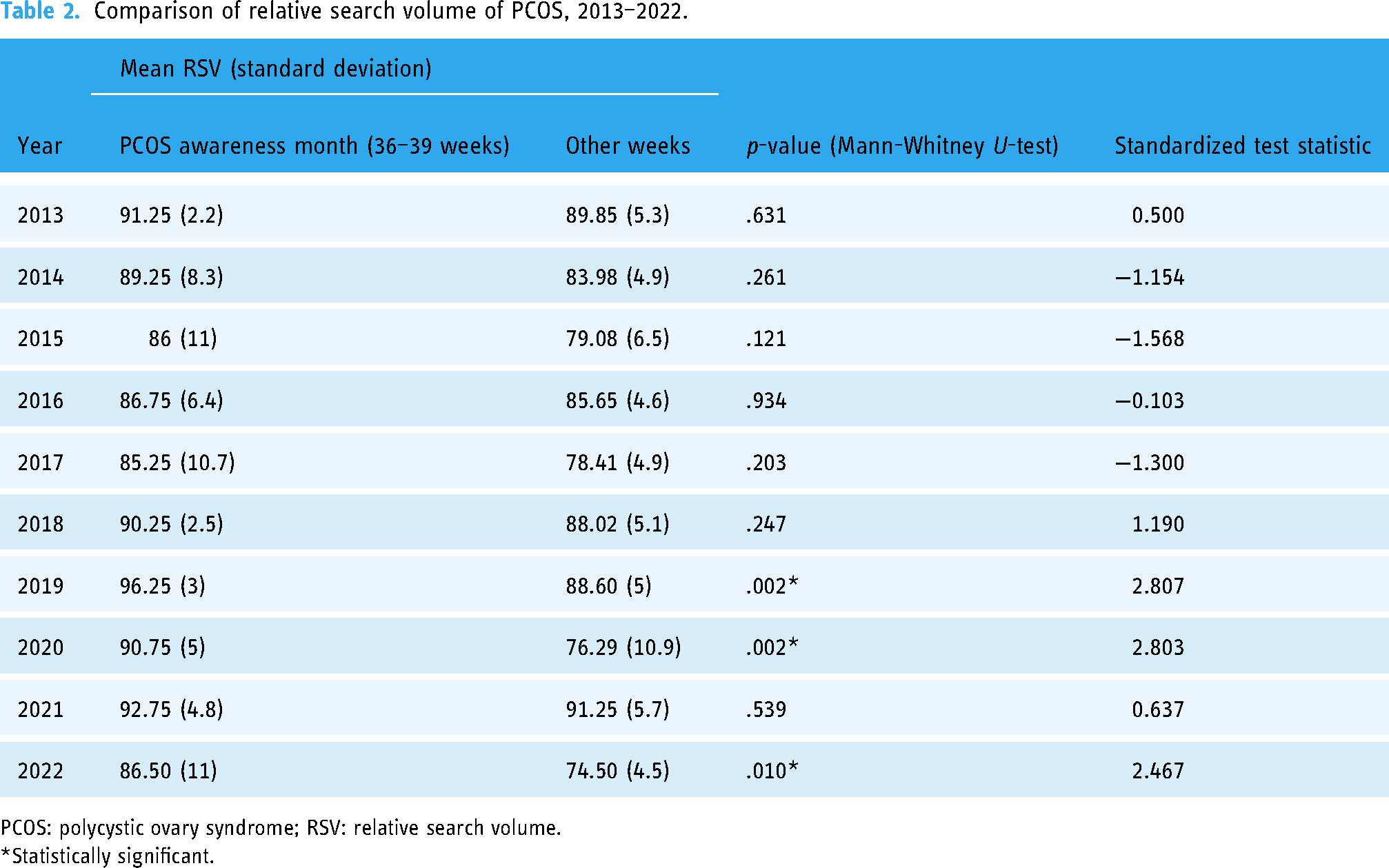
PCOS: polycystic ovary syndrome; RSV: relative search volume.
*Statistically significant.
Funding for PCOS research
We retrieved 41,292 journal articles that showed an overall increasing trend in the total number of PCOS-funded articles till 2020, followed by a decline that might be attributed to the disruption caused by the COVID-19 pandemic, as shown in Figure 3A. The total number of funded articles published in 2022 (577 funded articles) was lesser than the total funded articles in 2016 (607 funded articles). However, the unfunded PCOS literature continues to grow. The top 20 funding organisations, based on the greatest number of PCOS articles funded, were from the USA and the UK. Only one of the top 20 funding bodies belonged to an upper-middle-income country, China—The National Natural Science Foundation of China. There has been a positive trend in the number of funded research articles since 2000, which has declined since the onset of the COVID-19 pandemic (Figure 3B
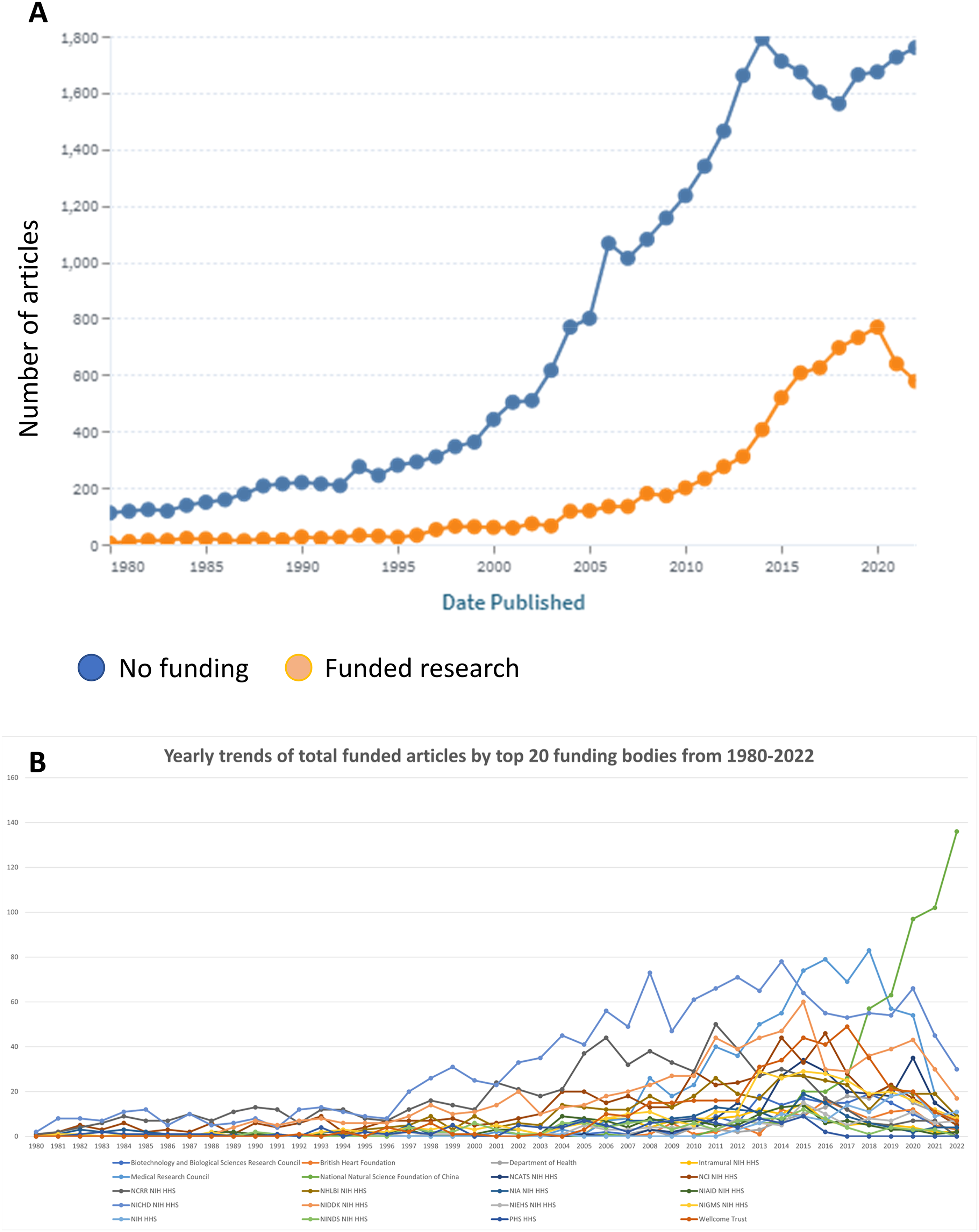
Yearly trends of the total polycystic ovary syndrome (PCOS) funded articles by top 20 funding bodies from 1980 to 2022: (A) trends of funded and unfunded research and (B) trends of top 20 funding organisations for PCOS research.
Discussion
To the best of our knowledge, this is the first attempt to study PCOS search interest and information-seeking behaviour around the year. There has been a significant increase in online searches for PCOS-related information, especially since October 2009. While there was no specific PCOS event during this time (October 2009), the increase in online search may correspond to increased economic internet access with decreasing costs to afford mobile technology globally. A significant spike in search interest in April 2020 and a further increase in July 2020 corresponds with the first wave of the COVID-19 pandemic when global lockdowns were in place. However, we have noticed a decline in funded research since the COVID-19 pandemic. We hope these trends will reverse soon following the economic recovery following the pandemic aftermath.
PCOS Awareness Month is an effective international awareness initiative to involve the masses and increase online PCOS information-seeking behaviour, especially in recent years. However, a decline in search trends post-awareness month may indicate continuous participation from various stakeholders is needed to sustain the global reach and encourage positive online coverage. PCOS influencers may lead destigmatising conversations and positive outreach campaigns about PCOS. 22 The significant increase in search volumes in recent years may also reflect the impact of legal recognition of PCOS awareness month and the creation of international guidelines for PCOS in 2017 and 2018. The latter received extensive coverage and highlighted the importance of holistic care and reducing stigma around women with PCOS. As seen in our analyses, these events may have encouraged active participation from various stakeholders and the general public. The increasing trend in PCOS searches online has mirrored the increase in funded and unfunded research since the 2000s. However, we have noticed a decline in funded research since the COVID-19 pandemic. We hope these trends will reverse soon following the economic recovery following the pandemic aftermath. Investigating how disruptions caused by the pandemic influenced PCOS research funding would be valuable.
The top associated keywords with PCOS bolster the need to address the unmet psychosexual and other needs of women with PCOS, which could be done by fostering supportive communities and providing holistic medical care. There is also a need to increase the global reach of PCOS awareness month, especially in African, Asian, South American, and non-English speaking European countries. We highlighted this deficit in our previous work as well. 12 International bodies may consider using dedicated themes annually to highlight a specific aspect of PCOS, as has been done previously for World Hypertension Day, a single-day campaign which amasses over 250 million impressions just on social media. 23 A deeper dive into how these trends correlate with clinical developments or shifts in treatment approaches would enrich the discussion. For instance, the rise in queries related to PCOS supplements and fertility hints at the changing priorities and interests of individuals affected by PCOS. Understanding how these trends align with clinical research could guide healthcare providers in addressing patient concerns more effectively. 24
The current literature on the impact of reproductive health-related campaigns across different regions is divided. While Cervical Cancer Awareness Month and Cervical Cancer Prevention Awareness Enhancement Month did not raise public interest in cervical cancer in Japan, Breast Cancer Awareness Month successfully improved public awareness of breast cancer in the USA.8,14 The reasons for the success and limitations of various such interventions are poorly understood. Therefore, the success of PCOS Awareness Month presents an important case study on the effective use of resources to promote information-seeking behaviour. In the broader context, our findings underscore the dynamic nature of public interest and information-seeking behaviour related to PCOS. The implications of this study extend to the development of targeted awareness campaigns, educational resources, and research funding strategies. Future research should focus on assessing the long-term impact of awareness initiatives, exploring regional variations in search behaviour, and understanding the evolving needs of individuals with PCOS.
Our study's strengths include using datasets from the largest and the most commonly used search engine (Google) globally. Google search has a market share of over 90% globally. 16 Google Trends has been extensively studied as a timely, robust, and sensitive surveillance system.25,26 However, only those regions/ people with internet access can be accounted for in our study. Currently, internet reach has been estimated to be around 60% globally.27,28 Google uses its non-public mathematical models to calculate relative search volume. Hence, Google Trends lacks full transparency and reproducibility.
Additionally, Google Trends data only provides numerical values and does not provide context for why a particular trend may be occurring. Manual verification of the included studies and data availability statements of the included funded studies using the Lens database were not made, which is another limitation of the study. Those research grants/awards that have been awarded but have not yet yielded any publications are not included in our analysis, which is a limitation of our analysis. Future research is needed to focus on the content and context of online discussions to study their productivity and extent of misinformation, if any. Finally, statistical analyses do not reflect the overall positive impact brought by an awareness campaign. Despite this, our study provides valuable insight into the online trends and associations with PCOS search interest.
Conclusions
There is a continuous increase in online information-seeking behaviour for PCOS, suggesting the need to ensure easy-to-access and evidence-based information is available to such information seekers. The data of associated searches and rising trends are valuable to understanding the public needs, which may be translated into research questions. PCOS Awareness Month is an effective international awareness campaign to involve the masses and increase online PCOS information-seeking behaviour. However, continuous participation from the various stakeholders is needed to sustain the global reach and encourage positive online coverage. There is also a need to increase funding to match the public needs in PCOS research.
Supplemental Material
sj-docx-1-dhj-10.1177_20552076231220787 - Supplemental material for Increasing trends in online information-seeking and decreasing trends of funded research for polycystic ovary syndrome: An 18-year joinpoint analysis of Google Trends data from 2004 to 2022
Supplemental material, sj-docx-1-dhj-10.1177_20552076231220787 for Increasing trends in online information-seeking and decreasing trends of funded research for polycystic ovary syndrome: An 18-year joinpoint analysis of Google Trends data from 2004 to 2022 by Kashish Malhotra and Punith Kempegowda in DIGITAL HEALTH
Supplemental Material
sj-docx-2-dhj-10.1177_20552076231220787 - Supplemental material for Increasing trends in online information-seeking and decreasing trends of funded research for polycystic ovary syndrome: An 18-year joinpoint analysis of Google Trends data from 2004 to 2022
Supplemental material, sj-docx-2-dhj-10.1177_20552076231220787 for Increasing trends in online information-seeking and decreasing trends of funded research for polycystic ovary syndrome: An 18-year joinpoint analysis of Google Trends data from 2004 to 2022 by Kashish Malhotra and Punith Kempegowda in DIGITAL HEALTH
Footnotes
Abbreviation
Acknowledgements
Not applicable.
Contributorship
KM and PK conceptualised the study design. KM formulated the methodology, extracted the data, performed analysis, visualised data, and wrote the first draft. PK provided critical inputs towards analysis, data interpretation, and revisions and supervised the project. Both authors reviewed the final manuscript.
Consent statement
Not applicable as no patient data was collected. Only analysis of publicly accessible anonymised data was done.
Data availability
The original contributions presented in the study are included in the article. Further inquiries can be directed to the corresponding author.
Declaration of conflicting interests
The author(s) declared no potential conflicts of interest with respect to the research, authorship, and/or publication of this article.
Ethical approval
Only publicly accessible data was collected. No human or animal participants were involved and no patient data was collected. No human-identifiable data is reported in this study.
Funding
The author(s) received no financial support for the research, authorship, and/or publication of this article.
Guarantors
KM and PK.

Supplemental material
Supplemental material for this article is available online.
References
Supplementary Material
Please find the following supplemental material available below.
For Open Access articles published under a Creative Commons License, all supplemental material carries the same license as the article it is associated with.
For non-Open Access articles published, all supplemental material carries a non-exclusive license, and permission requests for re-use of supplemental material or any part of supplemental material shall be sent directly to the copyright owner as specified in the copyright notice associated with the article.
