




Abstract
Objectives
The study aimed to determine the following four differences between students in the fields of nursing and health systems management: (a) attitudes towards web-based learning, (b) online course anxiety, (c) online course self-efficacy, and (d) intentional use of technology for learning and find factors that influence students’ intentional learning with technology.
Methods
The study utilized an explanatory sequential mixed methods design. The study was performed according to the checklist for assessment and reporting of document analysis for mixed methods design and research in health professions education. We included students from the School of Health Sciences, including those studying nursing and health systems management. There were 304 students included in our study.
Results
Students from health systems management had more positive attitudes toward web-based learning than nursing students. Health science students’ years of study, online course self-efficacy, and web-based learning influence intentional learning with technology among students. The qualitative finding corresponds only with the qualitative result demonstrated that online course self-efficacy predicts the intentional use of technology for learning.
Conclusions
It is needed to consider factors for designing effective online learning experiences in health science, enabling educators to enhance intentional technology-based learning for nursing and health systems management students through web-based learning optimization.
Keywords
Introduction
The outbreak of COVID-19 has had a profound impact on the world, with the World Health Organization declaring it a pandemic in March 2020. The pandemic has resulted in significant loss of life and has had a significant global impact. One of the most severely impacted sectors has been education.1,2 As a result of the COVID-19 pandemic, educational institutions have had to rapidly adjust and adopt new ways of delivering instruction, such as using technology and remote teaching-learning methods. 3 Students have been expected to familiarize themselves with online learning methods, to maintain both synchronous and asynchronous communication with their instructors and peers. 3 Many educational institutions realized the increased significance of distance learning, along with the need for improvement.4,5 The academic performances of students who took the same course in a face-to-face setting over the previous five years were compared, and the findings showed a statistically significant preference for online teaching. 6 Health science students, who typically rely on hands-on learning experiences and access to clinical resources, have been particularly impacted by the shift towards web-based learning (WBL), 7 which refers to the application of learning strategies in a constructive and collaborative learning environment, utilizing web-based tools and resources. 8
Recent research has shown that healthcare science students have mixed feelings about web-based education. 6 While some appreciate its convenience and adaptability, allowing them to manage their studies alongside other responsibilities, others have conflicting opinions. 9 Many students have also expressed concerns about the lack of hands-on training, limited access to clinical resources and equipment, and difficulties staying motivated and self-disciplined during online learning. 10 In low-income countries, it was observed that while there was a positive attitude toward online health science education, certain individuals faced obstacles, primarily related to inadequate internet connectivity and a lack of appropriate equipment, such as laptops.11, 12
One study has shown that the switch to online courses in health sciences such as medicine, pharmacy, nursing, and dentistry has significantly reduced students’ anxiety levels. 13 However, others found that the abrupt transition to online learning caused students to feel overburdened and stressed. 14 The self-efficacy of online courses which refer to the perception of their ability to effectively utilize computer/online to accomplish tasks 15 may be crucial factor to use online courses. Contrarily, a group of nursing students reported more negative emotions with distance learning than health systems management students. 16
Students’ self-efficacy with the technology employed in online courses has significantly impacted their learning experiences.17, 18 A study involving nursing students showed that higher self-efficacy led to better academic results, such as completing academic assignments. 18 However, no study has compared feelings of self-efficacy regarding online courses between nursing and health system management students.
Furthermore compatibility of users and the technology utilized in online courses has been related.17, 19 Compatibility was identified as one of the key criteria impacting medical students’ independent technology use in a study that was done among them. 20 A study performed with students taking online health systems management courses revealed that they felt excellent with their information technology abilities (compatibility). 6 Hence, this current study sought to find elements affecting intentional learning with technology among health science students following the COVID-19 outbreak.
Research aims and questions
The study's aims were twofold: first, to identify differences between nursing and health systems management students regarding their attitudes and abilities related to WBL, online course anxiety (OCA), online self-efficacy (OSE), online course compatibility (OCC), and intentional use technology for learning (ITL). Second, to identify factors that may influence the students’ ITL, such as OCA, OSE, OCC, and background characteristics such as gender, status, age, type of institution, and year of study. Accordingly, the research questions are:
Do nursing and health systems management students differ in terms of WBL, OCA, OSE, OCC, and ITL? Do OCA, OSE, and OCC, as well as background characteristics such as gender, status, age, type of institution, and year of study, may influence ITL?
Method
Study design
This study used an explanatory sequential variant of mixed methods design. 21 It was conducted to develop meaningful insights into complex ongoing distance learning issues. 22 It adheres to the excellent reporting of a mixed methods study. 23 The study uses a convenience sample. Through an online questionnaire, data were collected through quantitative (cross-sectional design) and qualitative methods from health science students. The Checklist for the Use and Reporting of Document Analysis (CARDA) was utilized for the article, with a focus on mixed methods studies and research in health professions education. 24 (https://www.equator-network.org/reporting-guidelines/guiding-document-analyses-in-health-professions-education-research/). The data were collected from January 2021 to December 2021.
Participants and procedure
The participants in the present study consisted of 304 students from the University of Ariel. Inclusion criteria were students belonging to the School of Health Sciences, studying nursing and health systems management. Students who have participated in web-based learning and online courses. And students who have the required technology and internet access engage in online learning. Exclusion criteria students who are not belonging to the School of Health Sciences, nursing, or health systems management programs. Students who have not taken any web-based learning or online courses and students who lack the necessary technology or internet access for participating in online learning activities. Nursing, and health systems management students were chosen for this research due to the differences between the sense of the professions: Nursing students focus on training in clinical patient care, involving hands-on patient interactions, performing medical procedures, and delivering direct care. On the other hand, students in the Health Systems Management track are equipped with knowledge related to the administrative and managerial aspects of the healthcare system. They focus on healthcare organization, policy, finance, and the overall functioning of health systems.
The students partook in the research voluntarily. An initial e-mail detailing the study's aims and importance was sent by independent research assistants. Students were instructed to fill out the questionnaire one time. Five participants were excluded because the high number of missing values exceeded the edge of 40% in scale items.
Survey
The questionnaire was composed of five sections:
The first section consisted of the WBL Attitude Scale, which is composed of 16 items. Seven negative items were reversed. The higher the score, the more positive the attitude, and vice versa. Cronbach's alpha was found in this study to be 0.89. One example of an item: “Web-Based Learning allows me to learn freely by using my own time.” Items were scored on a 5-point Likert response scale with 1 = very much in disagreement and 5 = very much in agreement. 25
The second section consisted of OCA, OSE, and OCC; sub-scales retrieved from the nursing students’ use of online courses. OCA was composed of four items, including the following item: “I feel apprehensive about using online courses.” OSE was composed of two items, including: “I expect to become proficient in using online nursing courses.” OCC was composed of three items, including: “Using online courses is compatible with most of my learning.” Cronbach's alpha was found in this study to be 0.9, 0.72, and 0.9, respectively. Items were scored on a 7-point Likert response scale with 1 = exceptional disagreement, and 7 = exceptional agreement. 15
The third section consisted of the Self-Directed Learning with Technology Scale, comprising two sections: self-management and ILT. The self-management section contained two items. Cronbach's alpha was found to be 0.56. The ITL section included four items. Cronbach's alpha was found to be 0.83. An example of an item included the following: “I find out more information on the Internet to help me understand my lessons better.” Due to the low self-management internal reliability (Cronbach alpha) score and without the given opportunity to delete items for improvement, the two items were removed. Items were scored on a 6-point Likert response scale with 1 = not at all and 6 = all the time. 26
The three sections of the questionnaire underwent translation between English and Hebrew, both ways and were subsequently validated.
The fourth section consisted of five open-ended questions, which allowed students an opportunity to explore more about students educated with online courses. An example of an open-ended question is: “In your opinion, what crucial elements do students need to be able to learn with technology?”
The fifth section consisted of background characteristics, such as gender, age, religion, year of study, and health discipline type. Completion of the survey was voluntary.
Statistical analysis
For the first aim, G*Power Version 3.1 27 was calculated to determine the sample size required for comparison between subjects, a two-tailed t-test with uneven groups. We used the following parameters: Cohen's d = 0.5; α = 0.05; power = 80%; allocation ratio N2/N1 = 0.25. This gave a minimum sample of 200 participants.
For the quantitative section, statistical analysis was performed using software packages. With the Statistical Package for the Social Sciences (SPSS TM), 26.0 version (IBM, Chicago, Illinois, USA), we calculated Cronbach's alpha, descriptive statistics, χ2, independent t-tests, correlation, and multiple regression analysis (with dummy variables to year of study, gender and institution type).
Five open-ended questions were used for the quantitative section to allow students to elaborate on their perceptions and experiences regarding WBL, OCA, OSE, OCC, and ILT. The open-ended responses were analyzed qualitatively using Microsoft Excel software aid conducting conventional content analysis. 28 The traditional method of analysis allowed for data categorization and examination. Two authors coded text responses, identifying keywords, labeling high-frequency words, and categorizing them. Continuous comparative systems and re-examining categories permitted the emergence of themes of health science students data. A third investigator reviewed and coded the text distinctly, and a final session was held to resolve differences among team. 29
Ethical considerations
The University's Institutional Review Board (Ethics Committee for Nonclinical Human Studies) approved this research (AU-HEA-GG-20200786). Participants were delivered with reliable information regarding the research goals and participated at their own free will. Those who wanted to partake signed an informed consent form before filling in the survey. The participants were guaranteed that they could withdraw from the study at any time, that their answers would be reserved private, and that the survey would be analyzed anonymously.
Results
Quantitative results
The participants comprised 304 students (nursing students: n = 219; health systems management students: n = 85). The mean age of students from both groups was 27.32 (SD = 7.63). Most of the participants were female (85%), single (63%), and religious (52%). Furthermore, in both groups, most participants were first-year students of the academic program (see Table 1).
Frequency and percentage of distribution within the groups.

p < 0.05; **p < 0.01.
There were no differences between the two groups regarding OCA, OSE, and OCC. However, there were differences between the two groups concerning WBL and ILT. Students from the Health Systems Management Department had a more positive perspective on WBL than nursing students. However, regarding ILT, nursing students had a more positive perspective than health systems management students (Table 2).
Nursing and health systems management departments’ perspectives regarding WBL, OCA, OSE, OCC, and ILT.
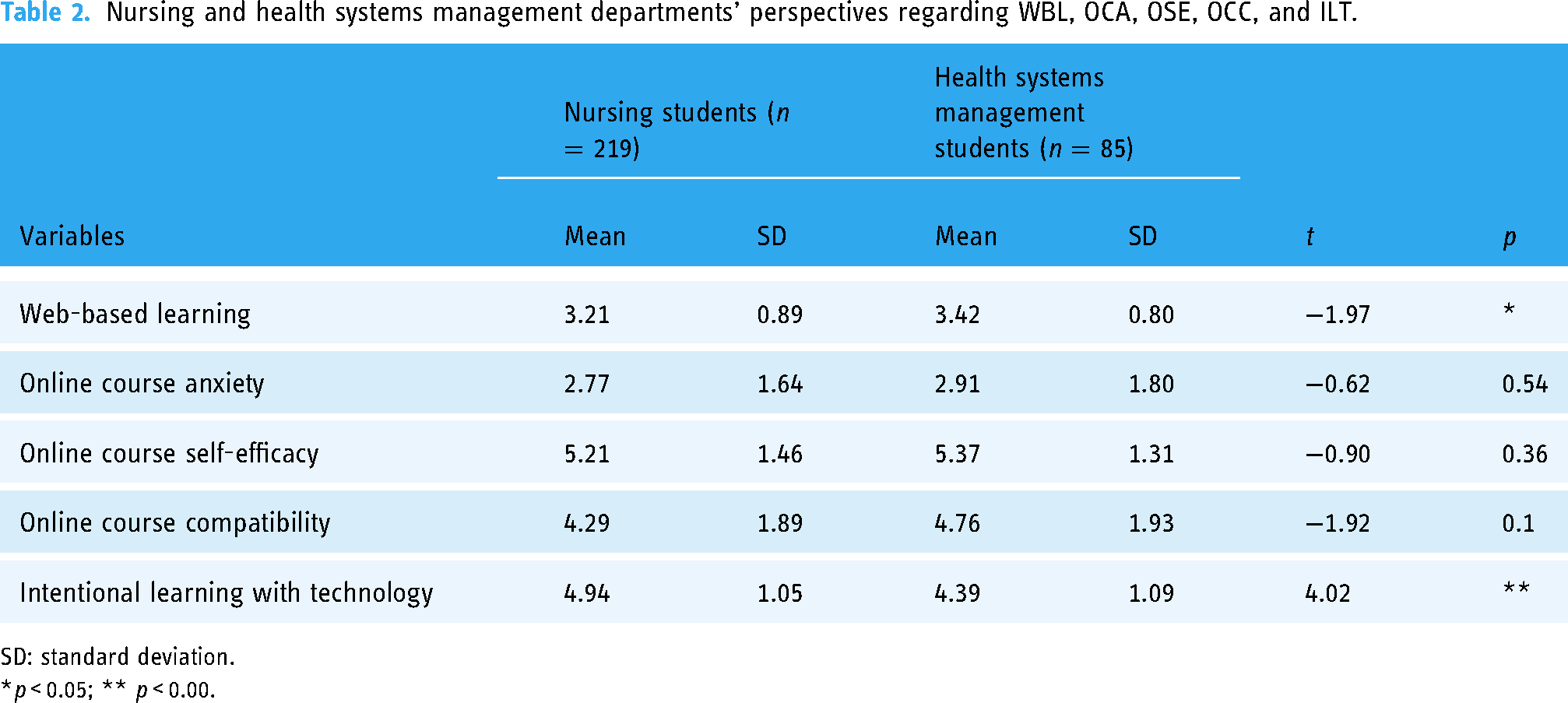
SD: standard deviation.
*p < 0.05; ** p < 0.00.
Health systems management students’ perspectives on WBL enabled them to choose courses they wanted to take, providing more abundant learning information, and learning freely by using their own time significantly more positively than nursing students. Furthermore, health systems management students felt less isolated from their teachers and classmates as a result of WBL, in comparison to nursing students (Table 3).
Nursing and health systems management departments’ perspectives regarding web-based learning.
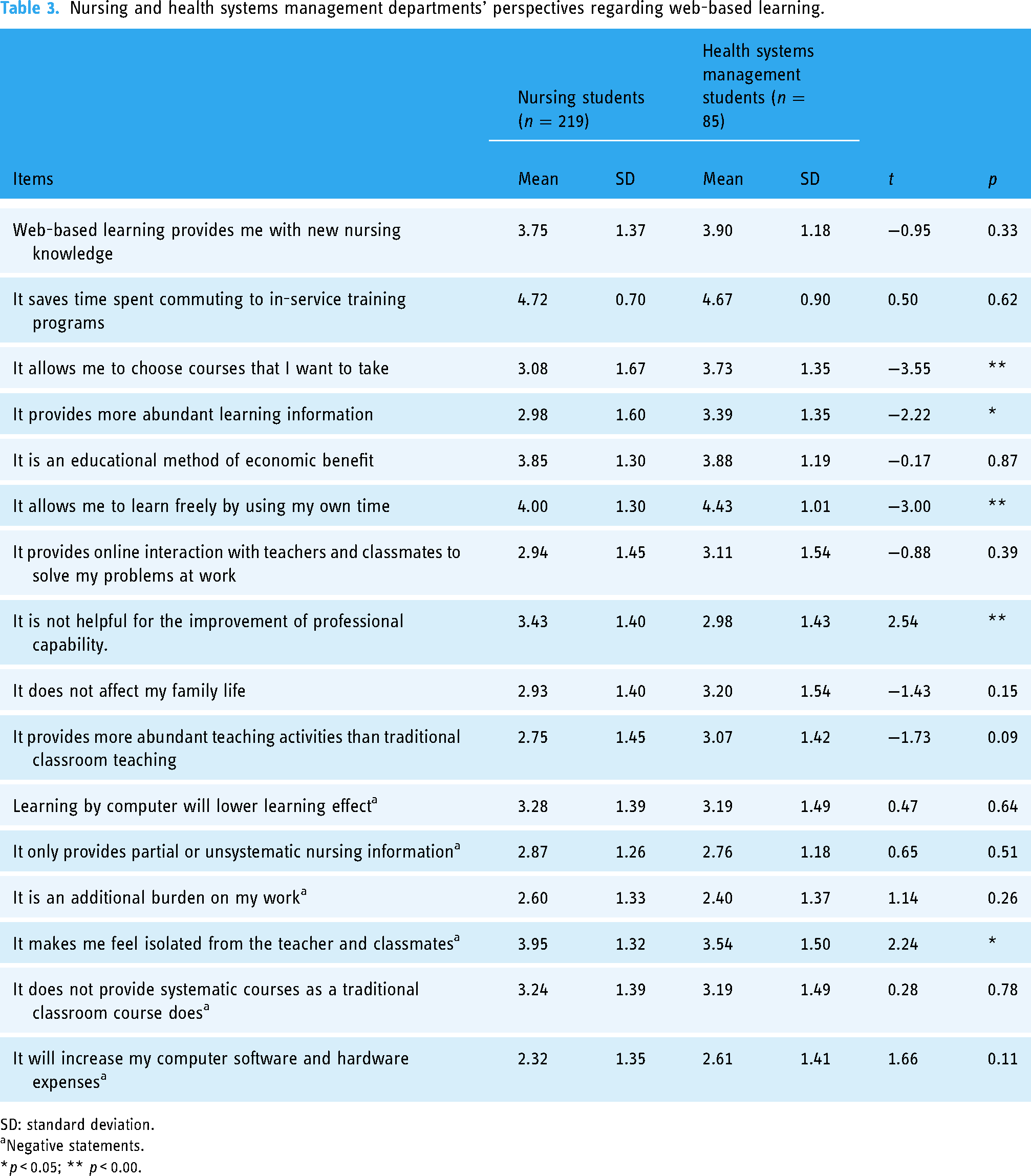
SD: standard deviation.
Negative statements.
p < 0.05; ** p < 0.00.
Correlation coefficient was calculated to examine the potential relations among the study variables. Age was negatively associated with OCA, and positively associated with OCC, OSE, WBL, and ILT; institution type was negatively associated with OCA, and positively associated with OCC, OSE, WBL, and ILT; and year of study was negatively associated with OCA, and positively associated with ILT. The variables OCA, OCC, OSE, WBL, and ILT were all related to each other (Table 4).
Correlations between variables.

p < 0.05. **p < 0.01.
To further explore the research aim, if background characteristics (gender, age, institution type, and year of study), OCA, OSE, OCC, and WBL influence ILT among students from health science faculty it was conducted multiple regression analysis. The model analysis was significant (F = 3.64, p < 0.00; Table 5) and explained 10%. Year of study (fourth year), OSE, and WBL significantly influence ILT (see Table 5).
The effect of background characteristics and WBL, OCA, OSE, and OCC on ILT.
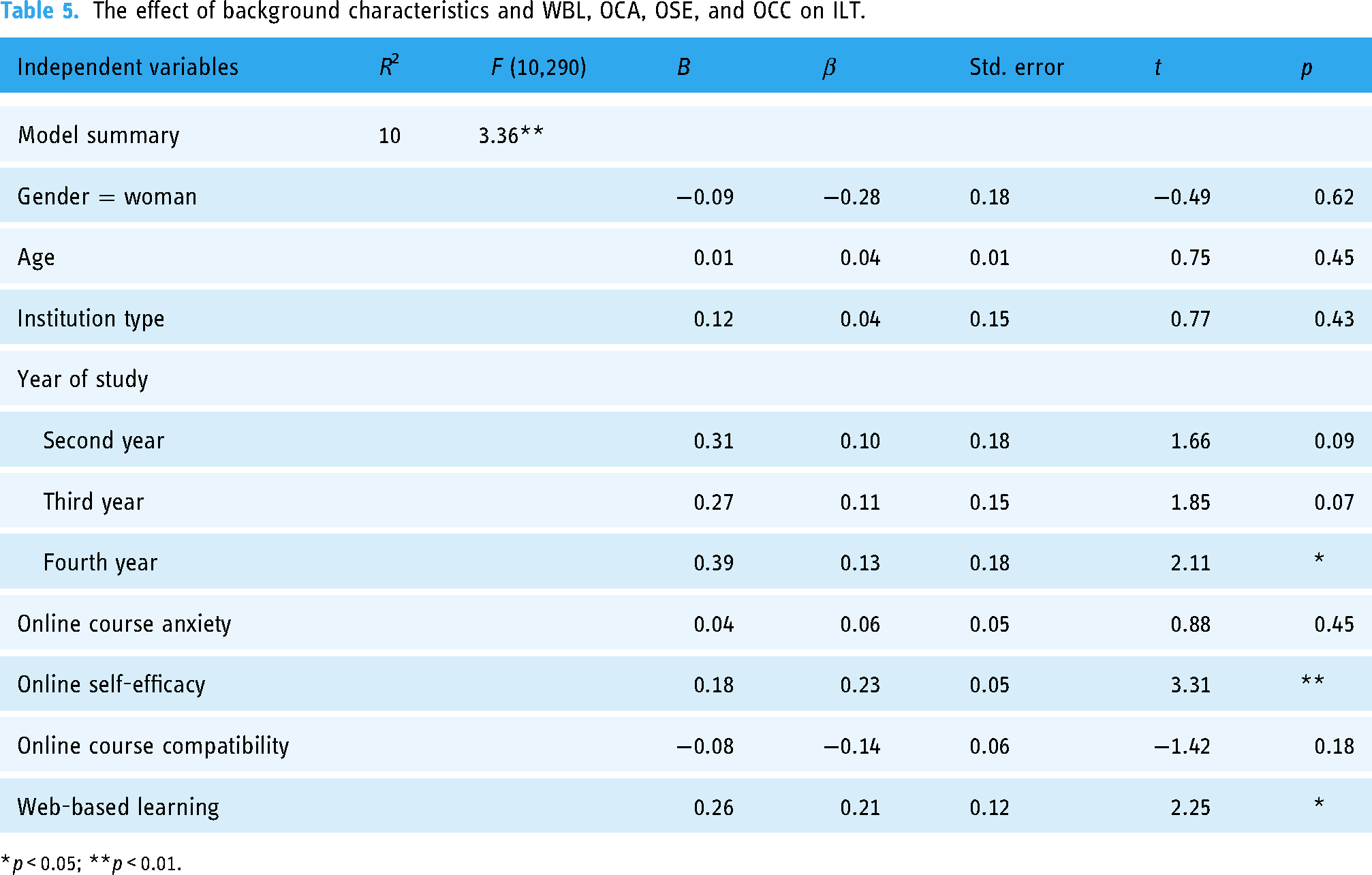
p < 0.05; **p < 0.01.
Qualitative results
Based on an in-depth analysis of the answers to the survey's five open-ended questions, two main themes emerged. First theme: Weighing WBL: Health Systems & Nursing Students' Views. This theme had 2 sub-themes, while health systems management students emphasized the advantages of WBL (sub-theme, WBL benefits: Insights from Health Systems Management Students) nursing students reported its disadvantages (sub-theme, Challenges of WBL: Perspectives from Nursing Students).
One health systems management student wrote about the ability to learn at their convenience and at the right pace: “Web-based learning can be a great way to improve your studies because it allows you to learn in a way that fits your pace and routine. With the flexibility to learn at your own time, in your own space, it can be more comfortable and make it easier for you to understand and retain the material.” (Male, 25 years old)
Another health systems management student reported on the ability to combine work and family demands with studies: “Web-based learning is a great option for students who have other obligations, such as work or family, as it allows them to fit their education around those commitments.” (Female, 23 years old)
An additional health systems management student noted the advantage of exposure to diverse ways of learning and the use of different technologies that suit their needs, all without leaving the house: “Web-based learning provides access to a wide range of educational resources and opportunities through virtual tools, such as online textbooks, videos, and interactive quizzes, which can enhance the learning experience.” (Female, 27 years old)
However, nursing students reported mainly the drawbacks. They also mentioned that the loss of connection with other students hindered their ability to learn effectively. One nursing student reported: “Web-based learning has limited face-to-face interaction between students and instructors, as well as between students themselves. It is harder to get the same level of feedback and support that they would get in a traditional classroom setting.” (Female, 24 years old)
Some nursing students mentioned a lack of hands-on experience and the potential for technical difficulties. They explained that nursing education heavily relies on clinical practice and hands-on experience, which may be limited in an online learning setting: “Web-based learning has the lack of hands-on experience and limited opportunities for practical application, of course, this is a big disadvantage to the nursing profession.” (Female, 29 years old)
There were also descriptions of technical and technological difficulties that negatively impacted the overall learning experience of nursing students: “Web-based learning has technical difficulties, such as internet connectivity issues or difficulty navigating online course platforms. These issues can cause disruptions to the learning process and make it harder for students to learn.” (Female, 24 years old)
However, all health science students demonstrated higher self-efficacy in online courses, which may eventually lead to ILT.
Second theme: Self-efficacy in online courses. Both health systems management and nursing students claimed that when they had a strong belief in their own abilities to successfully complete an online course, they were more likely to take active steps toward their learning, such as setting clear goals, seeking out necessary resources, and monitoring their progress while learning with technology. The second theme supports the second aim of the quantitative findings in the part that self-efficacy in online courses is related to ILT among health science students.
A health science student claimed that: “I have a high level of self-efficacy in learning through online courses, I am more likely to engage in intentional learning with technology, and more active and self-regulating my online learning.” (Female, 23 years old)
One health science student suggested that the solution to the challenges of online learning is setting goals to guide information-seeking, which can enhance a sense of self-efficacy: “I think that online course self-efficacy is a key factor in learning with technology. If I know how to operate online courses, it makes me set specific learning goals and seek out relevant information aids with technology.” (Male, 24 years old)
Discussion
The study aimed to explore two main objectives. First, identify differences between nursing and health systems management students regarding their attitudes and abilities related to WBL, OCA, OSE, OCC, and ITL. Secondly, to identify the main factors that affect the students’ intentional learning with technology, such as online course anxiety, self-efficacy, compatibility, and background characteristics such as gender, status, age, type of institution, and year of study.
Regarding the first research aim, the quantitative finding showed that Health systems management students had more positive attitudes towards WBL in comparison to nursing students and the qualitative findings reinforced it. Nursing education relies heavily on clinical practice and hands-on experiences, 30 which may be limited in an online setting. Similar research involving 470 nursing students revealed that only 34% believed online learning to be as effective as traditional in-person instruction. The study suggests that technical issues can be addressed to improve the effectiveness of online learning, specifically through programs that promote hands-on learning. 31 An investigation into nursing students’ experiences of moving from on-site instruction to remote learning using digital technology found that the majority preferred in-person education over distance learning. 32
Students from the fields of health sciences appreciated the flexibility and convenience of online learning.6, 12 An additional study compared how health systems management and nursing students felt about distance learning and found that nursing students perceived more negative emotions related to the use of technology. This difference could be due to the hands-on nature of the nursing profession. 16 Clinical procedures: urinary catheter insertion and blood sample retrieval.
When it comes to ILT, the quantitative finding showed nursing students had a more positive perspective than Health Systems Management students. A possible explanation for this is anchored in the meaning of “Intentional learning with technology,” perhaps the nursing students assume that technologies refer to specific tangible technologies as clinical aids for learning technologies as mannequins that mimic real patients in nursing simulation centers. A recent meta-analysis that examined the effectiveness of virtual reality technology in nursing education found that virtual reality was effective in improving knowledge. 33 Another study using simulation mannequin technology found this way of learning to be a powerful technological tool and effective in acquiring basic nursing skills. 34 It is recommended that nursing students need to involve their senses during their learning, such as vision and hearing, with the help of videos and virtual reality technology, to simulate a typical clinical setting. 16
Moreover, the quantitative results from the analysis of data for the second research objective which are consistent with the qualitative findings, indicated that OSE, reflecting students' confidence in using technology, and have significantly affects intentional learning with technology among health science students. Regarding OSE, a study examining public university students’ engagement with online courses revealed that individuals with higher online self-efficacy tended to perform better in their online coursework, indicating the importance of self-efficacy in technology-related learning perceptions. 35
Regarding WBL, the quantitative finding indicated the influence of intentional learning with technology. Another study conducted with health science students showed its numerous benefits during the WBL learning process, students benefited from increased flexibility, opportunities for collaboration and participation, as well as a sense of self-direction, which allowed them to construct their own understanding through problem-solving activities that mirrored real-world scenarios. 36 An additional study that involved medical students learning through WBL workshops discovered that web-based education allows for the delivery of relevant content without sacrificing interactivity and practical relevance during the learning process. 37
This study shed light on the differences between nursing and health systems management students’ attitudes. Furthermore, the study elucidates that OSE and WBL have a significant influence on intentional learning with technology among health science students. It highlighted the importance of self-efficacy and the benefits of WBL for health science students. However, it is essential to acknowledge certain limitations, such as potential sampling biases and the reliance on one self-report data, questionnaire which may have influenced the findings. Future research could address these limitations and explore this issue with more objective various tools and additional factors that influence ILT among health science students. Another limitation of the study focused exclusively on students within the School of Health Sciences, potentially limiting the generalizability of our findings to a broader population of students in different academic disciplines or institutions. Conducting studies beyond the School of Health Sciences to include students from other academic disciplines can offer a broader perspective related to attitudes and factors influencing intentional technology-based learning. Another limitation related to single institution data collection, which may possess characteristics and organizational structures not necessarily representative of other educational institutions. Future research should conduct in several academics' institutions to enhance the external validity of our findings.
Conclusions
It was found that health systems management students display more positive attitudes toward WBL compared to nursing students, on the other hand, nursing students hold a more favorable perspective on ILT than health systems management students.
Additionally, the study reveals that OSE and WBL significantly influence ILT among health science students. These factors play a crucial role in influencing students’ ability to engage effectively with technology for their learning purposes.
Overall, these conclusions emphasize the importance of considering these factors when designing effective online learning experiences for health science students. By recognizing these factors, educators can develop strategies to enhance intentional technology-based learning and optimize the benefits of WBL for both nursing and health systems management students.
Footnotes
Acknowledgments
Yisca Berenshtein was supported by the Top-Ariel scholarship for excellent undergraduate research students.
Contributorship
Y.B, R.T, I.H.H, and G.G. conducted all research stages.
Declaration of conflicting interests
The authors declared no potential conflicts of interest with respect to the research, authorship, and/or publication of this article.
Ethical approval
This study was conducted according to ethical guidelines and was approved by the Institutional Review Board of Ariel University.
Funding
The authors received no financial support for the research, authorship, and/or publication of this article.
Guarantor
G.G.
Informed consent
Informed consent was obtained from all research participants involved in the study.
