




Abstract
The recent COVID-19 pandemic has brought the debate around vaccinations to the forefront of public discussion. In this discussion, various social media platforms have a key role. While this has long been recognized, the way by which the public assigns attention to such topics remains largely unknown. Furthermore, the question of whether there is a discrepancy between people's opinions as expressed online and their actual decision to vaccinate remains open. To shed light on this issue, in this paper we examine the dynamics of online debates among four prominent vaccines (i.e., COVID-19, Influenza, MMR, and HPV) through the lens of public attention as captured on Twitter in the United States from 2015 to 2021. We then compare this to actual vaccination rates from governmental reports, which we argue serve as a proxy for real-world vaccination behaviors. Our results demonstrate that since the outbreak of COVID-19, it has come to dominate the vaccination discussion, which has led to a redistribution of attention from the other three vaccination themes. The results also show an apparent discrepancy between the online debates and the actual vaccination rates. These findings are in line with existing theories, that of agenda-setting and zero-sum theory. Furthermore, our approach could be extended to assess the public's attention toward other health-related issues, and provide a basis for quantifying the effectiveness of health promotion policies.
Introduction
The recent coronavirus (COVID-19) pandemic has brought considerable attention to vaccinations. Today, the discussion on vaccinations cuts across a multitude of issues, ranging from topics such as efficacy, safety, and trust, to topics related to ethical, religion, and personal liberties to name a few.1–4 It has also attracted participation among diverse audiences such as policymakers and government agencies, health professionals, scientists, various advocacy and interest groups, and the public at large. Although the current discussion around vaccinations may seem a relatively recent phenomenon, it is, to a large extent, but one chapter in a longstanding public discussion spanning over more than two centuries, which revolved around “pro–” and “anti–” vaccination debates and social movements.5,6 The contemporary public discussion about vaccinations occurs largely online, 7 and in particular on social media. 8 This use of online platforms not only impacts the vaccination discussion itself but also more broadly the way by which vaccine related information is consumed and produced. While the use of online platforms in the context of vaccinations has attracted considerable attention, the interplay between participation in vaccination discussion and actual vaccination-related behaviors is not yet fully understood. 7 This paper aims to explore this interplay through the lens of public attention as it is captured by online social media. It is necessary to point out that the term “interplay” here refers to the potential impact of social media on human actions, which has been studied elsewhere (e.g.,9,10). In other words, our basic premise is that social media can impact human behavior. Based on this premise, we examine how public attention is allocated across several vaccination types, and then compare it with actual vaccination rates. Our analysis takes advantage of the recent COVID-19 pandemic which has evidently attracted much attention in the online public vaccination-related discourse, thus providing a unique opportunity to explore how the public assigns attention to vaccinations in the presence of a major disruptive public health event.
The overall approach in investigating these questions is by focusing on four distinct vaccinations, namely COVID-19, Influenza, Measles, Mumps, and Rubella (MMR), and Human Papillomavirus (HPV). While the COVID-19 vaccines were chosen due to their impacts on the current world order, the other three (i.e., Influenza, MMR, and HPV) stem from the robust nature of the debate around them in recent years (e.g.,11,12) before the emergence of COVID-19. A second, equally important reason for this choice was the public availability of authoritative data on their respective vaccination rates. However, it should be noted that the MMR and HPV vaccinations are geared towards children, while the other two are designed for the majority of the population. Together, this set of vaccinations allows us to compare public engagement (and attention) and vaccination rates across the different vaccines and assess the impact of the COVID-19 vaccination debate on public engagement.
Our assessment of public engagement and attention distribution among the various vaccines in social media focuses on Twitter due to its prominent role in vaccine-related debates (e.g.,13,14). While public attention is often difficult to quantify, one approach to assessing it is through monitoring and analyzing the ebb and flow of online discussion on social media platforms (e.g., Twitter), an area that has received increasing attention in recent years in public health studies (e.g.,15,16). To that end, we analyzed a data set covering 2015 to 2021 in terms of tweet message volumes that is used as a proxy for public engagement and attention.
As the Greek philosopher Aristotle said, “Man is by nature a social animal,” 17 and it is through the interaction of various media that we communicate and disseminate information. Over time, the medium of dissemination has evolved, from handwritten papal bulls, the printing press, to wireless communication technologies, such as radio and television broadcasting. Such evolution enabled the dissemination of audio and visual content to a more and more broader audience both nationally and internationally. For example, by the late twentieth century, around 98% of households owned at least one television. 18
Today printed and broadcast media, often referred to as “vertical media,” 19 aims to cover potential interests and topics, and has become an integral part of modern society. Consequently, considerable research has been dedicated to the study of mass communication and the underlying principles and theories that govern it. In the context of our research, there are two key related theories that are of particular importance for our analysis: the agenda-setting theory and the zero-sum theory
Agenda-setting theory, 20 generally examines the relationship between the media and the public agendas with respect to a specific topic, highlighting that the media can affect the salience of issues in the public agenda. In earlier agenda-setting studies, it was argued that the media could not only influence what people think about, but also how they think about it.21,22 This early work has spurred research investigating the impacts of the media on the public's perceptions with respect to politics, economics, and public health.23–26 In the context of public health, several authors have noted the role of agenda setting played by the media in influencing health-promoting change.27–31
The rise of Web 2.0 32 has sprung renewed interest in agenda-setting in the context of social media due to the ability to facilitate “two-way communication”. Such technologies, also called “horizontal media,” 19 emphasize the importance of the individual and reduce the barriers to user participation. Various studies have explored the applicability of agenda-setting theory in the digital age, as well as how social media shape public discourse and attitudes towards specific topics.19,22,33–35 One example of this is how the agenda can be influenced by the networked association of issues through social media.36–38
A second, related theory, that is of particular importance to our research is the zero-sum theory. This theory, which can be seen as complementing the agenda-setting theory, is based on the premise that human (and by extension the public's) attention is finite, which leads to a competition among the various issues in the media in which increased attention to one issue will lead to a decrease in attention given to other issues. 39 Like the agenda-setting theory, the zero-sum theory was originally proposed in the context of vertical media (i.e., “one-way” communication). More recent studies which have examined this theory in the context of social media suggested its applicability is given the inherent finite nature of human attention regardless of the subject matter at hand (e.g.,40–42).
Turning back to the study of social media on health-related topics, we are especially interested in the online debates regarding vaccination under this context. Looking back at disease outbreaks over the past two decades, such as the Ebola and Zika viruses and the current COVID-19 pandemic, they all have substantially impacted, to varying degrees, on our environment, economy, and society as a whole.43–50 Therefore, developing vaccines, especially for vaccine-preventable diseases, has become crucial to preventing the spread and thereupon helping the world return to somewhat normalcy.
As mentioned above, the discussion regarding vaccination has been longstanding but with disparate voices. Pro-vaccination supporters urge the importance of vaccination for public health, whereas anti-vaccination groups argue their concerns about safety, religious and philosophical beliefs, which has made the vaccination debate polarized over time.2,4,51,52 This is especially the case today with mass communication through social media. Social media enables individuals to share their opinions about vaccinations online, but at the same time puts them in an information “dye vat,” in the sense there are all sorts of words (either positive or negative) about vaccinations that can become mixed together and alter people's perceptions of vaccination. 53 It is through such exposure that an individual's perception towards vaccination might change under the impacts of various information traffic, resulting in diverse vaccination sentiments, and thereafter, making vaccination campaigns more challenging.54,55 In this regard, it is crucial to understand how the public's attention maps to various vaccination-related themes on social media, especially with respect to their limited attention capacity, and how such attention compares to the reported vaccination rates in reality. These questions have direct practical applications, such as topics around improving public health awareness and the effectiveness of health promotion policies.
In the remainder of the paper, we will demonstrate the methodology used, including data collection, sentiment analysis, and comparisons between online vaccination debates and offline vaccination rates, to investigate the dynamic attention of individuals on various vaccination-related themes on social media (section “Methodology”). After that, we will discuss and conclude the key findings (section “Results and Discussion”) and how our work contributes to the current literature in the Conclusion Section.
Methodology
Studies focusing on improving public health awareness have increasingly relied on leveraging social media data (e.g., Twitter). These studies have indicated that public attention can be reshaped, to a certain degree, when different public health issues are prominent on social media. In this regard, we would argue that understanding the dynamics of public attention among competing themes for attention in the context of vaccination could have the potential to provide informed insights for improving vaccination-related health outcomes.
To illustrate this potential, we took the United States as a case study to quantify public attention to four vaccines through monitoring and analyzing the ebb and flow of their online discussion on Twitter and identifying the corresponding vaccine sentiments. In what follows, we will introduce the datasets used in this study (section “Data Collection”), and describe how we classified this data by vaccine sentiment (section “Sentiment Analysis and Emotion Detection”). We will then compare four different online vaccination discussions with actual vaccination rates to uncover potential links between them (section “Online/Offline Comparison”). These steps are illustrated in Figure 1 and are further elaborated in the subsequent subsections.
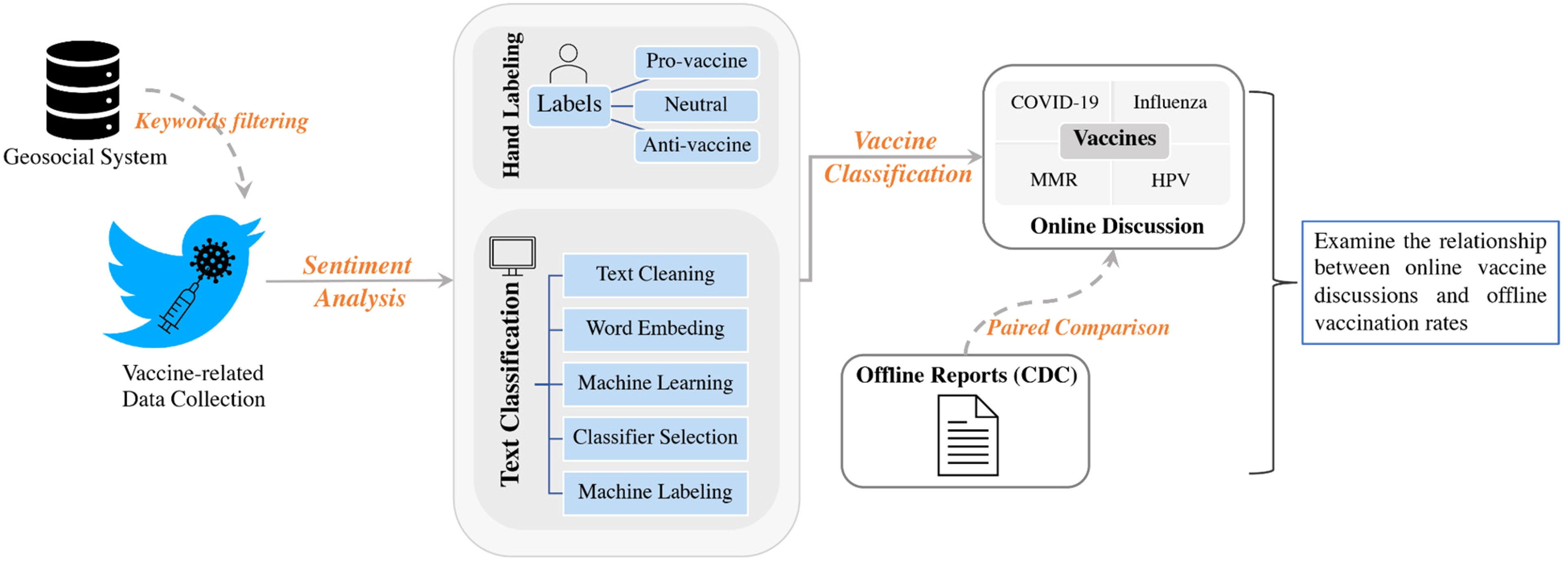
The workflow for comparing between online social media discussion and vaccination rates.
Data collection
In order to understand how public attention maps to various vaccination-related themes on social media, we extracted vaccine-related tweets sent in the United States from January 2015 to July 2021, which consists of around 11.7 million Twitter messages sent by approximately 2.6 million distinct users. The data were collected by utilizing Geosocial Gauge system 56 using the keywords “vaccination” and its derivatives, such as “vaccine,” “vaccines,” “vax,” “vaxine,” “vaxx,” as well as “immunization” and “immunisation” as search terms (these terms were found to frequently turn up in the online narrative about vaccines on Twitter. 57 Table 1 provides an overview of the distribution of distinct tweets and users by years. It is necessary to point out that the study period used here was constrained by the available data at hand, and we will come to this issue in the Discussion section. Nonetheless, the Twitter dataset used here still contains a considerable long period for investigating changes in public attention over time in the subsequent analysis.
The distribution of distinct tweets and users by years from 2015 to 2021.

In order to understand how public attention compares to reported vaccination rates, we collected actual vaccination rates for four distinct vaccines, namely COVID-19, Influenza, HPV, and MMR vaccines, from the United States Centers for Disease Control and Prevention (CDC). More specifically, the COVID-19 vaccination dataset 58 records the total number of people with at least one dose based on the jurisdiction where a recipient lives from Jan 2021 to July 2021. The influenza vaccination dataset 59 consists of estimated seasonal influenza vaccination coverage from 2015 to May 2021, which is measured based on the National Immunization Survey-Flue (NIS-Flu) and the Behavioral Risk Factor Surveillance System (BRFSS). It is necessary to mention that the influenza vaccination coverage collected was measured based on different socio-demographic groups (e.g., “> 6 Months”, “5–12 Years”, “13–17 Years”, “> 18 Years”), but they all have a very similar pattern (see Appendix A1). As we are focusing on vaccination rates and people's choices to become vaccinated at large, the age of legal majority (i.e., 18 years) was selected to represent the decision-making of whether to be vaccinated or not. Turning to MMR, the vaccination dataset documents the estimated MMR vaccination among adolescents from 2015 to 2021, and the HPV dataset records estimated HPV vaccination among adolescents with individuals at least one dose from 2016 to 2021. 60 Table 2 gives a summary of all datasets aforementioned.
Description of datasets used in the study.

MMR refers to Measles, Mumps, and Rubella; b HPV refers to Human Papillomavirus.
Sentiment analysis and emotion detection
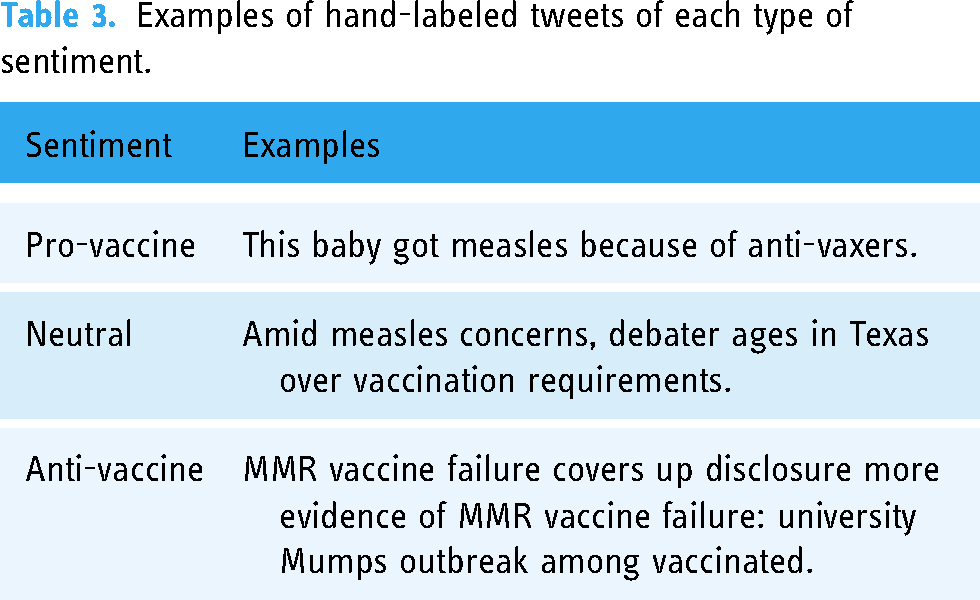
To extract information about the population's attitude towards vaccination from the collected Twitter data corpus, sentiment analysis was performed. In the context of this paper, we refer to sentiment analysis as Natural Language Processing (NLP) based techniques that focus on unraveling individuals’ opinions, attitudes, or emotions from text messages regarding to a specific topic—in our case, the online social media discussion about vaccination. 61 In this study, we aim to classify tweets into one of three classes—“Pro-vaccine,” “Neutral,” and “Anti-vaccine”, and do so by integrating supervised machine learning with word embedding techniques.
Examples of hand-labeled tweets of each type of sentiment.
Performance metrics of the XGBoost classifier.

Online/offline comparison
After all the tweets were labeled, we separated the tweets into the four different vaccination themes aforementioned (i.e., COVID-19, Influenza, MMR, and HPV). Specifically, we used the keyword “coronavirus” and its derivatives, such as “covid,” “covvax,” “covvaax,” to extract tweets that are related to COVID-19 vaccination theme. Similarly, we utilized keywords of “influenza,” “mmr,” “hpv” and their derivatives to extract tweets related to Influenza, MMR, and HPV vaccination themes, separately. It is crucial to point out that although some tweets may consist of multiple themes, we only focused on tweets that had one specific theme discussed. The reason for this relatively stringent condition is to prevent inferring type I errors in sentiment classification. In this regard, tweets that had more than one vaccination theme mentioned were removed from the corpus, resulting in a total of 3,720,721 unique tweets for subsequent analysis and comparison. In this form, the distinct vaccination themes allowed us to make a cross-comparison of public engagement and attention as well as the corresponding vaccine sentiments among different themes in social media.
To quantify changes in the activity levels of vaccination discussions on Twitter, we used a quarterly time interval as the analysis unit and measured the relative percentage of users who participated in each vaccination discussion. Subsequently, we compared trends in the Twitter traffic of the four vaccination discussions to trends in the corresponding vaccination rates over time. In doing so, we are able to better understand how public engagement and attention to different vaccination-related themes in social media compare to actual vaccination rates.
Results and discussion
Table 5 displays both absolute value (i.e., number of unique users involved in each vaccination discussion) and relative value (i.e., percentage of users involved in each vaccination discussion relative to total users for the quarter) while Figure 2 shows the quarterly percentage of users from 2015 to 2021. Generally speaking, these show how the public's attention, while being finite due to the zero-sum theory, 39 switches from one vaccination to another over time. For example, in the first half of 2015, the vaccination conversation about the MMR dominated the online discussion which can be attributed to the measles outbreaks in California, 57 but the percentage of users gradually declined in the second half of 2015 as the public's attention switched to focusing largely on influenza during the winter period. More recently, they show the substantial redirection of public attention towards the COVID-19 vaccine in 2020. Since then, the dominance of the COVID-19 vaccine discussion has drawn the most public attention and has maintained its dominance until the end of the study period. Specifically, the number of users of who posted COVID-19 vaccine tweets accounted for 73.5% in 2020 Q1 (see red highlights in Table 5) and gradually increased afterward, reaching its highest point in 2021 Q1 (97.4%). Although there was a subtle decrease (around 1%) after 2021 Q1, the COVID-19 vaccine discussion overshadows other vaccine discussions. One possible explanation for this finding is that generally, people tend to be more interested in recent happenings that are more relevant to them and that the uncertainty of new things stimulates their curiosity, prompting them to engage in the discussion of more contemporary issues in order to gain an understanding of the current situation. This observed online behavior is in line with the agenda-setting and the zero-sum theories, which state that the media has the capability in shaping people's agenda or priority of issues, that public attention is finite, and that the public is generally uncomfortable in new settings until they achieve some degree of orientation to their new surroundings. 72

The quarterly distribution of percentage of users by different vaccine discussion from 2015 to 2021.
Number of users by quarter in four different vaccination discussions on twitter from 2015 to 2021.

Another noteworthy finding is that the influenza vaccine discussion demonstrates a cyclical pattern, with peaks generally occurring during the winter flu seasons before the COVID-19 outbreak (see blue highlights in Table 5). Although the phenomenon diminished significantly with the rise of the COVID-19 vaccine discussion, we still observed a small peak of flu vaccine discussion during winter flu season in 2020, while the public's attention to other vaccines has diminished (see Figure 2). This suggests a potential association between COVID-19 and flu vaccines that may result from the perceived similarity between the two illnesses (e.g., 73 ). For example, both COVID-19 and flu viruses are contagious respiratory illnesses that can spread from person to person, and people who have COVID-19 or flu usually have several similar symptoms.74,75 Such an association between COVID-19 and influenza was also recently reported by Bruine de Bruin et al. 76 across demographic groups in the United States.
The second part of our analysis focused on examining the relationship between the online vaccination debates and the public's actual vaccination behavior over time. To that end, we compared trends in Twitter traffic for the four different vaccines with trends in the actual vaccination rates. Due to the limited time granularity of the CDC data, we measured the monthly vaccination rates for COVID-19 and influenza vaccines and annual rates for MMR and HPV vaccines, respectively. To mitigate the impact of the size-related issue (e.g., unequal distributed population) on representing the Twitter traffic, we calculated the odds ratio of users by normalizing the corresponding Twitter population (see Eq. 1).
Figure 3 displays the temporal distribution of scaled odds ratio of vaccine discussion online (red color) as well as the scaled growth rate of actual vaccination offline (blue color) for the four different vaccines. Figure 3 also shows how the HPV and MMR vaccine rates are rather volatile at the yearly time granularity, without any apparent patterns in their trends in Twitter and actual vaccination rates. Nonetheless, we do observe a periodic change in the influenza vaccine, where the peak rate of flu vaccinations emerges close to the peak of the flu vaccine discussion on Twitter, and the peak regularly appeared during the winter period (i.e., flu season) (see Figure 3(b)). Exploring this phenomenon more, we compared the absolute flu vaccination rate at each month and found that more people took the flu vaccine during the COVID-19 pandemic (flu vaccination rate increased from around 40% to 50% after the outbreak) as shown in Figure 4. This finding coincides with the work of Roman et al., 77 indicating that the prominence of an issue (here referring to COVID-19 vaccine discussion) on social media has the potential to affect the public's behavior on another issue (here refers to the uptake of flu vaccine) due to the public associating the two themes. This is also in line with the concept of the Network Agenda Setting introduced by Guo and McCombs, 38 who pointed out the role of cognitive components in the process of representing reality. For instance, with respect to COVID-19 (i.e., the reality) the cognitive components could be considered as information that describes the characteristics of the virus (e.g., the symptoms) or the vaccine. To this end, the more frequently two issues are associated within the media, the more likely they are to be perceived as interdependent on the public agenda. Moreover, because COVID-19 and influenza share certain aforementioned similarities, the public's uptake of influenza vaccine (as shown in Figure 4) was influenced by online COVID-19 vaccine discussion, whereas the same phenomenon was not observed in MMR or HPV vaccines.
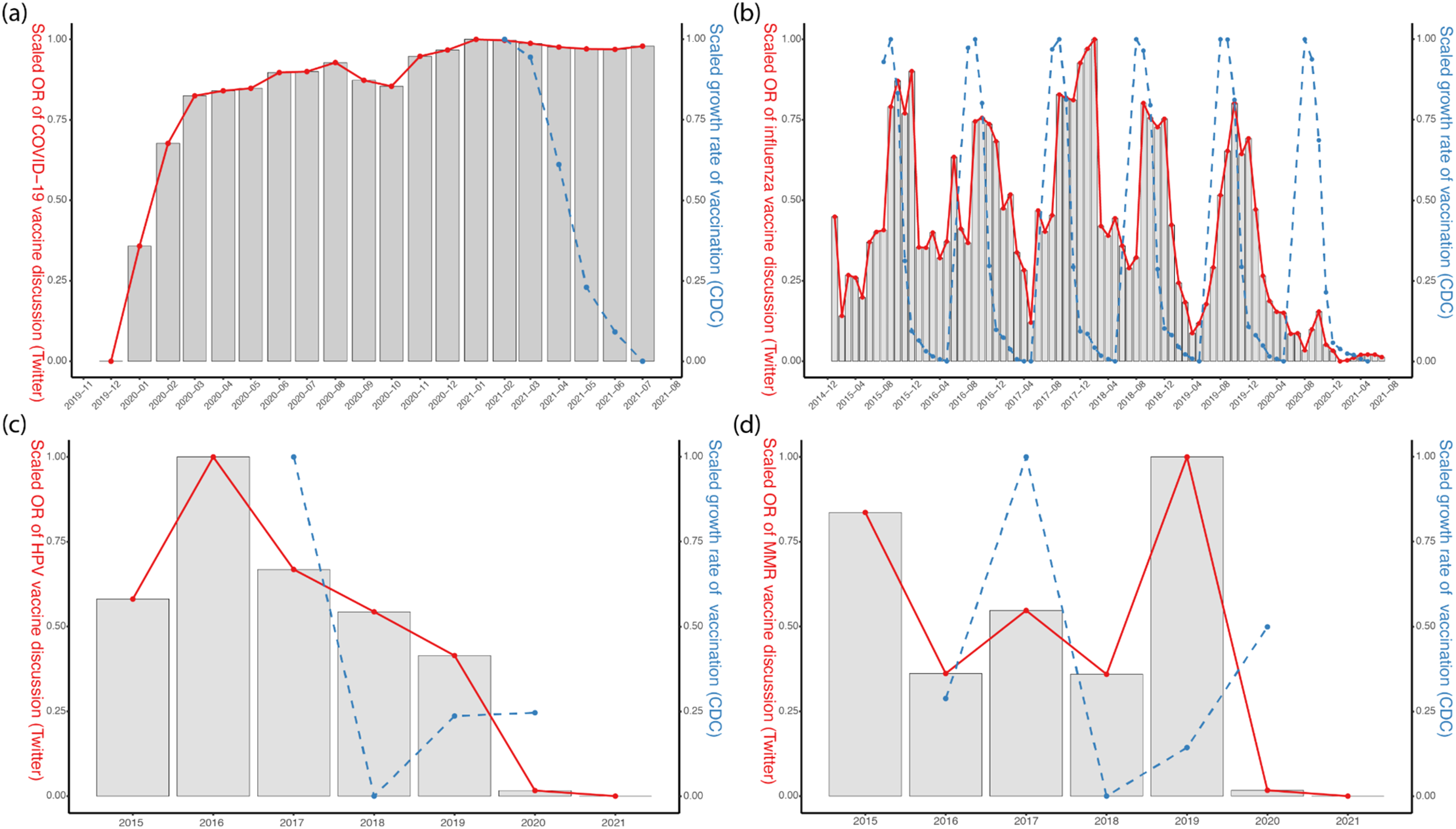
The comparison between different vaccine discussions on Twitter and growth rate of the actual vaccination rate collected from the CDC (a) COVID-19; (b) Influenza; (c) HPV; (d) MMR.

The distribution of absolute influenza vaccination rate by month recorded by the CDC (Note: there is no data available for June).
To further help understand the underlying mechanism of how social media is shaping and influencing people's perception and emotion towards vaccination, we classified users’ attitudes into three sentiments, namely pro-vaccine, neutral and anti-vaccine, and monitored the shifts of emotion with respect to different vaccines over time. Figure 5 presents the distribution of these sentiments with respect to the four different vaccines on a quarterly basis. The results show that in general, a positive vaccine sentiment is dominant, and the pro-vaccine users grow faster than the anti-vaccine group, indicating that the online vaccine discussion has the potential to enhance public awareness of the importance of vaccination. Digging more into this, Figure 6 displays the changes in people's emotions regarding the four vaccines over time. This figure clearly demonstrates the gradual shift from influenza, MMR, and HPV to COVID-19 after 2019 (the COVID-19 outbreak). Moreover, besides the feelings of fear, anger, and sadness concerning the COVID-19 vaccine, we observed more positive emotions in the online discussion, such as anticipation and trust. This again implies the positive nature of the social media discourse, and by extension the public awareness, of vaccination campaigns.
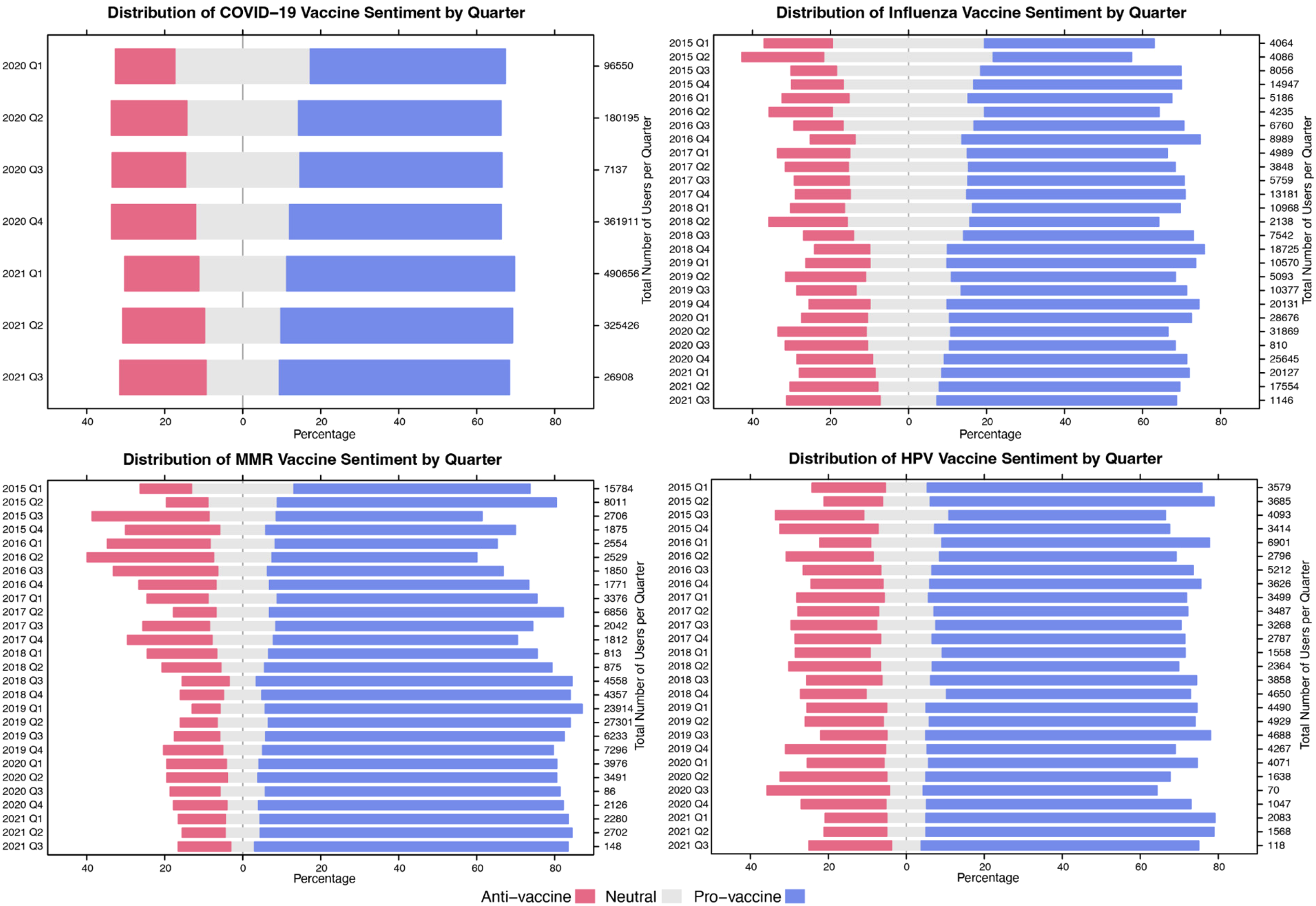
Distribution of different vaccine sentiments by quarter (a) COVID-19; (b) Influenza; (c) MMR; (d) HPV.
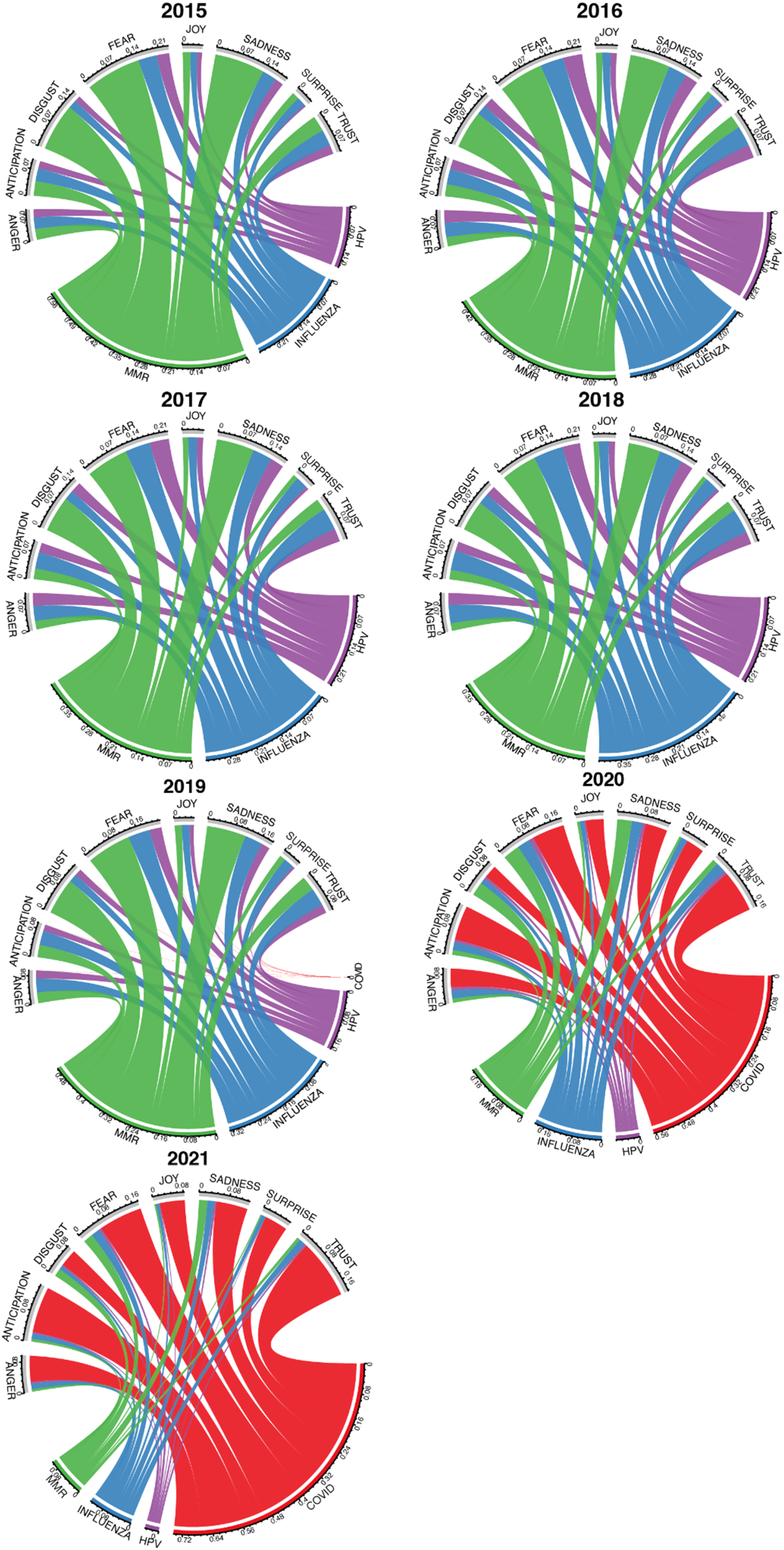
The changes of emotion over time for different vaccines.
It is also interesting to examine the relationship between the public's online attention to COVID-19 and influenza, as shown in Figure 2, and the actual influenza vaccination rates as shown in Figure 4. Specifically, while most online public attention was diverted toward the debate around COVID-19, and despite a mental association between COVID-19 and influenza, 76 there was a relatively moderate increase in the influenza vaccination rates in 2020 and 2021 (10%) which is consistent with the variations observed between years prior to COVID-19 (e.g., when comparing 2017–2018 and 2018–2019). A possible explanation for this is the existence of a psychological omission bias in the decision whether to vaccinate for influenza or not, i.e., a preference toward inaction that may result in harm greater than the potential harm that may be caused by action.78,79 More recently, however, it was suggested that the choice between action and inaction is more nuanced and involves a judgment of how effective taking action might be when faced with an undesirable situation. 80
Conclusion
The unprecedented COVID-19 pandemic has taken the discussion around vaccinations to new heights in the modern information environment, where dissemination and communication of information have become much more convenient and rapid than ever before. This environment, along with the finite nature of human attention creates a perpetual challenge of choosing how attention should be distributed across several competing vaccination themes (i.e., zero-sum dynamics).
In this context, we have proposed a way to study and compare the public vaccination discussion and actual vaccination-related behaviors based on social media data. We did so by analyzing and monitoring the ebb and flow of online debates regarding four prominent vaccines (i.e., COVID-19, Influenza, MMR, and HPV vaccines) on Twitter in the United States from 2015 to 2021, and compared them with actual vaccination rates from governmental reports, which are considered as “real-world” vaccination related behaviors. Moreover, in order to uncover the underlying mechanism of social media in shaping and influencing people's vaccination attitude and emotions, sentiment analysis based on word-embedding techniques and machine learning algorithms, as well as emotion detection based on the NRC Word-Emotion Association Lexicon were conducted to classify online users’ attitudes and emotions towards different vaccinations over time. In doing so, we were able to capture how the public's attention maps to various vaccination-related themes and how such attention relates to the actual vaccination behaviors.
Using the United States as a case study, we found COVID-19 vaccination drove a sharp drop in online communication about other vaccination topics (i.e., Influenza, MMR, and HPV). In other words, the COVID-19 vaccination debate surged in the wake of the COVID-19 outbreak, reallocating attention from other vaccination-related themes. However, a more intriguing insight is that we still can observe an associated conversation about influenza under the dominance of COVID-19 vaccination debate, while other vaccination discussions have almost diminished. Part of the reason could be the underlying similarity (e.g., similar symptoms) between the COVID-19 and influenza. Furthermore, our results show that positive vaccine sentiment is dominant across different vaccination themes throughout the years, implying the positive nature of social media and the public awareness of vaccination campaigns. Our findings also highlight the discrepancy between the online debate as captured on Twitter and the actual vaccination rates. Specifically, while more recently most attention was given to COVID-19 over influenza, the actual influenza vaccination rates remain relatively constant. This apparent discrepancy can be explained, at least in part, by the role omission bias plays in people's decision to vaccinate or not.
As the modern information landscape is highly complex and diverse, it is important to consider the findings described here in that context. While our study focused on Twitter as a representative of the public discussion around vaccinations, it is but one of several prominent social media platforms on which the vaccination debate is carried on. Thus, additional research is needed in order to examine if, and if so how our findings would compare with a similar analysis on other social media platforms. Building on this, this study focused on the United States, and from this point of view, future work is needed on applying the proposed method to other countries. In other words, the methodology is informed by the nature of the data and the academic context, so is contingent by definition. The methodology proposed may then need to adjustment for studying other countries. Such comparative research using different data sources or different case studies, however, does not currently exist to the authors’ knowledge. At a more local scale, another possible extension of this work could focus on a more nuanced analysis to explore if there are any differences across different geographical regions. This expansion could be further complemented by considering changes in scientific evidence, guidelines, systemic features, such as access, debates around possible mandates, vaccine shortages, to name a few, to improve the analysis accuracy. Another area of further inquiry relates to the fact that while our study only used the vaccination rate as a simple proxy for people's vaccination behavior, it should be recognized that vaccination rates are the product of many factors, such as demographic characteristics, socio-economic status, and accessibility to health resources. Additional research is therefore needed in order to examine the relationships between these factors and the public's overall vaccination behavior. In terms of analysis, tweets that contained more than one vaccine were removed as mentioned in the Methodology to prevent inferring type I error in sentiment classification. However, in future work more analysis is needed to better understand such kinds of tweets, for instance using aspect extraction to identify opinion targets in texts. Moreover, the emotion measures in this study may reduce our understanding of specific contents, such as discussion of more marginal debates both nationally and globally. Therefore, more concrete sentiment analysis needs to be considered in future work, for example, the debate regarding vaccine equity, and the common challenge of sarcasm. 81
Nonetheless, analyzing and comparing the four different online vaccination debates as well as linking observed findings to existing theories in mass communication (e.g., agenda-setting and zero-sum theory) and psychology (e.g., omission bias) provide insightful information for understanding the underlying engagement and attention competition among different vaccination themes. The approach presented in this paper takes advantage of the recent availability of social media data, which enables, for the first time, to examine the vaccination debate and its relation to actual health outcomes over long periods of time. With the increased availability of such data sources, the method presented here could be expanded to assess the public's attention to other health-related issues and provide a basis for quantifying the effectiveness of health promotion policies.
Footnotes
Acknowledgements
The authors would like to thank the anonymous reviewers who provided valuable feedback which helped improve the quality of the paper.
Contributorship
QC: Methodology, Software, Formal analysis, Visualization, Writing - Original Draft, Review & Editing; AC2: Conceptualization, Writing – Original Draft, Review & Editing, AC1: Supervision, Conceptualization, Methodology, Writing - Review & Editing.
Declaration of conflicting interests
The author(s) declared no potential conflicts of interest with respect to the research, authorship, and/or publication of this article.
Ethical approval and consent to participate
Not applicable, as this article utilized publicly available tweets, which is not considered as human subjects research. It did not entail the collection of data through interaction with individuals, nor any private information. Moreover, we adhered to Twitter's developer agreement and policy.
Funding
The author(s) received no financial support for the research, authorship, and/or publication of this article.
Guarantor
Not applicable.
