



Abstract
El Paso, Texas, like many communities along the United States/Mexico border, suffers from a lack of access to many social determinants of health, especially in low-income neighborhoods. These long-standing problems have only been exacerbated by the COVID-19 pandemic. The Texas Tech University Health Sciences Center El Paso Health Education and Awareness Team (EP-HEAT) is an organization that was established with a focus on disseminating health information to the community. EP-HEAT received funding from Microsoft Corporation to facilitate technology education workshops for underserved populations. These workshops were held in English and Spanish and attempted to improve social determinants of health in the community which can be negatively exacerbated by a lack of digital inclusion. Community members who attended workshops completed a LinkedIn Learning Path, or both were offered an anonymous post-course survey with a mixed method questionnaire on how their knowledge of basic technology or job skills was improved by engaging with the provided workshops and learning paths. Overall, 80% of community members who participated in the workshops reported learning a new skill, and 91% of participants who started a LinkedIn Learning Path were able to finish. The workshops were well received by the community and highlighted the potential for these programs to enhance digital skills and upward workforce mobility.
Introduction
The COVID-19 pandemic affected the world in multiple domains, including community health, 1 mental health,2,3 and overall economic growth. 4 Many efforts during the pandemic have sought to improve reskilling and up-skilling job seekers.5–7 Reskilling is defined as developing additional skills and new capabilities to help one move to a new role. In contrast, upskilling is training that enables one to become better at a job they already perform. Unemployment and underemployment can affect the lives of community members, negatively impacting both physical and mental health, often resulting in a positive feedback loop where the unemployed forego their physical and psychological well-being as they fall deeper into poverty. 8 Efforts toward a positive intervention to retrain the under or unemployed have proven to improve the economic and health outcomes of individuals.8,9 Studies have reported a disproportionate incidence of COVID-19 infection, hospitalizations, and deaths among persons identifying as Hispanic or Latinx.1,10,11 Latinx workers, particularly women, faced devastating job losses during the COVID-19 recession. 12 Independent of the COVID-19 pandemic, minority-majority and mainly Hispanic communities have diminished access to healthcare infrastructure13–15 and lack access to or struggle with social determinants of health, including neighborhood conditions, working conditions, income, and education.16–18 Importantly, digital inclusion has been recently considered a social determinant of health with paramount importance and broadly includes the development of digital skills, access to devices, training, and tech support. 19 Developing a program for the community members of El Paso that provides retraining, reskilling, and upskilling, as well as helping to promote digital inclusion, will help individuals with improving job prospects and ultimately improve the overall community health and well-being.
To increase health education and promote social determinates of health in the border community, faculty from the department of medical education, as well as medical and graduate students at Texas Tech University Health Sciences Center at El Paso, established the El Paso Health Education and Awareness Team (EP-HEAT). EP-HEAT is a community outreach organization combining faculty and student efforts that hosts COVID-19 and other health information sessions, health education workshops, and resource distribution events. 20 Given the need of the local El Paso community, we focused our efforts on the zip code 79905, where the TTUHSC El Paso campus is located and where only 68% of residents have a high school diploma, or equivalent, or less. Additional training is vital for community members to provide stability against changes in the job market and economy.
With the assistance of a Microsoft Corporation grant, EP-HEAT expanded its team to include Promotores de Salud (Community Health Workers), hereafter referred to as Promotores. Promotores are community members with formal health education and communication training and are integral team members with first-hand experience, usually residing in the communities they serve . 21 The Microsoft grant served as a pilot program to assist low-income families in the 79905-zip code, among the lowest-income zip codes in El Paso. The program provided individuals with internet access, computer and health literacy skills, and skills training for workforce development which are all social determinants of health. Additionally, LinkedIn offered free learning Paths toolkits to address the digital divide during the COVID-19 pandemic (Table 1) to teach skills and improve basic digital literacy amongst community members. Upon completion of a LinkedIn Learning Path, a certificate of completion was provided, allowing participants to include this experience as part of their resumes and ultimately make them more competitive job applicants. 5 EP-HEAT launched the weekly workshops to infuse workforce development efforts with a grassroots strategy for outreach and family health education, computer literacy, and technology skills training. EP-HEAT established this program to empower community members with upskilling and reskilling opportunities. The pilot program focused on two technology training aspects hosted in partnership with Microsoft and LinkedIn: The first training focused on digital literacy and teaching community members basic computer skills. The second training was a job-training program focused on implementing and completing LinkedIn Learning Paths. Both technology training courses were offered in English and Spanish to accommodate our local population, with the EP-HEAT students, faculty, and Promotores working side by side as trainers (Figure 1).

Model of the integration of EP-HEAT members and the community members through a digital skills training program.
List of available LinkedIn learning paths.

To our knowledge, EP-HEAT was the first organization to establish a pilot program that focused on providing bilingual technology education workshops with Promotores and students serving as educators. EP-HEAT launched the pilot program within the El Paso border community, where more than 80% of the population is Hispanic. 22 The program's goal was to focus on technology-specific education training to help spread digital literacy and improve the community members’ digital competencies crucial for the current information-based job market. 23 Technology training programs can be cost-effective for all parties when focusing on reskilling and upskilling,9,24 and addressing digital inclusion as a social determinant of health. We hypothesized that providing culturally relevant health education and computer literacy training would empower underserved families to take ownership of their health needs and break down cultural barriers to wellness and employability. Here, we describe the subjective experience of community members that participated in either program. The impact of this project reflects the Microsoft Skills for Employability Outcomes by engaging an underserved population in learning pathways and credentials that will provide them with in-demand job skills. Additionally, TTUHSC El Paso expanded the capacity for outreach to underserved populations in its service region by adding culturally competent Promotores to navigate cultural and language barriers to participation.
Materials and methods
All individual tutors, including EP-HEAT members and Promotores, were required to complete at least one LinkedIn Learning Path before the program launched; however, many members finished more than one pathway. For example, EP-HEAT's project director and coordinator opted to complete the “Project Management” and “Master-In Demand Professional Soft Skills” pathways. The complete list of pathways offered is shown in Table 1. To ensure an instructional standard, Promotores completed three pathways: basic computer and internet literacy, project management, and customer service.
Once the EP-HEAT trainers (students, faculty, and Promotores) completed at least one LinkedIn Learning Path, received certificates of completion, and became familiar with the online platform, the pilot program was launched. Acknowledging that many community members did not have access to the internet or a device to complete the LinkedIn Learning Paths, EP-HEAT set up weekly bilingual tutoring sessions at TTUHSC El Paso's campus (Figure 1). This program allowed our EP-HEAT trainers to provide 1:1 tutoring in English and Spanish and establish relationships with the community members, ensuring the attendees completed their LinkedIn Learning Paths and obtained their certificates. The completion time of the pathways varied from 5 to 30 h. As an incentive for completing the LinkedIn Learning Paths, community members received a free Lenovo ThinkPad if they completed a LinkedIn Path, courtesy of PlanItROI, in collaboration with Microsoft Corporation. In total, 200 Lenovo ThinkPads were donated for this pilot program.
Efficacy of participation in the EP-HEAT tutoring sessions and completing the LinkedIn Learning Paths technology literacy course were assessed by anonymous surveys distributed to participants via paper or email. This pilot project was considered IRB-exempt (E22017). A waiver of documentation of consent was allowed due to the research presenting no more than minimal risk of harm to subjects and involves no procedure for which written consent is normally required outside of the research context. In addition, the impact on community members’ technical skills was also evaluated by an anonymous survey. The surveys were used to gauge how completing the LinkedIn Learning Path and participating in EP-HEAT tutoring sessions impacted community members’ skills and technical knowledge. Additionally, the surveys queried participants about their motivation behind starting a pathway and the perceived benefits of participating in addition to participation hurdles. Responding to the survey, community members consented to engage in the research study. Email reminders were sent as appropriate, based on weekly monitoring of the survey response rates. The survey was open for one month from the day of the initial invite. Community members that participated in the training program were included in the study. The analysis was limited to this population. Community members who did not participate in the training program were excluded from the study. Data was plotted using GraphPad Prism (La Jolla, CA) and Microsoft Excel (Redmond, Washington).
Results
Basic technology literacy course
Out of the 48 participants who completed the Basic Technology Literacy course, only 10 completed the survey. Of those surveyed, 60% (n = 6) indicated that they were employed and not looking for a new job, and 40% (n = 4) participants were currently in school (Table 2). We did not determine the type of school participants were enrolled in. The distribution of participant gender was overwhelmingly female, 70% (n = 7), and 30% (n = 3) male (Figure 2(a)). Participants in the basic technology literacy ranged from 18 years to over 50 (Figure 2(b)). The overall program feedback was overwhelmingly positive. At the outset, the program's goal was to increase basic technology literacy so that all participants would have a basic framework for using a computer and identify online digital skills resources after the class. Another goal was to “train the trainer”: educating the participants well enough to feel comfortable training other community members to complete this course. Responding to, “Do you believe this introductory course has improved your ability to work with computers?” all respondents answered that the course had improved their ability to work with computers. In addition, all participants responded that they would recommend the course to others and felt comfortable training others. When queried, “After taking this class, would you now feel comfortable training other people on how to use computers?” 90% (n = 10) of participants said they would feel comfortable training other participants (data not shown).

Breakdown of basic technology literacy participant demographics by gender (n = 10) (a), and age of participants (b) (n = 7–10).
Quantified survey responses.

Linkedin learning pathways course
Of the 276 participants who started a LinkedIn Learning Path, 102 participated in the survey evaluation of the program. Sixty-four percent (n = 15) of participants were female, 36% (n = 8) were male, and 4% (n = 1) preferred not to answer (Figure 3(a)). Nearly half of the participants decided not to disclose their age, although, from those that did choose to disclose their age, the most common response at 25% (n = 15) was over 50 years old (Figure 3(b)). Eighty-one percent (n = 83) of the survey respondents chose to complete the LinkedIn Learning Paths in English, while 18% (n = 19) chose to participate in Spanish pathways (Figure 3(c)). Responses varied for participants who disclosed their employment status in the non-binary questionnaire. However, the most common response was that the participant was employed and not looking for employment (Figure 3(d)).

Breakdown of learning path participant demographics by gender (a), age (a), survey completion language (c), and employment status (d).
Of all participants who attempted a pathway (n = 276), over 91% were able to complete at least one of the pathways they started (Figure 4). Ninety-five respondents said they would recommend completing a pathway to other people (Table 2). Another critical piece of information collected was which pathway each participant decided to attempt. The most commonly utilized course was the customer service pathway (Figure 4). Community members stated that the Customer Service LinkedIn Learning Path would enable them to gain the necessary skills for various employment opportunities (data not shown).
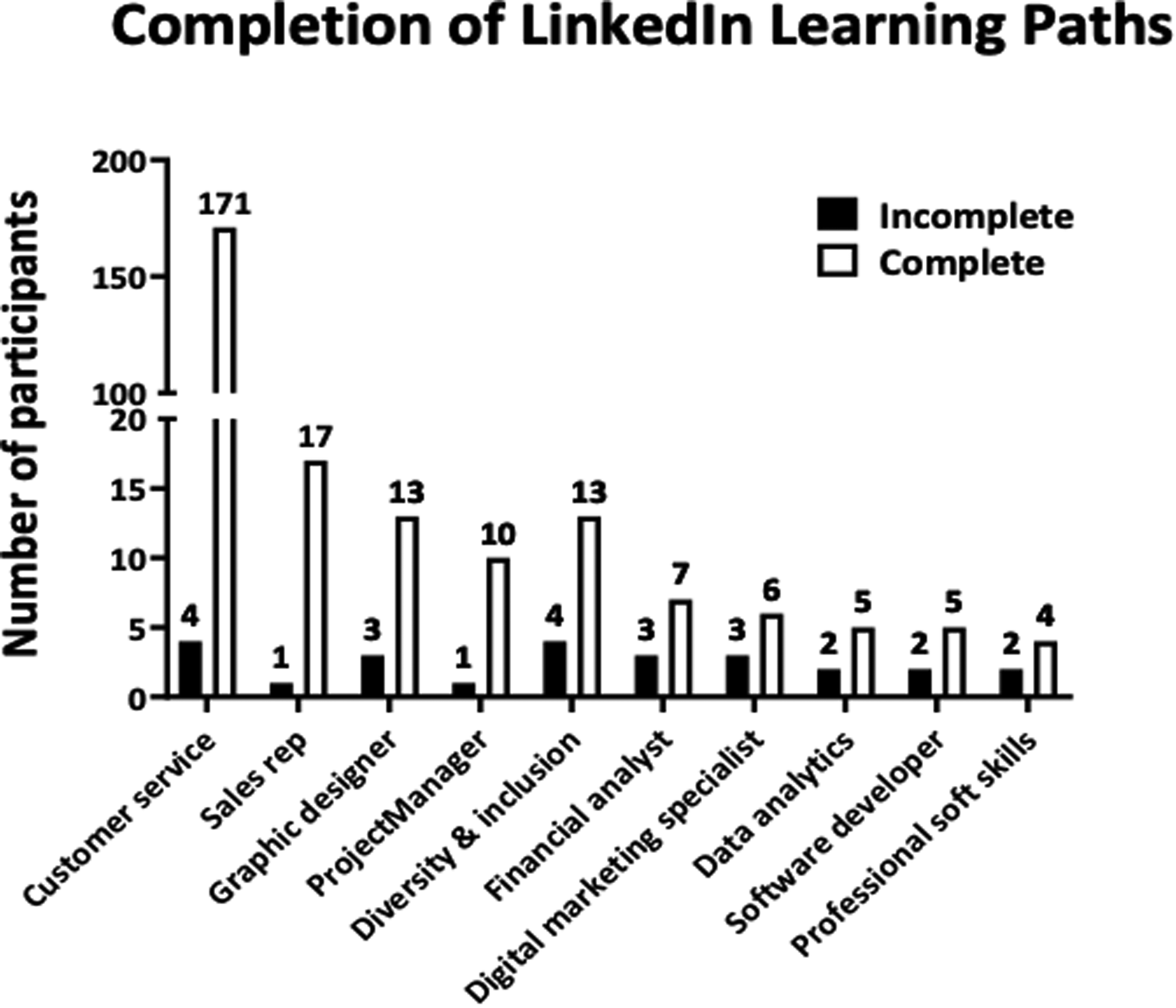
Graph of LinkedIn learning paths including the number of community members that completed a path (n = 251) and those who did not (n = 25). The customer service path was the most utilized and completed course.
In terms of benefits, the participants perceived they gained, over 75% answered that they had improved skills (79%, n = 80) or knowledge (75%, n = 76). Almost 50% (n = 47) believed that completing the pathway enhanced their self-confidence (Figure 5(a)). No respondents reported thinking that the information they learned was not helpful, and only four participants found the path overwhelming (Figure 3(b) and (d)). When asked about hurdles participants faced and prevented them from completing a pathway, two participants indicated that having the necessary tools to complete the pathway, like the internet or a computer, is a barrier to completion (Figure 3B). It was not determined whether these two participants could attend the weekly workshops. Five participants indicated they did not have enough time (Figure 3(b)).
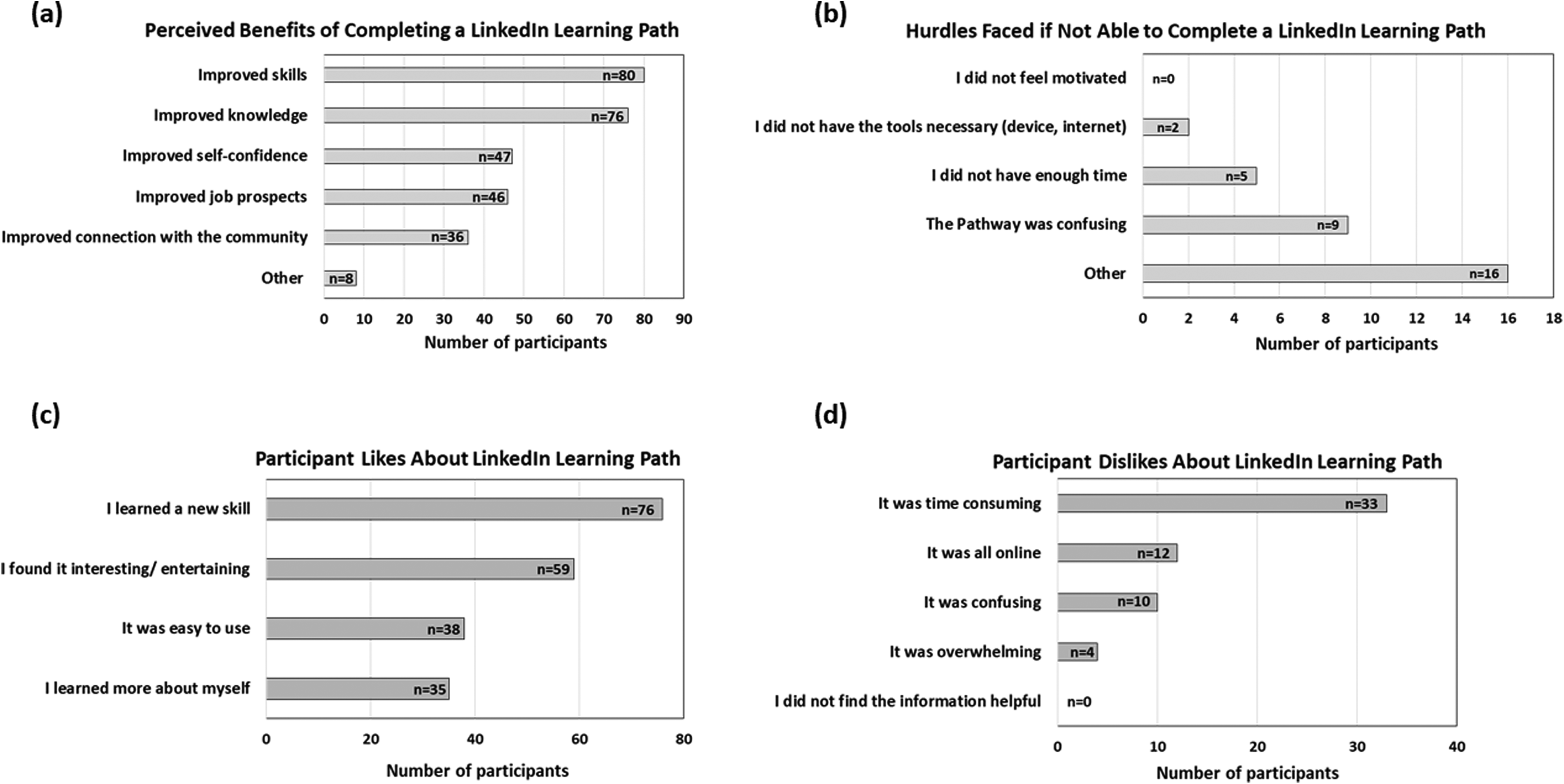
Breakdown of survey results of participant perceived benefits after completing a path (a), hurdles faced that resulted in the inability to complete a path (b), likes (c), and dislikes (d) of paths.
Participants reported several features they liked and disliked while completing their pathways. Thirty-seven percent (n = 38) of participants reported thinking the pathway was easy to use as a feature that they liked. In contrast, 10% (n = 10) of participants found the pathway confusing to use as a feature they disliked (Figure 5(c) and (d)). Seventy-five percent (n = 76) of participants believed they learned a new skill, and 58% (n = 59) of participants found their chosen pathway interesting or entertaining (Figure 5(c) and (d)). The most considerable drawback, considered a weakness for 32% (n = 33) of participants, was that completing was time-consuming. Twelve percent (n = 12) of participants reported the fact that the course was all online to be a dislike (Figure 3(d)).
Promotores as integral team members
The Promotores were asked about common difficulties they faced while recruiting and training participants for the LinkedIn Learning Paths. They found that pathway language was a significant hurdle for the community of 79,905. While many pathways were offered in Spanish and English, the Spanish pathway was always longer than its English counterpart. The Promotores did not have difficulty following up with community members who had trouble completing their pathways. Promotores also reported it was relatively easy to communicate with community members about their course progression and completion. The Promotores also helped various community members identify low-cost internet service so the participants could continue to use their devices at home.
Discussion
Initial feedback from participants was very positive. Over 80% of respondents reported learning a new skill, and 91% of participants who started a pathway were able to finish. Job training and educational attainment are consistently linked to health outcomes. Chiefly, in zip codes 79905, where 68% of residents have a high school diploma, or equivalent, or less, additional training was vital to provide stability against changes in the job market and economy. The upward socioeconomic mobility provided by upskilling and reskilling for better employment opportunities has been associated with better health outcomes.25,26 As more and more of people's interactions with their healthcare move online (telemedicine, patient portals, online billing, etc.), improved digital literacy could be the best target for improved social determinants of health. 19 The Basic Technology Literacy course aimed for this goal, evidenced by every participant believed it improved their skills with computers, and that 90% of these participants believed they could then go and improve other individuals’ skill with computers. The latter result should be the true aim of courses to improve digital literacy, because if participants can go and teach their individual circles then a compounding effect occurs and mass change throughout a community is affected.
Promotores were essential to the project's implementation, as they identified and recruited eligible community members, worked 1:1 with community members during the workshops, and followed up with participants throughout the courses. Additionally, given that Promotores worked in the communities they were often raised in, they offered unique insight into cultural dynamics unfamiliar to many EP-HEAT members, especially the students. The Promotores trained the students on how to effectively communicate, establish trust, and build relationships with community members. Promotores identified community members who would benefit from the LinkedIn Learning Path training program in this project. They also helped with the next step of connecting participants who completed the pathway with the following: (1) Identifying low-cost internet options offered in the El Paso community, specifically in the 79905-zip code; (2) Establishing connections with Workforce Solutions Borderplex (WSB), a county agency which is the local workforce development board that connects job seekers with employment opportunities. At the workshops, WSB also presented about local job opportunities and how to utilize the completion of the LinkedIn Learning Path for job applications.
In communicating with community participants, Promotores received feedback regarding the LinkedIn Learning Paths, including (1) Many individuals, particularly older and retired participants, used the program as an opportunity for personal enrichment rather than to improve job prospects, (2) Many older individuals only spoke Spanish; thus, bilingual staffing was crucial to effectively engage participants. As part of the bilingual staff, bilingual students worked as language brokers and guides throughout the various workshops, which strengthened their relationship with the community, and furthered their understanding of the participants’ digital experience. Additionally, a space of awareness was created for future medical professionals by exposing them to the challenges faced by their future patient population. This awareness allowed them to take a step toward addressing the “super social determinants of health”: digital literacy and internet connectivity. 19
Results from this project indicate the next steps to include connecting participants with established job resources to maximize the utilization of new skills and improve job attainment. Following up with these participants regarding the direct impact of the pilot program on their lives is critical to evaluate the long-term success of these programs. We have preliminary insight into this. For example, one participant is now taking additional courses at a community college to further their education. Another participant teaches her young children how to use a computer to type and find educational resources online. Moreover, other community members expressed taking an active approach to their learning and improving their skill sets because of these programs.
Limitations
Despite the initial success of the Computer Basic Skills Program and LinkedIn Paths, several limitations were present. The first limitation was the lack of access to technology, 27 this was mitigated by providing participants with computer equipment such as the Lenovo ThinkPads. However, this would present a significant financial burden to organizations lacking substantial funding. Secondly, despite being provided with a computer platform to complete learning pathways, it is common among minority and low socioeconomic communities to have difficulty accessing the internet at home, 28 with some people only having access through phones or public places such as libraries. Third, although the LinkedIn Learning Paths were offered in multiple languages, the Spanish courses were often longer than their English counterparts. As one final limitation to other similar programs, the LinkedIn Learning Paths were only cost-free for a limited amount of time during the height of the COVID-19 pandemic. Therefore, any program wishing to utilize these materials would also face an additional financial burden. These costs and limitations would need to be mitigated to provide benefit to the community without being a burden for organizations.
Conclusion
To address the multiple crises posed by the COVID-19 pandemic to the residents of zip code 79905, TTUHSC EP-HEAT facilitated a unique partnership with Microsoft and LinkedIn to increase basic technology literacy and access to LinkedIn Learning Paths. In addition, EP-HEAT initiated an innovative pilot program that allowed community members to participate and complete the LinkedIn Learning Paths. Feedback from participants was very positive; most participants learned a new skill and formed connections with EP-HEAT Promotores, students, and faculty, which is still ongoing.
Supplemental Material
sj-docx-1-dhj-10.1177_20552076231154383 - Supplemental material for Closing the digital divide: Developing a platform to conduct training, outreach, and education for employment skills
Supplemental material, sj-docx-1-dhj-10.1177_20552076231154383 for Closing the digital divide: Developing a platform to conduct training, outreach, and education for employment skills by Sarah Johnson, Jesse Allen, Lorena Fernandez, Veeravenkata Garikiparthy, Laura Renovato, Maria Land, Leticia Favela, Karina Becerra, Ricardo Belmares, Nathan Holland and Jessica Chacon in Digital Health
Footnotes
Acknowledgements
The authors thank the following individuals for their expertise, support, and assistance throughout all aspects of our study: Patricia Rodriguez, Vianey Jaurequi, Ester Rodriguez, Luz Gamez, and the TTUHSC El Paso Office of Institutional Advancement. The authors also express gratitude to the following funding resources that were instrumental in initiating this project: Microsoft Corporation and Workforce Solutions BorderPlex. J.A.C has also received funding from The Meadows Foundation, Blue Cross/Blue Shield of Texas, The Caring Foundation of Texas, Wells Fargo, JPMorgan Chase, and the AT&T Foundation.
Contributorship
All authors discussed the results and contributed to the final manuscript.
Declaration of conflicting interests
The authors declared no potential conflicts of interest with respect to the research, authorship, and/or publication of this article.
Ethical approval
This pilot project was considered IRB-exempt (E22017).
Funding
The authors disclosed receipt of the following financial support for the research, authorship, and/or publication of this article: This work was supported by the Microsoft (grant number 24329320304030).
Guarantor
JC

Supplemental material
Supplemental material for this article is available online.
References
Supplementary Material
Please find the following supplemental material available below.
For Open Access articles published under a Creative Commons License, all supplemental material carries the same license as the article it is associated with.
For non-Open Access articles published, all supplemental material carries a non-exclusive license, and permission requests for re-use of supplemental material or any part of supplemental material shall be sent directly to the copyright owner as specified in the copyright notice associated with the article.
