




Abstract
In general merchant ships do not have medical facilities on board. When seafarer got sickness or accident, either ship captain or officers who are in charge will assist them, but these people do not have enough medical knowledge. To overcome this, we developed a Seafarer Health Expert System (SHES) that can facilitate telemedical services in an emergency. A comprehensive analysis of seafarers’ medical issues that were conducted from medical records of patients assisted on board ships by the International Radio Medical Center (C.I.R.M.), Italy. Data mining techniques are involved to manage epidemiological data analysis in a two-phase setup. In the first phase, the common pathologies that occurred onboard were analyzed, later a detailed questionnaire for each medical problem was developed to provide precise symptomatic information to the onshore doctor. In this paper, we mainly highlighted the SHES framework, design flow, and functionality. Besides, nine designing policies and three actors with separate working panels were clearly described. The proposed system is easy and simple to operate for anyone of no computer experience and create medical requests for the fast delivery of symptomatic information to an onshore doctor.
Introduction
About two million seafarers are working in 50,000 merchant ships and carrying 90% of global merchandise. Seafaring is a kind of occupational group that is more vulnerable to safety and personal health issues. 1 These people are largely connected with severe health risks mainly caused because of isolation, climatic changes, and heavy workload. Accidents onboard are also common during material shipping.1,2 Despite ecological factors, disturbance and ship vibrations are also effects working quality and rest progression. 3 Other medical problems such as musculoskeletal strain, clamor, and exhaustion make them high work pressure. 4 Ship sailing involved continuous working hours, and spend long periods away from the coastal life. 5
Seafarers have come across a proper medical check-up before they entering into a vessel, but because of anomalies in marine life, there is always a constant risk of getting sick or to experience injuries. In this case, the lack of health professionals onboard makes the situation even worse. By staying away from home initiate sadness and isolation in seafarers. 6 Seafarers need a better companion at work and recommend developing habits of having a conversation with colleagues, maintain a healthy diet, and always engaged in positive activities like sports, listen to music, also reading could relieve them excessive stress. 7
The studies related to seafarer’s health had concluded all sailing works could not be substantial. The better information on associated risk factors from well-conducted studies could explore the seafarer's medical problems.8–10 Also, it is beyond the expectation to diagnose disease with limited symptomatic information, and shipping staff usually approach ship pharmacy for simple medical problems. In case of emergency, the ship’s captain can seek medical advice from a Telemedical Maritime Assistance Service (TMAS) centers. 11 But there is a constant risk for transferring true medical evidence just only through telephone or electronic mails. In such cases, proper use of modern telecommunications and remote medical care technologies could help in favor of seafarer’s health issues.
Shipping is an individual working environment of primary features like age, lifestyle, body mass index (BMI), and physical activities. 12 When compared to onshore residents, seafarers had more rights for medical care and health safety. 13 But, the possibility of having better onboard medical assistance in case of serious pathologies has been becoming a challenge for ages. 14 The unavailability of medical doctors, limited medical supplies for ship pharmacy represent relevant obstacles in providing reasonable quality medical care to seafarers.15,16 Recent technical advancements if properly used could offer the chances for the development of seafarer’s medical systems. In this frame we have developed a seafarer's health expert system (SHES) to help seafarers to generate quality telemedicine services. 17 It can bring a significant advantage in the case of onboard diseases or injuries and allows remote doctors in better pathology assessment.
There is a constant advantage for expert systems and the internet of things (IoT) in particular. Expert systems help solve complex problems with human knowledge, and these systems can represent the human intelligence or commands of machine language. 18 On the other hand, a person who is in charge of the healthcare onboard had limited medical knowledge and provide nominal medical support. 19 Sometimes, symptomatic information of pathology could hinder by lack of medical expertise to ship captain or medical officers. In such a condition, the TMAS doctor cannot identify the exact medical condition of the seafarer. By digital healthcare equipment like SHES, an onshore doctor can access patient data without a problem. This paper explains the idea behind SHES development, working functionality, and architecture principles in the provision of medical help to seafarers from a remote area.
SHES guidelines and principles
Patient records
Seafarer's medical records were extracted from the clinical database of the International Radio Medical Center (C.I.R.M). 20 C.I.R.M. is the Italian TMAS and represents the maritime assistance center with the largest experience worldwide in providing medical assistance to sailing seafarers. The clinical data of ship workers were securely stored with limited access for authorized people. C.I.R.M. is maintaining these records for 20 years with good maintenance and encryption. The clinical data of ship workers were securely stored with limited access for authorized people. C.I.R.M is maintaining these records for 20 years with good maintenance and encryption.
SHES principles and policies
A review of medical records was properly executed to categorize diagnostic characteristics, and problem statements. Each record has been investigated in the two-step methods. At first, simulation of common seafarers' medical problems was done by adopting text mining techniques. Text mining is a type of Natural Language Processing (NLP) technique that performs the linguistic analysis. 21 Long sentences in patient records are breaks down into understandable words for structural medical description and were evaluated by the tokenization method. 21 We identified 52 medical issues including 35 diseases and 17 accidents type (Table 1). Secondly, depending on individual pathology, a specific questionnaire item has developed for each disease. Identification of individual pathology integrated with symptomatic data further studied. Table 2 presents nine SHES principles accompanied by its guidelines and outcomes.
Onboard medical issues.

System designing principles along with guidelines.

CIRM: Center of International Radio Medicine; GDPR: general data protection regulation
SHES designing and functionality
Designing flow
Design flow provides ideas behind system design in a documented manner. 22 Figure 1 illustrates the SHES design flow with three individual panels and its functionalities. In the seafarers’ panel, the onboard healthcare staff operates SHES with predefined credentials for generating new medical requests. After adding seafarer’s details like gender, age, nationality, blood pressure, pulse rate, BMI, etc. In the follow-up screen, it asks to select a medical problem from the list defined in Table 1. Thereafter the system presents a new screen with a symptomatic questionnaire of a selected category. The collective response of each questionnaire is directly transmitted to a doctor panel called ‘medical flag’.

SHES design flow.
TMAS doctor panel assesses the medical flag. Subsequent analysis of seafarers' requests and specialists delivers responses including diagnostic and drug information, treatment measures, and immediate precautions that have to follow onboard. The Administrative (TMAS center) panel is update medical flag status and keeps active in the system until the seafarer completely recovers. The use diagram of three SHES actors including duties is presented in Figure 2.
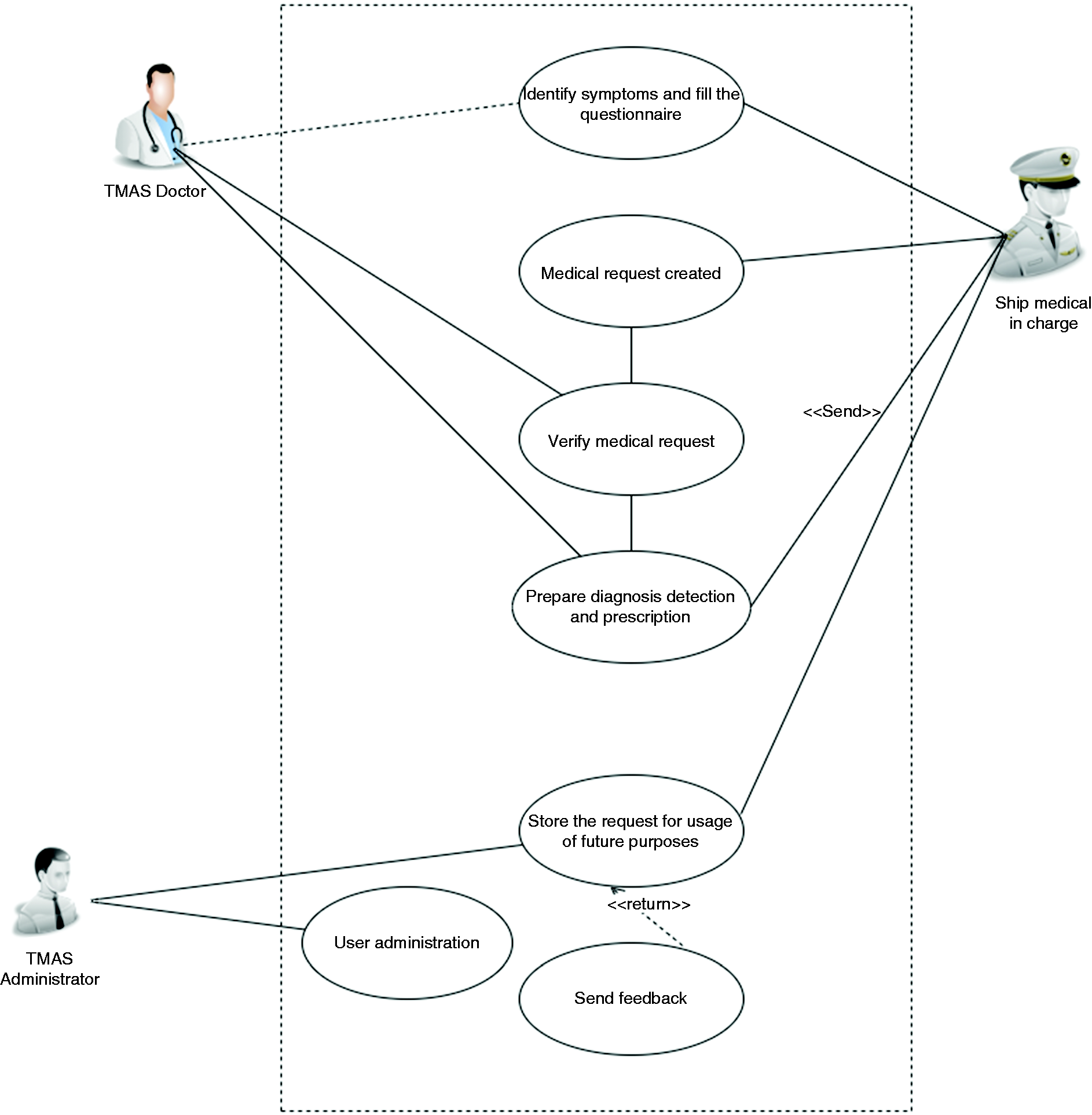
SHES use-case diagram.
Technical design
The SHES is a centralized application that all users can utilize the system through a centralized server. Technical design defines the adaptation of application principles and characteristics (Table 2) to an organized solution that meets user standards. Front end-user interface (UI) elements enable seafarers to create a medical flag. This flag carries and stores symptomatic information to the webserver and the SHES desktop screen collects and transfers to the TMAS doctor. A load balancer is introduced among these WEB servers in the distribution of workloads and enhance the system performance (Figure 3). Two main servers (i.e., WEB and TMAS) are included to manage the patient requests, and application programmable interface (API) directs the server access, collects and delivers responses. 23 The SHES accessing via the internet with a secure sockets layer (SSL) implementation, and firewall for data protection between systems are introduced. Two network firewalls were imposed to have system security from unauthorized access and private network usage. Authentication for each user can be provided by the system administrator.

SHES technical architecture model.
Discussion
When a seafarer gets sick, communication between doctor and patient can be done either by phone or email. Sometimes, it is hard to evaluate the actual patient situation with limited clinical information. Therefore, the demand for telemedical services is encouraged by the possibility of creating a new medical expert system. 24 In this paper, we proposed a design of SHES that can create a better improvement of seafarers' health, and this system is designed for the goal of providing long term health services. The SHES is a software application for easy management of telemedical services to crew members with limited medical knowledge. As mentioned, onboard staff possess limited medical knowledge and the medical capabilities of these people are modest. Therefore, the SHES application can explore the possibility of providing onboard medical care.
The SHES architecture was designed after careful understanding of C.I.R.M medical records of seafarers and developed with individual strategies, principles, and guidelines. All clinical records were properly analyzed and onboard medical problems are labeled into two distinct categories such as diseases and accidents. Every medical problem is predefined by a specific set of questions that aims to deliver symptomatic information to the TMAS doctor. Nine separate principles are defined on service, database, and application functionalities. The SHES design flow consists of three panels namely ship, doctor, and TMAS center panels. The technical architecture is developed with web and TMAS servers. Web servers are incorporated to process the medical flags and TMAS servers are incorporated to securely store the medical requests. We also added two network firewalls to protect SHES from unauthorized access and private networks.
Conclusions
Since the beginning of the 21st century, developments in IoT technologies encourage the development of new medical systems. This paper presents the introduction of SHES development that aims to deliver medical services for seafarers onboard. We employed contemporary IoT methods for SHES designing and it could be a primary application in maritime health. The idea behind current development can open new possibilities for future inventions of remote healthcare centers.
Footnotes
Acknowledgments
We would like to acknowledge the support provided by ITF trust (Grant No. 1276/2018).
Contributorship
GB: Study development and manuscript preparation, FA: Critically reviewed and approved the study.
Declaration of conflicting interests
The author(s) declared no potential conflicts of interest with respect to the research, authorship, and/or publication of this article.
Ethical approval
The ethical committee at Center Of International Radio Medicine (C.I.R.M.) has approved the study.
Funding
The author(s) disclosed receipt of the following financial support for the research, authorship, and/or publication of this article: Executive board of the International Transport Workers’ Federation (ITF) supports this project and partly getting support from the International Radio Medical Center (C.I.R.M).
Guarantor
F AMENTA.
Peer Review
This manuscript was reviewed by reviewers who have chosen to remain anonymous.
