



Abstract
This study sought to examine the predictive utility of the theory of planned behavior (TPB) for mask wearing behavior. Data was collected during the Texas public mask mandate (October 11-November 24, 2020) and post-mandate (March 25-April 29, 2021). University students were recruited through the department’s online subject pool. Participants during the mandate (N = 579; M = 18.70, SD = 1.17; 60.8% female) and post-mandate (N = 236; M = 19.15, SD = 1.02; 50% female) completed identical TPB measures and demographic measures. Using structural equation modeling (SEM), attitudes, subjective norms and perceived behavioral control were associated with stronger mask wearing intentions. Intentions were positively associated with mask wearing behavior. Perceived behavioral control also had a direct positive association with wearing a mask in public. These findings suggest that the TPB is successful in predicting mask wearing behavior, which could have implications for prevention programs and public health campaigns.
Keywords
Introduction
Declared a worldwide pandemic in March 2020 (World Health Organization, 2020), COVID-19 has been observed to be a highly infectious disease caused by the SARS-CoV-2 virus. While there are a number of effective vaccines in production, the ever-evolving virus continues to infect and re-infect individuals (Rahman et al., 2022; Ren et al., 2022), making other health promotion behaviors (e.g., mask wearing) just as important as vaccine uptake (Brüssow et al., 2021). National and local governments have encouraged health protective strategies and guidelines to slow transmission rates. An effective method that was encouraged to reduce transmission was to wear face-coverings, such as N-95 masks, cloth masks, or surgical masks (Liao et al., 2021; Lindsley et al., 2021). Within the U.S., several states implemented mask mandates, requiring individuals to wear masks when in public (Centers for Disease Control, 2021; Jacobs and Ohinmaa, 2020). Although states varied in terms of when and how long these mandates were implemented, the state of Texas implemented a mask mandate on July 2, 2020. The mask mandate ended on March 10, 2021 (Texas State Law Library, 2021). These mandates were associated with decreased transmission and hospital admissions due to COVID-19 (Joo et al., 2021), and increased mask wearing compliance (Haischer et al., 2020).
However, many individuals continued to avoid mask wearing during the mandate or after the CDC updated guidelines for vaccinated individuals (Haischer et al., 2020; Rossi and Moore, 2022). Previous research has cited various factors, such as personal comfort and convenience (Howard, 2020), attitudes and beliefs about COVID-19 (Romer and Jamieson, 2020), and social and cultural norms (Lu et al., 2021; Timpka and Nyce, 2021) as impediments to face mask use. Additionally, younger individuals are less likely to wear masks compared to older adults (Liu and Arledge, 2022; Rossi and Moore, 2022). As face coverings are an effective tool to reduce transmission, using a health behavior theory to model prediction use of facemasks can be an effective way to determine prevention efforts that can be most effective (Chan et al., 2020), particularly in young adults. Health behavior theories offer a way to ground our understanding of what might drive individual behavior, such as wearing a mask in public. To understand what contributes to a young person’s mask-wearing out in public, using a theoretical approach that captures attitudes, norms, and controllability over the behavior can allow interventions to be tailored to the experience of young people.
Theory of planned behavior
The Theory of Planned Behavior (TPB) is an established behavior theory that has been used to predict health-related behaviors (Ajzen, 1991; Godin and Kok, 1996), such as smoking cessation (Bledsoe, 2006) and physical activity (French et al., 2005). The TPB predicts behavior from behavioral intentions, which are informed by three factors: 1) people’s positive or negative attitudes towards the behavior, 2) subjective norms relating to social expectations, and 3) people’s perceived behavioral control (Pan and Liu, 2022; Wollast et al., 2021).
In the context of COVID-19, TPB has been used to predict a variety of health behaviors including social distancing (Frounfelker et al., 2021; Yu et al., 2021) and intentions to receive the vaccine (Shmueli, 2021). In particular, mask wearing has received some attention due to its role as a preventive measure against infection and as a method to reduce transmission of COVID-19. For example, one study used the TPB to look at what factors predicted mask wearing intentions among international students (Sun et al., 2021). Attitudes, perceived behavioral control, and subjective norms were found to predict mask wearing intentions for international students, with subjective norms being the strongest predictor (Sun et al., 2021). Attitudes and subjective norms were also found to be predictors of mask wearing intentions among residents in Pakistan (Irfan et al., 2021) and among those traveling by plane (Pan and Liu, 2022). Although the TPB has been expanded to look at the role of other possible factors (e.g., mask availability, perceived benefit of mask usage; Irfan et al., 2021), one factor that has not been examined is the role of public mask mandates. Although public mask mandates are associated with fewer new COVID-19 cases, hospital admissions, and deaths (Adjodah et al., 2021; Nguyen, 2021), little research has looked at their influence on mask wearing intentions. Therefore, this study aimed to address that gap by using the TPB to look at mask wearing intentions both during and after a public mask mandate.
Study overview
The current study sought to examine the predictive ability of the theory of planned behavior to predict mask wearing to mitigate the spread of COVID-19 during and post-state level mask mandates in a sample of college students. Consistent with theory, it was hypothesized that positive attitudes, subjective norms and perceived behavioral control would be associated with stronger intentions of wearing masks (H1). It was also hypothesized that higher intentions to wear masks (H2) and higher perceived behavioral control (H3) would be directly associated with wearing a mask in public. In particular, this study was interested in the role of state implemented mask mandates on these relationships; however, no a priori hypotheses were made concerning how the mandates would affect the association between these constructs.
Method
Participants
Participant demographic information.

Measures
The TPB contains five domains: subjective norms, attitudes, perceived behavioral control, intentions, and behavior. As specified for TPB measure creation and adaptation (Fishbein and Ajzen, 2010), a clearly defined target behavior is specified (i.e., mask-wearing in public). TPB measures were adapted by switching out the target behavior from the original study (wearing personal protective equipment while working with pesticides) for the target behavior (wearing a mask out in public) of the current study. Measures for all five domains were included, alongside a measure for demographics. This data was collected as part of a larger COVID-related study. All measures and procedures were approved by the university’s Institutional Review Board. This study was not pre-registered; however, all measures, data, and analyses can be shared upon request to the corresponding author.
Subjective norms
Subjective norms around mask wearing in public consisted of four items on a 7-point Likert scale from 1 (strongly disagree) to 7 (strongly agree) (adapted from Norris and Myers, 2013; Rezaei et al., 2019). An example item would be “My family would approve of me wearing a mask while out in public.” Higher scores reflect greater subjective norms around mask-wearing behavior. Internal reliability during the mandate (α = .95) and post-mandate (α = .94) was adequate.
Perceived behavioral control
Perceived behavioral control over wearing a face mask in public was assessed using four items on a 7-point Likert scale from 1 (strongly disagree) to 7 (strongly agree) (adapted from Norris and Myers, 2013; Rezaei et al., 2019). An example item would be “The decision to wear a mask out in public is completely up to me.” Higher scores reflect greater perceptions of control concerning wearing masks in public. The internal reliability during the mandate (α = .80) and post-mandate (α = .79) was adequate.
Attitude
Attitude toward wearing a face mask in public was assessed using four items on a 7-point Likert scale from 1 (strongly disagree) to 7 (strongly agree) (adapted from Rezaei et al., 2019). An example item would be “wearing a mask out in public is wise.” Higher scores reflect positive attitudes towards wearing a mask in public. Internal reliability during the mandate (α = .85) and post-mandate (α = .86) was adequate.
Intention
Intention to wear a face mask in public was assessed using four items on a 7-point Likert scale from 1 (strongly disagree) to 7 (strongly agree) (adapted from Norris and Myers, 2013; Rezaei et al., 2019). An example item would be “I intend to wear a mask while out in public in the future.” Higher scores indicate greater intentions to wear a mask in public. Internal reliability during the mandate (α = .98) and post-mandate (α = .99) was adequate.
Behavior
Behavior to wear a mask was assessed using two items (adapted from Dickie et al., 2018). Responses to the items were on a 5-point Likert scale from 1 (never) to 5 (always). One item asked participants to identify their general mask wearing behavior in public, and the second item asked participants to indicate how often they wear a mask around others they do not live with. Higher scores indicate greater mask usage in public. Internal reliability was adequate during (α = .62) and post-mandate (α = .78).
Procedure
Both mandate and post-mandate data collection occurred online through the Psychology Department’s subject pool. All participants agreed to participate. All measures and procedures were identical for both the mandate and post-mandate waves of data collection. All participants completed the subjective norm, perceived behavioral control, attitude, intention and demographic measures. All participants were debriefed on the study goals and received partial course credit as compensation.
Data preparation and analysis overview
Structural equation models (SEMs) were used to test how the Theory of Planned Behavior (TPB) model influenced mask wearing behavior. Separate analyses were used to look at mask wearing behavior during and after the mask mandate. SEM models were chosen in order to examine the influence of positive attitudes, subjective norms, and perceived behavioral control on mask wearing intentions (H1) and whether higher mask wearing intentions were associated with mask wearing behavior (H2). This type of analysis also allowed us to examine whether perceived behavioral control was directly related to mask wearing behavior (H3).
All analyses were conducted using package lavaan version 0.6-17 (Rosseel, 2012) in R version 4.3.2. Particularly, the function sem was used to analyze the COVID mask data before the mandate as well as the data after the mandate. The observed variables (i.e., the responses to the survey questions) were treated as ordinal data using the “ordered = TRUE” option in sem. Model chi-square (χ2), root mean square of error approximation (RMSEA), comparative fit index (CFI), Tucker Lewis Index (TLI), and standardized root mean square residual (SRMR) are reported as indications of model fit. Descriptives, confirmatory factor analysis (CFA), and SEMs were computed.
While no a priori power estimated were computed, we have did conduct a post hoc power analysis and based on the analysis conducted in semPower (https://sempower.shinyapps.io/sempower/), we had a power of > .99 and an estimated effect size of 0.50 for the pre-mandate sample and a power of 0.96 and an estimated effect size of 0.50 for the post-mandate sample.
Results
CFA measurement model
Confirmatory factor analysis results for during-mandate and post-mandate datasets.
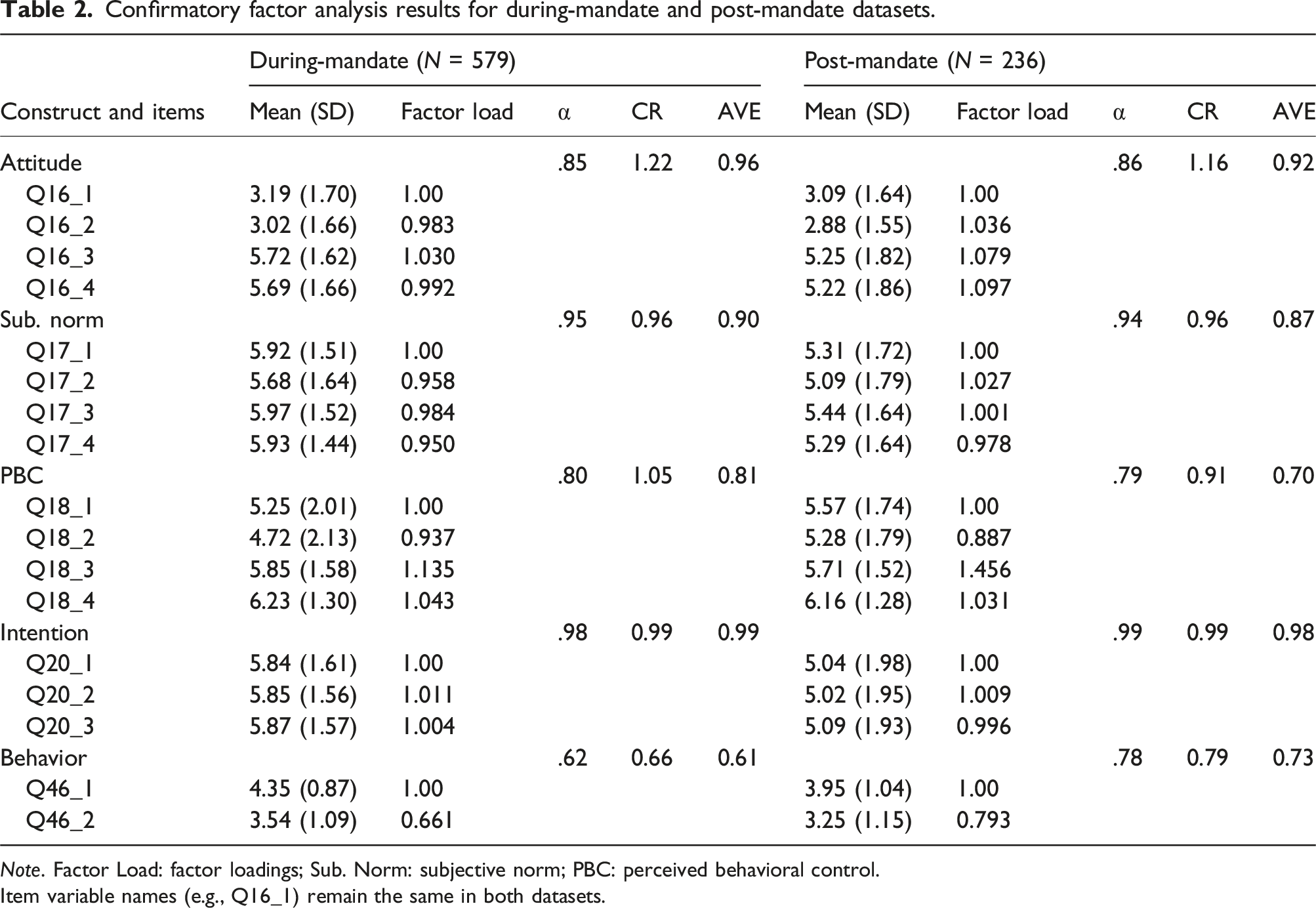
Note. Factor Load: factor loadings; Sub. Norm: subjective norm; PBC: perceived behavioral control.
Item variable names (e.g., Q16_1) remain the same in both datasets.
A CFA was run on the post-mandate data. The model fit indices again demonstrated mixed fit [χ2 (109) = 1073.48, p < 001, CFI = 0.998, TLI = 0.997, RMSEA = 0.194, and SRMR = 0.125], with standardized factor loadings ranging from 0.793 to 1.456.
During the mask mandate
The SEM model appeared to be adequate for the survey data during the mask mandate [χ2 (111) = 3317, p < 10-6, CFI = 0.997, RMSEA = 0.224, and SRMR = 0.159]. Standardized parameter estimates are presented in Figure 1. The constructs of perceived behavioral control (β = 0.15, p < .001), subjective norm (β = 0.42, p < .001), and attitude (β = 0.35, p < .001) were positively associated with intention to wear a mask, which was in turn significantly associated with mask-wearing behavior (β = 0.76, p < .001; H1 and H2 supported). The link from perceived behavioral control to mask-wearing behavior was also significant (β = 0.12, p = .002; H3 supported). All covariances among perceived behavioral control, subjective norm, and attitude were also highly significant. Estimated SEM during the mask mandate. Note. All parameters are statistically significant.
Post-mask mandate
The SEM model appeared to be adequate for the survey data after the mask mandate [χ2 (111) = 1108, p < 10−6, CFI = 0.998, RMSEA = 0.196, and SRMR = 0.127]. Standardized parameter estimates are presented in Figure 2. Similar to during the mandate, the post-mandate model demonstrated positive associations between attitude (β = 0.50, p < .001), subjective norms (β = 0.34, p < .001), and perceived behavioral control (β = 0.08, p = .013) on intentions to wear a mask (H1 and H2 supported). The link from perceived behavioral control to mask-wearing behavior (β = 0.16, p = .005), was again significant in the post-mandate model (H3 supported). Estimated SEM post-mask mandate. Note. All parameters are statistically significant.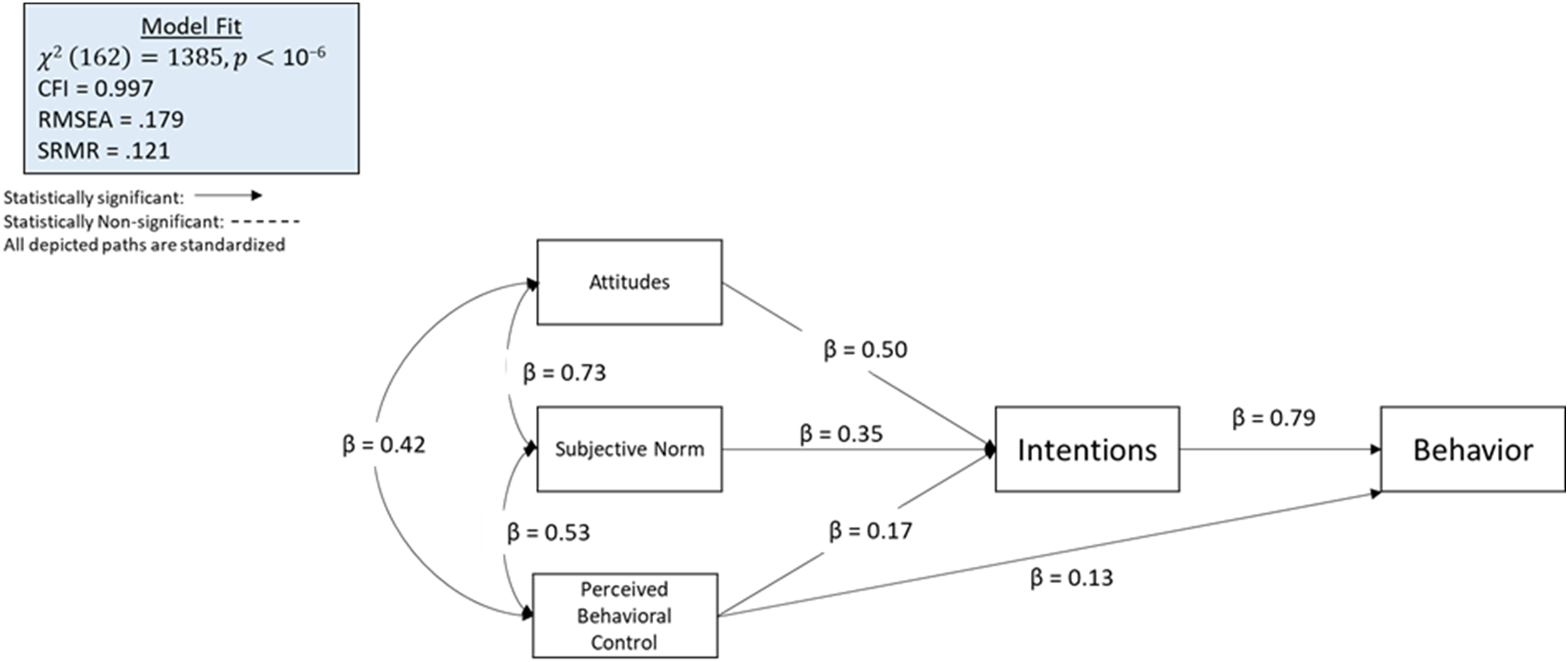
Discussion
The purpose of this study was to examine whether the TPB could be used to predict public mask wearing behavior both during and after a mask mandate during the COVID-19 pandemic. Considering that the TPB is a common health behavior model, it was hypothesized that attitudes, subjective norms, and perceived behavioral control would be positively associated with stronger intentions of wearing masks (H1), and that intentions would be positively associated with mask wearing behavior (H2). It was also hypothesized that higher perceived behavioral control (H3) would have a direct positive association with wearing a mask in public. No explicit predictions were made concerning how the context of the mask mandate would affect the model paths; thus, no hypotheses were formed regarding changes during- to post-mandate.
Across the two waves, consistent support for the three hypotheses was found. The results show positive associations between subjective norms, attitude, and perceived behavioral control predicting intentions, which then predicts masking behavior. Both data collection waves showed support for the direct path from perceived behavioral control predicting mask wearing behavior. Past research has demonstrated individuals are more likely to report wearing a mask under a mandatory policy compared to a voluntary policy (Betsch et al., 2020). Additionally, regardless of mask-wearing policy (i.e., mandatory vs voluntary masking), individuals tend to view others wearing masks as prosocial compared to others not wearing a mask (Betsch et al., 2020). Therefore, it is not surprising that out of the three constructs predicting intentions, subjective norms was the strongest predictor of intentions to wear a mask during the mandate. Once the mandate was lifted, attitude was the strongest predictor of intentions. This could speak to the larger context of the COVID-19 lockdown policies and stage of the pandemic on behavior. Research has indicated that depending on the stage of the pandemic, psychosocial predictors (i.e., self-efficacy, attitude) may shift in uniquely predicting mask-wearing behavior (Magoc et al., 2023). In terms of predicting mask-wearing intentions, this study demonstrates a similar shift in what is the strongest predictor.
Overall, these findings are consistent with previous work that has explored the role of TPB on COVID-19 related behaviors, such as hand-washing, social distancing, and receiving the vaccine (Frounfelker et al., 2021; Shmueli, 2021; Wollast et al., 2021). In the context of intentions towards mask wearing, the TPB has been found to predict mask wearing intentions amongst international students in China, with subjective norms being the strongest predictor (Sun et al., 2021). The current study replicated this finding using a college student sample in the United States, including replicating the finding that subjective norms are the strongest predictor of mask wearing intentions during a public mask-wearing mandate. Considering that both samples used college students, this effect may be related to work that has found that younger individuals are motivated to wear masks due to the desire to protect both themselves as well as others (Asri et al., 2021).
Additionally, the TPB framework has been previously extended to consider other factors related to mask wearing, such as mask unavailability and the cost of face masks. Attitudes, subjective norms, risk perceptions, and perceived benefits of mask wearing have all been found to be positive predictors of mask wearing intentions, with mask unavailability and face mask costs being negative predictors (Irfan et al., 2021). While this study did not examine availability and costs of masks, the current study extends the literature by considering the previously unexplored role of mask mandates and their impact on mask-wearing intentions and behavior.
Implications
This study provides evidence for targets for prevention programs that are focused on increasing mask wearing and other preventative behaviors. Attitudes and subjective norms have been previously identified as behavioral predictors of mask use in previous studies (Barile et al., 2020). Public health campaigns should consider using behavioral models and theories, such as the TPB, to target the most effective variables when intervening to increase mask wearing behavior. For example, according to the norm activation model (NAM), targeting moral obligation (e.g., responsibility to protect vulnerable others from disease) increases individuals’ personal norms about engaging in the behavior (Schwartz, 1977). These types of campaigns during the pandemic showed some evidence of success in increasing preventative behaviors (Rui et al., 2022). The current study also provided initial evidence that when there are state and local requirements to engage in health behaviors, subjective norms may be an important contributor to deciding to wear a mask. Whereas when there is not a requirement, attitudes may be a more important predictor. Therefore, targeting the most relevant psychosocial construct when there are and are not additional parameters in place (i.e., laws and mandates) could be a particularly effective intervention.
Considering that the TPB was an effective model for predicting public mask wearing behavior in this study, the TPB could be expanded to look at other preventative behaviors associated with disease transmission (i.e., vaccination for other communicable diseases, hand washing for other respiratory diseases, etc.). In fact, interventions that target attitudes have been related to changes in behavior across various health behaviors, including STD/STI testing (Booth et al., 2013), binge drinking (French and Cooke, 2011; Todd and Mullan, 2011), smoking cessation (Tseng et al., 2017), and eating behaviors (Karimi-Shahanjarini et al., 2013; Mullan et al., 2013).
Limitations
Although this study has many strengths, some limitations must be considered. First, the study used a cross-sectional between-subjects design for data collection during the mandate (wave 1) and post-mandate (wave 2) time periods. Although both waves drew participants from the same subject pool, a within-subjects longitudinal design (i.e., collecting data from the same participants both during and post-mandate) would have allowed for more confidence in how external factors (e.g., local mandatory mandates) directly influenced components of TPB to predict behavioral intentions. Additionally, the use of a college student sample may limit generalizability of these findings for individuals who are older or not college educated. Specifically, the findings that, during the mandate, subjective norms were a stronger predictor of intentions echoes prior research that norms are more influential in young adults (Asri et al., 2021). Therefore, this pattern may not be found in an older non-student sample; future research should examine how the impact of subjective norms on TPB changes across the lifespan and education-level (Baker et al., 2007). Finally, the current study included self-report data on mask wearing behavior. Given the politicized nature of mask wearing behavior, any self-report data may have been inherently biased as individuals may feel the need to report behavior that they feel is expected (either wearing a mask or not).
Summary and conclusion
Wearing a mask has been shown to be an effective preventative behavior to reduce the spread of illness, particularly during the COVID-19 pandemic. The current study sought to examine the predictive utility of the theory of planned behavior for predicting mask use both during and following a mandated requirement to mask in public. Findings from this study suggest that the Theory of Planned Behavior is a successful model for predicting mask wearing behavior. Importantly, similar results were found in the performance of the model with and without mandates which has potentially important implications for interventions used across varying levels of policies (i.e., mandates). This study highlights the potential of interventions placing emphasis on specific constructs over others depending on when the behavior of interest is not required by law. Future studies should examine legislative and external controls when examining the effects of behavioral models on outcomes.
Footnotes

Ethical statement
Author contributions
Kianna Arthur (Conceptualization [Support]; Data Curation [Lead]; Investigation [Support]; Methodology [Support]; Resources [Support]; Writing – original draft [Lead]; Writing – review & editing [Lead]), Rachel Smallman (Supervision [Support]; Writing – original draft [Support]; Writing – review & editing [Support]), Jessica C. Lowe (Writing – original draft [Support]; Writing – review & editing [Support]), Yang Ni (Formal Analysis [Lead]; Data Curation [Support]; Writing – original draft [Support]), and Sherecce Fields (Conceptualization [Lead]; Investigation [Lead]; Methodology [Lead]; Project Administration [Lead]; Resources [Lead]; Supervision [Lead]; Writing – original draft [Support]; Writing – review & editing [Support]).
Funding
The authors received no financial support for the research, authorship, and/or publication of this article.
Declaration of conflicting interests
The authors declared no potential conflicts of interest with respect to the research, authorship, and/or publication of this article.