



Abstract
This study delves into the realm of informal cancer caregivers. Through a meticulous bibliometric analysis, the study sheds light on the burgeoning interest in this field, with a significant focus on the psychological well-being, subjective burden, and psychosocial support for caregivers. A significant portion of the retrieved articles (n = 1366) was published after 2017 and primarily disseminated through a select number of journals. Notably, the study reveals a substantial gap in randomized controlled trials addressing interventions tailored to family caregivers, indicating a critical need for more high-quality trials to guide effective support strategies. Despite the increasing recognition of caregivers’ significance, limited research collaboration was observed, emphasizing the importance of fostering collaborative efforts to address cultural differences and expand the scope of research on cancer caregivers globally. The findings underscore the urgent call for comprehensive interventions and collaborative endeavors to optimize the well-being of family caregivers.
Background
An informal caregiver (or family caregiver) is an unpaid person who provides a wide range of physical and emotional assistance for a person with a disability or serious disease (Schulz et al., 2020; The National Alliance for Caregiving (NAC) and AARP, 2020). The National Alliance for Caregiving and the Family Caregiving conducted and published the most recent report on “Caregiving in the U.S 2020”. The report revealed an increase in the number of family caregivers in the United States of 9.5 million from 2015 to 2020. The report also revealed that family caregivers are in worse health compared to 5 years ago (Prudencio and Young, 2020; The National Alliance for Caregiving (NAC) and AARP, 2020). The report also revealed that 6% of the care recipients were cancer patients (The National Alliance for Caregiving NAC and AARP, 2020). Given that the number of cancer cases is on the rise globally (World Health Organization, 2022), the need for family cancer caregiver is expected to increase with time. Furthermore, cancer management is advancing rapidly (Liu et al., 2023; Nasir et al., 2021; Yap et al., 2021), and in many cases, cancer is considered a chronic disease rather than a sudden life-threatening illness. These developments in cancer management shifted the burden of caregiving to informal caregivers. During cancer diagnosis and treatment, family caregivers provide practical and emotional support to patients, facing both objective and subjective burdens (Borrescio-Higa and Valdés, 2022; Sun et al., 2019). These burdens, experienced differently by each caregiver, often lead to significant psychological pressure (Wen et al., 2022) Studies show that caregiving can compromise the quality of family life, highlighting the need for psychosocial support for caregivers to improve overall health outcomes for both patients and caregivers (Becqué et al., 2023; Ringborg et al., 2022).
Understanding the significance of psychological well-being and support for informal cancer caregivers necessitates a thorough examination of existing research in this area. In recent years, bibliometric analysis and mapping have become common methods for analyzing scientific literature across various disciplines, including psychology, cancer research, and mental health (El Bairi et al., 2021; Mainwaring et al., 2020; Martín-Del-Río et al., 2021; Zhu et al., 2022). These studies provide insights into research trends, citation patterns, subject areas, influential journals, collaborative networks, and influential countries, offering a comprehensive overview of the research landscape. The current bibliometric analysis aimed to examine publication trends and patterns in the cancer caregiver literature with a particular focus on understanding research growth, key contributors, citation analysis, research collaboration, and mapping frequent research topics.
Methodology
Study design
This was a cross-sectional descriptive bibliometric analysis of literature on psychological well-being, subjective burden, and psychosocial support of informal cancer caregivers. In bibliometric analysis, in contrast to a systematic review, no detailed screening, critical appraisal, and no meta-analysis are carried out.
Database used
The Scopus database, developed by Elsevier in 2004, was chosen as the data source for the present study. Scopus includes a large number of documents published in journals indexed in different subject areas, including life sciences, social sciences, physical sciences, and health sciences. In terms of coverage, Scopus is considered superior to both the Web of Science and PubMed (Singh et al., 2021). In terms of use in bibliometric analysis and mapping, Scopus has several advantages that help facilitate the analysis and mapping. Data for Scopus can be exported to VOSviewer (Van Eck and Waltman, 2010) to map the data. Scopus has a search platform that allows for developing a long search string using various Boolean operators. Scopus also allows for the investigation of various quantitative bibliometric indicators through the “analyze” function.
Citation analysis
Articles with the highest number of citations were considered the most impactful. Articles were sorted based on the number of citations received and the 10 most cited papers identified. These articles were analyzed to identify topics that attracted most attention in the field. The Hirsch index (H-index) was used to assess and compare scientific impact of active journals in publishing articles in the field of cancer informal caregivers (Hirsch, 2005).
Selection criteria
Supplemental I lists keywords used to retrieve documents related to psychological well-being, subjective burden, and psychosocial support; family caregivers; and cancer. These keywords were developed by the author based on MeSH terms. The results of the search on cancer, family caregivers, and psychological well-being, subjective burden, and psychosocial support were combined to produce the overall search query.
Exclusion criteria
The exclusion criteria included articles not finally published, and articles with the following terms in the title: paid, “objective burden”, financial, cost, economic, volunteer, “formal caregiver*”, “professional care”, “professional caregiver” validation, reliability, or translation of scales. The duration of the study included all times up to December 31st, 2023. The study period was chosen to show the evolution and growth of scientific literature over a long period. Confining the study period to the last decade will not give an overall picture of the evolution and development of the field. In the current study, no language restriction was imposed on the search strategy. Supplemental II is a flow diagram, adapted from PRISMA reporting guideline, showing the number of retrieved documents in each step in the search strategy (Page et al., 2021).
Validation of the search strategy
The development and validation of the research strategy were carried out with the help of two volunteers (A. A. and S.Z.) who were asked to read the titles and abstracts of a sample of the retrieved documents (the top 100 cited articles). The volunteers reviewed the titles and abstracts of the selected sample and judged whether the article was within the scope of the study or false-positive. In case of disagreement, the main author made the final decision. The search strategy was continuously modified based on the information provided by the volunteers regarding false positive articles. The fine-tuning of the search strategy was stopped when the volunteers reported no irrelevant/false-positive results in the top 100 cited articles. For validation of the absence of negative results (missing results), the number of publications by the top active authors was compared with the number of articles actually published by each author using a correlation test. The results of the correlation testing were highly positive and significant (p < .01; r = 0.72) suggestive of high validity (Sweileh et al., 2018).
The search query resulted in 1366 records. We followed the recommendations laid out in PRISMA (Preferred Reporting Items for Systematic Reviews and Meta-Analyses) to include relevant research papers in our review with minimum false positive and negative results. We used filtering at several stages of the study selection process after identifying relevant documents in the Scopus database. These stages included (1) checking for duplicate records, (2) applying exclusion and inclusion criteria such as time interval, document type, and document source; and (3) quality screening using titles and abstracts of a sample of 100 articles.
Data export and statistical analysis
The dataset obtained by the refined search string was exported from Scopus to Microsoft Excel to identify the most prolific countries, institutions, and journals. The “export” function present in Scopus was used to accomplish the transfer of information. For each article in the dataset, the following information were exported: title, name of the journal publishing the article, the year, names of authors with their country and institutional affiliation, author keywords, abstract, language of the title/abstract, type of access (open access vs not), and the number of citations received at the time of analysis. The data in Microsoft Excel were used for quantitative analysis (core journals, countries, and annual growth pattern) and for data mapping using VOSviewer program (author-author networking). For analysis of the top cited articles, the types of articles, study design, and the overall research themes presented in the top cited articled were presented.
Data mapping
Keyword co-occurrence analysis and author-author research collaboration were assessed using bibliometric mapping created by the VOSviewer program (Van Eck and Waltman, 2010). The visualization of author collaboration networks provides a graphical representation of the relationships among researchers within a specific field, revealing key collaborators and research clusters. In our study, we focused on authors who met stringent criteria to ensure relevance and impact: a minimum of five publications, at least 50 total citations, and a minimum of five collaboration ties measured by total link strength (TLS) in VOSviewer. The TLS is a metric used in network analysis to quantify the strength and number of connections between nodes (in this case, authors). The TLS reflects both the number of co-authored publications and the frequency of collaboration. This ensures the inclusion of authors with significant scholarly contributions and recognized influence, highlighting those who are actively engaged in collaborative research. By applying these criteria, our study effectively captures the most active, influential, and well-connected researchers, mapping the intricate web of academic relationships that drive innovation and knowledge dissemination in the field. By analyzing co-authorship patterns, the map identifies clusters of authors who frequently collaborate on research projects, indicating strong ties and networks within the academic community. Through the visualization of author connections based on co-publication patterns, researchers can gain insights into collaborative relationships, identify key opinion leaders, and explore the structure of scientific collaboration networks. This type of map facilitates the identification of influential authors and research groups, fostering interdisciplinary collaborations and knowledge dissemination within the academic community.
Results
Characteristics and growth pattern of the retrieved articles
The research query found 1366 articles (research articles: n = 1247; 91.3% and review articles: n = 119; 8.7%). Approximately half (n = 696; 51.0%) of the retrieved articles were available in open-access sources. All the retrieved articles had an English abstract. However, 54 (3.9%) articles had bilingual titles and abstracts; both English and non-English, mainly Spanish (n = 18; 1.3%). The retrieved articles received 40,024 citations, an average of 29.3 citation per article and an h-index or 93. Research publications in the field started as early as 1984. The growth pattern (Figure 1) of the publications can be divided into three phases. An emergence period (1984 – 1998); a fermentation period (1999 – 2005); and a take-off period (2006 – 2023) with a fluctuating but steep increase in the annual number of publications. Annual growth of publications on psychological well-being, subjective burden, and psychosocial support on family caregivers of cancer patients (1984 – 2023).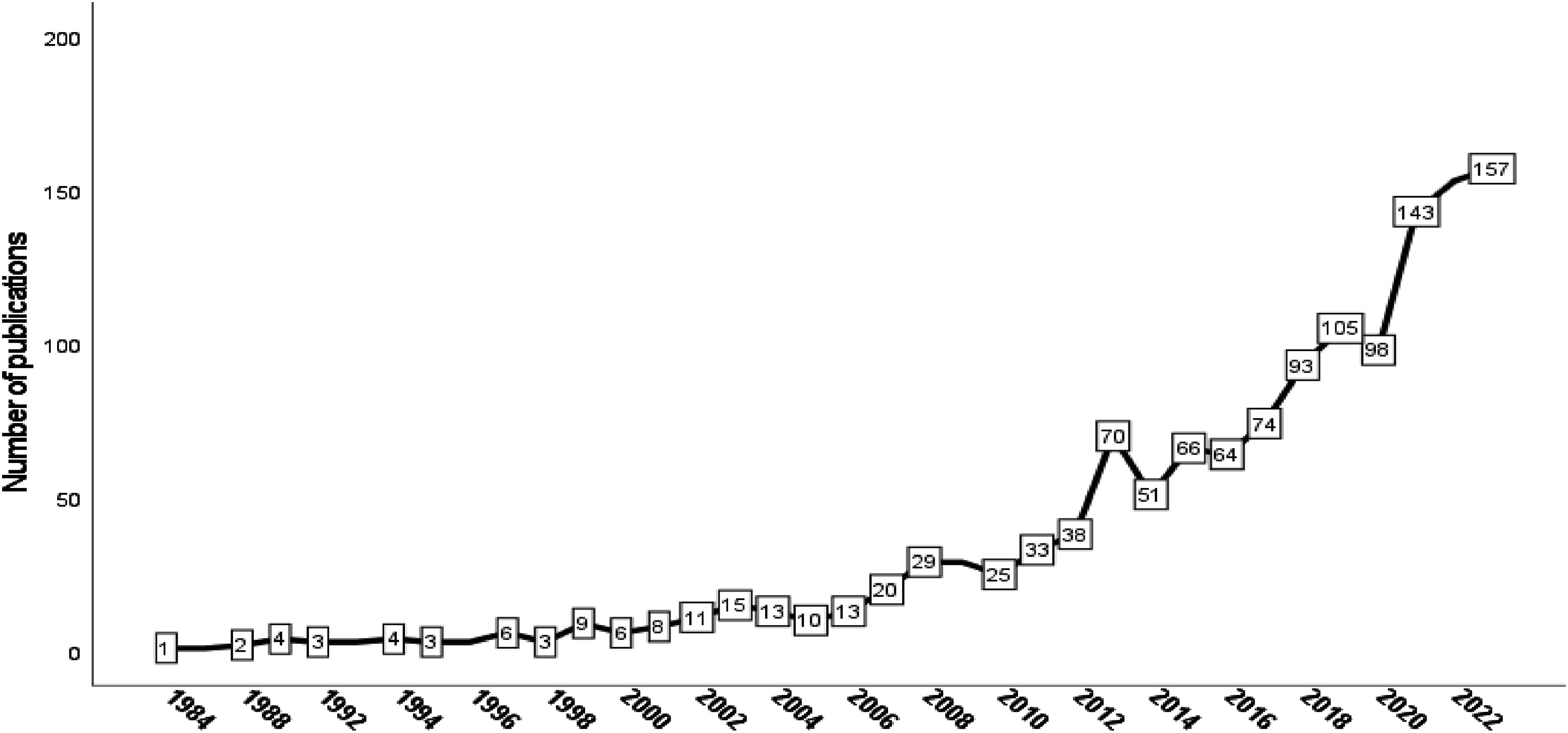
Scope of the retrieved articles
Of the retrieved articles, there were 188 (13.8%) articles on social support, 293 (21.4%) on subjective burden, and 977 (71.5%) on psychological well-being and mental health of the family caregivers of cancer patients. The sum of the three topics exceeded 100% because of potential overlap among the three topics. The research on social support and subjective burden started to appear after 2010 while those on psychological well-being started to appear after the year 2000. Of the retrieved articles, eight articles were identified as randomized controlled trial (RCT). The RCTs were published over 15 years with no increasing pattern. Most RCTs investigated various interventions aimed at improving the well-being of family caregivers of cancer patients focusing on coping skills and improving caregivers’ quality of life through counseling and education (Belgacem et al., 2013; Ghorbani et al., 2020; McMillan et al., 2006). Of the eight RCTs, only one found no significant impact of the intervention (Stehl et al., 2009).
Core countries and institutions
Core countries in publishing articles on psychological well-being, subjective burden, and psychosocial support of family caregivers of cancer patients (1984 – 2023).

Keyword co-occurrence
Keywords with 10 or more occurrences (n = 73) were visualized. The most frequent keywords in the dataset were those related to cancer and caregivers, followed by the following keywords: “quality of life” (n = 194), burden/” caregiver burden” (n = 182), depression/depressive symptoms (n = 168), anxiety (n = 94), and social support (n = 92). Chronological analysis of author keywords indicated that research on resilience was the most recent.
Core journals publishing in the field
Core journals in publishing articles on psychological well-being, subjective burden, and psychosocial support of family caregivers of cancer patients (1984 – 2023).

H-index of the journals was obtained from Scimajo journal ranking Web site. Journals with higher H-index has higher scientific impact.
Core authors and research collaboration
Figure 2 shows the core authors in the field; those with the largest node size. Kim, Y., Tang, S.T, and Reblin, M. appeared to be the most prolific scholars in the field. To assess the extent of author-author research collaboration, all authors with a minimum number of publications of five, total citations greater than 50, and minimum link strength of five (n = 74) were mapped using VOSviewer. The map included 11 clusters. Each cluster represents a group of collaborating authors. There was one cluster that included 10 or more researchers suggestive of limited author-author collaboration in the field. Cross-country research collaboration between countries with 10 or more publications (n = 30) showed relatively inadequate international research collaboration, but a notable research collaboration was present between the UK and Australia. Network visualization map of author networks with a minimum contribution of five articles, total citations of at least 50, and a minimum total link strength or five. The net number of authors in the map was 74. The duration covered was from 1984 to 2023.
Highly cited articles
Top 10 cited articles on psychological well-being, subjective burden, and psychosocial support of family caregivers of cancer patients (1984 – 2023).

Discussion
We may summarize the findings of the current study in the following points. First, 1366 articles were published globally on the topic during the past 39 years. More research could be invested in this extremely large and important group of people present worldwide. Second, approximately half of the retrieved articles were disseminated through a limited number of core journals. Therefore, the topic is of interest to a limited number of journals. Third, authors present in high-income countries made the highest contribution, while authors in the Eastern Mediterranean and African regions made the least contribution. Fourth, author-author interactions and cross-country research collaborations in this field were relatively poor. This might be due to the unique psychological characteristics of caregivers in different cultures. Fifth, caregiver burden, depression, and support were the most cited and visible topics. Sixth, research on family cancer caregivers emerged from different journals in different disciplines, including psychology, oncology nursing, cancer, and palliative medicine. The interdisciplinary approach is the key to achieving optimal individual and community health since human well-being lies in the understanding of the biological, behavioral, social, and public health sciences in a complex and multidimensional way (Mabry et al., 2008).
The current study indicated that publications on psychological well-being and psychosocial support of cancer family caregivers were relatively recent. It has been reported that caregiving disrupts the mental health of caregivers (Yang et al., 2012) and when caregivers’ psychological well-being is impaired, patients' well-being is also disrupted. The psychological wellbeing and support for family caregivers of cancer patients are extremely important since cancer caregiving has unique features different from that of other chronic health conditions (Kent et al., 2016). Family caregivers of cancer patients have to psychologically adapt to the health deterioration of cancer patients over a short period and deliver complicated care without prior knowledge or training (Sherwood et al., 2008).
The steep increase in the annual number of publications in the last decade is attributed to the increase in the number of cancer patients and cancer survivors (Torre et al., 2016). Advancements in cancer therapy shifted cancer care to home settings with more involvement of family members to achieve optimal cancer therapy (Teschendorf et al., 2007). A similar finding regarding the growth of publications was observed in a previously published bibliometric review. The authors of the review concluded that there has been growing research interest in informal caregivers, specifically in the fields of gerontology and mental illness (Ferreira et al., 2022).
Randomized controlled trials play a crucial role in advancing evidence-based practice in the field of family caregiving for cancer patients. It is noteworthy that only a few RCTs were found among the retrieved articles, indicating a gap in the existing literature. This highlights the need for more high-quality RCTs to evaluate interventions targeting family caregivers of cancer patients comprehensively. By conducting well-designed RCTs, researchers can generate robust evidence to guide the development and implementation of effective interventions tailored to the unique needs of family caregivers. These interventions can ultimately improve the quality of care provided to cancer patients and enhance the well-being of their caregivers. Therefore, future research efforts should prioritize conducting RCTs in this field to address this knowledge gap and provide evidence-based support to family caregivers facing the challenges of caring for loved ones with cancer.
In the current study, the US ranked first in terms of the number of publications in the field, followed by the UK, Australia, China, and Taiwan. A bibliometric study on the health of family caregivers of dementia patients found the US ranked first, followed by the UK and Australia while China ranked sixth and Taiwan was not in the core list (Shi et al., 2020). A second bibliometric study on scientific research publications on family caregivers, in general, indicated that the US ranked first followed by England, Canada, and Australia, while China ranked 7th and Taiwan ranked 14th (Ferreira et al., 2022). Furthermore, the study indicated that the US contributed to approximately 40% of publications on family caregivers in general. However, in the current study, the contribution of the US was approximately 39.0% which implies the validity of the results. The leading role of the US and European countries in this field was not surprising given that similar results were obtained in other scientific and medical fields (Sweileh, 2021a, 2021b). The limited contribution of countries in the Eastern Mediterranean region to the field may be attributed to cultural rather than scientific reasons. The cultural and religious factors in most Arab Muslim countries consider family care as part of Islamic and religious regulations that are transferred from one generation to another (NM and AM, 2015). Little is known about family caregiver burden and psychological well-being in Arab countries, and this field is considered under-researched (Alsirafy et al., 2021).
Author keyword analysis showed that burden, depression/stress, and QOL are the most investigated and discussed topics. However, the positive aspects of caregiving have been under-researched. Family caregivers have been called “the invisible patient” since they may be forgotten during the treatment course of the respective partner (Adelman et al., 2014). Analysis of 30 studies, including 21,149 cancer caregivers, indicated that the prevalence of depression and anxiety was 42.30% and 46.55%, respectively (Geng et al., 2018). Family caregivers of cancer patients are subject to poor QOL due to the caregiving burden (Rha et al., 2015; Im Song et al., 2011). Studies indicated that the caregiving burden of cancer patients is the most influential in determining the QOL of family caregivers (Grant et al., 2013; Tamayo et al., 2010). Different factors were reported to determine the caregiver burden (Seo and Park, 2019). A Korean study indicated that hope is a determining factor in the burden on family caregivers (Choi et al., 2016).
The results of the analysis indicated that the research on cancer family caregivers was characterized by limited international and national research collaboration, which negatively affects research quality, productivity, and citations (Abramo et al., 2009). Research on cancer caregivers, in particular, requires international research collaboration to help in the development of this discipline in different cultures (Coccia and Wang, 2016). Caregiving experiences might be different in different countries and cultures and research collaboration helps improve the visibility of these differences. Research collaboration is a key element in efforts directed toward alleviating the psychosocial burden on family caregivers. The limited national and international research collaboration in this field is in contrast to the increasing trend of national and international research collaboration in medical and psychological disciplines (Coccia and Bozeman, 2016).
The current study has a few limitations that are common to most bibliometric studies. First, the research strategy is never 100% perfect and the presence of false negatives or positives remains a possibility. Second, the use of one database in the search strategy underestimates the research productivity from non-English countries due to the presence of un-indexed journals in these countries. Third, the use of the term family caregivers might be misleading in certain cased where friends might take the job of informal caregiver. Despite these limitations, the present study has certain points of strength. The present study is the first study to provide intensive bibliometric analysis and mapping of the topic. The use of PRISMA-adapted flow diagram introduced a quality dimension to the search strategy. Finally, analysis of RCTs identified certain research gaps in the field of study.
Conclusions
The manuscript presents a comprehensive overview of the literature on psychological well-being, subjective burden, and psychosocial support for informal cancer caregivers through a meticulous bibliometric analysis. The outstanding findings of the study highlight the rapid growth in publications concerning cancer caregivers, reflecting the increasing recognition of their vital role in cancer care. However, despite the burgeoning interest, a notable research gap exists in the scarcity of RCTs addressing interventions for improving the well-being of family caregivers. The few RCTs identified in the analysis underscore the urgent need for more high-quality trials to evaluate interventions tailored to the unique needs of family caregivers comprehensively. These trials are essential for generating robust evidence to guide the development and implementation of effective support strategies, ultimately enhancing the quality of care provided to cancer patients and the well-being of their caregivers. Additionally, the study reveals limited international and national research collaboration in this field, highlighting the importance of fostering collaborative efforts to address cultural nuances and expand the scope of research on cancer caregivers globally.
Supplemental Material
Supplemental Material - Bibliometric analysis of global research on psychological well-being, subjective burden, and psychosocial support of family caregivers of cancer patients
Supplemental Material for Bibliometric analysis of global research on psychological well-being, subjective burden, and psychosocial support of family caregivers of cancer patients by Waleed M Sweileh in Health Psychology Open
Supplemental Material
Supplemental Material - Bibliometric analysis of global research on psychological well-being, subjective burden, and psychosocial support of family caregivers of cancer patients
Supplemental Material for Bibliometric analysis of global research on psychological well-being, subjective burden, and psychosocial support of family caregivers of cancer patients by Waleed M Sweileh in Health Psychology Open
Footnotes
Declaration of conflicting interests
The author(s) declared no potential conflicts of interest with respect to the research, authorship, and/or publication of this article.
Funding
The author(s) received no financial support for the research, authorship, and/or publication of this article.

Supplemental Material
Supplemental material for this article is available online.
Appendix
References
Supplementary Material
Please find the following supplemental material available below.
For Open Access articles published under a Creative Commons License, all supplemental material carries the same license as the article it is associated with.
For non-Open Access articles published, all supplemental material carries a non-exclusive license, and permission requests for re-use of supplemental material or any part of supplemental material shall be sent directly to the copyright owner as specified in the copyright notice associated with the article.
