




Abstract
This study aimed to validate the Spanish version of the COVID-19 Student Stress Questionnaire (CSSQ), a 7-item tool assessing COVID-19-related stressors among university students, namely, Relationships and Academic Life, Isolation, and Fear of Contagion. Participants were 331 Spanish university students. Factor analyses sustained the three factor solution of the original tool. Data also revealed satisfactory convergent and discriminant validity, suitable internal consistency, and significant associations with psychological symptoms, as measured by the Symptom Checklist-90-Revised. The Spanish version of the CSSQ represents a valid tool to be used in clinical settings to timely identify students at high psychological risk and to develop evidence-based interventions during/after the pandemic.
Introduction
Over the 2 years of the Coronavirus Disease 2019 (COVID-19) pandemic, research has increasingly highlighted remarkable levels of stress and psychological disease among the general population (Barrios et al., 2020; Bueno-Notivol et al., 2021; Lima et al., 2020; Liu et al., 2021; Martínez-Lorca et al., 2020; Pietrabissa and Simpson, 2020; Rajkumar, 2020; World Health Organization, 2020a).
However, a specific branch of research has focused on the impact of the COVID-19 emergency on university students’ wellbeing, since they were considered a vulnerable population even before the pandemic (Auerbach et al., 2018; Ballester et al., 2020; Teixeira et al., 2021; Zivin et al., 2009). Specifically, research conducted during the COVID-19 outbreak has underlined significant levels of anxiety and depression reported by students worldwide (Aristovnik et al., 2020; Browning et al., 2021; Cao et al., 2020; Charles et al., 2021; Husky et al., 2020) as in Spain (Marques et al., 2021; Odriozola-González et al., 2020). Moreover, research has also demonstrated a significant increase in psychological suffering among university students as the pandemic was progressing (Debowska et al., 2020; Volken et al., 2021; Zhang et al., 2020; Zurlo et al., 2022a). This has raised the necessity for timely assessment of students’ psychological health and its predictors in order to develop tailored evidence-based interventions preventing mental illness escalation (Wade et al., 2020).
I, research has developed several measurement tools to be used for the assessment of specific COVID-19-related stressors (e.g., the COVID-19 Stressor Scale, CSS; Tambling et al., 2021; the Pandemic Stressor Scale, PaSS; Lotzin et al., 2021a, 2021b), and psychological health outcomes (e.g., the COVID-19 Peritraumatic Distress Index, CPDI; Qiu et al., 2020; the Coronavirus Anxiety Scale, CAS; Lee, 2020; the Fear of COVID-19 Scale, FCV-19S; Ahorsu et al., 2020).
Nonetheless, despite their proven validity, all these measures target the general population. However, the COVID-19-related experiences may significantly vary according to different population groups (i.e., university students), thus requiring the adoption of specific tools addressing the specificities of each target population.
Accordingly, in response to the abovementioned need, research has provided a tailored tool, namely the COVID-19 Student Stress Questionnaire (CSSQ; Zurlo et al., 2020). The CSSQ represents a brief (7-item) and psychometrically robust instrument, tapping specific sources of stress potentially experienced by students due to the COVID-19 outbreak: (1) Relationships and Academic Life (i.e., assessing perceived stress related to changes in relationships with relatives, university colleagues, professors, and in academic life); (2) Isolation (i.e., assessing perceived stress related to the condition of social isolation and changes in couple’s relationship/intimacy/sexual life); and (3) Fear of Contagion (i.e., assessing perceived stress related to the fear about the contagion risk). The scale also provides the Global Stress score (i.e., a composite measure including the three abovementioned subscales), which can be useful to evaluate the overall perceived levels of stress related to the COVID-19 pandemic and containment measures among university students.
The CSSQ is currently available in Italian, English (Zurlo et al., 2020), and Turkish versions (Gundogan, 2022), and it is increasingly addressed by researchers exploring the impact of the COVID-19 pandemic among university students worldwide (e.g., Co et al., 2021; Bhargav and Swords, 2022; Barad et al., 2022; Bobade and Naik, 2021; Eloff, 2021; Hoferichter and Steinberg, 2022; Lardone et al., 2021; Mahadi et al., 2022; Maryin and Nikiforova, 2021; Momo, 2021; Okun et al., 2022; Procentese et al., 2021; Rogowska et al., 2021; Rusch et al., 2021; Somma et al., 2021; Sommantico et al., 2022). Specifically, recent studies have provided evidence supporting CSSQ-subscales as significant predictors of psychological disease among university students (e.g., Bhargav and Swords, 2022; Gundogan, 2022; Mahadi et al., 2022; Zurlo et al., 2022a; Zurlo et al., 2022b), so indicating the key role of CSSQ as a mental health screener.
Therefore, the current study aims at responding to the need to foster timely psychological assessment of specific stressors influencing mental illness escalation among students in the current pandemic period and, accordingly, to develop tailored interventions promoting psychological health among Spanish-speaking university students.
In this direction, the main purpose of the present study is to translate and validate the Spanish version of the CSSQ. This is also considering that the Spanish language, spoken by 543 million people worldwide, represents one of the most widespread languages globally (Szmigiera, 2021). To test the psychometric proprieties of the Spanish version of the COVID-19 Student Stress Questionnaire (CSSQ), namely the COVID-19 Student Stress Questionnaire-Español (CSSQ-es), the following research objectives (RO) are defined: RO1. Testing whether the factor structure of the CSSQ-es confirms those of the original CSSQ (Structural Validity). RO2. Testing whether the CSSQ-es has a satisfactory Convergent Validity. RO3. Testing whether the CSSQ-es has satisfactory Discriminant Validity. RO4. Testing whether the CSSQ-es has satisfactory Internal Consistency.
Method
Study design and participants
An online cross-sectional survey form (hosted by Microsoft Teams) was developed for this study. A convenience sample was used, and data were collected from 12 to 29 April 2021 with students from four Spanish Universities (Universidad Complutense de Madrid, Universidad Francisco de Vitoria, Escuela Cruz Roja, Universidad de Córdoba). The survey link was sent via academic mailing lists and social media groups. The research project and its objectives were also widely diffused by the authors during their class. Students enrolled in Faculties of Health Sciences were asked to participate on a voluntary basis and did not receive rewards for completing the survey. At the beginning of the survey link, there was an information sheet explaining the research aims and students’ rights. Specifically, information on their rights to not participate in the study (refusal to take part in the study won’t impact their course of study), as well as to withdraw at any time, without giving any reason and without suffering consequences of any kind, were fully given. Furthermore, students were informed about the privacy policy (i.e., data collected can be used for future research; data will be analyzed for research objectives only; statistical data obtained can be presented at scientific conferences and publications; their personal information will remain fully anonymous and confidential; only researchers will have access to the data that will be processed in accordance with the current regulations). The research project - targeting Spanish students enrolled in Faculties of Health Sciences - was approved by the Ethical Committee of Universidad Complutense de Madrid (22/03/2021) and was implemented in accordance with the 1964 Helsinki declaration and its later amendments or comparable ethical standards, as well as with the Law 3/2018 (December 5) on the Protection of Personal Data and guarantee digital rights and Regulation 2016/679 of the European Parliament of 27 April 2016 on the Protection of Natural Persons in Data Processing.
After reading the information sheet, students were asked to complete the informed consent form, in which they declare their consensus to participate in the study and the consequent processing of their sensitive personal data. To be eligible, participants must be university students (post-secondary; including undergraduate students and postgraduate students—masters or equivalent) with age ≥18 years. Exclusion criteria were the absence of consensus and not being a post-secondary student or being a doctoral level students (PhD student or equivalent). For evaluating the sample size required, we considered the rules of thumb on the adequacy of sample size for factor analysis, which suggested a ratio of 5–10 participants per item for N = 300 (for N > 300 this ratio can become progressively lower) and which defined a factor analysis sample of 50 as very poor, 100 as poor, 200 as fair, and 300 as good (Comrey and Lee, 1992; Costello and Osborne, 2005; DeVellis, 2017). Overall, 331 university students participated in the study on a voluntary basis and provided written informed consent. There were no missing data. Therefore, in the present study, the sample of N = 331 was evaluated as adequate to test the factor structure of the 7-item CSSQ-es.
Measures
First, background information was collected by using single-item questions on Age, Gender, University Name, Degree-Program, and Year of Study.
Second, the proposed Spanish version of the COVID-19 Student Stress Questionnaire (CSSQ) was administered. The CSSQ was created by Zurlo et al. (2020) and measures COVID-19-related sources of stress among university students. It comprises 7 items (on a 5-point Likert scale ranging from 0 = Not at all stressful to 4 = Extremely stressful) divided into three subscales: Relationships and Academic Life (4 items), Isolation (2 items), and Fear of Contagion (1 item). The range of the Global Stress score is 0–28. The CSSQ revealed a suitable internal consistency (McDonald’s ω = 0.71; Cronbach’s α = 0.71).
Finally, the questionnaire included the Symptom Checklist-90-Revised (SCL-90-R; Casullo and Pérez, 2004; Derogatis, 1994), assessing the presence of symptoms of psychological suffering over the past week. The SCL-90-R consists of 90 items (on a 5-point Likert scale ranging from zero = Not at all to four = Extremely) divided into 9 subscales: Somatization (12 items, Cronbach’s α = 0.90), Obsessive-Compulsive (10 items, Cronbach’s α = 0.88), Interpersonal Sensitivity (9 items, Cronbach’s α = 0.84), Depression (13 items, Cronbach’s α = 0.91), Anxiety (10 items, Cronbach’s α = 0.89), Hostility (6 items, Cronbach’s α = 0.81), Phobic Anxiety (7 items, Cronbach’s α = 0.80), Paranoid Ideation (6 items, Cronbach’s α = 0.78), and Psychoticism (10 items, Cronbach’s α = 0.83). The SCL-90-R also provides the Global Severity Index (GSI; Cronbach’s α = 0.97)—calculated by summing all the responses divided by 90—which addressed the number as well as the intensity of the symptoms.
Procedure
In order to obtain the Spanish version of the CSSQ, a back-translation process, in line with Brislin’s classic back-translation model (Brislin, 1970), and following the international guidelines (Muñiz and Bartram, 2007; World Health Organization, 2020b), was carried out.
In particular, a process of repeated independent translation and back-translation by a team of translators was conducted. A bilingual translator blindly translated the CSSQ from the original language to the Spanish language; a second bilingual translator independently back-translated the tool from the target language to the original language. Furthermore, the two versions of the CSSQ (original language and back-translated version) were compared for concept equivalence. According to Brislin’s classic back-translation model (Brislin, 1970), minor changes should be made when an error was found in the back-translated version, and another translator should retranslate the items. In our process, no significant discrepancies were found between the two versions. Afterwards, five bilingual experts, including the authors of the original version of the CSSQ, evaluated the translations. They made minor changes and then agreed that the final version of the tool has no errors in meaning. The final Spanish version of CSSQ was, therefore, administered (see Appendix 1).
In order to test the psychometric proprieties of the Spanish version of the CSSQ, the European Federation of Psychologists’ Association’ standards and guidelines (Evers et al., 2013) and the COnsensus-based Standards for the selection of health status Measurement INstruments (COSMIN) Checklist (Mokkink et al., 2012) were followed as frameworks to guide our choices of measurement properties and parameters. Therefore, validity evidence was examined in relation to Structural Validity, hypotheses testing for Convergent Validity and Discriminant Validity, and Internal Consistency. Interpretability was also described.
Data analysis
The statistical analyses were carried out by using SPSS version 21 and AMOS tool version 26. Descriptive statistics of the study sample’ background information were preliminary carried out. Firstly, in order to assess the Structural Validity of the CSSQ-es (RO1), Exploratory Factor Analysis (EFA) was preliminary performed to explore the structure of the CSSQ-es. Principal Components Analysis (PCA) with oblique promax rotation was used. The factorability of the correlation matrix of the scale was evaluated by Kaiser–Meyer–Olkin (KMO) measure and Barlett test, of sphericity. Communality >0.30 for each item, Cattell’s scree test, and inspection of scree plot were used to verify the factor structure of the CSSQ-es (Costello and Osborne, 2005). Afterwards, Confirmatory Factor Analysis (CFA) was performed by using the maximum likelihood (ML) as estimation method (Kline, 2016; Pritikin et al., 2018). Standard indices were used to evaluate the goodness-of-fit, namely χ2 non-significant (p > 0.05), Standardized Root Mean Square Residual (SRMR < 0.08), Root Mean Square Error of Approximation (RMSEA < 0.08), Comparative Fit Index (CFI > 0.95), and Tucker-Lewis Index (TLI > 0.95) (Hu and Bentler, 1998).
Secondly, Convergent Validity was evaluated (RO2). Specifically, Convergent Validity was tested by exploring standardized factor loadings and AVE of factors as well as by analyzing correlational analyses between the scales scores of the CSSQ-es and the scales scores of the SCL-90-R. A questionnaire is considered as possessing adequate convergent validity whether the standardized factor loadings are all equal to or above 0.5 and statistically significant, and when AVE of each factor is equal or above 0.5 (Fornell and Larcker, 1981; Hair et al., 2010). Considering the correlation analyses, we hypothesized that the scales scores of the CSSQ-es and the scales scores of the SCL-90-R should be significantly and positively related (i.e., the higher the perceived levels of COVID-19-related stressors, the higher would be the perceived levels of psychological disease). For correlations, Cohen’s thresholds (Cohen, 1988) were used to interpret the effects size, considering that r < 0.30 denotes a small/weak correlation; 0.30 < r < 0.50 denotes a medium/moderate correlation; r > 0.50 denotes a large/strong correlation. Disattenuated correlations of the CSSQ-es subscales scores with all the SCL-90-R subscales scores were also calculated, and a second-order factor analysis was performed to test the correlation between the Global Stress Score of the CSSQ-es and the Global Severity Index of the SCL-90-R. Finally, Means and Standard Deviations scores of the Global Severity Index (GSI) from the SCL-90-R were also calculated for women and men.
Thirdly, Discriminant Validity (RO3) was tested. Specifically, Discriminant Validity was examined by carrying out a comparison between the square root of the AVE values (SQRT AVE) and the correlations between the CSSQ-es subscales, as well as by exploring the correlations between the CSSQ-es subscales and the Global Stress scores. A questionnaire is considered as having suitable discriminant validity if the SQRT AVE values are above the correlations among factors (Fornell and Larcker, 1981), and the correlations between each CSSQ-es subscale and the Global Stress scores are significant and higher in size than the correlations among factors.
For testing the Internal Consistency of the CSSQ-es (RO4), McDonald’s Omega (ω; McDonald, 1999) and Composite Reliability (CR; Fornell and Larcker, 1981) were calculated, considering ω ≥ 0.7 and CR ≥ 0.7 as indicators of adequate internal consistency.
In addition, considering the Interpretability of the CSSQ-es, item means, standard deviations, and ranges of the CSSQ-es scales were calculated. Skewness and Kurtosis were used to judge the normality of data. A Z-score was calculated by dividing the skew values or excess kurtosis by their standard errors. The distribution is considered to be approximately normal when Z-scores fall between −2 to +2 (George and Mallery, 2012).
Results
Participants
Characteristics of study participants (N = 331).

RO1. Structural Validity: Exploratory Factor Analysis and Confirmatory Factor Analysis
Data indicated that the factor structure of the CSSQ-es confirms that of the original CSSQ. In particular, findings from the Exploratory Factor Analysis (Principal Components Analysis; Oblique promax rotation) showed that the Kaiser–Meyer–Olkin measure was 0.74 and Bartlett’s test of sphericity was significant (χ2 = 354.537, df = 21, p < .001), confirming that the data were adequate for the factor analysis. All the items have communalities >0.4, supporting the inclusion of all the 7 items comprised within the CSSQ-es. The examination of the scree plot and the scree test showed that the departure from linearity corresponded to a three-component solution, revealing that our data should be analyzed for three components. These findings were, therefore, in line with the original version of the CSSQ (Zurlo et al., 2020). The three-factor solution explained a variance of 63.46% from a total of 7 items.
Therefore, Confirmatory Factors Analysis demonstrated that the three-factors model, including all the 7 items, revealed good fit for all the indices (χ2 = 10.31, p = .89; SRMR = 0.04; RMSEA = 0.05; CFI = 0.97; TLI = 0.95). Specifically, as for the original version of the CSSQ, the factor Relationship and Academic Life comprises 4 items assessing perceived stress related to relationships with relatives, relationships with university colleagues and with professors, and academic studying; the factor Isolation comprises 2 items assessing perceived stress related to isolation and changes in couples’ relationship/intimacy/sexual life due to the social isolation; and the factor Fear of Contagion consists of a single item assessing perceived stress related to the infection risk (Figure 1). Confirmatory factor analysis of the COVID-19 Student Stress Questionnaire-Español (CCSQ-es) (three-factor model).
RO2. Hypothesis Testing: Convergent Validity
Data indicated that the CSSQ-es has strong convergent validity. In particular, the standardized factor loadings of each of the 7 items were well-above 0.5 and statistically significant (p < .001) (Figure 1), and the values of AVE of the three factors were all above 0.5 (i.e., AVE values: Relationships and Academic Life = 0.577; Isolation = 0.637; Fear of Contagion = 0.557).
Correlations of the COVID-19 Student Stress Questionnaire-Español (CCSQ-es) scales with SCL-90-R scales.
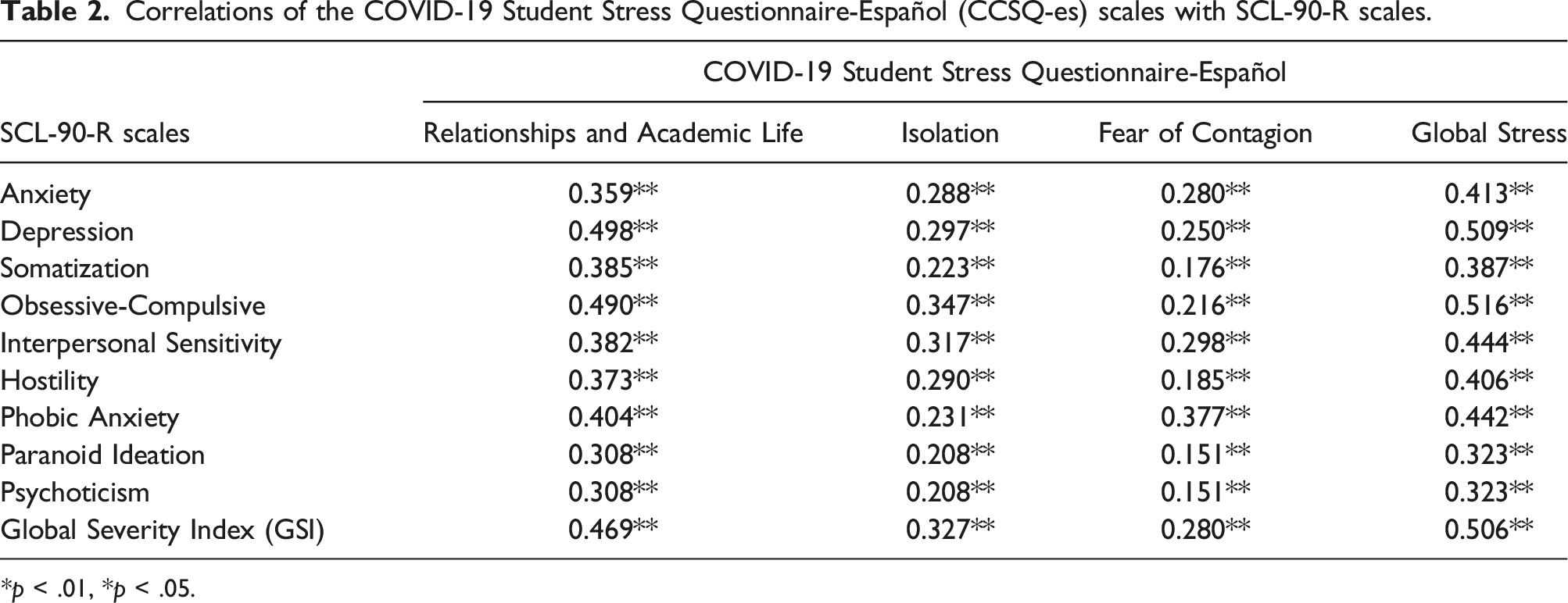
*p < .01, *p < .05.
Disattenuated correlations of the CSSQ-es subscales scores with all the SCL-90-R subscales scores were also calculated; they ranged from 0.18 to 0.52 and were all significant (p < .01) (Appendix 2). The correlations were greater between the Relationship and Academic Life subscale and, respectively, the Depression (0.52) and Obsessive-Compulsive subscales (0.53). Moreover, the correlation between the second-order factor of the Global Stress Score of the CSSQ-es and the Global Severity Index (GSI) of the SCL-90-R showed an overall correlation of 0.67 (p < .01). Accordingly, data endorsed that the CSSQ-es has strong convergent validity.
RO3. Hypothesis Testing: Discriminant Validity
Intercorrelations between the COVID-19 Student Stress Questionnaire-Español (CCSQ-es) scales.
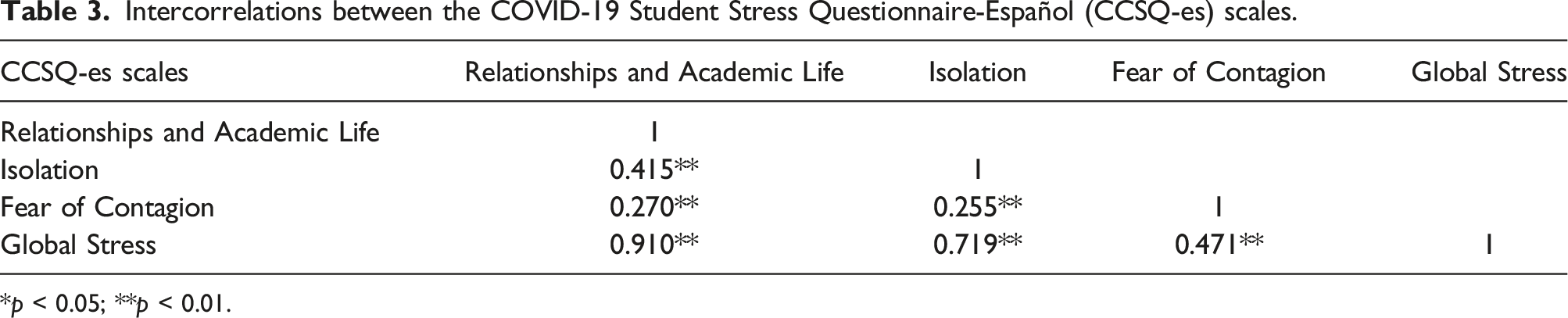
*p < 0.05; **p < 0.01.
RO4. Internal Consistency
Data revealed that McDonald’s omega coefficient was 0.71 and the Composite Reliability value was 0.90, so indicating a suitable internal consistency.
Items, mean, SD, and range scores of the COVID-19 Student Stress Questionnaire-Español (CCSQ-es).

Mean scores ranged from 1.49 (Item 7. How do you perceive the changes in your sexual life due to the social isolation during this period of COVID-19 pandemic?) to 3.00 (Item 6. How do you perceive your academic studying experience during this period of COVID-19 pandemic?), while standard deviations ranged from 0.88 (Item 1. How do you perceive the risk of contagion during this period of COVID-19 pandemic?) to 1.32 (Item 7. How do you perceive the changes in your sexual life due to the social isolation during this period of COVID-19 pandemic?). Skewness and kurtosis values for all the variables fall within the range of −2 to +2 (i.e., Skewness values from −1.28 to 1.70; Kurtosis values from −1.28 to 0.52), indicating that the data were approximately normally distributed.
High perceived levels of stress related to the COVID-19 pandemic and containment measures are represented by scores that are one standard deviation above the mean value (e.g., 84th percentile), whereas low perceived levels of stress are represented by scores that are one standard deviation below the mean value (e.g., 16th percentile) of the distribution of the CSSQ-es scores among Spanish university students. Accordingly, scores equal to 20 or above indicate high perceived levels of COVID-19-related Global Stress; scores equal to 10 or below indicate low perceived levels of COVID-19-related Global Stress; scores between 11 and 19 indicate average perceived levels of COVID-19-related Global Stress among Spanish university students.
Discussion
This study aimed to translate and validate the Spanish version of the 7-item COVID-19 Student Stress Questionnaire, namely the COVID-19 Student Stress Questionnaire-Español (CSSQ-es). Indeed, given the remarkable rates of severe psychological suffering reported by university students before the pandemic (Auerbach et al., 2018; Ballester et al., 2020; Teixeira et al., 2021; Zivin et al., 2009), and also considering the increasing rates of mental health disorders reported by students during the pandemic (Marques et al., 2021; Odriozola-González et al., 2020), a wider application of a brief, tailored, and valid tool assessing specific COVID-19-related sources of stress could promote a timely identification of those university students at high psychological risk in the current pandemic time.
Overall, our findings indicated that the CSSQ-es is a multidimensional tool, which revealed satisfactory convergent and discriminant validity, and acceptable internal consistency. Specifically, the CSSQ-es covers three meaningful factors (i.e., Relationships and Academic Life, Isolation, and Fear of Contagion) and provides a Global stress score, as for the original version (Zurlo et al., 2020), measuring the overall stress related to COVID-19 and containment measures among university students.
Considering the existing research exploring the impact of the COVID-19 pandemic on university students’ life, in terms of perceived stress related to changes in relationships and academic life (Conceição et al., 2021; Dotson et al., 2022), isolation (Chen et al., 2020; Leal Filho et al., 2021), and fear of contagion (Rodrí guez-Hidalgo et al., 2020), we can emphasize the great potential of adopting a valid and brief (7-item) tool able to comprehensively capture the main challenges university students dealt with and are still facing during the current period of the pandemic.
From this perspective, significant associations between the CSSQ-es scales scores and psychological disease, as measured by means of the SCL-90-R subscales, were also found. This provided further support for the potential of the CSSQ-es as a useful mental health screener (Gundogan, 2022; Zurlo et al., 2022a, 2022b). Indeed, these findings suggested the meaningfulness to adopt the CSSQ-es to identify those students in need of psychological support, as well as to recognize specific risk factors requiring careful consideration, exploration, and re-definition within evidence-based interventions (Zurlo et al., 2020). This is particularly relevant considering that students participating in the present study showed remarkable levels of psychological suffering compared to the general population. Indeed, in the present study, the SCL-90-R Global Severity Index (GSI) Scores were for Women M = 1.45 (SD = 0.73) and for Men M = 1.36 (SD = 0.81), while, in the Spanish validation study of SCL-90-R (Casullo and Pérez, 2004), the GSI Scores were for Women M = 0.16 (SD = 0.09) and for Men M = 0.13 (SD = 0.07).
In line with these findings, research conducted during the COVID-19 emergency (e.g., Aristovnik et al., 2020; Browning et al., 2021; Marques et al., 2021; Odriozola-González et al., 2020) and, specifically, those studies adopting the SCL-90-R to detect psychological suffering in the university student population revealed severe psychopathological portraits related to the pandemic. For example, a study conducted by Jiang (2020) showed that, during the pandemic, students reported higher than normative values in anxiety and phobic anxiety, somatization, obsessive-compulsive, interpersonal-sensitivity, and paranoid ideation scores.
In the same direction, a study conducted by Vallone et al. (2021) revealed that 31.9% of male students and 27.4% of female students reported clinical levels of anxiety, while 28.3% of male students and 32.9% of female students reported clinical levels of depression due to the substantial changes in daily routines and to the perceived “sense of losses” experienced at the relational level. In addition, this study also underlined remarkable clinical levels of paranoid ideation and psychoticism reported by students during the COVID-19 emergency (i.e., 35.5% of male students and 14.0% of female students reported clinical levels of paranoid ideation; 33.8% of male students and 23.2% of female students reported clinical levels of psychoticism). These latter findings highlighted the significant presence of experiences of alienation related to this unprecedented global crisis.
Moreover, a repeated-cross sectional study conducted by Zurlo et al. (2022b) in the Italian university context at three stages during the pandemic (Stage 1, April 2020; Stage 2, November 2020; Stage 3, April 2021) revealed that students’ perceived levels of COVID-19-related stress (measured by the CSSQ) and psychological symptoms (measured by the SCL-90-R) significantly increased as the pandemic was progressing.
All these studies sustained the meaningfulness of adopting specific tools, such as the CSSQ, so effectively responding to the global necessity for researchers and practitioners to undertake significant efforts to prevent mental disease escalation and promote students’ psychological adjustment during this critical stage of transition.
However, interestingly, although the three-factor structure of the original CSSQ was confirmed, the means scores (standard deviations) of the CSSQ-es scales reported in the current study were greater than those reported in the original validation study conducted with a sample of students from Italy (Relationships and Academic Life M = 4.95, SD = 2.74; Isolation M = 3.51, SD = 2.05; Fear of Contagion M = 1.61, SD = 1.12; Global Stress M =10.07, SD = 4.52). This seems to suggest that sampled students in Italy reported lower perceived stress related to COVID-19 and containment measures than Spanish students sampled in the present study.
Nonetheless, these findings can be also interpreted in light of the differences in the two study samples; that is, the CSSQ was validated with a sample of students from Humanities degree courses, while, in the present study, students were all from Health Sciences degree courses.
Although both samples consisted of university students (not personally involved—like healthcare professionals—in providing care services during the COVID-19 pandemic), we can hypothesize that the greater participation of their educational environment in facing the pandemic may have resulted in higher levels of COVID-19-related stress. This hypothesis could be sustained by considering the large body of studies conducted during the pandemic which have targeted university students from the healthcare fields ; that is, Aslan and Pekince, 2021; Safa et al., 2021), highlighting remarkable levels of perceived stress and psychological suffering. In particular, students from health sciences may have experienced higher levels of perceived stress related to changes in relational and academic life (e.g., faculty members/supervisors were frontline in facing the pandemic) and to the fear of the virus (e.g., increased scientific knowledge of the effects of the virus).
However, these data may also be interpreted considering the timing of questionnaire administration. Specifically, whereas the CSSQ validation study was conducted in the early stages of the pandemic (2020), the data from the present study were collected after 1 year from the beginning of the pandemic (2021). Accordingly, in line with studies providing evidence supporting that university students’ individual and relational disease is significantly increasing according to the progression of the COVID-19 emergency (Debowska et al., 2020; Volken et al., 2021; Zhang et al., 2020; Zurlo et al., 2022a, 2022b), we hypothesize these higher levels of COVID-19-related stress could be explained in light of the protracted global crisis and its related containment measures. Further applications of the CSSQ, and specifically of the CSSQ-es, are therefore needed to assess perceived levels of COVID-19-related stressors in the current pandemic time.
ì despite the proven validity of the CSSQ-es, some limitations need to be addressed. Firstly, the sample was a convenience homogeneous sample of Spanish students enrolled in degree courses from Faculties of Health Sciences with a majority being women (84.6% are females). Therefore, further studies on larger and more representative samples of the student population from Spain are needed to allow the generalizability of these results (e.g., a nationally representative sample, more men). In particular, students from different fields (e.g., Humanities, Engineering, Business) and diverse academic and social backgrounds are needed to confirm the results reported in the current study. Another limitation refers to the physical health of students. Indeed, there are no questions assessing whether or not the participants were infected with the COVID-19 virus. Therefore, considering that being personally infected by the virus may impact differently on individuals’ mental health (Rahman et al., 2021), future research could also include this information in order to address its potential impact on students’ perceived levels of COVID-19-related stressors and on their psychological health. Also, the sample was not necessarily representative of the students from other countries with Spanish-speaking population, and further applications of the CSSQ-es are needed to evaluate its generalizability in those countries.
Moreover, despite its merits (i.e., low research costs, convenience for researchers and participants, ease of data entry and analysis, reaching target populations during the COVID-19 pandemic), the use of online surveys may entail the risk of fraudulent activity (Lawlor et al., 2021). Nevertheless, considering the lack of rewards and the absence of suspicious responses in our dataset, we considered the chance of multiple and/or inconsistent responses to be relatively low. Furthermore, given that the CSSQ-es is a self-report measure and is based on positive self-reporting items (no retroverted items or distracting items are included), we should also mention the risk of social desirability bias. Finally, although findings showed that the CSSQ-es has robust psychometric properties, this study is based on a single measurement wave, and no extended test of psychometric properties could be performed, such as test—retest reliability.
Nevertheless, despite these limitations, this study supports the appropriateness of the Spanish version of the COVID-19 Students Stress Questionnaire, a 7-item scale with robust psychometric properties, to be used for the assessment of COVID-19 sources of stress among Spanish university students and for the development of tailored interventions aiming to promote their psychological wellbeing during and after this unique global emergency.
In particular, specific recommendations for actions to be implemented at the individual, community, and policy levels should be highlighted. At the individual level, we considered the meaningfulness to adopt the CSSQ-es in the clinical setting as a tool for assessing students’ psychopathological risk, developing tailored interventions, as well as for monitoring and evaluating the effectiveness of interventions.
At the community level, universities could consider to widely adoptthe CSSQ-es as mental health screener for all their student population, so timely identifying students particularly affected by the COVID-19 pandemic who are at higher psychopathological risk. Universities could also offer tailored mental health services and develop both face-to-face and online initiatives for students (e.g., Hood et al., 2021; Maddah et al., 2021), with the aim to reinforce and foster a sense of support and of belonging to the university community. This, indeed, may help reduce the negative impact of stress related to changes in relationships and academic life and perceived isolation.
Finally, at the policy level, although the COVID-19 pandemic has required the governments to put several efforts into managing the global crisis, greater attention was given to the medical emergency rather than to the mental health emergency. However, this study emphasized the need for administrations to implement actions to effectively deal with the psychological impact of the COVID-19 pandemic. From this perspective, the adoption of brief, easily administered, valid, and specific tools, such as the CSSQ-es, could be recommended when providing gold standards for the development of research and interventions effectively counteracting the negative psychological consequences of the COVID-19 crisis.
Footnotes
Declaration of conflicting interests
The author(s) declared no potential conflicts of interest with respect to the research, authorship, and/or publication of this article.
Funding
The author(s) disclosed receipt of the following financial support for the research, authorship, and/or publication of this article: STUDENT-WELL (Erasmus+ Project). This publication reflects the views only of the authors, and the Commission cannot be held responsible for any use which may be made of the information contained therein (2020-1-UK01-KA226-HE-094622).
Ethics statement
The research was approved by the Ethical Committee of the Universidad Complutense de Madrid and was implemented in accordance with the 1964 Helsinki declaration and its later amendments or comparable ethical standards.

The COVID-19 Student Stress Questionnaire-Español.
The English version is provided in brackets.
Nada estresante
Algo estresante
Moderadamente estresante
Muy estresante
Estremamente estresante
(Not at all stressful)
(Somewhat stressful)
(Moderately stressful)
(Very stressful)
(Extremely stressful)
1. ¿Cómo valoras el riesgo de contagio durante este período de pandemia COVID-19? (How do you perceive the risk of contagion during this period of COVID-19 pandemic?)
0
1
2
3
4
2. ¿Cómo valoras la condición de aislamiento social impuesta durante este período de pandemia COVID-19? (How do you perceive the condition of social isolation imposed during this period of COVID-19 pandemic?)
0
1
2
3
4
3. ¿Cómo valoras las relaciones con tus familiares durante este período de pandemia COVID-19? (How do you perceive the relationships with your relatives during this period of COVID-19 pandemic?)
0
1
2
3
4
4. ¿Cómo valoras las relaciones con tus compañeros universitarios durante este período de pandemia COVID-19? (How do you perceive the relationships with your university colleagues during this period of COVID-19 pandemic?)
0
1
2
3
4
5. ¿Cómo valoras las relaciones con tus profesores universitarios durante este período de pandemia COVID-19? (How do you perceive the relationships with your university professors during this period of COVID-19 pandemic?)
0
1
2
3
4
6. ¿Cómo valoras tu experiencia académica de estudio durante este período de pandemia COVID-19? (How do you perceive your academic studying experience during this period of COVID-19 pandemic?)
0
1
2
3
4
7. ¿Cómo valoras los cambios en tu vida sexual debido al aislamiento social durante este período de pandemia COVID-19? (How do you perceive the changes in your sexual life due to the social isolation during this period of COVID-19 pandemic?)
0
1
2
3
4
_____ +
_____ +
_____ +
_____ +
_____ +
Global score _______
Disattenuated correlations of the Student Stress Questionnaire-Español (CSSQ-es) scales with the Symptom-Checklist-90-Revised (SCL-90-R) scales.
*p < 0.05; **p < 0.01.
SCL-90-R scales
Relationships and Academic Life
Isolation
Fear of Contagion
Anxiety
0.377*
0.308*
0.299*
Depression
0.523*
0.334*
0.283*
Somatization
0.408*
0.246*
0.198*
Obsessive-Compulsive
0.532*
0.390*
0.237*
Interpersonal Sensitivity
0.436*
0.352*
0.324*
Hostility
0.401*
0.331*
0.225*
Phobic Anxiety
0.422*
0.255*
0.393*
Paranoid Ideation
0.330*
0.222*
0.182*
Psychoticism
0.362*
0.238*
0.188*