




Abstract
Data from the Global School-based Student Health Survey (GSHS) conducted in 2009 consisting of 5192 Pakistani school-going adolescents was used to assess the association between parent-child-relationship and physical-aggression. A multilevel-weighted-cox-proportional-algorithm was performed. The overall prevalence of physical-aggression was 41% of which 27% had a poor parent-child relationship. Male adolescents who have a poor bond with their parents had two times the prevalence of physical-aggression (95% CI: 1.82, 3.00) than those female adolescents with the strong parent-child-bonding. The findings of this study implicated that the poor parental bond and the role of gender as potential factors in physically aggressive adolescents.
Introduction
Aggression has multidimensional forms, including social, verbal, or physical and it may be either directed externally toward others or navigating inwards leading to self-harm (Kumari and Kumar, 2018; Ramos, 2013). One of the most common forms of aggression is physical aggression which is a behavior causing physical harm or threatening other individuals physically, it is usually as an effort to preserve self-image and includes physical fighting and violent crimes such as robbery, and other high-risk behaviors (Denson et al., 2006; Sharma and Marimuthu, 2014). Recent times have witnessed an increased incidence and upward trend of aggression among youth predominantly adolescents (Sharma and Marimuthu, 2014). As per WHO, the global burden of aggression and other mental disorders in adolescence under the age of 16, ranges from 12% to 29%, clearly evidencing the fact that aggression among children and adolescents is a major concern in the current scenario (WHO, 2003). There are multiple risk factors and determinants of physical aggression predominantly peer pressure, school social environments, (Pickett et al., 2009) growing substance abuse, use of excessive junk food, sedentary lifestyle (Kumari and Kumar, 2018) exposure to community violence, poor parental bonding, monitoring and support, media exposure, (Ramos, 2013), academic issues, physical or sexual abuse (Sharma and Marimuthu, 2014), cultural norms reinforcing different treatment between male and female adolescents (López et al., 2008) among others. As per WHO adolescence comprises individuals between 10 and 19 years of age and are considered to be engulfed among identity versus identity confusion, hence in this stage parental support, bonding and encouragement are the key determinants that can help an adolescent pass through this phase without being deviant (Ramirez, 2016; Sokol, 2009; WHO, n.d.). Multiple global studies have been conducted in past years which strived to establish a relationship between parental bonding with physical aggression among adolescents. In one of such study conducted on Nigerian secondary students, it was concluded that the students who perceived that their mothers or fathers are manifesting more love, care, and attention on them are less likely to perpetrate physical aggression as compared to those who perceive their parents as more authoritative and overprotective (Ojedokun et al., 2013). Other studies also support this notion that parental lack of affection and communication and low level of parental support and attachment, causes psychosocial distress leading to physical aggression and violent behaviors (Estevez et al., 2005; Iniewicz et al., 2011; Savage, 2014). Parental attachment in adolescence is extremely essential as it serves the purpose of regulation of stress, buffering of aggression and provides a secure base for an adolescent to explore and grow (Moretti and Peled, 2004; Ndugwa et al., 2011; Patel et al., 2007; Sroufe et al., 1999). Various studies have also linked different parenting styles to different forms of aggression, Permissive parenting which is the high level of responsiveness and low level of monitoring on the part of parents was associated significantly with high levels of physical aggression in adolescents, as the child is not held accountable for his or her actions (Hoskins, 2014; Rubin and Burgess, 2002). Authoritative parenting which is high in responsiveness and demandingness is associated with less externalizing behaviors that is the adolescent is least likely to be deviant and develop physical aggression (Gonzalez et al., 2002; Hoskins, 2014; Steinberg and Silk, 2002). It was also reported by one of the studies that students who don’t live with their parents and don’t have a strong bond with them are more likely to develop aggressive behaviors and carry murderous and fatal weapons like handguns (Orpinas et al., 1999).
Different cultures and ethnicities adopt different parenting styles, hence it is extremely important to take into consideration the effect of parental bonds and physical aggression in adolescents in Asian culture as well (Bornstein, 2012). There are very limited Asian studies that have explored the relationship between parental bonding and physical aggression specifically in adolescents, however, those which have strived to explore this association have concluded almost similar findings. Few studies conducted in India on adolescents concluded that parental bonding has a direct influence on levels of aggression in adolescence, the more close-knitted and nurturing parent-child relationship is, the less likely an adolescent would develop physical aggression (Indumathy and Ashwini, 2017; Sharma, 2016). Certain studies conducted on Korean students in grades 7–9 revealed that along with other factors, a poor parental bond is one of the reasons causing physical bullying behavior, physical self-harm, and aggression in adolescents (Lee, 2016; You et al., 2015). Similar findings were reported in one of the studies conducted in China suggesting that the more conflicted parent-child relationship leads to physical aggression among adolescents (Yeh et al., 2010).
In the Pakistani setting, where obedience is considered as an obligation for children and most parents adopt harsh disciplinary measures to reprimand their child in case of conflicts (Batool, 2013), the parent-child relationship must be explored as a potential risk factor for physical aggression in adolescents. Very limited studies were documented which aimed to determine the potential risk factors of developing aggression among adolescents in Pakistan. In one such study, it was concluded that permissive parenting is associated with increased physical aggression in adolescents, and authoritative parenting is negatively associated with physical aggression as these parents not only set disciplinary boundaries for children but also give them the warmth and space needed by them (Batool, 2013). Another study also concluded that adolescents that have dysfunctional bonding with their parents scored high on aggression and other mental health problems (Saleem et al., 2017). It was suggested by one of the studies that the emotional intelligence of parents is indirectly associated with aggression levels of adolescents, emotionally trained parents will be able to form a good bond with children leading to lesser levels of aggression in adolescents (Batool and Bond, 2015). With growing youth violence cases in Pakistan and a limited number of studies, the association between parental bonding and physical aggression in adolescents must be established. Therefore, the main aim of this study is to determine the burden of physical aggression in Pakistani adolescents and its association with parent-child.
Methodology
The current paper has used data from The Global School-based Student Health Survey (GSHS) conducted in 2009 by the World Health Organization (WHO) in collaboration with United Nations International Children Emergency Fund (UNICEF), and United Nations Education Scientific and Cultural Organization (UNESCO), and with technical assistance from the Centers for Disease Control and Prevention (CDC). This Cross-sectional study comprising of a national representative sample of school-going adolescents aged 11–16 years was supported by the National ministries of Health and Education of Pakistan using a two-stage cluster sampling technique. The primary sampling units were schools, in total 44 schools were selected with probability proportional to enrollment size. Whereas, the secondary sampling units were all students belonging to grades 8–10.
A total of 5192 students have participated in this survey. A self-reported questionnaire was used to collect the following information: dietary behaviors; self-care practices; mental health; physical activity; protective factors; tobacco use; and violence and unintentional injury. The questionnaire of this survey was translated into the regional languages of instruction for content validity following face validity.
The outcome variable was considered as a binary that is the presence of physical aggression more than 1 day during the past year or otherwise. The primary exposure of this study was the parent-child relationship. Students who indicated that their parents supervise academic and social activities, understand child’s problems were categorized as strong child-parent relationship coded as “0” whereas, those students who indicated that their parents were either supervising academic and social activities or understand child’s problems were categorized as moderate child-parent relationship coded as “1” and those students who indicated that their parents were neither supervising academic and social activities, nor understanding child’s problems were categorized as poor-child relationship coded as “2.” Other socio-demographic variables were also considered.
This survey includes design (sampling) weights to account for unequal selection probabilities of clusters hence, a multilevel weighted cox-proportional algorithm was performed on complete cases that are 4254 observations using STATA version 15. Descriptive statistics were performed for categorical variables by computing frequencies and percentage in cross-tabulation, stratified on physical aggression status. To assess the relationship between physical aggression and all independent variables including primary exposure, crude prevalence ratios along with 95% confidence interval were reported using a multilevel weighted cox-proportional algorithm for univariate analysis at the significance level of 0.25. Variables that were found significant at the univariate level were checked for multicollinearity. Stepwise model building technique was employed to construct a multivariable model using a multilevel weighted cox-proportional algorithm at the significance level of 0.05 and adjusted prevalence ratios along with 95% confidence level were reported for all the significant variables. Plausible interactions were also assessed.
Results
Sample characteristics
Table 1 shows the descriptive statistics of the sample population on key variables (N = 4254).
Descriptive characteristics of school-going adolescents: Global-school based student health survey.
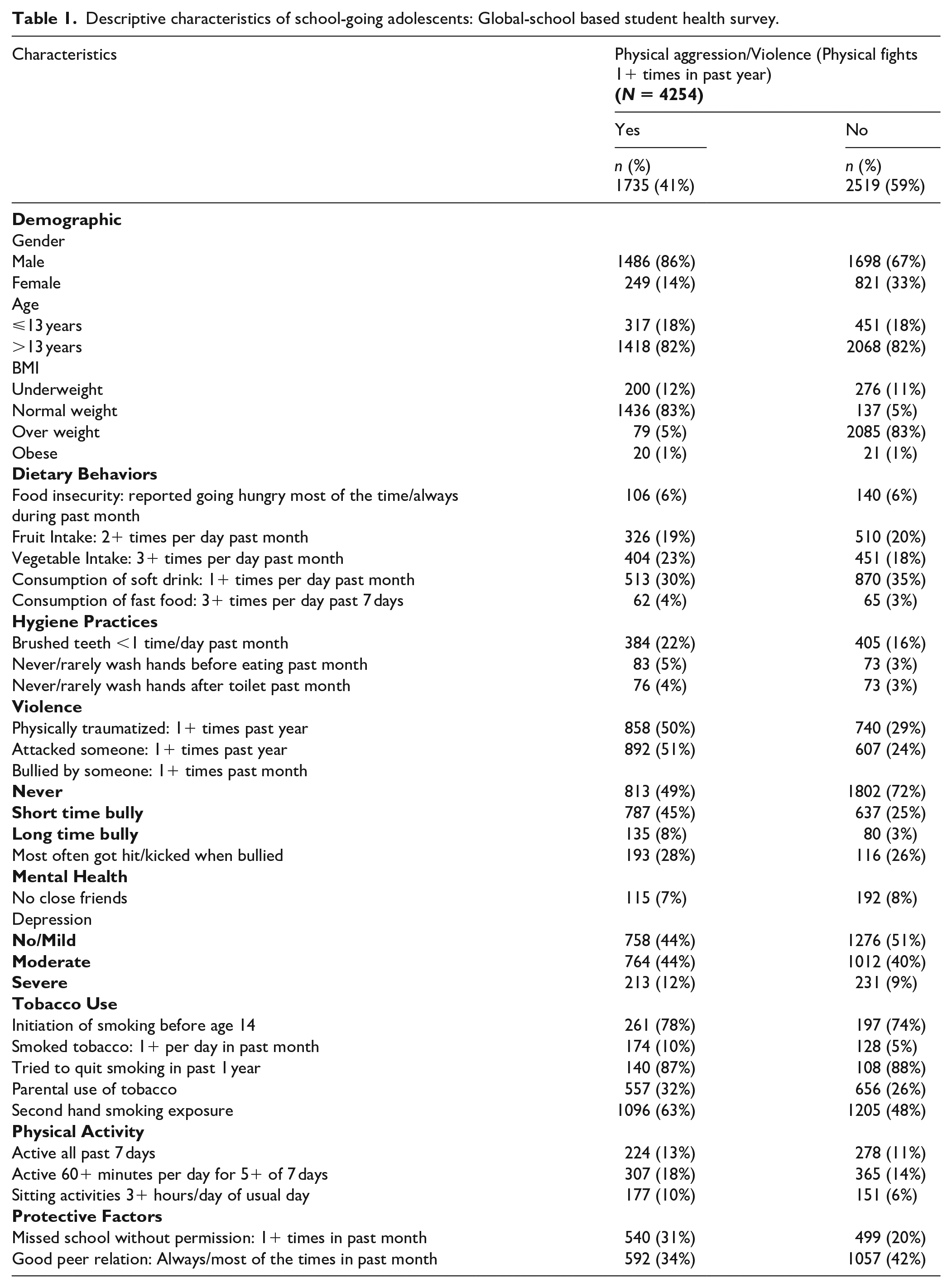
The overall prevalence of physical aggression on more than 1 day during the past year preceding survey was found to be 41% (n = 1735) among the sample population. The prevalence was higher among adolescents older than 13 years (82%) and it was prominently greater among boys (86%) than girls (14%).
Violence
Fifty percent of adolescents reporting physical aggression also reported being suffered from at least one physical trauma in the past 1-year preceding survey compared to only 20% of non-physically aggressive adolescents. A significantly larger proportion of physically aggressive adolescents was bullied (53%) 1 or more times in the past month preceding the survey, out of which 28% were most often being kicked and/or hit. On the contrary, 28% of physically non-aggressive adolescents were bullied in the same time period and 26% of them were being hit and/or kicked.
Mental health
Severe depression was present among 12% while moderate depression was reported by 44% of physically aggressive adolescents. Conversely, the prevalence of severe and moderate depression among non-aggressive individuals was 9% and 40% respectively.
Tobacco use
The prevalence of current tobacco use was twice as much (10%) among physically aggressive than non-aggressive adolescents (5%). However, the desire to quit smoking among tobacco users was observed slightly more in non-aggressive adolescents (88%).
Approximately 32% of adolescents having physical aggression reported their parental use of tobacco compared to 26% of non-physically aggressive adolescents. Likewise, the proportion of second-hand smoking exposure was comparatively high in physically aggressive adolescents (63%) compared to non-physically aggressive adolescents (48%).
Physical activity
Interestingly, physically aggressive adolescents (18%) were comparatively more likely to be physically active for 60 or more minutes in a day than non-violent adolescents (14%). Conversely, the majority of physically violent individuals (10%) also reported spending 3 or more hours in a day doing sitting activities than only 6% of physically non-violent adolescents.
Protective factors
In comparison to non-physically aggressive adolescents (42%), physically aggressive individuals (34%) are less likely to have good peer relationships. Also, they had missed school more frequently (31%) in the past month preceding survey without permission that those who are not physically aggressive (20%).
Twenty-seven percent of physically aggressive adolescents had poor parent-child relationships compared to 22% of non-aggressive adolescents. Similarly, strong parent-child bonding was reportedly less among physically violent adolescents (23%) while a moderate relationship was reported by 50% of adolescents regardless of the presence of physical aggression (Table 2).
Descriptive of primary exposure and outcome: Parent child relationship and physical aggression among school going adolescents: Global school based student health survey.

Findings from Multilevel Cox Proportional regression (Table 3) suggest that adolescents exposed to long term bully had a higher prevalence of physical aggression as compared to non-bullied adolescents (adjusted PR: 1.71, 95% CI: 1.41, 2.08). Likewise, physically traumatized adolescents had approximately twice the prevalence of having physical aggression (adjusted PR: 1.70, 95% CI: 1.50, 1.93) than non-traumatized adolescents. The prevalence of physical aggression was also higher among current tobacco users (adjusted PR: 1.12, 95% CI: 1.03, 1.23) and less physically active adolescents (adjusted PR: 1.18, 95% CI: 1.05, 1.32). On the other hand, adolescents with good peer relations had 1.12 times the prevalence of physical aggression (95% CI: 1.02, 1.24) than those with no good peer relations.
Multilevel cox proportional regression analysis with interaction of factors associated with physical aggression among school going adolescents.

Note. ^ signifies interaction between gender and degree of parental-child bonding.
A significant relationship was found between gender and parent-child bond indicating that female adolescents who have a poor bond with their parents had 1.5 times the prevalence of physical aggression (95% CI: 1.02, 2.29) than those female adolescents with a strong parent-child bond. The prevalence of physical aggression was 2 times higher for male adolescents having poor (95% CI: 1.82, 3.00), moderate (95% CI: 1.46, 3.74) as well as strong parent-child bond (95% CI: 1.57, 3.57) than female adolescents having a strong bond with their parents.
Discussion
This study associated one of the potential risk factors, poor parental bond with physical aggression in Pakistani school-going adolescents. The results of the study reported that 27% of the physically violent adolescents had poor parental bonds as compared to 23% of non-aggressive individuals. Various studies backed this finding and demonstrated that poor parental bonds, lacking of nurturing parental behaviors, and conflicted parental relationships are associated with physical aggression, violence, bullying, and other externalizing behaviors in adolescents (Ojedokun et al., 2013; Sharma, 2016; Yeh et al., 2010).
Our study found an interaction between parental bonding and gender suggesting that female adolescents who had poor parental bonds with their parents had comparatively more prevalence of physical violence as compared to those who have good parental bonds. This was not the case in adolescent boys in whom the prevalence of aggression was high across all levels of parental bonding indicating that physical aggression and violence are not dependent on parental bonding. This study finding was in agreement with various other studies which suggested that boys scored significantly higher on all forms of aggression regardless of any parental bonding as compared to girls (Batool, 2013; Wahl and Metzner, 2011). The probable reason for consistently aggressive behaviors of male adolescents might be the pubertal changes, peer pressure as well as spending maximum time in the company of other people rather than family due to which parental bonding does not seem to affect the aggression levels as compared to female. Literature supports this notion as certain studies report that due to the cultural norms female adolescents are expected to stay at home and are closely monitored by their parents but such is not the case in male adolescents as their violent behaviors toward peers, overt actions and staying out and socializing is considered as the sign of masculinity which might trigger the aggressive tendencies (Belknap, 2014; Park et al., 2017). Moreover, studies also suggest that aggression in adolescent males is more likely to be caused or enhanced by negative school environments rather than home environments as they face more social integration problems with peers, have a higher probability of getting rejected by classmates, and more chances of negative interaction with the teachers (Beaman et al., 2006; Cillessen, 1996; Coie et al., 1982; López et al., 2008).
Our study found few other predictors of physical aggression in adolescents. One of the findings of this study reported that a significant proportion (50%) of physically aggressive adolescents had suffered an episode of violence, predominantly being kicked or hit, in the preceding 1 year of the survey conducted as compared to the non-violent individuals. This finding suggests that bullied adolescents are much more likely to indulge in physical aggression and violence. This is supported by a study which indicated that bullied victim reported more physical and verbal aggression as compared to the non-bullied counterpart (Craig, 1998). The results of our study also indicated that the prevalence of tobacco use was twice as much in physically aggressive adolescents as compared to their non-aggressive counterparts. Similar findings were reported in other studies that the risk of smoking tobacco was increased in adolescents with aggressive dispositions (Kelishadi et al., 2015; Whalen et al., 2001). Moreover in this study, a comparatively higher proportion of exposure to second-hand smoke was seen in physically violent adolescents as compared to the non-aggressive ones, this was in agreement with another study which evidenced that adolescent girls who are comparatively more exposed to second-hand smoke are more likely to have aggressive behaviors (Khorasanchi et al., 2019). The probable reason for this association might be the mood swings and addictive tendencies associated with aggression.
Indulging in physical activities was another factor significantly associated with less physical aggression in adolescents. The adolescents who were classified as physically aggressive were seen to be less physically active than those who were non-violent. Studies have reported that increased participation in physical extracurricular activity and strong involvement in sports are associated with reducing physical aggression in adolescents depicting that physical activity is associated with less likelihood of aggressive behaviors in adolescents (Park et al., 2017; Rotter et al., 2015). The probable reason for this finding might be that the physically active adolescents direct their energies more toward activities and that’s why indulge less in aggression. Good peer relationship was one protective factor against physical aggression. Stable friendships and healthy peer relationships were less likely found in physically violent adolescents as compared to non-aggressive adolescents. A similar finding was found in the literature which suggested that adolescents high on peer attachment and reciprocated friendships were least aggressive, neutralizing stress, and strong emotional support might be the reasons for this association (Adams et al., 2005; Laible et al., 2000).
This study is based on secondary data from a global school-based student health survey. Secondary data has many advantages to offer in the epidemiological researches of healthcare predominantly the completeness of data, its availability, and cost-effective access (Hoffmann et al., 2008). Utilizing the secondary data in this research has led to several strengths in this study which include large sample size and the external validity or generalizability especially to the adolescent population of Pakistan. The design of this study is a cross-sectional design; hence temporality cannot be established. Moreover, some of the important factors reported by literature that might be associated with physical aggression in adolescents were not collected.
Conclusion
The findings of this study implicated that the conflicted parental child relationship and the role of gender as a potential factor in physically aggressive adolescents. The consistently high prevalence of aggression among male adolescents suggests that appropriate behavioral intervention should be given to male adolescents so that their violent tendencies can be reduced at the start of the adolescence phase. Physical activities and healthy peer relationships should be encouraged by parents to reduce aggressive tendencies in adolescents. The usage of substance abuse should also be strictly discouraged in adolescents. Moreover, the finding also emphasizes the need for parental interventions including parental counseling, educating as well as family therapies for parents of children of either gender as they could be effective in reducing violence and physical aggression in adolescents.
Footnotes
Declaration of conflicting interests
The author(s) declared no potential conflicts of interest with respect to the research, authorship, and/or publication of this article.
Funding
The author(s) received no financial support for the research, authorship, and/or publication of this article.
