



Abstract
This research extended current positive psychological research by investigating the mediating effect of shyness on the association between optimism, psychological vulnerability and subjective well-being. Two hundred fifty-five volunteer university students (131 females and 124 males, mean age = 23.14) participated in the study. The structural equation modeling revealed shyness fully mediated the effect of psychological vulnerability on subjective well-being, while shyness partially mediated the effect of optimism on subjective well-being. Also, bootstrapping procedures confirmed that psychological vulnerability was indirectly associated with subjective well-being through shyness, whereas optimism was directly associated with subjective well-being. The implications for future studies and the limitations of the study were discussed in the context of the relevant literature.
Introduction
In recent decades, associated with the increase of positive psychology which concerns with the strengths that enable individuals and communities to thrive (Gable and Haidt, 2005), psychological research has made an increasing effort to understand factors that promote subjective well-being (SWB) and other positive emotions. Rather than repairing the worst things in life, positive psychology has focused to thrive individuals and communities (Seligman and Csikszentmihalyi, 2000). In this manner, SWB which has two main components labeled as affective component and cognitive component has become a major topic of interest. Similarly, Diener et al. (1999) stated that SWB contains people’s emotional reactions and global judgments of life satisfaction.
Domains of SWB are interrelated but also distinguishable. The affective domain of SWB indicates the presence of positive affect and the absence of negative affect (Diener et al., 1999). Positive affect means experiencing a high frequency of positive affects such as elation, happiness, and pride, whereas negative affect means experiencing a high frequency of negative affects like shame, hostility, envy, and sadness (McCullough et al., 2000). The cognitive component refers to perceived quality of life which represents one’s general cognitive perception of their relations with themselves, their family, and friends (Suldo and Huebner, 2004: 180). Accordingly, individuals with high SWB see their life as a whole as positive, feel primarily more affirmative emotions and less unfavorable emotions (Myers and Diener, 1995).
Previous empirical studies attempted to understand the factors that contribute to SWB. A comprehensive review of the literature indicated that SWB was positively correlated with several psychological strengths and positive outcomes such as self-esteem (Joshanloo and Daemi, 2015), gratitude, forgiveness (Datu, 2014), and hope (Parker et al., 2015). Likewise, research indicated that people high in SWB are likely to have larger social rewards; richer social interactions; superior work outcomes; and more activity, energy, and flow (see Lyubomirsky et al., 2005). SWB was also found negatively related with maladaptive constructs like social anxiety, interaction anxiety (Öztürk and Mutlu, 2010), and loneliness (Ye and Lin, 2015).
As a psychological strength, optimism seems to be a strong predictor of SWB. Optimism or thinking optimistically about the future can be defined as the anticipation or the belief that good things will happen in important domains of life (Scheier and Carver, 2009). Optimistic individuals tend to have positive and favorable expectations about their future instead of being pessimistic. Optimism helps people to continue their positive expectations rather than focusing on problems (Goleman, 2000) because the optimist generally have a sense of confidence and they think that difficulties can be handled successfully and may achieve their goals in life in different ways (Carver and Scheier, 2002).
The bulk of research demonstrated that optimism is associated with broad range of positive constructs and well-being. As an example, Chang and Sanna (2001) indicated that optimism had a direct link with life satisfaction, positive affectivity, depressive symptoms, and negative affectivity. Similarly, optimism has a positive relationship with sense of coherence and hope and negative relationship with generalized anxiety disorder (Ben-Zur, 2003; Kelberer et al., 2018; Krok, 2015). Karademas (2006) suggested that optimism has been related to physical and psychological health and functioning. Also, Liu et al. (2018) demonstrated that optimism was positively related with general self-efficacy, satisfaction with life, and positive affect and negatively related with shyness and negative affect. Thus, when these theoretical explanations and research findings are considered, the following hypothesis has been formed.
“
In contrast with optimism, psychological vulnerability (PV) as an individual weakness may be a negative predictor of SWB. PV can be defined as a cognitive belief of self-worth which depends on success or approval of others (Sinclair and Wallston, 1999). According to Ingram and Price (2010), individuals who can see as vulnerable are liable to, or susceptible to, psychological disorder and health problems. PV refers to having negative cognitive schemas which make the individual more fragile to stress (Sinclair and Wallston, 1999). Numerous research studies have investigated the link between PV and adaptive constructs, and these studies revealed that PV tends to be negatively associated with SWB, resilience, hope (Satici, 2016), positive affect, self-efficacy, optimism, emotional support, and social support (Sinclair and Wallston, 1999). PV was also positively associated with depressive symptoms (Sinclair and Wallston, 2010). Therefore, the following hypothesis can be presented based on these theoretical explanations and the findings of previous research.
“
Shyness as a mediator
Shyness as a debilitating experience can be defined as being unrest in the presence of others and restriction of normal social behaviors because of the fear to meet people (Buss, 1980) and inhibition in interpersonal circumstances (Henderson and Zimbardo, 1998). As an excessive self-focusing concept, shyness influences one’s own thoughts, feelings, and physical reactions (Saunders and Chester, 2008). It may lead to social incompetence and even overall social inhibition. Shyness includes some negative feeling such as clumsiness, concern, stress, and discomfort when met with strange people (Cheek and Buss, 1981), and it is problematic for an individual who experiences it.
Research suggests that shyness as a prevalent feeling affecting a wide range of individuals may have serious psychological effects and may decrease well-being. Shy people were found to have less social support and limited friendship networks (Jones and Carpenter, 1986), had difficulties establishing satisfying relationships, and report poor friendship quality (Asendorpf, 2000). Research suggests that shyness was associated with emotional problems, feeling lonely, anxiety, social helplessness, distraction, and neuroticism (Bian and Leung, 2015; Ebeling-Witte et al., 2007; Sato et al., 2018; Zee and Roorda, 2018). Shyness was also found correlated with social anxiety, positive affect, and negative affect (Findlay et al., 2009). Moreover, Jackson et al. (2000) indicated that shyness is correlated with optimism and social support. Finally, Satici (2019) suggested that shyness could reduce SWB. As a result, the final hypothesis of the research has been formed based on the previous research findings.
“
Method
Participants
The study was conducted with the participation of 255 (131 (51.4%) females, 124 (48.6%) males, Mage = 23.14, standard deviation (SD) = 3.17) university students in Artvin, Turkey. There were 78 participants (30.6%) from the first grade, 63 participants (24.7%) from the second grade, 72 participants (28.2%) from the third grade, and 42 participants (16.5%) from the fourth grade.
Measures
Optimism
Revised Life Orientation Test (LOT-R) was developed by Scheier et al. (1994). This inventory consists of eight items (e.g. “I’m always optimistic about my future”) which include four filler items (e.g. “It’s easy for me to relax”). The LOT-R has a 5-point Likert-type rating. A rising score represents a greater tendency toward optimism. Turkish translation of this inventory was carried out by Aydin and Tezer (1991) and Türküm (2001). These investigators stated that the Turkish LOT-R was acceptable psychometric properties. In this study, it was understood that the reliability coefficient (α = 0.74) was acceptable.
Psychological vulnerability
The Psychological Vulnerability Scale (PVS) was developed by Sinclair and Wallston (1999). This inventory contains six items (e.g. “I often feel resentful when others take advantage of me”). The PVS has a 5-point Likert-type rating. A rising score represents a greater tendency toward PV. Turkish translation of this inventory was carried out by Akin and Eker (2011), and they stated that the Turkish PVS was acceptable psychometric properties. In this study, it was understood that the reliability coefficient (α = 0.73) was acceptable.
Shyness
The Revised Cheek and Buss Shyness Scale (CBSS-R) was developed by Cheek and Briggs (1990). The inventory consists of 13 items (e.g. “I feel tense when I’m with people I don’t know well”). The CBSS-R has a 5-point Likert-type rating. A rising score represents a greater tendency toward shyness. Turkish translation of this inventory was carried out by Koydemir (2006) and stated that the Turkish CBSS-R was acceptable psychometric properties. In this study, it was understood that the reliability coefficient (α = 0.89) was acceptable.
Subjective well-being
Two measures (Satisfaction with Life Scale (SWLS) and Positive and Negative Affect Schedule (PANAS)) were used to assess SWB. The SWLS was developed by Diener et al. (1985). The SWLS consists of five items (e.g. “So far I have gotten the important things I want in life”). It has a 7-point Likert-type rating. A rising score represents a greater tendency toward life satisfaction. Turkish translation of the SWLS was carried out by Durak et al. (2010). These investigators stated that the Turkish SWLS was acceptable psychometric properties. In this study, it was understood that the reliability coefficient (α = 0.77) was acceptable. PANAS was developed by Watson et al. (1988). It consists of 20 items and two dimensions (positive affect (PA) and negative affect (NA)). It has a 5-point Likert-type rating. Turkish translation of PANAS was carried out by Gençöz (2000). This investigator stated that the Turkish PANAS was acceptable psychometric properties. In this study, it was understood that the reliability coefficients (α = 0.82 and 0.70) were acceptable.
Data analysis
Bivariate correlations and descriptive statistics were computed for all variables using IBM SPSS Statistics version 20. Structural equation modeling (SEM) techniques with maximum likelihood estimation was conducted to test the mediational model via AMOS Graphics. After confirming the measurement model, we conducted structural equation model according to the recommendation of Anderson and Gerbing (1988). The parceling method was used since optimism, PV, and shyness have a uni-dimension structure. Parceling is a highly suggested method for providing high reliability and better normalization and reducing sampling error (Little et al., 2013).
Finally, we performed the bootstrapping techniques in AMOS Graphics, which were used to assess the significance of the mediating role. In this study, we estimated 10,000 bias-corrected bootstrap 95 percent confidence intervals (CIs), which should not contain 0 for the indirect effect to be significant.
Results
Preliminary analysis
Table 1 showed the descriptive statistics of study variables. As seen in the table, the study variables showed significant relationships with each other. Optimism was significantly and positively associated with life satisfaction and positive affect. Otherwise, optimism was significantly and negatively associated with shyness and negative affect. Furthermore, as expected, there was significant and negative relation among PV, negative affect, and shyness.
Correlations and descriptive statistics of the study variables.

SD: standard deviation; PA: positive affect; NA: negative affect; LS: life satisfaction; OpPar: parcels of optimism; PvPar: parcels of psychological vulnerability; ShyPar: parcels of shyness.
p < 0.01.
Measurement model
The measurement model involved 4 latent factors, namely, optimism, PV, shyness, and SWB, and 11 observed variables. This four-factor measurement model fits the data well with χ2 (52, N=255) = 115.12, p < 0.001; comparative fit index (CFI) = 0.98; goodness of fit index (GFI) = 0.96; Tucker-Lewis index (TLI) = 0.98; standardized root mean square residual (SRMR) = 0.035; and root mean square error of approximation (RMSEA) = 0.045 CI (0.017, 0.067). In the measurement model, all factor loadings (ranged from −0.40 to 0.86) were found to be significant. Therefore, it has been seen that latent variables can be represented.
Structural model
We first tested the full mediator model that not included direct paths from optimism and PV to SWB. The full mediator model provided an adequate fit to data: χ2 (40, N=255) = 99.63, p < 0.001; CFI = 0.95; GFI = 0.93; TLI = 0.93; SRMR = 0.074; RMSEA = 0.077 CI (0.058, 0.096); Akaike information criterion (AIC) = 151.63; and expected cross-validation index (ECVI) = 0.60. After seeing the full mediator model, we tested the partially mediated model which contained direct links from optimism and PV to SWB. This model also showed an adequate fit to the data (χ2 (38, N=255) = 57.27, p < 0.001; CFI = 0.98; GFI = 0.96; TLI = 0.98; SRMR = 0.036; RMSEA = 0.045 CI (0.017, 0.067); AIC = 113.27; ECVI = 0.45), but the direct path from PV to SWB was insignificant (β = −.11, p > 0.05). Therefore, we deleted the insignificant path and repeated the analysis. According to the final model, all goodness-of-fit indexes are sufficient criteria (χ2 (39, N=255) = 58.26, p < 0.001; CFI = 0.98; GFI = 0.96; TLI = 0.98; SRMR = 0.037; RMSEA = 0.044 CI (0.016, 0.067); AIC = 112.26; ECVI = 0.44) and all paths are significant. See Figure 1 for the final model.
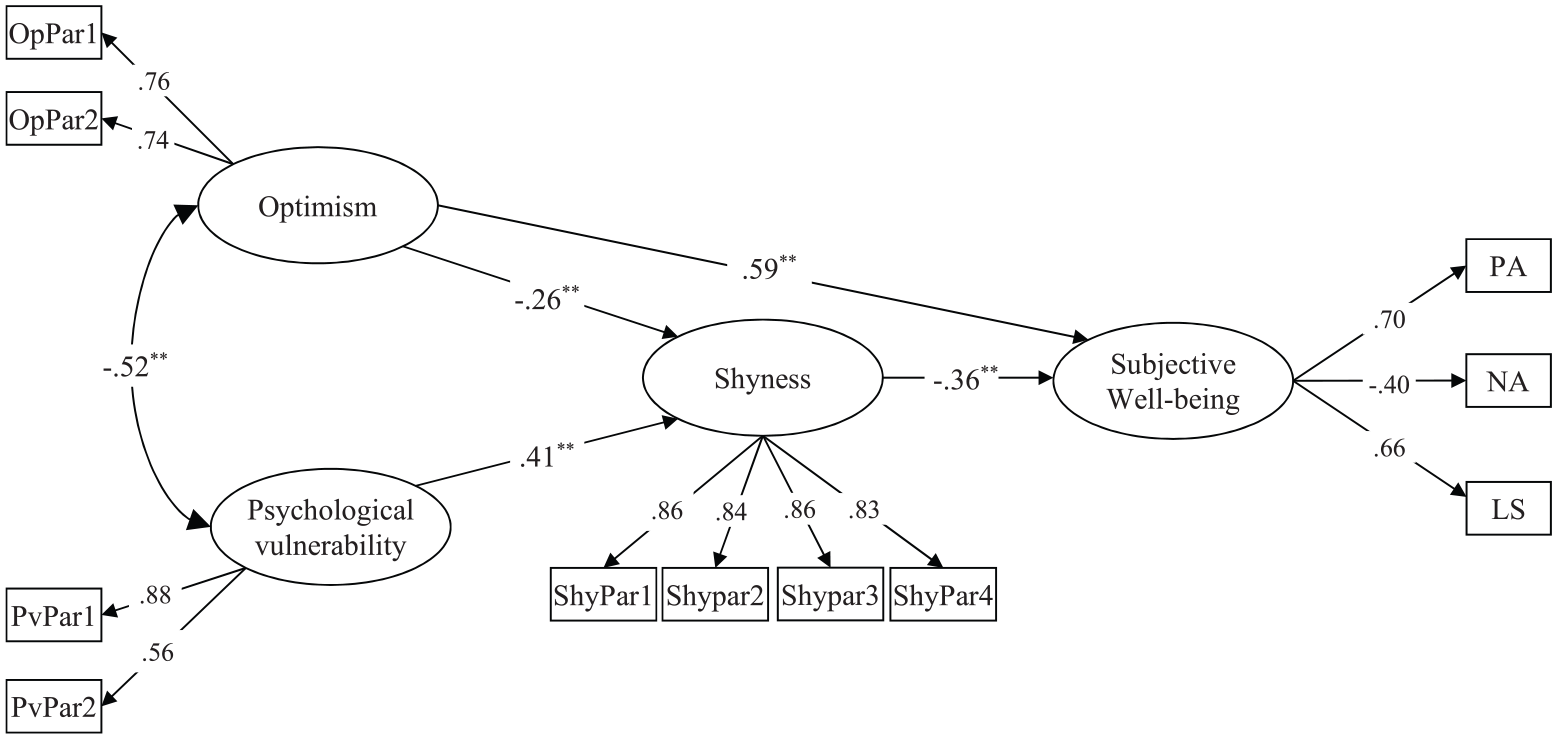
Standardized factor loading for the final structural model.
Bootstrapping
We also examined the significance of the direct and indirect paths in the model with the bootstrapping technique. This technique yields 95 percent CIs and is found to be significant if the CIs do not contain zero. As seen in Table 2, it can be said that optimism significantly predicts SWB through shyness (bootstrap estimate = 0.09, 95% CI (0.03, 0.18)). The indirect effect of vulnerability on SWB was also significant (bootstrap estimate = −0.15, 95% CI (−0.28, −0.06)).
Bootstrapping results.

CI: confidence interval.
Discussion
As a state of inhibition and discomfort in social situations, shyness can be defined as a negative reaction when being in an unfamiliar environment or seeing a stranger characterized by tension, worry, feelings of awkwardness, and avoiding eye contact (Cheek and Buss, 1981). Researchers have argued that shyness is a vulnerability factor to psychological problems, and shy people are more fragile to psychopathology based on a lack of social interaction (Gazelle and Ladd, 2003). Shy people experience low SWB (Booth et al., 1992). Thus, the purpose of the current research was to investigate the possible mediating effect of shyness on the relationships among optimism, PV, and SWB.
As expected, the mediating effect of shyness was confirmed through statistical analysis. Findings of the current research indicated that the association between optimism and SWB can be partially explained by being shy. Although previous studies indicated that optimism was positively correlated with SWB (e.g. Barnett and Martinez, 2015), no study has investigated the possible variables which may mediate this relationship. Researchers suggested that shy individuals are likely to perceive lower social support from their environment (e.g. Zhao et al., 2013) which can be accepted as a resilience factor and positively related with optimism and SWB (Friedman et al., 2006; Karademas, 2006). According to Jones and Carpenter (1986), shyness correlated negatively with the number of friends and the size of the social network. Contrarily, social network richness has been shown to correlate positively with optimism and well-being (Türküm, 2005). Jackson and colleagues (2000) propounded that shyness and pessimism are two personality correlates of loneliness that reduces SWB the level. They also found that shyness is negatively associated with optimism. Hence, it can be stated that this result is consistent with that of previous studies suggesting that shyness may play a role in the relationships among optimism, PV, and SWB.
The study also indicated shyness fully mediates the relationship between PV and SWB. Shy people usually generally report lower well-being, experience adjustment difficulties, and are more vulnerable to psychological problems such as loneliness and depressive symptoms (Findlay et al., 2009; Rowsell and Coplan, 2013). Schmidt and Fox (1995) suggested that shyness is significantly related to neuroticism and extraversion which are closely associated with PV and SWB. In addition, some research studies have provided evidence that shyness is linked with PV and several maladaptive variables, such as peer victimization, internalizing problem, and depressive syndromes (Coplan et al., 2017; Liu et al., 2019). Moreover, shyness was found negatively linked with indices of well-being like self-esteem and emotional support (Şahin and Gizir, 2014).
The analyses also suggested that optimism is negatively related with shyness and PV, while optimism was found to be positively related with SWB. Moreover, PV was found to be negatively related with SWB and positively related with shyness. These findings are in line with those of the previous literature that has demonstrated that optimism is positively related with indices of SWB and negatively related with shyness and aversive constructs (e.g. Chang and Sanna, 2001; Jackson et al., 2000; Karademas, 2006). Results of the current research are also parallel with the findings of the study which resulted that PV was negatively related with SWB (e.g. Satici, 2016). Some other research proved PV has an association with poor social skills and low social support which have an impact on shyness (Segrin et al., 2015).
The current study is surely not without limitations. First, convenience sampling was used and participants were university students in Turkey, which limits the generalizability of the findings. So, replications are needed with diverse sample groups to allow generalization. Second, a self-report scale was used to collect the data. Future research studies are needed which may use different methods to reduce the subjectivity. Third, the correlation cross-sectional nature of the study precludes definitive statements about causality among these variables. Longitudinal or experimental studies will help more causal evaluations. Finally, the current study examined shyness as a mediator on the relationship between optimism, PV, and SWB. Other possible mediators may be examined.
Implications
Despite the several limitations which have been addressed above, the present study has some implications for counseling practice. The current study presents an empirical framework that shyness partially mediated optimism–SWB relationship and also fully mediated PV–SWB relationship. Shyness may be a risk factor for SWB and may have made a negative contribution on both optimism–SWB and PV–SWB relationships. Thus, counselors may develop psychoeducation or training programs such as non-verbal interaction skills (Mahmoudi and Andarieh, 2015) due to shyness’ negative impact on speaking and communication skills or life skills training program (Arpana and D’Souza, 2012) to enrich student’s SWB. Counselors may also develop programs to increase assertiveness, self-confidence, and social skills because shyness is closely related with non-assertiveness and shy individuals report a lack of confidence and more perceived social skills deficit (Ghasemian et al., 2012). This kind of programs may diminish the impact of shyness on college student’s life, so they may be more resilient and their SWB level may increase.
The results of the current study also have some implications for preventive counseling. The analyses have revealed the association between optimism and SWB, as well as PV and SWB. Research indicated that a high level of SWB may be beneficial in all areas of life (e.g. Lyubomirsky et al., 2005). Using several methods in counseling and focusing to enrich optimism and to reduce PV may have a positive impact on SWB. Increment in SWB correlated with high levels of sociality which reduces shyness. Moreover, college students may face challenges of living in communities, homes, and college environments, which may make them fragile to psychological problems. Professionals may discover the protective factors such as optimism and focus on fostering resilience to support well-being.
Footnotes
Funding
The author(s) received no financial support for the research, authorship, and/or publication of this article.