




Abstract
Sensory-processing sensitivity differentiates individuals according to responsivity to internal and external stimuli. It has been positively correlated with depressive symptoms. Meanwhile, sense of coherence, an individual’s perception that stressors are comprehensible, manageable, and meaningful for their life, could improve depression. This cross-sectional study investigated the moderation effect of sense of coherence on the relationship between sensory-processing sensitivity and depressive symptoms in university students. Japanese students (N = 430) participated in a questionnaire survey that assessed levels of sensory-processing sensitivity, sense of coherence, and depressive symptoms. The results showed that a strong sense of coherence moderated the relationship between sensory-processing sensitivity and depressive symptoms in university students.
Keywords
Introduction
Recently, attention has been paid to sensory-processing sensitivity (SPS) as a predictor of an individual’s development and state of health. SPS is a temperament trait underlying individual differences in personality development and involving a tendency to perceive internal and external stimuli at a lower threshold and to be more easily affected by those stimuli (Aron and Aron, 1997; Smolewska et al., 2006; Wolf et al., 2008). Many studies have revealed adaptive characteristics of high-SPS individuals, such as more positive emotions in supportive environments (Jagiellowicz et al., 2016; Pluess and Boniwell, 2015); however, these individuals tend to have mental health problems, such as symptoms of depression. University students are known to experience various stressful events (Kreß et al., 2015). Studies with samples of university students have consistently reported the positive correlation between SPS and depressive symptoms (e.g. Liss et al., 2008; Yano and Oishi, 2018). Thus, further studies are needed to examine the mechanisms underlying the relationship between SPS and psychopathology, which could help us to find ways to reduce depressive symptoms in high-SPS students (Bratholm Wyller et al., 2017; Greven et al., 2019).
Sense of coherence (SOC) may be one of the factors that would moderate the relationship between SPS and mental health (Evers et al., 2008). Antonovsky (1987) defined SOC as a global orientation that expresses the extent to which one has a pervasive, enduring though dynamic feeling of confidence that (1) the stimuli derived from one’s internal/external environments are structured, predictable, and explicable (i.e. comprehensibility); (2) the individual has adequate resources to meet the demands (i.e. manageability); and (3) these demands are worthy of commitment or energy investment (i.e. meaningfulness). Many studies have pointed out that strong SOC maintains and promotes one’s mental health. For instance, individuals with strong SOC can mobilize the resources suitable for the situations and cope with stressors effectively when they experience stressful events (e.g. Antonovsky, 1987; Togari et al., 2008). Grevenstein and Bluemke (2015) showed that SOC could predict health-related indices (e.g. mental health and life satisfaction) even after controlling for all the Big Five personality factors.
Antonovsky (1987) stated that the level of SOC was relatively stable; however, recent studies suggested that cognitive-behavioral approaches, such as mindfulness-based stress reduction and life skills training, increase the level of SOC (Ando et al., 2011; Kase et al., 2019). Given the negative correlation between SPS and SOC (Evers et al., 2008), it is inferred that a strong SOC leads high-SPS students to better mental health. However, few studies have examined the moderation effect of SOC on the relationship between SPS and depressive symptoms. Therefore, this study aimed to investigate the associations of SPS, SOC, and their interaction with depressive symptoms in university students. The results of this examination are expected to give us a better understanding of the mechanisms underlying the relationship between SPS and depression.
Method
Participants and procedure
We asked 465 Japanese university students to participate in a cross-sectional questionnaire survey using a pencil and a paper and obtained consent from all of them. As those who did not complete the questionnaires (i.e. missing data; n = 24) and those who replied with unnatural responses such as the same marks for the entire scale (n = 11) were excluded, a total of 430 students (valid response rate = 92.4%; 221 men and 209 women; mean age = 20.5 years, SD = 0.9) were analyzed. This study was approved by the ethics committee of the first author’s university.
Measurements
19-item Japanese version of Highly Sensitive Person Scale (HSPS)
SPS was assessed using HSPS (Takahashi, 2016), which is the revised version of Aron and Aron’s (1997) original scale for Japanese individuals. This scale comprises 19 items, and each item was assessed on a 7-point Likert-type scale, with higher scores indicating higher SPS.
Japanese version of the 13-item Sense of Coherence Scale (SOC-13)
SOC was assessed using SOC-13 (Yamazaki, 1999), which is the revised version of the 13-item Orientation to Life Questionnaire (Antonovsky, 1987) for Japanese individuals. This scale comprises 13 items, and each item was assessed on a 7-point Likert-type scale, with higher scores indicating stronger SOC.
Japanese version of Center for Epidemiologic Studies Depression Scale (CES-D)
Depressive symptoms were assessed using CES-D (Shima et al., 1985), which is the revised version of Radloff’s (1977) original scale for Japanese individuals. This scale comprises 20 items, with higher scores indicating more severity of depressive symptoms. Each item was assessed on a 4-point Likert-type scale from 0 = “none or less than 1 day” to 3 = “always or more than 5 days”; each point represented the frequency of experiencing the depressive symptoms shown by each item. Although a score of 16 or higher is highly suggestive of depression (Radloff, 1977), recent studies (Kaneita et al., 2006; Konno et al., 2010; Nagase et al., 2009) have pointed out that this cut-off score is not suitable for Japanese individuals, as it could overestimate the severity of depressive symptoms among them. Furthermore, many studies have used the CES-D score as a continuous variable rather than as a dichotomous variable (e.g. Hamamura and Mearns, 2019; Okumura and Sakamoto, 2009). Therefore, we used depressive symptoms as a continuous variable and did not consider the CES-D cut-off score in the statistical analyses.
Japanese version of Ten Item Personality Inventory (TIPI-J)
As SPS has been confused with neuroticism and introversion, the effects of these traits should be controlled for when investigating the relationships between SPS and other variables (e.g. Jagiellowicz et al., 2016). Therefore, we used neuroticism and extraversion (contrary to introversion) as control variables.
The levels of neuroticism and extraversion were assessed using the relevant domains of TIPI-J (Oshio et al., 2012), which is the revised version of Gosling et al.’s (2003) original scale for Japanese individuals. Each domain comprised two items assessed on a 7-point Likert-type scale. Higher scores represent higher tendencies of the traits.
Statistical analyses
First, the descriptive statistics for each variable were calculated after verifying the reliability of each scale by calculating Cronbach’s α coefficients. Since TIPI-J has only two items for each domain, the reliability was assessed using within-domain inter-item correlations rather than the Cronbach’s α coefficients (Gosling et al., 2003; Oshio et al., 2012). Second, we conducted correlation analyses, that is, calculating Pearson’s product–moment correlation coefficients, among all variables. Finally, a hierarchical multiple regression analysis predicting CES-D scores was performed. Prior to this analysis, all predictor variables were centered at their mean. Gender, age, extraversion, and neuroticism scores were entered in the first step as control variables. The scores of HSPS and SOC-13 were entered in the second and third step, respectively. Finally, the interaction term between HSPS and SOC-13 scores was entered in the fourth step. All statistical analyses were performed using IBM SPSS (version 25.0), and the level of significance was set at 5 percent.
Results
Cronbach’s α coefficients were .82, .74, and .85 for HSPS, SOC-13, and CES-D, respectively. This study showed the significant inter-item correlations of neuroticism and extraversion, r = .33 and .53 (ps < .01), respectively. Descriptive statistics (i.e. mean scores, standard deviations, 95% confidence intervals, theoretical ranges, and observed ranges) for each variable and the Pearson’s product–moment correlation coefficients among all variables and demographic data can be seen in Tables 1 and 2, respectively.
Descriptive statistics for each variable.
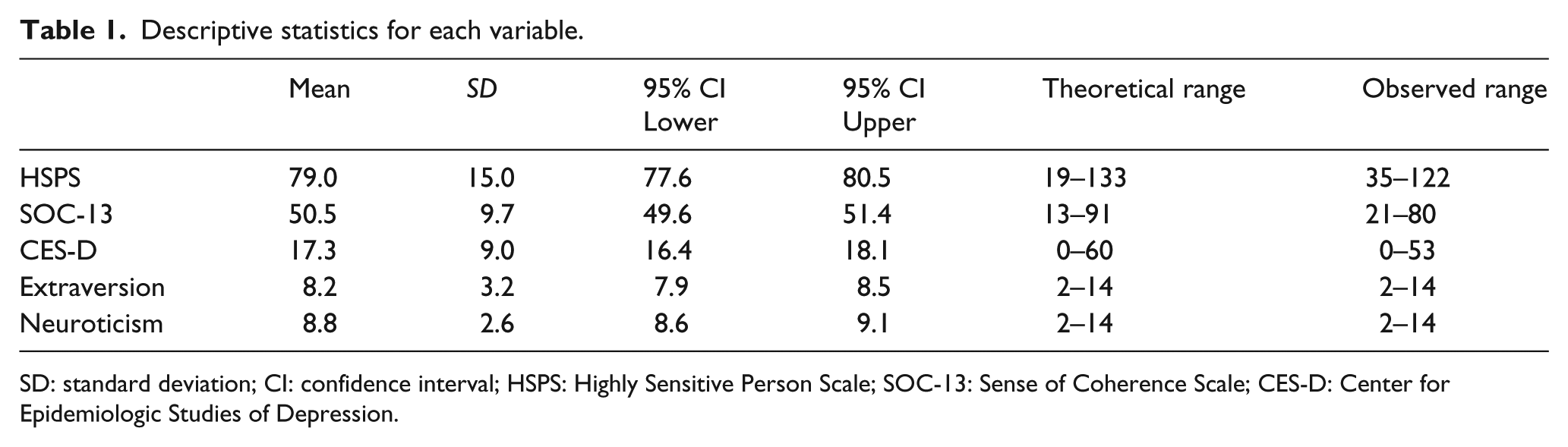
SD: standard deviation; CI: confidence interval; HSPS: Highly Sensitive Person Scale; SOC-13: Sense of Coherence Scale; CES-D: Center for Epidemiologic Studies of Depression.
Pearson’s product–moment correlation coefficients among all variables (N = 430).
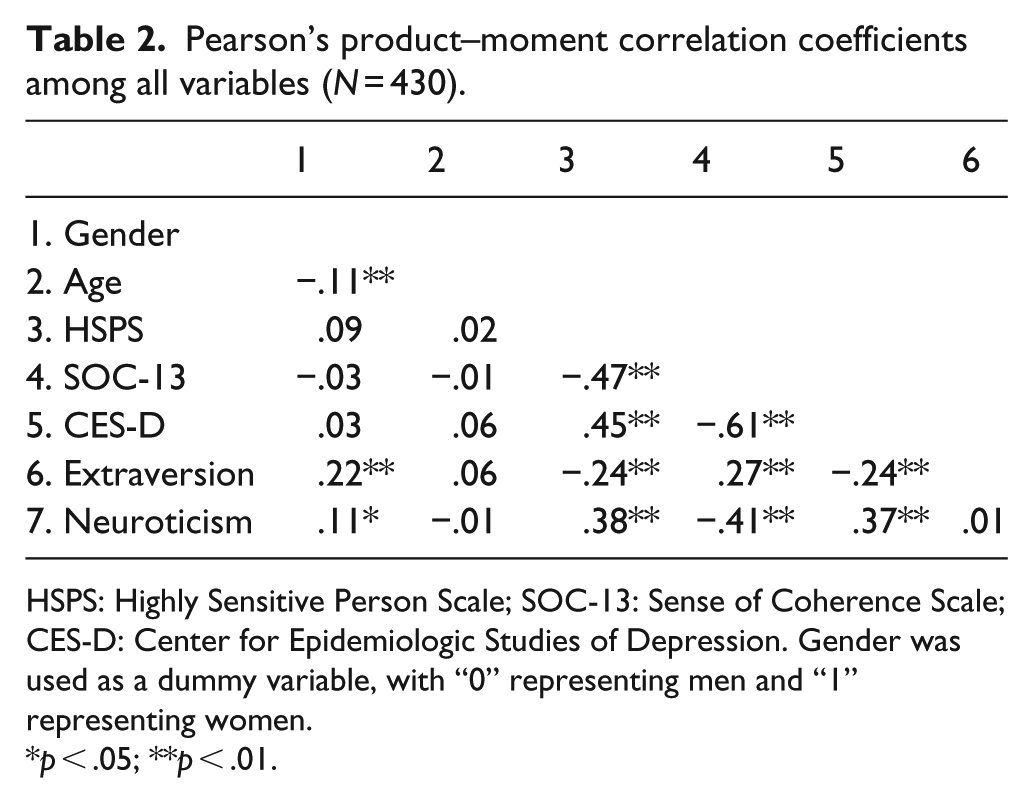
HSPS: Highly Sensitive Person Scale; SOC-13: Sense of Coherence Scale; CES-D: Center for Epidemiologic Studies of Depression. Gender was used as a dummy variable, with “0” representing men and “1” representing women.
p < .05; **p < .01.
Hierarchical multiple regression analysis (Table 3) showed that all the coefficients of determination (R2s) and their increase (ΔR2s) were significant in each step (ps < .01–.05), and no multicollinearity could be found between all the predictor variables (variance inflation factor (VIF) = 1.02–1.47). As the interaction between HSPS and SOC-13 scores was significantly associated with the CES-D scores, a simple slope test was performed (Figure 1). The result showed that HSPS scores were positively associated with CES-D scores only for those reporting low SOC-13 scores, that is, 1 SD below mean (β = .24, 95% confidence interval (CI) = [.13, .34], p < .01). When SOC-13 scores indicated 1 SD above mean, HSPS scores were not significantly associated with CES-D scores (β = .10, 95% CI = [−.01, .20], ns).
Hierarchical multiple regression analysis predicting CES-D scores (N = 430).
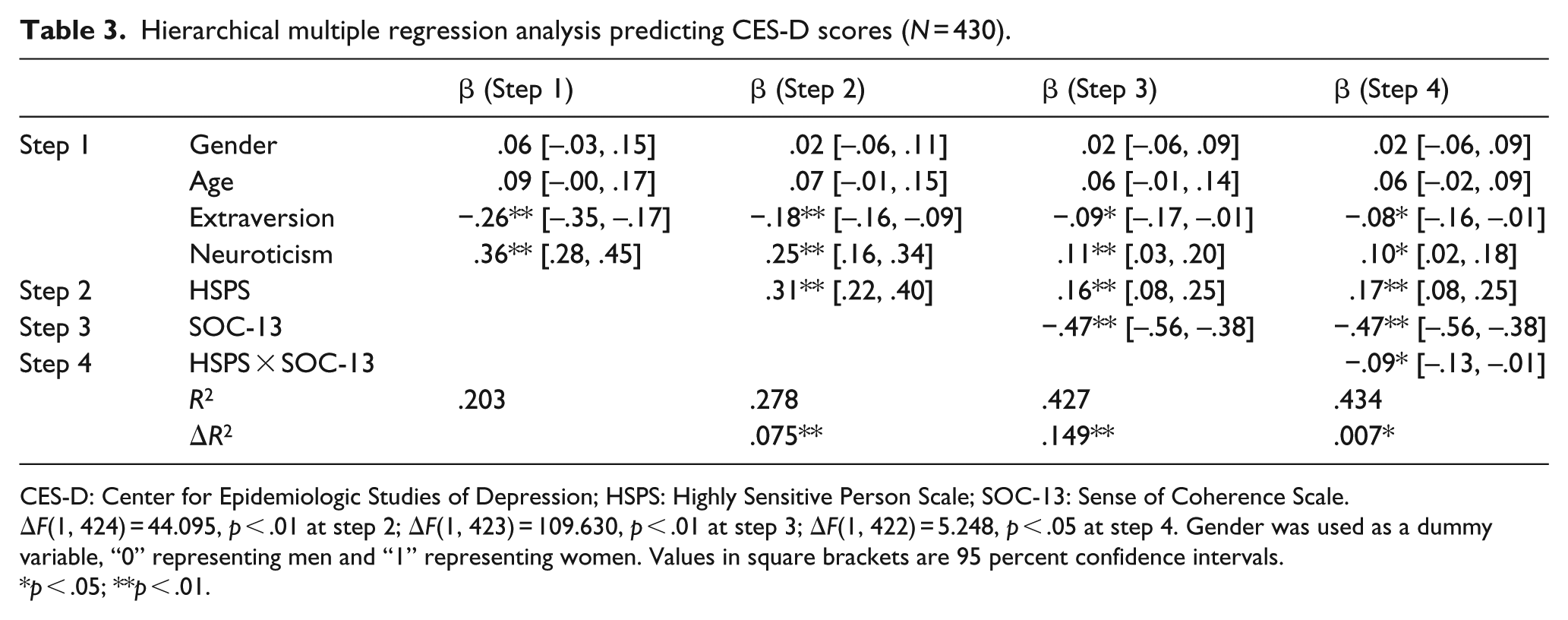
CES-D: Center for Epidemiologic Studies of Depression; HSPS: Highly Sensitive Person Scale; SOC-13: Sense of Coherence Scale.
ΔF(1, 424) = 44.095, p < .01 at step 2; ΔF(1, 423) = 109.630, p < .01 at step 3; ΔF(1, 422) = 5.248, p < .05 at step 4. Gender was used as a dummy variable, “0” representing men and “1” representing women. Values in square brackets are 95 percent confidence intervals.
p < .05; **p < .01.

The interaction effect of HSPS and SOC on CES-D scores.
Discussion
Several studies inferred that becoming easily over-aroused due to perceiving more stressors promoted learned helplessness, which led high-SPS individuals to poorer mental health (Benham, 2006; Brindle et al., 2015). A recent study reviewed the above articles and hypothesized that dysfunctional cognitive responses to environmental stimuli (e.g. rumination, avoidance) mediated the relationship between SPS and psychological distress (Bratholm Wyller et al., 2017). Conversely, SOC includes an individual’s perception that various stressors are structured, predictable, and explicable; that the stressors are meaningful and challenges rather than burdens; and that they have enough resources to cope with various stressors (Antonovsky, 1987; Yamazaki, 2008). These findings suggested that a strong SOC prevented high-SPS students from experiencing the abovementioned issues (i.e. over-arousability and dysfunctional cognition), and consequently decreased the severity of depressive symptoms. For instance, those who perceive that various stressors are structured and predictable could be less likely to become over-aroused, although high-SPS students perceive more stressors. In addition, those who perceive that they can cope with stressors effectively or that these stressors are meaningful for their life may not tend to experience dysfunctional cognition, such as helplessness or negative rumination.
Strengths, limitations of this study, and future directions
The main strengths of this study can be seen with two points. First, the moderation effect of SOC could have implications for revealing the mechanisms underlying the relationship between SPS and psychopathology. This study may provide findings for improving the hypothetical model developed by Bratholm Wyller et al. (2017). Second, most of the SPS-related studies have involved Western samples (Lionetti et al., 2019); therefore, because this study involves Eastern samples, it could be valuable. As mean scores in each variable were similar to those found in recent studies (e.g. Hamamura and Mearns, 2019; Kase et al., 2016; Oshio et al., 2012; Yano and Oishi, 2018), the sampling from the population of Japanese university students could be valid. However, there are also several limitations in this study.
First, this study used a cross-sectional approach; thus, causal relationships among SPS, SOC, and depression remain unclear. Second, although this study suggests that SOC moderates the relationship between SPS and depressive symptoms, it has not been revealed how best to strengthen SOC (Togari et al., 2008). Therefore, future studies should reveal the causal relationships among the variables using a longitudinal approach and find ways to strengthen SOC of high-SPS students.
Antonovsky (1987) pointed out that SOC could be affected by three kinds of experiences: “participation in shaping outcomes (achieving valuable results),” “underload-overload balance (moderate burdensome experiences),” and “consistency (experiences based on shared values and rules).” Accordingly, the approaches for promoting these experiences could help individuals to effectively strengthen SOC. A recent study suggested that life skills training is an effective approach for strengthening SOC in high-SPS students (Kase et al., 2019). Life skills enable individuals to deal effectively with demands in daily life, and the approaches to increase life skills are often called “life skills training (LST)” (World Health Organization, 1994). High-SPS individuals tend to possess low skills in interpersonal relationships (Liss et al., 2008) and low ability to cope with emotions (Brindle et al., 2015). Therefore, an examination from the perspective of LST may provide key information for strengthening SOC and improving depressive symptoms in high-SPS students.
Footnotes

Declaration of conflicting interests
The author(s) declared no potential conflicts of interest with respect to the research, authorship, and/or publication of this article.
Funding
The author(s) disclosed receipt of the following financial support for the research, authorship, and/or publication of this article: This work was supported by JSPS KAKENHI, Grant Number JP19J20902.