



Abstract
The purpose of this study was to explore the physical, social, and mental health correlates of executive functioning in adults. Our sample consisted of 250 adults aged 18–55 years who participated in a survey. Participants reported on their physical health behaviors, family closeness, and mental health. Using hierarchical linear regression, the final model explained 41 percent of executive functioning in adults. Dispositional forgiveness of situations, stress, and living in a single-family home were the only significant correlates of executive functioning. These results are useful for better understanding possible mechanisms through which to improve executive functioning in adults.
Introduction
Executive functions (EF) refer to mental processes such as inhibitory control, working memory, and cognitive flexibility that assist people to engage in goal-directed behaviors (Diamond, 2013). Higher EF is predictive of better health (Reimann et al., 2018), greater wealth, and less crime in adulthood (Moffitt et al., 2011). Furthermore, EF is positively correlated with positive psychology attributes such as gratitude and life satisfaction (Miley and Spinella, 2006). In short, EF improves the quality and longevity of life for individuals and the communities they live in. Understanding the factors that lead to improved EF in adulthood is therefore important to making gains in improving population health. It is believed that a combination of emotional, social, and physical needs must be met to improve EF in adults, but to date it is unclear what are the best approaches to improving EF during adulthood (Diamond and Ling, 2016).
Prior studies have examined the relationship of a variety of healthy behaviors, mental health, and positive psychological traits with EF. In a systematic review of studies pertaining to physical activity and cognitive performance in older adults, Cai and Abrahamson (2015) found that physical activity is related to improvements in EF among those with mild cognitive impairment. Conversely, a review of studies relating to diets high in saturated fat demonstrated that high saturated fat intake is related to decreased EF and cognitive impairments (Francis and Stevenson, 2013). Sleep is also important to cognitive health, and replacing sedentary time with sleep can improve executive functioning performance on tasks in adults (Fanning et al., 2017). Though effortful and domain-specific, cognitive training such as playing brain training games has also demonstrated some success in enhancing adult EF (Gajewski et al., 2017; Marceau et al., 2017; Van Vleet et al., 2016). However, research on physical healthy behaviors and cognitive training has been far from conclusive. Physical activity appears to have modest effects on adult EF and cognitive training appears to be domain-specific and intensive (Diamond and Ling, 2016; Fanning et al., 2017).
Social and mental influences have a known effect on the development of EF and may also influence adult EF. For example, being raised in an institution or experiencing abuse can impair EF development, while holding hands with a loved one may at least temporarily improve EF in stressful situations in adults (Davidson and McEwen, 2012). Stress in particular is known to be a significant predictor of decreased EF in adults. In a study of 98 community members ranging in age from 19 to 89 years, increased stress as measured by the Perceived Stress Scale was associated with worse performance on episodic memory tests among young, mid-life, and older adults (VonDras et al., 2005). Poor mental health such as depression and anxiety has been associated with lower adult EF performance (Kanske and Kotz, 2012). It is believed that positive mental health may improve adult EF though there is limited research connecting positive psychological characteristics to EF. In a study of 113 college students, forgiveness, gratitude, hope, and optimism were examined to see whether they explained variation of EF in hierarchal modeling (Kruger, 2011). Although all variables were positively correlated with EF, in the final hierarchical model, only forgiveness and hope were associated with increased EF (Kruger, 2011). In another study of 61 healthy undergraduate students, researchers found that optimism counteracted the negative effects of pain on EF (Boselie et al., 2017). Similarly, in a study of 154 adults aged 17–76 years, researchers found that gratitude was associated with increased EF (Miley and Spinella, 2006). However, findings have been mixed across studies and types of EF measured. For example, Miley and Spinella (2006) found that greater forgiveness was associated with lower inhibitory control skills, but in a study of 48 undergraduate students researchers found that forgiveness of others was associated with better working memory (Pronk et al., 2010).
A limitation of the prior research is that typically only one or a few items were examined in relation to EF. The failure to include physical healthy behaviors with social health, mental health, and positive psychology may lead to conclusions that are confounded by unmeasured variables. For example, stress is known to be related to decreased physical activity levels (Stults-Kolehmainen and Sinha, 2014), and gratitude is associated with participation in healthy activities such as a healthy diet and greater physical activity (Hill et al., 2013). Thus, failure to measure stress and gratitude in studies examining the relationship between physical activity and EF may be confounded by these unmeasured variables. Additional value for including measures of healthy behaviors, mental and social health, and positive psychology into one model is that it allows us to examine the unique variance that each contributes to adult EF.
In this study, we seek to build on prior research by examining the relationship of healthy behaviors, social health, mental health, and positive psychology with adult EF in a single model. This will help to reduce the likelihood of unmeasured confounding in our results and will allow us to examine the unique variance that social and mental health and positive psychology have on adult EF above and beyond physical healthy behaviors. The purpose of this study was to examine correlates of EF in adults relating to physical health behaviors (e.g. diet, exercise, and sleep), social factors (e.g. family closeness), and mental health (e.g. stress and positive psychology characteristics such as forgiveness, optimism, hope, and gratitude). A second aim was to examine whether some characteristics were more important to adult EF when examined together. We hypothesized that a combination of healthy physical, social, and mental health factors would be more strongly associated with EF than either physical or mental health factors alone and that given the importance of addressing emotional needs that positive psychological traits would be particularly important. More specifically, we hypothesized that diet and exercise would have modest positive associations with EF, while depression, sleep difficulties, and stress would predict a significant proportion of model variance and be negatively associated with EF. Less is understood about the association between family closeness and positive psychology with EF, but we hypothesized that as a group these variables would significantly explain model variance and positively affect EF.
There are multiple definitions of stress and positive psychology constructs. Here, we include the definitions used for purposes of this study. Stress includes the degree to which one’s current life circumstances are labeled as uncontrollable, unpredictable, and/or overly burdensome (Cohen et al., 1983). We define optimism as one’s belief that good things will happen in the future versus bad things (e.g. pessimism; Segerstrom et al., 2011). Similar to optimism, hope is the action of overcoming despair (Haugan et al., 2013), and gratitude is the tendency to recognize and respond with grateful emotion to other’s influence in their positive life experiences (McCullough et al., 2002). Forgiveness relates to one’s general tendency to transform a negative response to a transgression into a neutral or positive response (Thompson and Synder, 2003). Forgiveness can extend to others, one’s self, or challenging life circumstances.
Methods
Procedures
Our sample population consisted of 250 adults aged 18–55 years. The population was recruited through Amazon Mechanical Turk (MTurk). Demographic characteristics of MTurk users have been found to be similar to other survey services, allowing us to recruit a population of various ethnic, gender, and socioeconomic status (SES) backgrounds (Huff and Tingley, 2015). The MTurk registered users were able to view a description of the study if they were born between 1962 and 2000. Through MTurk, they then accessed a link to a survey posted on Qualtrics. Registered MTurk users who completed the survey were awarded US$2.50 for survey completion. All participants provided consent prior to beginning the survey, and the study was approved by the university Institutional Review Board. The sample of 250 was selected for the study at large to allow adequate power to conduct exploratory and confirmatory factor analyses using a structural equation modeling framework for factor analysis. The sample size is similar to other studies examining the relationship between EF and health behaviors (e.g. (Fanning et al., 2017; Miley and Spinella, 2006).
Measures
This study included measures of EF, physical health, familial closeness, and mental health. EF was measured through the Learning, Executive, and Attention Functioning (LEAF) scale (30 items; Castellanos et al., 2018). The LEAF includes 30 items measuring attention, processing speed, visual–spatial organization, sustained sequential processing, working memory, and novel problem solving. In the initial study, individual subscales had Cronbach’s alphas ranging from .69 to .92. In this study, we combined the EF subscales into one general EF construct. Physical healthy behaviors were measured by the number of fruits and vegetables consumed on an average day (The Fruits and Vegetables Checklist; Townsend et al., 2003); number of days per week a participant engaged in at least 10 minutes of vigorous physical activity on average (Centers for Disease Control and Prevention, 2011; Eyler et al., 2003); and sleep difficulties (“Over the last 2 weeks, how many days have you had trouble falling asleep or staying asleep or sleeping too much?” Behavioral Risk Factor Surveillance System Survey 2011; Centers for Disease Control and Prevention (CDC), 2011). Items for familial closeness were adapted from the Adult Filial Closeness Scale (16 items, α = .94; Black, 2016). Mental health was measured by stress (10 items, Perceived Stress Scale, α = .78; Cohen et al., 1994; Lee, 2012); hope (8 items, Hearth Hope Index, α = .72; Herth, 1992); optimism (6 items, Life Orientation Test–Revised, α = .68; Glaesmer et al., 2012; Scheier et al., 1994); gratitude (6 items, The Gratitude Questionnaire–6 Item Form, α = .82; McCullough et al., 2002); forgiveness of others (6 items; α = .81) and of situations (6 items, α = .87) using the Heartland Forgiveness Scale; Thompson and Synder, 2003); and locus of control (8 items, Levenson IPC (Internal, Powerful Others, and Chance) Scale, α = .87; Lefcourt, 1981; Levenson, 1973). For each multiple-item construct, items were summed and averaged to create a scale score. Refer to Table 1 for item means and Cronbach’s alphas.
Correlations, scale reliability coefficients, means, and standard deviations of demographic and key study variables (N = 250).
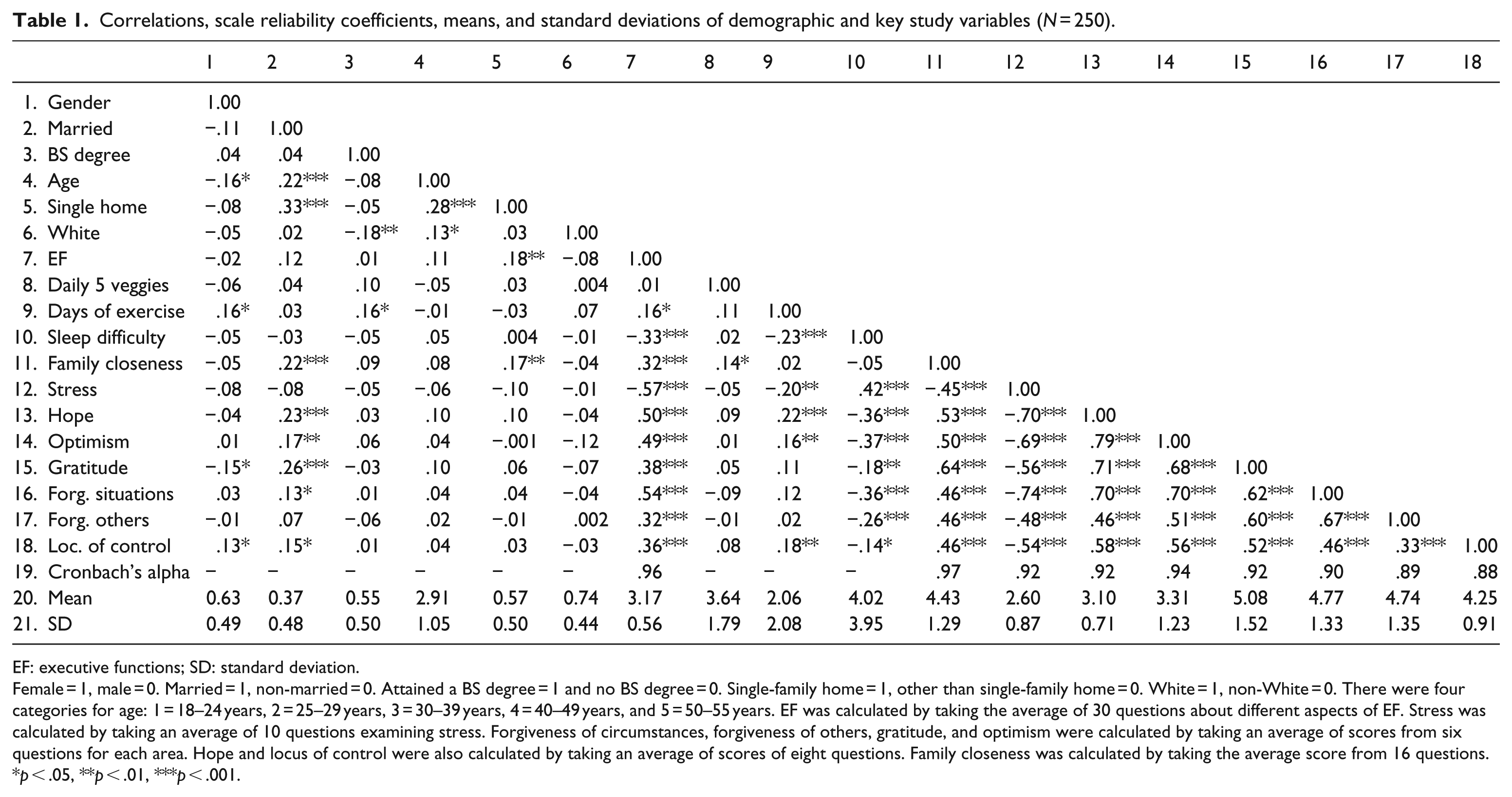
EF: executive functions; SD: standard deviation.
Female = 1, male = 0. Married = 1, non-married = 0. Attained a BS degree = 1 and no BS degree = 0. Single-family home = 1, other than single-family home = 0. White = 1, non-White = 0. There were four categories for age: 1 = 18–24 years, 2 = 25–29 years, 3 = 30–39 years, 4 = 40–49 years, and 5 = 50–55 years. EF was calculated by taking the average of 30 questions about different aspects of EF. Stress was calculated by taking an average of 10 questions examining stress. Forgiveness of circumstances, forgiveness of others, gratitude, and optimism were calculated by taking an average of scores from six questions for each area. Hope and locus of control were also calculated by taking an average of scores of eight questions. Family closeness was calculated by taking the average score from 16 questions.
p < .05, **p < .01, ***p < .001.
As EF has been associated with poverty and other sociodemographic conditions (Crandall et al., 2017; Hughes et al., 2009), we included the following demographic factors: gender, marital status, education level, type of home lived in, race, and age.
Data analysis
Data were analyzed in Stata 15.0. To examine the proportion of variance explained by demographic, physical, social, and mental health variables, we conducted hierarchical regression analyses using Stata’s nestreg command. Demographic factors were included in the first block followed by physical healthy behavior indicators (diet, exercise, and sleep) in the second block. In the third block, we added family closeness as a proxy for social health. Stress was added in the fourth block, and positive psychology traits were added in block five.
Results
Descriptive statistics
The majority of participants were male (62%), 74 percent of participants identified themselves as White/Caucasian, 37 percent were married, and 55 percent had a bachelor’s degree or higher. Table 1 contains the means, standard deviations, Cronbach’s alphas, and pairwise correlations of study variables.
Hierarchical linear regression models
In step 1, demographic variables did not significantly explain the variance for adult EF (F(df1, df2) = 2.05(6, 240), ΔR2 = .05, p = .06). However, one of the demographic indicators, living in a single-family home, was associated with higher self-reported EF (see Table 2). Adding physical healthy behavior indicators in step 2 significantly explained EF variance (F(df1, df2) = 11.46(3, 237), ΔR2 = .12, p < .001), with difficulties with sleeping associated with lower EF. The addition of family closeness in step 3 (F(df1, df2) = 23.91(1, 236), ΔR2 = .08, p < .001), stress in step 4 (F(df1, df2) = 50.32(1, 235), ΔR2 = .13, p < .001), and positive psychological variables in step 5 (F(df1, df2) = 2.34(6, 229), ΔR2 = .04, p = .03) all contributed to the variance in adult EF. In the final step, only living in a single-family home (b = .15, p = .02), stress (b = –.15, p = .01), and forgiveness of situations (b = .12, p = .01) were associated with adult EF. See Table 2 for the full results.
Hierarchical regression analyses: aspects of positive psychology as predictors of executive functioning.

Discussion
Consistent with our hypotheses, we found that physical healthy behaviors, social health, and mental health characteristics all significantly contributed to the variance of adult self-reported EF. In the final model with all variables included, only stress, forgiveness of situations, and living in a single-family home (a proxy for higher SES) were associated with EF. These results imply that mental and emotional health may be more highly associated with EF than markers of physical or social health. Although other studies have found an association between physical health indicators and EF (Blanton et al., 2012; Cai and Abrahamson, 2015; Fanning et al., 2017; Francis and Stevenson, 2013), it appears that mental health factors may trump physical health indicators. Stress was correlated with fewer days participating in vigorous physical activity and more difficulties sleeping. As such, it may be that studies that find an association between EF and physical health are actually confounded by unmeasured stress or positive psychological factors.
Stress and executive functioning
The result that stress is associated with impaired EF is consistent with prior research and well-recognized among researchers who study EF. For example, in a randomized control trial of 35 healthy adults, adults in the stress group had lower working memory (Luethi et al., 2009). Chronic stress has been found to impair brain structures and EF throughout the life course (Lupien et al., 2009), and daily stressors are also associated with temporary impairment of EF (VonDras et al., 2005).
Forgiveness and executive functioning
The relationship between forgiveness and EF is less well understood and requires more exploration. Similar to a previous study on undergraduate students (Kruger, 2011), our results demonstrated that forgiveness was particularly important to explaining variation of EF. Evolutionary models have demonstrated that the prefrontal cortex, which is largely the area of the brain that houses EF, is associated with more benevolent and less punitive actions likely because of improved theory of mind (Billingsley and Losin, 2017). Theory of mind includes the ability to recognize and attribute beliefs, intentions, desires, knowledge, and emotions to oneself and others and to recognize that others may have different perspectives from oneself (Premack and Woodruff, 1978). Therefore, higher EF may help people to forgive. Likewise, the ability to forgive may train new neural pathways in the prefrontal cortex, thereby improving EF.
However, unlike previous studies examining forgiveness and EF (Kruger, 2011), in this study, we examined two forgiveness constructs separately: forgiving others and forgiving situations. We found that forgiving situations, but not forgiving others, was associated with higher EF. Distinguishing between different aspects of forgiveness may be important as forgiving others and forgiving situations may require different neural networks. The process of forgiving situations certainly still benefits from strong theory of mind as it requires one to recognize their own beliefs, intentions, desires, knowledge, and emotions as they examine challenging situations in their lives. Insomuch as others have affected a challenging situation then forgiving situations may require understanding others’ intentions, beliefs, and knowledge. Yet, forgiving situations goes beyond what is required for forgiving self or others. Often, challenging situations are of longer duration and require constant or day-to-day interaction with the undesired situation—such as managing a chronic illness, dealing with a job that you dislike, or facing the death of a loved one. Therefore, the burden on neural networks and EF may be greater when forgiving situations. Higher EF may help a person to successfully navigate through a situation. For example, daily problem solving, planning, self-control, and maintaining motivation may be required to handle the challenges. Alternatively, the ability to accept these challenging situations may result in better EF through decreased stress, increased acceptance, and exercising the brain as you go through the cognitive process of forgiving challenges that are daily before you.
A study published in 2007 of 1766 undergraduate students may be useful in understanding the relationship between forgiving situations and EF. In this study, researchers found that a higher self-esteem was linked with higher forgiveness of situations (Strelan, 2007). Among children, there is some evidence linking increasing self-esteem with improving executive functioning (Diamond and Lee, 2011). To our knowledge, studies have not been conducted examining self-esteem and EF in adults. But if the same relationship exists in adults, then forgiving situations may help to build self-esteem and likewise yield improvements in EF.
Another possible explanation for how forgiving situations may improve EF is that often forgiving situations requires forgiveness of God or a higher power (e.g. Why did God allow my child to die? Or Why did God allow this disaster to happen? (Exline et al., 1999)). Difficulty forgiving God, perhaps even more so than forgiving others, is associated with negative emotion, but forgiving God leads to lower levels of anxiety and depression (Exline et al., 1999). Negative emotions in turn reduce EF (Diamond and Ling, 2016). Therefore, when people learn to forgive situations, their emotions may improve leading to better EF performance.
Relevance of findings to practice
Based on the results of the study, it appears that efforts to teach adults skills to reduce stress and increase their ability to forgive challenging circumstances might also contribute to higher adult EF. Prior studies have found some success in improving adult EF through stress reduction. For example, in older adults, participation in mindfulness-based stress reduction has been associated with small but significant improvements in EF (Moynihan et al., 2013). Less is known, however, about the success of building participant forgiveness of situations and its associated effects on EF. Part of the challenge lies in definitions of forgiveness, which have often centered on the ability to forgive self or others (Thompson and Synder, 2003). Traditional approaches to improving forgiveness have been individualized and often conducted in clinical settings (Baskin and Enright, 2004; Cosgrove and Konstam, 2008; Freedman and Zarifkar, 2016; McCullough et al., 2001). Although there are currently no known interventions focused on the forgiveness of situations, principles from existing interventions relating to forgiveness of self and others can be adapted. The most successful forgiveness interventions include cognitive, affective, and behavioral elements and follow a step-wise process with activities encouraging the participant to think through the situation, identify the pain, and find empathy (Baskin and Enright, 2004; Enright, 2001; Freedman and Chang, 2010; Freedman and Zarifkar, 2016; Wade and Worthington, 2005; Worthington, 2001; Worthington and Lavelock, 2011). As people learn to forgive challenging life situations, this may in turn increase their self-esteem and emotional well-being leading to better EF performance (Exline et al., 1999; Strelan, 2007).
Strengths and limitations
This was a cross-sectional sample. Although our hypotheses included EF as an outcome, directionality cannot be determined. Thus, it is also probable and consistent with previous literature that EF is a predictor of stress, forgiveness of circumstances, and SES (Moffitt et al., 2011). For example, in a study of 111 adults, higher EF was associated with increased ability to forgive over 5 weeks compared to participants with low EF (Pronk et al., 2010). Likely, there is some bidirectionality of these results as prior studies also indicate the importance of stress and SES to the development and maintenance of EF (Hackman et al., 2015; VonDras et al., 2005). Longitudinal studies are needed to further explore the directionality and magnitude of effects over time. Another limitation is that we only included one measure of social health, that of adult closeness with their family of origin. However, there are other important measures of social health including closeness with marital family and social connections that would also be important to measure. Finally, all results were based on participant self-report, which are known for being biased. Task or brain imaging measures of EF would be important to further examine the effects of different aspects of health on adult EF. Despite these limitations, this study has value in helping us to understand the relationship of multiple aspects of health with EF and the preliminary findings can help us explore additional ways to improve EF in adults. The results suggest that a special attention should be paid to adult emotional and mental well-being as it relates to their EF ability.
Footnotes
Author contributions
AAC conceived the study, conducted the analyses, wrote the “Introduction” and parts of the “Methods” and “Discussion” sections, and edited the entire manuscript. AC and JRM conceived the study, conducted preparatory literature reviews, and assisted in the interpretation of results. AC managed the MTurk responses and wrote parts of the “Methods” section. JRM wrote the “Results” section. RG and KN assisted in the interpretation of results, conducted literature reviews, and wrote the “Discussion” section. All authors approved the final version.
Declaration of Conflicting Interests
The author(s) declared no potential conflicts of interest with respect to the research, authorship, and/or publication of this article.
Funding
The author(s) received no financial support for the research, authorship, and/or publication of this article.