




Abstract
Until now, I have not responded to the undocumented and untrue portrayal of me in the Hoffman report, or the newspaper and email accounts of my alleged role in “torture.” I have waited several years because I believed that the American Psychological Association leadership would completely disavow the Hoffman report and find a way to restore my reputation as well as that of the other former American Psychological Association presidents and the small number of its senior staff who were also falsely accused. Although this has not yet happened, I remain optimistic that it will. Here I present the facts as they relate to me.
Keywords
Since 2009, a small group of psychologists has attempted to associate me, and some seven other former presidents of the American Psychological Association (APA), with a so-called “CIA torture program.” I have repeatedly denied such an association, and this has been confirmed by a number of individuals who have firsthand knowledge of the events.
In 1957, I established the first Department of Medical Psychology at what is now the Oregon Health & Science University in Portland, Oregon, and remained a professor there for 50 years before retiring in 2007. During 1966–1970, I served on the Advisory Panel on Psychological Assessment of the Central Intelligence Agency (CIA) along with David Wechsler and a representative from a psychological testing firm in Princeton, New Jersey, and another in Iowa City. And 30 years later (2000–2003), I served as a member of Kirk Hubbard’s three-person CIA professional advisory committee. Mel Gravitz and another former APA President, Ron Fox, were the other members. Our task was to help develop a more reliable and valid paper-and-pencil test for personality assessment of recruits to the CIA. One evening, during the completion of my 4-year term, I had dinner with Jim Mitchell and his colleague, John Bruce Jessen, both former military psychologists. They indicated to me that they were concerned that military psychologists serving overseas needed to be able to earn Continuing Education (CE) credits to fulfill their licensing states’ annual requirements. From my long experience as the National Consultant in Clinical Psychology to three Surgeon Generals, I was aware of this need and, together, Jim, Bruce, and I developed a basic framework. The company was named “Knowledge Works,” and it would offer a paper-and-pencil CE program to meet the perceived need. Mitchell and Jessen were to be the major stockholders, 50 and 49 percent, respectively, and, at their insistence, I agreed to a token 1 percent ownership. We knew it was not likely to be a money-maker.
Jim and Bruce prepared and submitted an application to the Accreditation Office of the American Psychological Association for Knowledge Works as a provider of CE credits. I was identified as one of the principals of the company and also listed as an instructor. APA granted 2 years of provisional accreditation. At this point, what follows is conjecture on my part, as I never was active in Knowledge Works.
From attending short and infrequent meetings of the Board of Directors, I learned that developing such a test was more difficult than anticipated. Furthermore, we became increasingly aware that an insufficient number of military psychologists might need this mechanism to earn CE credits. Accordingly, a new company, Mitchell, Jessen and Associates (MJ&A) was formed and submitted its own application to APA. When I read this second application years later, I learned that I was no longer a principal, but merely listed as an instructor. APA accreditation was not granted to this MJ&A application. It is critical that I add and that I emphasize that I was never involved with the activities of MJ&A again.
Fast forward some years, David Hoffman called me in relation to the alleged involvement of APA in the torture of terrorists. I readily agreed to meet with him. To refresh my memory, I telephoned the APA Accreditation Office and requested copies of the application from Knowledge Works plus the one from MJ&A. I was aware that beginning in 2009 a newspaper article and emails from several psychologists had appeared identifying me as a participant in the alleged torture activities of MJ&A. I was certain from this publicity that David Hoffman would inquire about my relationship to MJ&A. Accordingly, before he arrived I asked the APA Accreditation Office to mail him as well as me copies of those two applications.
Alas, when he arrived at my house, I learned that Hoffman had not read his copies. Accordingly, during his 5-hour-long interview of me, I repeatedly tried to get him to at least read my copies of the Knowledge Works and the MJ&A applications. He opted not to do so and continued pursuing his assumption that I was involved in the alleged “torture” activities of MJ&A. As he left, I asked David Hoffman to promise he would allow me to read, and correct if necessary, his description of my involvement in MJ&A. He agreed to this request.
One can imagine the shock and deep disappointment I experienced when the Hoffman report was leaked to The New York Times without the knowledge of anyone of us who were named in it. Thus, we were not given the promised opportunity to correct any mistakes it might contain. My shock was compounded when I saw my name prominently displayed in a lead article on the role of psychologists in torture by James Risen on the front page of The New York Times.
Until now, I have not responded to the undocumented and untrue portrayal of me in the Hoffman report, or the newspaper and email accounts of my alleged role in “torture.” I have waited several years because I believed that the APA leadership would completely disavow the Hoffman report and find a way to restore my reputation as well as that of the other former APA presidents and the small number of its senior staff who were also falsely accused.
Having waited in vain, now at age 92 I contacted Hubbard and asked him to write a letter on my behalf to the President of APA, describing my relationship to MJ&A. He complied, and I followed up with my own letter to the President, with a copy of it to the Leader of the Council of Representatives, the governing body of the APA. Copies of these two letters, and the response to me from APA, are reproduced here.
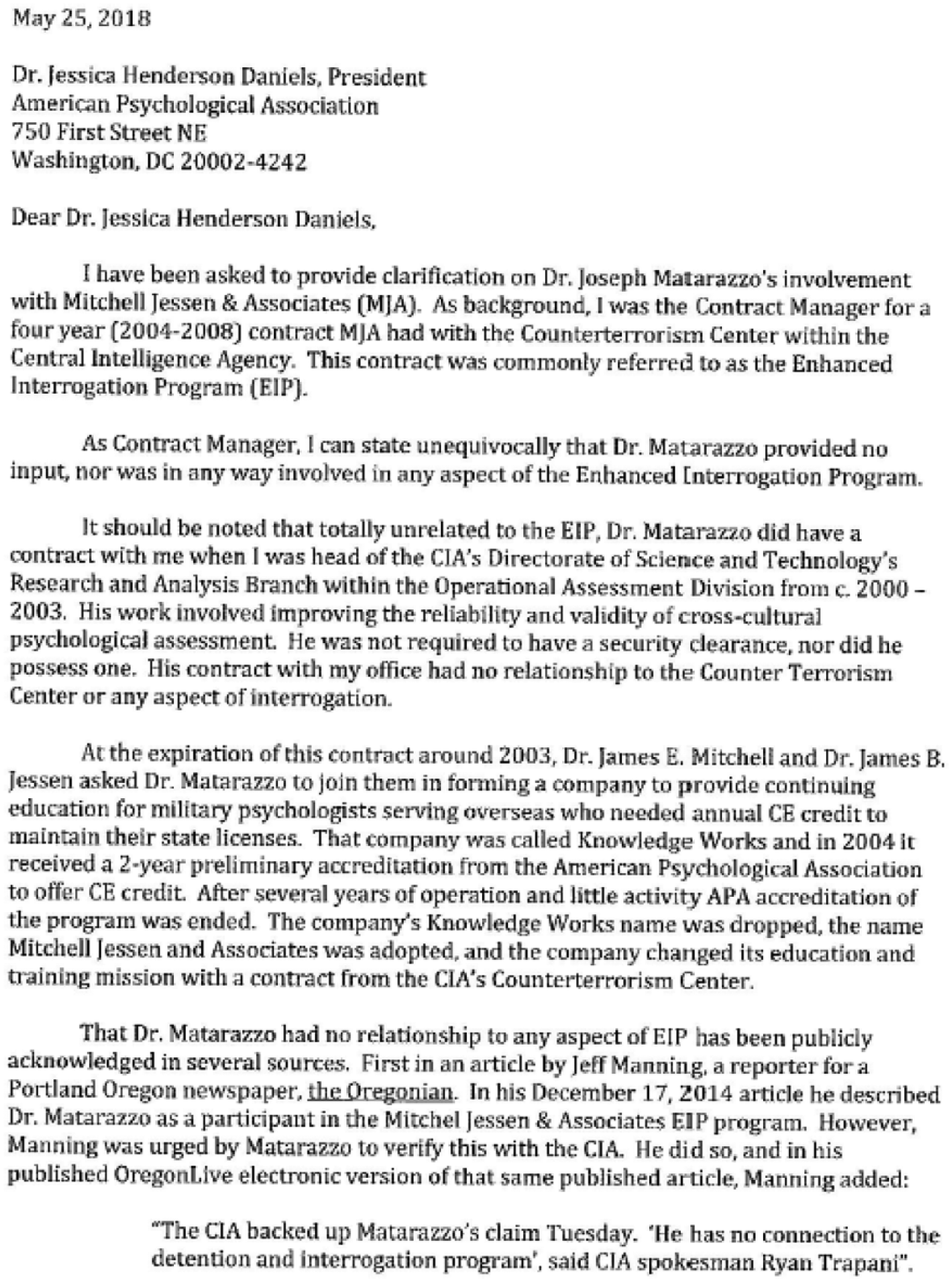


Needless to say, I was very pleased with Hubbard’s letter as well as the implications in APA President Jessica Henderson Daniel’s reply to me. I believe these three letters should begin the process of repair, and I have little doubt that the reputations of those of us who were maligned in the Hoffman report will be restored.
My last contact with the CIA consisted of a letter from Kirk Hubbard asking if I believed sleep deprivation constituted torture. I had covered the literature on this topic in an annual lecture to medical students and felt qualified to offer an opinion. Hubbard’s question consisted of 11 subparts, each dealing with an issue related to sleep deprivation. After I answered the items in the questionnaire, I felt my opinion would be insufficient to what I sensed were his needs. Accordingly, I sent the questionnaire to five prominent psychologists who I knew had done research on the subject, or had published in an area relevant to the query. I received their replies within a week and returned all five plus mine to Hubbard. From the research I had read on the subject, I was not surprised that all six of us agreed that, although annoying or uncomfortable, sleep deprivation was not torture. However, I do believe that sleep deprivation could be a form of torture when combined with multiple other techniques capable of breaking resistance.
I will end by sharing my belief that, in time, the damage the issue of “torture” has wrought on a number of American psychologists and the APA will have been corrected. Herd mentality on an even larger scale has occurred before in our country. As an example of why I am optimistic, I note that the passage of time has restored the reputations of many individuals who were falsely accused during the 1950s by Senator McCarthy. I firmly believe that restoration also will happen for those of us who have been unfairly portrayed in the media and in the Hoffman report.
Footnotes
Funding
The author(s) received no financial support for the research, authorship, and/or publication of this article.