




Abstract
Self-efficacy, denoting the degree of confidence an individual has in carrying out a specific activity, was initially discussed in the 1970s as a potential correlate of disease outcomes. Drawn from 35 years of related research, this review provides an updated understanding of the concept of self-efficacy and its relevance for arthritis management. There is a consistent link between self-efficacy, arthritis pain and disability, and adherence to recommended therapeutic strategies. A wide variety of intervention strategies improve arthritis self-efficacy, as well as outcomes. Steps to assess and intervene thoughtfully to maximize self-efficacy beliefs are likely to impact arthritis disability outcomes quite favorably and significantly, regardless of disease type, duration, or sociodemographic factors.
Introduction
Over 35 years ago, Albert Bandura (1977) proposed that the psychological variable of self-efficacy, a construct denoting one’s belief in his or her ability to successfully organize and implement a specific task, was a significant mediator of behavior. Bandura also proposed self-efficacy beliefs, which can be strengthened, potentially explained the discrepancy between having knowledge about a skill and the actual performance of this skill. Over the years, he and others have strongly supported the view that self-efficacy beliefs are predictive of motivation levels, thought patterns, moods, emotional reactions, and attitudes that can mediate the capacity and willingness to elicit behaviors that promote health (Bandura, 1977, 1986a, 1986b, 1997; Van der Bijl and Shortridge-Baggett, 2001), despite disconfirming experiences. Moreover, Bandura’s (1986a, 1994) research has supported the view that self-efficacy judgments can determine the extent to which a person will perform the adaptations needed to deal with chronic illness and its treatment.
In addition, this work points to how much effort will be expended on a task—and for how long—in the face of obstacles and aversive experiences (Bandura, 1997; O’Leary, 1985). Accordingly, in 1997, Bandura argued that because they are fundamental to many health-related behaviors and practices, self-efficacy beliefs were likely to be of immense importance in the context of influencing health outcomes among people with chronic illnesses such as arthritis. This is not only because self-efficacy beliefs predict the amount of effort and perseverance expended in reaching a goal, but they specifically influence the selection of goal-directed behaviors, in addition to the development of realistic goals (Berarducci and Lengacher, 1998).
The arthritic diseases, comprising over 100 forms of joint- and muscle-related disorders, continue to pose an immense burden on both the affected individual and the society (Baruth et al., 2013). Commonly associated with intractable pain, fatigue, weakness, functional and psychosocial limitations, plus progressive physical disability, and affecting millions of people worldwide, these conditions can be extremely debilitating. Moreover, several forms of arthritis, such as rheumatoid arthritis, systemic lupus erythematosis, and juvenile rheumatoid arthritis, are commonly associated with systemic problems that can severely magnify the extent of the prevailing disability and can challenge the affected individual’s coping capacity quite substantively (Arthritis and Related Conditions, 2011). The absence of a cure for any form of arthritis, the harmful side-effects of commonly used pharmaceutical strategies, the unpredictable waxing and waning of one or more physical aspects of the disease, and the immense psychological impact of all of these disabling conditions render the successful management of all forms of arthritis extremely challenging (Marks and Allegrante, 2007).
To this end, current researchers in the field emphasize the importance of minimizing disability and maximizing independence and life quality of the affected individual by assessing and treating both the biological as well as the psychological consequences of these conditions (e.g. Orengo et al., 2001; Somers et al., 2009a). In particular, given the link between a variety of human behaviors and several prevalent disease consequences of arthritis (Gaines et al., 2002; Harrison, 2004; Makelainen et al., 2009; Maly et al., 2005; Pells et al., 2008), and between self-efficacy and behaviors (Arnstein, 2000), Sharma et al. (2003) strongly supported a key role for continuing to examine the role of self-efficacy and its application in the context of strategies to optimize arthritis outcomes, such as modifying their activity levels and following complex medication regimens (Taal et al., 1993b).
However, even though self-efficacy has become a strong explanatory factor in efforts to help people deal with a variety of chronic diseases such as arthritis (Larkin and Kennedy, 2013; Rapley and Fruin, 1999; Sperber et al., 2013) and having the confidence to exercise, a crucial behavior among others for managing most arthritis conditions significantly improves the physical, social, as well as the health status of persons with arthritis (e.g. Der Ananian et al., 2008; Wright et al., 2008), very few current arthritis-related publications focus on the possible important assessment and treatment opportunities afforded by the insightful application of self-efficacy and its theoretical principles.
In light of the increasing role of health behaviors as mediators of health status, and the fact that adults with arthritis are required to often carry out highly complex novel behaviors, but may not be confident to do so, it was felt a comprehensive updated exploration of this topic could thus be very useful, first for extending our understanding of how this body of literature might be applied to better understand a variety of arthritis-related clinical features, and second, for guiding a more successful and efficacious clinical care process for people with arthritis, to manage their illness, in general. This review thus specifically focuses on examining some relevant past and current research concerning the link between behavior specific self-efficacy beliefs and one or more aspects of arthritis disability as reported over the past 35 years since Bandura brought his ideas to our attention, including the various attributes or dimensions of self-efficacy assessed in the context of arthritis. It also describes actual processes for enhancing self-efficacy directly, as well as what approaches may work to enhance self-efficacy indirectly. Although quite diverse, it was felt this information would be particularly helpful in efforts to better comprehend how certain confidence perceptions can explain the persistence of various symptoms, as well as suboptimal self-management behaviors that can negatively influence arthritis morbidity (see Tables 1 and 2). Some management strategies commonly recommended for minimizing the physiological, physical, or psychosocial consequences of arthritis where perceived confidence to carry out one or more of these tasks might make a significant difference to health outcomes are described in Table 3. Finally, tasks and behaviors people with arthritis may need to learn (Table 4) and the related implications of this research are discussed.
Some important physical and psychosocial manifestations of arthritis that may impact self-efficacy perceptions.

Some medical and nonmedical factors that may influence arthritis morbidity adversely if not remediated.

Management strategies commonly recommended for people with arthritis.

Behaviors or tasks people with arthritis may need to learn to effectively self-manage their condition.

This specific approach was implemented in light of the immense disease burden experienced by people with disabling arthritis worldwide, which shows no abatement despite modern technologies, and the fact that only one review paper on this potentially useful set of understandings could be located on PubMed, and this was published in 2001. Among six other reviews, retrieved using the key words arthritis and self-efficacy, two focused solely on osteoarthritis, and three on chronic illness or disability, and no current experimental reports were forthcoming on how building self-efficacy strategically can influence arthritis outcomes. There is currently no body of work consolidating the available research related to self-efficacy and arthritis, and its utility, despite the potential importance of revisiting and consolidating the research in this area. Consequently, this review specifically attempted to fill this gap by examining
the various self-efficacy attributes or dimensions that have been studied among arthritis samples over the past 35 years and their implications for practice and/or future research;
whether there have been consistent associations between these various self-efficacy attributes and arthritis symptoms and outcomes over the past 35 years;
whether there is any evidence of a dose–response effect between specific self-efficacy perceptions related to pain control, coping, management behaviors, and arthritis outcomes, and
whether it is possible to increase arthritis self-efficacy, and if so, what are possible best practice approaches.
Methods
To achieve the aims of this review, all relevant publications located in the Cumulative Index to Nursing and Allied Health Literature (CINAHL), Medline, PubMed, PsychINFO, Science Direct, Web of Knowledge, and Social Science Citation databases covering the years 1980–2014 were sought. To be included in the present review, only English language publications concerning arthritis disability and self-efficacy were deemed acceptable. The specific studies retrieved were categorized as either descriptive correlation or prospective studies with either theoretical or nontheory-based intervention protocols. The key search terms used were “arthritis” and “self-efficacy.” Studies detailing instrumentation processes related to the topic, those discussing diseases other than arthritis and those focused on chronic diseases, in general, were excluded (see Figure 1).

Literature review strategy summary.
Although the desired information was extracted from the available documents in a systematic way, no systematic review was conducted, given the many varied tools or approaches used to assess and/or estimate self-efficacy, the varied domains of self-efficacy assessed, the varied diseases studied, and their varied sampling strategies and research designs. Instead, in accordance with Bandura’s (1977, 1986b) belief that self-efficacy is an important behavioral mediator and may predict future behaviors (Jensen et al., 1991), this review examined whether this body of collective research constituted largely by cross-sectional data supports the view that arthritis disability may be impacted negatively by low self-efficacy perceptions and positively by efforts that enhance self-efficacy perceptions.
Since self-efficacy is a psychological attribute amenable to intervention, support for the efficacy of implementing theoretical as well as nontheoretical self-efficacy enhancing interventions to improve the performance ability of people with arthritis as outlined in Figure 2 was sought.

Hypothetical model of possible intermediate, primary, and secondary outcomes of utilizing self-efficacy enhancing strategies in the conservative management of arthritis.
Results
Among the articles that matched the search criteria, 873 related articles were found listed in PubMed, 625 in Web of Science, 700 in Science Direct, 312 in PsychINFO were listed, 213 were listed in CINAHL, 254 papers were listed in the Science Citation Index, and 210 related papers were listed in Academic Search Complete. Many listings overlapped and some were excluded if they were listed, but did not address the topic in question. Among the 200 articles employed for this review extracted from the various databases, articles that addressed issues related to arthritis management were included as required to provide a context for the challenges people with arthritis face and are required to deal with and adapt to (see Tables 3 and 4).
The specific studies detailing self-efficacy and some form of arthritis or arthritis symptom were divided into those that were cross-sectional in nature, and those that were prospective. Among those that were prospective were several clinical observational studies, and intervention studies, classified as theoretically based if they followed explicit recommendations for enhancing self-efficacy, and nontheoretical if self-efficacy was not specifically the target intervention.
Clinical studies linking arthritis self-efficacy to arthritis outcomes
In terms of evaluating the contribution of self-efficacy beliefs to one or more key arthritis outcomes, the literature reveals a broad array of 25 cross-sectional studies dating back to the 1980s that have examined the magnitude and direction of the theorized association between the concept of self-efficacy and arthritis functioning across several diverse domains, and among an array of arthritis sufferers (e.g. Gaines et al., 2002; Harrison, 2004; Maly et al., 2005). Others such as Taal et al. (1993a) have examined whether adherence to self-management strategies is related in part to their self-efficacy beliefs, whether there is a dose–response between self-efficacy magnitudes and symptom presentation, and the relationship of self-efficacy to arthritis symptoms (see Table 5).
Selected studies demonstrating statistically significant relationships between self-efficacy levels and key variables of importance in the management of arthritis, regardless of sample, or self-efficacy attribute assessed.
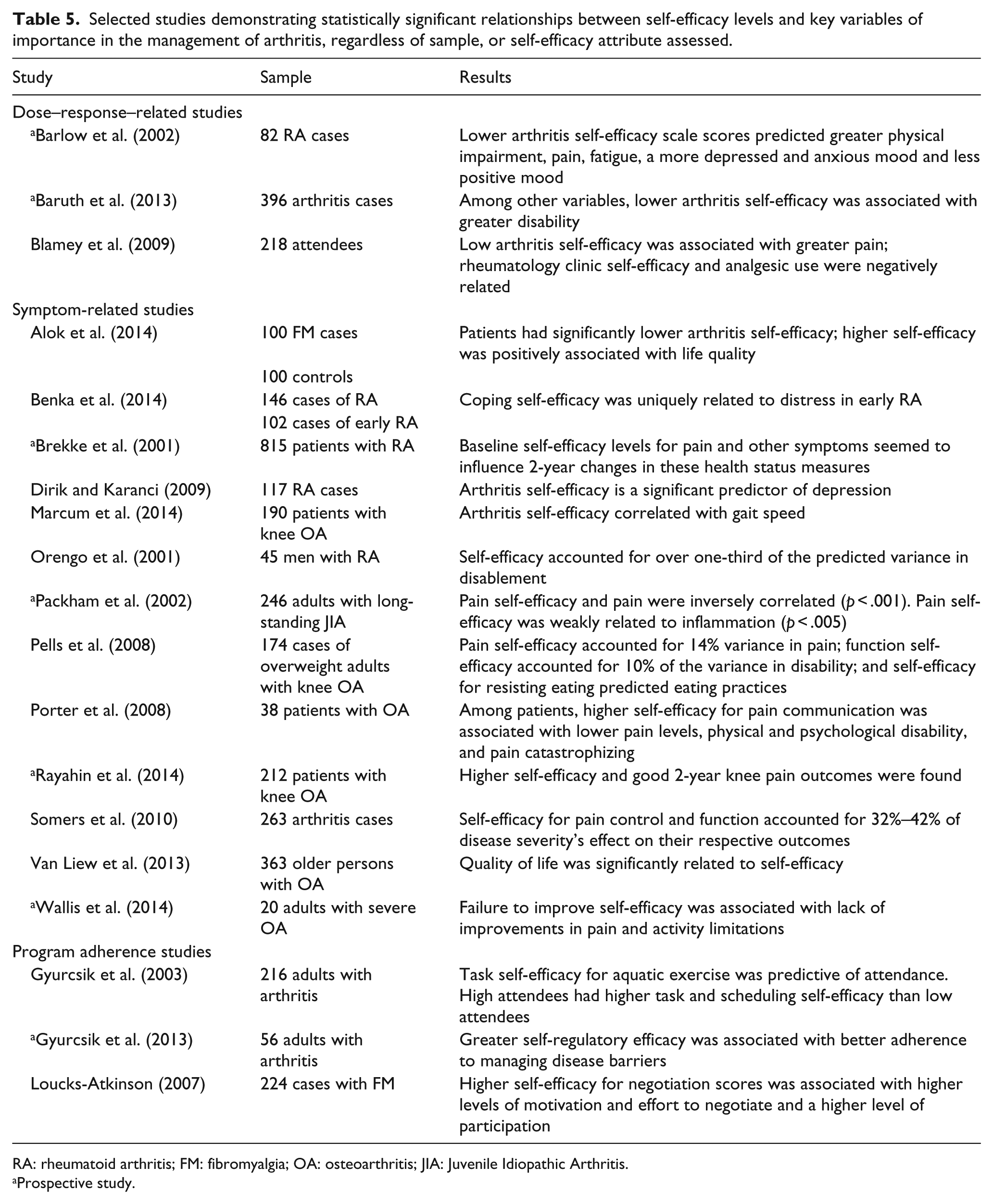
RA: rheumatoid arthritis; FM: fibromyalgia; OA: osteoarthritis; JIA: Juvenile Idiopathic Arthritis.
Prospective study.
Cases studied have predominantly included adults diagnosed as having varying degrees of disabling rheumatoid arthritis, osteoarthritis, and fibromyalgia, and the attributes of self-efficacy, predominantly studied as a behavior specific construct, have been assessed most consistently by the instrument developed by Lorig et al. (1989) that focuses on pain self-efficacy, self-management, and functional self-efficacy. However, self-efficacy for exercise, task self-efficacy, coping self-efficacy, self-efficacy for negotiation, scheduling self-efficacy, and mobility-related self-efficacy, as well as self-efficacy for weight reduction are among other domains that have been examined.
Despite this highly heterogeneous collection of research issues, instruments, samples, and design, among other factors outlined in Table 5, a consistent theme that emerges is that the level of perceived confidence in one or more behavioral domains is strongly associated with the magnitude of one or more disease-associated features, regardless of sample studied or instrument applied. Self-efficacy also correlates consistently with adherence to behaviorally oriented regimens, and appears to produce a variety of dose–response–related health outcomes. That is, notwithstanding the limitations of interpreting this broad array of cross-sectional and prospective data, a less than optimal level of confidence to carry out one or more essential behaviors related to the self-management process appears consistently related to an arthritis sufferers’ pain (Pells et al., 2009; Sinikallio et al., 2014), regardless of arthritis diagnosis (Brekke et al., 2001; Buckelew et al.,1994; Buescher et al., 1991; Keefe et al., 1997a; Packham et al., 2002).
The strength of an arthritis patient’s self-efficacy perceptions also consistently correlates with measures of functional status in a linear manner (Maly et al., 2006; Rejeski et al., 2001; Sinikallio et al., 2014), regardless of disease type, study sample, or sampling methods, or when differences in disease-associated variables and personality are controlled for (Benka et al., 2014). According to Somers et al. (2010), self-efficacy also clearly mediates the relationship between disease severity and pain and functioning, and in cases of older adults with knee osteoarthritis, functional self-efficacy explained the greatest amount of variance in all physical performance measures as determined by step-wise linear regressions (Maly et al., 2005).
In other studies, self-efficacy levels also explained differential disease responses (Bolen et al., 2010), as recently discussed by Allen et al. (2010) and Greene et al. (2006); health status (Cross et al., 2006); depression levels (Broderick et al., 2011; Dirik and Karanci, 2009); fatigue (Van Hoogmoed et al., 2010); life quality (Broderick et al., 2011); problems with medication adherence (Spruill et al., 2013); coping capacity (Gyurcsik et al., 2009); and adjustment efforts among people with rheumatoid arthritis (Lowe et al., 2008).
Additional correlations exist between prevailing levels of self-efficacy and extent of activity participation (Baruth et al., 2014; Dekker et al., 2009; Huffman et al., 2014; Hutton et al., 2009; Leveille et al., 2003), an essential component of arthritis management.
Self-efficacy for exerting control over stressors, and for effectively mobilizing the social network, also influences arthritis outcomes such as anxiety and depression (Dirik and Karanci, 2009; Lowe et al., 2008). Other research shows that fatigue, commonly associated with inflammatory arthritis (Riemsma et al., 1998); coping ability (Benka et al., 2014); and resilience, an important factor in predicting pain and physical functioning in people with arthritis, are consistently impacted by the nature of a person’s self-efficacy appraisals (Wright et al., 2008). Other data reveal that arthritis self-efficacy beliefs can affect the extent of analgesic usage (Blamey et al., 2009), participation in leisure time physical activities (Reinseth et al., 2011), adaptation or adjustment to one’s condition (Packham et al., 2002; Wright et al., 2008), the ability to resist excessive eating (Pells et al., 2008; Somers et al., 2014), and the ability to communicate about pain (Porter et al., 2008).
In short, even though Benyon et al. (2010) found no relationship between self-efficacy and pain as predictors of osteoarthritis outcomes in a systematic review, arthritis disability and the magnitude of an individual’s self-efficacy perceptions for managing their health condition appear to be consistently related in a dose dependent manner when taking all forms of arthritis and domains of self-efficacy. This cumulative body of ongoing research thus continues to support the view that efforts to both monitor and strengthen a patient’s self-efficacy appraisals (Brassington et al., 2002), which are amenable to change through various education programs and other strategies (Cross et al., 2006), may offer a potentially important, but often overlooked channel of opportunity for ameliorating the pervasive negative effects of arthritis on the affected adults’ physiological, emotional, occupational, and social well-being, as outlined recently by McKnight et al. (2010) and Benka et al. (2014).
Conversely, careful examination of self-efficacy perceptions and attempts to minimize the impact of low self-efficacy appraisals may specifically foster heightened psychological well-being (Benka et al., 2014) and better adjustment to the disease (Wright et al., 2008). Furthermore, thoughtful application of the self-efficacy concept can produce higher activity levels (Leveille et al., 2003), better exercise adherence (Gecht et al., 1996), improved performance ability (Gaines et al., 2002; Mendes de Leon et al., 1996; Strahl et al., 2000), more favorable self-reported pain task difficulty ratings (Rejeski et al., 1996), while fostering psychological thriving (Sirois and Hirsch, 2013) and general perceptions about functional ability (Mendes de Leon et al., 1996) among people with arthritis, regardless of level of physical function.
Consequently, efforts to help optimize self-efficacy for a variety of behaviors are arguably highly salient in efforts to yield more favorable outcomes for people with an arthritic condition than those attained when ignoring such efforts. Since the self-efficacy concept does not seem to have impacted the design of arthritis treatments as consistently as one might expect given its importance as a predictor of arthritis outcomes, the next section of this review examines the extent to which efforts to enhance arthritis self-efficacy directly as well as vicariously can indeed heighten the self-efficacy beliefs of arthritis sufferers, and if so, whether these are accompanied by positive changes in health outcomes believed to be associated with self-efficacy beliefs in selected cross-sectional studies outlined in Table 5 or in the above discussion.
Intervention studies linking self-efficacy to arthritis outcomes
In terms of prospective evidence linking perceived self-efficacy beliefs and arthritis outcomes, there are currently approximately 20 studies which have reported on interventions designed to improve self-efficacy among arthritis cases or on self-efficacy outcomes following interventions. Initiating this body of research was the work performed by Holman et al. (1989) who developed a comprehensive arthritis self-management intervention known as the Arthritis Self-Management Program (ASMP) where participants exhibited consistent significant early and sustained clinical improvements that seemed closely linked to changes in the participant’s self-efficacy scores for pain and managing fatigue. Strong support for self-efficacy as a salient outcome predictor was forthcoming after that, given that program participation not only heightened self-efficacy test scores but also reduced medical services usage and related health-care costs (Lorig et al., 1993), a finding later supported by several independent researchers (e.g. Barlow and Barefoot, 1996; Barlow et al., 1999; Braden et al., 1993; Cross et al., 2006, Davis et al., 1994; Leung et al., 2014; Nuñez et al., 2009; Taal et al., 1993b; Yip et al., 2008).
In accord with study results of Braden et al. (1993), Lorig and Gonzalez (1992) and Lorig and Holman (1993), 12 years after implementing the ASMP, Allegrante et al. (1993) who conducted a comprehensive hospital-based patient education program for people with knee osteoarthritis based on self-efficacy theory found that taking steps to specifically enhance the patient’s self-efficacy for walking produced significant and clinically meaningful improvements in the patient’s functional status without an increase in pain.
As part of this randomized controlled study, 47 patients with moderate to severe knee osteoarthritis, ages 40–89 years, participated in an 8-week walking education program conducted for 90 minutes three times per week for groups of 10–15 patients. Each session included direct instruction by a trained interventionist or a guest speaker on a topic of special interest, social support, light physical activity, and walking. Participants also received a manual describing exercises to be learned, a videotape and audiocassette about walking, and a diary in which they were asked to record their physical activity levels during the study. To enhance self-efficacy and task mastery, experimental group participants were exposed to the four strategies recommended by Bandura (1977, 1986b) for increasing behavioral competence, namely
facilitation of task mastery;
exposure to direct or vicarious walking experiences;
social and verbal encouragement and persuasion;
assistance in dealing with emotions believed to potentially impede adherence to walking.
Carefully organized into four successive phases that incorporated well-established methods for fostering the desired behaviors, including shaping and guiding, contracting, maintenance, and relapse prevention strategies, the results of this study strongly supported the beneficial application of self-efficacy theory in enhancing short-term outcomes for persons with disabling knee osteoarthritis.
In another study of patients with rheumatoid arthritis, Taal et al. (1993b) attempted to help participants adjust to their exercise, rest and medication regimens, and to the varying nature of the disease. They did this by helping them make the right decisions about required adjustments to their treatment regimens and how to carry out desired “self-management” behaviors. Based on Bandura’s (1977, 1986b) Social Cognitive Theory and the ASMP developed by Lorig and Holman (1993), the program goal was to strengthen the individual’s perceived self-efficacy, outcome expectations, and self-management behaviors and ultimately to better their health status. The program, which was evaluated prospectively, established significant positive effects for the group for functional disability, joint tenderness, the practice of relaxation and physical exercises, self-management behaviors, outcome expectations, self-efficacy for overall function, and knowledge. Positive results of the intervention for the practice of exercise, self-efficacy for function, and knowledge were still evident 14 months after implementation.
Hammond et al. (1999) similarly applied the self-efficacy construct to the design of an educational–behavioral joint protection program for 35 people with rheumatoid arthritis. The strategies this group used to maximize joint protection adherence, which were partly similar to those advocated by Jensen and Lorish (1994), included goal setting, contracting, modeling, homework programs, motor learning theory, recall enhancing methods, and mental practice. Although no significant changes in pain, functional disability, grip strength, self-efficacy, or helplessness were reported post-education, joint protection strategy usage was significantly increased at the 12- and 24-week follow-up. The sample was quite small, however, and the study may also have been too short in duration to demonstrate anticipated functional improvements. This is supported by a more recent study reported by Hammond and Freeman (2001) that detailed outcomes of a similar joint protection program for 65 people with rheumatoid arthritis after 1 year. In the latter study, as in the first study in 1999, the positive findings that adherence to the learned joint protection techniques was facilitated by the cognitive-behavioral strategies employed suggested that these strategies were effective for facilitating performances of the recommended behaviors.
In another study, after combining the principles of self-management, adult learning, case management, and self-efficacy enhancement in an interdisciplinary program that integrated group and individualized treatment, Alderson et al. (1999) reported significant increases in self-efficacy among 57 persons diagnosed as having arthritis who participated in such a program. These improvements were noted immediately following the program and were sustained for up to 6 months after the program. Disability and pain also decreased over the follow-up period.
Similarly, Brekke et al. (2003) who conducted a longitudinal observational study of 306 patients with rheumatoid arthritis over a 5-year period showed that changes in self-efficacy regarding pain as well as other symptoms were positively related to changes in perceived health status as outlined in Figure 2. This study also revealed that high levels of self-efficacy at baseline were positively related to improved pain perception after 5 years and that mental distress at baseline was related to reduced self-efficacy after 5 years.
Piyakhachornrot et al. (2011) who developed an integrated health education program including exercise based on self-efficacy theory that aimed to enhance self-efficacy expectations among patients with knee osteoarthritis showed positive results in a recent quasi experimental study. In terms of mastery experiences, patients were trained to precisely carry out their exercise regimens. They received demonstrations on how to do this and watched a patient with a similar condition carry this out. They were specifically encouraged to engage in exercise or perform activities related to reducing knee symptoms they had learned. To reduce emotional arousal, they discussed and shared strategies for reducing barriers to exercise and participants were trained until they felt confident to exercise.
Other interventions studied prospectively and found to impact arthritis self-efficacy and symptoms indirectly and favorably and that support a self-efficacy disease presentation link include the following: aquatic programs (Guo et al., 2009), cognitive-behavioral self-help interventions (Garnefski et al., 2013; Shigaki et al., 2013), exercise and dietary weight loss interventions (Focht et al., 2005), exercise and education interventions (Grønning et al., 2012; Hopman-Rock and Westhoff, 2000), tai-chi (Waite-Jones et al., 2013), and yoga (Evans et al., 2013) (see Table 6).
Selected intervention methods found to impact arthritis self-efficacy and symptoms vicariously and positively in prospective studies.

OA: osteoarthritis; RA: rheumatoid arthritis.
Recommended approaches for promoting arthritis self-efficacy.

Source: Adapted from Allegrante et al. (1993), Hammond et al. (1999), Lorig et al. (1993), Primdahl et al. (2011a, 2012), and Reinseth et al. (2011).
Anticipated impact of heightened self-efficacy beliefs on arthritis outcomes.

In addition, self-management programs, combined with adaptive pain coping skills training interventions and social emotional support to strengthen self-efficacy expectations (Taal et al., 1993a), may further enhance self-efficacy cognitions, plus the physical and psychological status of individuals with arthritis (Keefe et al., 1997a). Educating spouses, significant family members, and care-givers may also impact favorably upon a patient’s expectancies about their ability to control arthritis-related symptoms, such as pain and functional limitation (Beckham et al., 1995; Keefe et al., 1996, 1997b; Martire et al., 2003). However, very few studies have been designed to specifically impact self-efficacy directly, and to test whether this systematic theory-based self-efficacy enhancement approach is superior to that attained through nonspecific treatment approaches. Consequently, it is also unclear as to whether self-efficacy improvements observed in relation to a range of different interventions actually have a significant effect on or mediate the changes in the behaviors or symptoms that were observed in these studies.
Practical programmatic approaches and suggestions
In terms of seeking to apply self-efficacy theory to maximize arthritis outcomes, the literature on this topic strongly suggests that a direct focus on the development of self-efficacy or enhancing the patient’s prevailing self-efficacy in one or more domains will prove more valuable than not, even if indirect methods can heighten self-efficacy. Among the different methods for enhancing task or behavior specific self-efficacy, Bandura (1986b, 1997) and Strecher et al. (1986) originally suggested that clinicians try to: (1) identify and reinforce the patient’s past and present successful accomplishments, (2) direct the patient to observe successful behaviors of others, (3) provide positive feedback for the patient’s efforts or encourage people in the patient’s social network to do this, and (4) try to ensure their patients interpret their feelings correctly.
For example, if a patient in pain feels anxious about undertaking a new behavior such as exercising, the clinician might explain that their anxiety is justified, given what the patient is being asked to undertake, but that once the requisite skill is acquired, their pain will abate. They could also direct the patient to observe others similar to them carrying out the activity and experiencing a successful outcome. Because self-efficacy is strengthened by actually performing the task in question, rather than just discussing this (Blazer, 2002), the clinician may want to adopt a skills-based learning approach and help the novice patient to carry out the actual task requirements in a step by step fashion. The clinician can also offer timely and positive reinforcement and encouragement as the new skill is practiced and learned.
This approach of employing several principle sources of efficacy information successively to promote self-efficacy as outlined by Bandura (1977), including performance attainments, vicarious learning, verbal persuasion, and physiological feedback, was successfully employed by Kovar et al. (1992) who designed a multipronged intervention to heighten the well-being of older adults with knee osteoarthritis. To this end, this group employed a variety of learning activities that included lectures, discussions, brainstorming, demonstrations, goal setting, modeling, and mutual aid and support using a team approach, discussions, demonstrations, an exercise component, and a social component to provide an array of strategies believed to foster self-efficacy. Patients were also encouraged to work collaboratively with their leader and with each other to achieve their goals, and positive achievements were duly rewarded and reinforced.
Hammond et al. (1999), who attempted to enhance adherence to a joint protection program for people with arthritis, believed to be enhanced by fostering self-efficacy for this task, similarly included goal setting, contracting, modeling, homework programs, and recall enhancing methods in the implementation of that program. As supported by motor learning principles, these joint protection strategies were carried out incrementally, which is an important concept in building self-efficacy. As proposed by Bandura (1977), the learning process employed to build the patient’s confidence also involved a composite of verbal, visual, and kinesthetic instructions, supported by extrinsic feedback on performance achievements. In addition, subjects used mental imagery techniques and practiced in pairs or threes to improve skill acquisition. Finally, to promote generality of the motor learning experiences and self-efficacy expectations—the belief that the outcome of the behaviors will yield a specific result—attained under supervision in the investigator’s laboratory to the home environment, self-management and self-monitoring strategies were used. In agreement with the acknowledged role of encouragement and persuasion in enhancing self-efficacy beliefs, support for the desired changes was enhanced by inviting patient’s partners or significant others to attend the classes. The partners or significant others were asked by the investigator to help promote the patient’s use of the recommended novel practices at home and to assist with any required home modifications. The program and follow-up measures were implemented for only a short duration, however, and hence more powerful effects that might have accrued in the long-term might have been overlooked, in light of the challenges experienced on a day-to-day basis by this patient group, and the ability to learn a new skill in the face of pain, numerous task demands, and physical disablement.
More recently, Hammond and Freeman (2001) extended their ideas to helping their patients to acquire confidence in hand-joint protection methods by providing participants with a range of options for task performance, so that patients could select those methods they felt would work best for them. Again, a step-by-step approach was used, whereby practice started with blocked repetitions of single actions and progressed to sequences of activities requiring multiple joint protection methods. Mental rehearsal was included, as were contracting and goal-setting strategies designed to promote practice of joint protection at home between meetings. Participants were encouraged to write their goals in workbooks, and feedback was given on progress and problems at the beginning of each meeting. Individual’s practical problems were also discussed and group members used problem-solving methods to generate solutions.
In previous research, Alderson et al. (1999) developed an equally successful integrated group education and individualized treatment program using principles of self-management, adult learning, case management, and self-efficacy enhancement. The outcomes of the program suggested this combined approach is a very potent one.
Resnick (2002a) who conducted research to better understand the factors that can influence the efficacy beliefs of older adults as regards being motivated to participate in a rehabilitation program identified 11 major themes amenable to intervention. These included the following: motivation and verbal encouragement, having exposure to positive role models, being able to deal effectively with patient’s past experiences, and current aversive physical sensations.
Additional research has shown that for purposes of enhancing pain self-efficacy, a problem of major concern to all patients who suffer from arthritis: (1) the clinician should assess the extent of pain experienced by a patient during a demanding activity; (2) they should train the individual in pain reduction skills through relaxation, distraction, or imagery; (3) they should have the patient repeat the demanding activity while applying the acquired pain reduction skills and monitor the improvements in pain that result (O’Leary et al., 1988). In addition to educating patients to better manage pain, educating them to cope with disease flares and any disease progression, helping them to understand why and how emotional reactions can affect their disease status, may be of additional value in helping to increase a patient’s repertoire of coping responses (Barlow et al., 2002). Moreover, structuring exercise treatments in such a way that mastery experiences and positive feedback are maximized is recommended (Jerome et al., 2002).
Furthermore, cognitive-behavioral interventions designed to affect the perceptions of control and the individual’s coping patterns (Hammond and Freeman, 2006; Sinclair et al., 1998), along with coping skills training and related educational interventions, are found to enhance arthritis self-efficacy with respect to mood and fatigue, physical capacity, pain, disability, and function (Keefe et al., 1996; Lorig et al., 1989; Smarr et al., 1997; Stenstrom, 1994).
Additional evidence suggests, a sound patient–therapist relationship that permits mutual inquiry, information-giving, problem solving, and the negotiation of activity goals may foster a patient’s sense of confidence, as may setting short-term, rather than long-term goals for some desired achievement (Bandura and Schunk, 1981; Jensen and Lorish, 1994). That is, implementing a series of modest progressive behavioral changes over short time periods is more likely to result in observable increases in task self-efficacy than unrealistic long-term goals that do not incorporate well-designed successive action steps (Bandura and Simon, 1977; Jensen and Lorish, 1994), and achievable sub-goals. Starting with the easiest task or the task most likely to be successful is also indicated here, as are mastery aids that can be gradually withdrawn, plus role plays and homework (Lorig, 1986). Furthermore, practicing activities in venues and situations that closely approximate the actual activities patients need to perform in their daily lives may be helpful (Gage and Polatajko, 1994).
However, because an individual is less likely to perform an activity if they feel less than confident of achieving success, the role of prior negative experiences should be addressed early on, and a constructive plan of action developed to permit the patient to overcome any perceived barriers in this respect (Barlow et al., 1998).
In sum, many practical strategies exist to assist the clinician in raising the self-efficacy beliefs of individuals with various forms of arthritis. One or more of these approaches if thoughtfully applied have been found to foster better health outcomes than those achieved with standard practices of care.
Discussion
Self-efficacy, contextualized in this review as personal beliefs likely to be of immense importance in the context of influencing health outcomes among people with chronic illnesses such as arthritis and representing the strength to which one has the confidence to undertake a specific task, under a variety of conditions, is a well-accepted theme in the psychology literature. Given the accepted understanding that arthritis has both physical and psychological ramifications, this present review was undertaken to validate whether self-efficacy beliefs can either help to explain a significant degree of the overall attendant disability experienced by a person diagnosed as having arthritis, regardless of pathology, and if heightening self-efficacy perceptions is consistently accompanied by related improvements in disability outcomes, regardless of type of arthritis condition studied. In this respect, specifically examined were past and recent evidence linking the magnitude of the perceived self-efficacy scores of a variety of arthritis patient sub-groups and related disease manifestations, both those physical and cognitive, as well as functional and behavioral.
Although much of the related research remains cross-sectional, and thus no cause–effect relationship can be deduced despite findings that denote there is significant association between the extent of one’s self-efficacy beliefs and selected arthritis manifestations, prospective studies strongly support the view that regardless of numbers of affected joints, joint sites, or arthritis diagnosis, the role that self-efficacy perceptions or beliefs may play in mediating or moderating arthritis outcomes should not be ignored. In this respect, the present findings also concur with those of Primdahl et al. (2011b) who concluded self-efficacy scores assessed using the arthritis self-efficacy scale seem to be highly associated with physical disease-related variables in people with arthritis, regardless of study approach, evaluation tool, or sample studied. They also support the view of Dekker et al. (2009) that low self-efficacy is a risk factor for functional declines in cases with hip osteoarthritis.
Furthermore, several reports specifically indicate a strong relationship between levels of perceived self-efficacy and self-management behaviors (Prior and Bond, 2004), and adherence with exercise regimens (Brus et al., 1997; McAuley et al., 2003; Oliver and Cronan, 2002; Stenstrom, 1994), management approaches of great import to the preservation of joint health and general well-being of people with arthritis, regardless of form. Other findings show levels of perceived self-efficacy are negatively correlated with several commonly debilitating arthritis-related outcomes, such as fatigue and pain, and depression (see Table 5), but that bolstering a patient’s self-efficacy may help them to maintain an optimal level of physical function, despite the progressive nature of most of these diseases (Belza et al., 2002; Bent et al., 2001; Brassington et al., 2002; Oliver and Cronan, 2002). In particular, enhancing exercise self-efficacy, which is associated with exercise adherence (Gecht et al., 1996; McAuley et al., 2003; Oliver and Cronan, 2002) appears important for sustaining initial program benefits (Stenstrom, 1994) and physical activity goal achievement (Knittle et al., 2011).
Other research shows efforts to impact self-efficacy that lead to improvements in physical functioning are likely to yield significant early and sustained treatment benefits including the ability to manage arthritis pain and improved psychological well-being (Barlow et al., 1998; Holman et al., 1989). Importantly, these observed improvements are likely to be commensurate with those obtained by arthritis medications, while reducing utilization of, and dependency upon, health-care services (Lorig et al., 1993). Such outcomes, could in turn, reduce individual suffering as well as the collective societal burden of the disease, improve an affected individual’s life quality quite positively, and lessen current demands on an already overburdened health-care system. Tailored in light of an individual’s age, gender, ethnicity, health condition, socioeconomic status, and personal goals, carefully designed and implemented self-efficacy building interventions could permit people with arthritis to continue to be actively employed and independent, rather than dependent. In addition to the far-reaching economic consequences of this outcome, being able to work, which has enormous emotional health, physical health, and social implications, would in all likelihood prove highly efficacious (see Figure 2).
By contrast, arthritis patients with low perceived self-efficacy are likely to experience poor health outcomes, especially excessive pain (Daltroy 1993; Heiberg and Kvien, 2002; Somers et al., 2009a), physical disability, psychological disability (Shelby et al., 2008), and deleterious eating behaviors that lead to overeating and overweight (Pells et al., 2008). Furthermore, one can expect higher health-care costs (Walen et al., 2001).
It should be noted, though, that to be most efficacious, efforts to enhance self-efficacy among people with arthritis may need to be implemented over a long period of time, rather than a short period of time, and include different strategies for fostering different categories and degrees of task-related and symptom management confidence perceptions. Although it is unclear what specific approach is likely to prove optimal in heightening an individual’s arthritis self-efficacy level, the clinician should carefully select the intervention method(s) that will most closely achieve the desired outcomes for a given individual, in light of their disease presentation, and self-efficacy perceptions, and concentrate on those patients whose self-efficacy is weak in specific key self-management areas (Makelainen et al., 2009).
Conclusion
Arthritis, in any of its forms, is an extremely debilitating disease that requires a considerable degree of personal management. In this regard, a large volume of research strongly implies that optimally enhancing an individual patient’s perceived self-efficacy beliefs can be highly influential in fostering behaviors critical to an efficacious self-management process. Although no definitive conclusions can be reached in respect to either the frequency, duration, and intensity of interventions that will foster self-efficacy among people with arthritis, this review strengthens the basic support for this approach, and highlights the variety of ways Albert Bandura’s research can be applied to improve arthritis outcomes.
In the counseling domain, the present findings suggest that routinely assessing self-efficacy, which is easy to measure, and intervening accordingly thereafter, as indicated, is strongly recommended prior to simply communicating directives for a progressive series of weight reduction and dietary changes, as well as exercise and related health recommendations. To this end, making the importance of basic self-efficacy estimates in the context of arthritis treatment more visible in guidelines for standard care practices designed to enhance arthritis outcomes is also indicated. To foster confidence needed to achieve optimal arthritis health outcomes, careful assessment of factors influencing self-efficacy perceptions, such as prior experiences, extent of disease, availability of resources, and social support, followed by appropriately tailored self-efficacy enhancing strategies as outlined in this review to achieve mastery may be helpful, as indicated. Periodic re-assessments and a long-term, rather than a short-term, therapeutic relationship are deemed highly desirable in this respect, as is a mutual decision-making and communication process between the provider and patient.
Due to the very diverse nature of this body of literature, future research to examine the role of self-efficacy in mediating or moderating functional, social, emotional, and physical outcomes in specific arthritis sub-groups using random sampling, well-defined inclusion criteria, and validated instruments along with well-designed long-term prospective studies would be most helpful. Well-controlled intervention study comparisons testing whether theory-based approaches are more useful than nontheoretical approaches using validated outcome measures are also strongly indicated.
Footnotes
Declaration of conflicting interests
The author declares that there is no conflict of interest.
Funding
This research received no specific grant from any funding agency in the public, commercial, or not-for-profit sectors.