



Abstract
A decade on from the launch of Amazon's Alexa – the smart home's breakout product – the vision of semi-automated, pervasively sensed domesticity remains unrealised; industry losses are mounting; and big tech protagonists are in partial or full retreat from their smart home ambitions. Simultaneously, scholars draw attention to the dangers posed by the extractive business model underpinning this instantiation of the internet of things, in terms such as ‘data colonialism’, and call for an organised ‘unmaking’ of it. Against this backdrop, drawing on a 2 year study of six families living with smart home technologies (SHTs), we invoke the concept of ‘mundane resistance’, to describe the ways in which SHTs come to be diminished, or outright rejected, not by a singular user, but in the interplay of multiple members of the home in the course of their everyday participation in its moral economy. The outcome of these exchanges is a surveillance capitalism less panoptic than myopic. At a moment in time when the global economy is increasingly geared around the promise of generative AI, recognising the potential for such uncoordinated everyday acts to, in aggregate, disassemble the grand plans of the tech industry, is of considerable value. It serves both as a rejection of the industry's grandiose self-mythologising and as a statement of the ongoing importance of attending to the situated practices of everyday life, both in its repeating patterns and its quotidian idiosyncrasies.
Introduction
Capitalism's characteristic requirement for growth without end requires the regular identification of new markets from which value can be extracted. The tech industry's expansion in the first two decades of the 21st century was fuelled in large part by the colonisation of the public sphere via social media. Its capture, on private platforms like Facebook and Twitter (‘X’), has been a direct contributor to the ascent of Meta (Facebook), Alphabet (Google), Apple, and Samsung among the largest corporations in the world. Writing in 2025, it is generative AI which is the source of industry optimism for the ‘next big thing’, but for much of the preceding decade the Internet of Things (IoT), and in particular the ‘smart home’, was positioned as the new frontier where tech fortunes would be found.
The IoT posits a world in which the fabric of everyday life – from toothbrushes to bus stops – is embedded with digital technologies which plug it into global information systems, in doing so subjecting the material world and its attendant social practices to outside influences they were previously invisible to. Following its dazzling economic success with social media, the tech industry has sought to extend the same idea – using digital technologies to capture extant social exchanges within a gatekeepered process of economic valourisation – to new social domains. The smart home's application of the IoT to the mundane doings of everyday intimate lives is an attempt to integrate these most complex and rich social interactions with the networks of global capital, in the creation of a new site for ‘data colonialism’ (Couldry and Mejias, 2019; Goulden, 2021; Sadowski, 2019).
As van Dijck (2013) noted of the preceding application of this logic to the public sphere, ‘sociality is not simply “rendered technological” by moving to [a digital] space; rather, coded structures are profoundly altering the nature of our connections, creations, and interactions’ (p.20). Accordingly, emerging in response to the tech industry's investment in realising the smart home has been the critiques of its social consequences. Fears of pervasive digital panopticons capturing and exploiting our every waking and sleeping moment are a common feature of scholarly investigations of the IoT (e.g. DeNardis, 2020; Ehrenberg et al., 2023; Sadowski, 2020). In applying surveillance capitalism (Zuboff, 2019) to the most granular and intimate moments of people's lives, the threat of totalising disciplinary power is proffered: ‘smart tech is driven by the dual imperatives of digital capitalism: extracting data from, and expanding control over, potentially everything and everybody’ (Sadowski, 2020: 5).
The ‘smart home’ moniker was in use as early as 1984, and some of the underlying ethos dates back further still (Harper, 2003), but its current iteration really began in 2014 with the launch of the archetypal smart device, Amazon's Echo speaker, with its resident ‘Alexa’ virtual assistant. That same year Facebook – social media's own breakout product – celebrated its 10 year anniversary, announcing annual profits of $2.9bn. The smart home looked very different on its own decennial anniversary in 2024. Measured by reach, Alexa has been an enormous success – to date, Amazon claim over half a billion Alexa-enabled devices sold (Garfinkle, 2023) – and yet a decade on from Alexa's launch the smart home vision is in crisis. In July 2024, the Wall Street Journal reported on internal Amazon documents recording $25bn in losses from its devices division, between 2017 and 2021 (Mattioli, 2024). Separately, losses of $10bn in the same division were reported for 2022 alone (Nguyen and Kim, 2022).
Two observations immediately follow from these figures. Firstly, the sheer scale of the resources invested by the tech industry in remaking domestic sociality as a site of valorisation for their platforms. Given $35bn is only the losses for one company, over 6 years, it is safe to assume the overall investment over the past decade, by Amazon and its competitors in this space – including Alphabet, Apple, Sumsung, and Meta, besides countless smaller firms – is many times larger than this. In the underwriting of its ambitions, of capturing a new social domain as territory for capitalist extraction, the smart home has been an industry programme with few equals – or at least was, prior to the current level of speculative investment being funnelled into generative AI.
The second observation is that this programme has failed, and failed in a way that speaks to the ambition of this vision. Besides Amazon's losses, all the companies listed above have retreated partially or fully from their smart home offerings. There have seemingly been individual product successes – Amazon's Ring doorbell has become an increasingly common sight on the residential streets of the Global North for example – but the smart home vision was far more ambitious than this. The capturing of domestic life as a site of platform capitalism requires the smart home be an entire ecosystem of devices. This is evidenced by Amazon's experience of selling half a billion devices and yet losing billions of dollars – Alexa-enabled devices were sold as ‘loss-leaders’ intended to realise ‘downstream impact’ (Mattioli, 2024) – being various means of valourising domestic life. What was realised instead was, in the memorable words of an Amazon insider, ‘we've hired 10,000 people and we've built a smart timer’ (ibid.).
Given the scope of the smart home's goals, the failure to realise them inevitably has multiple sources. We do not seek to catalogue those sources here (many were noted relatively early on, e.g. Hargreaves and Wilson, 2017), but rather to draw attention to one which has previously been overlooked, namely quotidian acts of resistance between household members, when these technologies are introduced to the home. Commonly, considerations of technology adoption or rejection – even those dedicated to understanding the sociality of this process (e.g. Oudshoorn and Pinch, 2005) – focus on the relationship between designer, product and ‘user’, singular. Here, we use a Social Practice Theory (Reckwitz, 2002; Shove et al., 2012) frame to analyse a 2-year study of six UK families’ experience of living alongside smart home technologies (SHTs). We establish the importance of understanding the ‘user’ in the domestic sphere as a social unit – a household – with its own complex internal dynamics. From this beginning, we explicate the notion of ‘mundane resistance’, by which household members’ contestations of a technology's domestication (Silverstone and Hirsch, 1994) can, and do, result in that technology's partial or total abandonment.
Whilst their acceptance or rejection of fellow household members’ designs on their everyday shared doings may not be conducted wholly or even partially with any eye on the remote presence of Silicon Valley in the practice alterations they are confronted with, the outcome is nevertheless consequential for the realisation of the smart home vision. As Scott (2014) has argued, grassroots resistance to dominant actors like states or multinational corporations has often taken the form not of formally organised political action, but rather as ‘infrapolitics’, directed not towards directly challenging the dominant entity, but instead to pragmatically sidestepping the deleterious impacts they have on people's lives: ‘Why risk getting shot for a failed mutiny when desertion will do just as well? […] the accumulation of thousands or even millions of such petty acts can have massive affects’ (p.xx). In isolation each act of mundane resistance described below is only addressed to the same domestic relations from which they emerge, yet in their aggregate they critically undermine the process of data colonialism and, we argue, so contribute to the current malaise of the smart home vision.
This analysis serves as both a complement and corrective to those accounts seeking to forewarn of the dangers of smart technologies and the surveillance capitalism behind them, in highlighting that challenges to such outcomes do not have to come in the form of organised political resistance. We do this not to dismiss fears of a pervasively networked world enabling the realisation of corporate panopticons, but to offer up some much-needed scepticism to accounts – whether laudatory or dystopian – which assume the tech industry's capacity to practically achieve such outcomes. There is a danger that the presumed likelihood of such outcomes serves to bolster their chances of realisation, whether by attracting additional industry resourcing, or by winning the acquiescence of ‘end user’ families faced with the seemingly inevitable (Pangrazio and Zomer, 2025: 10).
We are also motivated to celebrate the capacity of everyday mundane acts to throw spanners into the works of these technically sophisticated, expensive, fragile machines. Our study, in the context of the smart home's failure, suggests that the first decade of concerted effort towards the vision of colonising domestic sociality has been to realise something much more limited: to borrow from the phrasing of Pridmore & Mols (2020), a structure not so much ‘panoptic’ as ‘myopic’.
The paper proceeds as follows: Section 2 introduces literature on the study's Social Practice Theory underpinnings, as well as research on both smart homes and resistance to digital technologies. Section 3 outlines the study's methodology, addressing the design and conduct of the fieldwork. The basis of our claim for mundane resistance is set out in Section 4, which covers the paper's data. Here we outline three forms which mundane resistance takes. Finally, in Section 5, we consider the lessons mundane resistance holds for evaluations of both the tech industry's grand ambitions and for critiques seeking to resist them.
Literature
The smart home
The smart home has been a subject of considerable sociological interest in recent years, particularly when viewed in the context of the broader Internet of Things (IoT) imaginary, which encompasses it (Goulden, 2021b; Lupton, 2020). Given the home's canonical position within sociology as a primary site of social reproduction, the interest in the application of this project at the domestic scale is unsurprising. Scholars have addressed the smart home's impact on domestic life in terms as varied as gender roles (Aagaard et al., 2023; Pink et al., 2022; Strengers and Nicholls, 2018), domestic hierarchies (Goulden, 2021; van der Zeeuw et al., 2023), affect (Hine, 2020; Liu, 2023), energy consumption practices (Hargreaves and Wilson, 2017; Johnson, 2020; Nyborg and Ropke, 2011), play (Humphry and Chesher, 2021), and privacy and surveillance (Chalhoub et al., 2021; Flintham et al., 2019; Maalsen and Sadowski, 2019).
This work has tended towards focusing primarily on what the adoption of SHTs means for domestic roles and relations, and the home's boundaries with the outside world. By contrast, research explicitly concerned with the adoption or rejection of SHTs has tended to neglect the home itself as a site of study. These studies, seeking to identify factors determining the diffusion of such technology, have instead drawn on sources such as media discourse (Rohde et al., 2023), marketing experts (Basarir-Ozel et al., 2023), or surveys of individual ‘consumer preferences’ (Gøthesen et al., 2023). Such analyses do not address the situated, shared, contested nature of action within domestic settings (Nyborg, 2015), and the interdeterminacy of technology adoption which stems from that (Silverstone and Hirsch, 1994: 6). Domestication theory (ibid.) provides a lexicon for unpacking this relationship between commodities and domestic life, by which the incorporation of the former into the latter serves to reshape both. Silverstone et al. (1994) posit this process takes place within a ‘moral economy’ of the household. This takes the outputs of the formal economy – commodities and associated meanings – and redefines them, according to the household's own values and interests. The evaluative selection of objects and the meanings inscribed in them is crucial to the maintenance of both the household's boundaries, and its internal coherence.
The ‘appropriation’ (ibid.) by which a product transitions from a commodity in the formal economy, to object in the home's moral economy, is rendered more complex in the case of SHTs. Like traditional communication technologies such as televisions and radios, SHTs are ‘doubly articulated technologies’ (Silverstone et al., 1994: 15): they are both object and media. As such they are simultaneously a ‘vehicle for domestic consumption, and a vehicle for consuming domestic life’ (Goulden, 2021: 905). However, SHTs’ status as Internet connected devices means that ‘new platforms, affordances, features, and versions are continuously added and updated to hardware already owned, initiating a type of reappropriation each time this occurs’ (Pangrazio and Zomer, 2025). Such appropriations are moments in time when the object's status is in flux, and rejection becomes a possibility (p.14).
A further layer is added to appropriation in the case of smart speakers like Alexa (Mascheroni, 2024). Unlike traditional ICTs, smart speakers also operate as infrastructure, connecting to, controlling and monitoring other devices. Mascheroni suggests that such devices not only implicate relations between household members, but also render ‘shifts in the power dynamics between humans and machines, with humans having little control over the choice of media content and, more generally, over the extraction, distribution, and analysis of users’ and home data’ (p. 60).
Social practice theory
Our study, in its design and analysis, was informed by social practice theory (SPT) (Reckwitz, 2002). SPT takes the role of practices – the ongoing, interconnected configurations of activities which constitute everyday life – to be the core unit of analysis. Practices are understood as consisting of three elements: materials (e.g. SHT devices), meanings (the cultural and symbolic importance of the act), and competencies (the skills required) (Shove et al., 2012). The relations between the elements of practice, including socialised codes, norms and (in)formal rules of conduct, shape both practices and which specific practices are enacted in which specific contexts. This duality between the elements and relations of practice runs through the practice theories of Reckwitz (2002), Giddens (1984) and Shove et al. (2012).
Emotions and affect can be located within any one of these elements of practice, the practice itself, and the norms that shape it, such as the comfort of being able to accomplish a particular task well and appropriately. This illustrates how affect is a regular accompaniment of practice, and one so commonplace it is often hidden or taken-for-granted. Schatzki (2001: 54) brings the interwoven and affective nature of practices to the fore via the term ‘teleoaffective’: the mix of understandings, moods and emotions that inform a practice, and select which to conduct in specific contexts. Teleoaffectivity thus helps organise the practice, and relations between practices. For Schatzki (2001: 58–61), teleoaffectivity more fully determines which practice to conduct when and why, and the appropriate feelings it should evoke, than practical intelligibility and materiality.
A change in any single element, or their combination, can prompt the evolution, or disappearance, of the practice as a whole. In its focus on activities as collective accomplishments, and their trajectories as outcomes of elements both human and nonhuman, and how they are interwoven at the level of practices and relations of practices, SPT serves well our interest in the interaction between SHTs and domestic life.
In conceptualising resistance, our analysis also draws upon Akrich's (1992) notion of in-scription and de-scription, being, respectively, the process by which designers embed specific meanings, values, and assumptions into technological artifacts during their creation; and the reproduction, reinterpretation or rejection of these scripts as they are incorporated into lived practices – often leading to outcomes that diverge from the original intentions of the designers. In the de-scriptions described below however, which we characterise as ‘mundane resistance’, our focus in not on SHT designers’ device in-scriptions, but rather on the practice in-scriptions of the household member seeking to integrate the device, and on subsequent de-scriptions of other household members. In other words, here the ‘designer’ is the individual family member who – in purchasing the device – would commonly be abstracted as the ‘end user’. Our users by contrast are the members of the family in their entirety, purchaser included. The ultimate role of the device is only stabilised as an outcome of the users’ collective revisions to the practice.
‘Collective’ here stresses the sociality of practices – it is not to imply parity between members. On the contrary, the home's hierarchies have considerable influence on the relative contributions of different members, as they influence the possibilities for household member's practice in-scriptions. Giddens articulates that practices are both the medium and outcome of social structure (1984: 25). Practices and social structures constitute one another through their repeated enactment in the doings and sayings of everyday life. We introduced earlier that one way in which practices are structured is through teleoaffective relations between practices. Schatzki (2001: 61) terms these ‘teleoaffective structures’. These sorts of relations, we suggest, are particularly significant in organising and managing domestic life. Actors are positioned or ‘situated’ by, and in relation to, their location within a network of social relations (p.83). A household member's ability to enact or resist a practice will depend on their position within the household's social relations, and that household's specific resources of practice, which are implicated in social reproduction and systematic social differences, such as gender and class.
Digital resistance
Research into forms of resistance to, and/or through, digital technologies and their social relations, has taken many forms. Particular attention has been given to workplace struggles, such as in the gig economy (e.g. Scholz, 2017; Woodcock, 2020); and to political activism (e.g. Sobré-Denton, 2016; Tufekci, 2017). Studies of resistance in what we might broadly term the domestic, private realm, is both relatively limited and disparate (Talwar et al., 2020: 287)
One influential treatment of this space is Nafus & Sherman's (2014) notion of ‘soft resistance’, whereby members of the Quantified Self (QS) movement deny the intentions of the ‘most hungrily panoptical of the data aggregation businesses’ (p.1785) which populate the self-tracking market, not with the motivation of unmaking this extractive model, but rather out of a sense that their own situated analytics offer a route to greater personal insight: ‘QS politics are not defiant toward the dominance of big data—they are instead in dialogue with it’ (p.1793). Wong (2021) applies this idea of soft resistance to UX designers attempts to shift the values of their employers, recognising the limitations that come from attempting to alter a power structure whilst remaining within its rules. There are echoes of this in Syvertsen and Enil's (2020) work on ‘digital detox’ discourse, and how this idea offers resistance to the all-consuming nature of social media, whilst simultaneously individualising the problem as one for the user to solve as a responsibilised neoliberal citizen.
Lastly, we highlight Gangneux's (2021) study of ‘tactical agency’ in the work of young people manipulating the read recipients attached to messenger services like Whatsapp, in order to control their engagement with both the platform and the friends they are in communication with. This work calls attention to everyday doings, to actions ‘situated simultaneously within the mundane as well as in power structures and socio-technological assemblages encouraging connectivity’ (p. 461). Whilst such actions are modest in isolation, they can in volume become transformative (Kleut et al., 2018). We shall return to these ideas in our Discussion and Conclusion.
Methods
The study consisted of a 22-month project beginning in January 2018 involving six co-habiting families, all located in a UK city, with 27 participants total. A professional market research agency, which specialised in recruiting for research projects, was hired to locate suitable participants, using criteria we provided. Each household was interviewed at home on eight occasions, over approximately 1 year, with both parents taking part in all interviews (see Table 1 for exception) and children participating periodically. Interviews primarily took place on weekday evenings after working hours, sometimes at weekends, depending on families’ preferences. Data collection primarily consisted of audio-recorded interviews, but was supported by technology tours of the home, whereby participants demonstrated their domestic practices in the spaces in which they took place. The study culminated with a single study-wide focus group, with all families represented by at least two members, in November 2019. Ethical approval for the work was granted by the University of Nottingham School of Sociology and Social Policy Ethics Committee.
Study families (27 participants) overview.
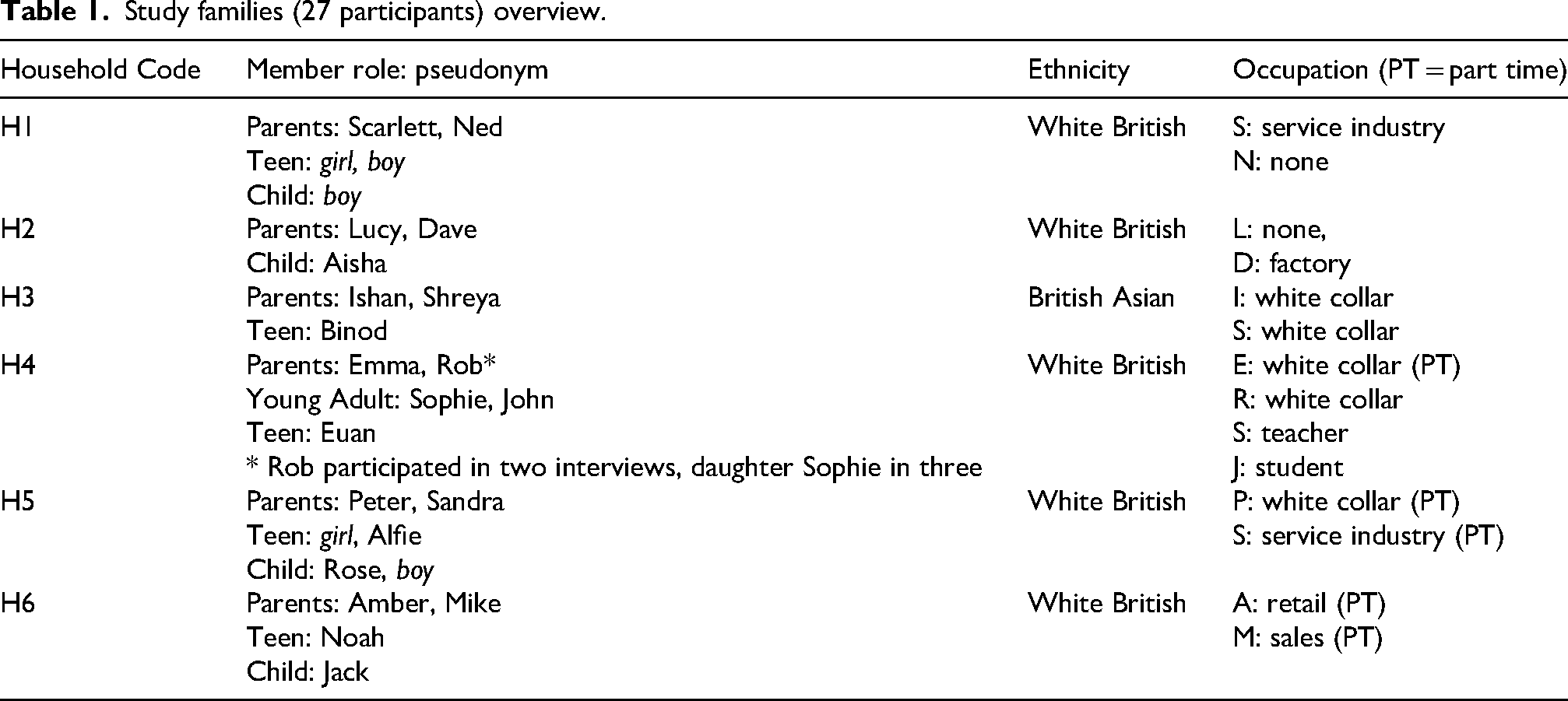
The study was motivated by a hypothesis that more complex domestic settings – which is to say those with multiple members separated by both gender and generation – would in turn generate greater challenges for technologies which sought to be ‘smart’, as realising such capabilities required some degree of dovetailing with the sociality of the setting (Goulden, 2021). Consequently, we recruited on four primary criteria, the first three being (1) the presence of multiple generations in the house (all had children, two also had grandparents living close by who visited daily); (2) located within the city (to render fieldwork sufficiently responsive to cater to families’ timetables); and (3) diversity on grounds of class, income and ethnicity. Social class was specifically targeted as a variable as studies involving technology deployments commonly fail to account for this, instead often relying on snowball sampling of researchers’ existing social networks (Henrich et al., 2010), or on recruiting those wealthy enough to already own the devices of interest. These are both approaches which skew towards an over-representation of middle-class professionals (a rare exception relevant to SHTs being Johnson's (2020) study of smart energy management in low-income homes). Class is a notoriously complex phenomenon (Bourdieu, 1987), and for the purposes of our study, social housing was used as an initial, necessarily imperfect, proxy for identifying working-class households during the recruitment phase, which were then supported by members’ own self-identification (Rubin et al., 2014). By this measure, two working-class households (H1 & H2) were recruited, with H6 also self-identifying as such. One household was of minoritised ethnicity (H3); the recruitment agency's attempts to recruit a second which also met the other criteria were unsuccessful in the timeframe available.
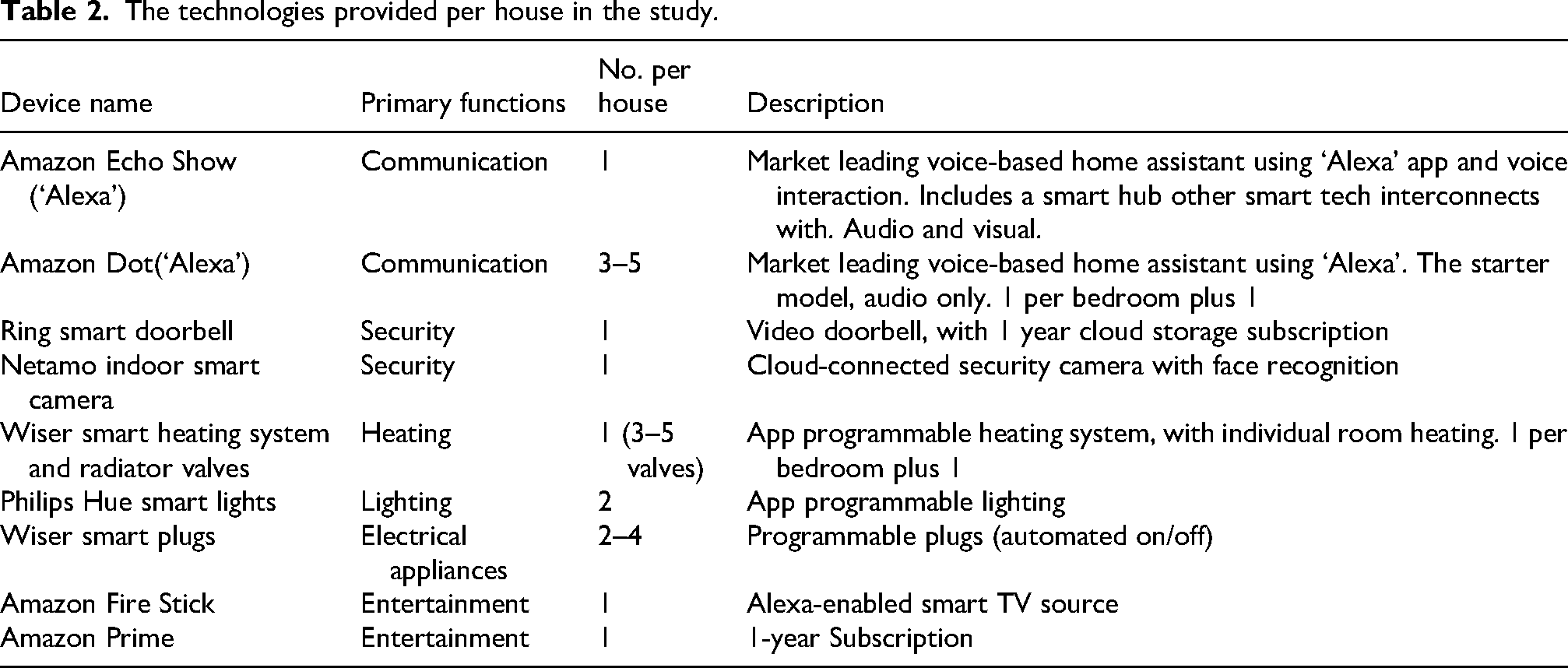
The fourth criterion for recruitment was an interest in SHTs, but none being already present. In respect of the technologies the study was interested in, this provided a relative baseline, against which accounts of any practice alterations would be easier to elicit. Households were provided with the devices listed in Table 2, which were then theirs to keep. The decision to allow participants to keep the devices was made for three reasons: (1) it served in lieu of compensation for the significant commitment (minimum 1 year) to the project we were asking for; (2) it encouraged participants to think of these devices as their own, and treat them accordingly; (3) it respected the fact that to remove the devices once the study was complete would be to burden the families with additional disruption.
The technologies provided per house in the study.
Interviews were carried out by one of the two members of the research team. Out of a recognition of interviews being themselves a grounded social interaction (Dingwall, 1997; Peneff, 1988), and so as to support the building of a rapport with the participants, the same researcher conducted all interviews with a family. Each interview was structured around a particular subset of family practices – such as security, family organisation, entertainment – and explored existing routines, and those that emerged or altered following the introduction of the SHTs used in the study. Interviews lasted between 90 and 120 min. So as not to overwhelm participants, the devices were introduced piecemeal over the first six months of the study.
Interviews were transcribed before being coded in Nvivo, using SPT-informed thematic analysis, meaning both inductive and deductive logic were applied. The researchers coded each other's interviews, to foster a shared awareness of each family's practices, and support consistency in conducting the fieldwork. At the start of the process, cross-member consistency was further supported by consensus coding of initial interviews, where both researchers coded the interviews before comparing results and refining codes.
From its outset, the study was alive to disagreements or tensions between household members with regard to any practice alterations following the introduction of SHTs, but it was only during coding and analysis that this interest coalesced around the notion of resistance, leading to this paper.
Data
In this section, we detail three different forms of mundane resistance, which we label upwards resistance, downwards resistance, and sideways resistance. These labels reflect the action's orientation to the existing moral order of the home, discussed further in Section 5. First, however, it is necessary to consider the context in which such resistance takes place. We use examples from our study to discuss the reciprocal relationship between the everyday enactment of social practices and domestic hierarchies.
Social practices and domestic hierarchy
As a shared endeavour, domestic life entails coordination between members. This is achieved against a backdrop of various hierarchies which influence individual members’ obligations and involvements. These hierarchies are commonly adhered to – hence their continuation. Practices which impact the whole household are commonly the domain of a single member, and in 20th-century industrial societies, such roles were usually distributed according to gender and weighted heavily towards the mother. These patterns endure, if in less stark terms than they once did (Altintas and Sullivan, 2016).
Responsibility for a domestic practice may be experienced as the burden of housework, but it also carries the possibility of agency, in managing other members in relation to that practice, whether in terms of their involvement, or what they receive from it. This is most clearly seen in the degree to which children are coerced into participating in some practices (as chores), and deliberately excluded from others (e.g. household finances), as part of their socialisation. The possibility of exercising such power over others is shaped in the contemporary home by notions of the ‘pure relationship’ (Giddens 1984) and its veneration of households built around democratic collaboration rather than stark asymmetries, even if these ideas tend to exist more in discourse than lived practice (Jamieson 1999). Accordingly, whilst what we might call practice power is likely more easily exercised over a child than a partner, the moral economy of the home does allow for claims to be pressed against the latter, though they may ultimately be resisted.
Practice power is also influenced by the material dimensions of any practice, which contribute to the skill required to participate, the shared meanings associated with that practice, and the possibilities of excluding or including other members. SHTs are no exception in this regard, and the pre-existing gendering of digital technologies as a masculine domain (Strengers, 2014) results in opportunities to exercise new control over others. This is taken to extremes in situations of domestic coercion and violence (Brookfield et al., 2024), but was also seen sporadically in our study. To give one example, the introduction of smart heating to our study's homes meant the controls for heating – beyond basic on/off functions on the main physical unit – were available only in an app, and even the basic functions could be overridden from there. In H3 and H5, the fathers took this as an opportunity to gatekeep the home's thermal comfort. In H5, Peter replaced the children's practice of setting their own bedroom's temperature with the room's radiator valve, with his new practice of monitoring and setting their room temperature via his heating app. In H3, Ishan refused to share access to the app – despite agreement that the new system was overheating the house – giving the reasoning that the system needed fine-tuning and until that was established at some future date, it be best that he alone could alter it. In doing so, he prioritised his own sense of responsibility for the masculinised task of effective heating management, over his partner Shreya's requests for the agency to fix it herself. As seen below, Shreya also used the SHTs to extend her own agency over him, though not without opposition.
Patriarchal positions were similarly taken to reinforce generational hierarchies. In H6, Mike refused the two boys access to a smart plug, out of fear that they weaponise it during any disagreement by using it to remotely power off each others’ game consoles, so escalating matters further. In H5 Sandra and Peter took the joint position that the kids could not have user accounts on the Alexa devices, because this would give them access to information on household purchases, and the ability to make such purchases.
Whilst in these examples the practice controller(s) were successful in implementing their practice modifications, at least for a time, we observed throughout the study numerous occasions where attempts to determine others’ access to, involvement with, or outputs from practices, were successfully stymied. It is these events on which we focus.
Upwards resistance
The first form of resistance observable concerns those in which the power struggle is most overt, namely situations in which resistance is in response to family management practice alterations. These entail the practice owner directly seeking to enhance their control over another family member. Particularly for families with children, the coordination of the numerous practices that constitute everyday life is a key activity, one which commonly falls under the mother's caring responsibilities.
This nexus of practices is in part driven by functional concerns of meeting the schedules of people and institutions outside the home, primarily entailing the tracking of where kids are in the present and where they will need to be at various future points, as well as ensuring the availability of whatever enabling materials (lunches, PE kits, etcetera) are required. To varying degrees, such coordination also entails making claims of adult partners’ time too. These practices are also a matter of teleoaffective concerns as to what are normatively desirable practices to enact, in which domestic spaces, at what times. Perhaps the starkest division between different members in this regard was H3, where mum Shreya's relevant teleoaffective formation is one of being organised, being active, and above all not ‘being lazy’. By contrast, husband Ishan and teenage son Binod see their discretionary time as being for leisure, focused primarily around watching football and gaming, respectively. Shreya's teleoaffective formation shaped her enthusiasm for those devices in the study – notably the Alexa devices and the Ring doorbell – which offered the possibility of remotely managing Ishan and Binod more effectively: What is it about this that motivates you to be proactive about learning [the Alexas]? Because it can help me with the things I want - with like the computers and stuff, they don't add anything to my life really, but this does because for me it's the practical things like the reminders, the fact that I can drop in on [Ishan and Binod], and that sort of thing. She can't wait for the Ring to come: ‘Oh, now you can take the dog for a walk’ or anything like that. Yes, I can actually watch what they do, if they've actually taken the dog out or not. I think just the fact that it allows us to organise things better, and I can leave the house knowing that I've set reminders and things like that, I like that. I know for a fact that she will be- -I'll love it, yes.- -an expert user on that blooming Alexa thing. I know for a fact because she's very interested in making… She wants our lives to be so organised, and I think, for me, I need that because I deliberately forget things. When you say, ‘deliberately forget things’ …? Maybe it's like if there's something on the calendar that I'm supposed to have done. Like when she was going to Kettering, I was supposed to make this type of food or… I was like, no, I'll make what I want to make or whatever. Are you worried about losing the ability to forget things when it suits you? I think that sometimes it was just a case of being really lazy. I'm going to be honest, just being lazy, I just didn't want to do it, but that'll come as no shock to her whatsoever. He recognises his time's up. Well, I think the problem with him is, with the games that he plays, a lot of the time he will be saying, ‘Kill him, kill him’ or ‘Batter him’ or whatever it is, and that's probably not a good thing for the Alexa to be hearing. Is that what's worrying you? No. It might be good for you to have one in your room if you want to try it for a bit. He can turn it off when he's gaming, can't he? Yes, but then it would just always be off. When I sleep, or when I'm doing my work, it will be off. Yes, I suppose, yes. Well, see how you feel, I feel like you're going to like it more than you think. […] All you really nag about is just me not getting up. Yes, and waking him up. That's why I quite like the idea of having a Dot in your bedroom, so I can just blast some music out. And that's why I don't have it! [laughter] Alexa has probably been out of her bedroom now for two weeks, and she's adamant it's not going back in. So obviously, at the moment, I'm not able to speak to Aisha upstairs unless I do it in my room, but then she won't catch it if she's in her room, but I'm going to try and talk her back around and say I'll turn it off at night-time.
The only household in our study where there was no sign of resistance at all from children to their parents’ SHT-involved practices was H1. Here, what was striking was the inversion of the hierarchies observed elsewhere, in the parents’ willingness to adapt their existing practices to the children's scripts for the SHTs. Accordingly, the Alexa came to be used primarily as a way in which the children could call down from their bedrooms for refreshments, which the parents then delivered to them. H1 is a culturally working class household, and whilst a link cannot be assumed, these findings can be read as commensurate with previous observations of the teleoaffectivites of working class parenting, that ‘as long as they provide love, food, and safety, their children will grow and thrive’ (Lareau, 2002: 748–749). By contrast, middle-class parents are more likely to express such demonstrations of care through service via the expenditure of time outside the home, in ferrying children to organised activities with perceived cultural merit.
Downwards resistance
Our second set of resistances to practice alterations comes in defence of the home's existing moral order. As such, they are less concerned with the specific manner in which a practice is performed, and more with the implications the enactment carries for domestic hierarchies. In H6, the Ring app (which notifies when motion is detected on the doorbell camera and displays the footage) was installed on the phones of parents Amber and Mike, and 13-year-old Noah. His parents were excited about giving Noah access, as he was periodically home alone, and knowing he could monitor the door without opening it gave them a sense of security. Lacking such a justification, younger brother Jack was not given such access. It only lasted a number of weeks, however, before Mike took the step of removing the app from Noah's phone, with a notably stumbling explanation which concluded that the app ‘wasn’t much use for him’. Mike would not be drawn further on this, but on an intermediate visit, Noah had excitedly told us about an episode when staying at his nans’ house, and he awoke in the morning to find a Ring notification from the early hours of his parents getting home from a night out. He texted them asking ‘What was you doing out till two o'clock in the morning?’. Our reading of these events is that they were related, and certainly the revocation of Noah's access ended this little experiment in technology-facilitated subversion.
This example of sousveillance was complimented by numerous examples across the study of kids particularly, but also parents, initially using the SHTs for playful means, including a son changing the smart lights in the parents’ bedroom to a disco theme and changing Alexa to reply in Spanish (H5), and a dad turning off a TV remotely via a smart plug whilst nan was watching it (H6). In H3, Binod used the Ring app's intercom function to prank some school kids passing in the street outside. However, his parents, receiving the notification of activity on their own phones, immediately intervened to put a stop to it. Binod afterwards uninstalled the app, which had been the only SHT he engaged with directly. Similarly, in the other households, kids rapidly abandoned their interest in the new devices once parents began to circumscribe the SHTs' use as playthings and enforced their own practice scripts instead, which had these devices as first and foremost serious tools to be used for supporting their domestic duties.
Sideways resistance
The third and final source of resistance differs from the previous two in being relatively unconcerned with the hierarchical teleoaffectivities of the home, instead being driven by rejection of the practice owner's attempted enrolment of others into actively participating in their reformulated script. In some cases, such enrolment is attempted out of necessity, as the practice-in-making cuts across existing practice domains, and so requires other members’ skills and knowledge. In H1, typical domestic practice gendering was subverted by mother Scarlett being the sole wage-earner, whilst partner Ned was the primary housekeeper. Accordingly, Ned did most carework in the home, including cooking, cleaning, and collecting the kids from school, whilst Scarlett took on some traditionally masculinised roles, including performing initial technology set-up and managing the household's passwords. Ned has minor learning difficulties, which he considers a factor in his relationship with technology. He often experiences tech as a source of anxiety or frustration, should it not respond as expected. In marked contrast with the situation in H3 and H5 discussed above, in H1 Ned tried to involve Scarlett in scheduling the smart heating, as he was struggling, but only succeeded in prompting very overt resistance in the form of a row, as a result of initiating these efforts just after a tired Scarlett had returned from a long day at work. As a consequence, the smart heating was left largely under manual control for the remainder of the study.
The fact that in this example such a temporary impediment (Scarlett's end-of-day exhaustion) left an enduring mark on the associated practice, is a salient reminder that – amongst the often overwhelming demands placed on parents in the contemporary family – it does not necessarily require sustained resistance from objectors for a practice owner to abandon modification efforts. It is also a testament to the indeterminacy of tech domestication.
In H4, the usefulness of the Alexa as a means of coordinating family life was degraded by the incommensurate practice scripts of individual members. These devices were set up by Father Rob. Son John struggled to use them to communicate with other members as each device had been named according to his father's vernacular for house rooms, a system which did not make sense to John. This situation was further complicated by some devices being moved by other members to different rooms after having been named. Here, the same tensions between different members’ knowledge and teleoaffectivities, which necessitate the work of family coordination in the first place, serve to undermine the utilisation of SHTs in supporting that work.
Where SHTs were in-scripted by their designers to automate some of this coordinating work, further resistance could be encountered: daughter Sophie deleted her Alexa user account as she found that her information (such as contacts and lists) was being automatically synced with other members’ accounts, which she saw as a breaching of her privacy. It is worth noting how these two contrasting examples demonstrate the scale of the challenge ‘smart’ devices face: for John, the device is simply dumb – which is to say mute – on the identification of rooms, leaving Rob to impose his own vernacular idiosyncrasies; for Sophie, the device attempts to smartly coordinate between members through automated sharing, only to transgress in doing so. In Sophie's case, the tension stems from ‘smart’ automation rather than a fellow members’ practice alteration. This is a confirmation of the relevance of SHT designers own scripts in the ongoing development of practices.
Discussion and conclusion
Our conceptualisation of mundane resistance between members of a household, and the ends it is directed to, shares some commonalities with soft resistance (Nafus and Sherman, 2014). The resistance we describe however takes place neither in response to nor in dialogue with the political economy of the tech industry, rather it takes place with almost total disinterest in it. In this sense, it is closer to Gangneux's notion of ‘tactical agency’ (2021), which is agnostic of the political economy in which it operates. We chose the label mundane resistance because it is a resistance rooted in everyday practical concerns, domestic hierarchies, and intimate interpersonal biographies. This is not to suggest that the scripts given to SHTs by their industry creators are irrelevant to the practice which emerges – on the contrary, the materiality of a practice remains a key element of it. When a child uses a Ring doorbell to monitor the early hours activities of his parents, it is precisely the designed-for capacity for remote surveillance which he is harnessing. What mundane resistance highlights though is that here the act becomes sousveillance rather than surveillance with complete disregard for the extractive business model of Amazon. When the parents in turn remove this capability from the hands of the child, they foreclose the possibility of a new practice emerging and a relative reconfiguration of domestic hierarchy. In doing so, they may undermine the business model's panoptic intentions, but their interest is only in upholding the moral economy of the home and their position as arbiters of it.
In previous work, we noted that ‘the IoT is constitutionally social in a way which no social media is’ (Goulden, 2021b). Social media is served to a singular user, curating (with significant algorithmic intervention) their network. The nature of the IoT, embedded in shared spaces rather than personal devices, refuses reversions to the individual sovereign consumer. One consequence of that distinction is seen above. We identify three forms of mundane resistance between members of the home, which we characterise as upwards resistance, downwards resistance, and sideways resistance, each orientated to the existing moral order of the home. Upwards resistance was seen from those rejecting existing practice owners’ inscriptions, which extended the owners’ agency over the resister in some manner. By contrast, downwards resistance came from practice-dominant members maintaining the status quo by rejecting attempts to (re)make practices from below. Sideways resistance differed in not being indexed to the distribution of power between members, but rather with more applied matters such as the legibility of the reformulated practice, or the timings of its adjustment. The prominent role of power in our analysis reflects the fact that any adjustment to domestic practices is inevitably enabled or constrained in relation to existing family hierarchies and roles.
A common thread through all these occurrences was the partial or total disengagement from SHTs, which followed. This, in many cases, was limited to only some family members, and so might not register in accounts of technology adoption focused on ‘the user’, yet the consequence was real enough. For the practice owner in the household, the imagined benefits of integrating SHTs into everyday domestic life were undermined without the participation of other family members. Some devices were subsequently abandoned entirely, others limited to only a subset of household members, or to only more basic (non-smart) functionality. These outcomes speak to an underlying tension in the design ethos of SHTs. They premise smart as enabling the empowerment of the user (singular), but the reality of shared domestic life described above demonstrates how, in a nested set of intimate social relations, such empowerment often disempowers others, and thus invites their rejection.
The business model of SHTs, centred around data extraction, makes them highly vulnerable to mundane resistance. Without the full participation of household members in utilising devices, industry visions of domestic panopticism go unrealised. The hopes of achieving what Zuboff terms ‘behavioural futures markets’ (Zuboff, 2019: 14), predicated on extrapolating from comprehensive datasets to accurately anticipate peoples’ actions, becomes reliant instead on a myopic perspective that captures but a fraction of domestic practices. Whilst it should be acknowledged that even neglected devices might continue to extract some forms of data from the home, this is a fragmentary colonisation at best. This is a state that contributes towards understanding the failure of the smart home vision for realising the levels of wealth extracted from social media.
Sadowski's (2020) account of the perils of smart tech, and the data extraction model which leverages it, calls for an ‘unmaking’ in response: ‘When it comes to smart tech, we can start unmaking by simply downgrading the unnecessarily upgraded things that now fill our lives, homes, and cities […] Strip out the sensors! Switch off the signals!’ (p.172). The mundane resistance described above made a significant contribution to such unmaking in our study homes. It commonly did so, though without any expressed intent towards the extractive designs of big tech, but instead towards navigating the everyday requirements of shared domestic life. As such, mundane resistance is a reminder that behind the venerated tech bros’ boosterism, and the meticulously curated tech demos that vanguard the arrival of new technologies, whether they be smart homes, AI, robots, or self-driving cars, their capacity for actually realising industry's promises remains highly suspect. A decade on, the smart home remains, in a great many respects, socially dumb, and a commercial failure. Recognising that a million small acts can, in their aggregate, unravel a seemingly unstoppable advance (Kleut et al., 2018; Scott, 2014) is important, not least because a sense of presumed inevitability is itself a factor which guides families’ acquiescence to the smart home's impositions (Pangrazio and Zomer, 2025: 10).
Even where SHTs succeed in offering individual practice owners additional utility, the greater affordances risk upset to the delicate power relations between household members that are substantiated in their social practices. Those members may in turn effect to undermine the reformulation of those practices, much as workers have resisted the use of disempowering technologies throughout the history of industrialisation (Merchant, 2023; Roy, 1952; Woodcock, 2016). And just as 19th century Luddites, 1950s ‘goldbricking’ machinists, and 21st century gig workers were and are, in-the-main, driven first and foremost not by grand political goals but by pragmatic concerns with their own immediate conditions, household members’ rejection of smart devices is a matter of everyday concerns, addressed to the home's quiet horizons. Mundane resistance serves as both a rejection of buying into the tech industry's grandiose self-mythologising and as a statement of the ongoing importance of attending to the situated practices of everyday life, both in its repeating patterns and its quotidian idiosyncrasies.
Footnotes

Ethical considerations
This study was approved by the University of Nottingham's School of Sociology & Social Policy Research Ethics Committee on 27 October 2017.
Author contributions
Paper based on data collected and analysed by both authors. Paper conceptualised and first drafted by the first author (Goulden), with additional material and input from the second author (Cameron).
Funding
This work was funded by a Nottingham Research Fellowship from the University of Nottingham.
Declaration of conflicting interest
The authors declared no potential conflicts of interest with respect to the research, authorship, and/or publication of this article.
Data availability statement
The ethnographic nature of the data in question means that fully ensuring anonymity as promised to our participants would require de-situating the data such that it would be of extremely limited research value, particularly without the contextual knowledge of the fieldworker. As such, the data is not available for sharing.