




Abstract
The antivaccine hesitancy movement represents a challenge to public policy and platform regulations. During COVID-19, various Latin American antivaccine groups clashed with official sanitary initiatives. Despite many responses, little progress has been made in reaching these groups to transform their perceptions about the benefits of the COVID-19 vaccine. During the pandemic in Latin America, the antivaccine network Médicos por la Verdad (Doctors for the Truth) gained prominence in various countries. Finding itself limited by legal and technical restrictions, this network used alternative media such as Telegram to disseminate messages. This study argues that such groups may be considered an antivaccination culture that opposes government measures. This focus emphasizes narrative construction and allows us to understand the phenomenon from the collective meaning-making perspective. This study analyzed 232,638 Telegram messages from 14 public channels associated with the Médicos por la Verdad network. Our findings indicate that this antivaccine network builds an oppositional culture expressed and reinforced through multimodal, trans-media, fragmented narratives and suspends disbelief that constructs a world where the community enacts a truth pact. These narrative methods foster building a resilient network of oppositional cultures, decreasing the effectiveness of policies. We conclude that research beyond the framework of misinformation and the analysis of conventional platforms is needed to understand the antivaccine oppositional cultures.
Keywords
This article is a part of special theme on Mapping the Micropolitics of Online Oppositional Subcultures. To see a full list of all articles in this special theme, please click here: https://journals.sagepub.com/page/bds/collections/micropoliticsonlinesubcultures
During the SARS-COV-2 pandemic, various groups opposed governmental health measures. In Argentina, these groups marched in downtown Buenos Aires alongside opponents of the legalization of abortion (Micheletto, 2021; Página 12, 2020). In Peru, some groups opposed vaccination passports (Infobae, 2021). In Mexico, in addition to demonstrations in the capital (Aguirre, 2021), some indigenous groups that distrust the government refused vaccinations (Romo, 2021). Similar events occurred in the US and many European countries. In the United States, a significant alliance between Tea Party members and armed militia groups opposed the sanitary measures adopted by state governors (Bogel-Burroughs, 2020; Villareal, 2021). In Spain, rioters demonstrated against curfews in Madrid (AS, 2020; La Sexta, 2020). Despite being considered the country that managed the pandemic the best, several antivaccine groups in Germany claimed that the state called the flu a pandemic (Bennhold, 2020a, 2020b). Other protests were held in the UK (Fresneda, 2021), Italy (El Mundo, 2021; Reuters, 2021), Belgium, Croatia, Italy, Northern Ireland, and Switzerland (Faiola, 2021).
Social media played an important role in increasing vaccine hesitancy (Tokojima Machado et al., 2020) and articulating the antivaccination movement (Germani and Biller-Andorno, 2021). During the pandemic, people used social media as a source of health information (Islam et al., 2021). Researchers found a correlation between high exposure to vaccine information on social media, negative perceptions, and higher levels of mistrust/distrust among the population (Demuyakor et al., 2021). Digital spaces offer antivaccine groups a forum to “share any kind of content, including science-related or medically sensitive content, which can reach a vast audience” (Germani and Biller-Andorno, 2021: 2). This pattern of behavior is also found among extremist groups that use social media to share information, reduce communication costs, and facilitate their organizations (Caiani and Kröll, 2015; Copsey, 2003; Della Porta and Mosca, 2006). In Latin America, social networks like YouTube have been identified as promoters of “misinformation and extreme content,” including mis/disinformation about COVID-19 vaccines (Álvarez-Benavides and Jiménez-Aguilar, 2020; Tokojima Machado et al., 2020; Vico and Rey, 2020).
Médicos por la Verdad (Doctors for the Truth) is an antivaccination network that began in Spain and rapidly expanded throughout Latin America. During the pandemic, this group prominently disseminated antivaccine messages across various digital spaces. This study argues that the group Médicos por la Verdad (MXV) produced a multimodal trans-media narrative on Telegram to construct a “possible world” (PW) where the threat is not the virus but a totalitarian, global state. Constructing a PW as a shared narrative is important because it offers a political space to confront the government's perspective. This study analyzed the different strategies used by the group to shape this narrative by constructing PW as an oppositional culture against official health measures in various Latin American countries.
Many authors have studied the relationship between digital platforms and extremist groups through the discursive construction of oppositional cultures (Caiani and Parenti, 2011; De Koster and Houtman, 2008). However, there is a research gap regarding the specific discursive strategies these groups employ to legitimize their oppositional discourses. To address this problem, we proposed a multimodal analysis of the MXV network strategy to better understand this phenomenon. Based on this empirical evidence, we argue that these groups position themselves as victims or threatened by inverting the official narrative of the pandemic and constructing a PW in which they are the holders of truth.
The paper is structured as follows. First, we review the categories of PWs and oppositional cultures. We then contextualized the emergence of MXV and its use of Telegram, which gives them space to construct an oppositional culture. Third, we analyzed the messages according to the identified discursive micro strategies. Finally, we addressed study implications for public policies and platforms.
Rethinking oppositional cultures in pandemic times
The term oppositional culture refers to a series of situated and embodied practices that mitigate the effects of oppression and reaffirm the cultural values of an oppressed minority (Mitchell and Feagin, 1995). Discursive practices are indispensable (Carroll and Ratner, 2001). These cultures seek to end inequality and confront disrespect for the community (Fraser, 1989, 1995). They subvert oppression through actions that transform material and symbolic conditions. A central element of this process is the reaffirmation of identity, which was previously subordinated to oppose injuries (Mansbridge and Aldon, 2001).
Here, we argue that in the subversion of positions, Latin American antivaccine channels on Telegram have assumed an oppositional discourse, situating themselves as oppressed minorities and building the illusion of threat through the mobilization of hate (Ahmed, 2004). In the fragmentation and recomposition of the historical relations between identity and representation, these groups construct their identity and harness certain aspects of popular discontent. They do so as part of a discursive strategy that connects certain aspects of popular experience and discursively positions them as subjects to institutional and social aggression. This false victimhood is founded materially on privilege loss. It provides a foundation for a demand to (politically or even physically) expel their “enemies” from the political community (McManus, 2020). These struggling discourses are always “in process,” “strangely composite” (Hall, 1988), and sometimes even contradict themselves and the actual world (AW).
Various groups have recently assumed an oppositional discourse using this strategy. In Western contexts, these groups appeal for a defense of the nation against external threats—Jews, immigrants, and communists are repeatedly mentioned—and the return to a “Golden Age'’ through the awakening of consciences (Gray, 2018; Griffin, 2000; Vasilopoulou, 2018). The need for a renaissance is attached to the exaltation of their “martyrs” (Caiani and Parenti, 2016; Griffin, 2003a, 2003b). Some groups hold an idealized vision of the past and adhere to monism (Powell, 1986). These positions are evident in South America among neo-patriotic far-right political groups (Sanahuja and Burian, 2021). Jair Bolsonaro, the president of Brazil, invoked an uncorrupted past in which there was no recognition of minority rights, social diversity, or cosmopolitan values (Sanahuja and Burian, 2020). The same trend can be identified in the Peruvian party “Fuerza Popular” (Popular Force), which proposed Keiko Fujimori as a presidential candidate (Meléndez, 2019). In the US, the ideological resurrection of extremist groups is categorized as paleoconservatism (Drolet and Williams, 2021). Latin American movements are similar in this regard. These political movements strive for a conservative turn to overthrow political elites and globalized institutions (Drolet and Williams, 2019).
Social networks have become privileged spaces that constitute oppositional cultures. Digital platforms provide efficient and cheap channels to disseminate discourse and are a medium for free speech with very little regulation. Thus, platforms allow them to construct a shared vision of the world in which they hold power (Copsey, 2003). In Spain, Álvarez-Benavides and Jiménez-Aguilar (2020) and Ben-David and Fernández (2016) have shown the importance of social networks for disseminating extreme-right discourses.
Antivaccination groups in Latin America have built an oppositional culture by positioning themselves as oppressed. This false victimhood responds to a loss of a privileged position and manifests as a deceiving narrative (McManus, 2020; Sanahuja and Burian, 2020). This discursive strategy has been made possible by the constitution of a PW that allows users to resignify their situation, supported and reinforced by a fragmented multimodal trans-media narrative in which users participate by exploring or speculating. Acknowledging that “vaccine hesitancy is an individual behavior resulting from broader influences and should always be looked at in the historical, political, and sociocultural context in which vaccination occurs” (Dubé et al., 2013: 1763) is vital to understanding this phenomenon.
Rise of PWs: Antivaccine oppositional discursive strategies
This study applied PW theory as an analytical device to understand the MXV mental map. PW theory originated in philosophy but gained popularity in narrative theory by the mid-70 s. PW is linked to the textual world and the mental faculty of simulation (Ryan, 1998). In the second half of the 20th century, philosophers of the analytical school focused on Leibniz's PW Theory to solve problems in formal semantics. Literary theorists like Eco, Pavel, Doležel, and Ryan have adapted this theory to narrative fiction (Ryan, 2014).
This PW is narrated by establishing imaginative recentering (Ryan, 2013), where users assign a truth value to their shared world during immersion. These worlds are characterized by autonomy (Pavel, 1975, 1986). Participants assumed a new ontological perspective on what existed and what did not exist. This estrangement has two positions within it. The first assumes that participants deviate only minimally from reality (Ryan, 1991). Except when the discrepancy is highlighted, everything is the same as in the real world (Lewis, 1978). The second viewpoint holds that the PW possibilities are unlimited. Since it is impossible to imagine all their properties, these worlds will always be incomplete (Doležel, 1998). This incompleteness facilitates participation in producing and exploring these worlds (Jenkins, 2006).
Another distinctive element of PWs is the richness of their environments, which provide an exciting and striking immersive space. This space comprises a plurality of related subjects, objects, and states and forms an autonomous system of representation (de la Maza, 2017) and attractive spaces for exploration and speculation (Ryan, 1991, 2001). This process transports the participants to a stimulating environment containing text, images, sounds, and interactive components (Ryan, 2014).
Complete immersion in PW is a twofold process. First, the user “absorbs” as many details of the PW as possible through the multimodal and trans-media narrative. However, these details do not necessarily form a coherent or all-encompassing image of the PW. Therefore, users actively participate in its development. This double absorption allows participants to experience and make sense of the world (Wolf, 2012). Thus, through a series of “experiences,” the user develops a cognitive map (Kitchin, 1994) that helps them navigate the PW.
Creating alternative or PWs is popular (Donovan, 2010; Kent, 2001; Schareffer, 1999; Walters, 2008). The massive amount of information in the digital space fosters active and collective participation in constructing meaning (Jenkins, 2006). This convergence of interactive media, content, and users has led to the development of multimodal trans-media narratives, in which telling a story is not limited to one medium or a single platform (Jenkins, 2006; Jenkins et al., 2003). Consumers actively expand their stories to create their world (Scolari et al., 2014). Whether fiction or nonfiction is involved, the user is critical in distinguishing whether multimodal statements reference the AW or a PW. Before immersion, users define it as the AW or PW (Ryan, 1991). Therefore, the position assumed by the user concerning the world they face is crucial.
PW theory has successfully developed a vision of narrative strategies for constructing PWs as deviations from the AW. We consider the theory of PWs a significant epistemic resource for understanding the evolution of alternative factual interpretations. It allows the creation of possible alternative realities without recreating the entire new world. Therefore, we contend that antivaccine supporters use this simulation to portray sanitary government measures as a totalitarian government, heightening confrontation. Creating a PW encourages an alternative interpretation of the “status quo.” The resulting narrative depicts various PWs in varying degrees of detail and precision and a situational representation that aids them in assuming a central position in the pandemic crisis.
Unlike disinformation (Bennett and Livingston, 2018; Wardle and Derakhshan, 2017), this theory allows observing the construction of a world the user assigns—a truth value through imaginative recentering (Ryan, 2013). This valorization was reaffirmed by immersion in fragmented, multimodal, and trans-media narratives experienced through exploration and speculation.
Materials and methods
Study design
This study is a multimodal analysis of 14 public Telegram channels associated with the MXV network defined by ground-truth criteria (Leskoveck et al., 2008), consisting only of channels claiming membership in their name. This network is a larger Telegramsphere (Simon et al., 2022) comprising 15,763 channels.
Data were collected between March 2020 and August 2021. Our method is based on the conceptual framework proposed by Peeters and Willaert (2022) and Willaert et al. (2022), exploiting Telegram's ability to forward messages from one group to another to reveal interconnected channels, gather data, and sketch information-sharing practices. Data were collected using the Telegram Application Programming Interface (API). All analyses were performed using R Statistical Software (v4.1.2; R Core Team, 2013), the igraph package (v1.2.6; Csardi and Nepusz, 2006), and the Gephi package (Bastian et al., 2009).
Doctors for the truth network on Telegram
MXV is an antivaccine network that denies the existence of the SARS-COV2 pandemic, opposes the use of masks, supports resistance to vaccination, and promotes a miracle cure. In a press conference video, this group argued (5:15) that “… the vaccine does not make any sense… since a vaccine is not going to do any good…” (Prego-Cancelo, 2021). According to fact-checking organizations, this network was founded in July 2020, and a few months later, its denialist rhetoric was broadcast in Argentina, Mexico, Chile, Peru, Puerto Rico, Colombia, Uruguay, and Costa Rica (Álvarez-Benavides and Jiménez-Aguilar, 2020; LatamChequea, 2021; Vico and Rey, 2020). MXV debates health institutions about the ‘true’ state of the pandemic. A clash with the state led to formal action against this group. For example, the General Council of Medical Associations of Spain and the Forum of the Medical Profession initiated disciplinary proceedings against their members (EFE, 2021; EuropaPress, 2020). In Argentina, sanitation authorities launched legal proceedings against them for violating health regulations (Aguilar, 2021).
The group intensively used the instant messaging platform Telegram to disseminate messages. Initially, MXV used Facebook as its preferred platform for video dissemination. Simultaneously, they toured Spain and other European countries (LatamChequea, 2021). Later, they disseminated their messages on YouTube and Rumble's video platforms.
MXV has held demonstrations in many countries. They began in Spain in March 2020. A few months later, they marched in Argentina, Mexico, and Peru (Aguirre, 2021; Infobae, 2021; Página 12, 2020). In all these mobilizations, they ratified their rejection of sanitary measures and denounced the beginning of a global sanitary dictatorship. In some of these demonstrations, participants shouted antisemitic and antiabortion slogans (Clarín, 2021a, 2021b; Gerber, 2021; Scolfeld et al., 2021).
Social pressure on platforms to moderate hate speech and misinformation during the pandemic (Krishnan et al., 2021) resulted in them adopting measures to regulate content violating their standards. During the pandemic, groups or individuals spread disinformation, vaccines were deplatformed, or their content was banned (Rosen, 2021). Deplatforming pushed these communities into alternative spaces to interact. Consequently, Telegram, a platform with a laxer policy than mainstream platforms, became popular for spreading antivaccine messages (Giménez, 2022; Urman and Katz, 2020; Walther and McCoy, 2021).
The relevance of Telegram is sustained by its reputation for protecting free speech, even if it is extreme, keeping this content available, and its ability to broadcast to many users (Rogers, 2020). The platform combines a private messaging service (similar to WhatsApp) with the possibility of disseminating messages to large audiences through its channels (Twitter-like functionality), allowing unlimited subscribers. Therefore, it has become a refuge for extreme content (Rogers, 2020). However, it promotes opposing ideological values through technological features (subversive affordance) (Santos et al., 2021). Before the pandemic, Telegram was not a relevant platform for investigating vaccine hesitancy (Germani and Biller-Adorno, 2021; Neff et al., 2021). However, after many antivaccine users migrated from mainstream platforms to Telegram during the pandemic, it became a relevant platform for studying antivaccine information and conspiracy theories (Hoseini et al., 2021; Johnson et al., 2020; Walther and McCoy, 2021).
Data collection
Analyzing Telegram enables the production of online antivaccine information and conspiracy theories. This “Big Data” approach poses a methodological challenge in determining relevant messages. Therefore, this study adopted a bottom-up approach. We employed the snowballing method by utilizing Telegram's app search, which exclusively retrieved channels containing query words in their names (Peeters and Willaert, 2022). This method considers message forwarding based on the strong affinity between channels. A two-hop snowball sampling method was used to construct the samples. Initially, we searched for Telegram channels using keywords such as “COVID,” “vaccines,” “antivaccines,” “pandemic,” and “Médicos por la Verdad” (Doctors for the Truth). This query retrieved 127 channels that served as initial seeds for our sample. Next, an extra hop is added to the selection by adding the channels mentioned in the retrieved messages. This process allowed the identification of 15,659 associated channels connected to the initial seed channels. This resulted in a dataset of two million messages with over 29 billion views published on Telegram between 20 March 2020 and 21 August 2021 (Figure 1). At this stage, we assumed that additional hops would add little new information (Burns and Grove, 2005). This Telegram data archive covered the time in Latin America impacted by the COVID-19 pandemic and allowed us to identify the broader landscape of oppositional Telegram channels. Data were collected using the Telethon Library API (Telethon, 2021) and pyTelegramBotAPI (2021).

This figure shows the frequency of messages from the network MXV between 20 March 2020 and 21 August 2021.
Ethical considerations
Following ethical research principles, all data were aggregated and pseudonymized to avoid identifying individual participants (Bradford, 2017; Reed-Berendt et al., 2022; Tiidenberg, 2018).
Data analysis
Kress and Van Leeuwen (1996) highlighted that political discourse is a form of multimodal communication that includes text, images, and sound, among other codes. These elements appear in the antivaccine rhetoric. We used a multimodal approach to analyze the observable properties of Telegram's antivaccine messages to explain narrative construction and PW. A critical assessment of the discursive modes identifies the multimodal narrative in the message and creates authenticity. Discursive modes are classified into text, video, audio, and hyperlinks. By identifying different sources, we revealed the mechanisms used to create plausibility. The network analysis emphasizes the relevance of a structure to its elements (Scott, 2000). This way, we can observe narrative interconnections among the Doctors for the Truth network.
To identify polarity, we used the Spanish version of the semantic lexicon Emolex (Mohammad and Turney, 2013). This linguistic approach uses a predefined list of words in which each word is associated with a polarity (i.e. positivity or negativity). To determine effective engagement, we identified the use of emojis, words of urgency, uppercase and infodemic words, exclamation marks, and calls for action. According to Danesi (2016) and Giannoulis and Wilde (2019), emojis and nonstandard punctuation (the use of caps in a message and repeated exclamation marks) have an emotive function in text messaging, conveying emotivity and working as a framing device to reinforce social meaning. Hence, we determined that their presence indicated that the sender sought affective engagement from the receiver. Sperber and Wilson (1995) provided a second criterion for identifying affective engagement. These authors identified the relevance of intention to communication irrespective of context and synchronicity. Specifically, in a pandemic context, for our corpus, we propose using certain expressions whose primary function is to obtain the receiver's attention as effective marks. We have identified them by reading the messages and classified them into three groups: words of urgency (“last minute,” “important,” and “urgent”), infodemic words (“virus,” “vaccines,” and “COVID-19”), and calls to action (“share,” “spread,” and “viralize”).
The classification criteria by type of source were as follows: “websites’’ refers to information published on blogs, personal websites, news articles, company profiles or educational resources (tierrapura.org, trikooba.com, etc.); “social networks’’ refers to publications in social media platforms (Facebook, Twitter, etc.); “video platform” comprises sources published in platforms specialized in video publishing (YouTube, Rumble); “Telegram Channels” when the source is another Telegram Channel, and “others” when the source cannot be classified in previous categories. Finally, we found multimodality in messages by identifying different semiotic modes (images, emojis, and speech marks) used to express meaning.
Results
Our results identified that during the pandemic, the MXV network used Telegram to construct a PW in which they were victims fighting not against the pandemic but against totalitarian states. By placing itself as a threatened group, the MXV's oppositional culture mobilized hate to expel its “enemies” from their communities. This discursive strategy successfully disseminated antivaccine messages across Latin America. The narrative comprises a series of multimodal trans-media fragments that generate immersive experiences for group members.
The development of this trans-media, multimodal, and fragmentary narrative relies on different discursive strategies that produce relatively durable and resilient networks. The first consists of “imaginative recentering” (Ryan, 2014), in which users actively assign the true character to PW. This typical operation in narrative fiction consists of a “willing construction of disbelief” (Gerrig, 1993: 230). With this members’ willingness, a “guided projection” can be developed (Gombrich, 1960: 169) through a series of discursive elements that underpin the PW. According to Gerrig (1993), emotions and the creation of authenticity support a fragmented narrative to achieve an immersive user experience. The following section analyzes how these discursive strategies operate within an MXV network.
Multimodal and transmedia storytelling. A practical element for constructing a PW “is using transmedia narratives (Jenkins, 2006; Kinder, 1991; Murray, 1997; Wolf, 2012). This narrative has expanded across modes (Krees and Van Leuween, 2001) and platforms, allowing users to explore its particularities at any time. The multimodal narrative manifests in texts, videos, audio, and hyperlinks in messages. However, its trans-media character manifests in using different platforms that support these modes and ensure additional access to its story through various venues. Furthermore, each gateway must be self-contained. They also offer users the chance to venture into wandering or developing conjectures. Simultaneously, multimodal discourse boosts the user experience through the richness of this alternative world. Hence, what users experience is not the simple reading of a text but the chance to immerse themselves in an exuberant space where they can “investigate.” Through their analysis of fragmented multimodal and trans-media narratives, users can “discover” what is going on.
Our analysis shows that the MXV network succeeds in configuring a multimodal (Kress and Van Leeuwen, 2001) trans-media narrative (Jenkins, 2006). We can establish these characteristics because we can identify the semiotic interactions between texts (54%), photos and videos (20%), webpages (20%), Telegram channels (5%), documents, and others (1%) to construct meaning in their different messages. These images and videos illustrate messages and are central in constructing meaning through different semiotic codes (textual and visual).
This network also uses more than 2400 platforms or websites to build discourse. The transmedia nature of these groups is created through several platforms (Jenkins, 2006), allowing users to construct complex meanings through the performative and creative coordination of messages issued by various authors on multiple platforms. The group employed other platforms, such as YouTube (19.8%), Telegram (9.1%), Tierrapura.org (5.93%), Facebook (4.7%), Twitter (4.4%), and Odysee (2.18%).
Figure 2 shows how the MXV network builds a multimodal discourse using a combination of videos and text. A combination of videos and sentences with exclamation marks was used. Simultaneously, a red dot appeared within the message as another multimodal visual element that attracted the user's attention. In the sentence “DESPIERTA, NOS ESTÁN MATANDO!” (Wake up; they are murdering us!), we can observe how the message developed from the perspective of a threatened oppositional culture.
This message was issued on 11 February 2021, within the MXV network.
Narrative fragments. An essential element in constructing a PW is the lack of a highly coherent narrative (Jenkins, 2006; Wolf, 2012). Given the immense amount of information circulating within conspiratorial networks, creating a single exclusive narrative is impossible. By contrast, a PW comprises multiple narrative fragments, allowing different users to develop their own experiences exploring the world, which is expanded by integrating new texts. Therefore, users build personal experiences when exploring this world. They could reconstruct their version of the PW, a personal experience to share.
In the case of MXV, we should not attempt to understand their discourse through text, videos, or photos issued from accounts directly associated with the denialist group. On the contrary, numerous fragmented narratives make up the denialist discourse: Fragments not necessarily built by the “MXV network. The denialist discourse published by the antivaccine group incorporates many fragments from other related channels within its network. This greater variety of authors and channels jeopardizes consistency. However, this loss is offset by the opportunities offered for exploration, promoting user immersion by increasing the depth of the PW.
Our multimodal analysis focused only on the MXV local network, which is embedded in a more extensive global network (Figure 3). The structural centrality of the local network is regarded by the global degree of centrality (Scott, 2000) of its members (“Channel_02” [784], “Channel_03” [455], “Channel_04” [153], “Channel_05” [185], and “Channel_06” [134]) and also using visual network analysis (Venturini et al., 2015) versus global network average of 3.607. Consequently, the discourse visualized by users in each channel includes messages from other channels in the network.
The oppositional Telegramsphere's network message forward structure embeds the MXV network, which is depicted in Figure 3 with node sizes by degree (Simon et al., 2022). Through the use of Force Atlas 2, the relative position of the 15,659 nodes (channels) is determined (Jacomy et al., 2014). The fact that the MXV network (black triangles) forwards a significant amount of messages from other channels that we identify by its location allows us to conclude that it plays an important role as a content aggregator in the broader network.
This fragmented narrative allows users to explore messages to construct meaning personally, increasing immersion within the discourse (Doležel, 1998; Jenkins, 2006). Additionally, it allows users to develop their narratives through personal exploration and share their narratives with other users beyond digital spaces.
This fragmented narrative on the MXV network channel is enriched by associations with other channels that do not directly belong to the network. In this regard, we noted the presence of other channels in an MXV network with different thematic narratives. For example, “Channel_16,” besides denying the existence of COVID-19 and promoting the rejection of government health measures, focuses on alerting humanity about the threat posed by a group of humans who, supported by their alien partners, seek to capture humanity (Figure 4). While “Channel_29” (Figure 4) was dedicated principally to denying the pandemic, it also promoted messages supporting Donald J. Trump's second term in office in the US.
On the right is a multimodal message alluding to the role of extraterrestrials living on earth. On the left is a message supporting Donald J. Trump's second term in office.
The two messages in Figure 4 show the opportunities offered by the fragmented narratives to address several topics. They are conspicuous to different users and simultaneously allow them to construct personal narratives by exploring other channels. Based on messages within the denialist network MXV, users can choose between immersing themselves in a narrative that involves aliens or leaning toward messages that support a second term for Donald J. Trump.
As a result, MXV discourse can be understood regarding its ability to articulate the messages of a succession of Telegram channels and, in this way, improve users’ immersive experiences. A fragmented narrative, whose theme is not exhausted by the denial of the pandemic, connects with other pieces that allow users to engage with new topics and access new networks.
Affective engagement. Frequent appeals to emotions (Ip, 2011) to capture user attention (Bilandzic and Busselle, 2017; Sabatinelli et al., 2006) contribute to suspending the judgment of reality. Emotions induce feelings of urgency and indignation that underpin an oppositional culture. Emotions facilitate user immersion in the PW (Genette, 1969). In other contexts, European extremist groups have successfully incorporated emotions as a “more personal” way to approach users (Forchtner and Kølvraa, 2017). Mouffe (2000) also mentioned the importance of emotions in political identification as a prelude to action. For example, German far-right parties have successfully used emotions to legitimize moral superiority over refugees and immigrants (Leser and Spissinger, 2020).
Here, the group seeks to achieve a “rebirth” or “awakening” among users by using positive emotions (65.12%), as shown in Figure 5. Positive emotions allow both empowerment and online construction of identity groups (Sels et al., 2021). In constructing an oppositional culture, the group places itself in a situation of oppression but does not emphasize grievances. It also associates different messages with positive emotions by discursively linking them to an immediate victory already in progress. To achieve this sense of urgency and increase the sense of immersion, the group used words (Figure 5) like “urgent” (7.13%), “COVID,” “vaccine,” and “virus” constantly (14.07%) as well as calls to action (2.4%), emojis (17.97%), repeated exclamation marks (70.3%), and the entire text in capital letters (70.3%).
Text classification was performed using the Spanish version of National Research Council (NRC) -emotion-lexicon v.0.92 (Emolex) dictionary of emotions in Spanish (Mohammad and Turney, 2013).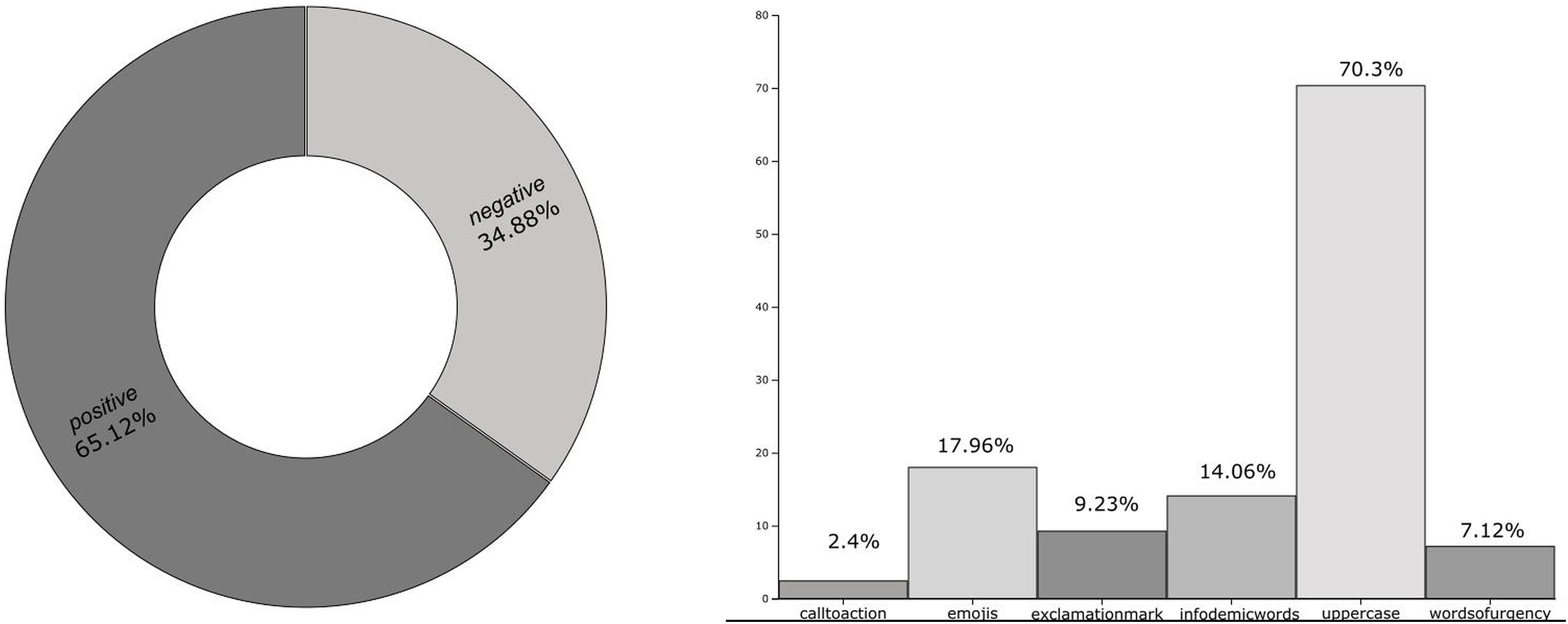
Creating verisimilitude. The central element of a fictional narrative is the achievement of authenticity. However, this is impossible without a previous pact with the users, where they exercise a “willing suspension of disbelief” (Gerrig, 1993: 230). The antivaccine group also expressed this willingness. However, it is also necessary to reinforce this willingness by mimicking journalistic formats such as quotations, eyewitness testimonies, the voice of authority, and expert testimony (Bennett and Livingston, 2018). These argumentative mechanisms are incorporated to construct “the truth” (Cook, 1994, 2001; Yule, 2020). Unlike journalistic or scientific discourses, the sources used were inaccurate and not rigorously selected.
Two main mechanisms are used to construct the “expert voice” or first-hand testimony in the channels. The first involves using quotation marks to indicate an expert's voice or quoting a first-hand testimony. Approximately 6.6% of the messages used this resource (directly quoting the available database). The second method of building verisimilitude involves citing sources. For this purpose, the group uses various sources resembling journalistic or scientific discourse. The sources were classified into five categories (Figure 6). These include websites, Telegram channels, social networks, and video platforms. Thus, when the group alternates the different sources without any pattern, it reinforces the illusion of truth entered into in its “pact” with the users. Users can watch direct “testimony” videos and articles from scientific journals underpinning the “truth pact.”

MXV discourse by source.
In the two messages in Figure 7, quotation marks were used to generate an impression of authenticity. In the image on the left, quotes simulate an expert judgment without specifying whom they are quoting, as follows: “YA SE HA INOCULADO EL VENENO TRANSGÉNICO LETAL” (The Lethal Transgenic Poison Has Already Been Inoculated). This statement alludes to a direct witness of an event. However, it never specifies who the author is and only vaguely points to world newspapers. The second image refers to “The Exposé” as an English newspaper and a blog. Hence, the blog quotes give the user the impression of an authentic media quote. Both cases exemplify the importance of discursive strategies in PW production.

On 31 October 2021 and 3 November 2021, the denialist network MXV sent two messages.
Jenkins (2006) observed that sense is not built into media appliances. In the user's mind, meaning is constructed from bits and fragments of information from the media flow. Figure 8 shows the MXV network's multimodal and multiplatform interaction capabilities (via links). This fragmented discourse provides users with a sense that guides their daily lives. The main narrative in this example centers on the negative effects of the COVID-19 vaccine. This narrative began with opposing health institutions’ vaccination efforts. Figure 8 shows the evidence collage (Donovan and Friedberg, 2019) used to create an image that condenses the pastiche of the multimodal discourse built in a shareable format.

Text messages published by the MXV network.
Figure 8 illustrates the strategies used by the MXV network. The first image (left) shows a video that was recontextualized to distort the meaning of the speaker's words (Dreyfuss, 2020). In a short clip, Jorge Ramos, a journalist, explained that he suffered minor side effects from the vaccination. However, in the image, the gravity of the situation has been exaggerated by adding the sentence “Jorge Ramos is scared,” implying serious consequences. A large syringe appeared in the same image, pointing to a man in pain. Another sentence appears at the bottom: “little by little, the truth is coming out.” The second image (center) uses two platforms (Telegram and video) to support the narrative that babies born to vaccinated mothers have tails, three arms, and four legs. The third image (right) emphasizes the vaccination risk by referencing a real article recontextualized by an Argentine newspaper. In the context of the Telegram channel, it was used to reinforce the narrative of the vaccine's negative effects.
In summary, within the context of the SARS-COV2 pandemic, this analysis identified the main discursive strategies used by the antivaccine network MXV to confront government health measures. A prior element central to creating a PW is anchored in the active willingness of the user to believe. Hence, these strategies play a central role in conveying the role of victims and propagating a discourse of redemption or an “awakening of consciences.” These discursive strategies reinforce user beliefs through multimodal and transmedia elements. Emotions and fragmented narratives simultaneously support user immersion. The active engagement facilitated by these discursive strategies seamlessly aligns with MXV's oppositional culture, where members intentionally suspend disbelief in embracing opposition to vaccination measures.
Discussion
Our findings show that MXV created a group identity and shared PW using diverse narrative strategies. These strategies rely on combining different modal forms such as text (54%), webpages (20%), and photos and videos (20%). Its emotional tone was achieved by appealing to positive emotions (65% of the messages) and using speech marks (upper case, 70.3%). Verisimilitudes were created with constant reference to video platforms (30.46%) and websites (36.33%). All these strategies are supported by the Telegramsphere (Simon et al., 2022), with a low global degree of connectivity (density = 0.3%), allowing users to wander and personally construct truth.
This study's results are consistent with those of other studies mentioning the importance of digital spaces for building oppositional cultures. They also argue that oppositional cultures are not just the result of deception or misinformation (Bennett and Livingston, 2018) by positing that these cultures are possible owing to a “willing suspension of disbelief” (Gerrig, 1993: 230). These expressions arise from the unsatisfied demands of the traditionally privileged social classes. Sanahuja and Burian (2020) considered that the manifestations of extremist groups grew out of inequality within the middle and privileged classes in Spain and Latin America, where governments have less capacity to face the unsatisfied demands of these sectors. Similarly, they represent sectors that consider themselves threatened by minority gains in cultural issues (Castillo et al., 2019).
Many authors have emphasized the role of media and group influences in the erosion of trust in the effectiveness and safety of vaccines (Grossman, 2021; Melton et al., 2021). This study points out the need to avoid overlooking the relevance of contextual influences. Our results suggest that the discursive emergence of oppositional cultures in the digital space is not simply a product of manipulation but is connected to the loss of privileges.
Conclusion
We established that MXV network members constructed an antivaccine oppositional culture that shared and developed a PW using various narrative strategies. The PW arises from a strategic decision to believe, resulting in the group's “imaginative recentering” (Ryan, 2014), which has arisen out of the members’ loss of a privileged position in society (Mc Manus, 2020; Sanahuja and Burian, 2020). The analysis shows that discursive manifestations on various Telegram channels formed this group's identity. The success of this networking lies in using fragmented multimedia and trans-media narratives, with a constant appeal to emotions and a lasting construction of authenticity.
Our main contribution is identifying the narrative strategies used by members of the MXV network to build an antivaccine opposition culture on Telegrams. This antivaccine network uses a dispersed network across the Internet, consisting of blogs, video platforms, and Telegram channels, among others, to disseminate its discourse, which comprises narrative fragments: texts, videos, photos, audio, and hyperlinks. In most texts, we identified a positive emotional tone-promoting action against vaccination. Verisimilitude was constructed through quotations and simulations of expert voices.
The analysis shows that this fragmented narrative network architecture gives them high resilience and that censorship cannot prevent dissemination. However, since the user accepts these discourses as true, their censorship only increases their legitimacy. Moreover, any lack of consistency can be easily integrated into the user's immersive experience. This highlights the importance of improving our understanding of oppositional culture development.
The construction of PW also explains the difficulty of reaching these groups and convincing them to accept vaccination through traditional health campaigns. In particular, the MXV oppositional culture enacts a willing suspension of disbelief that promotes the consumption of news and information only through deplatformed channels, blocking any other point of view that may call into question their position. Furthermore, negative judgments about these groups make the chance of transformation of discourse and behavior more challenging, as it makes them increasingly turn to their online bubbles and take up a defensive position. This also imposes significant challenges on content moderation. These networks are part of broader structures—religious, economic, and not just discursive, digital, or antivaccine—and the people who follow them are caught up in these interpretive networks. Therefore, we must also explore the underlying interests of these movements beyond political polarization and misinformation.
We hope our results will contribute to understanding the rise of antivaccine groups in different cultural contexts. One limitation of this study is that it does not explore the material conditions that explain the emergence of oppositional cultures. We believe it is critical to consider the cultural variables and discursive strategies used by antivaccine groups when developing public health policies or deploying technical solutions to contain the spread of the virus. These narratives are resilient, and the emergence of these groups cannot be understood in isolation or decontextualized. Furthermore, we must go beyond the discretionary measures taken by the platforms.
Footnotes
Declaration of conflicting interests
The authors declared no potential conflicts of interest with respect to the research, authorship, and/or publication of this article.
Funding
The authors received no financial support for the research, authorship, and/or publication of this article.
