




Abstract
Data work—the routinized, information-processing operations that support artificial intelligence systems—has been portrayed as a source of both economic opportunity and exploitation. Existing research on the moral economy of data work focuses on platforms where individuals anonymously complete one-off projects for as little as one cent per task. However, data work is increasingly performed inside organizational settings to promote more consistent and accurate output. How do technologists and data workers construct and morally justify these arrangements? This article is based on 19 months of participant-observation research inside a San Francisco-based startup. Drawing on theories of relational work, I show how managers in San Francisco and contractors in the Philippines collaborated to “clean up” the morally questionable status of data work. Managers attempted to engineer interactions with data workers to emphasize fun and friendship while obscuring vast inequalities. Filipino data workers framed American managers as benevolent patrons and themselves as grateful clients to reinforce managers’ sense of responsibility for their well-being. By shifting attention from the structure of roles to the structure of relationships in organization-based data work, this article demonstrates the function of culture and meaning-making in both generating reliable and accurate data and reproducing status hierarchies in the tech industry. Additionally, this article's examination of the complex and often contradictory dynamics of organizational attachment and marginalization has implications for debates about how the conditions of data work can be improved.
Research on artificial intelligence (AI) systems has revealed the hidden labor that enables innovation. Tech companies employ data workers who perform routinized information-processing tasks on digital assembly lines. Workers generate and annotate data to train AI systems, verify their output, and even “impersonate” AI by handling operations that are expensive to automate or which algorithms alone cannot complete (Shestakofsky, 2017; Tubaro et al., 2020). To reduce costs, tech companies in the Global North often source labor from countries in the Global South, where prevailing wages are lower (Le Ludec et al., 2023).
As demand for data work increases and its public profile expands, both academic and journalistic accounts point to its ambiguous moral status. The “custodians of the internet” (Gillespie, 2020), these workers “clean” data to prepare it for use in machine-learning models and “sanitize” social media platforms by removing content that might disturb users or advertisers. Data work can be an economic lifeline for individuals with few other economic opportunities (Johnston, 2022). At the same time, data work arrangements have also been described as dehumanizing and exploitative: workers are often treated as interchangeable and disposable, and low wages and poor working conditions amplify the massive inequalities between data workers and the technologists who rely on them (Denton et al., 2021; Muldoon et al., forthcoming; Newlands, 2021).
Existing research on the moral economy of data work focuses on digital platforms where individuals anonymously complete one-off projects, sometimes receiving just one cent for each completed task (Gray and Suri, 2019; Irani, 2015). By rendering workers as a nameless, faceless “crowd,” these platforms help technologists assuage their guilt about global inequities by allowing them to project their preferred narratives onto workers—for example, that they engage in data work for “fun” (Irani, 2015: 734) or to earn “extra cash” (Denton et al., 2021: 8). However, a new wave of studies investigates a different set of contexts, examining the “full-service” platforms and outsourcing companies that many AI firms now use to source data work (Miceli et al., 2020; Schmidt, 2022). In these settings, data workers become deeply embedded in organizational structures and processes and can be enrolled in direct interactions with the software developers and clients whose products they serve (Le Ludec et al., 2023; Tubaro, 2021).
How do technologists and data workers construct and morally justify these arrangements? This article presents a rare, in-depth analysis of organization-based data work. I mobilize data from 19 months of participant-observation research inside AllDone (a pseudonym), a San Francisco-based tech startup that employed 200 remote data workers in the Philippines. 1 Although Filipino data workers were incorporated into AllDone's organizational structure, their employment status as independent contractors meant that their membership in the firm remained marginal. These workers did not receive employment benefits and were often excluded from important organizational knowledge, decisions, and rewards.
Drawing on theories of relational work (Bandelj, 2020), I show how managers in San Francisco and contractors in the Philippines collaborated to “clean up” the morally questionable status of data work. Managers faced both material and moral dilemmas. They recognized that maintaining the stability of AllDone's data-processing workforce was essential to the company's success. At the same time, they expressed feelings of guilt and shame at how they benefitted from Filipino workers’ low wages and relatively poor working conditions. Managers responded to both problems by engineering interactions with data workers that emphasized loyalty, friendship, and fun, while obscuring vast inequalities.
Filipino contractors played an active role in this relational work. Despite stark disparities in compensation, contractors valued the stability of AllDone's employment arrangements. In their interactions with supervisors in San Francisco, they framed American managers as benevolent patrons and themselves as grateful clients. This depiction reinforced managers’ sense of responsibility for their well-being while also alleviating the managers’ guilt.
In the concluding section, I discuss this study's contributions to theories of data work. At a time when data work is increasingly embedded in enduring social and economic ties, this article shows the role of culture and meaning-making in both generating reliable and accurate output and reproducing status hierarchies in the tech industry. Additionally, this article's examination of the complex and often contradictory dynamics of organizational attachment and marginalization has implications for debates about how the conditions of data work can be improved.
The moral economy of data work
Researchers, journalists, and technologists have all pointed to data work's ambiguous moral status. Some note that remote data work can serve as a “lifeline” for people with few economic opportunities available to them, whether because they live in nations beset by economic turmoil (Johnston, 2022; Schmidt, 2022), or because discrimination prevents them from finding paid employment in local labor markets (Gray and Suri, 2019).
Yet many also characterize data work arrangements as “dehumanizing” (Panteli et al., 2020: 490) and “exploitative” (Denton et al., 2021: 1). Popular crowdwork platforms such as Amazon's Mechanical Turk (MTurk) facilitate short-term, transient, and arms-length ties between workers and employers. The platform's interface anonymizes participants, and employers can withhold payment for any reason. Crowdworkers often struggle with low and inconsistent wages, poor working conditions, intense competition for tasks, capricious algorithmic management systems, and social isolation (Gray and Suri, 2019). Workers’ invisibility in the eyes of employers degrades the status of data work, facilitating tech companies’ appropriation of value from low-wage workers (Newlands, 2021).
Software developers, too, have expressed anxieties about the moral dilemmas presented by data work arrangements. Technologists often frame their work “as non-hierarchical, mindful, [and] challenging,” undertaken in a “utopian space of networked creativity” (Irani, 2015: 735). However, confronting the reality of the highly routinized, low-wage work that supports AI systems can challenge these ideals and trigger moral conflict. For example, Irani (2015: 735) quotes an IT professional who reported that he “felt bad” about assigning “mindless work” to others. Denton and colleagues (2021: 8) describe how the creators of the ImageNet computer vision project produced a slide deck prompting self-reflection on whether they were “exploiting chained prisoners” by outsourcing the company's massive image labeling project to Turkers.
The design of the MTurk platform helps technologists resolve this tension by erasing the subjectivities of individual workers. Mechanical Turk allows software developers to justify low worker pay by aggregating data workers into a nameless, faceless abstraction, insulating developers from the realities of workers’ lives. Technologists can continue to believe that the money must go farther in the countries where workers are located, although many in fact live in the U.S., or that Turkers are just working for “fun” or “pocket change” (Irani, 2015: 734) when in reality, many depend on these platforms for income (Gray and Suri, 2019).
Because MTurk lacks mechanisms to facilitate communication between workers, collective struggles for dignity, respect, and improved wages and working conditions must occur off-platform, reinforcing the distance between workers and employers (Panteli et al., 2020). The design of these platforms supports Silicon Valley's techno-utopian ideology, as it enables software engineers to exhibit “willful blindness” toward the low-wage work and racialized workforces that facilitate technological innovation (Barbrook and Cameron, 1996: 45).
Although existing studies primarily focus on crowdwork platforms, recent research reveals that the landscape of data work is changing. The increasing prevalence of consumer-facing AI systems—including the rise of high-stakes applications like autonomous vehicles, for which ground-truth data “is a matter of life and death”—has amplified demand for accuracy in data work (Schmidt, 2022: 141). New ways of organizing data work have arisen to meet this demand, including “full-service” platforms and business process outsourcing (BPO) firms such as Appen, Hive, LeadGenius, Mighty AI, OneForma, Playment, and Telus (Gray and Suri, 2019; Muldoon et al., forthcoming; Schmidt, 2022). In these “deeply embedded” arrangements, hiring firms contract with third parties that maintain and manage data workforces, promising to ensure quality control for clients (Tubaro, 2021). Work may be performed in an office or remotely, often through a proprietary digital labor platform, and organizations may be involved in complex subcontracting relationships across subsidiary firms responsible for different functions in the AI production chain (Le Ludec et al., 2023; Schmidt, 2022).
There are significant differences between organization-based data work arrangements and crowdsourcing. Because outsourcing firms promise to deliver accurate results at scale, they often insert workers into organizational hierarchies that support task-specific training, managerial oversight, and communication among and between coworkers and managers (Gray and Suri, 2019; Schmidt, 2022; Tubaro, 2021). When workers develop expertise with particular products and processes, employers may start to see them as individuals. Some data workers may take on supervisory roles or collaborate with technologists and clients to address changing product features, edge cases, and unanticipated problems (Gray and Suri, 2019; Le Ludec et al., 2023). In contrast to the anonymity and transience of crowdwork contacts, long-term relationships can form among data workers, outsourcing firms, and clients.
In some cases, the advantages of organization-based data work over crowdwork platforms are clear: hiring firms gain improved reliability and accuracy, while workers may benefit from skill-building opportunities and enjoy higher and more consistent pay (Schmidt, 2022). However, sources of moral ambiguity persist: global competition among workers, unreliable demand for their services, and multilayered subcontracting relationships between firms can result in precarious jobs with opaque accountability structures. Meanwhile, the work generally remains highly repetitive, workers may face close surveillance and tight labor discipline, and massive inequalities between software developers and workers persist (Gray and Suri, 2019; Muldoon et al., forthcoming; Schmidt, 2022; Tubaro, 2021).
Research on the organizational aspects of data work remains rare (Le Ludec et al., 2023). However, a few recent studies have highlighted the increasing incorporation of data workers into organizational processes (Miceli et al., 2020; Schmidt, 2022; Tubaro, 2021). For example, Le Ludec and colleagues (2023) found that organization-based arrangements can bridge the gap between software developers and data workers by bringing them into direct contact with one another. As communications between data workers and technologists become more frequent, and as workers build long-term attachments to firms and develop valuable expertise, such interactions can become crucial to the successful performance of AI systems. Yet contacts across substantial power differentials may also stir up feelings of awkwardness and guilt for technologists, and anger and resentment for workers, potentially provoking tension and conflict. As Tubaro (2021: 938) notes, deeply embedded ties “inevitably include a human element—as any form of ‘relational work’ that deploys sociality as part of intentional efforts toward productive or monetary goals.” However, we still know little about how technologists and data workers navigate these interactions to ensure the smooth functioning of algorithmic systems amid transactions marked by moral ambiguity and stark global inequalities. To investigate this question, we must shift our attention from the structure of roles to the structure of relationships in organization-based data work.
Relational work
The relational perspective in economic sociology posits that markets are not simply sites of cold, rational economic calculation—they are instead imbued with cultural and moral meanings. Market actors engage in relational work, which Bandelj (2015: 242) defines as “the interactional efforts at negotiating economic relations, infused with sense-making, that have implications for power distribution between partners of exchange.” This concept has been elaborated in numerous studies examining how people mobilize social relations to undertake economic exchanges.
Relational work is particularly prominent in morally problematic transactions (Bandelj, 2020). For example, a fertility clinic's staff might downplay financial motives when facilitating interactions between egg donors and clients, striving to uphold the framing of the donation as a gift (Haylett, 2012). More mundane economic interactions can also present people with moral dilemmas and awkward moments that must be resolved through relational work, as when luxury hotel workers and patrons navigate the politics of tipping (Sherman, 2007).
Researchers have observed how people engage in relational work to define the meaning of economic ties across gulfs in social status. High-status actors are often perceived as inconsiderate and inauthentic (Hahl and Zuckerman, 2015). Consequently, economic elites frequently engage in practices that reinforce their moral standing and alleviate feelings of guilt and shame at benefitting from status differences. Examples of what we might call “top-down” relational work include when wealthy guests at luxury hotels self-consciously demonstrate that staff members’ knowledge and efforts are recognized and valued (Sherman, 2007), or when billionaires disguise their wealth by wearing working-class attire and insisting that they consider their hired help “the closest of friends” (Farrell, 2020: 193).
Lower-status individuals also engage in relational work to define economic exchanges strategically. When platforms afford creative freelancers (such as graphic designers and illustrators) the ability to communicate directly with employers, workers often attempt to infuse otherwise impersonal economic transactions with emotion, intimacy, and affection (Alacovska et al., 2024). Endowing freelancing relationships with meaning can help workers build long-term ties with clients to mitigate the precarity and insecurity of platform-based work (see also Panteli et al., 2020). In transnational labor relations marked by status differentials, workers may reshape their affective expression and even identities to match employers’ expectations of foreign workers, performing cheerfulness, gratitude, and servility to maintain stable and ongoing employment relations (Amrute, 2016; Hoang, 2015; Poster, 2019). 2
Although existing studies have largely neglected the role of relational work in labor arrangements, the concept can be especially useful in understanding the patterned relationships through which highly unequal exchanges—such as those typically found in data work—are rendered meaningful and worthwhile. Relational work between workers and employers can foster workers’ consent to the extraction of surplus value, supporting the smooth exchange of labor for wages across substantial power differentials (Mears, 2015).
Although scholars have emphasized that relational work is shaped by social context (Bandelj, 2020), researchers have rarely examined how organizational characteristics influence the dynamics of relational work. Organizational perspectives suggest that relational work will be affected by organizational cultures, or “pattern[s] of shared basic assumptions” that posit “the correct way to perceive, think, and feel in relation to problems” (Schein, 2004: 17). Existing studies highlight strategies of rational control through which companies elicit desired behaviors in data workers by appealing to their economic self-interest (Kellogg et al., 2020). However, strategies of “normative control,” drawing on rituals and cultural practices designed to cultivate commitment, can also play an important role in aligning workers’ experiences and identities with corporate objectives (Kunda, 1992). At the same time, workers can strategically mobilize the symbolic resources promoted by management to advance their own interests (Tomaskovic-Devey and Avent-Holt, 2019).
As AI systems advance and demand for reliable and accurate data work continues to increase (Tubaro et al., 2020), scholars must attend to how the texture of organizational life matters for both the successful accomplishment of data work and the functioning of AI systems. Otherwise, we risk reinscribing the misguided notion—which remains common among technologists (Denton et al., 2021; Irani, 2015)—that data workers are best conceptualized as isolated, rational economic actors divorced from concrete social and cultural contexts.
Research setting
At the time of my research, AllDone was an early-stage startup that ran a digital platform connecting buyers and sellers of local services across the United States (e.g. housecleaners, wedding photographers, math tutors). The 20 full-time employees in the San Francisco office comprised engineering, design, marketing, business, and operations divisions. Employee salaries were generally in the high five- to low six-figures, and compensation included a generous benefits package and stock options.
AllDone also employed 200 independent contractors located across the Philippines. Contractors completed routine information-processing tasks that supported the company's algorithmic systems. Offshoring this labor to the Philippines freed software developers to experiment with new features that could help the company scale rapidly and attract additional venture capital funding (Shestakofsky, 2024). Team members were recruited and supervised via oDesk, a digital platform that connects employers with remote freelancers. Members of AllDone Philippines were generally hired into long-term, open-ended contracts; by the end of my fieldwork, some had been with AllDone for four years. Contractors averaged $2.00 per hour in wages and 30 work hours per week. Compensation was similar to starting wages in other jobs in the BPO sector (e.g. back-office administrative roles, call center work), which primarily employs college-educated Filipinos and provides pay substantially higher than the local minimum wage (Sallaz, 2019). The proliferation of decentralized platforms makes it difficult to estimate the number of Filipinos engaged in data work; however, the Philippines has the world's sixth-largest population of online freelancers (Stephany et al., 2021).
Although AI systems rely on global flows of digital labor, how data work is accomplished can vary across geographical contexts (Posada, 2022). Norms of “workplace familism” are common in organizational settings across the Philippines. In such workplaces, “the nature of employment relationships is likened to a familial relationship” in which “leaders and subordinates seem to assume specific roles which are typically found in a family environment,” including leaders taking on “paternalistic attitudes” and the expectation that they will support and care for employees (Restubog and Bordia, 2006: 564).
Although studies addressing the organizational aspects of data work have focused on outsourcing arrangements (e.g. Le Ludec et al., 2023; Schmidt, 2022; Tubaro, 2021), firms have developed other strategies for maintaining remote workforces. Digital freelancing platforms (e.g. Upwork, Fiverr, Freelancer) allow companies to directly hire online workers. While freelancers are often hired to complete discrete projects, many develop ongoing, personal relationships with hiring managers, and companies can use freelancing platforms to build virtual teams (Alacovska et al., 2024; Stephany et al., 2021). At AllDone, delegating supervision, quality control, and personnel matters to local managers (also hired through oDesk) allowed the company to ensure the quality of data work while avoiding fees levied by outsourcing companies (Schmidt, 2022).
AllDone's data workers received training and managerial supervision to ensure the consistency and quality of output. Unlike the outsourcing model, however, recruitment and supervision were not subcontracted to a third-party company but instead handled by the hiring firm. Owing to its hybrid model—which I call partial internalization—AllDone can be viewed as an “exceptional case” that “magnif[ies] relational patterns that in more mundane contexts lack visibility” (Ermakoff, 2014: 227). Because AllDone's data workers and managers were in frequent contact with one another, the firm provided an opportunity to observe a multitude of interactions between both parties. This makes AllDone a particularly useful case study for theorizing how people manage the moral ambiguities of employment arrangments inside organizational settings that reduce the distance between data workers and software developers.
Methodology
I conducted participant-observation research at AllDone from February 2012 to August 2013, a time when technologists’ awareness of data work was beginning to grow. I initially gathered data while working one day per week as an unpaid intern. My role at AllDone evolved as managers asked me to contribute to a growing array of projects. Within a month I was offered a part-time, paid position, and five months later I became AllDone's full-time director of customer support and operations manager, which I performed while continuing my research activities. 3 I introduced myself to colleagues with my job title and a disclosure that I was researching the company. I entered the field just after AllDone received its first round of venture capital funding, and I left shortly after the second fundraise. Like many early-stage, venture-backed firms, AllDone was not a profitable enterprise.
I worked closely with members of AllDone Philippines in three capacities. First, I oversaw its division of 20 e-mail support agents, which a local manager directly supervised. Second, I served as an information broker between the San Francisco office and contractors in the Philippines: I wrote weekly product updates to inform contractors of changes to the platform, helped workers troubleshoot problems, and occasionally transmitted their feedback to software developers in San Francisco. Third, I wrote detailed instructions that data workers followed to execute one-off “special projects” assigned by members of the San Francisco staff.
My deep involvement provided unique insights into the company's operations (Anteby, 2013). My role in the organization allowed me to observe everyday interactions between managers in San Francisco and workers in the Philippines. I was included on AllDone Philippines’ internal e-mail lists and maintained regular communication with team leaders via e-mail, chat, and videoconference. I also took three trips to the Philippines: the first during my stint as a part-timer, the second as a full-time employee, and the third a year after I had left the company. These trips collectively spanned 31 days, during which I was able to interact with dozens of team members in person.
My analytic approach was abductive (Timmermans and Tavory, 2014), motivated by puzzling evidence that could not easily be explained by existing research on data work. Recording extensive fieldnotes throughout each workday and writing analytic memos after leaving the field each night helped me interrogate potential sources of bias (Anteby, 2013). In addition to writing analytic commentary after reviewing each day's fieldnotes, I coded select fieldnotes and documents in ATLAS.ti. Following my departure from the field, I continued to conduct informal interviews with informants, gathered data from public sources, and wrote analytic memos to link emergent theory and data to broader themes.
Data work at AllDone
AllDone's data workers logged into “portals”—or back-end, administrative webpages—to complete routinized, information-processing tasks. AllDone's leadership recognized that AllDone Philippines was a key contributor to the company's success. As Martin, one of AllDone's cofounders, once proclaimed, ‘portals are what made the difference for AllDone—what's separated us from other companies.’ 4
AllDone Philippines played an essential role in supporting the company's algorithmic systems. As Martin once put it in an e-mail to data workers, “AllDone simply wouldn’t be able to operate without Team Philippines. The website would simply stop. You guys are the gears that turn the entire machine.” The platform's purpose was to match prospective buyers with sellers of local services. Yet the company's software engineers—whose numbers doubled from four to eight during my fieldwork—were relentlessly focused on developing new features that they hoped would increase key user metrics and attract venture capital funding. Rather than dedicating scarce resources to building software that would perfect the matching process, engineers offshored the task to workers in the Philippines. Every time a buyer placed a request, it would be routed to the company's matching portal, where workers screened out potentially fraudulent requests. For each validated buyer request, the portal generated a list of potential matches from AllDone's database of service providers. A worker would manually select those she judged to be an appropriate fit to receive the request. Figure 1 shows how the portal worked for a contractor who was matching a buyer with providers of hair styling services. Workers’ verifications and matches were eventually used as training data for algorithms that automated the matching process.

AllDone's matching portal.
In addition to the matching function, engineers delegated many other long-term organizational processes to data workers. One division supported AllDone's growth by writing thousands of keyword-rich blurbs each week to boost the company's search engine rankings. Among myriad other tasks, members of AllDone Philippines proofread seller profiles, deleted inappropriate posts, and used prewritten e-mail templates to reply to incoming customer support inquiries. AllDone's data workers completed over 10,000 daily tasks. These efforts allowed San Francisco-based software engineers to prioritize testing and implementing changes to the platform.
The benefits of partial internalization
Jobs with AllDone Philippines offered wages and working conditions that were arguably as good as, and in some respects better than, those documented in prior research (e.g. Le Ludec et al., 2023; Miceli et al., 2020; Muldoon et al., forthcoming). As in some other deeply embedded arrangements, AllDone sought to build and leverage enduring relationships with workers. However, instead of purchasing access to labor organized by an outsourcing firm, AllDone developed direct and enduring ties with data workers who applied for jobs, were interviewed via Skype, and then hired and referred to as “team members,” exemplifying an employment model I call partial internalization. Workers were integrated into the hiring firm's organizational structure and rhetorically framed as insiders.
New recruits assumed positions at the bottom of AllDone Philippines’ organizational hierarchy. The team's general manager supervised five units led by four deputy managers and 15 associate managers (Figure 2). Local leaders developed training videos and extensive documentation to educate workers on their tasks. Regular quizzes and coaching sessions helped to guarantee the quality of workers’ output. When problems or questions arose, workers frequently turned to e-mail, chat, or videoconference to ask colleagues or local leaders for help, who could in turn consult with managers in the San Francisco office. Contractors developed expertise in their division's procedures, with some executing the same functions for years at a time.
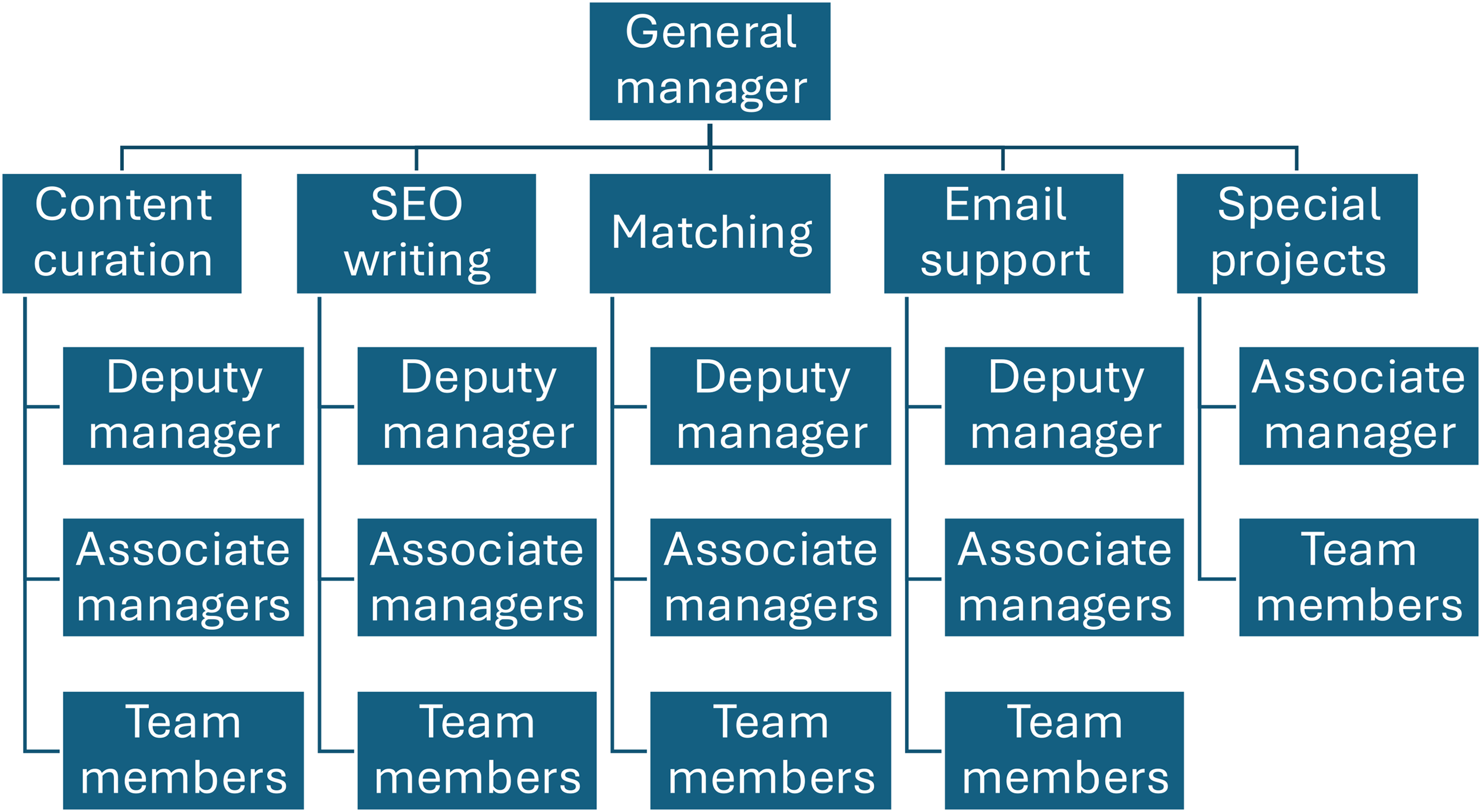
AllDone Philippines’ organizational structure.
AllDone Philippines’ hierarchical organization afforded data workers opportunities to pursue wage increases and career growth. Team members were granted occasional raises of $0.25 per hour, as well as bonuses of between $5 and $150 for reaching performance or service-time milestones. Some were promoted into managerial roles. Associate managers could earn $4 per hour, which was twice the average starting wage. Like call center jobs (Sallaz, 2019), for many contractors, working for AllDone provided a means of achieving socioeconomic mobility and decent living conditions in a nation with high rates of poverty and unemployment. In a typical month, between 0 and 2% of the team's contractors left the company voluntarily, a rate of turnover vastly lower than on crowdwork platforms (Gray and Suri, 2019).
The limits of inclusion
Although data work arrangements at AllDone were arguably more advantageous for workers than those documented in prior research, the moral status of data work at AllDone remained ambiguous. Despite the benefits described above, AllDone's Filipino workforce was not fully incorporated into organizational processes. Contractors experienced challenges and sources of precarity observed in other data work employment models. This was not lost on members of AllDone San Francisco, who sometimes expressed feelings of guilt and shame at how they benefitted from massive disparities in power and compensation between the two groups.
An anonymous survey of AllDone Philippines contractors organized by senior management surfaced common complaints stemming from workers’ classification as independent contractors. Filipino workers received no health insurance benefits or paid sick leave. Contractors were not entitled to company contributions to their social security accounts, and AllDone did not provide proof of employment to help contractors secure bank loans. Some workers, bemoaning tasks that felt “monotonous” and left them feeling “bored,” requested a job rotation system and “more challenging position[s]/task[s].” Some asked for additional compensation—including stock option grants—as well as more chances to advance up the company's occupational ladder.
Organizational hierarchies reinforced a divide between data workers in the Philippines and software developers in San Francisco. One way this divide manifested was in a lack of communication: developers sometimes neglected to inform managers in the Philippines of product changes that would affect their divisions. In one instance, software developers had implemented—and failed to announce—a product change that dramatically increased the volume of tasks that would have to be completed by one group of contractors, who were quickly overwhelmed by the new work. “We should have told them ahead of time so they would know it's coming, but it just didn’t occur to us,” Carter (AllDone's president) said in a meeting, his voice tinged with remorse. In cases like this, members of AllDone Philippines faced additional stress because they were deprived of relevant information or resources.
When AllDone Philippines’ leadership contacted engineers in San Francisco to share ideas or flag problems with the software, they found that their requests were usually disregarded. During my first trip to the Philippines, I had dinner with local managers at a restaurant in Cebu City. Rebecca says she used to notify Adam [the director of engineering] whenever members of her team found bugs in their administrative portal. She says Adam would always reply, “How many people is this affecting?” Ross and José both let out a knowing laugh as Rebecca goes on to say that no matter how she replied, Adam inevitably responded, “We’re not fixing it.”
As the head of AllDone's software engineering team, Adam's mandate was to drive continual experimentation with the product to generate exponential growth. Engineers perceived fixing issues with AllDone Philippines’ portals as a distraction from this goal. Indeed, over online chat, Adam once told me that “I ignore like 80% of requests” from AllDone Philippines.
Additionally, as “team members” who received periodic updates about the startup's progress from executives in San Francisco, contractors were aware of the disparity between the company's swelling coffers and their own relatively meager compensation. During another trip to the Philippines, the team's longtime general manager, Veronica, told me about a recent conversation with data workers that highlighted their growing dissatisfaction with being classified as independent contractors. ‘Especially with all this [recently raised venture capital] money—we keep telling the team that we have all these investors, and they are asking, "What does this mean for us?" I know we need [to hire] engineers, but I don’t see why we [in the Philippines] can’t have this too.'
Although they were told that they were members of an “AllDone family,” some workers were frustrated that they were not sharing in the wealth their labor was generating.
Managers in San Francisco expressed feelings of guilt about various aspects of AllDone's labor arrangements. As in the example above, when Carter described how “it just didn’t occur to us” to inform AllDone Philippines about a major product change, some appeared to feel ashamed after realizing they had not considered how their actions would affect data workers.
Software developers also expressed discomfort with assuming a superior role in AllDone's organizational hierarchy. Brett, a software engineer, told me about the first time he assigned a task to workers in the Philippines, a “data mining” project for which he had asked contractors to gather unstructured information from hundreds of web pages and enter each item into a spreadsheet. “We could have done it ourselves, but it was a really annoying task,” he explained. “I felt bad making them do it.” Accustomed to an office environment characterized by peer production, Brett apparently felt moral reservations about using his power over Filipino workers to assign them “annoying” work that he would prefer to avoid (Irani, 2015).
Additionally, the gulf in compensation between the teams seemed to bother employees. During an off-site staff event in San Francisco, Paul, a member of the marketing team, brought up the topic of my impending trip to the Philippines, remarking that he sometimes worried that the company's data workers were “exploited.” In sum, although AllDone's data work arrangements were arguably among the most humane in the industry, the moral status of data work at AllDone remained ambiguous.
Cleaning up data work through relational work
AllDone's dependence on its data-processing workforce created both material and moral dilemmas for San Francisco-based leaders. The company integrated Filipino contractors into organizational processes to take advantage of their accumulated knowledge and skills. The team's consistent and accurate output was essential to the day-to-day functioning of the product. At the same time, the direct and sustained contact between the teams made the moral quandaries that come with employing low-paid, offshore data workers unavoidable.
Managers organized their interactions with workers to serve two goals: eliciting contractors’ commitment to the company—which would ensure the continuity of business-critical routine functions—and resolving their own guilt about contractors’ wages and working conditions. Contractors, for their part, mobilized their interactions with managers to minimize uncertainty about the availability of work while pursuing possibilities for advancing their careers within a growing startup. They accomplished this by cultivating managers’ feelings of obligation to preserve their jobs and protect them from harm. In so doing, they reaffirmed managers’ belief that AllDone was creating positive change around the globe.
At issue in this analysis is not whether members of the organization displayed their “authentic” feelings on the job. When relationships span power asymmetries, material and affective offerings are often intertwined, making it impossible to separate “real” emotional displays from those that are purely instrumental (Constable, 2003). It is instead useful to view AllDone team members’ emotional expressions as performances that helped to solidify and stabilize employment relations amid longstanding global inequalities. At AllDone, acts of relational work took the form of reciprocal ties characteristic of clientelism, “in which an individual of higher socio-economic status (patron) uses his own influence and resources to provide protection or benefits, or both, for a person of lower status (client) who, for his part, reciprocates by offering generous support and assistance, including personal service, to the patron” (Scott, 1972: 92).
Top-down relational work
Managers in San Francisco mobilized relational work to bolster Filipino contractors’ loyalty to the company, envisioning expressions of loyalty, gratitude, and love as compensation for what Carter referred to as their “unglamorous work.” As Carter noted in a message to employees in San Francisco, he was eager for Filipino contractors to “treat AllDone more like an offline job than an online one,” making it important that the company “do whatever we can to help foster new friendships.” In Carter's telling, “hav[ing] an amazing time” and helping to “[m]ake everyone feel appreciated and loved” would presumably sustain contractors’ motivation and commitment as they performed repetitive tasks. Members of AllDone San Francisco planned regular trips to the Philippines to advance this goal, traveling to a different city each day to celebrate with local workers.
At gatherings in each city, managers praised contractors in speeches that emphasized Filipino workers’ essential contributions to the company. Carter emphasized not only managers’ gratitude, but also their affective ties to the data-processing workforce, noting that the purpose of their trip was not “just to eat, talk, dance, and have a fun time with you all.” “Martin, Ben, and I traveled 7000 miles—halfway around the world—so we could each say “mahal ko kayo” [I love you all] and “salamat” [thanks]. Team Philippines does incredibly important work for AllDone, and Team Philippines is filled with incredible people and we wanted each of you to know how much we appreciate and love and care for you all.”
As Carter's language of “love” and “care” suggests, leaders from San Francisco actively cultivated emotional bonds with Filipino data workers. Rather than reinforcing corporate hierarchies, managers endeavored to engage in warm and cheerful interactions with contractors. When members of the San Francisco office visited the Philippines, stops in each city began with leisure activities that brought the locals and visitors together in informal settings. For example, managers and workers traveled to a volcano south of Manila, took a midnight ferry to Puerto Galera, and visited an island resort in Bohol. During one trip, Carter wrote a message to staffers in San Francisco explaining how these visits had been oriented around “hanging out, eating, getting to know each other better, playing around, etc.” Instead of probing into the details of contractors’ work lives, managers asked about their families, hobbies, schooling, and previous jobs. Filipino data workers reciprocated these bids for connection by inquiring about managers' social lives while avoiding questions about their jobs and employment benefits. In each of the cities managers visited, nightly parties featured games, laughter, singing, and dancing, concluding with hugs and proclamations of love and gratitude between the American visitors and Filipino workers. Organizing visits that emphasized socializing, celebrating, and “friendship” helped managers obscure the substantial gulf in status that separated the two teams (Leighton, 2020).
Bottom-up relational work
Just as managers used relational work with the goal of building data workers’ commitment to AllDone, contractors relied on patterns of emotional expression to try to reinforce managers’ loyalty to them. Data workers’ performances highlighted the benevolence of AllDone's leaders and emphasized contractors’ reliance on them, construing the managers from San Francisco as altruistic patrons whose company was uplifting Filipinos. For example, following one trip to the Philippines, Carter sent an e-mail to team members expressing his love and gratitude. A data worker named Maura sent the following reply: “When I was reading your message of love to Team Philippines, I was really crying. […] I just want to say THANK YOU very much for your trust, love, and care for each of us. You just don’t know how you have helped a simple college student, how you have saved me from desperate situations. When I remember those days, I remember AllDone. You are the best bosses I have ever met in my whole life.”
Maura portrays herself as “simple” in relation to the company's leadership, whose care and magnanimity have transformed her life. Similarly, another data worker wrote, “I could never ever think of anything good I’ve done to deserve such wonderful bosses as you.” It was also common for AllDone Philippines’ local leaders to write messages to members of AllDone San Francisco featuring over-the-top displays of warmth and gratitude. A deputy manager named Ross closed one e-mail with the following missive: I treasure my AllDone life […] My dear bosses, wait for more weeks to come and we have more surprises for you – more amazing systems, more amazing TOOLS to make our team happier, and more amazing ideas. :) We do this because we OWE you and ALLDONE a lot and we want to pay you back by showing to you our commitment and love. […] I want to recommit to you now my 200% commitment, love, and loyalty to ALLDONE.
Ross’ message emphasized Filipino workers’ debt to the bosses in San Francisco and described his team's efforts to reciprocate by offering their “commitment and love.”
I often felt disconcerted by data workers’ apparent adulation of members of AllDone San Francisco. When we arrived at airports in the Philippines, we would often find a group of contractors unfurling custom-made and professionally printed banners, purchased at their expense, welcoming us to their city. In Dumaguete, data workers hired entertainers, including fire dancers and a drum troupe, to celebrate our visit. When we departed each city, contractors gave us both store-bought gifts (e.g. scarves, t-shirts) and handmade scrapbooks featuring colorful collages and letters replete with sentimental messages. As Adam told me upon our return to the office, “you were treated like royalty.” Indeed, one data worker sent an e-mail in which she described feeling “star-struck” in our presence. Following a celebration in Manila, Carter received this text message from a data worker named Joy: Wat u did for us is more than we cud ever ask. For many of us, just getting to see u visit us in person is a dream come true. Im not joking, i really heard team members express this behind ur back, hehe. Thank u so much for everything. […] Just promise us that u will visit us again. :)
In Joy's telling, the time that Carter spent in data workers’ presence was itself a gift. I was initially discomfited by Joy's text, which in exalting Carter's status seemed to simultaneously devalue Filipino workers. I later came to understand that, within the context of clientelistic relationships, efforts to highlight such status differentials may also be intended to implicitly underscore patrons’ obligations to their clients (Swidler and Watkins, 2017). For this reason, Joy's message can also be viewed as a bid for loyalty and care from a powerful figure who wielded substantial control over corporate resources (Hoang, 2015).
Turning ambivalence into altruism
While refiguring employment relations as patron–client bonds supported a shared goal of fostering stable ties between the firm and its data-processing workforce, interactions between the two teams also functioned to absolve managers of their guilt at benefitting from massive disparities in power and compensation. Like many other Silicon Valley entrepreneurs, AllDone executives often claimed that their profit-seeking company's actions were imbued with a moral purpose (Barbrook and Cameron, 1996). Echoing the testimonials provided by contractors, Carter sometimes sent messages to employees in San Francisco about how AllDone was changing the lives of data workers located thousands of miles away. In one all-staff e-mail, he shared an anecdote about a job applicant who “has been emailing Veronica daily for weeks telling her that he can’t feed his family and needs this job so his children can eat.” Carter continued: [I]f this is making you feel guilty about not helping the poor enough…just work harder at making AllDone successful. If we make AllDone a billion dollar company we will do more good in the Philippines and elsewhere than most non-profits could ever dream of. I actually developed a somewhat righteous anger for people who don’t appreciate the good that for-profit companies can do in develop[ing] countries. It's so blindingly obvious it hurts.
The stories Carter heard from Filipino data workers reaffirmed the common Silicon Valley narrative that tech companies like AllDone were changing the world for the better. ‘You can do so much more good at AllDone—giving Filipino people jobs, growing the economy, changing millions of lives—than you can in politics,' he earnestly told me at an off-site office party. Carter's relationships with data workers solidified his belief that heroic entrepreneurs like himself could offer hope to the deserving poor around the globe.
Contractors’ words and actions seemed to provide further evidence of AllDone's positive social impact. During one visit to the Philippines, Carter sent an e-mail to San Francisco-based employees recounting the stories of personal transformation that data workers had shared with the group. One had reportedly said, “AllDone has changed who I am. Before AllDone I was lost, but AllDone has given me something to be proud of in my life.” Another, he said, had stated, “Before AllDone, I was nothing. AllDone has reversed the course of my life.” Carter described being “almost overcome” with emotion upon learning that some data workers had taken some crappy, packed, un-air-conditioned bus 7 hours through winding, dirty roads across their island. They had spent a few days' earnings to pay for their tickets.
5
And there they were—not listening to me thanking them for writing thousands of blurbs for $2.50/hr—but I was listening to them thank me and thank AllDone for the wonderful opportunity we were providing them. “Every Sunday I go to church and I thank God for AllDone. AllDone has blessed our lives.” They said it again and again.
Carter added that, in contrast with employees in AllDone's San Francisco office, “These guys live such hard lives…[I]t's hot, humid, congested, and dirty everywhere. They have no AC or privacy.” Carter continued: And in the face of all this ugliness, they smile and are thankful for everything they do have. And, oh how thankful they are for AllDone. An employer who pays well and cares about me and invests in me and provides a community and an opportunity and rewards me when I work hard. If you’ve never had those things it truly must be a God send.
Carter expressed his appreciation of Filipino workers “for writing thousands of blurbs for $2.50/hr,” betraying his recognition of how little they were paid relative to their value to the company. However, his apparent unease with AllDone's employment practices was alleviated by data workers’ expressions of gratitude and loyalty. “Nothing,” Carter concluded, “will give me more pleasure or satisfaction or meaning than to create an enormous, profitable company that employs thousands and thousands of wonderful, deserving people like this around the globe.” Instead of feeling guilty about taking advantage of data workers, Filipino contractors’ emotional displays helped Carter reimagine his entrepreneurial activities as altruistic, allowing him to feel like the protagonist in a transnational “rescue narrative” (Constable, 2003).
Even San Francisco team members who had never set foot in the Philippines articulated this vision of AllDone as a benevolent and humane employer. On one occasion, a member of the marketing team named Paul asked me what I’d be doing on my next visit with data workers in the Philippines. Paul confesses that he sometimes struggles with feeling that members of AllDone Philippines are “exploited,” but then he remembers that these are good jobs in the Philippines. ‘Who am I to judge? They seem happy! We pay fair market wages in the Philippines. But we could pay twice as much and they still wouldn’t be as happy as they are now if we didn’t treat them well.'
Paul's mention of “exploited” workers suggests that he was uneasy with the massive pay gap separating employees in San Francisco from data workers in the Philippines. Yet his ambivalence about organizational inequalities was allayed by his perception—informed by both missives from management and the circulation of emotionally effusive e-mails from data workers—that Filipino contractors were “happy” because of how managers treated them.
AllDone executives appeared to have developed a genuine sense of responsibility for the welfare of the data workers they hired. For example, anticipating the transition from manual to automated matching, the cofounders spent months trying to find another company that might be interested in hiring the data workers whose jobs would be rendered obsolete. When their efforts failed, Carter asked both employees in San Francisco and deputy managers in the Philippines whether they could envision any new projects involving data workers that would be of use to the company. Owing in part to these efforts, 35 contractors lost their jobs—representing about one-third of the cuts that had initially been projected. Those whose contracts were terminated received up to six weeks of severance pay.
AllDone's leadership surely hoped to avoid substantial layoffs not only because they felt responsible for data workers’ welfare but also because of their more practical and self-interested concern with maintaining the team's stability and morale. Nevertheless, it is clear that managers believed it was important to preserve patterns of relationality emphasizing mutual loyalty and emotional bonds.
Discussion and conclusion
The rise of AI systems has forced technologists to grapple with the moral ambiguity of data work, which has been portrayed as a source of both opportunity and exploitation. In contrast with crowdwork platforms that atomize and anonymize workers, data work is increasingly performed in organizational settings that provide structures designed to increase the consistency and accuracy of output. Organization-based models can enable workers to develop valuable product-specific expertise, build long-term attachments to firms, and directly interact with the software developers whose products they support (Gray and Suri, 2019; Le Ludec et al., 2023). These arrangements can reduce the distance between technologists and data workers, making relationships between the two parties increasingly central to the success of AI systems. Consequently, the question of how technologists and data workers navigate and justify vastly asymmetrical relationships is vital for understanding the social construction of data.
This article has examined one firm to investigate how technologists and data workers negotiated the moral ambiguity of data work through their everyday interactions. At AllDone, where data workers were partially incorporated into organizational structures and processes, working conditions were arguably more favorable than those in alternative arrangements. Still, managers sometimes expressed guilt and shame about hiring low-wage Filipino workers to perform highly routinized tasks on the firm's margins. The company's dependence on its data-processing workforce, as well as data workers’ visibility to employers, created tensions and opportunities that both parties negotiated through relational work.
Whereas prior research on the organizational aspects of data work has illuminated how workers are trained and monitored to ensure reliable performance, the case of AllDone shows how organizations may also try to mobilize data workers’ subjective experiences to achieve corporate ends. At AllDone, the structure of interactions between managers and workers supported the firm's goal of maintaining a stable, long-term workforce capable of providing consistent and accurate output. Efforts to align workers’ sentiments and sense of self with corporate interests (Kunda, 1992) were layered atop work in and around algorithmic systems. This article's findings thus extend theories of normative control into the domain of data work, where existing accounts have documented strategies of rational control alone (Kellogg et al., 2020).
This study builds on other accounts of data work that move beyond narratives of isolation and exploitation to examine workers’ rich and often contradictory experiences of attachment and marginalization (Gray and Suri, 2019; Panteli et al., 2020). At AllDone, data workers achieved a degree of visibility unavailable to crowdworkers (Denton et al., 2021; Newlands, 2021). Managers’ recognition of workers’ humanity constituted workers as individuals entitled to be treated with some degree of dignity and respect (Sherman, 2007). Contractors took advantage of this visibility by engaging in bottom-up relational work, mobilizing the symbolic resources promoted by management to advance their own interests (Tomaskovic-Devey and Avent-Holt, 2019). Like freelance creative workers who cultivate long-term ties with clients (Alacovska et al., 2024), members of AllDone Philippines endeavored to build emotional connections with managers in San Francisco to forge enduring relationships. In the face of vast power inequalities, workers tapped into cultural schemas of clientelism, strategically deploying relational work to bolster managers’ feelings of obligation to protect workers from harm.
Analysis of the interactions between AllDone's managers and data workers suggests how techno-utopian ideologies (Barbrook and Cameron, 1996) can be reproduced even in settings where the tech industry's inequalities are rendered starkly visible. As they deployed top-down relational work to try to shape workers’ feelings, AllDone's managers simultaneously attempted to legitimate immense disparities in the firm's distribution of rewards, assuaging their own guilt surrounding the inequalities between themselves and data workers. Investing in relationships that held the appearance of transcending economic transactions did not simply foster contractors’ commitment to the firm and their consent to an unequal arrangement. These practices also allowed managers to recast vast asymmetries as something closer to parity (Leighton, 2020; Sherman, 2007).
Relatively disempowered workers, for their part, perpetuated the industry's prevailing ethos in an attempt to meet their own need for economic security, performing emotional displays that highlighted workers’ gratitude for and deference to managers (Amrute, 2016; Poster, 2019). Recognizing workers as individuals, acknowledging their efforts, and engaging in friendly, personalized interactions allowed managers to interpret workers’ expressions as genuine, helping them avoid feeling guilty about exploiting others. Meanwhile, data workers’ job responsibilities came to include sustaining managers’ images of themselves as people who were both “doing well” financially and “doing good” in the world (Sherman, 2007).
As the labor required to “clean up” data is reorganized, researchers must also grapple with changes in how the moral dilemmas of data work are sanitized. Scholars of relational work emphasize the importance of emotions, affect, and meaning-making in economic life. Relational work can help to reproduce existing hierarchies, but it can also open opportunities for interactions that alter power dynamics and subvert inequalities (Bandelj, 2020). As data work becomes more deeply embedded in social and economic ties, relationships between data workers and technologists are poised to become more central to the functioning of AI systems. Culture and meaning-making are thus likely to play an increasingly important role in both ensuring the accuracy and consistency of output, and in maintaining and challenging status hierarchies in the tech industry.
This study also demonstrates the importance of deepening analyses of the organizational aspects of data work (Le Ludec et al., 2023). In providing one of the earliest examples of organization-based data work—at a company that developed its model of partial internalization in the early 2010s—these findings call into question the notion that there has been a linear trend from arm's length crowdsourcing to long-run, trusting relationships in data work. Instead, it appears that different employment arrangements have long coexisted. At a time when data work is increasingly handled within formal organizations, organizational analysis can play an important role in developing our understanding of how people make sense of data work, how it is accomplished, and what implications it carries for workers and firms. Managers viewed AllDone's data workforce not only as an essential element of AI systems, but also as a flexible resource that could be deployed to delay expensive and time-intensive software development, or to quickly test-run experimental features before they were coded up. This suggests that companies with access to long-term data workforces may be more likely to rely on manual processes, rather than on automation alone, to solve organizational problems (Shestakofsky, 2017, 2024).
Existing studies of organization-based data work typically focus on intermediaries that organize data-processing workforces rather than on the firms whose products they support. Future studies of hiring firms can illuminate how corporate cultures (Tomaskovic-Devey and Avent-Holt, 2019) and funding trajectories (Shestakofsky, 2024)—as well as workers’ broader cultural contexts (Posada, 2022)—influence the structure of data-processing workforces, interactions between data workers and software developers, and data workers’ ability to make claims on organizational resources. This approach can shed new light on how technology companies support the accuracy and reliability of data work, while also illuminating the contours of inclusion and exclusion that shape workers’ experiences.
Finally, this article joins an ongoing conversation about how the conditions of data work can be improved. Others have discussed how changes to platform design, laws and regulations, technologists’ practices, and workplace advocacy could make data work arrangements less exploitative and more humane (Gray and Suri, 2019; Muldoon et al., forthcoming; Panteli et al., 2020). The case of AllDone suggests that innovations in organizational design can help companies advance their strategic goals while simultaneously helping to support workers’ dignity and livelihoods. Because members of AllDone Philippines were recruited and employed by a single hiring firm, their hours and pay appear to have been more consistent than both crowdwork and BPO arrangements, helping to promote the stability of the workforce. The firm's internalization of sociality also supported the development of a collective organizational identity, as well as enduring—and in some cases meaningful—relationships between colleagues. My argument here is not that AllDone offered “good jobs” according to some objective, external criteria; nor do I mean to suggest that AllDone was in any way an ideal employer. Instead, the case of AllDone simply points to organizational design as an underexamined—yet potentially meaningful—avenue for improving the conditions of data work.
Footnotes
Acknowledgments
I thank the editor, anonymous reviewers, Lindsey Cameron, Katy Habr, David Joseph-Goteiner, Corey Moss-Pech, Doron Shiffer-Sebba, Adam Storer, Julia Ticona, Elena van Stee, and Mengyang Zhao for sharing helpful feedback on previous drafts.
Declaration of conflicting interests
The author declared no potential conflicts of interest with respect to the research, authorship, and/or publication of this article.
Funding
The author disclosed receipt of the following financial support for the research, authorship, and/or publication of this article: This work was supported by the Horowitz Foundation for Social Policy and the UC Berkeley Institute for Research on Labor and Employment.
