




Abstract
Technological imaginaries have been increasingly shaping the future perceptions of cities. From artificial intelligence and distributed ledger technology to three-dimensional printing, high-tech artifacts are very often the premises of such imaginaries. However, technology does not only refer to artifacts. Technology also encompasses the processes around the artifacts: how the artifacts are designed, manufactured, used, maintained, and disposed. From this perspective, high-tech visions often disregard problems that pertain to resource extraction, labor exploitation, energy use, and material flows. On the contrary, low-tech and localized alternatives incite lower impact and higher resilience visions. However, they fail to offer solutions of the desired scale and intensity. To address this tension, we provide an alternative vision for mid-tech: a balance between the opposite extreme qualities of low-tech and high-tech. Through a case of open-source prosthetics, we illustrate how to synergistically combine the efficiency and versatility of high-tech solutions with the potential for autonomy and resilience that low-tech offers. Then we discuss a mid-tech approach for distributed ledger technology from a city as a license lens. We provide connections with existing or conceptual applications to show how distributed ledger technology could support more socially and ecologically responsible data practices for city governance.
Keywords
This article is a part of special theme on City as a License. To see a full list of all articles in this special theme, please click here: https://journals.sagepub.com/page/bds/collections/thecityasalicense
Introduction
Technological imaginaries are increasingly shaping the future perceptions of cities. The “smart city” is an emblematic perception of a technology-led urban future. It uses modern technology to enhance urban services’ efficiency, reduce resource consumption and CO2 emissions, and engage citizens more actively. From smart sensing and artificial intelligence technology to three-dimensional (3D) printing and distributed ledger technology (DLT), high-tech artifacts are the premises of such imaginaries. To understand the conditions under which such technology-driven urban utopias are possible, it is essential to discuss technology critically.
Technology not only refers to artifacts but also encompasses the processes around the artifacts: how they are designed, manufactured, used, maintained, and disposed (Giotitsas, 2019). It is thus crucial to examine the problems of the processes that underpin the technological artifacts involved. These processes may include resource extraction, labor exploitation, increased energy use, and excessive material flows related to high-tech artifacts. For example, public buildings can be lighted by “smart lighting,” entailing lamps with sensors connected to the Internet, which can be controlled remotely. They also connect to computers and follow voice commands, motion, or other sensing signals. This high-tech system may save energy by turning lights off and on seamlessly. However, when discussing energy savings, do we consider the environmental costs and energy during the production and disposal or recycling of these systems? Also, how easily does one maintain the high-tech artifacts that are usually complex and dependent on their manufacturing company?
High-tech artifacts such as computers, sensors, batteries, wind turbines, and solar panels require scarce metals and rare minerals. Such resources are often extracted in developing countries under questionable labor and environmental conditions (Sovacool, 2019). To use, produce, and recycle high-tech artifacts, energy is consumed, toxicity is generated, and inhuman and precarious labor is often involved (Sovacool et al., 2020; Lange et al., 2020). According to Parrique et al. (2019: 53), only a few technological innovations might help mitigate environmental degradation: “Past and current paces of technological evolutions are clearly at odds with the urgent and radical changes that the environmental crises call for.” Hence, faced with an intense environmental and social crisis today, we must consider all the consequences toward a green and fair economy.
On the contrary, low-tech artifacts incite lower impact and higher resilience visions (Kerschner et al., 2018). For example, instead of a “smartly lightened” building, one could design the building from a passive architecture approach, fully utilizing daylight. Alternatively, one could use simple pinned and flitch joints for small-scale buildings that allow easy assembly and disassembly. Low-tech is designed to be as simple as possible and, thus, tends to be cheap, easy to deploy, maintain, and adjust (Vetter, 2018; Bihouix, 2020).
However, low-tech may fail to offer the desired features, scale, and intensity of solutions. This commentary argues that what is required is the synthesis of the two polarities: high-tech and low-tech. To realize such a synthesis, we introduce the contours of a mid-tech vision inspired by Schumacher (1973). The goal is to contribute to normative discussions on sociotechnical imaginaries and desirable futures (Micheli et al., 2020).
The second section introduces a mid-tech approach through the OpenBionics initiative to heuristically illustrate how to combine low-tech and high-tech elements synergistically. Then, the third section discusses mid-tech for DLT as a rights management apparatus. It reflects back to the OpenBionics case to show how a mid-tech approach can mitigate and transcend the limitations of DLTs to support more socially and ecologically responsible data governance practices. Finally, the fourth section concludes by reflecting on a mid-tech trajectory that may lead to more sustainable and inclusive futures.
An illustrative case of mid-tech
Following the Buddhist idea of the “middle path” or the Aristotelian perspective on the “golden mean,” that is, the desirable middle between two extremes (Broadie and Rowe, 2002), this commentary introduces the concept of “mid-tech.” That is a balance between two opposite extreme qualities: low-tech and high-tech. Mid-tech could be understood as an inclusive middle that may go beyond the two polarities, incorporating them into a higher synthesis. Thus, in a mid-tech approach, low-tech and high-tech stop being mutually exclusive. They instead become a dialectic totality. Mid-tech may be abbreviated to “both…and…” instead of “neither…nor…”. Mid-tech could combine the efficiency and versatility of digital/automated technology with low-tech's potential for autonomy and resilience.
In the absence of thoroughly examined mid-tech examples, this commentary heuristically uses the paradigmatic case of OpenBionics to reveal critical elements of the mid-tech phenomenon (Stake, 1995). The OpenBionics initiative resonates with open-source values, enabling local adaptation (Kostakis et al., 2018). Therefore, the initiative is based on knowledge sharing, using high-tech to realize simple but robust technological structures. As we explain later, OpenBionics is not directly related to Big Data but is relevant to how data structures and systems are designed and how their coordination occurs.
The OpenBionics initiative
The robotics, prosthetics, and exoskeletons markets are dominated by rigid, complex devices typically equipped with expensive, bulky actuators. The latter require sophisticated sensing elements and human–machine interfaces to control and operate efficiently. For these reasons, the commercially available solutions are expensive. High-tech prosthetic hands cost between $25,000 and $75,000 (Resnik et al., 2012) and require significant effort and expenses to maintain and repair.
Additionally, amputees express their concerns about the weight of the devices and the difficulties faced with their operation, maintenance, and repairs (Edeer and Martin, 2011; Cordella et al., 2016). The fear of damaging their expensive prostheses leads most users to avoid using them for everyday tasks that may cause wear. Thus, futuristic, modern prostheses are mainly used at social events and outings. Moreover, according to Edeer and Martin (2011), the amputees’ involvement in developing or customizing a prosthesis increases the likelihood of prosthesis acceptance and long-term use. These factors motivate OpenBionics (www.openbionics.org) to research the design and development of affordable and lightweight open-source devices that are easy to build, maintain, and repair.
OpenBionics focuses on developing affordable, lightweight, and adaptive robotic and bionic devices that can be easily reproduced with off-the-shelf materials and rapid prototyping techniques. All the data required for the fabrication of its robotic and bionic devices (e.g. CAD files, electronic circuit diagrams, code) are available under commons-based licenses, complemented by step-by-step instructions that can facilitate their replication (Liarokapis et al., 2014). Over the past 5 years, the OpenBionics team started developing affordable, lightweight, adaptive, open-source wearable exoskeleton gloves that help persons with paralysis regain their lost dexterity or augment their performance, executing a plethora of everyday tasks that improve their life (Gerez et al., 2019).
High-tech and low-tech elements of OpenBionics
OpenBionics features open-source robotic, prosthetic, and exoskeleton devices, combining high-tech and low-tech elements. They deliver the required functionality and dexterity and simultaneously keep operation, repair, and maintenance costs, as well as complexity, minimal. To demonstrate the synthesis of low-tech and high-tech more evidently, we discuss three of these devices: the open-source prosthetic hand; the body-powered partial hand prosthesis; and the wearable exoskeleton glove.
The OpenBionics prosthetic hand (Figure 1) enables the amputee to interact with the environment without relying on complicated sensing or control mechanisms. For example, the design of the finger structures minimizes the mechanical components needed for motion transmission. Selectively lockable mechanisms allow for dexterous control of humanlike prosthetic devices, facilitating the execution of a plethora of grasping postures and gestures with a minimal number of actuators (Kontoudis et al., 2015). This simplifies the structure and operation of this prosthetic hand, making it more robust with less cost and weight.

The first version of the OpenBionics prosthetic hand. The left subfigure presents the motor and the three-dimensional printed and silicone parts needed to assemble the prosthesis. The right subfigure shows an assembled prosthesis fabricated with acrylic parts that are laser cut.
The wearable partial hand prosthesis and the wearable exoskeleton glove of OpenBionics (Figure 2) are powered by the amputee's body motion, transferring force from the shoulder to the fingers with cable transmission systems. No electronics or electric motors are required; hence, the devices are waterproof and easy to maintain (Gerez et al., 2019).
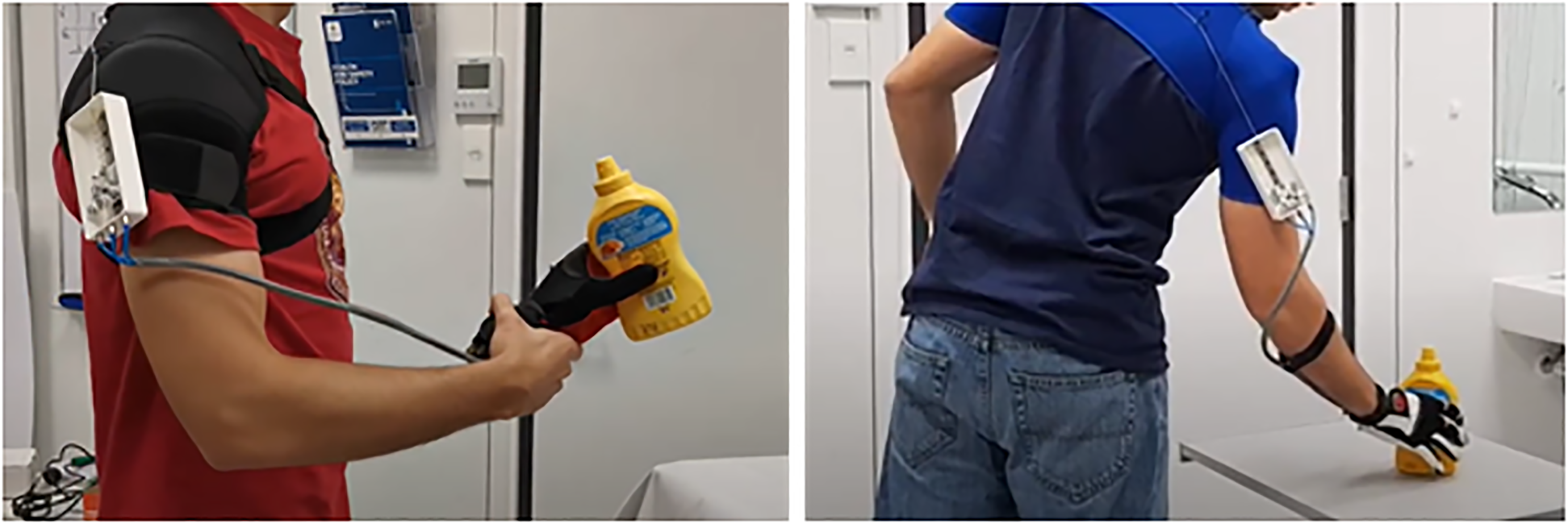
The OpenBionics body-powered partial hand prosthesis (left subfigure) and wearable exoskeleton glove (right subfigure).
The OpenBionics design process also involves high-tech elements: from the Internet, which serves to coordinate distributed collaboration among a dispersed community of designers, to smart motors and electronics, personal computers, and software used to produce the 3D designs. Moreover, manufacturing the devices involves 3D printing and/or laser cutting, another high-tech element.
The OpenBionics devices are arguably designed to last as long as possible: no planned obsolescence is involved because the incentive is not to maximize profits. Moreover, the mid-tech approach to design combined with its open-source nature makes them affordable, light, easy to replicate with off-the-shelf materials and 3D printing, easy to understand, and thus easy to maintain and repair. The sharing of design data allows the localization of a considerable part of the production, leading to lower environmental and economic costs from transportation while allowing customization to the users’ needs. Thus, a mid-tech approach arguably maintains a balance that synthesizes the best aspects of low-tech and high-tech.
A mid-tech approach for distributed ledger technology
A mid-tech approach helps to examine the DLT potential for urban governance. From the “city as a license” (CaaL) perspective, DLT is an infrastructure administering access and use of urban resources (Gloerich et al., 2020). CaaL is proposed as an alternative metaphor to dominant tech-driven smart city visions centered around service provision that views citizens as consumers (Elsden et al., 2018). For DLT-based data practices, CaaL provides a more politicized narrative to examine and influence imaginaries around nascent civic infrastructures. However, it simultaneously unfolds ambiguity around the transparency and accountability of complex data assemblages.
We extend the CaaL metaphor with two key dimensions. The first concerns all the stakeholders not included in the deployment of civic infrastructures but affected, nonetheless. There is a substantial impact regarding the production, use, and disposal of high-techs, such as DLT that geographically and ecologically sprawls beyond the infrastructure's deployment and the needs it serves. The second dimension concerns the dominant political and institutional structures in which digital technologies emerge. These structures are driven by profit-maximizing practices where users or local communities have little agency.
DLT follows the “smart” technology logic that Drechsler (2020) summarizes as reducing the capacity to make one's mind—a logic supported by interests looking to profit from it. DLT-based smart cities are meant to be “seamless,” meaning that people have things taken care of without them getting in the way, knowing, or being asked (Taylor, 2017). They are meant to be “data-driven” and “evidence-based,” which render things objectively true, ideally removed from human agency. Seamless, data-driven, and evidence-based infrastructures inevitably lead to disenfranchisement.
The example of OpenBionics is not data-driven but promotes data practices in the digital design and physical manufacturing processes. A mid-tech approach empowers human agency. Users decide which things are “taken care of” by design or localized manufacturing and where they need to participate in adapting, using, maintaining, and repairing their prostheses. Decisions are tailored to the users’ needs based on data from each consecutive production stage. The decisions may then become embedded in the technological cycle and reflect a collective consensus.
Moreover, as data structures are never neutral, power relations often manifest through the absence of data (Iliadis and Russo, 2016). OpenBionics, for instance, shares design and manufacturing data for its technologies. Data sharing is a political stance to de-abstractify technological artifacts by making visible processes and data upstream in production. Likewise, a mid-tech approach for DLT city infrastructures means considering data practices related to rights management decisions and the infrastructure and its lifecycle.
For example, when a city optimizes data to reduce its ecological footprint, it needs to include data from the manufacturing, maintenance, and end-of-life of its data infrastructures. This way, various elements supporting data governance are optimized to reduce the use of virgin materials, employ circular practices, or utilize localized maintenance. Mid-tech resonates with a critical data studies approach where the point is not data alone but the material and digital assemblages employed in generating, circulating, and deploying data practices (Iliadis and Russo, 2016).
These scenarios are currently speculative. Nevertheless, metaphors and imaginaries drive technological design and uptake. Mid-tech reinvigorates the role of DLT for urban data governance. A shared and immutable ledger facilitating access and use of urban data and resources may facilitate consensus on the expected social or ecological value and enable data governance strategies to achieve it. Mitigating and remedying the complex challenges of data assemblages is unique to every city, often extends beyond its boundaries, and requires broad participation and collective action. As the case of OpenBionics evinces, mid-tech approaches are consistent with transparent and participatory data practices, such as data pools, cooperatives, and commons (Hicks, 2022; Micheli et al., 2020; Prainsack, 2019; Smichowski, 2019).
DLT data represent a dynamic state of underlying real-life processes. Data are traces of human activity and coordination. Mid-tech enables a configuration for data assemblages that incorporates high-tech infrastructures, such as DLTs, along with low-tech elements and processes around the infrastructures’ support, maintenance, and deployment. This synthesis allows to mitigate data infrastructures’ ecological and social impact and enables practices that enhance human agency instead of engineering it away. Micheli et al. (2020) call for data governance perspectives that see “through the infrastructure” to address political questions pertaining to the sharing and use of data; participation in data governance; and the production and distribution of value created thereof. Mid-tech enables the CaaL perspective to address such questions for sustainable rights management in cities by considering a larger range of implications of sociotechnical data systems.
Conclusion
This commentary introduced mid-tech as a tentative framework balancing two extremes: low-tech and high-tech. This framework helps illustrate the options and implications embedded in technological artifacts. High-tech artifacts shape futuristic urban imaginaries premised on conflicting claims for efficiency, automation, or democracy. Such visions focus on the affordances of technological artifacts while ignoring the social and ecological externalities entailed in their production, maintenance, use, and disposal. Moreover, they fail to employ low-tech solutions to improve resilience and people's agency in shaping their surroundings.
We thus contribute to the “city as license” discourse by focusing on technological artifacts as manifestations of sociopolitical processes. The OpenBionics case illustrates a potential synthesis between low-tech and high-tech elements that may harness the versatility of digital and automation technology while increasing autonomy and adaptability for the end-users. It highlights a mid-tech trajectory that is progressive but not technodeterministic. Data practices and civic infrastructures extend the confines of the city. For example, the city is powered by industrial windmill farms in the mountains; infrastructures use embodied labor and material from elsewhere. Mid-tech builds on an understanding of technology that explicitly acknowledges such “data exchanges” as inevitably connected to unequal matter/energy exchanges and opens new pathways for coordination. A mid-tech approach for complex sociotechnical systems, such as urban DLT-based infrastructures, lies in creating spaces for deliberation and participation on a human scale, based on collective action.
Footnotes
Acknowledgements
The European Commission initially supported the OpenBionics initiative through the Integrated Project no. 248587, “THE Hand Embodied” (2010-2014), within the FP7-ICT-2009-4-2-1 program Cognitive Systems and Robotics.
Declaration of conflicting interests
The author(s) declared no potential conflicts of interest with respect to the research, authorship, and/or publication of this article.
Funding
The author(s) disclosed receipt of the following financial support for the research, authorship, and/or publication of this article: This work was supported by the H2020 European Research Council, Horizon 2020 Framework Programme, FP7 Information and Communication Technologies (grant number 802512, 869595, 248587).
