



Abstract
Building on critical approaches that understand algorithms in terms of communication, culture and organization, this paper offers the supplementary conceptualization of algorithms as organizational figuration, defined as material and meaningful sociotechnical arrangements that develop in spatiotemporal processes and are shaped by multiple enactments of affordance–agency relations. We develop this conceptualization through a case study of a Danish fintech start-up that uses machine learning to create opportunities for sustainable pensions investments. By way of ethnographic and literary methodology, we provide an in-depth analysis of the dynamic trajectory in and through which the organization gives shape to and takes shape from its key algorithmic tool, mapping the shifting sociotechnical arrangements of the start-up, from its initial search for a viable business model through the development of the algorithm to the public launch of its product. On this basis, we argue that conceptualizing algorithms as organizational figuration enables us to detail not only what algorithms do but also what they are.
Introduction
‘We shape our tools and then our tools shape us’. This maxim, apocryphally attributed to Marshall McLuhan, marks the starting point of the present investigation. As algorithms are becoming central tools for an ever-expanding variety of human activities, the importance of understanding the mutually constitutive relationship between people and technologies – how we shape our algorithms and how our algorithms shape us – is reactualized.
At their most basic, algorithms are procedures for problem-solving; step-by-step programs containing a fixed sequence of specific instructions to be executed until a solution to the stated problem is reached (Hopcroft and Ullman, 1983). This suggests the existence of algorithms as empirically identifiable phenomena, or ‘objects of knowledge’, but does not specify this existence (Ziewitz, 2017), thereby indicating the need to query the epistemology and ontology of algorithms (see inter alia Ames, 2018; Berry, 2011; Krasmann, 2020). Such query raises concern with the agential capabilities of algorithms, their status as tools for social organizing as well as organizational actors in their own right (Just and Latzer, 2017; Pentzold and Bischof, 2019). Seeking to understand the mutualities of algorithms as subjects and objects of organizing, we propose an investigation of how algorithms partake in sociotechnical arrangements.
Sociotechnically informed investigations approach algorithms from various angles, e.g., communication (Lomborg & Kapsch, 2020), culture (Seaver, 2017) and organization (Neyland, 2015), each emphasizing the dynamic, multiple and relational dimensions of human–machine interaction. Contributing to critical algorithm studies by building on these approaches, we propose to conceptualize algorithms as organizational figuration, initially defined as a ‘cartographic project’ of mapping an organizational ‘whole’ through the dynamic interrelating of ‘parts’ (Braidotti, 2011: 11; see also Couldry and Hepp, 2017). The conceptualization of algorithms as organizational figurations offers a starting point for detailing the spatiotemporal positioning of algorithms vis-à-vis other participating elements in sociotechnical arrangements.
We develop the conceptual and methodological understanding of algorithms as organizational figurations through a case study of a Danish fintech start-up that uses machine learning to create opportunities for sustainable pensions investments. For purposes of anonymity, and alluding to the product it offers, we speak of the organization as ‘SusPens’. Following SusPens from its initial search for a viable business model through the development of its key algorithmic tool to the public launch of its product, we map the shifting sociotechnical arrangements of this process. Applying our theoretical framework empirically, we ask: how does the development and operation of the machine learning algorithm for screening investment portfolios partake in the organizational figuration of SusPens?
The empirical contribution of the paper is to provide an in-depth analysis of the dynamic trajectory in and through which the organization of SusPens took (and continues taking) shape, identifying its changing figurations and the different positions of the algorithm in these figurations. On this basis, we discuss the conceptualization of algorithms as organizational figuration in three respects: algorithms are constituted through material and meaningful relations that develop in spatiotemporal processes and are shaped by multiple enactments of affordance–agency relations. In what follows, we first prepare the theoretical and methodological grounds for our study, then move into the empirical fray, detailing the figurations of SusPens before turning to the conceptual discussion of algorithms as organizational figuration.
Conceptualizing algorithms
Critical algorithm studies often begin from the observation that algorithms are ‘black boxes’, the particulars of which remain unaccountable (e.g., Pasquale, 2016). The metaphor of the black box establishes algorithms as unknowable objects of knowledge, indicating a need to probe how they are made as well as what they are. Here, the interrelations between algorithms and their social surroundings appears as key to unlocking them. Or, as Roberge and Seyfert (2016: 2) formulate the point: There is not one box, but multiple boxes. The opacity of algorithms is more precisely expressed in different forms of opacity, all of which, in specific ways, are contingent on the in-betweenness of a plethora of actors, both human and non-human (emphasis in original).
Seeking to provide an initial overview of the conceptual plurality that follows from the observation of empirical diversity, we begin this section by outlining three recurrent explanations of algorithms in terms of communication, culture and organization. We then move on to consider a key commonality of these three conceptualizations, namely, the understanding of algorithms as actively participating in sociotechnical arrangements (Curchod et al., 2020; Orlikowski and Scott, 2015; Pentzold and Bischof, 2019). Finally, we introduce the conceptualization of algorithms as organizational figuration, arguing that this approach to mapping empirical processes of inter-acting with algorithms offers a useful supplement to more established frameworks.
Communication
Conceptualizing algorithms in terms of communication may begin from the observation of parallel theoretical developments; just as the simple definition of algorithms as procedures for turning input into output resembles classical transmission models of communication, so the alternative assumption of algorithms’ ontological relationality resonates with theories of communication as dynamic processes of meaning formation (Lomborg and Kapsch, 2020). In both cases, then, we witness a shift in what is meant by ‘process’ from linear causality to complex interconnectivity. This conceptual correspondence is matched by empirical developments of increasing entanglements between algorithmic technologies and communication processes (Bucher, 2017; Collister, 2015).
As processes of digitalization and automation of communicative practices continue to gain traction, ascertaining the communicative effects of algorithms, especially pertaining to the organization of social media platforms (Etter and Abu, 2021; Leonardi and Vaast, 2017), has become a main concern of communication studies. Today, algorithms not only set the scene for human communication by producing new media logics (Klinger and Svensson, 2018) but increasingly order, influence and even take over communicative tasks (Wiesenberg et al., 2017; Zerfass et al., 2020).
While these developments have led some scholars to conclude that communication has become algorithmic (that is, taken over by algorithms), the emergent consensus is that human interpretation also shapes algorithms (e.g., through individuals’ actual use of a platform or service). Algorithms give shape to and are shaped by communication; they communicate and are communicated (Lomborg and Kapsch, 2020; Pentzold and Bischof, 2019).
Culture
Conceptualizing algorithms in terms of culture resembles communicative theories in so far as algorithms may be understood to give shape to (Gilbert, 2018; Striphas, 2015) or take shape in cultural contexts (Christin, 2017; Gillespie, 2016). Suggesting the limitations of both perspectives, Seaver (2017: 5) argues that ‘algorithms are cultural […] because they are composed of collective human practices. Algorithms are multiple, like culture, because they are culture’ (emphasis in original). Thus, conceptualizing algorithms as culture enables investigations of the ways in which algorithms interrelate with their social context, giving and taking shape – and, importantly, diversifying in the process.
Beginning from the recognition of algorithms’ multiplicity, the conceptualization of algorithms as culture offers a particular methodology in which algorithms are studied in their various use situations. This includes recognition of the involvement of the researcher, ‘producing algorithms as particular kinds of objects through our research’ (Seaver, 2017: 5). Whereas Seaver suggests various tactics for productive engagement with use situations, he argues that ‘questions about the particular workings of particular algorithms at particular moments in time remain broadly unanswerable so long as corporations are able to hide behind legal and technical secrecy’ (Seaver, 2017: 10).
Hence, Seaver conceives of algorithmic ‘black boxes’ in terms of hidden source codes and emphasizes how lack of access limits explanations. Geiger (2017), however, argues that access to source code is but one way of knowing algorithms, which does not, in fact, add much to our understanding of human–algorithm interrelations ‘in the making’. While Geiger’s case of Wikipedia is open source, he shows that the involved algorithms remain hidden in other ways. Thus, the methodological challenge is not so much one of opening the black box of algorithmic code but of being able to trace algorithmic appearance in sociotechnical arrangements.
Organization
The focus on interrelating social and technical elements is a staple of organization studies, which has been reconfirmed by current developments (Sørensen, 2018). By taking over fundamental organizational tasks such as coding, filtering, optimizing, ranking, searching, storing and verifying, algorithms perform (digital) organizing (Orlikowski and Scott, 2015: 210). As such, they are not just organizational tools but increasingly become able to organize (Faraj et al., 2018; Glaser, 2017).
This assertion alerts us to the interrelations between organizations and algorithms, ontologically and epistemologically. What organizational realities emerge in and through algorithms and how do these realities make themselves known? Kallinikos (2009) argues that the computational logic of algorithms is not only distinct from other organizational forms but is becoming the dominant form because organizations are increasingly ordered according to binary choices. Similarly, Berry (2011: 16) suggests that ‘computationality might […] be understood as an ontotheology, creating a new ontological “epoch” as a new historical constellation of intelligibility’. Thus, algorithms may be understood as ‘an interpretative key’ of modern rationality (Totaro and Ninno, 2014); they not only drive specific organizational changes but may explain broader shifts in social formations.
Neyland (2015), however, warns against positioning algorithms as the central explanatory device for present-day rationality. Instead, he suggests that algorithms are themselves in need of interpretation and argues that undertaking such interpretative efforts reveals algorithms to offer not one but multiple modes of ordering and understanding the world. From this perspective, algorithms are neither cause nor effect but must be explained in and as organizational relations. Or, as Lange et al. (2019) point out, algorithms escape traditional distinctions of subject and object of knowledge; they are both and neither – and have to be studied as such. Algorithms, in sum, do not explain organization but should be understood in organizational terms – that is, as they emerge in relation to the other elements involved in sociotechnical arrangements.
The organizational figuration of sociotechnical arrangements
Conceptualizing algorithms by way of communication, culture and organization variously highlights their processuality, multiplicity and relationality. Or, perhaps more precisely, each position begins with one of the three characteristics but implicates the two others in order to arrive at a conceptualization of algorithms as neither object nor subject; algorithms never exist independently of their use but only come to be as specific constellations (or enactments) of affordances and agencies (Neff and Nagy, 2016).
Here, the concept of affordances offers a basis for studying the relational properties of technologies; their action possibilities (Bucher and Helmond, 2018; Volkoff and Strong, 2018). Hence, ‘affordances is a noun that refers to the perceiving agent as well as to the environment’ (Madsen, 2015: 2), invoking potentialities for action, which may or may not become actualized. Similarly, the concept of agency has a double reference to the potential for action as well as the ability to act (Campbell, 2005). Here, agential potential is only realized in and through the coupling of (human and non-human) agents with affordances, turning possibilities for action into particular acts (Leonardi, 2011; Leonardi and Vaast, 2017). The point of introducing the distinction between affordance and agency, then, is not to separate the two, but to emphasize their relationality (Faraj and Azad, 2012; Vaast et al., 2017; Weltevrede and Borra, 2016).
Algorithms give shape to and are shaped by affordance–agency relationships, which are, in turn, often conceptualized as ‘arrangements’, ‘ensembles’ and/or ‘assemblages’ (Bader and Kaiser, 2017; Ettlinger, 2018; Faulkner and Runde, 2019). Sociotechnical arrangement, as the term has been developed and applied within science and technology studies, refers to the contextualized details of establishing sociotechnical systems or infrastructures (Bowker et al., 2010; Ribes, 2019); to the ways in which momentary enactments of available action potentials position and reposition the social and technical elements of an organization in relation to each other (Callon, 2004; see also, Ueno et al., 2017).
Recent work has suggested that we may understand the processuality, plurality and relationality of sociotechnical arrangements by mapping the specific positions of and shifting connections between the involved elements (Lee et al., 2019; Lupton, 2016; Straube, 2016). Such mapping, we argue, may usefully begin from the concept of figuration.
Mapping organizational figuration
First introduced to sociology by Norbert Elias, the concept of figuration aims to overcome distinctions between individual and society by viewing the social as a dynamic that takes shape in and through relations of interdependence (Connolly and Dolan, 2012; Dopson, 2005). While ‘figuration’ may be taken to refer to figures of speech, Couldry and Hepp (2017) posit the literalness of the concept as one of its main strengths when compared to other explanations of the relational dynamics of social plurality. Notions like ‘network’ and ‘assemblage’, they argue, are both structural metaphors that, useful as they may be, fall short of ‘…understanding the overall constructions of meaning that orientate human action’ (Couldry and Hepp, 2017: 61, emphasis in original). That is, figurations, like assemblages and networks, set out to ‘map the social’, thereby subscribing to a ‘flat ontology’ that places human and non-human actors on the same material plane (Couldry and Hepp, 2017: 228–229). However, only figurations are ‘living maps’ (Braidotti, 2011: 11) that place the explanation of the dynamics of social positioning on the same epistemological plane as these dynamics (Cendon, 2004: 30). Figurations, then, are organizations; or rather, they are processes that organize as well as the results of organizing processes. Thus, referring to the process of figuration as organizational may seem tautological, but we coin the concept of organizational figuration in order to emphasize the mutuality of giving and taking shape, particularly as pertaining to the involvement of algorithms. Algorithms, as we will show, are organizational figuration.
As Couldry and Hepp (2017: 65) put it: ‘the elements of a figuration only have a common form (a con-figuration), because there is something at stake in them, something that matters (is meaningful) to the actors involved’. It is in this sense that figurations, as Braidotti (2011: 11) also insists, are not metaphors for organizing, but are, in fact, organizational; one does not have to ‘step out of’ the concept of figuration to provide a full account of social relations. Rather, figuration is the process of continuously changing relations between elements in sociotechnical arrangements that gives meaning to each element as well as the arrangement as a whole.
Methodological considerations
Figurations are not ‘texts’ to be read and interpreted but ‘material and semiotic signposts for specific geo-political and historical locations’ (Braidotti, 2019: 34). When studying figurations, we should, therefore, treat symbolic and non-symbolic materials in the same manner, locating their positions and relations to each other. However, performing this task, understanding what a particular figuration is and could be, entices the researcher to become part of that figuration; or, as Haraway (with Goodeve, 2000: 107) puts it, ‘understanding the world is about living inside stories’. Thus, studying figurations involves a combination of ethnographic and literary tools.
Research context and design
Focussing, first, on the ethnographic dimension of our study, we draw on eight months of in-depth fieldwork in a Danish fintech start-up, SusPens, conducted by the first author from April 2018 to December 2018. We focus on the developmental trajectory of the organization and its central algorithmic tool, detailing the different organizational figurations of this trajectory.
Founded in January 2017, SusPens offers sustainable investment solutions to private costumers and institutional investors. The two founders, John and Erik (pseudonyms), established SusPens with the aim of mobilizing pensions savings towards a more sustainable future. Since its inception, the organization has grown steadily, adding people with technical skills, investment experience and marketing competencies to supplement the founders’ backgrounds in business and management.
During the time of the observations, SusPens developed a machine learning algorithm that uses name-matching to screen investment portfolios. The screening tool is based on – and enables – a simple investment strategy; all portfolios that contain companies engaged in fossil fuels, weapons or tobacco are excluded. On this basis, SusPens has launched two products: a sustainable pensions fund, offered to private customers in collaboration with an established insurance company, and a screening service for institutional investors who wish to check the sustainability of their own investment portfolios.
Seeking to understand the interrelations of the algorithm and the organization, the first author engaged with SusPens as a participant-as-observer (Gold, 1957), partaking in a total of 31 meetings and workshops. The organization held status meetings lasting 30–60 minutes twice a week. Here, the team members gave updates on their tasks and current challenges, and the founders shared information about the organization’s funding, announced strategic decisions and coordinated the activities of the team. In all, 27 status meetings were observed. In addition to these meetings, the first author observed four strategy workshops (see details in Table 1) in which she participated more actively, as she was asked to comment on the process and reflect on what had been observed during earlier meetings. Participation in the meetings and workshops enabled observations of interactions, discussions and negotiations between the organization’s members. The first author took hand-written notes of all meetings, including what was said, emotional reactions and physical interaction between the participants. These notes were elaborated and digitalized after the observations. The meetings were also voice recorded and professionally transcribed.
Observations.

The observations were supplemented with a total of 11 formal interviews and conducted during the fieldwork (for an overview, see Table 2). It was important to interview all members of the organization (eight at the time of the field work), as they could shed light on different aspects of the organization and its development. The two founders were especially interesting as managers and leaders of the organization, and they were interviewed five times in total. In the initial interviews, conducted in April 2018, the founders were asked to tell the story of SusPens, explaining the strategic choices, circumstances that affected their choices and their own personal experiences with and ambitions for SusPens. The three subsequent interviews were conducted in the middle and at the end of the fieldwork, when organizational events and/or developments enticed further elaboration of the founders’ viewpoints and interpretations.
Interviews.
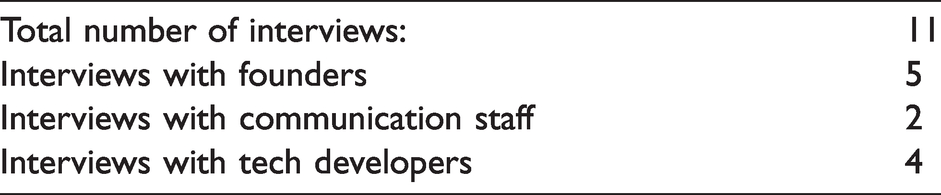
The remaining six interviews were conducted with non-founding members: the chief investment officer (CIO), three tech developers and two communication professionals. Each interviewee was asked to talk about their role in the organization and to describe SusPens and the organization’s technologies, focussing on their understanding of the algorithm. The interviews with the CIO and the tech developers focussed more on the creation and training of the algorithm as well as the potential opportunities and risks of working with this technology; the interviews with the communication staff were more about branding, sales and sustainability. All interviews were conducted in Danish and took place at the office of SusPens. To ensure an accurate record of the interviewees’ statements, all interviews were voice recorded and professionally transcribed. All quotes used for this article were translated from Danish to English by the authors.
Finally, the first author had access to the organization’s digital archives, which by the end of the fieldwork included 54 internal documents (memos, funding applications, investor presentations and working papers). The documents were mainly used for fact checking and to triangulate the observations and interviews. At the inception of their collaboration, the founders formulated their (changing) organizational vision, strategy and business model in working papers. Having access to these documents provides valuable and detailed accounts of the shaping of SusPens that occurred prior to the fieldwork.
Analytical strategy
The collected data was reviewed and analysed by all three authors in collaboration. Taking our cue from the so-called ‘Gioia method’ (Gioia et al., 2012), we coded the data dynamically and iteratively, moving between data, authors and theoretical conceptualizations. Hence, the first author initially coded all data in NVivo, searching inductively for interrelations between the organization and the algorithm. The coded data was chronologically ordered, offering the trajectory of SusPens in as much detail as possible. In scrutinizing this trajectory collectively, the authors identified a number of different sociotechnical arrangements, some of which superseded each other sequentially, others occurring simultaneously (for a visual overview, see Figure 3).
Moving from ethnographic to literary work, we were mindful of the need to focus on what figurations are rather than what they signify. Taking her cue from Haraway, Braidotti speaks of the identity of figurations as ‘conceptual personae’, defined as performative images of sociopolitical becoming that not only account for particular social constellations but also point to their transformative potential (Kember, 1996: 256). Figurations are dynamic and always open to change, but action as well as interpretation necessarily happens from within a figuration. Thus, figurations both enable and constrain change, and naming figurations is itself a political act. That is, conceptual personae – e.g., the cyborg (Haraway) and the nomad (Braidotti) – are agents of change as well as analytical tools, means of identifying a figuration and of shifting its relations from within.
As argued above, figurations are not ‘texts’ to be read, but realities to be seen. Yet just as digital tools may shed new light on literary texts (Buurma, 2015), learning to see and record the reality of sociotechnical figurations may require literary training and can be facilitated by literary tools. With inspiration from earlier use of Kenneth Burke’s notion of ‘poetic interpretation’ in algorithm studies (see Mohr et al., 2015), we introduce Burke’s dramatistic pentad as our particular strategy for identifying the conceptual personae of SusPens. While this may seem like a turn to the figurative, the sociological relevance of Burke’s work is widely recognized, especially as it contributes to the pragmatist understanding of the ‘drama of social life’ (Alexander, 2017; Lyman, 1990). As such, Burke’s approach is not incommensurable with the sociology of relations; to the contrary, it offers a specific means of identifying the sociotechnical entanglements and imaginaries of figurations (cf. Barad, 2007; Jasanoff, 2015).
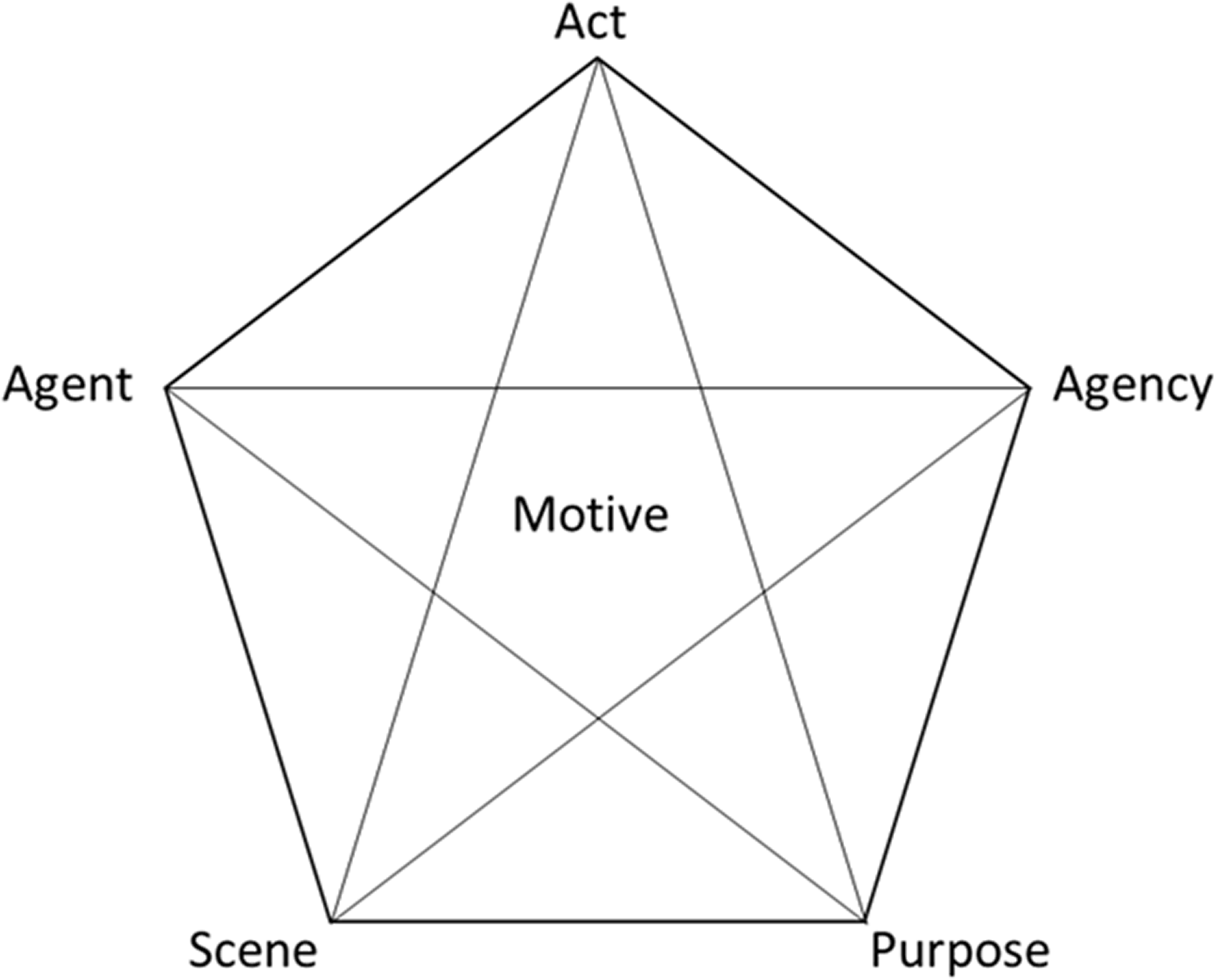
The pentad consists of five elements – act, scene, agent, agency (or means) and purpose – the sum of which makes up ‘the grammar of motives’. Here, Burke uses ‘agency’ to denote means of action, which sits somewhat uneasily with our previous definition of the term as the ability to act. Nevertheless, we have maintained the Burkean terminology here and in the analysis rather than replacing it with ‘means’ (as some do, but this is a practice of which Burke disapproved; see Burke, 1978). While this may complicate things somewhat, we believe that using the term ‘agency’ for what could otherwise be named ‘affordance’ is in itself indicative of the value of the pentad for studying the relationality of these two aspects of ‘the act’.
The five elements of the pentad are studied in relation to each other, identifying the motive, or conceptual persona, of each figuration. As Burke (1962: xvii) puts it: ‘…any complete statement about motives will offer some kind of answers to these five questions: what was done (act), when or where it was done (scene), who did it (agent), how he [sic] did it (agency), and why (purpose)’ (see Figure 1). Take, for instance, a fairy tale: a young man (agent) goes to a foreign land (scene) to slay a dragon (act) with a magic sword (agency) in order to free the people of the land (purpose). The motive of this tale (and any other pentad) does not present itself in the identification of these elements, but in the relations between them; what Burke terms ratios. For instance, if the hero of the fairy tale is successful, this would, indeed, be a heroic tale of individual accomplishment (established through an agent–purpose ratio), but we could also imagine a tragic tale of defeat, which would indicate fated determinism (a scene-agent ratio) and so forth.
The Pentad.
Working specifically with the pentad, the first author recoded the data, now looking for patterned recurrences of the five pentadic elements, which led to the identification of seven different figurations. In a final round of coding all authors participated in detailing the dominant interrelations (or ratios in Burke’s terms) of the different figurations, enabling us to name the conceptual personae of SusPens and to draw out aggregate dimensions with relevance for the further conceptualization of algorithms as organizational figuration (for an overview of this reiterative process and the data to support it, see Figure 2).

Data Structure.
In sum, we propose Burke’s pentad as an analytical strategy for naming the conceptual personae of figurations; in so doing, we assume that we cannot move beyond particular figurations, nor do we need to. Rather, we are only (and can only be) interested in things that matter in the dual sense of being and meaning something (Barad, 2011) at the level of specific sociotechnical arrangements. On this note, we turn to the study of such meaningful matters as they figure in the sociotechnical arrangement of SusPens.
Organizational figurations of SusPens
John: Robin and Michael were fooled by their own program.
Sara: No?
John [sarcastically]: That is not at all unprofessional.
Michael: It happens all the time. Do you want the long or the short explanation?
John: I really like the…
Sara: The long.
Michael: We do not know.
Sara: Ok, if that is the long one, what is the short?
(Status meeting, 01 October 2018)
We begin the analysis in medias res. On 1 October 2018, coinciding with the public launch of SusPens, the company’s developers obtained a 100% match in a test of the algorithm. Then, they ran an additional test and found that some of the results were ‘false positives’; that the algorithm was ‘cheating’ in order to provide the expected output.
As various members of the organization told and retold this key incident, at least two pentadic figurations were at play: First, one in which the algorithm (agent) cheats (act) during training (scene) in order to appear finished (purpose). The algorithm is both agent and agency in this figuration; it has taught itself to cheat as a means of obtaining the stipulated purpose in the most efficient manner. As the rebellious, yet compliant, act of ‘cheating’ was highlighted time and again, we have labelled the conceptual persona of this figuration accordingly: The Cheater is a figuration in which the algorithm dominates SusPens, passing its deceit on to the organization, which was launched without being able to fully provide its offered services.
To ameliorate this unintended and undesired outcome of the process of machine learning, a second figuration posits the programmers (agent) at its centre as they identify the flaw and reprogram (act) the algorithm (agency) in order to continue the training (scene) and enable the algorithm to match names correctly (purpose). We have labelled this figuration the Master Builder, since its dominant ratio is the agent–agency control that the programmers exert on the algorithm. This conceptual persona highlights the importance of the programmers in the shaping of SusPens, placing them in a dominant position in relation to other elements of the figuration.
Eventually, a third figuration emerges in which the algorithm is reinstated as compliant agency, making SusPens fully operational; having checked and double-checked that the algorithm’s training is correctly completed, the organization (agent) uses the algorithm (agency) to match company names (act) against existing data (scene) to find out which companies are involved in which investment funds and invest sustainably (purpose). The dominant agency–purpose ratio of this figuration leads us to name it the Servant. Here, the algorithm is able to act, but does so in the service of SusPens, enabling the organization to realize its purpose of serving society.
Even so, tensions remain and continue to arise because it is unclear to organizational members what, exactly, the algorithm – and, by extension, the organization – does. As regards the algorithm, not even the programmers seem to know. During training, they can control the input, check the output and recode the algorithm if a false positive is detected. But when the algorithm becomes operational, it is beyond human control in the double sense of being automated and unmonitored. As for the organization, its members have varying ideas of what should be its purpose and hold differing opinions of how well it performs.
The competing figurations in which the algorithm features variously and ambiguously as an independent agent and as the means (Burke’s agency) of carrying out the organizational purpose are, we believe, central to the sociotechnical arrangement of SusPens. In the following, we will detail how the figurations arise in and give shape to SusPens. In the first analytical round, we move back in time to present the trajectory of how SusPens, first, came to define itself as a fintech company and, second, chose to base its operations on a machine learning algorithm. On this basis, we move on to detail post-launch developments, identifying the pentadic figurations of giving shape to and taking shape from the algorithm that exist simultaneously as SusPens continues to define and redefine its business.
The formation of a pragmatic hero
It started with the idea of becoming a pensions fund, but we found out that you don’t just become a pensions fund. We thought it would be difficult, but we didn’t know it would be that difficult. It takes incredible amounts of capital, it takes loads of trust, it takes someone in the team with years of experience from the financial sector … So, we didn’t do that, and instead we have tried out various business models.
(John, 11 April 2018)
The foundational myth of SusPens is a classical heroic tale that goes something like this: two young professionals (agent) set out to create a pensions fund (act), intending to revolutionize the market for pensions investments (scene) and create sustainable investment (purpose). Born out of one of the founders’ first-hand experience (from a former job at a large international organization) with how slowly and reluctantly the global financialized economy is shifting towards sustainable investment, the story is one of seemingly infinite possibility: ‘Our goal is to build tomorrow’s pensions fund; a pensions fund that exclusively invests to improve our common future and avoids assets that actively erodes it’ (Internal document, 11 June 2017). The initial vision, then, was not specifically to create a successful fintech start-up but more broadly to reconfigure the financial sector; in one sweeping move millions of pensioners’ savings would transition from ‘black’ to ‘green’ investment.
The dominant agent–purpose ratio of this would-be figuration envisions a ‘big bang’ of sustainable investment. But the figuration never materialized, as the founders had neither the financial means nor the professional expertise to create a pensions fund: ‘…fairly quickly it became clear that it couldn’t be done, the entry barriers were simply too big’ (Erik, 11 April 2018). As such, the agent’s dream was thwarted by the constraints of the scene.
Having abandoned the organizational form of a pensions fund, SusPens’ founders were led in the direction of the bourgeoning market for financial technological innovation, and as members with different skillsets joined the organization, SusPens gradually took the shape of a fintech company. Importantly, the plan was still to use pensions for sustainable investment, meaning SusPens also sought for and established a partnership with an existing pensions fund: ‘They [the pensions fund] transform the funds to insurance and pension policies, and we market and sell them. The funds are made with our tools, so we guarantee that they are sustainable’ (John, 11 April 2018).
But which tools would provide the most efficient and effective means of realizing the end of sustainable investment? In seeking answers to this question, the figuration of SusPens became dominated by an act–agency ratio: the founders and the new organizational members (agent) tried out (act) various technologies (agency) that might help realize the goal of sustainable investment (purpose). In this figuration, the scene recedes somewhat but could be defined as the organization of SusPens itself as well as the context of fintech innovation. We label the conceptual persona of this figuration the Pragmatist to highlight how the members of SusPens were purposefully searching for an organizational form that in some way could realize their vision.
The transition from the pre-launch figuration of the Pragmatist to the figurations of the launched organization is not marked by externally imposed constraints but by the gradual shaping and stabilizing of SusPens as it looked for and found viable solutions. Upon entering the market, SusPens offered sustainable investment opportunities to private investors and screening services to professional investors. These offerings were based on the automated screening of investment portfolios, and while this figuration does not alter the underlying purpose of the organization completely, it does not realize it fully either.
Overachieving, underperforming automation
The way I understand it, we have this machine that can help us sort and screen, and exclude and include, according to certain parameters. That’s very smart and keeps costs down, but it also demands a sort of manual evaluation of the portfolio we end up with, checking whether the results are good enough. We have to check the quality of our portfolio in this automatic set-up.
(Josephine, 15 October 2018)
Moving from the trajectory that led to the launch, we now turn to post-launch developments in the sociotechnical arrangement of SusPens. Here, we first encounter the figuration that is offered to investors. This is the story of a company (agent) with a unique tool (agency) that enables it to provide sustainable investments at competitive prices (act) making it attractive to investors (purpose) on the financial market (scene). This figuration closely resembles that of the Servant and may be seen as a temporal extension from the moment of launch into the process of operation. However, the dominant ratio shifts from agency–purpose to agent–act, thereby centring the organization of SusPens and reimbuing it with the founders’ initial optimism. The agent is, once again, able to realize the purpose through action, but the purpose of changing the world has receded and securing customers now features as the main objective. Accordingly, the character of the agent continues its development; the hero becomes increasingly pragmatic.
Furthermore, sustainability has become an asset, a feature of the product that is enabled by automation, but this is not an easy story to sell. As the user experience designer complains: ‘Pensions are really complicated as it is, just explaining pensions is a big task. Explaining an algorithm […], it wouldn’t make sense’ (Martin, 19 October 2018). The chief marketing officer (CMO) divides customers into two groups: ‘investment savvy’ and ‘tech savvy’. With investment savvy customers, she says: I try to explain that we have built an algorithm for our investments, which makes it an automated process […], meaning we have lower costs on screening than competitors who have expensive sustainable products because they have to do it manually… (Josephine, 15 October 2018)
However, when SusPens gets into more detailed explanations of its operations, the level of automation is called into question. Or rather, the range and value of what the algorithm can do diminishes. The CMO knows this, as the introductory quote for this figuration reveals, and it is a main concern of the CIO who must compensate for the algorithm’s lack of sophistication: We get a lot of requests from loads of partners and investment houses who send us a portfolio saying can you screen this. And then we run it through and look at the average, is it correct what it has matched now? And that makes it a more than 100% solution. But it takes up much more of my working time, which is why I hope we can get to the automated solution, just making a disclaimer that says maybe there are very, very few mistakes in this. (Carl, 24 October 2018)
In order to capture both of these dimensions, the efficiency and lack of sophistication of the automated processes, we have labelled this figuration Automation, thereby indicating how the dominant agent–act ratio is mediated by the agency of the algorithm and highlighting the processual character of this figuration; as SusPense moves towards automation, the algorithm becomes more and more dominant – with the possibilities and limitations this incurs. This conceptual persona not only highlights the centrality of the algorithm in shaping the organization but also indicates that the resulting shape is becoming a matter of organizational concern. The algorithm both does ‘too much’ and ‘too little’; it is overarching and underperforming. This creates a major tension within the sociotechnical arrangement of SusPens and gives rise to further figurations that exist in conjunction with the marketed one.
Junk input creates junk output
The name matching has become a thorn in our side. If we do not have it, we cannot make the matches between the exclusion lists and what is inside the portfolios, which is the core of the screening algorithm. So, we’ve worked a lot on that […] trying to solve it with some machine learning technology. It is working much better now than it used to do, but it will probably never be a 100%
(Carl, 22 October 2018)
In one concomitant figuration, the algorithmic tool (agency) increasingly determines what can – and cannot – be done, meaning SusPens (agent) is now able to operate on the market for pensions investments (scene) offering potential customers more sustainable products (act), but that the ‘big bang’ transformation has been replaced by the seemingly less idealistic aim of ensuring the success of SusPens’ business model (purpose). Here, a dominant agency–act ratio continues the figuration of SusPens as an increasingly pragmatic organization. Not only has the organization accepted that change will happen incrementally, it is also coming to terms with the fact that its own investment products are less than perfect, sustainably speaking: We have discussed if we are to be fully open about it, and just put it up on our web page, writing that we have these stocks in our portfolio that we are not sure about, but that it is just not possible to do anything better today. (Carl, 22 October 2018)
Thus, the quality of available data and how it limits the parameters of the screening process is emerging as a main issue that reshapes the figuration of SusPens. Data, understood as the means of training the algorithm as well as the scene upon which the algorithm operates, is increasingly shaping the organization. We have labelled this figuration the Junk to indicate how the precision of the algorithm and the quality of the organization’s services are shaped by the digital environment. This reconfirms the issue of automation as both the strength and the weakness of SusPens and adds data quality as a key concern. In combination, the lack of (good) data and the limits of automation are leading some members of the organization to question what the algorithm does and how it shapes the organization.
Becoming an empty shell?
I was attracted by it, like cool that it was a pension that would be good for a lot of things. But now it is like it has become more specialized in the direction of climate because it is quantifiable and measurable and easy to report. But the more parameters that have to add up, like human rights and women in management, the more difficult it will be to create a portfolio that still gives a good return. Because it should not cost our users any money to protect something good; that is our entire selling proposition. (Maria, 15 October 2018)
The founders of SusPens continue to believe in the potential of the algorithm, seeing its development as an ongoing process. However, and as the introductory quote for this final figuration illustrates, some organizational members are less certain that more and more criteria can be added and, hence, question how sustainable the organization’s investments can become.
In response to these concerns, the CIO argues that ‘we are trying all the time to make the most sustainable solution possible, and we are the most sustainable you can find on the market, so I think that is ok’ (Carl, 22 October 2018). Thus, the overall disappointment with how little the algorithm does, whether in terms of automating the process or delivering a sustainable product, is tempered by an increasing acceptance of being a company that does less than what it set out to do – but more than anyone else.
In the course of this adjustment, and as anticipated in our mapping of the dominant agency–act ratio that shaped the figuration of Automation, the purpose of SusPens seems to be shifting. In this final figuration, a new agency–purpose ratio is emerging, as the algorithm (agent and agency), working with the available data (scene), provides cheap sustainable investment options (act) and maximizes the profits of SusPens (purpose). Within this figuration, tensions are mounting, as the organization’s human agents begin to question what SusPens has become. Increasing sustainability, they argue, may still be an operational outcome, but it is not as central to the organization as in earlier/competing figurations. Sustainability, they suggest, must be reemphasized if the organization is to avoid sedimentation in the form of an Empty Shell, the conceptual persona with which we indicate these members’ (and our) critical concern with the organization’s current figuration.
Algorithms as organizational figuration
In presenting the most dominant figurations of SusPens as they emerged in our engagement with the organization, we have both provided details of each and pointed to their interrelations. Thereby, we have illustrated the multiplicity and relationality of the dynamic process of sociotechnical arrangement, showing how different figurations unfold consecutively as well as concurrently and in various relations to each other (see Figure 3). Sometimes figurations exist in parallel, but they can also be in direct conflict and mutually exclusive, and they can co-exist competitively or even collaboratively support each other. From these many possibilities, two more general patterns of organizational figuration stand out: some figurations are sequential, replacing one another and marking important milestones in the temporal trajectory of sociotechnical arrangement. Others exist simultaneously, whether briefly shaping a particular moment (the three figurations that emerged around the incident of the false positives) or as more durable forms (the three figurations that each continue to shape SusPens), thereby pointing to the spatial multiplicity of sociotechnical arrangements.

Figurations Overview.
The sequential figurations mirror the dynamic of the introductory maxim; ‘first we shape our tools, then they shape us’. In looking to establish itself as a sustainable investment company, SusPens created an algorithmic tool, which gradually became co-constitutive of the organization. Furthermore, this trajectory confirms the dualities of most conceptualizations of algorithms (whether in communicative, cultural or organizational terms), highlighting interrelations of agency–affordance.
The analysis, then, supports insights gained from conceptualizing algorithmic involvement in sociotechnical arrangements in terms of communication, culture and organization, respectively. Importantly, if unsurprisingly, we have detailed the overall constitutive dynamic that Neyland (2015) denotes ‘organizing algorithms’ – algorithms are organized and organizing technologies. While the details of the process in and through which organizations and algorithms interrelate – what we have identified as the sequence and simultaneity of organizational figuration – are particular to each case, the dynamics of interrelating are not. Furthermore, our analytical identification of a number of different figurations supports the central point of Seaver’s (2017) conceptualization of algorithms as culture, namely, their multiplicity. Finally, the dynamic interrelations of meaning and matter confirm the processual character of sociotechnical arrangements as highlighted by the communicative conceptualization of algorithms.
Beyond these confirmations, however, the introduction of organizational figuration contributes to critical algorithm studies by detailing the relational ontology and performative epistemology of algorithms. That is, algorithms exist as and are knowable through organizational figurations. Let us discuss how this claim contributes to existing conceptualizations of algorithms as elements of sociotechnical arrangements.
Relational processes
As organizational figurations, algorithms are relational processes. That is, the elements of a sociotechnical arrangement only exist in relation to other elements of that arrangement – and the being and meaning of each element shifts with its position in the arrangement. Or, as Braidotti (2019: 34) explains, a figuration ‘…is the dramatization of processes of becoming, without referring to a normative model of subjectivity, let alone a universal one’. In operationalizing this claim, we have introduced Burke’s pentad, which details the interrelations between matter and meaning. Or, more precisely, how the elements involved in a figuration con-figure to become meaningful. The pentadic analysis shows how people, algorithms and other elements of organizational figurations become meaningful in and through their relations to each other. These relations may change, but relationality is the condition of possibility for all processes of mattering.
Operationalized thus, organizational figuration is a relational process to be mapped, not an object to be explained nor the explanation of anything but itself. Here, the map – that most representational of devices – becomes performative, as the researcher is inevitably part of the studied figurations, just as the algorithm and all other involved elements contribute to the map (Ziewitz, 2017). How the map is constructed depends on one’s own shifting positions within the studied arrangements. As organizational figuration, then, algorithms move through time, but can only be identified in and as a particular space – the sociotechnical arrangement of certain elements as they relate to each other now and now and now…sometimes extending the now when a figuration is sustained over time, sometimes multiplying space to include several figurations at once. These sequential and simultaneous dynamics of figuration, the different modes of interrelating, indicate the particular ways in which the involved elements are able to inter-act.
Multiple enactments of affordances and agencies
The basic action of any figuration is that of figuring itself, of becoming related and constituting the elements of a sociotechnical arrangement in relation to each other. As such, the elements of a figuration function as affordances for each other, the agency of which is realized in and through their specific relationalities. This explains algorithms’ dual position as affordances that invite action and agents that are able to act; while the elements of a figuration may be combined in different ways, patterns tend to emerge as some elements relate more easily than others and some invitations to action are more readily realized.
In the case of SusPens, we found that the giving and taking shape of the algorithm in relation to other organizational elements revolves around two tensions, one having to do with the type of agency (now returned to its typical meaning of capacity to act) that algorithms may exert, the other dealing with the relationship between humans and algorithms. As we have shown, the algorithm plays many different roles in the various figurations of SusPens; most notably, it enters into some as an affordance (what was labelled agency in the analysis), appears as agent in others and sometimes takes up both positions at once, thereby acting on its own. Furthermore, the algorithm is dominant in some figurations and subservient in others. Significantly, the algorithm did not acquire more agency over time; rather, it increasingly shaped the figuration with its limited agency. Thus, we might say, the organizational figuration of SusPens has become algorithmic.
Material and meaningful arrangements
This returns us to the issue of how algorithms should be conceptualized in relation to sociotechnical arrangements. Algorithms, we have suggested, cannot be studied as entities, but only in and as their relations to other elements in various figurations. Following Barad, Gamble and Hanan (2016: 266) assert that ‘there is no outside of matter just as there is no outside of meaning’. The meaning of any algorithm is its organizational figuration, which should be studied without privileging any one of the elements involved.
Thus, the concept of organizational figuration enables us to move beyond identifying spatial positions in a static arrangement or temporal developments in a linear trajectory to, instead, show how meaningful relations emerge in given spatiotemporal moments and shift in space and time. Empirically, the interrelations of sociotechnical arrangements are never given nor are they ever singular. Theoretically, organizational figuration offers a language for these interrelations. And methodologically, the concept enables analysis that neither reduces the relationality nor explains it in terms other than its own.
In our work with organizational figuration, we are primarily inspired by Braidotti whose conceptualization differs slightly from that of Couldry and Hepp. Beginning from Elias’ relational sociology, Couldry and Hepp offer a descriptive understanding of figurations. Braidotti, however, follows Haraway (1988) in emphasizing the positionality of relations and is just as concerned with the emancipatory potential of figuration as with existing power relations. Conceptual personae, Braidotti (1999: 91) argues ‘…act as the spotlight that illuminates aspects of one’s practice which were blind spots before’. Such illumination occurs through the naming of figurations from within, as the name highlights certain aspects of the relational dynamic. Thus, identifying the different conceptual personae of shifting figurations is in itself a political act, aimed at explaining, criticizing and potentially changing current figurations.
For critical algorithm studies, this both marks the potential of conceptualizing algorithms as organizational figuration – and the potential limitation of such conceptualization. As researchers (and/or other human agents) focus on the algorithm(s) involved in organizational figuration(s), they risk privileging the algorithm in the continued shaping of the organization. As Seaver (2017: 10) warns us: ‘it is too easy (and too common) to try reading programmers’ motivations off of algorithmic systems and to conclude that the programmers themselves must be algorithmic – limited by naive and rigid assumptions about human life’. Hence, let us specify our former claim: SusPens has not become algorithmic, but the organization increasingly takes shape from the algorithm and accepts that shape rather than continuing to develop the potential of the algorithm as organizational figuration.
The tendency towards accepting a certain figuration as the only possible sociotechnical arrangement, the only mode of being and acting available, is, we believe, inherently problematic; if and when we forget that algorithms are organizational figurations and begin thinking about organizations as algorithmic, then we stabilize the available relational dynamics, instating a limited and limiting map of what algorithms and organizations can be and do. Any such stabilization risks turning the living maps of algorithms as organizational figuration into just another type of black box whose opacity hides the fact that there is nothing inside.
Footnotes
Declaration of conflicting interests
The author(s) declared no potential conflicts of interest with respect to the research, authorship, and/or publication of this article.
Funding
The author(s) disclosed receipt of the following financial support for the research, authorship, and/or publication of this article: This work was supported by Velux Fonden (Grant No. 00013146).
