




Abstract
This paper is concerned with everyday data practices, considering how people record data produced through self-monitoring. The analysis unpacks the relationships between taking a measure, and making and reviewing records. The paper is based on an interview study with people who monitor their blood pressure and/or body mass index/weight. Animated by discussions of ‘data power’ which are, in part, predicated on the flow and aggregation of data, we aim to extend important work concerning the everyday constitution of digital data. In the paper, we adopt and develop the idea of curation as a theory of attention. We introduce the idea of discerning work to characterise the skilful judgements people make about which readings they record, how readings are presented, and about the records they retain and those they discard. We suggest self-monitoring produces partial data, both in the sense that it embodies these judgements, and also because monitoring might be conducted intermittently. We also extend previous analyses by exploring the broad set of materials, digital and analogue, networked and not networked, involved in record keeping to consider the different ways these contributed to regulating attention to self-monitoring. By paying attention to which data is recorded and the occasions when data is not recorded, as well as the ways data is recorded, the research provides specificity to the different ways in which self-monitoring data may or may not flow or contribute to big data sets. We argue that ultimately our analysis contributes to nuancing our understanding of ‘data power’.
Introduction: ‘data power’ and the turn to everyday monitoring
The growth in apps, wearables and networked technologies that measure or keep track of a plethora of bodily states, actions and experiences, has been referenced in a number of key discussions within social sciences. Self-monitoring has been characterised as disciplining and normalising, creating particular kinds of neoliberal, self-regulating subjects and reinforcing obligations for self-care (e.g., Lupton, 2016). For some, it is seen as part of the broader ‘datafication of health’ (Mayer-Schönberger and Cukier, 2013; Ruckenstein and Schüll, 2017; Van Dijck and Poell, 2016), in which, increasingly, aspects of bodily experience are transformed into quantified data. Self-tracking data may be seen as ‘lively’ (Lupton, 2016, 2018a) as they are aggregated, analysed, circulated and potentially repurposed. Scholars, for example, have drawn attention to the commodification of these data (e.g., Ajana, 2018; Van Dijck and Poell, 2016) and their potential contribution to surveillance, allowing, for example, health professionals access to individuals’ conduct (Lupton, 2012). The terms dataveillance and lateral surveillance are also used in this context, signalling the more diffuse network of actors among whom data may be circulated, including individuals who may willingly share their data with their own social networks (Andrejevic, 2005; Rich and Miah, 2017). 1
The foregoing scholarship has been characterised as being centrally concerned with ‘data power’ (Kennedy, 2018). Offering some critique of this, Ruckenstein and Schüll (2017) call for more attention to everyday engagements with data in practice: ‘Scholars who attend to the power dynamics of datafication have been faulted for their heavy focus on the oppressive, normalizing, and exploitative forces of datafication and their lack of attention to cases of noncompliance, appropriation and existential possibility’ (256).
Kennedy (2018) similarly argues that discussions of datafication tend to leave ‘little scope for agentic engagements with data’ (20). One response has been to turn to more ethnographically informed research. Gaining an understanding of everyday or mundane engagements with self-monitoring and the data that emerges, it is suggested, is important to inform both scholarship on, and policy and commercial expectations about, the role of data in society (Gorm and Shklovski, 2019; Kennedy, 2018; Pink et al., 2017; Weiner et al., 2017).
There is now a blossoming scholarship on everyday or mundane self-monitoring, often addressing fitness, exercise or food tracking, but also other areas including self-monitoring of chronic health conditions. A number of related themes are emerging in this scholarship and here we draw attention to three in particular. The first takes seriously people’s emotional engagements with self-monitoring data (Lupton, 2017; Pantzar and Ruckenstein, 2015; Ruckenstein, 2014), countering images of those who self-monitor as impartial, rational actors pursuing health aims (see Lupton, 2016, 2017; Pantzar and Ruckenstein, 2015). This has included discussion of the enjoyment or pleasure derived from self-tracking, associated with for example seeing personal successes or supporting a self-identity as a fit or healthy person, as well as disappointments, worry or frustration when these are not achieved (e.g., Ancker et al., 2015; Gorm and Shklovski, 2019; Lomborg and Frandsen, 2016; Lomborg et al., 2018; Lupton, 2018a, 2018b, 2019; Pink et al., 2017; Urban, 2017; Whitson, 2013).
A second theme concerns the different values attributed to data derived from self-tracking. In some instances, value is seen to derive from the (normalised) knowledge claims it allows, for example in the ability to detect patterns, or lend credibility to facts (Fiore-Gartland and Neff, 2015). However, data has also been shown to have communicative value, as a way to connect with others, or share intimate stories (Fiore-Gartland and Neff, 2015; Sharon and Zandbergen, 2017). In other instances, self-tracking may be linked to mindfulness and awareness of one’s own body and experience. Here, the act of monitoring or recording may be as, if not more important than, reviewing aggregated data (Nafus and Sherman, 2014; Sharon and Zandbergen, 2017). Scholars have also drawn attention to the situated and embodied way people make sense of, or assess the value of, tracking data in relation to other ways of knowing, as well as the way emotions are intertwined with these valuations (Lupton, 2018a; Lupton et al., 2018; Nafus and Sherman, 2014).
A third theme relates to the hidden or invisible work (Star and Strauss, 1999) of making data and allowing it to travel. Pink et al. (2018), for example, are interested in the often obscured or hidden work of mundane repair. Introducing the idea of ‘broken data’ and ‘repair work’, they argue for ethnographic attention to the constitution of digital data, describing a process of improvisation or repair to fill in the inevitable gaps in people’s self-tracking data. For example, people use multiple devices or use devices in unexpected ways such as using a step counter to record cycling. In this way, they suggest a focus on making sure data is coherent for oneself with no responsibility to provide accurate data to each device or app (Pink et al., 2018). In her work on a digitised, algorithmic physical rehabilitation system, Schwennesen (2019) also enrols ‘repair work’ to describe the way patients tinker with the system to make it work in practice. Other scholars draw attention to the broader work of engaging in self-monitoring, beyond generating data, 2 that remains invisible to its proponents (Ancker et al., 2015; Lupton, 2018b, 2019).
This discussion of emotional engagements with and different values of data, and the work of making data, go some way to restoring a degree of agency to those who self-monitor. It helps to complicate narratives about the disciplining and normalising power of self-monitoring practices and about the flows of self-monitoring data related to the potential for surveillance and/or commodification. The ethnographically informed work, in the tradition of user studies (Oudshoorn and Pinch, 2003), therefore provides empirical research ‘from below’ that helps to nuance the ‘data power’ argument. At the same time, some of this work also considers the agency of things/devices, which we discuss in more detail below.
In this paper, we aim to extend important work published in this journal concerning everyday data practices and, specifically, the everyday constitution of digital data (Lupton, 2018a; Pink et al., 2018, 2017). Taking inspiration from and building on the concepts of ‘broken data’ and ‘repair work’ (Pink et al., 2018), we adopt and develop the idea of curation in relation to self-monitoring, using material from our study of the everyday practices of monitoring blood pressure and/or body mass index (BMI).
Adding a curatorial lens
Curation is multivalent. Davis (2017) offers a theoretical treatment of digital curation, describing curation as a theory of attention, concerned with how people allocate and control attention. Drawing on examples relating to social media, she suggests that curation ‘broadly … refers to the discriminate selection of materials for display [online]’, where ‘productive curation’ involves deciding what to ‘document, make, share, and with whom’ and is integral to performances of self for oneself and for others (Davis, 2017: 771, 772).
While there has not been a thoroughgoing application of the notion of curation to self-monitoring, a sense of this selectivity is present in some emerging studies of everyday self-monitoring practices. Kent (2018: 67), in a study of how self-trackers represent ‘health’ through social media, discusses the way her participants construct an appropriate self-tracking persona ‘through careful inclusion and exclusion of certain health information’. Studies of calorie and of fitness tracking have documented the way participants may manipulate data input, for example not recording everything consumed on days of excess (Didžiokaitė et al., 2018; Lomborg et al., 2018), or not saving ‘unflattering’ runs (Esmonde, 2020: 84). They might also engage in ‘episodic use’ (Gorm and Shklovski, 2019) of tracking technologies, recording calories or wearing fitness trackers only on days when they anticipate good, interesting or useful numbers (Didžiokaitė et al., 2018; Esmonde, 2020; Gorm and Shklovski, 2019; Lupton et al., 2018). In this way, participants are selective in the records they create either imagining an external audience, or supporting their motivation and protecting themselves from disappointing outcomes.
In Nielsen’s (2015) work, the external audience is particularly important for patients, who she suggests undertake ‘filtration work’ when making entries to a new e-health system. This involves being selective in relation to what information to provide and has a particular, dialogic, orientation; patients imagined the receiver, and shaped their entries in line with conversations they hoped to pursue or avoid. Work on the development of a clinical self-monitoring system for diabetes similarly showed how patients might decline to share data or respond to clinicians’ messages (Piras and Miele, 2017). All of the studies discussed so far illustrate selectivity in records made or shared, suggesting there is value in the concept of curation in relation to self-monitoring.
In considering the value of curation as a conceptual lens in this context, we need to acknowledge that curatorial work is suffused with and inseparable from the emotions associated with tracking and the value of the data. In our discussion above, we have illustrated how people may gain pleasure or satisfaction and are able to communicate particular stories about themselves through the (hidden) work of curating their records. In this context, curation helps to bring together the three emerging themes we identified relating to self-monitoring, linking the hidden work of making data with the emotional aspects and the value of the data.
How does curation relate to the notions of repair work (Pink et al., 2018) and filtration work (Nielsen, 2015)? All these concepts help to bring to light the hidden work of making data. While curation signals the possibility of selectivity, repair work is suggestive of an ultimate hope of completeness. Yet it does involve putting materials together for one’s own satisfaction. Where curation may be broadly communicative, part of identity construction for oneself and conveying this to others, filtration work in Nielsen’s (2015) account is solely orientated to others. It is concerned with opening up or closing down particular conversations with specific actors. In this paper, we would like to propose curation as an overarching concept, where repair work and filtration work offer particular examples of this concept. Curation helps to illuminate the hidden or underarticulated work of producing and sharing self-monitoring records. It, thus, helps to bring the agency of those who monitor into view. Yet the concept of curation does not only illuminate the work of human actors, but may also acknowledge the work of materials.
Curation as socio-material practice
In her discussion of curation, Davis (2017: 775) attends to the agency of materials through making a distinction between ‘human’ and ‘machine’ curation, discussing how the design of platforms and algorithms shapes and constrains the way users produce and consume online content. Pink et al. (2017: 3) make a similar move in relation to self-monitoring data, wanting to take ‘users’’ perspectives seriously but also to ‘decentre the human’, suggesting that ‘personal data’ is ‘constituted and experienced between human and digital/algorithmic devices and processes’. The breakages in data they describe, when devices are not charged or lack connection, when software updates make existing devices redundant, or devices track some activities but not others, draw attention to the way devices and platforms shape the production of self-monitoring records. As we have discussed, their work also documents the way users may attempt to get around material constraints through their repair work (Pink et al., 2018). In previous research we have drawn attention to the multi-user functionality of some devices for measuring blood pressure and weight, to highlight the way these shape, or script (Akrich, 1992) particular ways of recording and sharing data (Williams et al., 2020). These sorts of socio-material analyses illuminate the way platforms and devices shape the production and management of self-monitoring records without resorting to technological determinism. They allow space for both users and technologies (and their developers) to have agency (Henwood and Marent, 2019; Lupton, 2018a; Oudshoorn and Pinch, 2003).
Yet, in considering the material dimensions of curation we would like to draw attention to the kinds of self-monitoring so far discussed in critical scholarship. This has, with notable exceptions (e.g., Lupton and Smith, 2018; O’Riordan, 2017), tended to focus on digital and networked types of self-tracking involving, especially, fitness and diet apps and wearables. Yet, as Neff and Nafus (2016: 98) note: ‘self-tracking tools do not have to be fancy’ and might include low tech materials such as pen and paper. Indeed, Fox and Duggan’s (2013) oft-cited research reported that the majority of Americans who track a ‘health indicator’ did this with pen and paper or ‘in the head’. Rather than equating self-tracking with digital and networked self-tracking, we think it is important to consider the wider materials and technologies and their place in the practices of self-monitoring. What, for example, are the implications of different materials for data flows? Further, since curation is concerned with allocating and controlling attention (Davis, 2017), are there material dimensions to paying attention, avoiding noticing or being inattentive to self-monitoring?
In sum, we propose that a curatorial lens facilitates the exploration of the way self-monitoring data is constituted in practice, illuminating the work of both humans and materials. Further, the idea of curation helps to link the work of making data with the emotional aspects of self-monitoring and the value of the data. In our analysis, we adopt this lens to develop a socio-materialist account (Henwood and Marent, 2019; Weiner and Will, 2018; Williams et al., 2020, forthcoming) of everyday data practices relating to self-monitoring, exploring what records people keep, what materials are involved and whether and how records are shared. We suggest that this curatorial approach helps to clarify the relationship between self-monitoring and the accrual and flow of data. By paying attention to which data is or is not recorded, as well as the ways data is recorded, the research provides specificity to the ways in which self-monitoring may or may not contribute to big data sets in different ways. It allows reflection on the ‘liveliness’ (Lupton, 2018a) of self-monitoring data, in terms of their potential to be circulated, reconfigured and monetised, and do so in ways that might act back on the individuals who generated them. Ultimately we propose curation can therefore be helpful in interrogating concerns with data power.
Methods
The paper is based on a UK study involving interviews with people who self-identified as monitoring their blood pressure or BMI/weight. Our engagement with self-monitoring stemmed from our broader interest in everyday health practices, the use of health technologies in domestic settings and the way these might redistribute health work between the home and the clinic (see Henwood and Marent, 2019; Weiner et al., 2017; Weiner and Will, 2018; Williams et al., 2020, forthcoming). Home blood pressure monitoring and BMI monitoring offer particularly interesting cases in the way they blur the boundary between the clinic and the home.
In the UK there are well established consumer markets for both blood pressure and BMI monitoring. A range of devices are available to purchase in supermarkets, pharmacies and online retailers, such as digital blood pressure monitors, digital and analogue weighing scales and digital body analysis scales. These products include both stand-alone and networked devices and may be accompanied by proprietary apps, but also paper booklets or diaries for recording readings (see Williams et al., 2020, forthcoming, for further analysis of this market). There are also other apps to calculate/track BMI or track blood pressure, such as MyFitnessPal and Apple Health, where data may be entered manually or pushed through from networked devices, as well as websites providing online BMI calculators. Both forms of monitoring have clear links to clinical interests. Monitoring blood pressure is well established in clinical practice and self-monitoring is increasingly sanctioned as one response to white coat hypertension (doctor-induced high blood pressure) (National Institute of Health and Care Excellence (NICE), 2011). Clinical concern with BMI and weight relate to obesity, and to risks of diabetes and cancer and forms part of public health messages (Gatineau et al., 2014; Hooper et al., 2016). In sum, both have clear clinical relevance and established self-monitoring markets.
While our study involves voluntaristic self-monitoring, we acknowledge the non-innocence of self-monitoring technologies and their links with broader socio-political contexts. Notwithstanding the contested history of BMI, the measure links with weight management which is associated with strong narratives of personal responsibility, guilt and shame (Lupton, 2013). This and other forms of tracking intended to work on the body relate to gendered norms of beauty and fitness as well as to health (Esmonde, 2020). Relatedly, there are clinical/psychological concerns about the possible links between food-tracking apps, such as MyFitnessPal, and eating disorders (Lupton, 2018b). Discourses relating to tracking are also infused with assumptions about people’s capacity to incorporate tracking which do not chime with gendered, classed or marginalised experiences of daily life or work routines (Ancker et al., 2015; Esmonde and Jette, 2018; Lupton, 2018b). At the same time, there are concerns that fitness tracking may be pushed or imposed (Lupton, 2016) by healthcare insurers or employers (Ajana, 2018; Esmonde and Jetter, 2018; Lupton, 2016). We note, however, the relevance of these concerns is limited in the UK context, where healthcare is largely accessed through a universal, national, government-funded system. Even so, self-tracking is likely to be linked with uneven and differentiated experiences and effects.
In our study, we made efforts to recruit a diverse sample. Following institutional ethics approval, we advertised on email lists at three UK universities and noticeboards across campuses, at older people’s groups and at community centres in less-advantaged areas. The advert sought people who identified themselves as ‘measuring and keeping track’ of either their blood pressure or BMI. In this paper, we draw on 67 interviews conducted with 81 people, including 14 interviews with couples. Participants varied in terms of age, sexuality, ethnicity, socio-economic background and health. All had acquired monitoring devices for themselves and no one reported acquiring these from employers or clinicians. While we were alive to issues of diversity, we did not find these significant in the current analysis, although they are more central to other themes (see Will et al., 2019).
In interviews, we asked people how they came to monitor or acquire a device, what they do or do not do with it and who else might use it, how this may have changed over time and with whom data is shared. The limitations of ‘conventional’ social science methods such as interviews for researching everyday life are well rehearsed (Martens et al., 2014: 3). People may find it difficult or are unable to talk about certain elements of their everyday practices, in particular embodied, tacit and affective aspects (Martens et al., 2014; Martens and Scott, 2004). The use of material objects or photos in interviews can provide an aid to memory and reflexivity that interviews alone cannot elicit (e.g., Harper, 2002; Woodward, 2016). In our interviews, we invited participants to demonstrate their monitors and talk through any records they kept and where these were stored. This helped both to prompt reflection and tie practices to particular time periods and events. We analysed the interviews thematically (Hammersley and Atkinson, 1995), collaboratively developing a coding frame, which synthesises our theoretical grounding with emergent themes.
In this paper, we focus on self-monitoring data practices and the materials this involves. It is not our intention to provide a definitive definition of self-monitoring and we do not see an obvious difference between this and self-tracking. Resonating with other research (e.g., Lupton, 2019) we followed an emic approach, keeping our recruitment material broad and allowing people to identify themselves as engaging in self-tracking in order to study what this involves for them. Lupton (2016) proposes that self-tracking entails ‘practices in which people knowingly and purposively collect information about themselves which they review and consider applying to the conduct of their lives’ (2). In our analysis, we explore the distinctions and relationships between these different potential aspects of self-monitoring focussing on three main themes: the relationship between taking and recording measures, how and where records are made, and storing and reviewing records.
Findings
1. The relationship between taking and recording measures
a. No records
We start our analysis by considering the approximately one-quarter of our participants who took measures but did not record these. Understanding curation to be concerned with attention, we consider what people are attending to in these cases. In other words, if they are not recording their data, what are they doing when they self-monitor? Sometimes participants did this for reassurance, just wanting to know if their blood pressure or BMI was in the normal range and they were able to recall this without needing to remember the precise number or to keep records. People talked of monitoring ‘to keep an eye on something’ or ‘for peace of mind’, illustrating the emotional resonance of the practice. For example, Gary explains he has anxiety issues and uses his blood pressure monitor for reassurance: ‘I need to know if there’s something wrong you know … So if I think I’ve got a bit of a headache or I get some palpitations I’ll check it’ (Gary, 45, school administrative officer, white British).
Gary does not record his readings, and cannot recall the precise numbers from the last time he used his monitor (four weeks before the interview), but knows they were ‘under the 140 and 90’ which he called ‘the bench mark’.
For other participants, monitoring was concerned with managing day-to-day conduct. Linda, for example, does not keep a record of her weight and uses BMI as trigger to take action when she sees herself ‘creeping’ near to the boundary between normal and overweight: If I see myself creeping … I haven’t actually got to the point of going into the next category … so it’s sort of time to take some action in the sense of, you know, just cutting back on what I’m eating, being more careful about portion sizes, that sort of thing. (Linda, 67, retired Further Education teacher, mixed heritage)
In these cases, people were not seeking to understand patterns in their data, but to attend to their immediate bodily status for reassurance or potential actions. Self-monitoring helps to address questions such as: how am I today? Am I stressed? Do I need to go to the doctors? Should I eat less today? This helps to explain why some participants cannot recall precisely or do not record or review their data.
b. Discerning work and partial data
Yet among those who did record data, participants described selective recording, including not recording particular readings. Ayo weighs herself on stand-alone digital scales, and records this into her Samsung Health app, which calculates her BMI. She told us she only records her weight when it had gone down: Ayo: When I weigh and it’s more and I’ve put on weight I don’t enter into the app to update my BMI … I only do it when I lose weight Interviewer: So how come you don’t put it in? Ayo: Because it makes me sad … The fact that I’ve put on weight, which is not what I want. I want to lose weight … So that’s sad for me so I don’t bother putting it onto … each time I found out I’ve lost weight then I add my weight here … I want to see that I’m losing weight on my app’. (Ayo, 33, university researcher, black African)
Other participants reported, in a more pragmatic vein, that there was no point noting down weight or blood pressure when it was stable, only noting when there is change. Annie records her blood pressure on scraps of paper and in a booklet. She told us she only notes this down when her reading is high: I don’t write down the good numbers, I only write down the bad numbers. So when it’s fine I don’t bother, but when it’s bad I think I probably should, because I’ve got a rubbish memory I think I probably need to keep a record of that. (Annie, 45, university administrative officer, white British)
The foregoing accounts illustrate how participants are selective in the way they compile data into records. We propose that they are undertaking discerning work (rather than ‘repair work’), making judgements about which readings are useful, or worth remembering or drawing attention to, and how to process or clean readings to make best sense of them. Further, rather than the metaphor of ‘broken data’, we propose the idea of partial data may be more apposite in these instances. Partial here has a double meaning, understood in the sense that only some of the data get recorded, but also in the sense of interested or partisan, in contrast to impartial or neutral. The readings written down or entered into apps may only be a subset of the readings taken and may be selected for very particular reasons.
c. Intermittent measures and partial data
In other interviews, participants told us of intermittent measurement which lead to intermittent records. In interviews relating to blood pressure, participants sometimes compiled records for time-limited periods specifically to take to clinical consultations. For example, Fred records his blood pressure for one month prior to his appointment compiling a spreadsheet which he prints to take to his doctor’s appointment. Such intermittent records resulting from intermittent measuring might be understood as a second form of partial data, in the sense that it is compiled from time to time. 3
Fred’s account is useful in reinforcing an important point of our analysis by demonstrating the considerable work of making records. Fred told us that he records his blood pressure on pieces of paper by hand (Figure 1), transcribing these data into a spreadsheet which he compiles specifically for his appointment (Figure 2). He labels the spreadsheet with the name of his GP practice and the date of his appointment. This helps to illustrate the curatorial work involved in making data ready to share. In moving from hand-written slips of paper to a neatly presented spreadsheet, Fred demonstrates the skilfulness and probity of his self-monitoring. The materiality of the spreadsheet communicates ‘I am a responsible patient, you can take my readings seriously’. 4

Fred’s handwritten notes, retrieved from the waste paper bin during the interview.
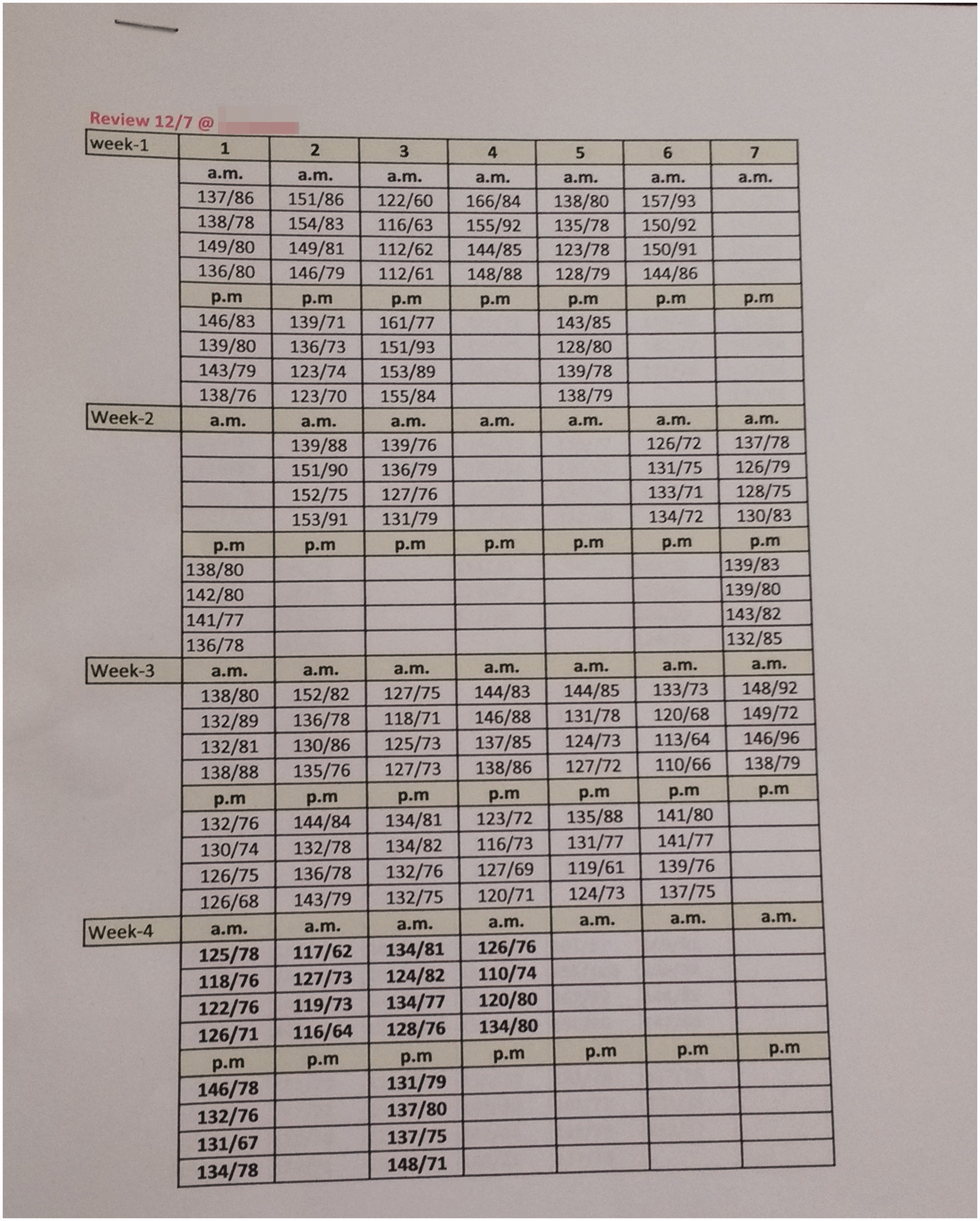
Fred’s spreadsheet compiled for his doctor’s appointment, practice name blanked out.
So far we have shown that the practices of taking a reading do not always lead to keeping a record of those data. For some of our participants, self-monitoring did not involve making any records. Where people do keep records, the readings entered into apps or recorded elsewhere may only be a subset of the readings taken. We have suggested the term discerning work to describe the skilful judgements people make about which data to record, which to omit, and how to process and present records that differentially draw attention to successes, warning signs or the credibility of the person making the record. We have also suggested that participants may create partial data both in the sense that they may choose only to record some of the readings they take, selecting these through the discerning work we have described, or in the sense that they measure, and therefore record, intermittently. From a user perspective, records may not be intended to be comprehensive or continuous, so here there is no ‘broken data’ and therefore no need for ‘repair work’. This means that, beyond the data breakages identified by Pink et al. (2018), there are other reasons why data may not flow seamlessly from measurement to an individual’s records to be aggregated by third parties. All of this should act as a gentle corrective to expectations about the exploitation of such data in existing literature (see Ruckenstein and Schüll, 2017; Van Dijck and Poell, 2016).
2. How and where to record
The analysis so far has mostly concerned which measures people record, but has also touched on the importance of how records are made and presented, particularly in our discussion of Fred. We now turn to this theme in more detail, to expand on issues around how and where people record and the materials involved. We will consider the socio-material arrangements in this curatorial work that draw attention to or deflect attention from different aspects of self-monitoring.
Visibility and being reminded
While half of the participants in the study had experience of using an app to track BMI, the visibility of paper records emerged as an important theme. For example, Becky told us she was losing weight together with her sister and sister’s wife. They met on Saturday mornings to record their weight and kept a joint record on a sheet of paper. The record had been set up on a spreadsheet, but this was printed off and weights written on by hand (Figure 3). When asked why they did not simply enter the data onto the spreadsheet, Becky responded: ‘I think because it was going to be a group thing that we could all jot it down while we were together. So I think that’s why I have a physical sort of … ’ (Becky, 36, charity researcher, white British).
In contrast to the digital co-presence discussed by Pink and Fors (2017), where people who are physically separate share data and are present together online, self-monitoring in our study involved physical co-presence where different materials come to the fore. A paper record in this account appears to allow these three women to participate together and to attend to their data collectively.
It was striking that records for sharing with partners, relatives and friends tended to be paper, charts and/or DIY forms of digitally networked communication such as texting or setting up WhatsApp groups. We encountered very little discussion of sharing through broader social media or proprietary self-monitoring apps that would facilitate sharing with wider social networks or publics, even where participants had devices with the capacity to do so. The materials our participants discussed appeared to allow them to do things together with limited, selected others (friends, family), and offer each other encouragement, while precluding broader attention. This finding resonates with some studies of digital self-tracking (Lomborg et al., 2018; Pink and Fors, 2017, cf. Kent, 2018), placing into question expectations of widespread lateral surveillance (Rich and Miah, 2017). Here we extend the existing analysis by considering not only with whom participants share, but also the materiality of sharing.
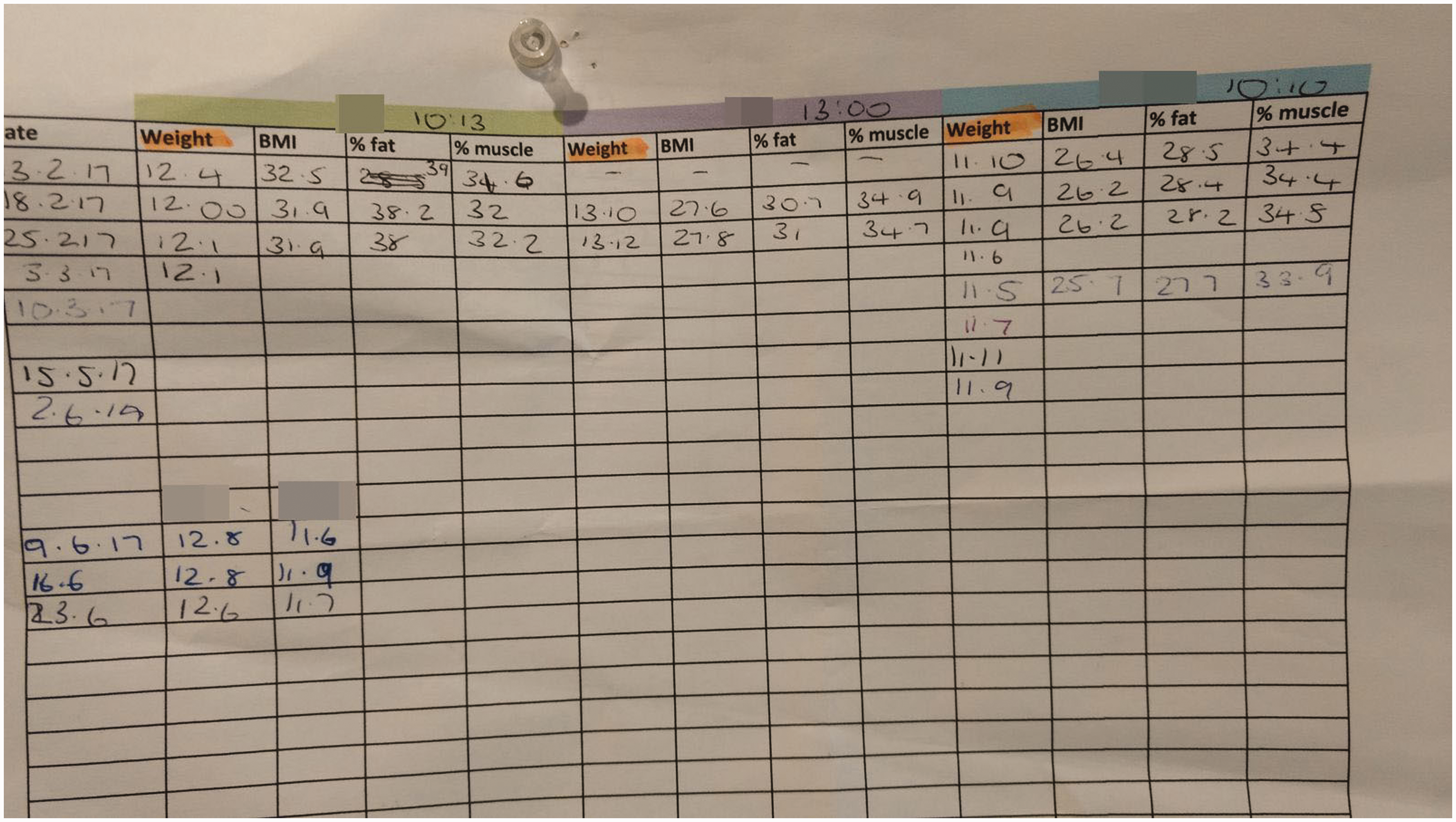
Becky’s ‘group thing’, names blanked out.
The visible emplacement of monitoring devices in particular domestic spaces, for example close at hand on a table next to a favourite armchair, may encourage people to monitor (Weiner and Will, 2018). In the same way, the emplacement of self-monitoring records, such as a chart pinned to a wall or a record on a mobile phone that is always to hand, might act as a reminder in different ways. Participants told us that leaving paper records and charts somewhere visible within the home helped to remind them to monitor or helped to keep commitments in mind. Becky, for example, told us that the shared record she made with her sister and sister-in-law was pinned to her notice board in her home office. She explained that this was visible enough to remind herself she was trying to lose weight, but not so public that visitors to the house would readily see it (compared with, for example, pinning it to the fridge in the kitchen). It is placed to hold her attention while avoiding drawing the attention of visitors. This concern with the emplacement of the chart suggests that even paper records have the capacity to act as ‘indiscreet technologies’ (see Oudshoorn, 2012), making public aspects of identity or practice that people would rather keep to themselves. In Becky’s case, the materiality and emplacement of the record lend themselves both to monitoring in a group and to keeping a project in mind, while allowing the record to remain relatively private.
Others told us that they recorded on the phone because it is always with them, unlikely to be forgotten or because it formed a convenient mode for transporting records. Bella, for example, related that it was not until she got her smartphone and found a free blood pressure app that she started to record her readings. Before that she had not made a record: because it was a pain in the neck … Because I had to keep writing it down and then remember to write it down and find the piece of paper, like that. So I was really happy when I found the app. (Bella, 57, charity administrator, white British) Interviewer: you said you’d put the records on your phone for a time. Was there any reason for that? Samuel: Only for ease of transport, I knew I’d have my phone with me. I haven’t kept them as a record, it was just a way of transporting information to the surgery with me. Interviewer: Okay, so was it an app for the blood pressure? Samuel: No, it was just a note. (Samuel, 62, university counsellor, white British) b. Not being reminded
While a few participants told us they had moved to apps from other ways of recording, in one instance a participant had moved away from an app, precisely because of the attention it demanded. Here again the emotional resonance of tracking comes into view. Andrea told us she used MyFitnessPal and that, while she continued to record her calorie intake in the app, she had stopped recording her weight in this because she found it contributed to her becoming ‘obsessive’ about it. At that point she told us she preferred to record her weight on a weekly basis in a notebook: So although I weigh myself at the minute, I’m not putting into MyFitnessPal because I found I was getting maybe a bit too – I started weighing myself every day and I may have got a little bit too obsessive about it … I felt I’ve gradually started being calmer about it … So I thought I’m going to gradually start doing all the things that I used to do again which is weigh myself once a week. (Andrea, 27, university administrator, white British)

Andrea’s ‘weekly weigh in’ note book.
In this section, we have paid particular attention to the materiality of records, looking at the different ways these contribute to paying and regulating attention to self-monitoring. Like others (Lomborg et al., 2018; Pink and Fors, 2017), we found little sharing through proprietary self-monitoring apps, but the employment of other materials – paper, spreadsheets, WhatsApp groups – which work to limit attention to small, selected groups of people. The visibility and emplacement of paper records may facilitate collective practice within the home and help to remind people to monitor or keep commitments in mind. The nearness of phones facilitates the recording of readings. Yet in one case, the immediacy of a mobile app was associated with over-attentiveness, and a paper record helped to remedy this. More baldly, the diverse materiality of self-monitoring records, including, but not limited to proprietary self-monitoring apps, suggests that self-monitoring data may not always be readily compiled or harvested by third parties, placing brakes on the liveliness (Lupton, 2019) of this data.
3. Storing and reviewing records
a. Broken data and repair work
Curation involves both what people make and what they keep and display. This relates to what they would like to remember or be reminded of. We found occasional stories of people going to efforts to retrieve data from different sources in order to retain a complete record. These may be understood as examples of the repair work and broken data proposed by Pink et al. (2018). John (55, IT support, white British) had recorded his weight and BMI on a weekly basis for the last decade using a number of different platforms. Initially he used a weight loss website called Weightloss Resource, because his wife was already subscribed to this. He ended this subscription in 2014, downloading his data to a Google Sheets spreadsheet, and moved to MyFitnessPal, which he used for 10 months before getting a Fitbit. He told us that to export his 10 months of data from MyFitnessPal would incur a fee, which he was not prepared to pay, although he lamented the ‘gap’ in his data.
We asked him at different points in the interview why he had downloaded his data and if this was important to him. His responses suggested an emotional connection to graphs as ‘comforting’. They also posed a link between records and biography – ‘a reminder of where you’d been and where you’d come to’. John related this to one particularly significant time in his life, during which one of his daughters was diagnosed with and treated for a serious illness. For John, retaining and looking over his records appeared to be both a way to celebrate his successes in weight control and to remember how he and his family had come through his daughter’s illness. This underscores the emotional and communicative aspect of these records.
b. Dormant records
In considering self-monitoring through the lens of curation, we have so far discussed record keeping practices in fairly deliberate terms. We have portrayed self-monitoring records as being created and shaped through a combination of the discerning work of humans and the materiality of the devices and broader technologies involved. Our final brief section provides a caveat to this view, suggesting that sometimes the human and material elements combined in such a way that participants found it difficult to keep track of their records. For example, Tony keeps records of monitoring his blood pressure in a rather ‘haphazard’ fashion on various slips of paper and backs of envelopes. He told us he stored most of his records in a bag but that he threw a lot of these away: Interviewer: Do you normally keep the readings in that? Tony: Yeah in a rather haphazard fashion. On bits of notes … I just used to write them down on bits of paper and shove them into this bag. And then I was packing this all away one day and suddenly thinking gosh there’s an awful lot of ancient results here, I’m never going to do anything with these and I remember I chucked a load away. (Tony, 54, electronic engineering lecturer, white British)
One way to interpret these accounts of lost or inaccessible records is through the lens of broken data, characterised by ruptures in people’s records. Yet, in these cases, these ruptures were not accompanied by efforts to repair the records except perhaps for the purposes of our interviews. Pieces of paper were stashed away in bags or with devices, computers and phones were upgraded, and old ones were discarded or moved to transitional spaces in the home such as the loft, just as old diaries were stored in the cellar. We find parallels within the sociology of consumption in Sophie Woodward’s (2015) notion of ‘dormant things’. This references the accumulation of things not currently being used which may be stored deliberately, but may also be forgotten. Drawing on Woodward, we propose these accumulated records might be considered dormant. While an important focus of our analysis has been to highlight people’s agential engagements with the constitution of data, the notion of dormant records helps to acknowledge disengagements and lack of intentionality. Records may have been created and stored deliberately but become dormant when they no longer hold participants’ attention.
Discussion
This paper introduces and develops an analysis of self-monitoring through the lens of curation. In doing so, it builds on and extends a now growing scholarship on everyday self-monitoring. By analysing data practices through the concept of curation, we illuminate both the human work involved in making and retaining records, while, at the same time, taking seriously the role of materials. Understanding curation as a theory of attention, we have analysed the different ways both humans and materials are implicated in drawing attention to, or detracting attention from, the practices of self-monitoring and the data these create.
In thinking through the work of curation, we have proposed the concepts discerning work and partial data in relation to self-monitoring. In suggesting these we have been influenced by Pink et al.’s (2018) concern with the way (digital) data is constituted in everyday situations. We find that their ‘concept metaphor’ of broken data and focus on the ‘work of repair’ do useful analytic work, although they describe only a small amount of the curatorial work we encountered in our study. The ideas seem to imply an aspiration for completeness which we find often absent. We think that discerning work in the context of self-monitoring provides a broader term for describing the work that people do to create self-monitoring records. We have shown how people do not necessarily record all the readings they take, but make decisions about which to record. In this way, records may be selective where people record only the data they are happy with, or that they feel they need to be reminded of. Here, data may be partial, but not necessarily broken, in the sense of representing an incomplete set of the data created and capturing the selectivity or interestedness of the data recorded. We have also suggested that data may be understood as partial when monitoring is undertaken intermittently, perhaps with specific purposes in mind (e.g., for a doctor’s appointment) or in seemingly less patterned ways. We recognise that all data is partial (Gitelman and Jackson, 2013), but think the notion of partial data, in contrast to broken data, helps to keep hold of this sense of selectivity and intermittency.
A second contribution of this paper is our analysis of the material dimensions of curation in relation to self-monitoring. Rather than figuring self-monitoring as exclusively digital or networked, we have documented the variety of materials associated with records and pointed to the way different materials help to hold or regulate participants’ attention. The visibility of paper records may facilitate people to monitor together when they are physically co-present. Notebooks or charts prominently emplaced might also help participants to remember to monitor or keep a commitment in mind. Self-tracking and other apps such as Google Sheets, and phone memos or notes helped to retain attention through their emplacement, always present and unlikely to be forgotten. Yet, as exemplified by one participant, the permanent presence of smartphones might risk people becoming over-involved in self-monitoring and the relatively static emplacement of paper records might enable monitoring to be kept at a distance. Further, when people shared self-monitoring records, these were mostly in the form of paper records and digital DIY networks. Compared with tracking apps, we suggest these are perhaps more straightforwardly discreet because sharing is more readily limited.
We propose that curation, as a theory of attention, helps brings together different aspects of self-monitoring discussed in the more ethnographically informed scholarship. It links the work of making records (e.g., Pink et al., 2018) with the emotional aspects of self-monitoring (e.g., Ancker et al., 2015; Gorm and Shklovski, 2019; Lomborg et al., 2018; Lupton, 2018a, 2018b, 2019; Pantzar and Ruckenstein, 2015; Pink et al., 2017; Ruckenstein, 2014; Urban, 2017) and what scholars have discussed as the different values of self-tracking data (Fiore-Gartland and Neff, 2015; Lupton, 2018a; Lupton et al., 2018; Nafus and Sherman, 2014; Sharon and Zandbergen, 2017). In undertaking curation, people constitute records that are pleasing or communicate aspects of their identity or biography (e.g., a trustworthy patient, a successful dieter). Materials may help to distance self-tracking so as to reduce obsessiveness or anxiety, or may act as a reminder of a commitment. In this way, we have shown that curation complements other research on how people make sense of or evaluate tracking data (Lupton, 2018a), by underscoring the way these valuations may prefigure and shape the generation of data in the first place.
While our analysis finds space for the agency of those who self-monitor in creating records, we have illustrated the difficulties some participants had marshalling unruly materials, as they decided what to keep or tried to remember if or where they had stored records. Following Woodward (2015), we have suggested the term dormant records to account for records that have been stored in case of potential future use, as well as those that are unattended and those that have been forgotten.
Our analysis has pointed to the way people engage and disengage with self-monitoring and the data that it produces. In this sense, it helps to put data and records in their place. Accounts of discerning work and partial data return a degree of agency to users of self-tracking technologies in the creation and circulation of data, while being attentive to the constraints imposed by the diverse materialities involved. Like others (Didžiokaitė et al., 2018; Esmonde, 2020; Gorm and Shklovski, 2019; Lomborg et al., 2018), we have shown that, even where people do record their data in ways that might be compiled by third parties (i.e. through apps), they do not necessarily give up all their data, and may be selective in what they record. They may also not be ‘hooked’ (Lomborg et al., 2018) into continuous monitoring and recording (see also Gorm and Shklovski, 2019), and therefore the data they produce may be limited, even if it is in a material form that can easily flow. The different materials enrolled for making and sharing records might further dampen expectations about the potentials for data flows.
To what degree does our analysis stem from cases we chose? Blood pressure monitoring and weight/BMI currently involve measuring devices that may be, but are often not, networked. Whether and how to keep records is relatively open. However, devices are likely to become increasingly networked or even wearable, suggesting a move from manual data input to system-generated records and more continuous measurement. Yet the discerning work in the creation of records we and others have observed suggests that people may still exercise a degree of agency over their self-tracking data. Further, as Lupton et al. (2018), Esmonde (2020) and Gorm and Shklovski (2019) amply illustrate in relation to activity tracking, people may still remove devices or delete unwanted data points, or only monitor on days that they think are likely to show desirable results. Moreover, as we have discussed, the materiality of records is entwined with the practices of monitoring. People’s willingness to use specific technologies may depend on the levels of visibility and discretion they offer and the degrees to which they are suited to the types of individual or collective practices of monitoring we have described. This means that, even when they could use them, people may sometimes eschew digital/networked technologies and use analogue/non-networked forms of monitoring and recording instead.
What does this all mean for the generation of big data and our understandings of data power (Kennedy, 2018)? Adopting a curatorial lens helps to unpack precisely which data points are recorded and omitted from self-monitoring records, and the ways in which these data may or may not travel beyond the people who generate them to be aggregated into big data sets and/or used by other actors. It thus adds specificity to discussions about data that does not become ‘big’ and lends nuance to our understanding of the potentials for data flows in practices of self-monitoring. Acknowledging the importance of discerning work, the partiality of data, the varied materiality of self-monitoring and the dormancy of some records suggests we should temper expectations about data flows, data power and claims about surveillance and exploitation linked to these.
Footnotes
Acknowledgements
We would like to thank all the people who volunteered to participate in the research for their time and interest. We are grateful to the editors of Big Data & Society, three anonymous reviewers and colleagues for their helpful comments, questions and suggestions on earlier versions and presentations of this article.
Declaration of conflicting interests
The author(s) declared no potential conflicts of interest with respect to the research, authorship, and/or publication of this article.
Funding
The author(s) disclosed receipt of the following financial support for the research, authorship, and/or publication of this article: This work was supported by the Leverhulme Trust under Grant RPG-2015-348.
