




Abstract
Objective
This study considers the example of one council who deliberately implemented menopause considerations into their well-being strategy instead of instituting a menopause policy. This example is used to explore whether such a strategy is a more viable and effective alternative.
Study Design
An online survey was distributed amongst council workers and completed by 189 individuals. The questions covered respondents’ own experiences of menopause transition at work (where applicable) and the availability of information and support for menopause at work, as well as a range of contextual factors.
Main outcome measures
Experiences of workplace environments and relationships by those experiencing menopause.
Results
Results on menopause experiences in this council are comparable to those in organizations who have implemented menopause policies or guidelines. Contextual factors, including gendered vertical segregation and racism, are highlighted as important factors influencing the experience of menopause transition in the workplace.
Conclusions
Early indications suggest that integrating menopause support into a health and well-being strategy helps mainstream menopause issues amongst staff. Long-term assessment is required to consider whether it is more effective than introducing a menopause policy or guidelines.
Introduction
With the advent of menopause as a more common topic of conversation in public life, the taboos surrounding menopause in the workplace are also being addressed, albeit very slowly. 1 Academic research into menopause experiences in workplaces has focused on three key means of support: menopause policies or guidelines, training and awareness raising (especially for managers)2,3 and the (re-)institution of Menopause Cliniques as a way to provide patient care outside of the workplace. 4 This paper focused on the first of these and questions whether there are alternatives to the recommendation 5 to introduce a menopause policy or menopause guidelines as effective ways to support those experiencing menopause transitions in the workplace. The usefulness of policies is dependent on the willingness of those transitioning through menopause to engage with the process, thus necessitating an ongoing dialogue that is not necessarily existent. 6 The individualized, and often health-related, nature of menopause symptoms makes ‘blanket human resource policies’ 7 inadequate. Normalising conversations about menopause, possibly with colleagues or via established processes with managers, can be a useful starting point to change organizational cultures. The integration of menopause awareness raising and support activities into established health and well-being policies could provide such an alternative. This study explores workers’ reactions to the implementation of such a health and well-being approach in one local council in the UK.
Methods
Between May and December 2019, an online survey was made available to all employees of one local council. The survey was structured to cover a range of issues relating to menopause in the workplace, including respondents’ own experiences of menopause and of the support provided, while also allowing for qualitative answers where appropriate. The survey was kept short to encourage completion and consisted of 37 questions, though routing meant that nobody was asked to complete every single question. After the initial, compulsory questions on information and consent, the survey covered background characteristics; work context and environment; uniforms or dress code; menopause information, guidance and policies in the workplace; perceptions and conversations or disclosure about menopause; individuals’ own experience of menopause and the interaction between menopause symptoms and working conditions. The survey ended with an open question on whether there were experiences of menopause at work that respondents wanted to share or if there were other comments they would like to make.
We used an adjusted scale to categorize menopause symptoms as previously suggested, 8 to allow for a focus specifically on the workplace context. The survey was open from 17 May 2019 to 21 December 2019. This prolonged period was intended to incorporate the entire process during which the council implemented menopause-related amendments to their health and well-being policy, 9 and to maximize the responses. It has, however, resulted in a drawback in that it is impossible to tell a before and after story of how responses might have changed once menopause support and information was instituted. 189 individuals responded to the survey. Although this amounts to only 2.7% of all council employees, it does constitute 4.5% of their female workforce. This cross-sectional study has obvious limitations, given its size. As such, it is not representative and provides an imprecise insight into the chronology of changes at the council. We cannot make any claims about longitudinal developments in this workplace or about causes and effects. A further limitation is that there is likely to be self-selection in terms of who took part in the survey that has resulted in a bias towards individuals who have an interest in, have experience of or who are knowledgeable about menopause transitions.
And yet the range of questions asked, in particular in combination with the qualitative and open-ended opportunities provided to respondents, provide a unique insight into the experiences of a different form of support for those transitioning through menopause in the workplace. We argue that the amended health and well-being policy is a viable and effective alternative to instituting menopause policies or menopause guidelines.
In the following, we provide an overview of the background information and characteristics of respondents to the survey. We then consider how workers at the council under investigation seek support and information within and outside of work. A discussion of the disclosure of menopause status and the impacts of gendered vertical segregation and ethnicity follows before we discuss the results, recommend strategies and conclude.
Results
Participant characteristics
The survey was targeted at individuals transitioning through menopause. Their age ranged from 25 to 64 years of age, with the majority in their mid-40s to mid-50s, reflecting the age demographic of other menopause research1,2 and the average age at which menopause is achieved (51). The majority (89.4%) of respondents identified as white, with 2.1% Asian/Asian British; 5.3% Black/African/Caribbean/Black British; 0.5% mixed/multiple ethnic groups and 2.6% preferring not to say. This represents a comparatively high number of respondents unwilling to state their ethnicity, which may speak to a workplace culture with implications for experiences of the menopause. The majority of respondents worked in office jobs and in Administrative and support service activities (26.3%); Human health and social work activities (19.4%); Professional, scientific and technical activities (11.3%) and other service activities (10.8%). However, not all of these activities are undertaken in an office environment (74.5%), as 38.3% worked flexibly in terms of location, 6.9% are mobile workers and 0.5% manual workers.
Further contextualization of results can be achieved by considering the work environment of respondents. As with most public sector organisations, 10 the council is female dominated (approximately 60:40). Thus, although nearly half (48.7%) of respondents describe their workplace as having roughly equal numbers of men and women, a large majority (41.8%) describe their workplace as female dominated and only 9.5% describe their workplace as male dominated. The hierarchical structure in the council is reasonably flat (72.3% do not have line management responsibility) and only 5.9% manage more than 21 people. This is reflected in the way that work is undertaken, with slightly over half (53.2%) of respondents stating that they have some say over the way that they work most of the time; and the majority of respondents stating that supportive feedback is given on the work they do either sometimes (35.4%) or most of the time (34.9%). 41.8% of respondents stated that staff are consulted about changes at work most of the time and 36.5% felt that they are consulted sometimes. Yet, as in any workplace, there are perceptions of widespread friction or anger between colleagues at work (65.8%). To counter this, the taboo around menopause requires an upturn in mentally empowering workplace health promotions. 11
Pro-active workers seek support and information outside and within work
The largest group (54%) of respondents were currently experiencing menopause, suggesting that those not experiencing it were less likely to respond. 10.1% had experienced it and 18.5% stated that they might be experiencing it but were not sure. In line with other research,2,12,13 the five menopause symptoms most frequently experienced by respondents were fatigue, hot flushes, night sweats, insomnia and changes in periods. When asked how they sought support for their menopause experience, council employees showed themselves to be pro-active and interested in being well informed. With regards to taking advice on their menopause, 66.1% had seen their GP and 49.6% had looked for information on the web or consulted books but 15.7% had not sought advice. Additionally, 10.7% had seen an alternative practitioner, 9.1% had sought other advice, for example, from friends and family, and 4.1% had consulted the NICE guidelines. 13 Questions about the existence of information on menopause in the workplace show that the efforts made to introduce this had not (yet) been successful. Only 20% of respondents stated that their workplace provided information about menopause but 85% stated that they would like this information to be provided at work. Those who stated that they did not want this information provided at work report on common issues14,15 including gendered ageism and sexism. Qualitative responses within the survey thus show that there is an expectation that raising a ‘women’s issue’ would exacerbate already present ageism: ‘the work place is sometimes age-ist as it is’ and a clear understanding that the intersection of gender and age is creating a particularly unpleasant working environment for older women: ‘I think there is enough bias against older women here without giving the guys another excuse to justify their assumed superiority’. In this context, 83.6% of respondents agreed, to some extent, with the statement ‘menopause is a sign of ageing’, further suggesting that ageism is keenly experienced.
In turn, 28.2% stated that their workplace has a menopause at work policy or menopause guidance, 30.8% of respondents said there was no such policy or guidance and 41% did not know. These findings are confusing in light of the introduction of menopause support into the health and well-being provision. Yet, there were also encouraging signs that the activities introduced were well received, with one respondent adding: I would like the last Menopause Conference to be built on and become an Annual Event where it is encouraged to talk about and inbuilt into ALL policies of [the] Council.
Overall then, and according to respondents’ views, the council’s employees seem to be a pro-active group in seeking information and support on menopause transitions outside of and within the workplace, whilst also being aware of gendered ageism and the implications this has for tackling menopause issues in the workplace. There are indications that the menopause support is welcomed, though there is no clear consensus from the overall survey responses and a limited degree of knowledge of the support that was implemented.
Gendered vertical segregation and the impact of ethnicity
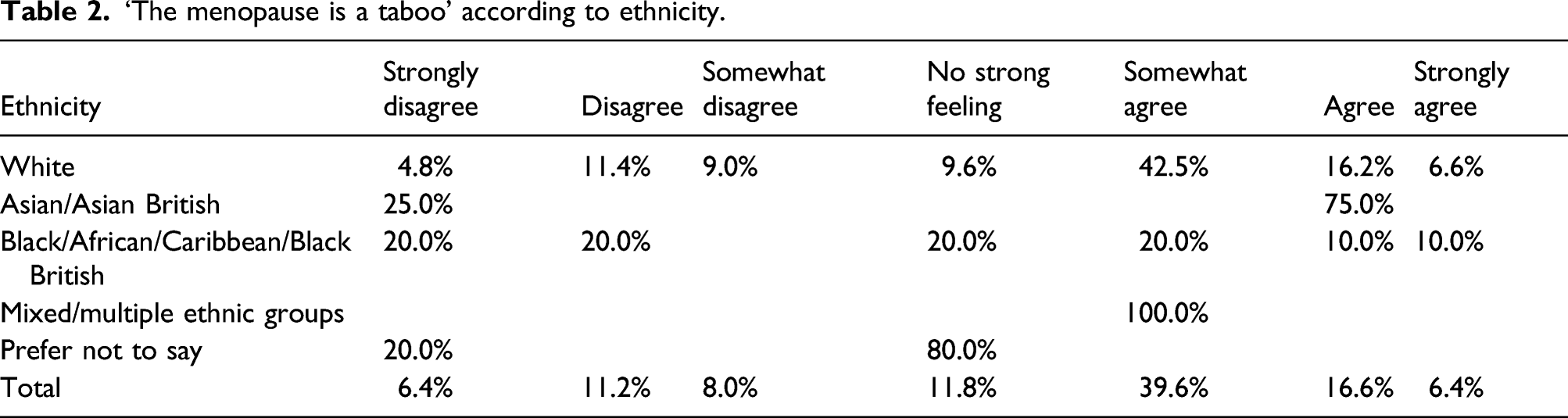
When asked about their perceptions of menopause, nearly half of respondents (45.7%) disagreed, or disagreed to some extent, with the statement ‘The menopause is something you can talk about at work’ and over half of respondents (62.6%) agreed, or agreed to some extent, with the statement ‘The menopause is a taboo’, demonstrating the need for greater openness around this subject. The inability to talk about the impact of menopause on work experiences has considerable implications for what support is perceived to be available and whether it is seen as freely accessible. Swapping stories, questions, tips, tears and laughter is an important part of menopause support.
16
This is visible in the way in which menopause status is disclosed at work. 53.2% of respondents disclosed their menopause status at work, with the majority disclosing to a colleague (84.3%) or line manager (83.1%). Combining the survey results on who they disclose to and additional qualitative comments from the survey suggests that gendered vertical segregation in the workforce is an issue.
17
Thus, the majority of respondents (41%) had disclosed their menopause status to a female the same age as them, 24.1% spoke to a female younger than them and 12% to a female older than them. There were far fewer who disclosed to men: 12% had also disclosed to a male younger than them, 7.2% to a male older than them and 3.6% to a male of the same age. Additional comments suggested that disclosure to male managers is difficult, so that talking to female colleagues or in menopause talking groups is preferable. ‘[My] immediate male boss has no empathy at all… [The] more senior male boss is not interested in anything anyone says, only his view of everything – he never listens’. ‘Every time I talk to my male manager he changes the subject and dismissed the discussion as a bit of a joke’. “I think this group is very helpful and making me aware of my symptoms’.
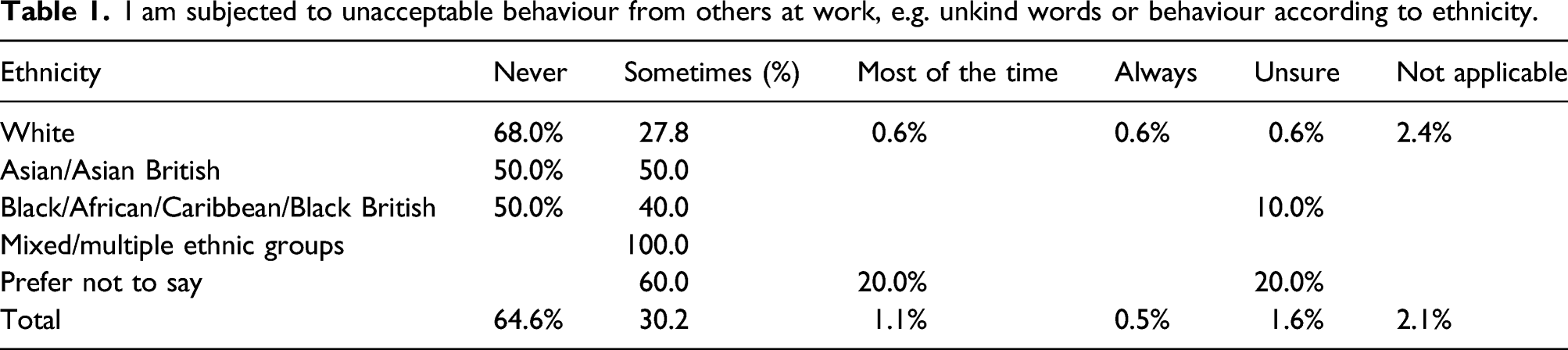
I am subjected to unacceptable behaviour from others at work, e.g. unkind words or behaviour according to ethnicity.
‘The menopause is a taboo’ according to ethnicity.
Discussion and recommended strategy
There are early signs that the different health and well-being–focused approach adopted by the council under investigation in this research is a suitable alternative to the often-recommended introduction of menopause policies or menopause guidelines. Results presented here are comparable to organisations where such policies or guidelines were introduced. Importantly, this alternative strategy relies on defining health as including both physical and mental health 18 and also on seeing menopause not overly or only negatively, as an affliction affecting all older women. 19 However, current data also demonstrate that, while council employees appear pro-active in tackling menopause-related issues with professional help, high levels of gendered ageism, exacerbated by racism, are having a significantly negative impact on experiences of work. One contributor to this culture is gendered vertical segregation (men tending to occupy managerial roles) accompanied by a general unwillingness to engage in ‘women’s issues’.
For many respondents, when asked for additional comments, they stated a need for greater openness at work surrounding menopause and related symptoms, which reinforces the intended approach of mainstreaming menopause via health and well-being initiatives. However, this also requires a cultural shift that will inevitably take time and will be best implemented top-down. The positive repercussions of such a shift would be considerable for all employees, not only those currently experiencing menopause, as it should alleviate awkwardness in male colleagues and managers and better prepare those who will experience menopause in the future, thus counteracting the unpreparedness for the impact of menopause symptoms expressed by some respondents.
Conclusion
The current study in one council shows that alternatives to the commonly recommended introduction of menopause policies and guidelines exist. The situation at the council is comparable to, if at times somewhat better than, that in other organizations that have such policies and guidelines. It will now be important to track the implications of this approach in the long term. In addition, this paper has highlighted the nuances in how menopause transitions in workplaces are experienced. The difficulties in talking about menopause in the workplace are exacerbated by gendered vertical segregation and by indications that racism has significant effects on how work in general is experienced. Overall then, there is a continued need to press for more openness and a normalization of conversations around menopause. There is also a need for clearer intersectional investigations into the experience of menopause in the workplace.
Footnotes
Declaration of conflicting interests
The author(s) declared no potential conflicts of interest with respect to the research, authorship, and/or publication of this article.
Funding
The author(s) received no financial support for the research, authorship, and/or publication of this article.
Contributorship
VB researched literature, conceived the study, developed the protocol, gained ethical approval, and rolled out the survey. RT undertook the initial data analysis and wrote the first draft of the manuscript. Both authors undertook an iterative analysis process, reviewed and edited the manuscript and approved the final version of the manuscript
Ethical approval
The University of Bristol School of Management Ethics Committee approved this study on 13 May 2019.
