




Abstract
Ageing populations are reshaping the political landscape in many democracies, raising concerns about intergenerational inequalities in power and representation. Do these political factors contribute to ageism toward older people? While ageism is a well-documented form of prejudice, its political roots remain underexplored. This paper examines whether perceptions of political exclusion based on age are linked to negative attitudes toward older people. Using original survey data from Italy, South Korea, and the United States, we study how both general concerns about older generations dominating political life and more personal feelings of age-based exclusion are associated with ageism. The results from all three countries reveal strong and consistent links between perceived political grievances and explicit expressions of ageism, whereas implicit ageism appears largely unrelated to political perceptions. Our findings suggest that age-based prejudice is not merely a cultural or psychological artefact, but is also connected to perceived injustices in democratic representation.
Introduction
Ageism – a form of prejudice directed at individuals based on their age – remains widespread and socially acceptable in many countries (Levy and Banaji 2002; Swift and Chasteen 2021). As with other group-based prejudices, the targets of ageism can experience significant and negative consequences, including reduced social standing, discrimination in the workplace, and diminished health outcomes (Bae and Choi 2023; Chang et al., 2020; Mikton et al., 2021). Researchers have therefore been interested in understanding the factors that increase the prevalence of ageism, especially toward older people. To date, much of this research has focused on social and psychological determinants of ageist attitudes and beliefs, emphasizing factors such as anxiety about ageing and death (Marques et al., 2020), limited contact with older people, and broader personality traits (Allan et al., 2014). While this work has advanced our understanding of the micro-foundations of ageism, it has largely overlooked the potential link between ageism and political factors (Sutter et al., 2022) – particularly grievances related to representation and power.
Assessing whether and how ageism is linked to political grievances is important, because ageing populations are a defining feature of many contemporary democracies (Goerres and Vanhuysse 2021). These demographic shifts have significant implications for the distribution of political power and its consequences for intergenerational relations. Older citizens tend to vote more (Blais and Rubenson 2013), and political elites are consistently older than the populations they represent (Berry, 2014; Stockemer and Sundström, 2018, 2022). As ageing accelerates, concerns have grown that democratic governments are prioritizing the interests of older generations at the expense of younger cohorts, who are increasingly excluded from political power (Buchmeier and Vogt 2024). In a variety of contexts, research has shown that perceived exclusion can fuel prejudice and conflict (Hansen et al., 2018; Schaafsma and Williams 2012; Stephan et al., 2000; Van Staveren and Pervaiz 2017). The excluded group’s resentment of their marginalization can crystallize into broader hostility toward the dominant group (Cramer 2016; Norris 2011). From this theoretical framework, we expect that individuals who believe their age group has limited influence over political decisions will develop more negative views of older people. In other words, ageism may emerge not simply as a psychological reaction to ageing or mortality, but as a response to perceived injustices in representation driven by the belief that older generations wield too much political power. This link between intergenerational conflict and ageism has been hypothesized previously (North and Fiske 2012), but to our knowledge it has not been explored empirically in prior studies.
In this article, we use original surveys fielded in three democracies with ageing populations – Italy, South Korea, and the United States – to study how individuals’ perceptions of age-based political exclusion correlate with both explicit and implicit prejudice toward older people. Though ageism encompasses prejudice toward people of any age group, we focus on attitudes toward older people because this is where concerns about power and dominance are most politically salient. 1 The surveys capture both general perceptions of generational imbalances in political power, as well as more personalized feelings of age-based exclusion from political life. Respondents also completed a series of items measuring ageist attitudes across four dimensions, including voiced preferences, affective warmth, stereotypes, and an implicit association test (IAT).
The analysis reveals a robust association between political grievances and explicit forms of ageism. Individuals who believe that older generations dominate politics, or who feel personally unrepresented because of their age, are more likely to express negative views of older people. These effects are consistent across all three countries and are often stronger than those of well-established predictors in the literature, such as age, gender, and anxiety about ageing. Our stereotype index – which captures agreement with common negative traits attributed to older people, such as incompetence, laziness, or pity – shows particularly strong links to feelings of personal exclusion from politics. By contrast, implicit ageism appears less sensitive to political perceptions, suggesting that subconscious biases may be shaped more by cultural learning than by political context.
We also find that political ideology shapes ageist attitudes, though in divergent ways across countries. In the United States, respondents at both ideological extremes, particularly on the right, express more ageism than moderates. In Korea, by contrast, it is left-leaning respondents who are most likely to express explicit ageism. In Italy, ideological differences are weak and inconsistent. These patterns suggest that the political framing of age-related issues, including elite discourse and partisan cues, may influence which ideological groups come to view older people as politically dominant or obstructive.
Our research design cannot eliminate concerns about confounding; in addition, we expect that reverse causation is also likely, such that ageist individuals are more likely to believe that older people are politically dominant. However, we believe our findings contribute to a growing literature on the political foundations of intergroup attitudes by underscoring the need to take seriously and study further the political determinants of age-based prejudice. Perceived intergenerational power imbalances, especially when felt personally, can be a potent source of resentment that relates strongly to prejudice. Our results lend initial empirical support to theories of intergenerational conflict that posit age-based underrepresentation as a trigger for social division. The cross-national consistency of our results suggests that a broader dynamic may be at work in ageing democracies: when political power is seen as concentrated in the hands of older people, prejudice against older generations is more likely to manifest. Addressing ageism, in this light, may require not only fostering intergenerational contact or alleviating existential anxiety, but also ensuring that democratic institutions feel inclusive to all age groups.
Research Design
Can perceptions of intergenerational power imbalances give rise to prejudice toward older people? We examine this question by analysing original survey data from Italy, South Korea, and the United States, three ageing democracies where generational divides increasingly shape political debates and policy agendas. 2 However, these countries differ, among other things, in the extent to which age groups are represented in political leadership and in how older cohorts dominate political office. The United States displays a large age gap between politicians and the public, whereas Italy and South Korea have much smaller gaps (Figure A.2). Yet similar age gaps mask important differences in representation: Italy shows moderate underrepresentation of both younger and older adults, while South Korea, despite its smaller age gap, strongly underrepresents younger citizens and overrepresents older ones, much like the United States (Figure A3).
In each country, we recruited samples of adult respondents that reflect the broader population across key demographic characteristics, including age, gender, and education. The surveys were fielded between December 2023 and January 2024, yielding 2249 respondents in Italy, 1998 in South Korea, and 1970 in the United States. The questionnaires were designed to measure a broad set of attitudes toward older people, capturing both explicit and implicit expressions of prejudice. In addition, the surveys included original measures of perceived political exclusion based on age, along with a battery of social and psychological characteristics commonly linked to ageist beliefs. This design allows us to assess whether citizens who perceive older generations as politically dominant at their expense are more likely to endorse age-based stereotypes or harbour bias against older people. Additional details on the survey implementation and sampling strategy can be found in the Materials and Methods section on Appendix B.
To measure ageism, we rely on four distinct outcomes that vary in the degree of explicitness. First, we use a direct measure of voiced prejudice, based on a seven-point scale that asks whether respondents prefer older people, younger people, or neither. Second, we use a feeling thermometer to construct a measure of the relative warmth expressed toward older people compared to younger and middle-aged adults. These two items capture explicit age-based preference and serve as straightforward indicators of negative sentiments toward one age group over another. Third, we build a multi-item index of ageist stereotypes, based on agreement with statements reflecting various dimensions of prejudice toward older people, including contempt, pity, and respect. Finally, we include an implicit measure of ageism derived from an Implicit Association Test (IAT) embedded in the survey. The IAT score captures automatic associations between old age and negative traits. Together, these four outcomes provide a broad and layered view of attitudes toward age groups, ranging from conscious preferences and stereotypes to subconscious bias.
Our main explanatory variables capture perceptions of generational political imbalances that benefit older people. We asked respondents to agree or disagree with five statements designed to tap into these perceptions. Three of these statements reflect more general concerns about representational imbalances that favour older generations: that politicians are too old in the country, that older leaders do not care about younger citizens, and that it is a problem when political leaders are much older than the public. The other two statements capture more personal forms of perceived exclusion: that the respondent’s own political views are not represented because of their age, and that they disagree politically with older people. We use the first three items to construct an index of generational grievance, and the final two to construct an index of personal political exclusion. These indices allow us to distinguish between abstract concerns about fairness in age-based representation and more individualized perceptions of marginalization due to age.
To explore the political correlates of ageism more broadly, we include indicators for right-wing and left-wing self-identification, derived from self-placement on a ten-point ideological scale. Though political orientation has not been central to most ageism research, we assess whether political ideology helps explain variance in ageist attitudes. In addition, we control for other factors drawn from literature on ageism and intergroup attitudes more broadly. First, we include an index of anxiety about ageing and death, which combines responses to two items measuring respondents’ concern about getting older and dying. Second, we construct an index capturing contact with older people, based on the frequency and quality of interactions with older adults in daily life. Both variables represent key mechanisms that have been consistently linked to ageist attitudes in previous research (Allan et al., 2014; Marques et al., 2020). Third, we add an ethnocentrism index, based on agreement with four statements reflecting exclusionary or derogatory attitudes toward other cultures. This measure accounts for certain people being more prone to generalized prejudice (Crawford and Brandt 2019). Finally, all models include a standard set of demographic controls, including respondent age, gender, educational attainment, employment status, and religious affiliation, several of which have been linked to ageism in some studies (Marques et al., 2020).
Results
We estimate a series of linear regressions to examine whether perceptions of age-based political exclusion are correlated with more ageist attitudes. All outcome variables, except for the IAT score, are standardized, and higher values reflect more negative views toward older people. Each model includes the same set of controls and regional fixed effects, and is estimated separately by country as well as in the pooled dataset. This approach allows us to assess both the consistency of the relationship across national contexts and the relative contribution of political grievances compared to other known predictors of ageism. Full regression tables are available in Appendix D.
Figure 1 presents results from models that include the generational grievance index together with the full set of covariates. Across all three countries and across all three explicit measures of ageism, individuals who express concerns about older generations dominating political leadership at the expense of younger generations are significantly more likely to display ageist attitudes, especially in terms of voiced preferences and affective warmth. The strength of this relationship is remarkably consistent, suggesting that perceptions of intergenerational political imbalance are a robust correlate of explicit age-based prejudice. The stereotype index shows a weaker association, and the IAT score remains largely unaffected. These patterns suggest that political grievances influence conscious evaluative judgements more than subconscious associations. Ageism and Perceptions of Generational Political Exclusion. Notes: OLS estimates and 90-95% confidence intervals of the regression coefficients. Ageism outcome variables are standardized, except for the IAT D-Score. The results include regional fixed-effects, and other covariates, such as working status and religion.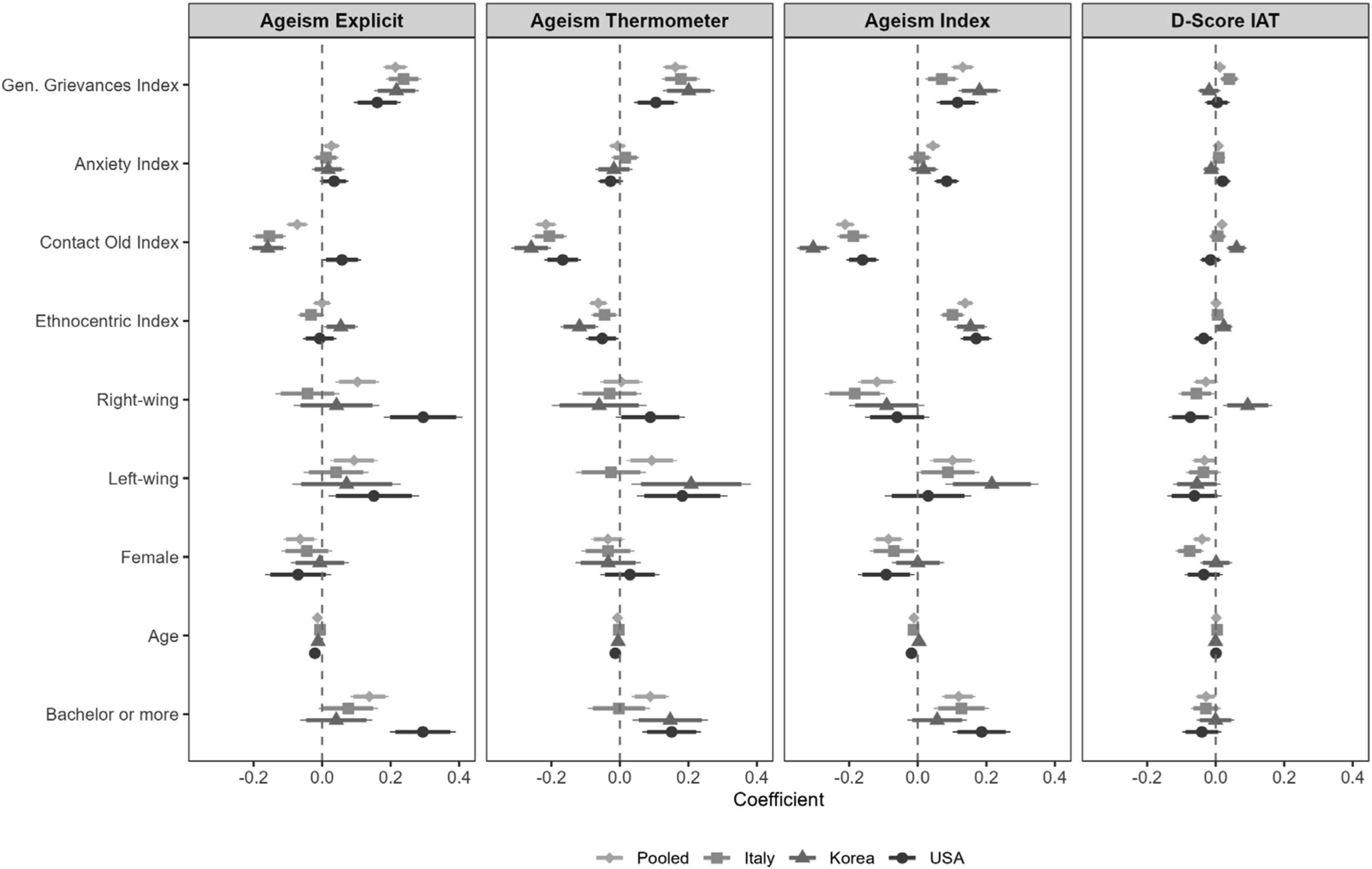
Figure 2 presents results from models that include the personal political exclusion index along with the same covariates. Again, we observe strong associations with explicit forms of ageism. Notably, personal age-based exclusion emerges as a particularly powerful predictor of ageist stereotypes, with especially pronounced effects in Korea and the United States. This pattern suggests that feeling personally unrepresented or politically sidelined because of one’s age may foster not just emotional resentment, but also more structured beliefs about the nature and behaviour of older people as a group. One possibility is that individuals who experience political exclusion are more likely to generalize their sense of marginalization into broader narratives about older generations, attributing negative traits such as laziness, incompetence and lack of moral standards. The stereotype index may be especially sensitive to this kind of projection. Ageism and Perceptions of Personal Age-Based Political Exclusion. Notes: OLS estimates and 90-95% confidence intervals of the regression coefficients. Ageism outcome variables are standardized, except for the IAT D-Score. The results include regional fixed-effects, and other covariates, such as working status and religion.
Results are generally robust to including both indices simultaneously in the models. The two grievance measures remain independently associated with explicit ageist attitudes when entered together. Generational grievances continue to be more closely associated with affective evaluations and voiced preferences, while perceptions of personal exclusion are more predictive of stereotype endorsement. Full estimates are presented in Appendix Figure D.7.
Alongside perceived political exclusion based on age, ideology also shows a relationship with ageism, though it varies by country. In the United States, respondents on both the left and right display more explicit ageism than centrists, especially on the preference and thermometer measures. In Korea, left-leaning individuals are consistently more ageist, a pattern that may reflect the structure of political debates and elite cues in that context. In Italy, ideology plays a smaller and less consistent role, suggesting that partisan identities may be less central to age-based attitudes.
Among factors previously cited as important contributors to ageism, more contact with older people is consistently associated with lower levels of explicit ageism across all countries and outcomes, as would be expected. The magnitude of the contact coefficients are similar to our political exclusion variables. In contrast, the anxiety index shows weak and inconsistent associations across the models, such that the relationships between ageism and political grievances are stronger. Finally, our indicator of generalized prejudice also tends to be associated with ageism, but more so for stereotypes of older people than explicit or implicit expressions of prejudice. Overall, these results suggest that political grievances may be as important for explaining ageism as other key factors identified by prior research.
Other demographic predictors also merit attention. Younger respondents are more likely to hold negative views of older people, a result that holds across all explicit measures and countries. Women, on average, display lower levels of ageist sentiment than men, particularly on the stereotype and thermometer scales. Higher education is sometimes associated with more favourable views, although the effect is not uniformly significant. Importantly, none of these traits meaningfully predict the IAT score.
The consistently null findings for the IAT deserve further comment. Unlike explicit measures, which appear responsive to contemporary concerns about representation and political voice, the IAT likely taps into more entrenched associations. Early theories propose that implicit attitudes, and particularly age stereotypes, are internalized during childhood and altered only gradually (Dasgupta 2013; Rothermund & De Paula Couto 2024; Vauclair et al., 2018). Moreover, the IAT has been shown to tap into generalized cultural associations rather than context-specific evaluations (Arkes and Tetlock 2004; Payne et al., 2017). If implicit ageism reflects these deeper, culturally embedded beliefs, it may be less responsive to short-term feelings of political exclusion or marginalization. This could explain why our measures of political grievance, despite their strong association with voiced preferences and evaluative judgements, do not translate into shifts in implicit bias.
Taken together, these findings align with the argument that ageism does not only emerge from psychological or cultural dynamics, but is also related to political factors, including perceived imbalances in the distribution of political power. When citizens believe that older generations dominate decision-making and marginalize younger perspectives, they are more likely to express prejudice against older people.
Discussion
Prior research has identified several social and psychological factors that contribute to ageist attitudes, including anxiety about ageing, lack of contact with older people, and broader personality traits (Allan et al., 2014; Marques et al., 2020). While these explanations have shaped much of the literature on ageism, they often treat prejudice toward older people as a relatively apolitical phenomenon. Our results indicate the importance of considering political contributors to ageism more seriously. Across three ageing democracies, we find consistent evidence that perceptions of political exclusion are strongly associated with negative views of older people. Individuals who believe that political power is concentrated in the hands of older generations, or who feel personally unrepresented because of their age, are significantly more likely to express explicit ageist attitudes and beliefs. This pattern aligns with broader theories of political resentment, where perceived exclusion from power can contribute to the emergence of group-based hostility (Cramer 2016; Norris 2011; Stephan et al., 2000). Our results thus suggest that ageism may emerge, in part, as a response to perceived imbalances in political representation and influence.
The evidence presented here is correlational and does not establish a causal relationship. We acknowledge the possibility that individuals who hold negative views of older people will be more likely to interpret political leadership through the lens of exclusion. It seems plausible this reverse causation occurs to some degree, even if our argument about perceived exclusion leading to prejudice is also correct. Furthermore, unobserved factors may jointly influence both perceptions of representation and expressions of ageism. While we attempt to address these concerns by controlling for a range of psychological, demographic, and ideological variables in different model specifications and subsample analyses, we cannot rule out all sources of bias. Given that our results align with well-grounded theoretical expectations and are highly robust, we believe they provide support for our argument, but also that they should motivate future research to leverage experimental or longitudinal designs to better identify causation and the precise mechanisms at play.
Another potential limitation to consider is that our survey data was collected through online opt-in panels. Though recruitment was guided by quotas for age, gender, and education, our respondents may differ from national populations in ways that we cannot fully observe. This possibility suggests that some caution is warranted when gauging the generalizability of our results. However, the core associations we document appear consistently across multiple demographic subgroups, including younger respondents (see Appendix E). This consistency suggests that the patterns we document are not confined to a narrow segment of the population. 3
While future research should assess causation and generalizability further, the patterns we observe are consistent, theoretically grounded, and politically meaningful. Across all three countries, explicit ageist attitudes are more common among individuals who feel politically marginalised due to their age. These results hold in models without covariates, when all components of the grievance indices are entered separately, and when younger respondents are analysed independently. When we focus specifically on younger respondents (those under 35), the associations between political grievances and explicit ageist attitudes become even stronger, particularly for the preference and stereotype measures. This pattern suggests that feelings of exclusion may be especially salient for younger cohorts, who may be more sensitive to inter-generational imbalances in political power. They also hold across different operationalisations of ageism. While the IAT score does not show strong relationships with political perceptions, this may reflect the limitations of implicit measures in capturing attitudes that emerge from context-specific grievances. If explicit prejudice is shaped by perceptions of injustice or under-representation, it is perhaps unsurprising that it responds more directly to political conditions. Finally, the patterns are particularly evident in South Korea and the United States, where the underrepresentation of younger adults in political leadership is pronounced and where political debates about generational fairness are especially visible. In Italy, where age imbalances between political leaders and citizens are smaller, political grievances still matter, but to a somewhat lesser extent.
The broader implication is that the structure of representation can shape not only political outcomes, but also intergroup attitudes. When younger citizens perceive that their voices are ignored or that political institutions consistently favour older cohorts, they may develop more hostile views of older people as a group. This hostility is not merely emotional, but appears to take the form of structured beliefs about the competence, warmth, or moral character of older adults.
Our findings suggest that political grievances related to perceived exclusion likely complement previously identified factors associated with ageist attitudes. Intergenerational contact continues to emerge as a consistent negative predictor of ageist attitudes in our results, and we also find that more general predispositions toward outgroup bias, captured through ethnocentrism, are modestly related to some ageist outcomes. Thus, feelings of political exclusion, contact, psychological predispositions, and generalized outgroup orientations may capture distinct but complementary pathways to age-based bias. Future research could explore further how these factors interact with each other and with country-level variables to affect the prevalence of ageism.
Our study has focused on ageism toward older people, but younger people are often subjected to ageism as well (North and Fiske 2012). In the Appendix, we show that our political grievance variables are not consistently associated with explicit or implicit prejudice toward younger people. The lack of relationship aligns with our theoretical expectations, given that older generations but not younger generations are overrepresented in positions of political power (Buchmeier and Vogt 2024). However, it seems plausible that ageism toward younger people may also manifest as a result of political factors in certain contexts. For example, widespread perceptions that younger people are too radical politically may contribute to ageist attitudes and beliefs. Given that the ageism literature has not adequately addressed ageism toward younger people (North and Fiske 2012), future studies should consider the link between politics and prejudice toward other age groups.
Ultimately, our study points to a broader concern for ageing democracies. If younger citizens come to see political institutions as dominated by older generations and unresponsive to their needs, intergenerational trust may erode. Prejudice and hostility toward older people may rise, particularly if these perceptions are reinforced by personal experiences of exclusion. While our evidence does not establish causality, it raises important questions about how the age structure of political power shapes social cohesion. Future work should explore whether reforms that increase political inclusion across age groups can reduce age-based resentment and foster more constructive intergenerational relations.
Supplemental material
Supplemental material - The political roots of ageism in greying democracies: Evidence from Italy, South Korea, and the United States
Supplemental material for The political roots of ageism in greying democracies: Evidence from Italy, South Korea, and the United States by Alonso Román Amarales, Scott Williamson in
Footnotes

Funding
The authors disclosed receipt of the following financial support for the research, authorship, and/or publication of this article: The authors would like to acknowledge funding by the Next Generation EU – Age-It – Ageing well in an aging society project (PE0000015). The views and opinions expressed are only those of the authors and do not necessarily reflect those of the European Union or the European Commission. Neither the European Union nor the European Commission can be held responsible for them.
Declaration of conflicting interests
The authors declared no potential conflicts of interest with respect to the research, authorship, and/or publication of this article.
Carnegie Corporation of New York Grant
This publication was made possible (in part) by a grant from the Carnegie Corporation of New York. The statements made and views expressed are solely the responsibility of the author.
Supplemental material
Notes
References
Supplementary Material
Please find the following supplemental material available below.
For Open Access articles published under a Creative Commons License, all supplemental material carries the same license as the article it is associated with.
For non-Open Access articles published, all supplemental material carries a non-exclusive license, and permission requests for re-use of supplemental material or any part of supplemental material shall be sent directly to the copyright owner as specified in the copyright notice associated with the article.
