



Abstract
In recent decades, populist parties and candidates have gained increasing electoral support across the world. Despite this evident electoral success of populists, however, recent experimental studies find limited effects of populist rhetoric alone on vote choice. If such rhetoric is not effective in shaping voting preference, why would politicians adopt it, and what might explain the electoral success of populist candidates and parties? We argue that populism might influence elections through increasing turnout instead of or in addition to changing voters’ preference for candidates. However, existing conjoint and vignette survey experiments generally focus on forced candidate choice, which assumes full mobilization, potentially biasing the between-candidate choice estimates and missing abstention decisions important in real-world politics. To address this, we conducted a large-scale U.S. conjoint experiment of campaign messaging with an explicit abstention option to test for the possible mobilization effects of populism independent of persuasion effects and the various associated policy positions. Our results show that while populist rhetoric has limited persuasive impact, it can slightly increase mobilization, especially among voters who already hold populist views. Overall, however, voters’ alignment with candidates’ policy positions matters far more for both vote choice and turnout than the use of populist messaging itself.
Introduction
In recent decades, populist parties and candidates have gained increasing electoral support worldwide. Populists portray politics as conflicts between two homogeneous groups, the good people versus the corrupt elites, and claim that the people should be the only legitimate source of power. Populism and its adherents pose a direct challenge to pluralism and liberal democracy (Mudde and Kaltwasser, 2018). When politics is portrayed as a moral conflict between good and evil, there is no space for opposition or diverse points of view. As such, it is important to understand the effects of populism on electoral politics. However, despite the electoral success of populist parties and candidates, recent experimental studies find limited persuasion effects of populism on individual vote choice (Dai and Kustov, 2023; Ferrari, 2024; Kittel, 2024; Kollberg, 2025; Neuner and Wratil, 2020, 2022). Furthermore, even voters who endorse populist views do not seem to be more supportive of populist candidates than non-populists. These null findings in experimental studies contrast sharply with populists’ real-world electoral gains, creating a puzzle: if populist rhetoric does not systematically convert voters based on policy preferences, what explains its electoral success?
As a potential explanation, we argue that populism might influence elections through increasing turnout instead of or in addition to changing voters’ preferences for candidates. One challenge to evaluating the effects of populism is that populism does not provide clear policy positions and thus always has to be combined with other “hosting ideologies” across the political spectrum from nationalism to socialism (Mudde, 2004b). As a result, it is hard to evaluate whether and to what extent the electoral success of populists is due to their use of populism per se or combinations of populism and related policy positions. 1 This may bias the between-candidate choice estimates and miss abstention decisions important in real-world politics (Miller and Ziegler, 2024).
We, therefore, design a new large-scale U.S. conjoint experiment of campaign messaging to test the mobilization effects (turnout) of populism in addition to the persuasion effects (vote choice) with an additional abstain option. By examining both mobilization and persuasion effects, our study seeks to clarify populism’s implications for democratic participation and electoral competition. Including an abstention option allows us to observe how populist messaging might shape turnout intentions within a realistic choice framework, even among relatively engaged survey respondents. This approach thereby extends our understanding of populism’s potential to mobilize voters—a dynamic that may emerge regardless of respondents’ actual turnout histories.
Our large-scale, preregistered U.S. conjoint experiment replicates prior findings of limited persuasive effects of populist rhetoric but also finds modest mobilization effects. In general, populist rhetoric increases the likelihood of voting. Specifically, populist rhetoric increases the likelihood of voting when used by candidates who share the respondent’s policy preferences, and especially among voters with populist attitudes. However, we find no evidence that it demobilizes non-populist voters. These results clarify when and for whom populism increases participation.
Persuasion versus mobilization effects of populism
As one of the most contested concepts in the social sciences, scholars have historically adopted different conceptualizations of populism, such as the political-strategic conceptualization (Weyland (2001a), 2017; Roberts (2006); Levitsky and Roberts (2011), the sociocultural conceptualization (Moffitt, 2016; Ostiguy, 2017), and the economic conceptualization (Acemoglu et al., 2013; Dornbusch and Edwards, 1991). While these different approaches to conceptualizing populism offer valuable insights into different aspects of populism, they have been criticized for their lack of clarity and for the fact that they tend to emphasize features that are not shared by all forms of populism around the globe (Bonikowski and Gidron, 2016a; Gidron and Bonikowski, 2013; Hawkins and Kaltwasser, 2018; Mudde and Kaltwasser, 2017; Mudde and Rovira Kaltwasser, 2018). Partly in response to these critiques, there has been a growing consensus across disciplines on the adoption of a more minimalist ideational conceptualization of populism that focuses on populism’s core features (Hawkins et al., 2018; Hawkins and Rovira Kaltwasser, 2017; Mudde, 2004a, 2007; Mudde and Kaltwasser, 2017), considering it a set of ideas portraying politics as a moral conflict between the pure people and the corrupt elites (Mudde, 2004b; Mudde and Kaltwasser, 2018).
Despite the evident success of populists, however, recent experimental studies that separate populism from its hosting ideologies have found limited effects of populism alone on vote choice. For example, using a nationally representative sample in Germany, Neuner and Wratil (2020) find that anti-immigration and pro-redistribution policy positions have much larger effects in attracting votes than populist priorities. In the U.S. context, recent survey experiments during different administrations find that populist rhetoric does not sway vote choice independent of policy positions (Dai and Kustov, 2023; Neuner and Wratil, 2022). These studies also find that populist voters are not more likely to support populist candidates than non-populist voters.
While studies show populist rhetoric (unlike policy positioning) alone doesn’t influence candidate choice in surveys, it may still influence electoral outcomes by influencing voters’ decision to vote and their overall political participation. This aligns with the literatures highlighting campaigns’ mobilization effects in resolving the “paradox of (not) voting” (Morton, 1991; Palfrey and Rosenthal, 1985; Uhlaner, 1989) and populism’s mobilization potential (Hameleers et al., 2018; Huber and Ruth, 2017; Immerzeel and Pickup, 2015; Morelli et al., 2021; Weyland, 2001b).
Many factors might influence voters’ decision to vote, such as the costs associated with (not) voting, the importance of an election, the linkage between a voter and a party (Blais, 2006; Powell, 1986). Empirically, electoral institutions that impose higher costs for not voting and facilitate more congruent voter-party linkage, such as compulsory voting and PR systems, generally lead to higher turnout (Cancela and Geys, 2016; Green et al., 2013). While populist campaigns do not directly change the costs of voting or abstaining, they can influence voters’ calculation about voting by increasing the perceived importance of an election and improving the congruence or linkage between the party/candidate and the voters.
Populists often emphasize threats to “the people” (the virtuous in-group) from the elite establishment or ethnic minorities (the corrupt out-groups) (Bonikowski and Zhang, 2023). They portray the in-group as an overlooked majority of ordinary citizens betrayed by elites, framing elections as opportunities to reclaim popular sovereignty. Those identifying with this “silent majority” are thus more likely to view the election as high-stakes, increasing their likelihood to vote or engage in other political activities (Simon and Klandermans, 2001).
The populist framing of the “silent majority” and the “corrupt elites” can also increase the perceived congruence between the candidate and voters who identify with the majority and distrust current institutions. Individuals with populist attitudes tend to feel more alienated from the mainstream parties and are also less likely to turn out and vote (Anduiza et al., 2019; Gidron and Hall, 2020). Voters with populist attitudes and those who distrust the political system might find populist candidates and parties more appealing. Indeed, Guiso et al. (2017) find that voters who distrust the political system tend to vote less and tend to vote for a populist party when it is an option in Europe.
In addition to the spread of people-centric and anti-elitist ideas, populist campaigns are also always morally charged. This is important because political psychology research reveals that politicians’ use of moral rhetoric can mobilize those already aligned with their positions (Jung, 2020). Recently, Kollberg et al. (2024) confirmed this applies to populist rhetoric as well, which can effectively rally supporters but hinder efforts to expand electoral support (also, see Blumenau and Lauderdale, 2024). However, just as campaign strategies have different (de)mobilization effects on specific subsets of voters (Hersh and Schaffner, 2013; Lau and Rovner, 2009), we expect populist campaigns to also work differently among subsets of voters. Specifically, populist rhetoric should only mobilize those who already support a candidate and find the messaging appealing. Otherwise, it may backfire (Kollberg et al., 2024).
Empirically, observational studies on the link between populist parties in parliament and overall turnout yield mixed results at the aggregated level (Huber and Ruth, 2017; Leininger and Meijers, 2021). The same holds true for turnout among specific groups, including those with populist attitudes (Immerzeel and Pickup, 2015). The inconclusive findings further suggest that any potential mobilization effects, if they exist, will depend on the host ideologies (policy positions) of populist campaigns and the types of voters they target.
Hypotheses
To address the apparent paradox of populism’s electoral success despite its limited persuasion effects, we aim to explicitly test, for the first time, its possible mobilization effects in a survey experiment. We argue that the effects of candidates’ use of populist rhetoric on voter turnout primarily depend on two factors: (1) voters’ own positivity or negativity toward populism and (2) the congruence between voters’ policy positions and those of the candidates (Dai and Kustov, 2023; Ferrari, 2024; Graham and Svolik, 2020; Silva et al., 2022).
As our background expectation, we consider the availability of congruent policy positions among candidates as the main factor influencing both individuals’ vote choice and turnout:
Individuals are more likely to vote (less likely to abstain) in a two-candidate election when at least one of the available candidates has congruent policy positions shared with them (as opposed to both candidates having non-congruent positions).
For our main confirmatory tests, we focus on populist rhetoric as a potentially important driver of voters’ mobilization. While the use of populist rhetoric in a campaign might not change voters’ preference for a certain candidate, it might still potentially influence their likelihood of voting for their preferred (policy-congruent) candidate in the first place. In particular, we consider a typical two-candidate race where voters have at least one preferred candidate and argue that the use of populist rhetoric in campaign messaging would likely mobilize voters who already hold populist attitudes and demobilize those who do not when used by that preferred candidate. Importantly, populism is likely only going to be (de)mobilizing when it is used by voters’ preferred candidate with congruent policy positions. We thus put forward the following two main hypotheses:
Populist individuals are more likely to vote (less likely to abstain) in a two-candidate election when their policy-congruent candidate uses populist rhetoric (as opposed to non-populist rhetoric, regardless of whether there is one or two congruent candidates and regardless of the non-congruent candidate’s use of populist rhetoric).
Non-populist individuals are more likely to vote (less likely to abstain) in a two-candidate election when their policy-congruent candidate uses non-populist rhetoric (as opposed to populist rhetoric, regardless of whether there is one or two congruent candidates and regardless of the non-congruent candidate’s use of populist rhetoric).
Altogether, our two conditional hypotheses imply that net mobilization effects and the net electoral benefits for candidates likely depend on the distribution of populist voters among their supporters and opponents in a particular political context. Still, given the majority support for at least some components of populism in contemporary politics (Wuttke et al., 2020), we can also specify a more general hypothesis about the likely average mobilization effects of using populist rhetoric by any candidate:
Individuals are more likely to vote (less likely to abstain) in a two-candidate election when at least one of the available candidates uses populist rhetoric (as opposed to both candidates using non-populist rhetoric).
Data and methods
Expanding the recent conjoint experiments by Dai and Kustov (2023), Neuner and Wratil (2022), and Ferrari (2024), we recruit a well-powered (90%+) online US sample (N = 3502/28016) approximating national demographics through Prolific. 2 While the two-party system in the U.S. provides fewer opportunities for organized populist parties, it still provides ample opportunities for populist candidates (Lee, 2019). In fact, scholars find that populist communication can be a strategic choice by candidates from all parties in the U.S. (Bonikowski and Gidron, 2016b; Dai and Kustov, 2022).
Following Dai and Kustov (2023), we embed the core elements of populist rhetoric in realist campaign messages, which mimic the type of information voters receive during elections. Unlike some other previous studies that only included various populist attributes (Neuner and Wratil, 2022; Silva et al., 2022), we also explicitly specify the non-populist, liberal democratic rhetoric as the baseline group for experimental comparison.
We adopt the ideational approach to operationalize liberal democracy and populism as multidimensional concepts, focusing on the core dimensions of (anti-pluralist) people-centrism and (moralized) anti-elitism as conjoint choice experiment attributes (Mudde and Kaltwasser, 2017, 2018; Wuttke et al., 2020). While both populist and liberal democratic forms of communication are often people-centric and critical of elites, they differ in how they portray these groups. Populists view the people as homogeneous, morally good, and unified by a single popular will, thus adopting an anti-pluralist stance. In contrast, liberal democrats see the people as diverse, with conflicting interests, embracing pluralism. At the same time, populists view elites as a homogeneous, morally inferior group. Consequently, anti-elitism in populism is inherently morally charged. 3
To separate populism from associated ideologies, we also include (randomized) immigration or economic policy positions as separate attributes independent from the populism attributes. These two issues have been most associated with right- and left-wing populism and have also been considered as “most important” by most US voters in recent years. 4
Finally, we include questions to measure respondents’ populist attitudes using existing scales (Wuttke et al., 2020), as well as their agreement with various immigration and economic policy positions to measure policy congruence. While our main specifications rely on direct policy congruence, we also replicate our analysis based on partisanship congruence (where pro-immigration, left-leaning positions are considered congruent for Democratic respondents and anti-immigration, right-leaning positions are considered congruent for Republican) respondents.
Given the recent call for “stimuli sampling” as an important complement to “participant sampling” to improve external validity (Clifford et al., 2023), we also randomize the messaging we use to communicate each of our treatments. Instead of using the same exact phrases or words to indicate a moralistic anti-establishment statement, for instance, we generate 16 distinct yet comparable messages mimicking real campaigns. 5 We also randomize whether candidates state their positions on economic or immigration policy in each message pair. In turn, this should improve the realism and generalizability of our experiment. For the list of all attributes and their implementation, see Table A8. Importantly, our experimental design does not make any constraints based on candidate congruency: respondents will be randomly exposed to profiles in which both, one, or neither candidate is policy-congruent. For more details, see our Design Table A9.
Overall, our conjoint design replicates the forced choice paired-profile design by Dai and Kustov (2023) with campaign messages of 8 candidate pairs in the US House general election setting, as well as extend it with an additional abstain option. The abstain option gives respondents an opportunity to indicate their non-preference, which arguably makes the experiment more realistic and allows us to test the mobilization effect of populist campaigns. Following prior literature, we decided not to include explicit party labels in either version of the conjoint design, as they would otherwise dominate all other attributes (see Silva et al., 2022). The vignette instruction is available in the Online Appendix.
Candidates’ backgrounds, campaign messages, and policy positions are embedded following the template below. Information in brackets are treatment attributes that are randomly assigned. For each of the rhetoric attributes, we include sixteen different versions/messages to increase the variation of campaign messages a respondent might receive. To maximize statistical power, we ensure all candidates use populist or non-populist rhetoric across both dimensions (i.e., use anti-pluralist and moralist or pluralist and non-moralist rhetoric). We also randomize whether a particular pair of candidates features their positions on immigration or the economy (but not both). For detailed attribute values and examples of candidate profiles and messages, see Online Appendix. Candidate [A/B] worked as a [elite: state official/government advisor/businessman/lawyer/professor/journalist/banker/executive; non-elite: social worker/teacher/firefighter/farmer/nurse/mechanic/retail worker/carpenter] before running and has [never held office before; held office for many years]. Campaign highlights: “[Anti-pluralist; Pluralist] AND [Moralist; Non-moralist]. [Anti-immigration; pro-immigration] OR [Right-leaning economic policy; left-leaning economic policy].”
After viewing each pair of candidate messages, the respondents are asked to indicate their subjective likelihood of voting for both candidates: “How likely is it that you would vote for someone like Candidate A and Candidate B in the upcoming election?” [Very likely, Somewhat likely, Neither Likely nor unlikely, Somewhat unlikely, Very unlikely]. They then indicate their (forced) choice response in the following prompt: “If these were the candidates in an upcoming election in your district, what would you do?” [I would vote for Candidate A/I would vote for Candidate B/I would abstain and not vote]. According to Miller and Ziegler (2024), a non-trivial proportion of US respondents might be expected to choose to abstain if given the option, highlighting the importance of considering abstention in conjoint experiments studying voter preferences.
Analysis and results
In line with previous conjoint analyses that introduce an abstain option in candidate choice, our sample shows that 11% of respondents abstained in the first conjoint task (16% on average across all conjoint tasks). Notably, this is close to the (clearly underreported) 14% of respondents who self-reported abstaining in the 2024 election in our survey. The positive correlation between 2024 abstention and average choice experiment abstention (r = 0.21) further indicates that people’s hypothetical conjoint choices may be reflective of their voting behavior.
We first replicate the main analysis of Dai and Kustov (2023) and test the effects of populist rhetoric on vote choice at the candidate-profile level. Consistent with their theoretical argument, we find that candidates with populist speech attributes are statistically more likely to be selected, especially among populist voters, though the effects are substantively very small. In line with their substantive results, we also find that these effects of rhetorical choices are completely trumped by those of candidates’ substantive policy positions. Detailed results are included in Table A2 of Online Appendix.
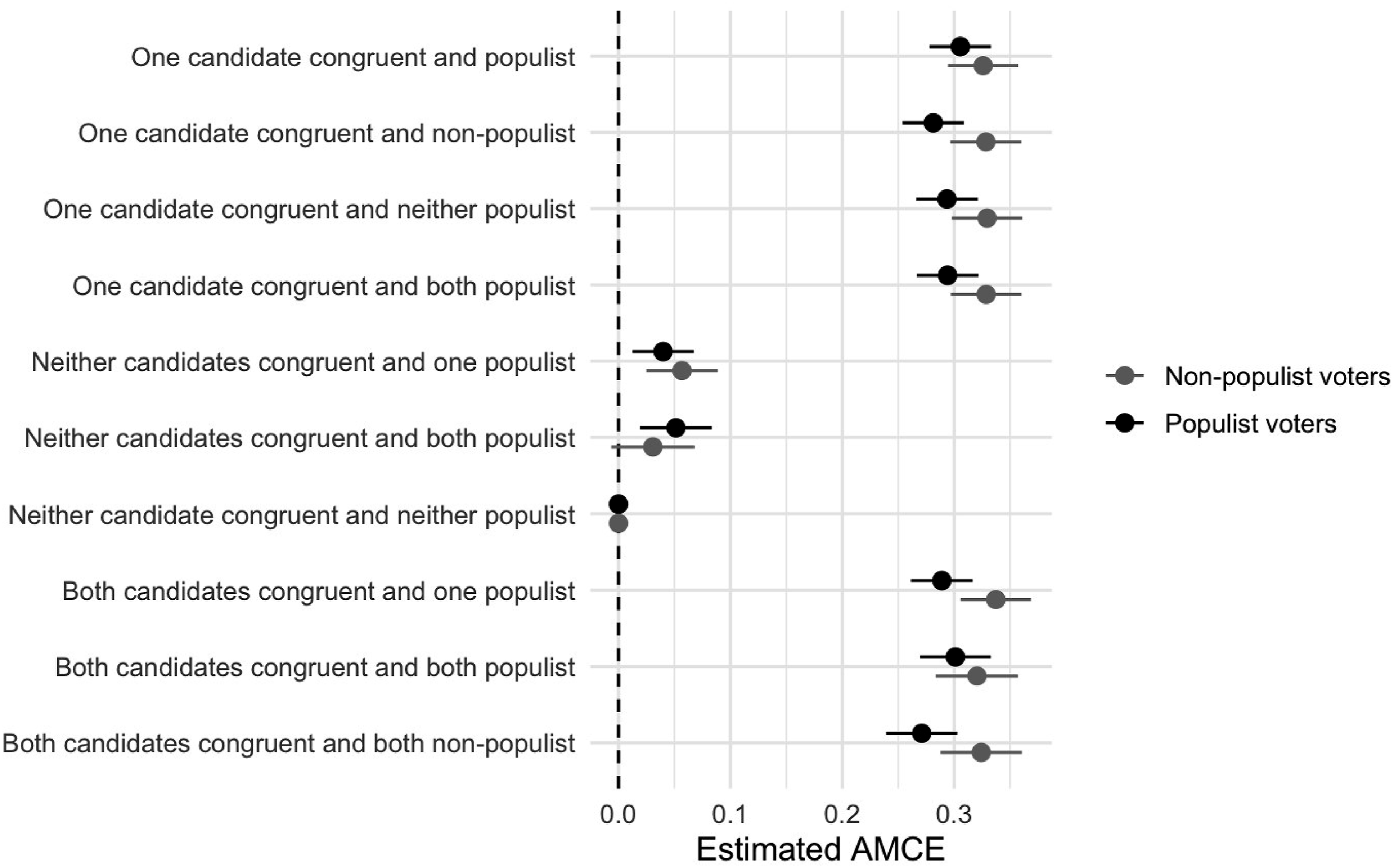
Our main results on the mobilization effects of populism are summarized in Figures 1–3 below. Given that our focus is on mobilization rather than persuasion, all hypotheses are tested at the more appropriate level of candidate pair rather than individual profile (e.g., see Clayton et al., 2023) by regressing the turnout/abstention outcome for each pair by the respondent on relevant conjoint pair attributes (with abstention coded as 1 and 0 otherwise, including voting for either candidate). As can be seen in Figure 1, consistent with H0, the probability of voting (instead of abstaining) in a hypothetical electoral contest is 27.4 percentage points higher when at least one candidate shares a congruent policy position with the respondent. The effect is both statistically significant and substantively large. At the same time, consistent with H3, having at least one populist candidate is associated with a 1.5 percentage point increase in the probability of voting. While statistically significant, the mobilizing effect of populist rhetoric is substantively small. Mobilization effects of policy congruency (H0) and populist rhetoric (H3). Effects of using populist rhetoric by policy congruent candidate on probability of voting for either candidate among populist and non-populist respondents (H1, H2). Effects of populist rhetoric and policy congruence by respondents’ populism on probability of voting for either candidate (exploratory).

To test the heterogeneous effects of populist rhetoric among populist and non-populist voters (H1 and H2), we estimate three models (Table A4), one using the populist group, one using the non-populist group, and one interaction model on all respondents. Since H1 and H2 concern the policy congruent candidate’s usage of populist rhetoric, following our pre-registered analysis plan, we restrict the data to having at least one policy congruent candidate in a pair of candidates. We visualize the AMCEs of populist speech attributes compared to non-populist (liberal democratic) attributes estimated from the interaction model in Figure 2. We find that while, in line with H1, populist voters are statistically more likely to vote when their policy congruent candidate uses populist rhetoric, this effect is substantively small. Furthermore, contrary to H2, we do not find any demobilizing effects of using populist rhetoric among non-populist voters. We replicate our main analyses using an alternative operationalization of congruence using partisanship instead of respondents’ reported policy preference, with no change in the underlying results. We include results of those robustness checks in Tables A6 and A7 of Online Appendix.
We further visualize the exploratory tests for each of the possible combinations of populism and policy congruence at the candidate-pair level in Figure 3. The condition in which neither candidate is policy congruent and neither uses populist rhetoric is treated as the baseline category. As expected under H0, having at least one policy congruent candidate in a pair significantly increases the respondent’s likelihood of voting. While we do not have theoretical expectations regarding the mobilizing effect of populism when it is used by a policy-incongruent candidate, our exploratory analysis suggests that, in the absence of a policy-congruent candidate, populist rhetoric from either candidate increases the likelihood of voting, regardless of whether the respondent holds populist attitudes.
Conclusion
Consistent with earlier findings, we find that populist rhetoric has limited persuasive power relative to substantive policy positions. However, we also find evidence that populist rhetoric can slightly increase turnout—particularly among voters who hold populist attitudes and encounter a policy-congruent candidate using such rhetoric. On the other hand, non-populist voters do not seem to punish their policy-congruent candidates when they use populist rhetoric. These results suggest that while populism is not a broadly effective persuasive style, it may still function as a low-cost mobilization tool for aligned voters, which can be consequential in close elections. Overall, as shown in our analyses, the congruence of substantive positions outweighs any effects of populist rhetoric on both vote choice and mobilization among populist and non-populist voters alike.
Given these limited direct effects of populist rhetoric on persuasion and mobilization, future research could explore its potential indirect effects—for example, how such rhetoric might attract disproportionate media coverage among journalists in increasingly polarized political environments (Manucci, 2017). At the same time, given the extensions to previous designs and the addition of abstention choices, our results also contribute to a better methodological understanding of increasingly popular (forced-choice) conjoint experiments and their potential limitations. Beyond academia, political practitioners could also benefit from an improved understanding of populism’s effectiveness in campaign messaging.
While our study provides insights into the mobilization and persuasion effects of populist rhetoric, it has limitations that future research should address. First, our experiment is conducted within the U.S. two-party system, where voters face fewer electoral options than in multi-party contexts. Populism’s mobilization effects may differ where alternative parties provide additional outlets for dissatisfaction. Future research should test whether our findings replicate in such systems. Second, our design follows the minimalist ideational conceptualization of populism and abstracts away from candidate-specific factors that are emphasized by other conceptualization approaches, presenting populist rhetoric in a controlled textual format. For example, since populism can also be closely tied to personalistic leadership, the speaker’s characteristics may influence its effectiveness (e.g., Weyland, 2024). Future studies could incorporate audio-visual stimuli to better capture the charisma component of populist appeals. These extensions would further clarify how populism influences electoral behavior.
Supplemental material
Supplemental material—What is populism good for? An experimental test of mobilization effects
Supplemental material for What is populism good for? An experimental test of mobilization effects by Alexander Kustov, Yaoyao Dai in Research & Politics.
Footnotes
Acknowledgments
The article is one of several joint articles by the authors. Author names appear in reverse alphabetical order and relfect a principle of rotation. We thank the audience and the 2024 APSA and 2024 EPSA annual conferences, the editors and reviewers for their valuable feedback.Please also add a Ethical considerations statement: The study design has received IRB approval (IRB-24-1158) and has been prereigstered on the Open Science Framework prior to data collection:  .
.
Funding
The authors disclosed receipt of the following financial support for the research, authorship, and/or publication of this article: The research was supported by UNC Charlotte's Nexus Seed Grant and FRG Grant.
Declaration of conflicting interests
The authors declared no potential conflicts of interest with respect to the research, authorship, and/or publication of this article.
Carnegie Corporation of New York Grant
This publication was made possible (in part) by a grant from the Carnegie Corporation of New York. The statements made and views expressed are solely the responsibility of the author.
Supplemental material
Notes
References
Supplementary Material
Please find the following supplemental material available below.
For Open Access articles published under a Creative Commons License, all supplemental material carries the same license as the article it is associated with.
For non-Open Access articles published, all supplemental material carries a non-exclusive license, and permission requests for re-use of supplemental material or any part of supplemental material shall be sent directly to the copyright owner as specified in the copyright notice associated with the article.
