



Abstract
Public inquiries serve as a path for citizens to convey daily grievances directly to politicians, seeking resolutions. This paper examines their role as an information supply channel in the agenda-setting stage. Political agendas often exhibit socioeconomic bias, reflecting the interests of affluent groups, partly due to policymakers’ reliance on narrow information sources. We argue that exposing decision-makers to diverse, everyday citizen concerns through public inquiries contributes to a more equitable and inclusive political agenda. We test this argument using comprehensive data from Israel’s parliament, specifically examining the parliamentary Special Committee for Public Inquiries. We find that this committee’s agenda exhibits a high representation of issues concerning lower- and middle-class individuals. This finding has implications for how policymakers can broaden their agenda to address often-neglected issues and groups.
Introduction
Studies consistently indicate that policy agendas tend to reflect the interests of affluent and well-connected groups, resulting in representational inequality (Gilens, 2012; Lupu and Pontusson, 2011; Page et al., 2013). One key reason for this bias is the decision-makers’ reliance on information that reflects the interests of these groups, making it more likely that issues affecting the upper classes will be placed on the agenda. Consequently, to reduce agenda inequality, policymakers should be exposed to more diverse information on policy problems. When examining information diversity, existing research distinguishes mostly between information provided by interest groups and government agencies (Baumgartner and Jones, 2015; Workman et al., 2009). We argue that an overlooked source of information that can advance a more egalitarian agenda is public inquiries.
Public inquiries are citizen-initiated communications directed at politicians, intended to present and seek assistance with resolving daily problems and difficulties. Public inquiries constitute information originating directly from citizens and often address the everyday concerns of middle- and lower-class citizens (André et al., 2015; Knesset, 2012; Petersen and Eckman, 2023). To test our argument, this paper draws on the case of Israel, where a unique institutional setting—the Knesset’s Special Committee for Public Inquiries (CPI)—offers a formal venue for addressing issues raised directly by citizens. The analysis is based on over 400 committee hearings held between 2009 and 2019. The findings show that the CPI dedicates a significantly large share of its agenda to addressing issues affecting lower-middle-class individuals. This suggests that public inquiries can diversify the issues on the agenda, with implications for understanding agenda inequality and representation.
Inequality in agenda representation
Agenda-setting is the first and most essential stage in the policymaking process. Issues must be placed on the political agenda before policies can be formulated or implemented (Baumgartner and Jones, 2009; Green-Pedersen and Walgrave, 2014), as excluded issues are unlikely to be addressed (Bachrach and Baratz, 1962; Schattschneider, 1960).
In representative democracies, elected officials are expected to respond to public concerns, and ideally, citizens’ priorities and the political agenda should be aligned. In practice, however, politicians often prioritize issues that reflect the interests of the groups they consider important (Bevan and Jennings, 2014; Bonafont and Palau, 2011; Vliegenthart and Walgrave, 2011). Different social classes tend to prioritize different policy concerns. Lower-income groups often emphasize immediate social needs, such as welfare and public services, while wealthier groups prioritize issues like taxation and market regulation. The difference in priorities stems from material factors like poverty, unemployment, and insecurity (Flavin and Franko, 2017; Traber et al., 2022). Research in the U.S. (Bartels, 2016; Gilens, 2012; Gilens and Page, 2014; Traber et al., 2022) and Europe (Lupu and Warner, 2021; Persson and Sundell, 2023) consistently shows that the policy issues prioritized by lower-income citizens are less likely to be represented in the political agenda. Decision-makers typically adopt positions favored by higher-income groups, meaning that the less affluent are already disadvantaged at the agenda-setting stage (Persson and Sundell, 2023; Traber et al., 2022), thereby undermining political equality (Dahl, 1961). There are various explanations for this outcome (Griffin and Anewalt-Remsburg, 2013; Grose, 2011; Page et al., 2013). This paper focuses on the role of information.
The role of information supply in agenda-setting
Information is central to the agenda-setting process. Policymakers rely on information to identify problems, assess their urgency, and determine whether state intervention is necessary. The policy environment is information-rich. Policymakers cannot attend to all the information they receive; therefore, they need to filter and prioritize it. Policymakers often rely on intermediaries such as lobbyists, interest groups, and experts (Workman et al., 2009). Moreover, the social backgrounds of elected officials affect their informational networks; those from affluent environments tend to be embedded in elite social and professional circles, increasing their exposure to upper-class concerns (Carnes and Lupu, 2015). This reliance on narrow, privileged networks restricts the types of information policymakers attend to and, correspondingly, the issues that are placed on the agenda (Baumgartner and Jones 2015).
When examining information supply channels or actors, research usually distinguishes between interest groups, experts, and government agencies and their effect on information diversity (Workman et al., 2009). However, these groups do not reflect the priorities of low- and middle-class citizens or their daily concerns (Baumgartner et al., 2009). Correspondingly, for a diverse agenda that will represent the priorities of all classes, policymakers should be exposed to information on the priorities of the low-middle classes as well. While all information channels are subject to various forms of bias, exposure to diverse sources mitigates the inherent bias of elite networks (Gilens and Page, 2014). We argue that public inquiries can be one way for policymakers to gain exposure to more diverse information.
Public inquiries
Public inquiries serve as a direct channel of communication between citizens and their elected officials. Historically, citizen–representative interactions were limited to election periods; however, over time, citizens increasingly appealed directly to politicians (André et al., 2015; Norton, 2012). Public inquiries served as a vital channel for individuals excluded from formal politics, such as citizens without voting rights. Public inquiries, therefore, allowed them to reach out to politicians and influence issues of concern (Carpenter, 2021). At present, inquiries are usually initiated by citizens who have exhausted conventional solutions and lack the organizational capacity that characterizes more resourceful actors (Norton, 2012). Public inquiries differ from public opinion. They function as a bottom-up flow of policy-relevant information addressing individual problems and requests for assistance, rather than as a generalized signal of public attitudes or policy preferences captured by traditional public opinion surveys. We argue that public inquiries can serve as an information channel during the agenda-setting stage.
Although personal and unmediated, public inquiries are valued by elected officials. They offer not only electoral advantages, especially during campaign periods, but also policy-relevant insights. Politicians often consider direct contact with citizens vital for understanding public sentiment and identifying emerging issues (André et al., 2015; Jackson, 2006; Norton, 2012; Walgrave et al., 2023). Public inquiries typically address issues such as bureaucratic red tape, service provision, and regulatory gaps, which ordinary citizens encounter in their everyday lives (André et al., 2015; Petersen and Eckman, 2023). In this way, public inquiries extend the scope of information supply beyond elite sources like interest groups and experts, as well as beyond broad non-elite channels such as news media or general public opinion data. They offer uniquely detailed and personalized information on the immediate impact of policy failures, making them a potent channel for elevating the concerns of underrepresented groups. Issues raised in public inquiries may be less familiar to elected politicians, who often come from more affluent backgrounds or are exposed to information coming from elites. Correspondingly, public inquiries may serve as an additional information channel that elevates the concerns of underrepresented groups and, in turn, affects the policy agenda. Therefore, we hypothesize that: When the policy agenda is based on public inquiries, the agenda is more likely to reflect lower- and middle-class issues.
To test this hypothesis, we use the case of the CPI in the Israeli parliament.
The Committee of Public Inquiries in the Israeli parliament
Israel is a parliamentary democracy with a proportional closed-list electoral system, where the entire country serves as a single district. All governments are coalition governments, and many parties determine their candidate lists internally (Atmor and Friedberg, 2013; Hazan, 1998). This structure creates a weak constituency link (Rolf, 2014).
The Parliamentary Committee of Public Inquiries (CPI) differs from other parliamentary committees. Its mandate is broad and is not limited to a specific policy field (e.g., health or education). While similar to other committees, the committee chair has the agenda-setting power; the issues placed on the CPI agenda are based on the public inquiries the committee receives, rather than from other sources, such as interest group activities or media coverage. This makes it an official arena, where bottom-up concerns are presented directly to legislators.
The process of submitting an inquiry is designed to be highly accessible, allowing any citizen or resident to submit an inquiry via the committee’s online interface on its website or by mail. There are no formal limitations on the number of inquiries an individual may file. The committee dismisses a small number of inquiries for irrelevance or procedural reasons (e.g., serial applicants). Some inquiries are handled directly through the relevant government agencies, and some are brought to the committee’s agenda. This research will focus on the latter 1 .
Data and method
This study examines whether an agenda based on public inquiries represents more lower and middle-class policy issues. The analysis is based on the CPI in Israel. The Israeli case is appropriate for this study for two main reasons. First, it has an official platform for public inquiries, allowing for a direct examination of its agenda, which is important given that, in most cases, public inquiries are typically private matters submitted directly to the elected politician. Second, the weak constituency link in the Israeli system makes it a most likely case for examining the effect of public inquiries on the political agenda. This is because low electoral accountability reduces constraints on politicians; therefore, they are more open to receiving new information and acting on it.
The analysis is based on all CPI committee hearings held from 2009 to 2019. During this period, there were three Knesset terms: 18 - 2009–2013, 19 - 2013–2015, 20 - 2015–2019. The unit of analysis is a committee hearing. Each committee hearing was manually coded for the Knesset term, the committee chair, the chair’s party affiliation, the chair’s ideological score, and the coalition government’s ideological score, as explained below.
Issues concerning the lower-middle class.

To examine whether the CPI agenda is uniquely focused on lower- and middle-class policy issues, we need a relevant benchmark. To that end, we compare the CPI’s agenda with that of two other standing committees: the Labor, Welfare, and Health Committee (LWHC) and the Economic Committee (EC). We chose the LWHC committee because its jurisdiction directly addresses issues concerning lower- and middle-income classes. Conversely, the EC has a broad mandate covering finance, market regulation, and infrastructure, typically reflecting upper class and business interests. Crucially, while the CPI’s agenda is based on information from the public inquiries, the LWHC and EC agendas are based on information coming from the media, interest groups, and parliamentary initiatives (such as bills and motions). Each LWHC and EC hearing was coded similarly to the CPI.
In total, the analysis covers 5204 hearings (446 from the CPI, 2207 from the LWHC, and 2551 from the EC). To account for differences in the number of hearings held by each committee (see Appendix A), the analysis examines the share of hearings on the lower-middle class in each committee, rather than the absolute number. To further examine the suggested information mechanism, a logistic regression model was conducted. The dependent variable is binary, indicating whether the hearing addressed issues concerning the lower-middle class (1) or not (0). The key independent variable is the parliamentary committee in which the hearing took place, categorized as CPI, LWHC, or EC. To account for possible dependence between observations, we clustered standard errors by Knesset term. We further control for the ideology of the committee chair and the coalition government, as a more left-leaning government or chair would theoretically be associated with a greater focus on lower-middle-class issues (Allen and Bara, 2021). We distinguish between the two measures because coalition governments in Israel are often ideologically heterogeneous. Therefore, the ideology of the committee chair can diverge from that of the government. The ideological score of the committee chair is based on the CMP RILE scores (Lehmann et al., 2024). 3 The government ideology was calculated as a weighted average of the RILE scores of all coalition partners (see Appendix B).
Results
The CPI agenda
Figure 1 describes the CPI agenda during the examined period. As seen in Figure 1, Transportation accounted for 22.2% of the agenda, addressing issues like public transportation and road infrastructure. Social Welfare comprised 16.6% of the agenda, covering matters such as benefits for people with disabilities and support for at-risk populations. Health represented 11.9% of the focus, concentrating on medical infrastructure and patient care. Law and Order made up 9.6%, including hearings on emergency services and prisoners’ rights. Government Operations accounted for 7.6% of the agenda, addressing inquiries on local authorities, public administration conduct, and postal services. Domestic Commerce accounted for 5.2% of the agenda, with hearings focusing on issues such as enforcement actions and debt recovery related to state insolvency. The agenda of the public inquiries committee (2009−2019).
Frequency and proportion of low-middle class by committee type.

Figure 2 illustrates the proportion of hearings devoted to lower-middle-class issues across committees over time, by Knesset term: the 18th Knesset (2009–2013), 19th Knesset (2013–2015), and 20th Knesset (2015–2019). As can be seen, the CPI consistently dedicated a substantial portion of its agenda to lower-middle-class issues (ranging from 37% to 53% across the Knesset’s terms). This suggests that the CPI’s focus on lower-middle-class issues is not a transient phenomenon but rather a stable characteristic. Percentage of hearings on low−middle−class issues by committee and knesset.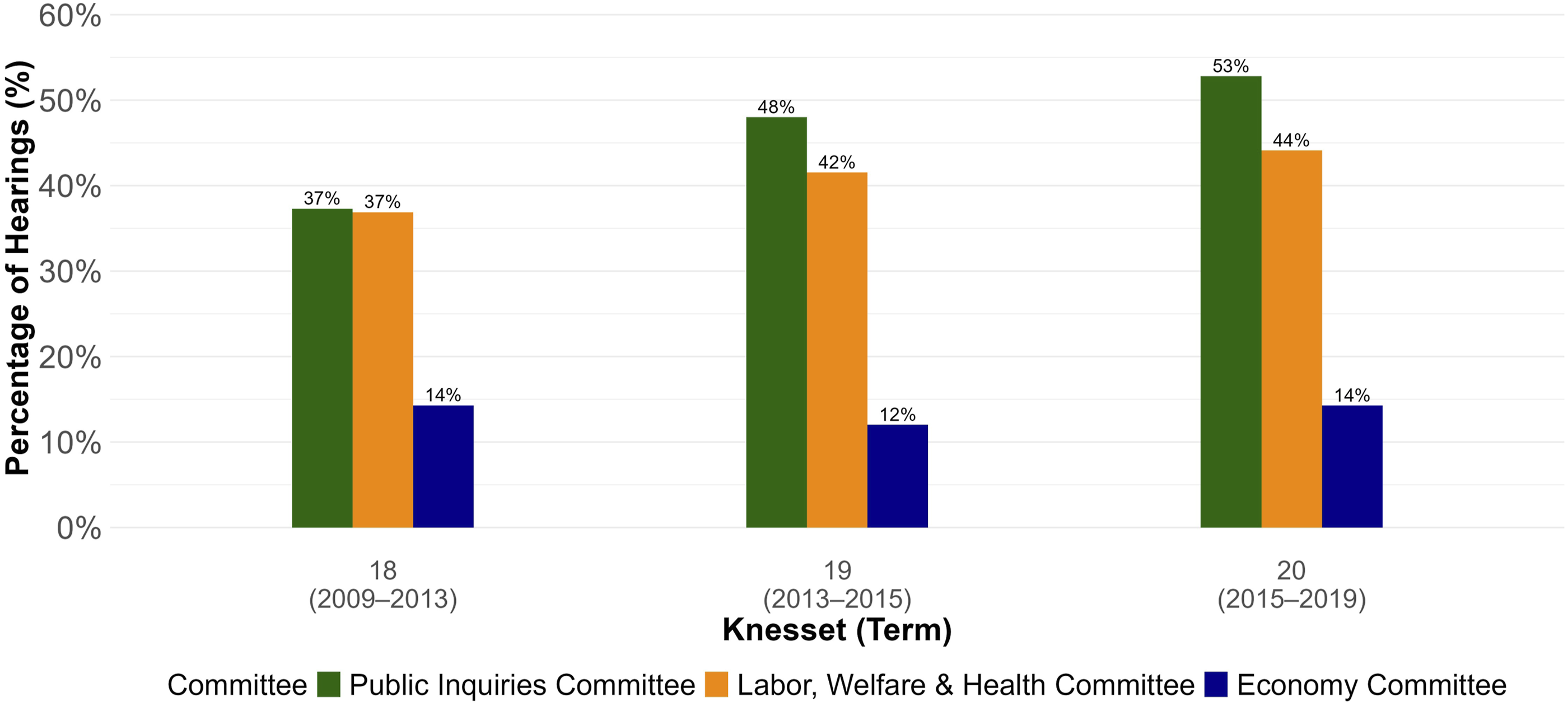
Logistic regression results for low-middle class focus.

a*p < 0.05, **p < 0.01, ***p < 0.001.
As shown in Table 3, both the LWHC and the CPI are significantly more likely to address lower-middle-class issues compared to the EC. Specifically, the odds of a hearing focusing on these issues are 4.30 times higher in the LWHC than in the EC (OR = 4.30, p < 0.001). The effect is even stronger for the CPI; its odds of addressing these issues are 6.20 times higher compared to an EC hearing (OR = 6.20, p < 0.001). These findings suggest that when the political agenda is primarily based on public inquiries, it is more likely to prioritize the concerns of the lower-middle class.
Figure 3 illustrates the average marginal effect of committee affiliation on the probability of a low-middle-class focus. It shows that relative to the EC, the probability of both other committees addressing low- and middle-income issues is higher. Specifically, the LWHC has a marginal effect of approximately 0.27. The marginal effect for the CPI is substantially larger, at approximately 0.38. Average Marginal effects: Committee type probability of low-middle class issue.
The ideology of the committee chair and the government was not statistically significant at the acceptable level (p > 0.05). This suggests that the difference in the agenda composition is not a function of the ideology. Correspondingly, this further supports our argument that the information supply channel is the more potent driver of the low-middle-class agenda than the ideological component. Taken together, our findings support our hypothesis, demonstrating that when the policy agenda is based on public inquiries, it leans more toward lower-middle-class issues.
Conclusion
The policy agenda is often biased towards issues prioritized by more affluent groups. This, among other reasons, is a result of the skewed information to which policymakers are exposed. This research has demonstrated that this bias can be decreased once policymakers are exposed to a different source of information, namely, public inquiries.
Based on the CPI’s agenda in Israel, this study’s findings indicate that when the agenda is based solely on public inquiries, the grievances of lower- and middle-income classes are more likely to be represented. We suggest that this is because public inquiries that come directly from citizens are more likely to provide policymakers with information on low- and middle-income issues. Correspondingly, this study suggests that individual concerns can be translated into broader issues placed on the parliamentary agenda. Moreover, the findings underscore the potential of citizen-driven inputs within institutional mechanisms to broaden the scope of the political agenda. It highlights the importance of examining how everyday interactions between citizens and institutions can shape patterns of political representation.
This study is limited to a single case and a specific subset of parliamentary activity. Nonetheless, we believe that the findings from the Israeli case can be generalized to other parliamentary democracies. MPs are attentive to public inquiries. Hence, although the Israeli case is a most likely case for public inquiries to influence the policy agenda, given the low constituency link, some effect, even if more moderate, should be observed in other parliamentary democracies. We expect that in countries with stronger constituency link, public inquiries from the representative’s constituency might have a higher effect on the political agenda than other public inquiries. This, however, deserves further research.
Previous studies have found that issues affecting low- and middle-income populations are less often represented in politicians’ decision-making agendas. We followed this finding in grouping low- and middle-class-income issues. Nonetheless, low and middle-class issues are not the same. Further research should examine whether public inquiries address more low- or middle-class issues and whether there is a difference between the effect of each type of issue on the decision agenda.
This study analyzed public inquiries within a formal parliamentary arena. However, such inquiries often reach politicians directly. It is therefore plausible that the same agenda profile seen in the CPI agendas also applies to the personal agendas of individual politicians who receive public inquiries through other channels. Understanding the role of public inquiries in shaping the parliamentary agenda can thus shed light on broader mechanisms of political responsiveness. Future research should build on this insight by examining the nature of public inquiries in greater depth. Specifically, it could address questions such as which issues citizens raise with their representatives, how MPs address and respond to public inquiries, and whether this agenda-setting leads to concrete policy outcomes.
Footnotes

Ethical considerations
Ethical approval was not required for this study in accordance with local/national guidelines.
Funding
The authors received no financial support for the research, authorship, and/or publication of this article.
Declaration of conflicting interests
The authors declared no potential conflicts of interest with respect to the research, authorship, and/or publication of this article.
Data Availability Statement
The data supporting the findings of this study are available on request from the corresponding author. The full dataset will be deposited in a public repository upon article acceptance, as per the journal’s data sharing policy.
Carnegie Corporation of New York Grant
This publication was made possible (in part) by a grant from the Carnegie Corporation of New York. The statements made and views expressed are solely the responsibility of the author.