




Abstract
The singular use of they/them pronouns to refer to gender-nonconforming persons is growingly accepted grammar in the English language. Yet Americans’ comfort and willingness to use gender-neutral pronouns are divided along partisan lines. It is important to better understand potential ways to influence people’s acceptance with the use of gender-neutral pronouns given the psychological harm that misgendering a person can induce. In this paper, we report the results from a pre-registered survey experiment on a large and nationally representative sample in the U.S. to investigate how normative messages encouraging the use of they/them pronouns influences people’s comfort using gender-neutral pronouns and willingness to state their personal pronouns. We also examine the downstream effects of these messages on expressions of tolerance/prejudice towards people who identify as transgender. We find, counter to our hypotheses, that normative messages do not depolarize the public and can sometimes backfire and increase existing divisions, largely due to shifts observed among Republicans, independents, and men.
The singular use of they/them pronouns to refer to gender non-conforming people is growingly accepted grammar in the English language (Baron, 2020). The word “they” has become the pronoun of choice for individuals who identify as gender non-binary and coincided with a growing movement to “use pronouns to signal gender identity, as in ‘my pronouns are they/them/theirs’ to indicate that the speaker wishes for others to refer to them with the singular pronoun they” (Arnold et al., 2021: 1688, emphasis in the original). In 2019, Merriam Webster declared “they” as its “Word of the Year” after searches for the word on their site increased by 313% (Mendes, 2021).
A recent survey of transgender adults in the U.S. showed that nearly half of the respondents report asking people to refer to them with they/them pronouns, although most also report they sometimes use she/her or he/him pronouns; the survey indicated that 40% described themselves as “nonbinary,” 22% as “gender non-conforming,” 22% as a “transgender woman,” and 12% as a “transgender man” (Parks et al., 2023). Yet Americans are divided over how comfortable they are using gender-neutral pronouns to refer to others (Geiger and Graf, 2019). Prejudice against the use of gender-neutral pronouns is rooted in what individuals and groups view as socially appropriate behavior. Misgendering a person, by referring to them by “a gender different than the gender with which they would identify” is “psychologically harmful and can lead to feelings of negative affect, low appearance state self-esteem, and stigmatization” (Mendes, 2021: 321). Yet no studies, to our knowledge, have investigated how social norm-based messages that encourage the use of they/them pronouns for people who identify as gender non-conforming influence public opinion on this polarized topic.
In this paper, we report the results from a pre-registered survey experiment on a large and nationally representative sample in the U.S. funded through a grant from Time-Sharing Experiments in the Social Sciences (TESS) to investigate how normative messages encouraging the use of they/them pronouns influences people’s comfort using gender-neutral pronouns and willingness to state their personal pronouns. We also examine the downstream effects of these messages on expressions of tolerance/prejudice towards people who identify as transgender. We find, counter to our hypotheses, that normative messages do not increase the acceptance of the singular use of they/them pronouns, do not mitigate divisions in the public and in fact, sometimes backfire and increase resistance to the message, largely due to shifts observed among Republicans, independents, and men.
Theoretical expectations
A social norm is defined as “an expectation about appropriate behavior that occurs in a group context” (McDonald and Crandall, 2015: 147). Social norms are “formed in group situations and subsequently serve as standards for the individual’s perception and judgment when he [sic] is not in the group situation” (Sherif and Sherif, 1953: 202-203). Valued and frequently employed aspects of the self-concept, such as gender, are categorizations that are readily accessible in memory and that shape information processing, attitude formation, and behaviors (Bem, 1981; Mackie et al., 1996).
Many scholars distinguish between two distinct types of normative appeals (Chung and Rimal, 2016; Cialdini et al., 1991; Rimal and Lapinski, 2015): first, descriptive norms refer to an informational summary of how the group behaves (the percentage in a group who vote, conserve energy, recycle, etc.,); second, injunctive norms communicate what people should do, or how they ought to behave based on what is socially approved of or valued by the group. Geber and Hefner (2019: 10) state, “Whereas descriptive norms refer to the prevalence of a behavior within a reference group, injunctive norms refer to the social approval of the behavior by referent others.”
For a norm to influence attitudes or behaviors, whether through its internalization or due to external motivations to conform, a person must have acquired knowledge about the existing norm (Crandall et al., 2002). Descriptive norms can thus serve as decision shortcuts for how to present oneself by highlighting the prevalence of a behavior, and therefore, what is likely appropriate, in a context (Chung and Rimal, 2016). For instance, Republicans were more likely to believe in climate change and support pro-climate policies when told that their fellow Republicans agreed with the scientific consensus and supported action to address the problem; thus, information that communicates a descriptive norm can influence partisans even on a highly politicized issue (Bayes et al., 2020; Van der Linden et al., 2019). Messages that emphasize recent trends shifting toward any norm can be influential even when a minority of others are performing the behavior (Mortensen et al., 2018; Sparkman and Walton, 2017). Descriptive norms are most likely to influence attitudes and behaviors when the norm is salient and attention has been drawn to it (Hogg and Reid, 2006; Ryoo and Kim, 2023). In line with this research, we hypothesize that providing a description that normalizes the singular use of they/them pronouns to refer to transgender and gender non-conforming persons will increase people’s comfort using gender-neutral pronouns and willingness to state one’s personal pronouns (H1).
Injunctive norms communicate how people ought to behave and what is socially expected in any context. The power that injunctive norms exert on human behavior is due, in part, to people’s motivation to gain or maintain social approval—or to avoid social sanction—by conforming to shared standards of behavior (Leoniak and Cwalina, 2019). As we discuss in more detail below, when behavioral norms are (accurately or inaccurately) perceived as divided along partisan lines, injunctive normative appeals that communicate how one ought to behave (e.g., “telling them how they should conduct themselves”) can lead to further partisan divisions (Jost et al., 2022). Nonetheless, based on the large literature that has demonstrated the powerful impact of communicating injunctive norms on individuals’ behaviors across settings, we hypothesize that communicating an injunctive norm will increase people’s comfort using gender-neutral pronouns and willingness to state one’s personal pronouns (H2).
Further, some have demonstrated that messages that are “normatively aligned”—that is, “emphasize congruent descriptive and injunctive norms (e.g., behavior that is both common and approved or uncommon and disapproved)—are often superior to those relying solely on one norm type” (Cialdini and Jacobson, 2021: 2). For example, in one field experiment, an aligned descriptive and injunctive normative message promoting towels reusage in hotels had a stronger impact on guests’ behavior compared to the impact of either message in isolation (Schultz et al., 2008). Therefore, we hypothesize that exposure to a message that emphasizes both a descriptive and injunctive norm about the use of they/them pronouns to refer to transgender and gender non-conforming persons will increase individuals’ expressed comfort using gender-neutral pronouns and willingness to state one’s personal pronouns (H3).
The existence of strong pre-existing internalized norms related to a gender binary (Bem, 1981) lead to a particularly difficult test-case for our hypotheses about the efficacy of the messages we employ on people’s related attitudes and behaviors. The singular use of they/them pronouns challenges the gender binary and are used by and applied to transgender persons. We thus examine the impact of social norm-based messages on two related but “downstream” attitudes. We hypothesize that communicating descriptive and injunctive norms in isolation or in conjunction regarding the singular use of they/them pronoun use will increase individuals’ support for online forms including more than two options for those who identify as gender non-binary (H4).
Social norms are often a cause of prejudice based on the need to conform with and uphold prevailing group-accepted beliefs and actions (McDonald and Crandall, 2015). Research on prejudice, conceptualized as a label used to describe a negative attitude toward a group, can be reduced through adaptation of prevailing and changing social norms (Crandall et al., 2002). There is a pressing need to identify communication strategies that can reduce transphobia among the U.S. public (Broockman and Kalla, 2016; Flores et al., 2018; Jones et al., 2018). We hypothesize that exposure to descriptive or injunctive messages normalizing the behavior of stating one’s personal pronouns would increase tolerance (i.e., reduce prejudice) towards transgender persons (H5). In addition, we investigate whether any effects are contingent on whether the distinct types of messages appear in isolation or in conjunction (Research Question 1).
As noted above, on issues where partisan divisions exist (or is perceived to exist), communicating norm-based messages may lead to further divisions (Jost et al., 2022). For instance, during the COVID-19 pandemic, Republicans who lived in neighborhoods with higher proportions of Republicans were less likely to comply with recommended pro-social health behaviors such as wearing a mask in public; Democrats were more likely to wear masks, and the local (partisan) context had no impact on their observable behaviors (Baxter-King et al., 2022). Prior research has demonstrated that simply providing a definition of transgender prior to asking about support for transgender bathroom access policies led to lower levels of support for the policy among white, cisgender, and straight men (Flores et al., 2021). The effectiveness of any norm-based appeal may be predicated on whether the norm has been well-established or not among any social group; thus, we explore the extent to which any treatment effects are moderated by partisanship over comfort using they/them pronouns to refer to gender non-conforming and transgender persons (Research Question 2).
Experimental design
We conducted a survey experiment on a large and diverse sample of Americans (n = 1600) to test our preregistered hypotheses and research questions. The study was funded by TESS and fielded by the National Opinion Research Center (NORC) from July 8–August 2, 2022. The sample was a general population survey with quotas for party identification, gender, age, and region. The complete sample demographic statistics are reported in the Supplemental Material (SM) section 1. Respondents began the survey by providing consent to participate and then were randomly assigned to one of four experimental conditions: (1) a control condition; (2) a condition that highlights the growing acceptability of the singular use of they/them pronouns to refer to transgender or gender-nonconforming people and asks respondents to select their pronouns from a list; (3) a condition that emphasizes an injunctive norm that states that referring to people by the pronouns they determine for themselves is something everyone should do; and, (4) a condition that provides the descriptive norm and selection of pronouns along with the injunctive norm message.
Respondents in the control condition read an unrelated short text before responding to the dependent measures. The full wording of the information in each condition is reported in the SM section 2. Respondents randomly assigned to the descriptive-norm only condition read the following statement: “A transgender individual has a gender identity that differs from the sex the person was identified as having at birth. The singular use of they/them pronouns to refer to transgender or gender-nonconforming persons is growingly accepted grammar in the English language. If you need to refer to a person who uses they/them pronouns in a formal context, you can use the gender-neutral honorific ‘Mx.’ Instead of ‘Mr.’ or ‘Ms.’” Respondents in this condition then selected their pronouns from a drop-down list (the question offered “multiple select” options). This operationalization sought to normalize the behavior by explaining that the singular use of they/them pronouns is “growingly accepted grammar in the English language” (i.e., a dynamic, trending norm) and inducing them to report their pronouns. 1 The injunctive-norm treatment included the following sentences: “Referring to people by the pronouns they determine for themselves is basic to human dignity. This is something everyone should do. Being referred to by the wrong pronouns is harmful to transgender and gender non-conforming persons. Together, we can transform society to help improve the quality of all people’s lives.” The information employed in the injunctive norm treatment was adopted from language used on the International Pronouns Day website, held on October 19, 2022, which seeks to “make respecting, sharing, and educating about personal pronouns commonplace” (https://pronounsday.org/). The focus of the injunctive message is thus on the correct usage of pronouns as applied to transgender and gender non-conforming persons, not on the correct usage of they/them pronouns per se. 2
All respondents were asked the following questions immediately following exposure to the experimental treatments. The survey asked respondents, “How unwilling or willing are you to state your own pronouns to people you meet for the first time?” (1 = Extremely unwilling to 7 = Extremely willing). We measured comfort using they/them pronouns with the following item: “How uncomfortable or comfortable would you feel using they/them pronouns to refer to transgender or gender non-conforming persons?” (1 = extremely uncomfortable to 7 = extremely comfortable). In addition, respondents were asked the extent to which they disagreed or agreed with the following statement: “When a form or online profile asks about a person’s gender, it should include they/them options for transgender or gender non-conforming individuals?” (1 = strongly disagree to 7 = strongly agree).
3
Finally, to measure tolerance towards transgender persons, we asked two items developed by Broockman and Kalla (2016)—to what extent do you disagree or agree with the following statement: (1) “I would feel comfortable working closely with a transgender person (a person who was born with a boy’s body but now identifies as a woman or a person who was born with a girl’s body but now identifies as a man)”; and, (2) “Saying you are a gender that is different than the one you were born as is morally wrong.” (1 = strongly disagree to 7 = strongly agree). We created an index that is an average of the items where higher values represent greater prejudice (
Results
Let us begin by examining the impact of the presentation of the descriptive norm on our primary variables to test our first hypothesis. We summarize these results in the top row of Figure 1 where the plotted points are the impact of the treatment with 95% confidence intervals (the treatment effects are estimated with linear regression).
5
We observe a null effect for both one’s willingness to state their pronouns (p = .604), and their comfort using such pronouns (p = .589).
6
Turning to H2—the presentation of the injunctive norm—we observe, contrary to our expectations, that the injunctive norm alone reduced respondents’ willingness to state their pronouns, Main treatment effects for the entire sample.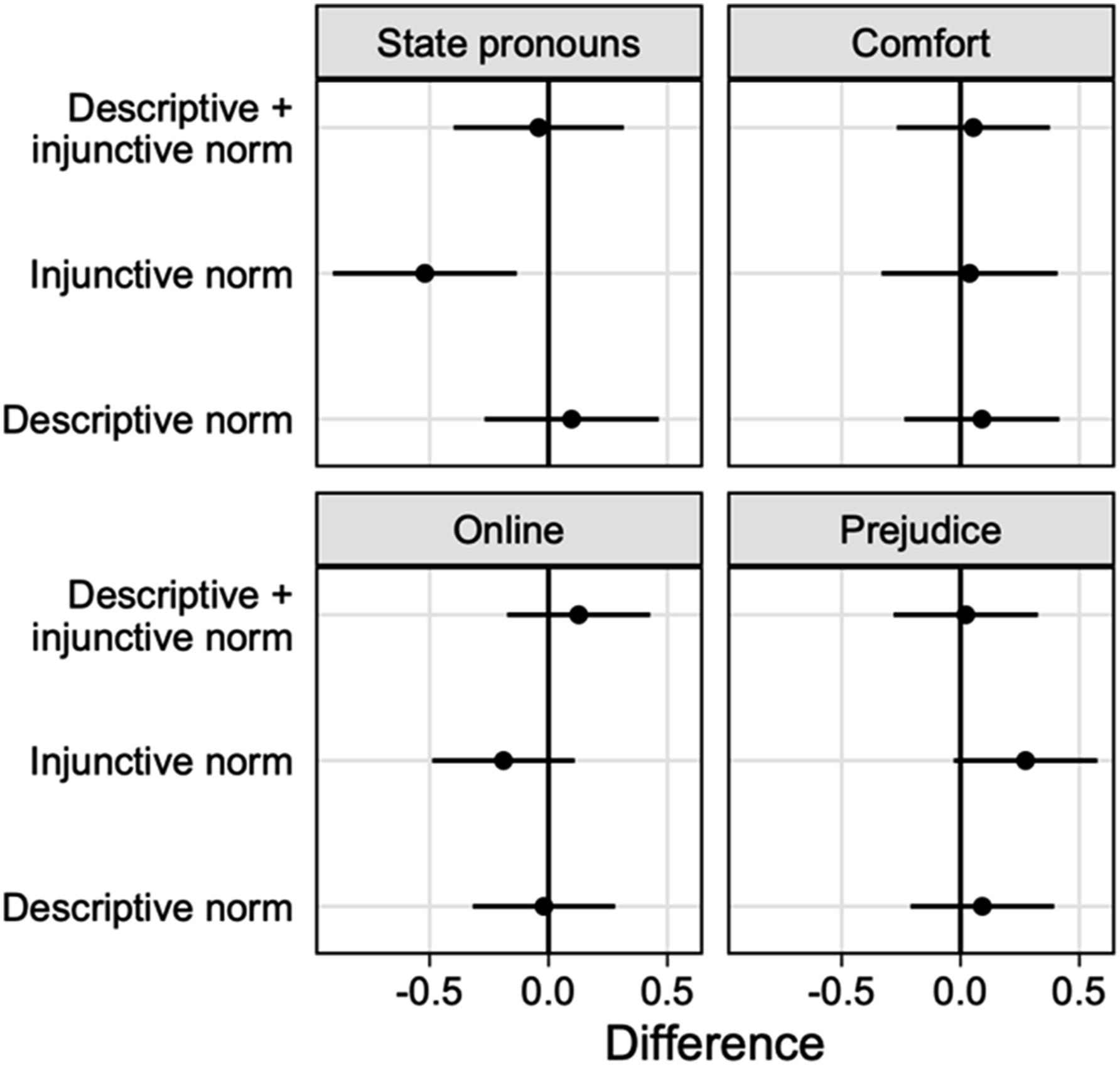
Let us now turn to our two downstream outcome variables in order to examine the influence of norms on support for online forms offering non-binary options (H4) and transprejudice (H5). We do not observe statistically significant treatments effect at the 0.05 significance level for either treatment across the two variables. We summarize these results in the bottom row of Figure 1, where the plotted points are the effect of the treatment, with 95% confidence intervals. 7
Let us now turn to partisan differences in the presentation of norms to examine if there are heterogeneous treatment effects (we classify leaning independent as partisans).
8
The results are presented in Figure 2, where the plotted points represent treatment effects with 95% confidence intervals. The presentation of the descriptive norm has no meaningful effect on any partisan group across the four variables. It is possible these null findings are the result of a “pre-treatment” effect (Druckman and Leeper, 2012)—that is, the parties’ position on this issue have already diffused through the electorate and opinions are becoming hardened. In totality, the results suggest a limited effect for the descriptive norm and both norms presented together to influence attitudes about non-binary pronouns. Treatment effects by party identification.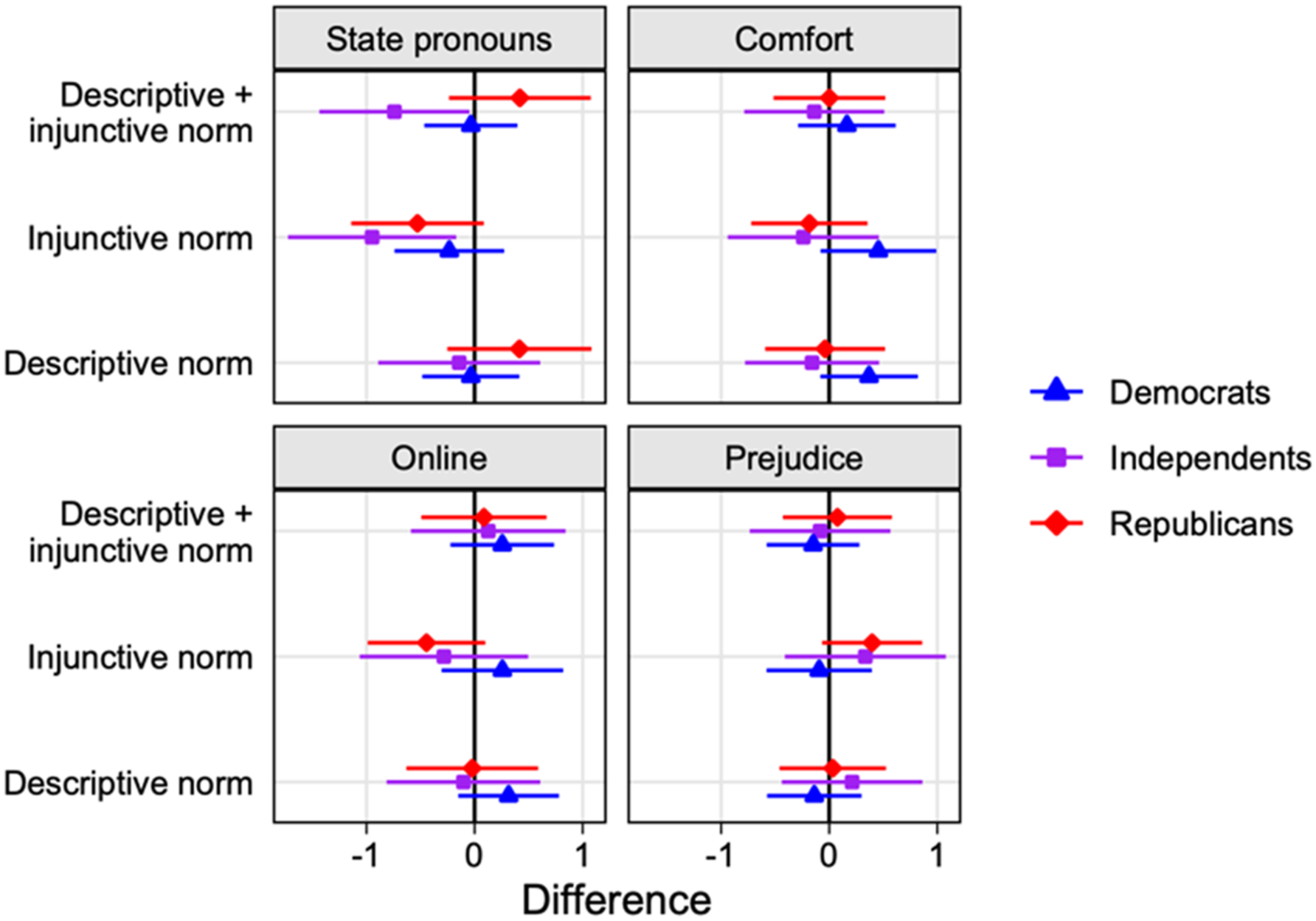
Turning to the injunctive norm, in the case of one’s willingness to state their pronouns, we observe significant decreases among Republicans (
Accounting for the issue of multiple comparisons does not fundamentally alter this account. When estimating the treatment effects on the entire sample using the step-down methodology of Westfall and Young (1993), we continue to find a backlash to the injunctive norm in the entire sample on one’s willingness to state pronouns. However, we are no longer able to differentiate between partisan groups when accounting for multiple comparisons. Full results of these analyses are presented in the SM section 7.
Treatment effects by sex and partisanship
Although we did not pre-register hypotheses regarding heterogeneous effects by sex of the respondent, we believe examining if the effect of the treatments varies by both party and sex is worthwhile. Men have less positive attitudes about transgender individuals (e.g., Lewis et al., 2021). One proposed mechanism is that of a “masculinity threat” (e.g., Rivera and Dasgupta, 2018; Willer et al., 2013) in which men respond negatively to nonconforming individuals to reaffirm their own masculinity. For example, male respondents in a gender-threat condition—where they were presented with information indicating they exhibit feminine traits—expressed higher levels of transphobia (Konopka et al., 2021). Likewise, Harrison and Michelson (2021) find that support for transgender rights decline for those men who are exposed to threat. Existing research therefore suggests that men will be more likely to respond negatively to the treatments.
We focus on our two primary dependent variables, with results presented in Figure 3 which displays treatment effects with 95% confidence intervals conditioned on partisanship and gender. While our results are not definitive given the sample sizes, our results are mostly consistent with the “masculinity threat” hypothesis as it is independent and Republican men driving the results observed earlier, though we do note that independent women are less willing to state their pronouns in the “Descriptive + injunctive” condition. With that said, we find that the treatments in two cases have a positive effect among Democratic women. Future work might further investigate how communication effects vary by sex of the respondent. Treatment effects, conditioned by sex and partisanship.
Conclusion
It is well documented that descriptive and injunctive norms are powerful sources of social influence. Yet our treatments did not increase acceptance of the singular use of they/them pronouns. Moreover, in one case we observed a “backfire effect”—exposure to the injunctive norm in isolation led respondents to become less willing to state their preferred pronouns in social settings, due to the reaction of Republican and independent males. Backfire effects refer to a phenomenon that occurs when exposure to a persuasive appeal causes an audience (or subgroup of that audience) to shift their opinion in the opposite direction of the message (Nyhan and Reifler, 2010; Swire-Thompson et al. 2020). If positions on these attitudes are beginning to crystalize in the public, it may prove difficult for the presentation of norms alone to shift attitudes. Rather, it may take time for such partisan divisions—as has been the case for other “culture war” issues (Baldassarri and Park, 2020)—to dissipate. For example, perhaps “social network effects”—that is, as more of the public comes to personally know a gender nonconforming individual—might drive this change and this is a process that may take some time (Tadlock et al., 2017).
We acknowledge a potential limitation of our descriptive norm treatment insofar as the operationalization did not strictly communicate the percentage of individuals (e.g., partisans) who report a willingness to use they/them pronouns to refer to gender non-conforming people. In addition, providing a definition of transgender could have unintentionally caused some respondents to resist it. It will be important in future studies to investigate other ways of operationalizing descriptive norm-based interventions in this domain. It may not be surprising that the descriptive and injunctive normative messages in our study were not impactful among Republicans, given that “interventions are unlikely to be effective merely because they depict a norm of similar others, but rather require that the group is seen as important to the individual, and is satisfying its social needs” (McDonald and Crandall, 2015: 149). Nonetheless, the backfire result we observed among Republican and independent males who were exposed to the injunctive-normative message was unexpected and worth additional investigation. Although our study does not pin down the specific underlying process that caused the backfire effect, this is an important avenue for future research. In addition, it will be important for future work to connect norm-based messages with trusted in-group sources, which might lead these appeals to be more impactful on this issue linked with partisan culture wars.
Supplemental Material
Supplemental Material - Do norm-based appeals affect the acceptance of the singular use of they/them pronouns?
Supplemental Material for Do norm-based appeals affect the acceptance of the singular use of they/them pronouns? by Judd R. Thornton and Toby Bolsen in Research & Politics.
Footnotes
Declaration of conflicting interests
The author(s) declared no potential conflicts of interest with respect to the research, authorship, and/or publication of this article.
Funding
The author(s) received no financial support for the research, authorship, and/or publication of this article.

Supplemental Material
Supplemental material for this article is available online.
Notes
References
Supplementary Material
Please find the following supplemental material available below.
For Open Access articles published under a Creative Commons License, all supplemental material carries the same license as the article it is associated with.
For non-Open Access articles published, all supplemental material carries a non-exclusive license, and permission requests for re-use of supplemental material or any part of supplemental material shall be sent directly to the copyright owner as specified in the copyright notice associated with the article.
