




Abstract
How do smaller states position themselves in the biggest diplomatic forum when a regional power with which they share deep economic and political ties is engaged in foreign adventurism with its neighbors? We answer this question by examining how the five Central Asian countries (the “-stans”) have crafted their United Nations General Assembly (UNGA) speeches in the aftermath of three recent instances of Russian foreign adventurism: Russo-Georgian War in 2008, Crimea Annexation in 2014, and the Russo-Ukrainian War in 2022. Our quantitative assessment of the appearance of sovereignty frames in the UN General Debate corpus from 1992 to 2022 suggests that while historically the Central Asian states have refrained from invoking themes related to sovereignty, the recent full-scale invasion of Ukraine has shifted these countries’ position, whereby they no longer keep themselves away from discussions related to state sovereignty. The fact that Central Asian countries are willing to engage in discussions that are not liked by Russia suggests that these countries are attempting to make their concerns about an aggressive regional power known to the global community.
Introduction
How did Russia’s recent engagement in foreign adventurism, for example, the full-scale invasion of Ukraine, affect the diplomatic posture of its regional allies? Some suggest that Russia is losing friends across the board, particularly in the Central Asian (CA) region, where it has traditionally enjoyed considerable influence. 1 News headings such as “Former Soviet States are Distancing Themselves from their Old Imperial Master” (Marat and Engvall, 2022) and “Central Asian Countries are Subtly Distancing Themselves from Russia” (The Economist, 2022) garnered much attention. Events such as CA leaders’ public rebuke of Russia (Lillis, 2022) as well as their refusal to send the military to fight the war on behalf of Russia (Marat and Engvall, 2022) also substantiate these claims. However, these symbolic observations lack a systematic assessment. They might just be cherry-picked instances of diplomatic actions that do not reflect a broader picture. In fact, some scholars question whether CA leaders really are distancing themselves from Russia, citing their ambiguous voting patterns on the UNGA resolution regarding the Ukraine War (Dumoulin, 2022), increased bilateral trade (Warrick, 2023), and unusually frequent top-level meetings with Russian officials (Umarov, 2022). This study contributes to this ongoing debate by providing a systematic analysis of the historical trend in the foreign policy preferences of CA leaders.
Looking back on history since their independence, the Ukraine War is not the first time CA states have found themselves in a difficult situation. Russia has been involved in three large-scale military intrusions, since the collapse of the Soviet Union: the Russo-Georgian War of 2008, the annexation of Crimea in 2014, and the full-scale invasion of Ukraine in 2022. As such, in this study, we ask: How have CA states opted to navigate the thorny issue of having a belligerent yet closely allied regional power in the most visible global arena, namely, the UNGA? Are they willing to invoke themes in their UNGA speeches that Russia may not like in the aftermath of unprovoked attacks on other post-Soviet countries?
Utilizing UNGA speeches, we uncover that CA leaders have historically sought to avoid the controversies surrounding Russian adventurism in the UNGA. However, the full-scale invasion of Ukraine has made them wary of ever-growing Russian imperial ambitions. As such, CA leaders have opted to invoke the idea of sovereignty more vocally to express their concerns about an aggressive regional power in their UNGA speeches. The remaining parts of this study proceed as follows. The following section briefly discusses the significance of studying the UNGA speeches. Next, we describe our research design, including the measurement of “sovereignty” frame appearances. We then present the main results and conclude by highlighting our contribution to the literature and providing avenues for future research.
The significance of UNGA speeches
We utilize the UN General Debate corpus (Baturo et al., 2017; Jankin et al., 2017) to quantitatively analyze the trend of the prevalence of the “sovereignty” frame from 1992 to 2022. 2 The dataset contains an English version of 5820 speeches in total, with each year’s number ranging from 167 to 193. The UNGA is a platform of great diplomatic import as it is an intergovernmental entity with most member-states. Every September, country leaders from UN member-states gather in New York and give a speech highlighting the issues they deem important. Topics of global significance, such as economic affairs, nuclear proliferation, and territorial disputes, are commonly debated in the forum (Peterson, 2023). These speeches are especially important for minor powers, for example, CA states, as the UNGA is the most public-facing international organization (Baturo and Gray, 2024). As noted by Adhikari et al. (2022: 402), “for less powerful countries, the UNGA annual meetings provide a particularly valuable opportunity for making their views heard.” Furthermore, since UNGA sessions are widely covered by news media and are attended by high-level political dignitaries, leaders “need to craft carefully worded statements that reflect their country’s priorities” (Kentikelenis and Voeten, 2021: 727).
Unlike UNGA voting records (Voeten, 2013), the conventional measure to capture foreign policy preferences, UNGA speeches can be used to capture nuanced positions beyond simple (dis)approval of limited issues (Baturo et al., 2017). 3 However, text-as-data applications of UNGA speeches are still limited (Baturo et al., 2017). This study bridges that gap and contributes to the international relations literature by promoting a rich understanding of how smaller states craft their speeches when faced with an aggressive regional power.
Capturing sovereignty frame in UNGA speeches
In this study, we analyze how likely CA states are to invoke ideas of sovereignty in their speeches in the immediate aftermath of Russian attacks on other post-Soviet states. We focus on the framing of “sovereignty,” given its symbolic usage in UNGA speeches (e.g., Jaffe and DeYoung, 2017). We suggest that if CA states are wary of Russian intrusions then they are more likely to make that known to the global community because President Putin believes that “true sovereignty is possessed by only a few great powers; the sovereignty of states it views as dependent on great powers is limited” (Remler, 2020) and “as a great power, Russia has a right to veto the sovereign political decisions of its neighbors” (Person and McFaul, 2022: 23).
The list of sovereignty-related keywords and examples of their appearance in UNGA General Debate speeches.

Note. The year and country of the speech that contains examples are shown in parentheses.
We measure the prevalence of the sovereignty frame by the dichotomous variable indicating the appearance of one or more sovereignty-related words at a sentence-level. 5 When analyzing, we aggregate sentence-level sovereignty frame appearance by taking an average. The average is inversely weighted by speech length, that is, the number of sentences within a speech so that each speech is treated equally.
The primary objective of this study is to compare the trend in the prevalence of the sovereignty frame for CA states. We then compare how their speeches differ from those of other post-Soviet countries and the rest of the world. The first group comprises the five CA states. The second group includes post-Soviet states outside Central Asia, that is, Armenia, Azerbaijan, Estonia, Latvia, Lithuania, and Moldova. 6 These groupings are influenced by prior studies that have suggested that, upon Crimean annexation, “none of the Central Asian countries could afford themselves a position entirely opposed to Russia’s” (Dzhuraev, 2015: 9). However, some non-CA post-Soviet countries immediately started boosting their defense expenditure. Also, CA states have long adhered to a “multivector foreign policy,” which is grounded on the idea of maintaining a cordial relationship with all great powers to serve their own interests (Vanderhill et al., 2020). For instance, in addition to sharing several multilateral platforms with Russia, CA states are also part of “C5+1”—a diplomatic platform with the United States. So, it is conceivable that these states would, to some extent, coordinate their foreign policy response to Russian aggression.
Moreover, other post-Soviet countries have shared a much rockier relationship with Russia since their independence. For instance, much to Russia’s displeasure, Estonia, Lithuania, and Latvia are members of the North Atlantic Treaty Organization (NATO). Armenia has been vacillating between the European Union and Russia since its independence (Terzyan, 2019). Azerbaijan also shares a turbulent relationship with Russia, mainly due to Russia playing both sides in the longstanding Armenia-Azerbaijan conflict (Safi and Aslanli, 2017). These groupings allow us to examine how CA leaders compare with other post-Soviet countries with less cordial relationships with Russia, giving a more nuanced understanding of CA states’ foreign policy. We excluded Russia, Belarus, Ukraine, and Georgia from the above groups, given their direct involvement in Russian adventurism (as a main actor, an active partner, or a target). 7
Russian adventurism and state responses in the UNGA
Figure 1 presents our main findings regarding the trend in the prevalence of the sovereignty frame in UNGA General Debate speeches.
8
The vertical axis indicates the sentence-level probability of the appearance of sovereignty-related words, averaged across groups of countries as described above. The figure also shows a trend in non-post-Soviet states as a reference. For both CA and non-CA post-Soviet states, the sovereignty frame was the most prevalent at the time of their independence (in 1992), when almost 12% of sentences in a speech in both sets of countries were devoted to the messages around the sovereignty frame. This pattern is not surprising, as all these countries were in their formative years seeking legitimacy for their statehood. This initial trend disappeared after a few years, and from the late 1990s, post-Soviet states started to show a similar level of sovereignty frame prevalence as in non-post-Soviet states.
9
The historical trend of the prevalence of the sovereignty frame across countries.
Turning to the discussion of the response to Russian adventurism, we focus on the years 2008 (the outbreak of the Russo-Georgian War), 2014 (Crimea Annexation), and 2022 (the full-scale invasion of Ukraine). For all these years, the UNGA General Debate took place in September after the Russian attacks. For 2008, we find marked differences in responses of CA states compared to other post-Soviet states. Compared to 2007, non-CA post-Soviet states used significantly more sovereignty frames in their 2008 speeches, primarily due to the increased salience in their territorial integrity. A case in point is how Estonian President Ilves repeatedly invoked the sovereignty frame in the 2008 UNGA speech: “the unacceptability of threatening with use of force, or actual aggression against a nation’s territorial integrity, was grossly and grotesquely violated” (Ilves, 2008). However, CA states seem to have reduced, rather than increased, the use of the sovereignty frame in response to the Russo-Georgian War. For instance, Kazakhstan, a post-Soviet country like Georgia that shares a long land border with Russia, only invoked the sovereignty frame once, and that too without directly naming Russia. Kazakh Foreign Minister Tazhin remarked, “Given recent complexities and collisions, it is urgent to preserve basic principles of international law, including the one of the territorial integrity” (Tazhin, 2008).
A weaker but similar pattern holds for the response to the 2014 annexation of Crimea. Again, relative to CA states, non-CA post-Soviet states show a clear increase in the use of the sovereignty frame compared to the previous year. For instance, Lithuanian President Grybauskaitè repeatedly invoked the sovereignty frame by making statements such as “It is our duty to support the peace, sovereignty and the territorial integrity of Ukraine, [prevent] redrawing the borders of sovereign states, [and respect] the fundamental principles of state sovereignty and territorial unity” (Grybauskaitè, 2014). CA countries were more circumspect in their speeches. For instance, the Kyrgyz Minister of Foreign Affairs Abdyldaev lumped Ukraine with other ongoing conflicts in the world and avoided invoking the idea of territorial integrity—“the relevance of political and diplomatic conflict resolution is reconfirmed by the situations in Afghanistan, the Sahel, East and West Africa, Ukraine, and Syria” (Abdyldaev, 2014). Similarly, Kazakh Foreign Affairs Minister Idrissov did not mention words such as sovereignty at all in the speech (Idrissov, 2014). Such speech patterns of CA leaders led some scholars to suggest that all five CA countries were “supportive of the Russian side of the crisis to various degrees” (Dzhuraev 2015: 5).
In 2022, however, the sovereignty frame is more prevalent in both groups of countries’ speeches, albeit the increase is significantly larger in non-CA post-Soviet states. Countries such as Kazakhstan, which had previously refrained from invoking ideas related to sovereignty, presented itself more forcefully in the 2022 speech. President Tokayev remarked that “we must rethink the linkages between three primordial principles: the sovereign equality of States, the territorial integrity of States, and peaceful coexistence among States” (Tokayev, 2022). Non-CA post-Soviet countries also strongly invoked the idea of sovereignty in their speeches. Estonian President Karis, for instance, remarked that Russia “attacked democratic and peaceful sovereign Ukraine […] with the goal of ending the sovereignty [and] helping Ukraine to protect its right to exist is our collective obligation [because Russia has blocked] any resolutions regarding the grave violation of the sovereignty and independence of Ukraine” is a case in point (Karis, 2022: 2). In 2022, the rest of the global community also raised concerns about sovereignty more vocally.
To further assess the precise magnitude and statistical significance of our initial findings, we examine the response to Russian adventurism by estimating a difference-in-difference estimator using the OLS regression (linear probability) model:
Figure 2 summarizes the difference-in-difference estimates (see Online Appendix A for the regression table). Each panel contains conditional OLS coefficients of Russian adventurism year for CA, non-CA post-Soviet, and non-post-Soviet states, that is, the rest of the world. The top panel indicates the result that is averaged across all years since 1997. In this panel, non-CA post-Soviet states increase the expression of sovereignty concerns in response to Russian adventurism, and this difference is statistically significant The difference-in-difference estimates of the response to Russian adventurism across CA and non-CA post-Soviet states. 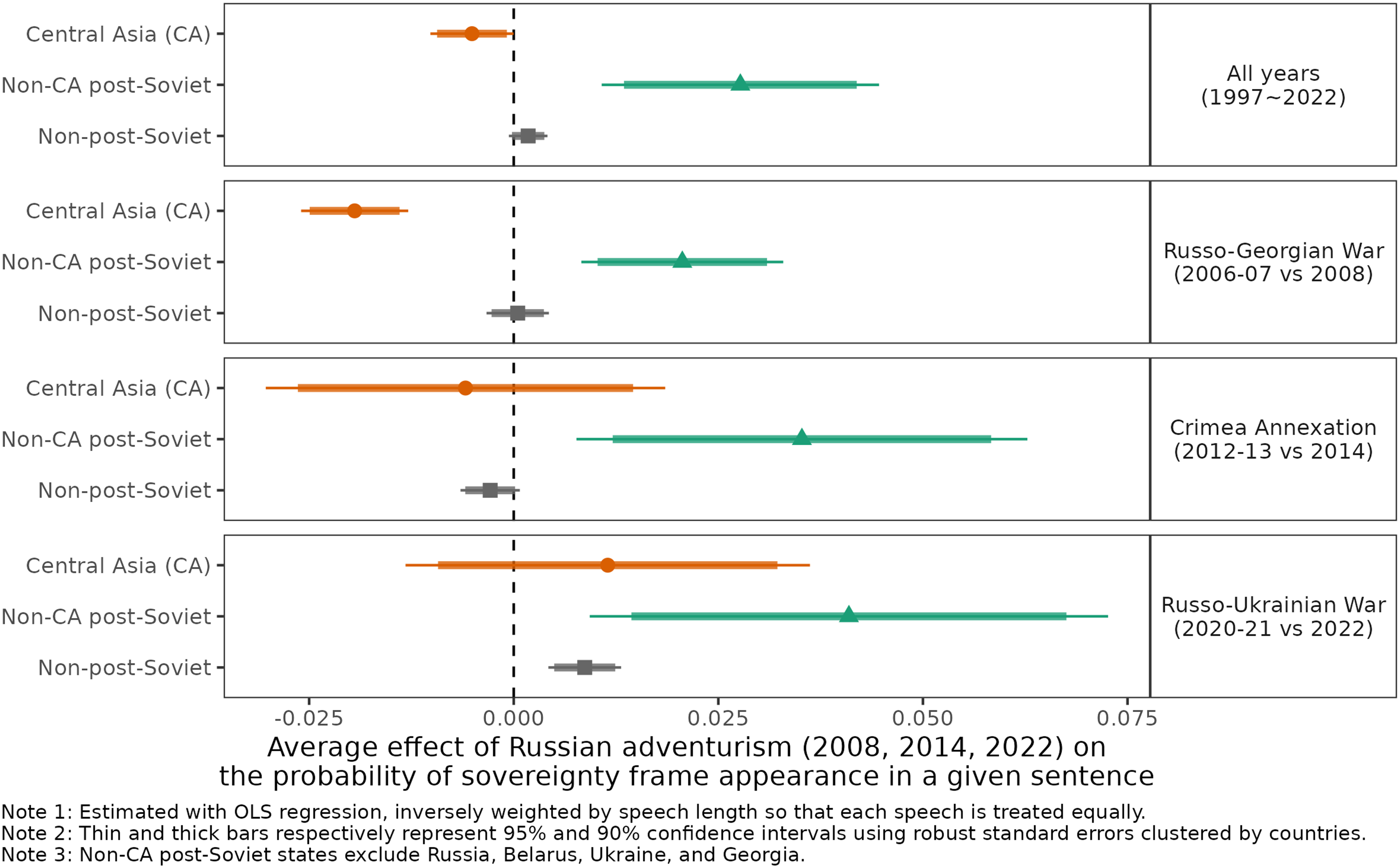
Bottom three panels of Figure 2 disaggregate the difference-in-difference estimates by each event of Russian adventurism in 2008, 2014, and 2022. The results confirm implications from Figure 1. In response to all events, non-CA post-Soviet states were highly vocal in sharing sovereignty concerns with the international community. The responses from CA states, on the other hand, differ across events. In response to the 2008 Russo-Georgian war, CA states significantly reduced their expression of sovereignty concerns, the pattern directly conflicting with other post-Soviet states. This tendency persists, although it is weaker and not statistically significant
Concluding remarks
In this study, we examine how countries that are deeply reliant on Russia have crafted their major foreign policy speeches in the years following Russia’s foreign adventurism. Utilizing UNGA speeches from 1992 to 2022, we uncover that CA leaders generally tend to deemphasize sovereignty-related themes. However, this tendency is weakening or even flipping in more recent instances of Russian adventurism, making CA leaders resemble leaders of non-CA post-Soviet states who have been consistently cautious about Russia’s actions. These findings demonstrate the value of text analysis and contribute to the burgeoning literature concerning the UNGA on why some minor powers change their positions and how solidarity is broken among closely allied countries (e.g., Brazys and Dukalskis, 2017; Brazys and Panke, 2017).
On the policy implication of our findings, since the start of the Russia-Ukraine conflict in 2022, two global superpowers, China and the United States, have actively sought to increase their influence in Central Asia. For instance, President Xi Jinping organized the first-ever “China-Central Asia Summit” in May 2023. Some suggest that this conference, which excluded Russia, was China’s effort to present itself as a state willing to fill the economic and security void left by a war-distracted Russia. Hayley (2023) writes that during the meeting, President Xi Jinping “unveiled a grand plan for Central Asia’s development […] taking on a new leadership role in a region that has traditionally been a Russian sphere of influence.” Similarly, US President Joe Biden met with CA leaders on the margins of the 2023 UNGA session and discussed a range of issues, “including the need to respect the sovereignty and territorial integrity of all nations” (The White House, 2023). Therefore, it remains to be seen who will emerge as the most significant player in the region—Russia, China, or the United States—and what the future course of action will be by CA leaders.
Supplemental Material
Supplemental Material - Russian adventurism and Central Asian leaders’ foreign policy rhetoric: Evidence from the UN general debate corpus
Supplemental Material for Russian adventurism and Central Asian leaders’ foreign policy rhetoric: Evidence from the UN general debate corpus by Bimal Adhikari and Gento Kato in Research & Politics
Footnotes
Declaration of conflicting interests
The author(s) declared no potential conflicts of interest with respect to the research, authorship, and/or publication of this article.
Funding
The author(s) disclosed receipt of the following financial support for the research, authorship, and/or publication of this article: This work was supported by the Meiji University Financial Aid for Proofreading and Submission to International Publications.

Supplemental Material
Notes
References
Supplementary Material
Please find the following supplemental material available below.
For Open Access articles published under a Creative Commons License, all supplemental material carries the same license as the article it is associated with.
For non-Open Access articles published, all supplemental material carries a non-exclusive license, and permission requests for re-use of supplemental material or any part of supplemental material shall be sent directly to the copyright owner as specified in the copyright notice associated with the article.
