




Abstract
A key grievance of the student labor movement is that across much of academia, and especially in the social sciences and humanities, stipends tied to PhD assistantships fall short of a living wage. In this article, we consider the issue from a pedagogical perspective, expecting that higher pay may lead to stronger program outcomes. We collect and validate data on assistantship stipends in political science from PhDStipends.com, and on tenure-track placements from an analysis of departmental placement pages. Graduate pay is significantly associated with tenure-track placements in the job market cycles spanning 2019–2021, independently of program size, rank, student unionization, location, and institution type and endowment. Across model specifications, a US$5,000 increase in student pay corresponds with 2.7 more placements per 100 enrolled students (or 34% of the median rate) over this period.
Introduction
Financial compensation is strongly related to job performance, in academia and beyond (Ahmad and Jameel 2018; Demerouti et al., 2018). Among undergraduate students, financial burdens often lead students to either reduce the number of courses they take, or push them to drop out of school altogether in order to secure paid work (Joo et al. 2008). The situation is no different for many graduate students, including PhD students. Despite the generally held belief that “you get paid to go to grad school,” the reality is often more complex—and financially precarious—for people seeking advanced degrees.
Indeed, financial precarity is ubiquitous among graduate students in the US, where graduate stipends tend to fall short of the living wage standards, and generally hover around the poverty level (Copeland 2021; Glover 2019). Even in more lucrative STEM fields, such as the biological sciences, recent work found that across 178 institutions, only 2% paid students more than a living wage (Woolston 2022). Finances have accordingly been cited as a stressor for graduate students across fields of study (Flaherty 2018). In political science, a recent study found that mental health issues are endemic among students in seven top-ranked programs, and financial precarity was described as a contributing factor (Almasri et al. 2022).
There is a rationale for why PhD wages are not higher. Typically, the assistantships that stipends are tied to are part-time appointments, yielding around 20 hours of work per week for departments, and the contracts last 9 months (Glover 2019). Seen in this light, a stipend of US$25,000 per year pays over US$32 per hour, well above the living wage in most parts of the United States. But graduate stipends operate in a complex economy. Renewal of assistantships is usually tied to academic performance, thus doubling or even tripling the amount of labor required to keep one’s salary. Moreover, many universities disallow outside work, capping students’ earnings to the amount of their stipend plus whatever they can earn over the summer months (Glover 2019, 2-3).
This analysis looks at graduate student pay from another angle: that of program outcomes. Setting aside the debate over whether students deserve higher wages, there may be another reason for which student pay should be higher. If better wages lead to greater success, then this will be reflected in program outcomes, and higher-paying departments can reap reputational benefits as a result.
In this paper, we test the proposition that student pay can improve outcomes. We begin the paper by describing three theoretical mechanisms that may drive this relationship, and then operationalize our independent variable. Specifically, we create a measure for student pay at 85 PhD-granting programs based on data sourced from PhDStipends.com, which we validate with administrative data collected directly from program directors. Then, we collect information on tenure-track placements by program from departmental placement pages and link the two measures while controlling for program size, rank, resources, student unionization, location, and institution type. 1
Our results consistently demonstrate a relationship between graduate pay and student outcomes. They indicate that providing ample resources is a key piece of student success, and that programs that pay students well may gain an advantage over others in terms of placing students into tenure-track positions.
More broadly, our analysis highlights the centrality of livable pay to the graduate student experience. Tenure-track placements are an outcome that occurs well downstream of how much a student is paid, and innumerable life and academic experiences occur between a student’s initial salary offer and their graduation several years later. Finances are likely to impact each step of this process, from students’ living arrangements and transportation, to how supported they feel in their programs. If the discipline wishes to foster student success, and welcome a more diverse next generation of colleagues, higher pay in the graduate years should be a central discussion.
Resources and student success
Research from a variety of contexts ties employee compensation to performance, and while existing work is scant, this relationship may be particularly true among graduate students. In pursuit of their degrees, students contend with poorer pay and more stressors than similarly skilled workers (Woolston 2022), such that even small improvements to their work situation may yield considerable gains. Indeed, a recent APSA Graduate Placement Report found that simply having “full funding,” regardless of the package, is a key predictor of job placement (McGrath and Dias, 2021).
Theoretically, there are a few mechanisms by which better pay may improve outcomes. For one, higher pay can help programs recruit more talented students, a link that exists at the faculty level (Winter et al., 2007). Second, higher pay may also reduce the stressors of financial precarity, allowing students to commit themselves to their work. There is evidence that undergraduate student performance is heavily influenced by financial debt, especially for lower-income students (Dwyer et al., 2012), and financial concerns are a major source of stress for graduate students as well (Cantwell and Rowland 2022). Finally, student pay may proxy for other forms of support that may also improve outcomes, such as mental health counseling, summer employment, or research and conference funding. A recent study of political science PhD students found that research funding, alongside financial compensation, was positively associated with program satisfaction (El Kurd and Hummel 2023).
These mechanisms set up a strong theoretical expectation that student pay can improve outcomes in political science graduate programs. That said, we view testing their relative strength as part of future work. Here, our goal is to provide foundational research on this topic, responding with data to a key point in debates over student pay.
Data and methods
Measuring student pay
Our data on student pay come from PhDStipends.com, a website where students attending (or contemplating) graduate school can enter information on the amount that they are paid (or were offered) by their program. We collect 256 entries from students who began their programs between 2013 and 2018. These entries provide information on 85 programs in the United States; the median program has two entries in the data, and the maximum has 12.
For each program, we take the mean of the stipends reported in the data to estimate the amount that programs pay their students. The program names, stipend estimates, and number of observations are presented in Online Appendix A.
Obviously, this measure is an estimate of program stipends, and not necessarily the “true” amount that students are paid. As such, the measure requires validation. To test the measure’s validity as cleanly as possible, we reached out to graduate program directors to solicit administrative data on student pay, asking for the mean 9-month stipend for students in their program as of January 2023. We then compared their responses to the mean PhDStipends.com entry for their program over the past 5 years. The relationship between the true and Internet-sourced data was r = 0.85. This strong correlation gives us confidence that estimates from the website are a valid measure of student pay, even though they are not collected from a scientific sample. 2 Details about this exercise, as well as additional validation of the measure, are presented in Online Appendix B.
To demonstrate the variation in student pay, we present a histogram of mean stipends, as collected from PhDStipends.com, across the 85 programs in Figure 1. The median program provides a stipend of about US$20,800 per year, roughly in line with our priors about how much graduate students were paid in the mid-2010s. There is ample variation in the data, with a standard deviation of about US$6,000, and the distribution in wages appears to be bimodal, with a large cluster of programs paying between US$16,000 and US$24,000 per year, and a smaller set for which estimates are closer to US$30,000. Estimated mean PhD stipends in 85 political science departments (entering cohorts 2013-2018).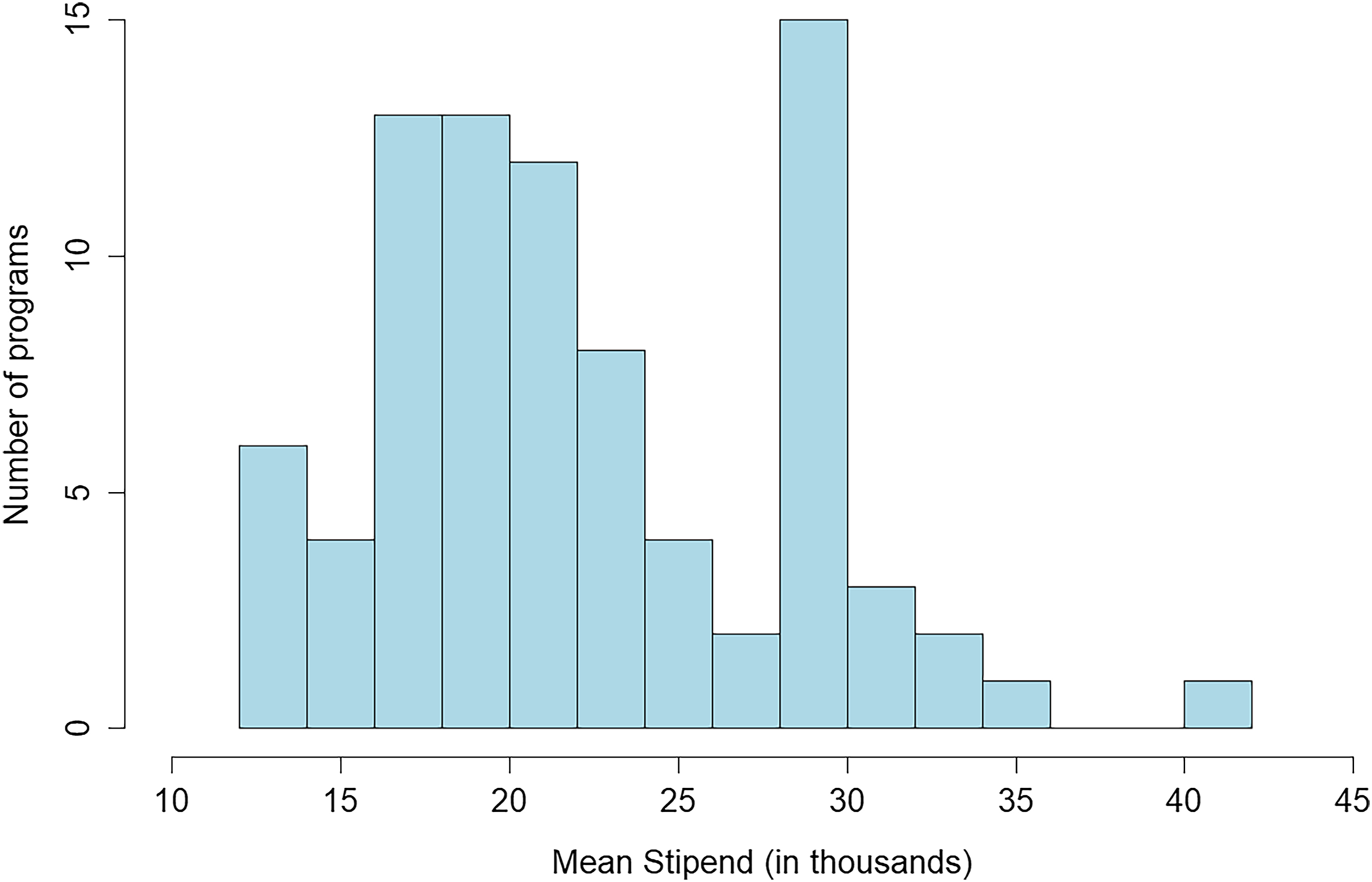
Measuring program outcomes
To study program outcomes, in early 2022, we visited the PhD placement pages of all 85 programs with data on PhDStipends.com to determine (a) whether a program provided comprehensive information on placements, and if so, (b) how many tenure-track placements their 2019, 2020, and 2021 graduates obtained.
We use tenure-track placements as a measure of program success because, even as many political scientists go on to productive roles in industry or government, the tenure-track placement is still the focus of most programs and represents the “gold-standard” of success for students wishing to go into academia. In line with this, and from a research perspective, there is almost no incentive for a program to under-report its number of tenure-track placements, conditional on its reporting in the first place.
Of course, not all programs present placement information on their websites. We took careful note of those that do not, because omission may be endogenous to other variables of interest. For instance, programs that lack the staffing to keep their websites updated may also lack the resources to pay students well. Alternatively, those that struggle with placement outcomes may be less inclined to present comprehensive information on their sites. Programs were counted as listing comprehensive placement information if they provided (a) the institutions where their graduates began their post-doctoral careers, and at least two of the following: (b) the graduates’ names, (c) the year they graduated, or (d) whether the position was tenure-track or not. 3 Any combination of two of these items allowed us to quickly ascertain the number of recent tenure-track placements.
Most of the program websites we visited met the criteria above, but 23 of 85 did not. To account for selection bias, we ran a logistic regression that predicts comprehensive reporting, and took the inverse of the model’s fitted values as observation-level weights in the analyses presented later. The results of this model can be viewed in Online Appendix C.
For the 62 programs with comprehensive placement information, we count the tenure-track positions obtained by students who graduated in 2019, 2020, and 2021. We count placements at US and non-US institutions separately, but otherwise make no distinction between the institution type, rank, or department (i.e., a tenure-track placement in Sociology “counts”). We included placements that were not a graduate’s initial post-doctoral position but did not include placements that were due to begin after fall 2021, as we did not expect websites to be updated with future placements.
How is the number of tenure-track placements distributed by program? The long-tailed distribution presented in Figure 2 tells a story of the “haves” and “have-nots.” While the median number of placements per program was four, a group of 14 programs account for more than half (54%) of the placements in our dataset. This group is highly ranked, with a median ranking in the US News and World Report of #9, but they also have numbers in their favor, with an average of 90 enrolled graduate students compared to 50 for other programs. Distribution of tenure-track placements by program (2019–2021).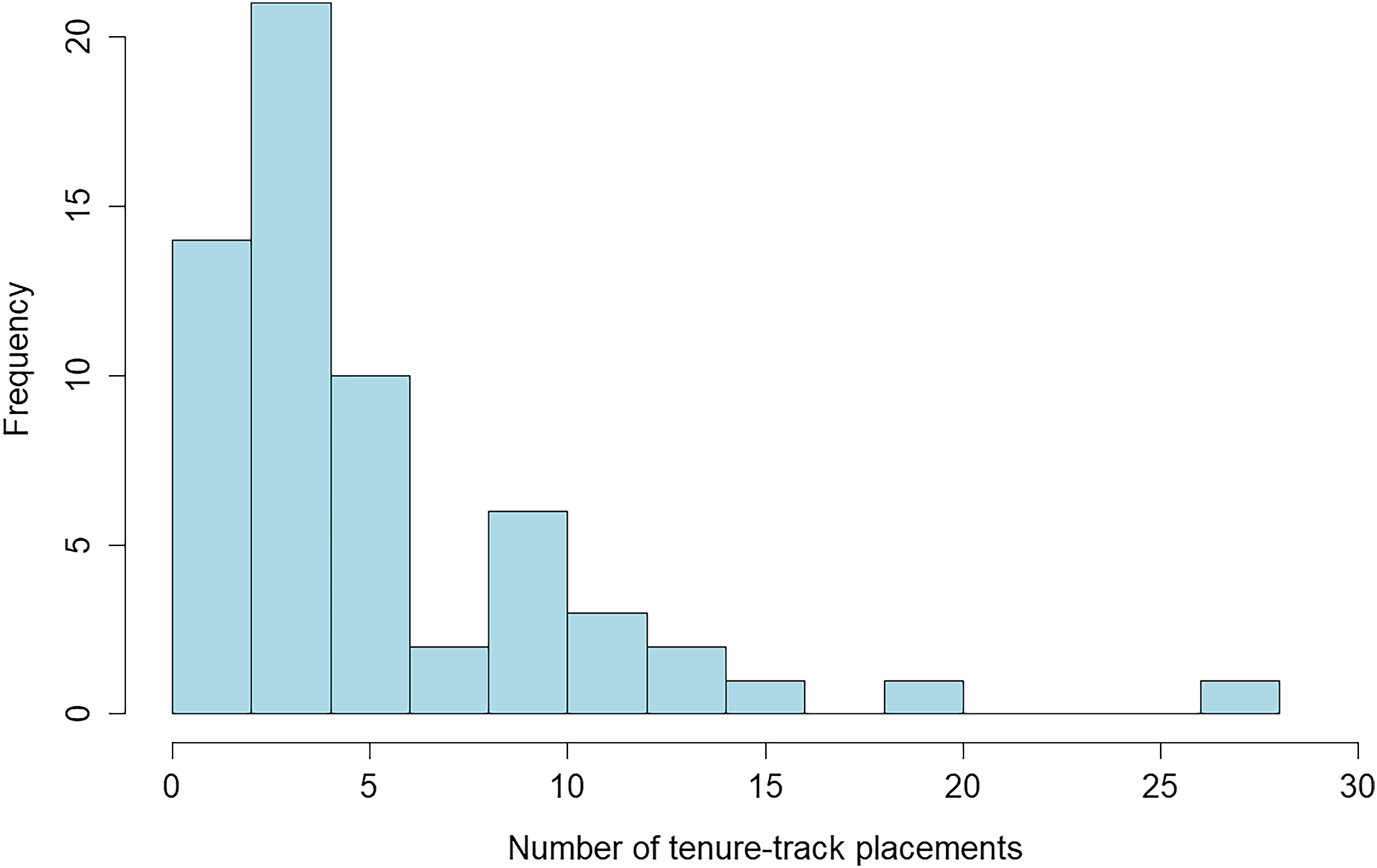
Other factors that may explain placements
Finally, to isolate the relationship between graduate pay and program outcomes, we accounted for other factors that may lead some programs to see more tenure-track placements than others. The first of these is a program’s rank according to the US News and World Report, which despite the metric’s methodological limitations (Ehrenberg 2005), is likely to be reflective of the reputation, student quality, and research productivity of a department (Bastedo and Bowman 2009; Sweitzer and Volkwein 2009). We use rankings from 2013, when students in the 2013–18 academic years would have selected their programs, reverse them so that higher values indicate a better ranking, and collapse them by decile to smooth out the noise in the measure.
Resources and program size may also affect outcomes. Wealthier institutions spend more on instruction students than those with fewer resources (Baum and Lee, 2018), so we include the logged endowment per full-time student for each university in our dataset as a control. Conversely, research at the undergraduate level indicates that small class sizes associate with success (Kuh, 2003; Millea et al., 2018, and the same logic may apply to graduate programs, where students might get “lost in the shuffle” in a program too large. As such, we also control for the program size, measured by the number of enrolled graduate students.
Unions, geography, and institution type are other sources of variation. Unionized graduate students are higher-paid and report feeling more supported in their programs (Rogers et al., 2013), making unionization a potential confounder in our analysis. Public schools may have ties to other state-funded institutions in their region, improving placement, and universities in large urban areas may be better able to attract students, as young people and academics prefer living in cities (Kulis and Sicotte, 2002; Lee et al., 2019). 4
Details on how we collected these variables are presented in Online Appendix D. We also collected data on each program’s geographic region, the variance in stipend reports (as a measure of pay inequality), and whether it was ranked as a top program in subfield of political science, but none of these associated with placements. Given our small dataset, we exclude them from the analysis to maintain an appropriate balance between the number of predictors and model degrees of freedom.
Explaining placement outcomes
The previous section described how we collected information on the number of tenure-track placements by program, how much each paid its graduate students, and a variety of other institutional factors that may affect program success. Now it is time to model the relationship between pay and outcomes quantitatively.
We operationalize the dependent variable in two ways. First, we look at the raw number of placements, and then the number per 100 enrolled graduate students. We also operationalize the independent variable in two ways. One is with the raw stipend amount, in thousands of US dollars, and the second is the stipend amount in relation to the county-level cost of living estimate from the MIT Living Wage calculator.
Determinants of tenure-track placements among 62 political science departments.

Extrapolating from these models, it appears that US$5,000 in graduate pay corresponded with one more placement in our period of study, or about 2.7 more placements per 100 graduate students. These effects may seem small, and while they are not large, they should also be considered in light of the dismal job markets between 2019 and 2021. During this time, the median department placed only four students into tenure-track positions. A pay hike of US$5,000 would therefore correspond with a 25% increase in placements relative to the median.
Another way to operationalize graduate pay is in relation to the local cost of living (COL). This is a tricky variable to incorporate for two reasons. First is that COL estimates are specified at the county level and are noisy when counties contain a mix of urban and rural settings (Blanciforti and Kranner 1997). Large research universities are almost the archetypal example of this, as the areas around many land-grant universities operate as “small cities” in rural areas. 5 Second is that graduate pay and COL both associate positively with placements; by placing one in the numerator and the other in the denominator, the resulting measure’s relationship with placements is likely to be weak.
Relationship between cost of living-adjusted pay and tenure-track placements per 100 enrolled students.

While the results are weaker using the COL-adjusted measure of pay, they are still indicative of a relationship between how graduate students are paid and their success in the program. How much of these weaker results is due to measurement, and how much should be taken at face value, is an open question. In the appendix, we present a simulation exercise showing that a small-to-intermediate amount of noise in COL measures would lead to weaker results than raw stipends, even if the former have a stronger “true” relationship with outcomes. That said, we also explore how taking the COL-adjusted results at face value may be informative too, by pointing to mechanisms that depend less on how much it costs to live in an area.
Of course, there are other ways to model the relationship between graduate pay and job outcomes. We were able to execute some of these, while others were constrained by data availability. For example, our results are similar when tenure-track placements (as count-type data) are modeled using a negative binomial regression. We also find compatible results when outcomes are measured as the share of academic placements that are on the tenure-track, recognizing that not all PhD graduates go into academia. 6 Other approaches were less tractable. Initial placements may say more about a program’s influence than those obtained a year or two later, but only about one-quarter of the placement pages we studied made this distinction. We also would have liked to know how much each program tied stipends to research versus teaching duties, however, this was not possible to deduce using our data.
Conclusion
In this study, we collected data from PhDStipends.com to estimate the average graduate student pay across PhD-granting departments in political science. These data were validated and used to explain variation in program’s placement outcomes, while controlling for a variety of relevant confounders. We find that graduate pay is significantly associated with job placements, independently of program size and rank, student unionization, location, and institution type and endowment. The relationship between student pay and placement is significant: a US$5,000 increase in student pay corresponds with 2.7 more placements per 100 enrolled students, or a 34% increase relative to the median. We think that these findings have a profound meaning for PhD programs, not only from the standpoint of student success, but also for students’ and the programs’ well-being.
We acknowledge that our findings are limited, and more work is needed to fully understand the causal mechanism linking pay with professional outcomes. In the literature review, we identified three mechanisms that may explain a relationship between pay and outcomes, and future research can begin to arbitrate between these. A panel survey of students, for example, may ascertain the extent to which pay impacted their choice of program, contributes to or mitigates their day-to-day stress, and associates with other forms of support from their program. These could in turn be used to explain a wider variety of success metrics over time, such as graduation from their program or publishing a peer-reviewed article.
Over the last few years, a spike in student labor action has provided ample evidence that financial scarcity casts a long shadow over the graduate experience. In November 2022, almost 50,000 graduate students across the University of California system went on strike, resulting in the largest higher education strike in US history. Students have also gone on strike at the University of Michigan and Temple University in the past year. Meanwhile, major universities such as Harvard, Penn, and Carnegie Mellon have moved proactively to increase graduate pay. These actions may have been primarily in response to high inflation and housing costs, but our work adds another reason that programs should improve compensation: educational outcomes. Low graduate student pay doesn’t only affect student welfare, it also affects program’s ultimate success in placing their graduate into academic jobs that they were trained to attain.
Understanding the relationship between PhD stipends and educational outcomes is of crucial importance, especially in the age of rising costs of living (especially housing) across the United States (Diehl 2021; Langin 2022). Financial insecurity impacts every aspect of graduate student’s lives, from their living arrangements, ability to put food on the table, afford a mode of transportation, start a family, go on vacation, or do many other activities that we associate with comfortable and healthy life. Our research shows that it also clearly and meaningfully impacts their ability to thrive on the highly competitive job market. If this link exists, then pay likely also impacts other aspects of graduate program’s successes. For example, most programs would articulate a commitment to diversity and equity that involves recruiting students from diverse socioeconomic and racial backgrounds. But low pay is likely a barrier to recruiting students with families who they cannot rely on for financial help.
The big-picture implication of our work, then, is not simply that higher pay leads to better tenure-track placement, but that if our findings extend, compensation likely ties to many aspects of a graduate program’s success and vitality. Departments wishing to recruit diverse and successful cohorts that feel supported in their programs should make livable pay a top priority.
Supplemental Material
Supplemental Material - PhD stipends and program placement success in political science
Supplemental Material for PhD stipends and program placement success in political science by Seth B. Warner and Dominik Stecuła in Research & Politics
Footnotes
Acknowledgements
We would like to thank Sydney St. Rose-Finear for her research assistance with this project, the many directors of graduate studies who replied to our survey, and the editors and reviewers at Research & Politics for their constructive comments and support.
Declaration of conflicting interests
The author(s) declared no potential conflicts of interest with respect to the research, authorship, and/or publication of this article.
Funding
The author(s) received no financial support for the research, authorship, and/or publication of this article.

Supplemental Material
Supplemental material for this article is available online.
Notes
References
Supplementary Material
Please find the following supplemental material available below.
For Open Access articles published under a Creative Commons License, all supplemental material carries the same license as the article it is associated with.
For non-Open Access articles published, all supplemental material carries a non-exclusive license, and permission requests for re-use of supplemental material or any part of supplemental material shall be sent directly to the copyright owner as specified in the copyright notice associated with the article.
