




Abstract
Does individual variation in affective empathetic capacity systemically condition a person's willingness to support pre-emptive military action? In this note, I theorize that individuals who are more prone to feeling affective empathy are less likely to support conflict escalation. To evidence this theory, I conduct a survey asking individuals about their willingness to support a military attack against a non-specific rogue state that is on the verge of acquiring nuclear weapons. The results demonstrate that the probability of an individual supporting such a strike is strongly conditioned on their affective empathetic capacity. This finding holds regardless of model specification and controlling for rational beliefs about material outcomes. Affective empathy may, therefore, have a powerful palliating effect upon the processes that contribute to conflict escalation.
Introduction
Does an individual’s affective empathetic capacity systematically condition their willingness to support pre-emptive military action in a crisis? The answer to this puzzle is important for several reasons. On a practical level, modern American politicians routinely call for pre-emptive military actions against “rogue states” (e.g., Trump, 2017). Understanding individual variation in voter support for these calls to arms, then, has axiomatic value for understanding real-world American foreign policy. On a more erudite level, a great deal of scholarly research currently demonstrates cognitive/strategic empathy’s capacity to dampen the psychological processes that contribute to conflict escalation (Kertzer et al., 2019; Yorke, 2023). 1 Yet most existing work on affective empathy ignores its potential to lessen conflict escalation, choosing instead to focus on its humanitarian effects (e.g., Bayram and Holmes, 2020). 2 Therefore, this note is the first (to my knowledge) to systematically investigate whether affective empathetic capacity might dampen support for conflict. 3
To investigate that possibility, I here present 121 individuals with a survey vignette about a hypothetical crisis scenario in which a rogue state is on the verge of acquiring nuclear weapons. In this context, I find that survey respondents with greater affective empathetic capacity scores will be less likely to support a military strike. This result confirms that affective empathy systemically conditions support for pre-emptive military action and has significant implications for our understanding of emotions, empathy, and conflict.
Theory and hypothesis
Why should an individual’s affective empathetic capacity affect their decision-making about whether to support military escalation? First, affective empathy removes the emotional stumbling blocks to the cognitive activation required for perspective taking. The affective desire to share emotions such as pain and pleasure provides a powerful mental incentive to evaluate one’s actions through the eyes of others, as perspective taking facilitates the sharing of emotions (Head, 2012). Affective empathy thus reinforces cognitive empathy—and its well-known tendency to deescalate conflicts (Yorke, 2023).
Second, affective empathy provides an altruistic rationale for conflict de-escalation. The altruistic motivation stems from feeling other-oriented emotion. Specifically, when one’s emotions are elicited by and congruent with the perceived welfare of another person in need, those emotions provide a motivational incentive to try and increase the other person’s welfare in order to have the empathy-inducing need removed (Batson, 2010). Both Edele et al. (2013) and Winczewski et al. (2016) demonstrate that this altruistic motivation cannot be explained by cognitive empathy. These rationales lead to my hypothesis.
Individuals with greater affective empathetic capacity will be less predisposed to support military action during a crisis. The hypothesis is subject to some clarifying caveat and scope conditions. First, I caveat my hypothesis by explicitly stating that its independent variable (IV) is affective empathetic capacity—not situational affective empathy. I make affective empathetic capacity the IV to ensure external validity since, in the real world, nothing guarantees that a person’s heightened predisposition to feel emotions in general will translate into situational affective empathy. It is common, however, in existing international relations (IR) studies of cognitive empathy to experimentally induce perspective taking (e.g., Kertzer et al., 2019). To maximize external validity, I thus sacrifice the ability to compare my study “apples to apples” with existing experimental studies of cognitive empathy. Second, the hypothesis’s scope does not extend to escalations that are justified with a humanitarian rationale. It is entirely possible—even probable—that the theory’s logic would lead more emotionally empathetic individuals to be more supportive of escalation if the rationale were humanitarian.
Survey design and data collection
To investigate whether affective capacity might be correlated with support for crisis escalation, I turn to the results of a survey designed and administered on Mechanical Turk (MTurk) during 2020. Notably, 2020 was after the beginning of MTurk’s quality crisis (Kennedy et al., 2020). Therefore, to ensure only high-quality responses, I require that my 121 respondents (1) qualify as MTurk Masters, (2) complete two attentiveness checks, 4 and (3) not share IP addresses.
The overall design of the survey instrument is shown in Figure 1. It began with a standard battery of demographic questions before introducing respondents to a survey vignette borrowed largely verbatim from Tomz and Weeks (2013). The vignette describes a scenario in which a rogue state will build nuclear weapons within six months. The vignette specifies, “the country’s motives remain unclear, but if it builds nuclear weapons, it will have the power to blackmail or destroy other countries.” Respondents were then told that the state has one-tenth the military power of the United States and that a pre-emptive military strike on the country’s nuclear facilities would be successful. Design of the survey instrument.
The vignette next informs the survey respondents that the state in question is autocratic and led by a single leader. Providing this information standardizes respondents’ understandings of regime type. The survey vignette further specifies the political situation in the foreign country: “The country’s leader does not have unchallenged authority. Powerful domestic actors have urged the leader to take a more hard-line approach to relations with the United States. The leader has repeatedly referred to the United States as a ‘threat’.”
The vignette also shows the face of the “leader” in question (Figure 2): an AI-generated white male with a neutral expression. By using an AI-generated face that mirrors the demographic plurality within the sample, I keep the situation general for scientific purposes, avoid making the scenario about any real country, and control for variation in how respondents might imagine the autocrat’s appearance. AI-generated leader’s headshot.
I then ask respondents a series of questions about how they would respond to the situation. The first is whether or not they would choose to launch a military strike on the rogue state. I choose to make this variable, the dependent variable (DV), binary to force respondents to take a position. I next ask respondents a series of questions about their perceptions of the material consequences of attacking. This allows me to control for cognitive and other non-affective factors that may have affected a respondent’s decision-making.
Finally, I administer the Toronto Empathy Questionnaire (TEQ) to gauge each respondent’s affective empathetic capacity. I choose to administer my measure of affective empathetic capacity last to avoid biasing the respondents. 5 The TEQ is a 16-item questionnaire in which each element is measured on a 5-point Likert scale (Spreng et al., 2009). Affective empathetic capacity (the IV) is calculated by summing individuals’ responses to each item. TEQ scores can range from 0 to 64 and correlate positively with behavioral measures of social decoding and self-reported measures of empathy and negatively with measures of autism symptomatology (Spreng et al., 2009).
Analysis and results
The observational results yielded by the survey instrument are illustrated in Figure 3. In illustrating each subject’s decision about whether to strike, Figure 3 strongly suggests that individuals with higher TEQ scores are less likely to support escalation. To quantify this plainly observable effect, I employ binary logistic regression analysis. Survey respondents’ strike decisions and TEQ scores.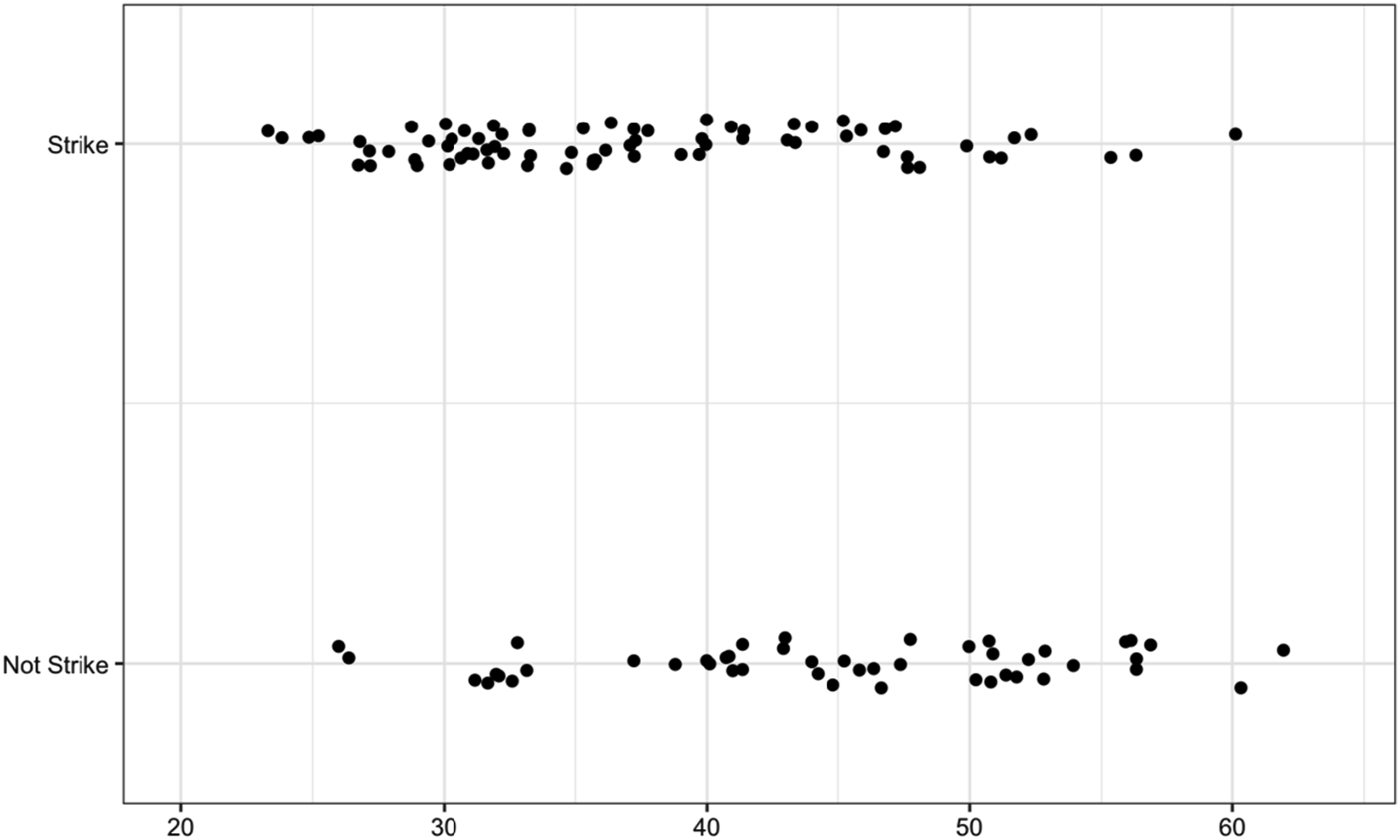
Effect of TEQ scores on strike probability under different model specifications.
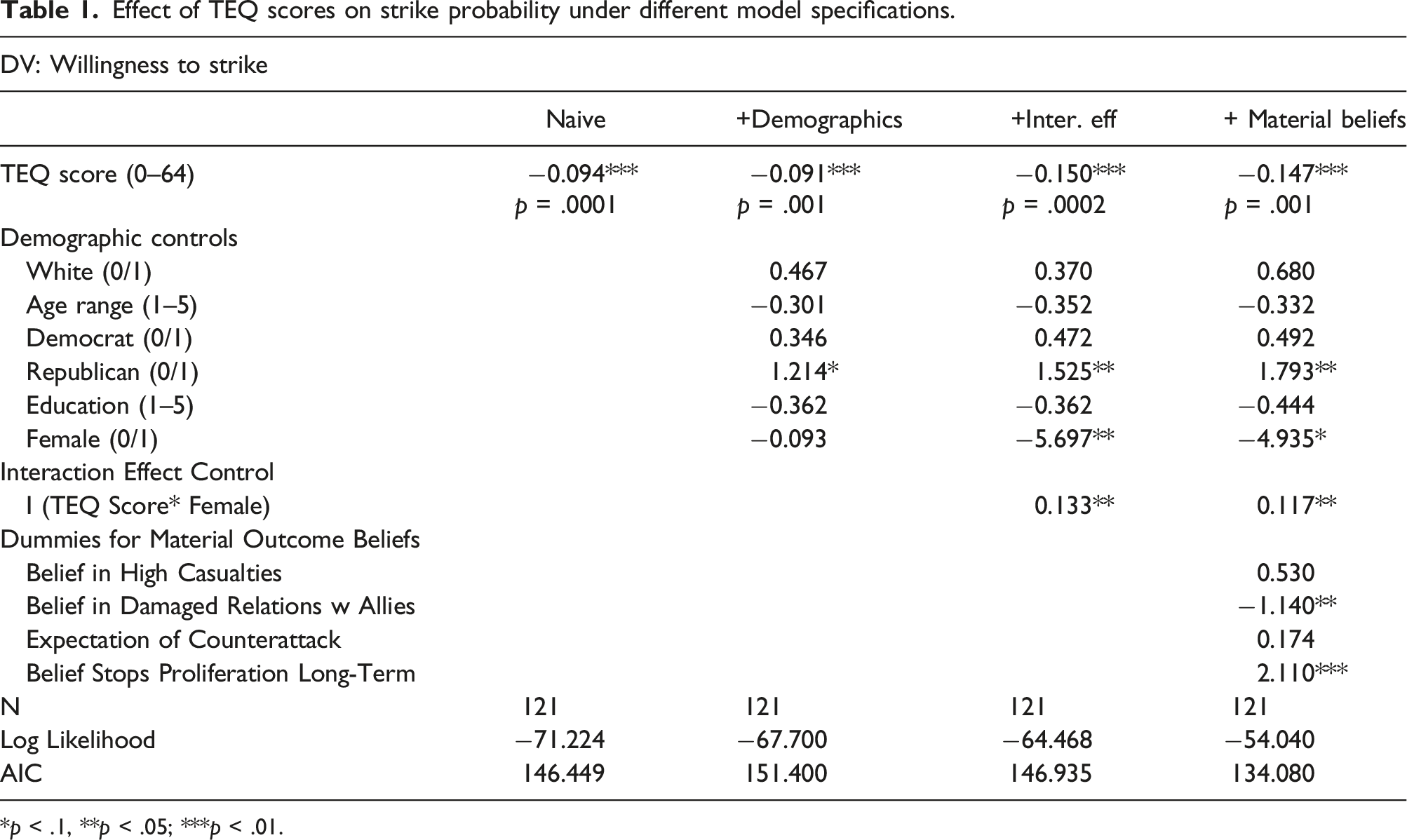
*p < .1, **p < .05; ***p < .01.
Finally, in the last model specification, I control for a series of material expectations that respondents reported after deciding whether or not to strike. Controlling for cognitive and rational material factors that may have influenced a respondent’s decision-making allows me to better measure the true effect of affect. As expected, I see that multiple material factors impacted respondents’ decisions. However, even controlling for these material calculations, affective empathetic capacity continues to be one of the strongest probabilistic predictors of support for military action.
Conclusion
In this note, I evidence that affective empathy substantially conditions support for pre-emptive military action. In particular, using evidence from a survey vignette, I demonstrate that when rogue states are on the verge of proliferating, people with higher TEQ scores are less likely to support a military attack. The strength of these findings is that they are statistically robust regardless of model specification.
However, the findings also suffer from several limitations. For one, they rely on a single study with a relatively small sample size (
My limited findings, though, do have significant implications. First, they demonstrate that empathy broadly—not just cognitive empathy—can palliate conflict. This finding opens the door to studying a new type of empathy in a security context—an exciting prospect given the amount of scholarly attention that cognitive empathy alone has attracted over the past five decades (Yorke, 2023). I, therefore, hope that this note will contribute to new research at the intersection of empathy, emotion, and security studies.
Supplemental Material
Supplemental Material - Does affective empathy capacity condition individual variation in support for military escalation? Evidence from a survey vignette
Supplemental Material for Does affective empathy capacity condition individual variation in support for military escalation? Evidence from a survey vignette by Max Constantine Corkan Plithides in Research & Politics.
Footnotes
Declaration of conflicting interests
The author declares no potential conflicts of interest with respect to the research, authorship, and/or publication of this article.
Funding
The author discloses receipt of the following financial support for the research, authorship, and/or publication of this article: This work was supported by the Institute for Humane Studies, George Mason University.

Supplemental Material
Supplemental material for this article is available online.
Notes
References
Supplementary Material
Please find the following supplemental material available below.
For Open Access articles published under a Creative Commons License, all supplemental material carries the same license as the article it is associated with.
For non-Open Access articles published, all supplemental material carries a non-exclusive license, and permission requests for re-use of supplemental material or any part of supplemental material shall be sent directly to the copyright owner as specified in the copyright notice associated with the article.
