




Abstract
In this paper, we analyze the short-term impact of the Russian invasion of Ukraine on Europeans’ attitudes toward democracy. For this purpose, we leverage the coincidence of the Russian invasion of Ukraine on February 24, 2022 with the fieldwork of the European Social Survey in 10 countries. By means of an unexpected event during survey design, we analyze the impact of the invasion on 12 different attitudes toward democracy, including overt support for democracy, satisfaction with democracy, as well as the importance attributed to particular democratic principles. The results of this comprehensive analysis reveal that the invasion did not have a substantive impact on individuals’ attitudes toward democracy. The invasion of a neighboring democratic country by an autocratic power did not alter Europeans’ satisfaction with democracy, their support for this political regime, or the importance they attribute to different democratic principles.
Keywords
Introduction
Since its outset, the Russian invasion of Ukraine has been characterized by political leaders, like US President Joe Biden, as a battle between democracy and autocracy (Youngs, 2022). In fact, some have argued that this conflict has led to a renewed international commitment to defend liberal democracy, in a process that could ultimately strengthen democracy in Europe and beyond (Way, 2022). Yet, we do not know if the Russian invasion of Ukraine has instilled greater enthusiasm for democracy among citizens. Hence, it is relevant to assess whether this is the case, and to do so by focusing on different manifestations of citizens’ attitudes toward this political system, ranging from their satisfaction with democracy to the importance they attribute to its core principles.
In this paper, we examine the effects of the Russian invasion of Ukraine on citizens’ overt support for democracy, their satisfaction with this political system, and the importance they attribute to different democratic principles. Our identification strategy leverages the coincidence of this invasion on February 24, 2022 with the fieldwork of the European Social Survey (ESS) in 10 European countries. This allows us to conduct a comprehensive analysis of different attitudes, since this round of the ESS includes a special module of questions on citizens’ understandings of democracy (see Ferrín et al., 2018). Through this data, we analyze the impact of the invasion on 12 different indicators measuring different manifestations of citizens’ attitudes toward democracy and its core principles.
The results of this comprehensive analysis, based on an unexpected event during survey design (Muñoz et al., 2020), reveal that the invasion did not have any substantive impact on individuals’ attitudes toward democracy. Europeans remained equally supportive of democracy, they did not become more or less satisfied with this political regime, and they did not change the importance they attribute to particular democratic principles.
Theoretical background
Research on citizens’ political support and their attitudes toward democracy indicates that these can change in the short-run in response to relevant events such as political scandals, terrorist attacks, foreign policy crises, or epidemic outbreaks, among others (Bol et al., 2021; Colombo et al., 2022; Norris, 2011). In fact, these events can have an impact on citizens’ attitudes even if they occur in other countries, since they may signal a potential threat or crisis in one’s own country (De Vries et al., 2021; Legewie, 2013). However, the underpinnings of these short-term fluctuations in individuals’ attitudes toward democracy remain understudied, especially when it comes to the particular manifestations of these attitudes that might be most affected by events that signal a potential threat to one’s own country.
In this paper, we contribute to this literature strand by analyzing whether and how the threat posed by the invasion of a neighboring democratic country by an autocratic regime affects individuals’ attitudes towards democracy, like their support and satisfaction with this political system. Exogenous threats not directly related to democracy, like the outbreak of an epidemic or a terrorist attack, have had immediate short-term effects on these attitudes (see e.g., Colombo et al., 2022). Hence, a situation like the invasion of Ukraine, which is directly framed by pundits and leaders as a direct confrontation between autocratic and democratic worldviews (Youngs, 2022), could potentially have an even greater impact on citizens’ views about democracy. The invasion of Ukraine has not only been considered a potential challenge for the stability and safety of European neighboring countries, but also a direct threat to Europe’s liberal democratic order (see Way, 2022).
The invasion of a neighboring democratic country, such as Ukraine, by an autocratic power, like Russia, is, therefore, a salient political event that can potentially affect how Europeans think and feel about democracy in the short-run. In response to the threat posed by the invasion of a country located at the doors of the EU eastern border and the fear of conflict extending to countries closer to the heart of Europe (e.g., Poland), we can conceive citizens potentially reacting in two opposite ways. In light with the rally-round-the-flag hypothesis, Europeans may “rally around democracy” and increase their satisfaction and support for this political system and its core principles. However, this security threat could also lead to an opposite “authoritarian” reaction among citizens, who may become less satisfied and supportive of democratic regimes and their principles.
When it comes to the first potential reaction, the political support literature has provided consistent evidence in line with the rally-round-the-flag hypothesis (Kritzinger et al., 2021). Political support increases in response to dramatic international events or when a country faces an external threat (Hetherington and Nelson, 2003; van der Meer et al., 2023). This hypothesis has been tested by using different types of events that trigger the rally-round-the-flag, like terrorist attacks, COVID-19, foreign policy crises, or the outbreak of wars, and by focusing on different manifestations of political support: satisfaction with government, approval of the president/prime minister, or political trust (see Kritzinger et al., 2021, for an excellent overview). Hence, this literature has mostly focused on the approval of officeholders or the evaluation of political institutions.
We propose that in the case of an autocratic power invading a democratic country, the rally-round-the-flag hypothesis should also apply to the more abstract support citizens extend to their political regime, as well as to their satisfaction with this political system. In response to an autocratic external threat, citizens may increase their support and satisfaction with their democracies, since in the face of inter-group conflict, individuals are more prone to develop a positive view of their in-group and to perceive social institutions more favorably (Lambert et al., 2011; Lai and Reiter, 2005). This should be especially so in cases like the invasion of Ukraine, where an authoritarian power threatens a neighboring country that, as most other European countries, is democratic. In line with this presumption, support for democracy has increased substantially among Ukrainians after the outbreak of war (Onuch, 2022). Similarly, a study conducted among students of Western European universities indicates that the Russian invasion of Ukraine led to greater attachment to the EU (Steiner et al., 2023). Hence, Europeans may not only become more satisfied with their democratic regimes, but also more supportive of this political system and its core principles, which became increasingly under threat after the Russian invasion. In others words, as a result of the invasion Europeans may “rally-round-democracy.”
When it comes to the second potential reaction, we must consider that beyond democracy, the Russian invasion also poses a direct threat to the European security structure. This is relevant, because in some instances, security threats, like for example, 9/11, do not enhance democracy, but promote, instead, limitations in democratic rights (Youngs, 2022). Among citizens, threats, like terrorist attacks or pandemics, can in some cases make individuals more authoritarian, ethnocentric, and open to accept restrictions on civil liberties (Davis and Silver, 2004; Hansen and Dinesen, 2022; Hetherington and Suhay, 2011). These effects appear to extend to individuals’ preferences about political authorities, such as increasing support for “strong leaders” (Amat et al., 2020). Citizens might think that leaders and political systems that do not face some of the constraints posed by liberal democratic principles could be more effective at preventing the escalation of war or, eventually, waging it against an authoritarian power that does not face such constraints. All in all, this would suggest that Russia’s invasion of Ukraine could potentially trigger an authoritarian and anti-democratic response among Europeans, which would translate in a reduction in their satisfaction and support for this political system, and the attribution of lower importance to core liberal democratic principles.
Data and identification strategy
The tenth round of the ESS was on the field in 11 countries on February 24, 2022, when Russia invaded Ukraine. This overlap allows us to implement an Unexpected Event During Survey Design to study its effects (Muñoz et al., 2020).
The ESS is an ideal instrument to test the impact of the invasion on individuals’ attitudes toward democracy. First, because the survey fieldwork and the invasion overlapped in 11 different countries. Second, because the tenth round of the ESS includes a comprehensive set of questions about citizens’ support for and satisfaction with democracy, as well as about the importance they attribute to key democratic principles (see Ferrín et al., 2018).
We rely on multiple items included in this round of the ESS. First, we measure how satisfied citizens are with the way democracy works in their country (on a 0–10 scale, with 0 denoting “not at all satisfied” and 10 “completely satisfied”). Second, we analyze citizens’ support for democracy through the importance they attribute to live in a country that is governed democratically (on a 0–10 scale, with 0 denoting “not at all important” and 10 “extremely important”). This type of overt support for democracy does not necessarily imply that citizens reject authoritarian alternatives, though. Hence, we also measure support for democracy by analyzing the extent to which citizens reject a strong leader who is above the law (on a 0–10 scale, with 0 denoting “not at all acceptable” and 10 “completely acceptable”).
Since democracy is a multidimensional entity, the invasion might impact citizens’ opinions about some aspects of democracy but not others. To move beyond generic indicators of support for democracy, we also consider the importance that citizens attribute to 10 specific elements when thinking about democracy. 1 For all these elements, respondents had to indicate how important they think they are for democracy on a 0–10 scale, where 0 indicates that an element is “not at all important for democracy in general” and 10 that it is “extremely important.” First, we consider the importance citizens attribute to three key elements of liberal democracies: free and fair elections; minority rights; and the rule of law (equality before the law). Second, we analyze elements that go beyond, complement, or can even stand in contradiction with liberal democracy. We consider elements related to: direct democracy—citizens voting in referenda; social models of democracy—governments protecting citizens against poverty and reducing income differences; populist notions of democracy—the views of the people prevailing over those of the elite and the lack of constraints on the realization of the will of the people; and, finally, multi-national democracy—decisions being adopted at the national and not the EU level.
On February 24, 2022, the ESS was in the field in Switzerland, Greece, Italy, Montenegro, Macedonia, the Netherlands, Norway, Portugal, Spain, Poland, and Serbia. We consider that those interviewed after February 24 were treated, while those interviewed before that date constitute our control group. 2
This identification strategy hinges on two key assumptions (Muñoz et al., 2020). First, that the timing of survey interviews is as good as random and therefore unrelated to attitudes toward democracy (ignorablity). Second, that any difference we observe between respondents interviewed before and after February 24 is the sole consequence of the invasion (excludability).
A key decision for the plausibility of these assumptions is the selection of the bandwidth of days around the date of the invasion that we include in our estimation, which we base on an empirically driven approach through the analysis of statistical power. First, we take the distribution of our key variable of interest (support for democracy) within each of the countries to determine the size of an effect that would be substantively relevant. We consider a change of half a standard deviation in support for democracy to be substantive. In the pooled sample, this equals 0.95 units (in the 0–10 scale), and in most countries, this is similar to the difference in support for democracy among those with a low and a high level of political interest, a common predictor of this variable (see Appendix C for further details). Using this value for each country, we then estimate the bandwidth of days around the invasion and its corresponding sample size. The power analyses, summarized in Appendix C, lead to the exclusion of Norway, since it fails to achieve a 0.8 level of power within a ±30-day bandwidth. 3 In all other cases, a bandwidth that ranges between ±2 days in the case of Spain and ±19 days in the case of Switzerland is enough to achieve a 0.8 level of power. Some could argue, though, that effects smaller than those equivalent to one half of a standard deviation could also be of relevance. Therefore, in subsection F.1, we estimate the impact of the invasion on the basis of wider bandwidths that aim to detect smaller effects equivalent to a change of one-third of a standard deviation in the variable measuring support for democracy.
The balance tests summarized in Appendix D reveal some imbalances in covariates linked to the survey reachability of respondents such as their age, education, gender, labor market status, and participation in the last national elections. 4 Therefore, all our estimates are fitted with entropy balancing weights that include these covariates. 5
Another relevant aspect for our identification strategy is the salience of the event and its unexpected nature. As described by Steiner et al. (2023), during the final months of 2021, Russia started accumulating troops along the Russian and Belorussian borders with Ukraine. However, at the time, Russia firmly denied the accusations of its intention to invade Ukraine. Hence, the invasion and massive attack against Kyiv on February 24 took many by surprise (see Steiner et al., 2023). Our analysis of Google trends, summarized in Appendix B, reveals that this seems to be the case among the general public of most countries, and that this was, in fact, a very salient event. In any case, since we cannot be entirely certain that all respondents were exposed to the event, all the estimated effects must be interpreted as an Intent-To-Treat (ITT).
Results
Figure 1 summarizes the results about the impact of the invasion on citizens’ support for democracy, their rejection of authoritarian alternatives, their satisfaction with democracy, and the importance they attribute to three key elements of liberal democracies. The results indicate that the impact of the Russian invasion of Ukraine was negligible. There are almost no differences in any of these attitudes toward democracy among those interviewed right before and after the invasion. Out of 60 coefficients, only four are statistically significant at the 95% level and two at the 99% level. For example, in the case of the Netherlands, respondents’ interviewed after the invasion seem to become more supportive of democracy (attribute higher importance to democracy) and less likely to support a strong leader who is above the law. The latter is the largest effect we find among the statistically significant ones (one point difference). All other five are substantially weaker. Effect of Russian invasion on attitudes toward democracy by country (1). Note: OLS estimation with entropy balancing weights. Thick and thin lines are 95 and 99% confidence intervals, respectively. The N corresponds to the number of individuals interviewed within each bandwidth.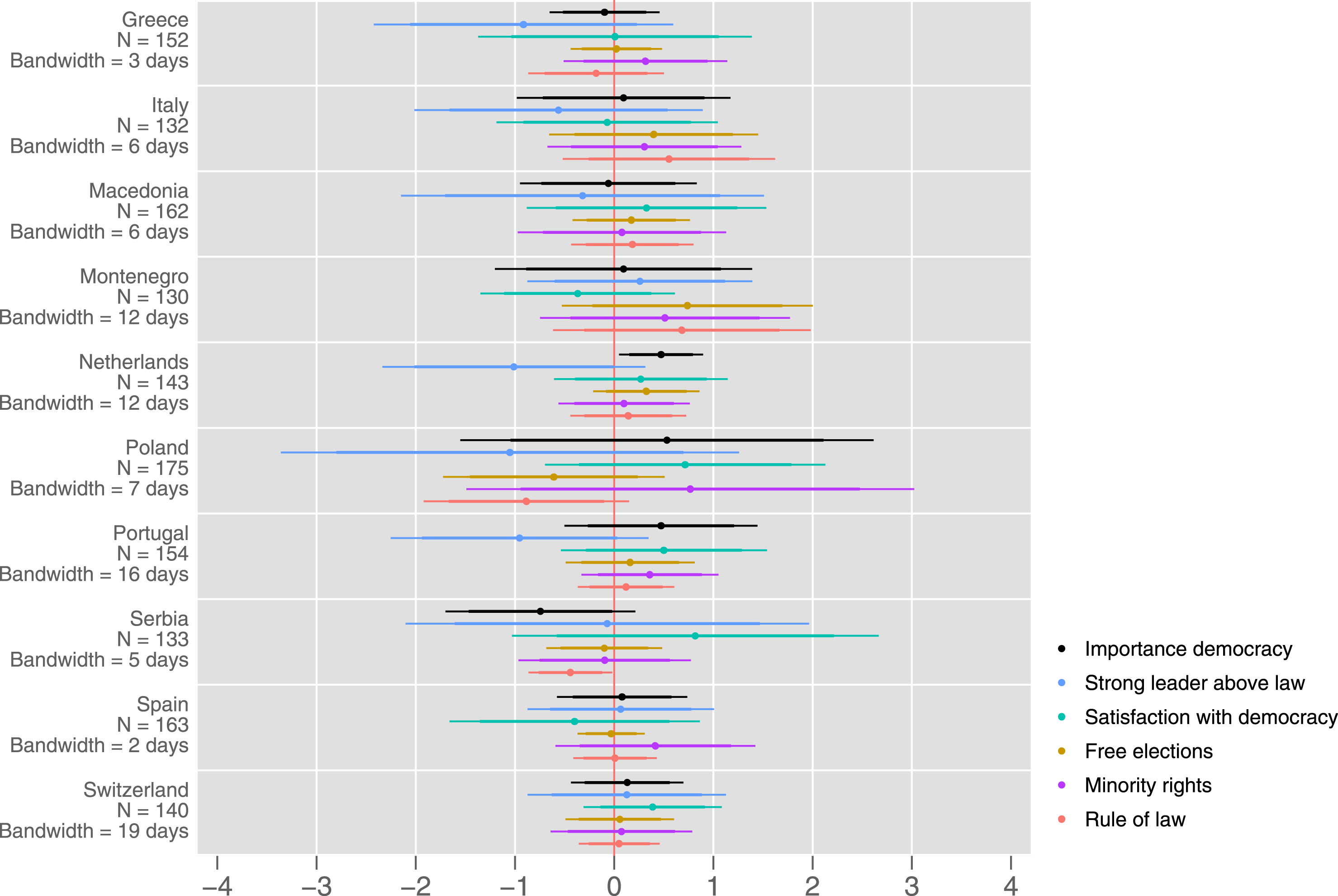
Moreover, in Appendix E, we replicate these analyses adjusting the p-values for the multiple tests that we conduct in each of the countries (12 per country, corresponding to the 12 dependent variables). When we implement these multiple hypothesis test corrections, none of the coefficients remains statistically significant at the 95% confidence level (see Figure E1).
The previous results refer to citizens’ general support for democracy and the importance they attribute to some key liberal principles of this political system. Given the fundamental nature of these democratic principles, these attitudes might be crystallized and, therefore, less open to change in the short-run (see Hernandez, 2019). Figure 2 focuses instead on the importance that citizens attribute to other elements and principles that are not so central to liberal democratic systems, or that might even, in some cases, stand in opposition to some central tenets of liberal democracies. However, once again, the results appear to indicate that the Russian invasion of Ukraine did not have substantial effects on these attitudes toward democracy. Out of 60 coefficients, only one is statistically significant at the 99% level and two at the 95% level. Moreover, independently of their statistical significance, all the estimated coefficients are substantially smaller than one in all cases. In Figure E2 of Appendix E, we correct the p-values of these estimates to account for multiple hypothesis testing. When we implement this correction, only the coefficient for the protection of citizens against poverty remains statistically significant at the 95% level in Portugal. Effect of Russian invasion on attitudes toward democracy by country (2). Note: OLS estimation with entropy balancing weights. Thick and thin lines are 95 and 99% confidence intervals, respectively. The N corresponds to the number of individuals interviewed within each bandwidth.
The previous results are based on an analysis conducted country-by-country. In Figure 3, we pool all these countries together. To do so, we rely on the same bandwidths that we used in our country-by-country analysis to ensure that each country remains sufficiently powered, and we control for unexplained heterogeneity between countries through country fixed-effects. The results indicate that, if anything, Europeans became less likely to accept a strong leader who is above the law and more supportive of minority rights and free elections. However, these effects are of very small, or even trivial, magnitude. They correspond to a change equivalent to one twelfth, one thirteenth, and one tenth of the standard deviations in the corresponding variables.
6
In fact, when taking into account that in this analysis we are also testing multiple hypothesis, none of the coefficients remain statistically significant at conventional levels (see Figure E3). Effect of Russian invasion on attitudes toward democracy (pooled sample). Note: OLS estimation with entropy balancing weights and country fixed-effects. Thick and thin lines are 95 and 99% confidence intervals, respectively.
In Appendix F, we discuss additional analyses aimed at probing the robustness of these findings. In subsection F.2, we estimate the impact of the invasion using an overpowered (30 days) bandwidth in all countries. In subsection F.3, we establish February 22 as an alternative cutoff for our treatment (see Appendix B). In subsection F.4, we replicate our analyses excluding paper-and-pencil self-administered interviews. Finally, in Appendix G, we conduct additional robustness checks related to non-response and the potential threat posed by pre-existing time trends. Overall, the results of these robustness checks lend further credibility to our findings about the null effects of the Russian invasion.
Conclusion
Existing studies on citizens’ political support indicate that these attitudes can change in the short-run in response to salient political events like terrorist attacks, epidemic outbreaks, or political scandals, among others (Bol et al., 2021; Norris, 2011). Following this literature, we propose that an exogenous shock, such as the Russian invasion of Ukraine—explicitly framed by many as a battle between democracy and autocracy—could potentially have a significant impact on what Europeans think about democracy. Our results, based on a comprehensive analysis of attitudes toward democracy in 10 European countries in the aftermath of the invasion indicate that this is not the case. At least in the short-run, the invasion did not alter Europeans’ satisfaction with democracy, their support for this political regime, or the importance they attribute to different democratic principles.
While these results stand in contrast with the idea that such events could lead to a “rally round democracy” among citizens, or to an opposite authoritarian response that depresses citizens’ satisfaction and support for democracy, they are in line with the null effects of the invasion on citizens’ attitudes toward globalization identified by Gutmann et al. (2022). When it comes to the broader political support literature, these results also somehow contrast with the idea that these attitudes fluctuate in the short-run in response to political events (Norris, 2011). However, they are in line with recent analyses that focus on long-term changes in these attitudes, which indicate that they are characterized by substantial stability (Wuttke et al., 2022).
Analyzing the potential reasons for these null findings goes beyond the scope of this article. However, one may speculate that a potential reason could be related to citizens’ lack of attention to international news. The additional analyses that we conduct in Appendix H suggest that this is probably not the case. We must acknowledge, though, that our results focus on the immediate aftermath of the Russian invasion. That is, we have estimated the effects of the invasion in the short-run. Future studies should analyze if the invasion, and more generally the war in Ukraine and all the reactions and counteractions that it generated, affected citizens’ attitudes towards democracy in the medium and long term.
Supplemental Material
Supplemental Material - The (null) effects of the Russian invasion of Ukraine on Europeans’ attitudes toward democracy
Supplemental Material for The (null) effects of the Russian invasion of Ukraine on Europeans’ attitudes toward democracy by Enrique Hernández and Macarena Ares in Research & Politics
Footnotes
Acknowledgements
The authors thank Enrique Prada for excellent research assistance. We are also grateful to Alexander Wuttke, the two anonymous reviewers and the editors of Research & Politics for helpful comments and suggestions.
Declaration of Conflicting Interests
The author(s) declared no potential conflicts of interest with respect to the research, authorship, and/or publication of this article.
Funding
The author(s) disclosed receipt of the following financial support for the research, authorship, and/or publication of this article: This research has received funding by the European Union (ERC Starting Grant 101042292 DEMOTRADEOFF). Views and opinions expressed are however those of the authors only and do not necessarily reflect those of the European Union or the European Research Council Executive Agency. Neither the European Union nor the granting authority can be held responsible for them.

Data Availability Statement
Data Replication materials are available at the Harvard Dataverse (Hernández and Ares, 2023).
Supplemental Material
Supplemental material for this article is available online.
Notes
References
Supplementary Material
Please find the following supplemental material available below.
For Open Access articles published under a Creative Commons License, all supplemental material carries the same license as the article it is associated with.
For non-Open Access articles published, all supplemental material carries a non-exclusive license, and permission requests for re-use of supplemental material or any part of supplemental material shall be sent directly to the copyright owner as specified in the copyright notice associated with the article.
