




Abstract
Although gender-related attitudes have played an increasingly larger role in recent U.S. elections, the implications of feminist identity beyond electoral politics remain largely understudied. This paper examines how the interaction of feminist and party ID impacts political elite evaluations and policy attitudes that are not gender-based by relying on an original survey fielded as part of the 2020 CES and the 2016 ANES. Our analyses show that feminists of both parties give the highest feminist ratings to co-partisan elites. However, while Democratic feminists rate Democratic elites as more feminist than Republican elites, Republican feminists rate the two similarly. Furthermore, within both parties, feminist self-labeling is associated with increased support for policies that advance social equity and inclusion. This gap in policy preferences between feminists and non-feminists largely persists across ideologies—among liberal, moderate, and conservative members of both parties. These findings suggest that feminist identifiers constitute a distinct group within each party, and fostering feminism across political leanings may strengthen public support for more equitable and inclusive policy goals and outcomes.
Group identities have long been recognized as important factors influencing the political behavior of individuals and groups (e.g., Huddy, 2013). One of these consequential identities is feminist self-identification (e.g., Cook, 1993; Oceno et al., 2023). Although feminist identity is more common in women, anyone can hold a feminist identity as it is not simply an operationalization of being female, but it is instead connected to a worldview of equality among genders (e.g., Aronson, 2003; Conover, 1988). Feminist identity has been found to play a significant role in vote choice beyond individuals’ partisanship and gender (e.g., Cook, 1993; Oceno et al., 2023). However, its implications beyond electoral behavior remain largely understudied in American politics. This omission may be partially due to the correlation between feminist ID and Democratic partisanship, and the tendency to equate the two. Nonetheless, there are significant amounts of Democrats who do not identify as feminists and non-negligible amounts of Republicans who do identify as feminists. Furthermore, when considered separately from partisanship, feminist identity has been found to significantly affect perceptions of not only gender, but also racial discrimination (Harbin and Margolis, 2022). This paper broadens the study of feminist identity as a unique cleavage beyond electoral behavior and gender or racial attitudes by investigating whether and to what extent those who identify as feminists in each party differ from those who do not identify as such (i.e., non-feminists) in terms of their attitudes toward elites and public policies.
Specifically, employing data from an original survey fielded as part of the 2020 Cooperative Election Study (CES) and the 2016 American National Election Study (ANES), we examine how the interaction between feminist and party ID is associated with political elite evaluations and policy positions beyond gender issues. Our analyses show that feminists in both parties are more likely than out-party feminists and non-feminists of either party to evaluate co-partisan elites as more feminist. Furthermore, Democratic feminists evaluate Democratic elites to be significantly more feminist than Republican elites, whereas Republican feminists rate the two similarly. Finally, within both parties, feminists are more likely than non-feminists to endorse public policies that advance social equity and inclusion, even after controlling for ideology. These results demonstrate that feminist identifiers represent a distinct subgroup within each party that is significantly more supportive of equitable and inclusive policies. Feminism thus represents an identity with implications that extend beyond partisanship and gender.
Partisanship and feminism as aligned or cross-cutting identities
Group identification is politically consequential because it links an individual to the social world. As Social Identity Theory (SIT; Tajfel and Turner, 1979) posits, individuals can maintain a positive self-image and enhance their self-esteem when they identify with a positively valued group. Specifically, those evaluations stem from the favorable comparison of the ingroup relative to the outgroup(s). Analogously, Self-Categorization Theory (SCT; Turner et al., 1987) and Optimal Distinctiveness Theory (ODT; Brewer, 1991) identify two group dynamics: individuals’ tendency to conform to the norm (i.e., majority) of their ingroup, thus minimizing intra-group differences and meeting inclusion needs, and their tendency to positively differentiate the ingroup from the relevant outgroup(s), thus maximizing inter-group differences and meeting distinctiveness needs.
Individuals identify with multiple groups simultaneously. In this regard, research on social sorting shows that American parties have become increasingly homogeneous and, consequently, many of Americans’ identities align with their partisanship (e.g., Abramowitz, 2010). In other words, the overlap in membership among socio-political groups has significantly grown (Mason, 2018). Furthermore, partisans have become more and more aligned with their party by adjusting their policy positions to the ones of polarized party elites (Levendusky, 2009). However, conflicts between individuals’ partisanship and other identities can emerge and create cross-pressures that likely have a moderating impact on attitudes and behavior (e.g., Mason, 2017).
Regarding gender issues, the Democratic and Republican positions have become increasingly divergent over time (e.g., Wolbrecht, 2000). Consequently, a partisan gender gap has developed (e.g., Gillion et al., 2020). In recent elections, partisan divides have been driven less by gender identity itself and more by attitudes about women and gender relations (Sides et al., 2020). In particular, sexist attitudes have become particularly salient and electorally consequential since the 2016 presidential campaign (e.g., Schaffner, 2022; Valentino et al., 2018).
Similarly to sexism, recent scholarship suggests that feminism likely played a key role in vote choice in 2016 (e.g., Oceno et al., 2023). However, the political implications of feminist identification have received considerably less attention than sexist attitudes despite the increased salience of gender considerations since 2016. Feminism is a strong socio-political identity whose influence on political attitudes extends beyond sex or gender identity (e.g., Conover, 1988; Cook and Wilcox, 1991; hooks, 2000). However, as a result of several waves of the feminist movement and a diverse set of perspectives and approaches to feminism, the feminist label does not have a static or single definition. Instead, individuals likely accept or reject the label for vastly differing reasons, while attaching widely different meanings and connotations to it (e.g., Oceno 2020; Reid and Purcell, 2004; Roy et al., 2007). Democratic identifiers, particularly women, are more likely to call themselves feminists (e.g., McCabe, 2005). Nonetheless, over the last several decades, Republican and/or conservative women have participated in conservative women’s organizations that compete with liberal feminists over the right to make representational claims about women’s interests (Schreiber, 2008). In other words, it is important to recognize that women tend to have highly heterogeneous conceptualizations of their gender identity, women’s empowerment, and feminism (e.g., Aronson, 2003; Klar, 2018). Partisanship can be viewed as an important lens through which partisans interpret the meaning of the feminist label and, consequently, decide to embrace or disavow it.
This paper addresses an important gap in the literature about gender-related identities and attitudes by examining the political impact of the interaction between feminist and party ID. As data from the 2016 ANES and 2020 CES shows, being a feminist is the norm within the Democratic Party, whereas not identifying as a feminist is considered the norm within the Republican Party. 1 This means that feminism and partisanship are aligned among Democrats, while they are cross-cutting among Republicans. However, there are non-negligible proportions of feminists in both parties, whom we argue represent a distinct subgroup. Despite partisan differences in the understanding of the label, Democrats and Republicans who adopt the label display significantly different attitudes toward elites and policies from those who eschew it, even when those non-feminists are their co-partisans. As feminist identity has been found to affect views toward racial discrimination (Harbin and Margolis, 2022), it can also heighten awareness around socio-political equity and inclusion.
Political elite evaluation and policy implications of feminism
First, we examine how partisan and feminist identities interact in influencing the extent to which the public perceive prominent political figures to be “feminist.” Drawing on SCT and ODT, both Democratic and Republican feminists can be expected to give higher ratings on feminism than either out-party feminists or non-feminists to in-party figures, as this enhances their perceived inclusion based on two identity dimensions at once—feminism and partisanship. In other words, partisan feminists will rate their co-partisan elites as highly feminist to make them appear as similar as possible to themselves.
Hypothesis 1a: As compared to out-party feminists or non-feminists, feminists within each party will give higher feminism ratings to in-party elites. In addition to maximizing inclusion in their party, we can expect feminists to reinforce perceived partisan differences. However, due to social sorting, these perceptions are likely influenced by aligned versus cross-cutting partisanship (e.g., Mason, 2017, 2018). We know that feminist and party ID tend to be aligned among Democrats but to be cross-cutting among Republicans. This implies that by giving higher feminist ratings to Democratic than Republican elites, Democratic feminist voters can maximize the distance between themselves and the outgroup both in terms of feminism and partisanship. In contrast, cross-pressured Republican feminist voters cannot be expected to significantly differentiate between Republican and Democratic elites, because maximizing their distinction from the out-party would come at the cost of enhancing the conflict between their partisan and feminist ID.
Hypothesis 1b: While Democratic feminists will give higher feminism ratings to in-party than out-party elites, Republican feminists will not significantly differentiate between in- and out-party elites. Next, we examine how feminist identification across parties is associated with support for more progressive public policies, namely, policies promoting social inclusion and equity. Feminist identity has been found to be closely linked to advocating for gender equality (e.g., Aronson, 2003). Feminist ID tends to also lead to greater awareness of sexism and ability to address gender discrimination and sexual harassment (e.g., Landrine and Klonoff, 1997; Leaper and Arias, 2011). Furthermore, gender scholars have shown that there is a positive relationship between feminism and gender-based policies (e.g., Burns and Gallagher, 2010). However, it remains unclear whether this relationship extends to policy attitudes beyond gender. We argue that feminist identification is likely associated with support for policies that broadly advance inclusion and equity in U.S. society. There is some evidence in political science that feminism has implications for attitudes toward underrepresented and underprivileged groups (e.g., Conover, 1988; Harbin and Margolis, 2022). Accordingly, we hypothesize that both Democratic and Republican feminists will have distinct policy preferences from co-partisans who are not feminists. Although feminism is positively correlated with liberalism (e.g., McCabe, 2005), our conjecture is that the relationship between feminism and inclusive and equitable policies is not merely ensuing from feminists being liberal. In fact, feminism encompasses a range of ideological positions.
2
Our hypothesis is that, even after controlling for ideology to account for more liberal members, feminists in each party will still constitute a distinct subgroup. This feminist subgroup will be particularly committed to a social justice agenda that extends beyond women’s and gender rights.
Hypothesis 2: Across parties, feminist identifiers will be more supportive than non-identifiers toward public policies that promote social inclusion and equity.
Data and methods
We employ data from two nationally representative surveys. The first is an original survey that was fielded as part of the CES from September 29 to November 2, 2020 on a sample of 1,500 U.S. adults. The second—the 2016 ANES—relies on a sample of 4,270 U.S. adults who completed the pre-election wave (September 7–November 7, 2016). Our theory focuses on how, across parties, feminist identification influences evaluations of party elites and policy preferences. Feminist self-identification is measured using a standard item that is included in the 2016 and 2020 ANES as well as recent literature (e.g., Oceno 2020; Oceno et al., 2023). 3 To examine elite evaluations, in the 2020 CES, we asked respondents whether and to what extent they considered ten political figures to be a feminist. 4 Five were well-known Democrats—Joe Biden, Hillary Clinton, Barack Obama, Michelle Obama, and Alexandria Ocasio-Cortez, while five were influential Republican figures—George W. Bush, Kelly-Anne Conway, Sarah Palin, Donald Trump, and Ivanka Trump. We combine the feminism ratings of the Democratic and Republican figures into two additive scales ranging from 0 to 1. Both scales have high internal consistency (α = 0.85 and α = 0.80, respectively).
Furthermore, to analyze the impact of feminist identity on policy attitudes across parties, we employ two batteries. Specifically, in 2020, we have created a 5-item additive scale (α = 0.83) that measures support or opposition to immigration policies, such as granting legal status to illegal immigrants who meet certain requirements, reducing legal immigration, and increasing spending on border security, including building a wall with Mexico. Additionally, in 2020, we have constructed an 8-item additive scale (α = 0.77) that measures support or opposition to policies about policing, such as requiring police officers to wear body cameras, increasing or decreasing the number of police, and creating a national registry of police who were investigated or disciplined for misconduct. Both scales range from 0 to 1, where higher values indicate support for more inclusive immigration policies and more equitable and just policing policies.
As for 2016, we have created a 4-item additive scale (α = 0.74) that captures support or opposition to immigration policies. 5 For instance, participants were asked whether they favor birthright citizenship for unauthorized immigrants’ children, whether immigrants who were brought to the U.S. illegally as children should be allowed to remain in the country, and whether they favor building a wall on the U.S.-Mexico border. Moreover, we focus on respondents’ attitudes toward transgender bathroom access: whether transgender people should be allowed to use the bathrooms of their identified gender. Both the immigration scale and the transgender item are standardized from 0 to 1, where higher values indicate endorsement of more inclusive policies toward immigrants and transgender individuals.
The main explanatory variable is the interaction between a feminist self-identification dummy and partisan (Democratic or Republican) dummies. 6 First, we examine this interaction as a predictor of partisan figures’ ratings on feminism, thus testing H1a and H1b. We then analyze the interaction as a predictor of policy attitudes, thereby testing H2 in both 2016 and 2020. All analyses also control for ideology, political interest, gender (female = 1), race (non-Hispanic white = 1), age, education, income, and religiosity. 7
Feminist ID within parties: Implications for political elite evaluations
Figure 1 shows predicted feminism ratings of Democratic (left panel) and Republican (right panel) elites among feminists and non-feminists by party. All figures display predicted values that are surrounded by 83.5% confidence intervals (e.g., Arceneaux et al., 2016).
8
In relation to Democratic elites, ratings by Democratic feminists are largely and significantly (p < .001) higher than the ones by any other subgroup (Republican feminists or non-feminists of either party). These results are consistent with H1a: Democratic feminists rate in-party figures as more similar (i.e., more feminist) to themselves as possible, as doing so can enhance their perceived inclusion in both the Democratic and the feminist ingroups. As for Republican elites, ratings by Republican feminists are also substantially and significantly (p < .001) higher than those by Democratic feminists or non-feminists of either party, thus providing further support for H1a. Republican feminists are similarly motivated by the desire to bring co-partisan elites closer to them on both the partisan and the feminist identity dimensions. Predicting feminism ratings of political elites by feminist and party ID.
Furthermore, Democratic feminists provide significantly (p < .001) higher feminism ratings to Democratic than Republican figures, as this enables them to successfully differentiate between the in- and out-party. Instead, Republican feminists rate Democratic and Republican figures similarly (p = NS) on feminism or, in other words, fail to differentiate between them. These results lend support to H1b: feminists within the Democratic Party largely distinguish themselves from out-partisans by evaluating co-partisan elites as more representative of feminism than out-partisan elites, as their partisan and feminist identities are aligned. In contrast, Republican feminists do not significantly distance themselves from the partisan outgroup because their partisanship conflicts with and, thus, cross-pressures their feminist ID.
Feminist ID within parties: Implications for policy attitudes
Next, we examine the interaction of feminist/non-feminist ID and partisanship as a predictor of policy preferences. Figure 2 displays predicted support for more inclusive immigration policies (left panel) and more equitable policing policies (right panel) in 2020. In relation to immigration, support is significantly higher among feminists than non-feminists within both parties: by about 12% (p < .001) among Democrats and over 12% (p < .05) among Republicans. Similarly, in relation to policing, support is significantly higher among feminists of both parties: by over 12% (p < .001) among Democrats and about 7.5% (p < .05) among Republicans. These results are strongly consistent with H2: feminist identifiers appear as a distinct subgroup across parties. They are largely more favorable than non-feminists toward policies advancing social inclusion and equity. Predicting policy attitudes by feminist and party ID in 2020.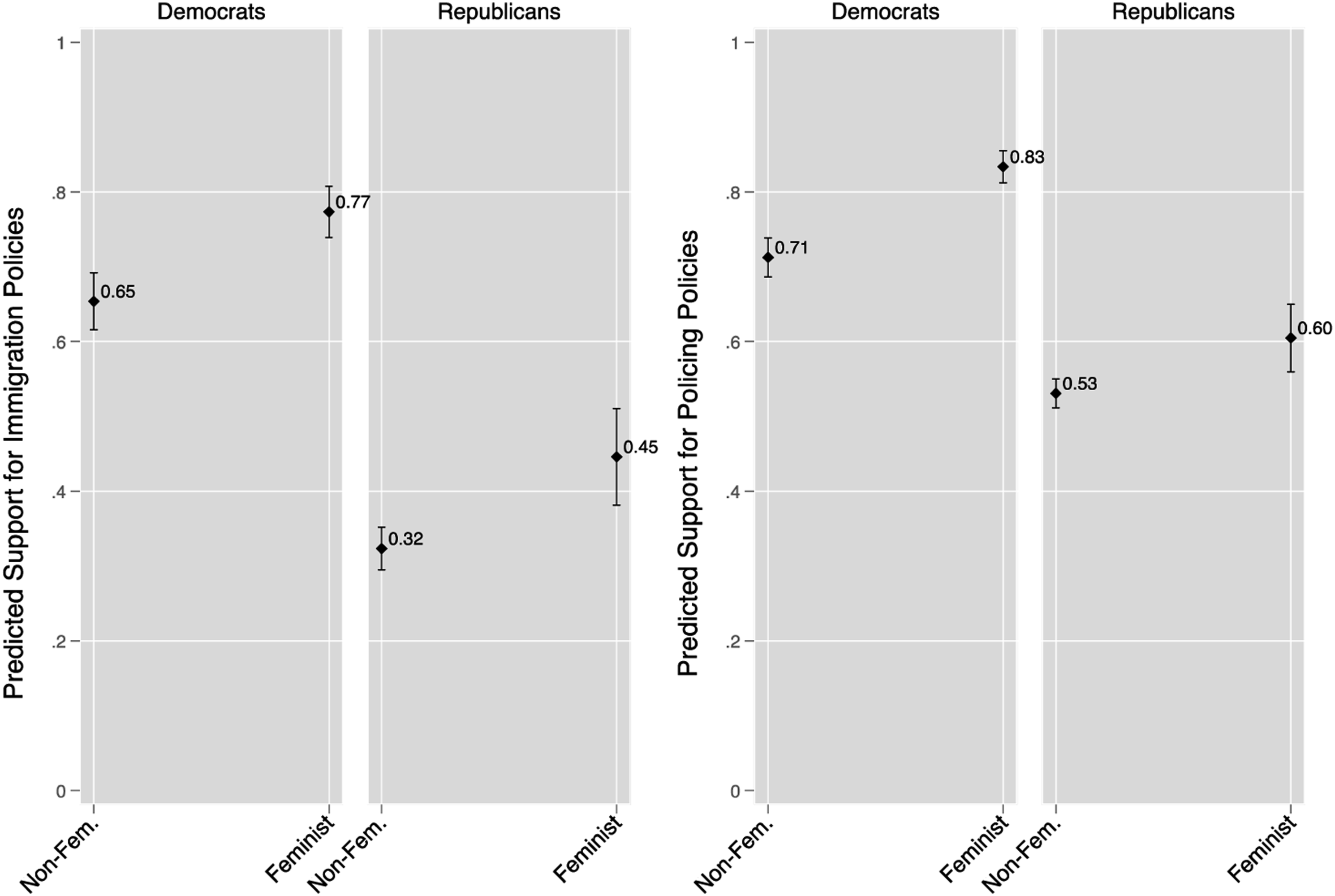
Figure 3 illustrates predicted support for more inclusive policies toward immigrants (left panel) and transgender individuals (right panel) in 2016. As in 2020, feminists of either party are significantly more supportive of such policies. Feminists are about 7% more likely (p < .001) than non-feminists in the Democratic Party and nearly 7% more likely (p < .001) than non-feminists in the Republican Party to endorse inclusive immigration policies. The gaps between feminists and non-feminists are larger regarding transgender policy—by over 12% (p < .001) among Democrats and about 9.5% (p < .01) among Republicans. These results provide further clear support for H2. Predicting policy attitudes by feminist and party ID in 2016.
To better understand whether these findings are merely driven by ideological differences, we have also analyzed our models by participants’ ideology. 9 The gap in policy positions between feminists and non-feminists largely persists across ideologies—among liberals, moderates, and conservatives in both parties. Furthermore, we have disaggregated our models by racial subgroup among Democrats. 10 Differences in predicted policy support between feminists and non-feminists are larger among non-Hispanic white than non-white Democrats.
Conclusion
Feminism and partisanship, while often correlated, are distinct identities that interact to create unique political elite evaluations and policy preferences. This paper relies on an original survey to demonstrate that feminists in both parties maximize their perceived closeness to other party members and sense of inclusion on multiple identity dimensions by giving higher feminist ratings than either non-feminists or out-party feminists to in-party elites. At the same time, due to social sorting, Democratic feminists enhance their distinctiveness and distance from out-party members by rating in-party elites as largely more feminist than out-party ones, whereas Republican feminists’ ratings do not significantly differ between in- and out-party figures.
Importantly, the interaction between feminist and partisan identification has key policy implications. Feminists in both parties demonstrate more support for public policies that advance social inclusion and equity goals beyond women’s rights and gender issues in both 2016 and 2020. This is consistent with recent results pointing to the association between feminist ID and recognition of racial discrimination (Harbin and Margolis, 2022). It suggests that a path for promoting public support for more inclusive, equitable, and just policies and outcomes may be to foster feminist identification and/or pro-feminist attitudes among Americans of all political leanings.
Overall, our results indicate that a salient label by itself, such as feminism, can enhance cleavages between parties, while also having a distinct impact on political attitudes within parties. Our choice to operationalize feminism as self-identification further shows that the label itself can affect preferences regardless of how individuals conceptualize it. It may therefore be a productive avenue for future research to examine how the influence of feminism varies when participants are provided with a definition of feminism, or when they are classified based on feminist beliefs.
Supplemental Material
Supplemental Material - Feminism within parties: Implications for political elite evaluations and policy attitudes
Supplemental Material for Feminism within parties: Implications for political elite evaluations and policy attitudes by Marzia Oceno and Lauren Chojnacki in Research & Politics
Footnotes
Acknowledgements
We thank Cindy Kam and John Sides for their constructive and helpful feedback.
Declaration of conflicting interests
The author(s) declared no potential conflicts of interest with respect to the research, authorship, and/or publication of this article.
Funding
The author(s) received no financial support for the research, authorship, and/or publication of this article.

Supplemental material
Supplemental material for this article is available online.
Notes
References
Supplementary Material
Please find the following supplemental material available below.
For Open Access articles published under a Creative Commons License, all supplemental material carries the same license as the article it is associated with.
For non-Open Access articles published, all supplemental material carries a non-exclusive license, and permission requests for re-use of supplemental material or any part of supplemental material shall be sent directly to the copyright owner as specified in the copyright notice associated with the article.
