



Abstract
Research in the wake of the contentious 2016 presidential primaries contends both Democrats and Republicans were internally divided along psychological lines. Specifically, MacWilliams (2016) finds authoritarian personality was strongly related to Trump support among Republican primary voters, and Wronski et al. (2018) finds authoritarianism was strongly related to Clinton support among Democratic primary voters. In this paper, I reassess the relationships between authoritarianism and 2016 primary candidate preferences for both Republicans and Democrats. I analyze two new large, probability-based surveys and generate random effects estimates using these surveys and two national surveys from Wronski et al. (2018). Overall, I find authoritarianism was moderately associated with support for Clinton over Sanders among Democratic primary voters, but weakly associated with support for Trump among Republican primary voters. My findings indicate authoritarianism may have played a more limited role in shaping Americans’ candidate preferences in the 2016 presidential primary elections than past studies have suggested.
Introduction
Political psychologists have long been interested in how authoritarian personality shapes political behavior in the United States (Adorno et al., 1950; Hetherington and Weiler, 2009). In two recent accounts, MacWilliams (2016) and Wronski et al. (2018) extend this line of inquiry to intra-party contexts by evaluating how authoritarianism was associated with Americans’ candidate preferences in the 2016 presidential primaries. MacWilliams (2016) argues authoritarianism was associated with support for Donald Trump over other Republican candidates in 2016, while Wronski et al. (2018) find that authoritarianism was associated with support for Hillary Clinton over Bernie Sanders among Democrats, but insignificantly related with support for Trump among Republicans. While these studies diverge somewhat on whether authoritarianism spurred support for Trump among Republicans, they agree authoritarianism played an important role structuring Americans’ intra-partisan political behavior during the 2016 primaries.
In this paper, I reexamine the relationships between authoritarianism and partisans’ 2016 primary candidate preferences. I conduct additional tests of the hypotheses that authoritarianism was associated with greater support for Trump and Clinton among their parties’ respective primary voters using two large, probability-based surveys. I twice find that authoritarianism was neither significantly associated with support for Trump among Republican primary voters, nor support for Clinton among Democratic primary voters (though just barely shy of significance in one case). And while random effects estimates pooling across the four available national samples between this study and Wronski et al. (2018) suggest authoritarianism was moderately associated with support for Clinton among Democratic primary voters (Wronski et al., 2018), authoritarianism seems to have been very weakly associated with Trump support for Republicans (MacWilliams, 2016). My findings indicate authoritarianism played a more limited role shaping Americans’ candidate preferences in the 2016 primaries than past studies have suggested.
Authoritarianism and candidate preferences in the 2016 primaries
Associations of 2016 Republican primary candidate preferences reproduced from MacWilliams (2016). Entries are logistic regression coefficients with standard errors in parentheses. Sample includes only “likely Republican primary voters.” Source: MacWilliams 2016, University of Massachusetts Amherst Political Science Department December 2015 National Survey.


Associations of authoritarianism to support for Republican primary candidates reproduced from MacWilliams (2016). Points are predicted probabilities of support for five Republican candidates with 95% confidence intervals as functions of authoritarianism. Sample includes only “likely Republican primary voters.” Source: MacWilliams 2016, University of Massachusetts Amherst Political Science Department December 2015 National Survey.
Associations of 2016 Democratic primary candidate preferences reproduced from Wronski et al. (2018). Entries are linear probability model coefficients with standard errors in parentheses. Partisan groups include independent leaners. Comparisons are Clinton over Sanders for Democrats and Trump over Cruz for Republicans. Source: Wronski et al. 2018, YouGov 2017, CCES 2016.


Associations of authoritarianism to support for Clinton and Trump in 2016 primary reproduced from Wronski et al. (2018). Points are predicted probabilities of support for Clinton over Sanders among Democrats (blue) and Trump over Cruz among Republicans (red) with 95% confidence intervals as functions of authoritarianism. Partisan groups include independent leaners. Source: Wronski et al. 2018, YouGov 2017, CCES 2016.
In this paper, I reevaluate the associations of authoritarianism and support for Trump and Clinton in the 2016 primaries. Why might these relationships warrant further assessment? First and foremost, MacWilliams (2016) and Wronski et al. (2018) reach different conclusions about how authoritarianism was associated with Republicans’ preferences in the 2016 primaries. Widely publicized media claims following MacWilliams (2016) suggest there was something psychologically distinct about Trump’s 2016 primary supporters relative to standard Republican identifiers, and that Trump was uniquely attractive to these authoritarian individuals among many Republican candidates. These popular accounts often imply psychological authoritarians are something of a lurking danger in the mass polity, and that 2016 was an example of this voting bloc collectively rearing its head. 4 Yet my reproductions of Wronski et al. (2018) suggest that non-authoritarian Republicans supported Trump’s primary campaign at rates similar to authoritarians; thus, it is unclear whether the credit (or blame) for Trump’s success in the 2016 primary can be mostly attributed to psychologically authoritarian Republicans.
Second, there are potential issues with the samples analyzed by Wronski et al. (2018) and MacWilliams (2016). The national samples analyzed in Wronski et al. are quite small: whereas MacWilliams’ December, 2015 survey includes 540 likely Republican primary voters, Wronski et al.’s CCES includes 260 Democratic and 145 Republican primary voters after listwise deletion, and their YouGov survey includes 195 Democratic and 119 Republican primary voters. These samples are concerning because samples with fewer than approximately 250 observations often generate unreliable correlational estimates (Schönbrodt and Perugini, 2013). Further, perhaps due to their small samples, Wronski et al. exclude Kasich and Rubio voters, who comprise 14% and 11% of the Republican primary electorate, from their study. Analyses of large samples would be beneficial towards reducing sampling error, increasing statistical power (Arel-Bundock et al., 2022), and allowing supporters of many major Republican primary candidates to be analyzed. Another potential concern with Wronski et al. and MacWilliams’ samples is that they are drawn from opt-in web panels. The generalizability of estimates derived from non-probability panels is the subject of ongoing debate, with some studies finding discrepancies to favor probability-based approaches (Malhotra and Krosnick, 2007; Meng, 2018; Yeager et al., 2011) and others finding approximately similar results across recruitment methods (Berrens et al., 2003; Clifford et al., 2015; Vitriol et al. 2019). Verifying that the associations identified by Wronski et al. (2018) and MacWilliams (2016) also emerge in probability-based samples would bolster these studies’ claims.
Finally, I argue MacWilliams (2016) does not provide sufficient evidence to sustain the claim that authoritarianism was associated with support for Trump in the 2016 primaries, but not other Republican primary candidates. MacWilliams (2016) claims that “Trump supporters are also distinct in their attitudes from the followers of the other Republican candidates.” MacWilliams reports the association of authoritarianism with Trump support (which is positive and significant), but does not report comparable coefficients for the other four Republican candidates. Instead, as shown in Table 1, MacWilliams (2016) presents models for these other candidates while interacting authoritarianism and terrorism threat. Without further information about the unconditional (or “main”) effects of authoritarianism, which is unavailable, it is impossible to conduct significance tests on the difference in the coefficients for authoritarianism across the five candidates. Notably, Figure 1 also shows a positive association between authoritarianism and support for Cruz, which could be consistent with Wronski et al.’s (2018) analyses. However, whether Trump and Cruz supporters significantly differ in authoritarianism in MacWilliams (2016) is unknown. As it stands, I argue MacWilliams’ claim that authoritarianism was associated with support for Trump, but not other Republican primary candidates, is insufficiently supported by the reported analyses.
Data and methodology
Sample descriptions. PRRI and ANES data are weighted. Sample sizes are after listwise deletion. Source: MacWilliams 2016, University of Massachusetts Amherst Political Science Department December 2015 National Survey, Wronski et al. 2018, YouGov 2017, CCES 2016, 2016 ANES Time Series, 2016 Public Religion Research Institute (NORC AmeriSpeak panel).

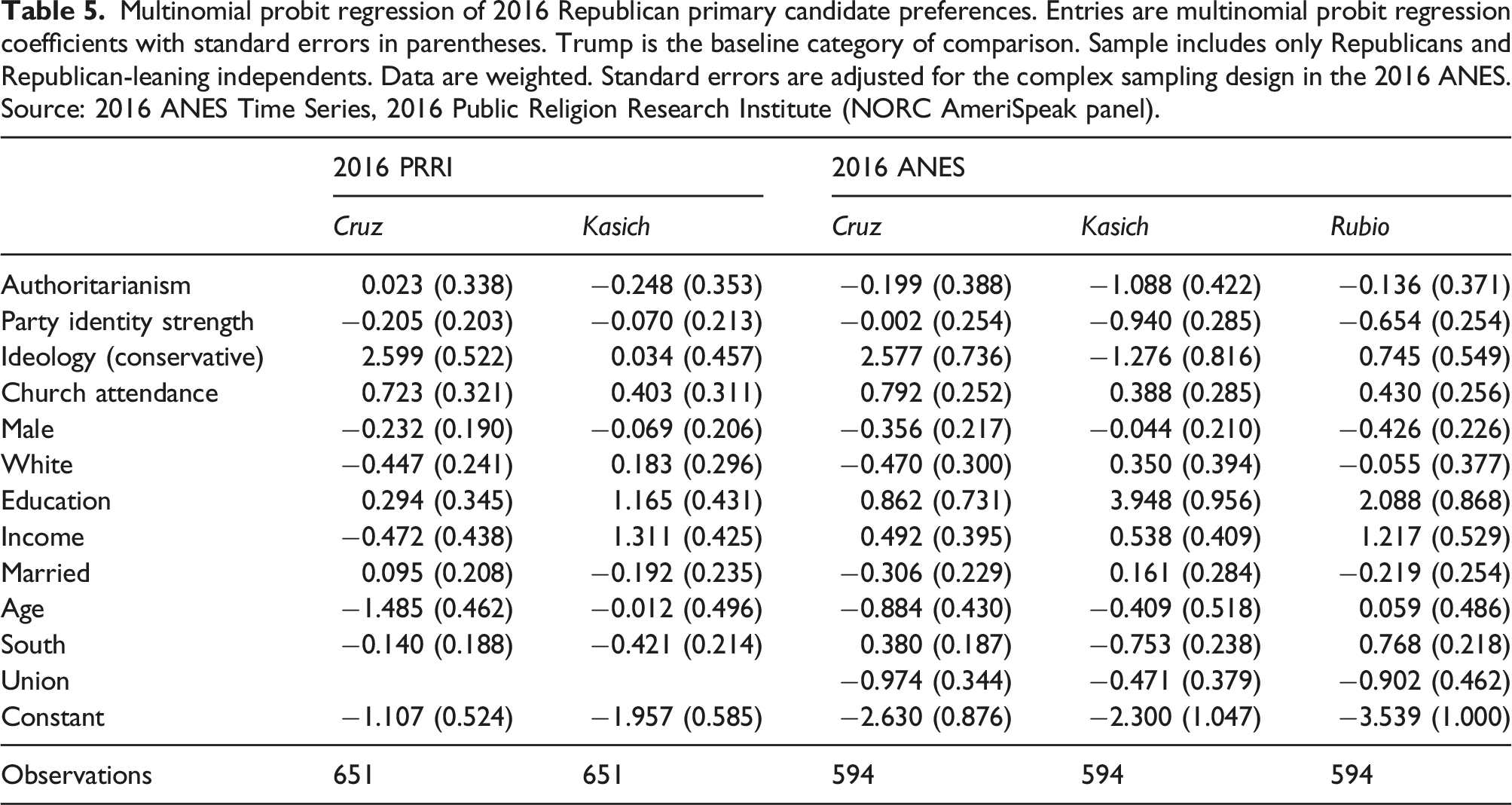
I model Democrats’ primary preferences using linear probability models with a dependent variable that takes values of 0 (Sanders) and 1 (Clinton). I model Republicans’ primary preferences using multinomial probit regression with a dependent variable that takes values of 1 (Trump), 2 (Cruz) and 3 (Kasich) in the PRRI, plus 4 (Rubio) in the ANES. 6 I also use all four estimates from Wronski et al.’s CCES and YouGov surveys, the ANES, and the PRRI survey in random effects models to estimate authoritarianism’s overall associations with Clinton and Trump support. 7 To facilitate random effects modeling of the Republican primary, I collapse the dependent variables into binary Trump/non-Trump outcomes and estimate these associations using linear probability models. However, the random effects estimates should be interpreted with caution, and always alongside the estimates from individual surveys, because these models aggregate over potentially important differences in the surveys’ recruitment methodology, timing, and analytic modeling.
I assess authoritarianism with the standard four-item childrearing values measure, which is the same authoritarianism measure used by Wronski et al. (2018) and MacWilliams (2016). I use the same set of controls as Wronski et al.’s CCES model 8 : age, gender, ethnicity, education, income, marriage, church attendance, southern residency, partisan identity, ideology, and union membership (which is not available in the PRRI survey). The covariates in this model differ from those used in MacWilliams (2016) to analyze the Republican primary, most importantly in that MacWilliams controls for terrorism threat but not partisan identity strength. However, in Appendix C, I show that my key findings are not substantively changed when using MacWilliams’ alternative model to analyze the Republican primary.
Results
Associations of 2016 Democratic primary candidate preferences. Entries are linear probability model coefficients with standard errors in parentheses. Sample includes only Democrats and Democratic-leaning independents. Data are weighted. Standard errors are adjusted for the complex sampling design in the 2016 ANES. Source: 2016 ANES Time Series, 2016 Public Religion Research Institute (NORC AmeriSpeak Panel).


Predicted probability of Clinton vote in 2016 Democratic primary. Points are predicted probabilities of support for Clinton over Sanders with 95% confidence intervals as a function of authoritarianism. Sample includes only Democrats and Democratic-leaning independents. Data are weighted. Standard errors are adjusted for the complex sampling design in the 2016 ANES. Source: 2016 ANES Time Series, 2016 Public Religion Research Institute (NORC AmeriSpeak panel).
Multinomial probit regression of 2016 Republican primary candidate preferences. Entries are multinomial probit regression coefficients with standard errors in parentheses. Trump is the baseline category of comparison. Sample includes only Republicans and Republican-leaning independents. Data are weighted. Standard errors are adjusted for the complex sampling design in the 2016 ANES. Source: 2016 ANES Time Series, 2016 Public Religion Research Institute (NORC AmeriSpeak panel).
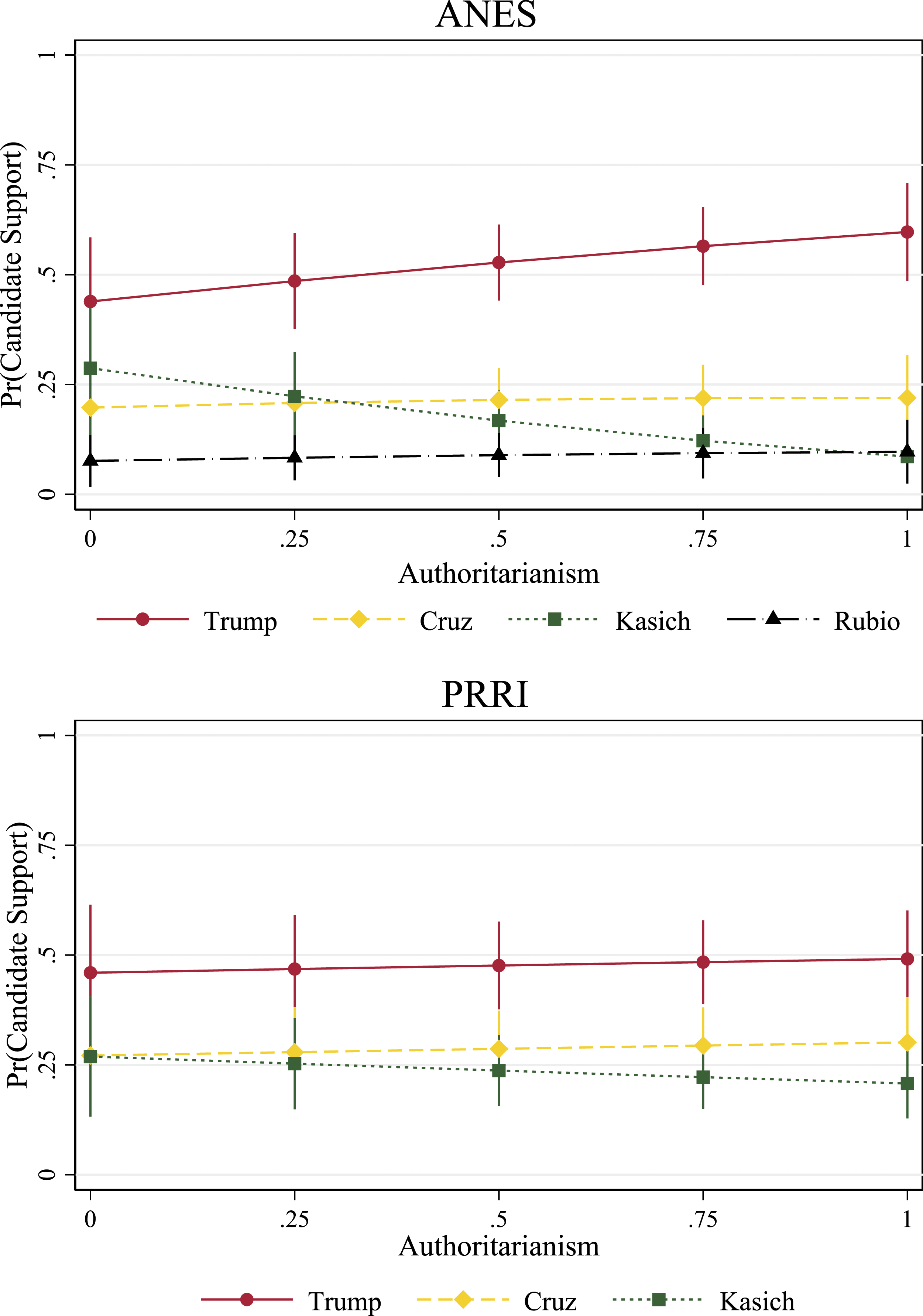
Predicted probabilities of candidate preferences in 2016 Republican primary. Points are predicted probabilities of support for each candidate with 95% confidence intervals as functions of authoritarianism. Sample includes only Republicans and Republican-leaning independents. Data are weighted. Standard errors are adjusted for the complex sampling design in the 2016 ANES. Source: 2016 ANES Time Series, 2016 Public Religion Research Institute (NORC AmeriSpeak panel).
Discussion
Before concluding, it is worth directly addressing the major limitations of my analysis. I use cross-sectional survey data to estimate the effects of authoritarianism on 2016 primary candidate preferences. As such, I cannot empirically discern the direction(s) of causality that generate correlations between authoritarianism and primary candidate preferences. A foundational assumption of political psychology is that personality occurs causally prior to political behavior. However, this assumption is seen as increasingly untenable. In recent studies, Bakker et al. (2021) find political attitudes and identities affect personality traits, and Luttig (2021) similarly finds Trump support causes Republicans to report higher levels of authoritarianism (but see also Engelhardt et al., 2021 who find authoritarianism is exogeneous to political attitudes/identities). The estimated effects of authoritarianism on primary candidate preferences in this study risk being biased by reverse causal influences, so they should be viewed as strictly associational.
A second issue is that it is difficult to handle partisan identity strength and ideology with a regression-based design. Partisan identity and ideology causally follow from authoritarianism (Hetherington and Weiler, 2009; Luttig, 2017), so controlling for these variables risks attenuating the estimated effect of authoritarianism. However, if authoritarianism is endogenous to partisan identity and ideology, and partisan identity and ideology cause primary candidate preferences, excluding these variables risks confounding authoritarianism’s relationship with primary candidate preferences. In supplemental analyses (Appendix D), I drop these covariates and find the random effects estimated association of authoritarianism with support for Clinton increases modestly from 0.11-points to 0.17-points, while the association with Trump support barely decreases from 0.05-points to 0.04-points.
Conclusion
Prior research contends that psychological authoritarianism divided American partisans during the 2016 presidential primaries, spurring support for Hillary Clinton among Democrats (Wronski et al., 2018) and support for Donald Trump among Republicans (MacWilliams, 2016). Towards confirming how authoritarianism was related to primary candidate preferences in 2016, I examined two new large, probability-based surveys. I twice failed to find authoritarianism was significantly associated with support for Clinton among Democrats or support for Trump among Republicans in the 2016 primaries. Using a random effects model to pair my analyses with two reproduced from Wronski et al. (2018), I found a moderate association between authoritarianism and support for Clinton among Democratic primary voters. However, I also found MacWilliams’ (2016) claim that authoritarianism was strongly associated with support for Trump among 2016 Republican primary voters to be considerably overstated.
That I find authoritarianism had weaker effects than past studies is not especially surprising; social scientific replication studies generally find smaller effects than original studies (Camerer et al., 2018). Ideally, however, we would know what caused these discrepancies. In my view, four factors could explain these discrepancies: differences in (1) sample size; (2) survey timing; (3) survey recruitment; and/or (4) modeling decisions.
Sample size is very likely one reason why I find smaller effects than past studies. The typical political science study is underpowered and, therefore, noisy (Arel-Bundock et al., 2022); there is an inverse relationship between sample size and effect size in published social science research (Gerber et al., 2001; Kühberger, Fritz, and Scherndl, 2014); and the publication of large effects when analyzing small samples is more or less mechanical when publication biases favor significant findings because only large effects can attain significance in small samples (Esarey and Wu, 2016; Loken and Gelman, 2017). Large, out-of-sample tests are useful in this regard because they reduce noise and offer opportunities for mean reversion to emerge. In addition, the surveys’ timings likely affected the estimated associations between authoritarianism and primary candidate preferences. Studies assessing these associations have used surveys spanning 2015–2017, and there is no guarantee these associations were stable over this period. Specifically, although authoritarianism seems to have been weakly associated with Trump support during the primaries and afterwards in vote choice recalls, authoritarianism could have been more strongly associated with Trump support immediately before the primary’s onset when MacWilliams’ study was fielded. Finally, further discrepancies could be caused by differences in sample recruitment. Since the goal of this inquiry is to identify the associations of authoritarianism with primary candidate preferences in the electorate, generalizability to this population is important. Claims of generalizability are typically seen as more credible when analyzing probability-based surveys like the ANES and PRRI, even though non-probability surveys can still be informative.
Although differences in survey size, timing, and recruitment strike me as plausible causes of the discrepancies between my estimates and those of past studies, I do not believe differences in modeling decisions explain these discrepancies. The main regression model I use is admittedly different from the one MacWilliams (2016) used to examine the Republican primary; however, I also find weaker associations using MacWilliams’ preferred model (Appendix C). My estimates also remain relatively weaker when controls for partisan identity strength and ideology are dropped (Appendix D), using different likely voter screens (Appendix E), and using logistic regressions (Appendix F). Across multiple model specifications and samples, authoritarianism is moderately associated with Clinton primary support and weakly associated with Trump primary support.
This study makes several important contributions. My analyses add to an emerging line of scholarly inquiry concerned by the intra-partisan consequences of psychological differences (MacWilliams, 2016; Wronski et al., 2018; Luttig, 2017). Although I find authoritarianism likely mattered less in shaping 2016 presidential primary preferences than extant research suggests, this does not necessarily mean psychological traits are unimportant in intra-partisan contexts; rather, I hope my findings prompt further inquiry into whether and how psychological differences manifest in intra-party divisions. However, this study does show the claim that authoritarianism “provided the fuel for Trump’s [primary] campaign” is overstated (MacWilliams, 2016). To be clear, this is not to say Trump was not authoritarian himself—his dehumanizing rhetoric, nativist appeals, and calls for political opponents to be jailed suggest otherwise (Jardina and Piston, 2021). But despite Trump’s authoritarian proclivities, the distribution of his primary support in authoritarianism was similar to other Republican candidates. My findings thus support accounts that argue other social and economic transformations better explain Trump’s electoral success than psychological authoritarianism (Gordon, 2016). As such, it would not be surprising if authoritarian and non-authoritarian Republicans rally behind Trump’s recently announced 2024 primary campaign.
Supplemental Material
Supplemental Material - Authoritarianism and support for Trump and Clinton in the 2016 primaries
Supplemental Material for Authoritarianism and support for Trump and Clinton in the 2016 primaries by Trent Ollerenshaw in Research & Politics
Footnotes
Declaration of conflicting interests
The author(s) declared no potential conflicts of interest with respect to the research, authorship, and/or publication of this article.
Funding
The author(s) received no financial support for the research, authorship, and/or publication of this article.

Supplemental Material
Supplemental material for this article is available online
Notes
References
Supplementary Material
Please find the following supplemental material available below.
For Open Access articles published under a Creative Commons License, all supplemental material carries the same license as the article it is associated with.
For non-Open Access articles published, all supplemental material carries a non-exclusive license, and permission requests for re-use of supplemental material or any part of supplemental material shall be sent directly to the copyright owner as specified in the copyright notice associated with the article.
