



Abstract
As an infectious disease, malaria consumes around 250 million yearly clinical cases and with more than half a million annual deaths. It has shown tremendous burden for the economic and social life of many countries around the world, particularly in the tropical and developing nations. The conventional wisdom claims that the prevalence of malaria infection either prolongs or should be positively correlated with outbreaks of civil conflicts. We contend that malaria infection should deter civil conflict occurrences because warming parties should avoid engaging each other in areas with rampant malaria infection. We test the hypothesis with 20 years of geo-referenced panel data of conflict event and malaria risk from Sub-Sahara Africa. Our result renders strong support for our hypothesis that areas with more malaria infection tends to have less civil conflicts.
Introduction
Malaria, a prevalent tropical disease, significantly impacts global human settlement. Accounting for approximately 250 million annual clinical cases and over half a million deaths, malaria imposes substantial economic and societal burdens, especially in developing nations within the tropics (Sachs and Malaney, 2002: 680). Malaria infection has been identified as a major barrier to economic development in the Global South (Worrall et al., 2005).
A parasitic infection transmitted via the female Anopheles mosquito, malaria profoundly affects human health and military efficacy in tropical climates (Holt et al., 2002). The disease’s prevalence in tropical forests and jungled marshes, common mosquito habitats, has made it a most daunting challenge for warfare in these regions (Slater, 2009). History is replete with instances where malaria impeded effective warfighting in the tropics, particularly against unacclimated troops. It notably hindered military efficiency during World War I, the Pacific campaigns of World War II, and American engagements in Indochina during the Cold War (Beadle and Hoffman, 1993; Bello, 2005; Brabin, 2014).
Although malaria’s impact on international conflicts is well recognized, its systematic examination in the scholarship of civil conflict dynamics remains rare. A handful of existing studies concur on a positive correlation between malaria prevalence and civil conflicts. Yet they diverge on whether pathogen prevalence predisposes countries to civil war or if civil war augments disease incidence (Hendrix and Gleditsch, 2012; Letendre et al., 2010). Furthermore, Bagozzi (2016) argues that malaria prevalence may extend the duration of civil conflicts.
In this article, we hypothesize that malaria prevalence can lead to reduced civil conflict incidences. This theory arises from the assumption that both government and rebel forces would likely strive to evade areas stricken with the disease, resulting in fewer militarized civil conflicts in regions prone to severe malaria infection. To empirically test this hypothesis, we diverge from the traditional methodology in prior research, which uses country as the unit of analysis. Instead, we delve into the influence of malaria prevalence on the actual battlefield selection at the subnational level.
We employ granular data from the Uppsala Conflict Data Program Georeferenced Event Dataset (UCDP-GED) (Sundberg and Melander, 2013) and GIS-referenced malaria data from the Malaria Atlas Project (MAP) (Guerra et al., 2007; Hay and Snow, 2006). We focus on Sub-Saharan Africa, a region characterized by both high malaria prevalence and frequent civil conflicts (Buhaug and Rød, 2006). Our empirical analysis robustly supports our hypothesis, revealing a negative correlation between malaria prevalence and the occurrence of civil conflict battles.
This article is organized as follows. First, we situate our study in existing literature and explain our theory about how malaria could decrease civil conflict occurrences. Next, we introduce our data sources, empirical models, and statistical results. Using South Sudan as a case study, we further illustrate the relationship between malaria infection and civil conflict dynamics. We conclude the article by noting the limitations of our study and suggesting directions for future research on pandemic and civil conflict dynamics.
Malaria and civil conflicts in Sub-Sahara Africa
Malaria’s global infection patterns are different across continents because of its association with the prevalence of certain mosquitos. Of these, Sub-Saharan Africa has the most stable rates of malaria infection (Carter and Mendis, 2002: 567). Meanwhile, Sub-Saharan Africa has received considerable scholarly attention within the literature on civil conflicts, given its large number of nation-states within the African continent and its expansive geographical span. We argue that malaria has a temporal-spatial effect on geographical locations of civil conflicts in Sub-Saharan Africa.
Bagozzi argues that malaria should be considered a rough terrain factor that can “asymmetrically enhance rebel group’s defensive capabilities and thus prolong the duration of civil war” (Bagozzi, 2016: 817). He points out that the cost of malaria will be higher for larger government troops, who are less likely to develop immunity to malaria than rebel groups due to frequency of troop rotation. Meanwhile, the presence of malaria can prevent government from constructing crucial infrastructure and poses challenges to the projection of government forces (Bagozzi, 2016: 817–8).
Does this effect on prolonging civil war mean there are more frequent battles among warring parties? Historical evidence suggests the opposite: malaria has been recognized as a significant factor that hinders effective fighting in tropical areas. While malaria’s rough terrain effect may favor the rebel forces, it is also reasonable to expect that government forces would avoid engaging with rebel forces in places with high infection rate of malaria. Such engagement would diminish the advantage enjoyed by the government troops while favoring the rebel forces. Consequently, government forces would naturally seek to fight the rebel forces in other locations where they have a better chance of success. Additionally, while rebel forces may develop some immunity to malaria, this immunity is not necessary long-lasting (Struik and Riley, 2004). Repeated malaria infection can still have negative health consequences (Hafalla et al., 2011; Weiss et al., 2010). Therefore, neither government nor rebel forces would willingly engage in military battles in area where there is prevalent malaria risk. Moreover, escalated fighting between government and rebel forces often leads to the displacement of civilian population seeking refuge in more challenging terrains, thereby increasing their vulnerability to malaria. As a result, we expect malaria infection to deter militarized battles, leading us to hypothesize a negative correlation between battle location and malaria infection.
Data
To examine the local-level relationship between conflict and malaria risk, we compile a panel dataset spanning 20 years (2000–19) in Sub-Saharan Africa. The dataset contains geo-referenced information on both conflict occurrences and malaria risk. Our dependent variable is the occurrence of civil conflicts and is constructed using UCDP-GED. We specifically focus on the subset of state-based violence, which includes events where at least one side is the state. We also construct an alternative dependent variable using records of battles from the Armed Conflict Location and Event Data Project (ACLED) for robustness checks (Raleigh et al., 2010).
Our independent variable is the risk of malaria infection, which we measure using the proportion of children 2–10 years of age showing detectable Plasmodium falciparum parasite (Pfpr 2-10). 1 We obtain these data from MAP, a public health data initiative known for its comprehensive cross-national geo-referenced malaria risk data. MAP employs a two-step meta-analysis process to construct the malaria risk measures (Bhatt et al., 2015; Pfeffer et al., 2018). First, they aggregate geo-referenced surveys on mosquitos and falciparum parasite prevalence from various sources. Second, they fit spatial-temporal epidemiological models using the vector data to interpolate malaria risk data in area-years where direct measurements are not available.
To account for potential confounders, we include a set of covariates in our statistical models. Malaria risks can be associated with state capacity, roughness of physical terrain, level of development, and population mobility, which are widely recognized determinants of civil conflicts (Chang and Wei, 2019; Datta and Reimer, 2013; Martens and Hall, 2000). To account for confounders, we control for indicators of these factors in our statistical models. First, we control for indicators of physical rough terrain, including forest area, mountainous area, and precipitation level. Second, we control for indicators of development level, including night-time light, urban area, irrigated area, and population. Thirdly, we control for state capacity measured by distances to border and distance to capital (Chen and Nordhaus, 2011). Finally, we account for population mobility by controlling for the presence of refugee camps.
We obtain most of the above covariates from the PRIO-GRID 2.0 database (Tollefsen et al., 2012). To complement these, we utilize data from four additional sources: nighttime light data from new data work that harmonizes the pre- and post-2013 satellite data (Li et al., 2020), forest coverage data from the Global Forest Change data (Hansen et al., 2013), precipitation data from The Tropical Rainfall Measuring Mission (Huffman et al., 2007), and location for refugee camps from Geo-Refugee (Fisk, 2017).
All the data are transformed into PRIO-GRID vector grid networks with resolutions of 0.5 × 0.5 decimal degrees. 2 By merging these datasets, we construct a 20-year (2000–2019) panel of raster data covering grids located in Sub-Saharan Africa (by United Nation’s definition). 3
In Figure 1, we present a visual depiction of our dependent and independent variables, along with their correlation. Panel (a) and (b) show the spatial distribution of state-based conflicts and malaria risk in Sub-Saharan Africa, showcasing significant variation across the region. Panel (c) depicts the bivariate correlation between state-based conflicts and malaria through a boxplot by group. It shows that grid-years with recorded state-based conflicts (top box) on average exhibit lower malaria risk than those without conflicts (bottom box), providing initial support for of our hypothesis. Spatial distribution of state-based conflicts and malaria risk.
Empirical models and results
We fit logistic regression models to systematically investigate the relationship between malaria risk and the occurrence of conflict. Our dependent variable is a binary indicator of conflict occurrence at the grid-year level. Malaria risk is our main independent variable. We also control for a set of conventionally important predictor of civil conflicts, including physical rough terrain, development level, state capacity, and human mobility. To address spatial-temporal dependencies, we incorporate spatially and temporally lagged dependent variables—the former is defined as the proportion of a grid’s 10 neighboring grids that have conflicts in the previous year and the latter whether a grided cell has conflict occurrence in the previous year (Ward and Gleditsch, 2008).
4
Formally, for Grid i in Country j in Year t

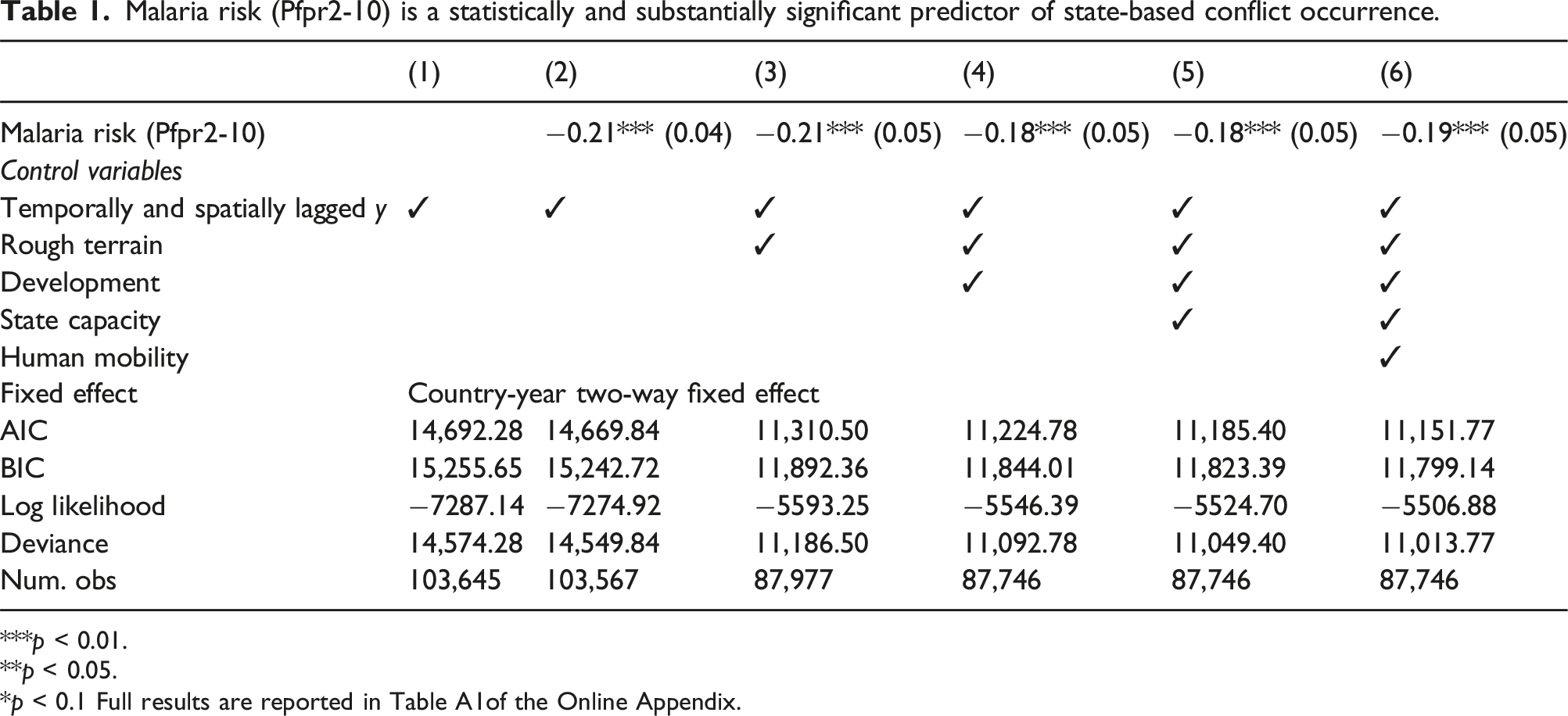
Malaria risk (Pfpr2-10) is a statistically and substantially significant predictor of state-based conflict occurrence.
***p < 0.01.
**p < 0.05.
*p < 0.1 Full results are reported in Table A1of the Online Appendix.
Across models, the estimated coefficients for malaria risk have larger absolute values compared to all those of control variables. This suggests that the magnitude of the effect of malaria is the largest even comparing with conventional important predictors of conflict occurrences.
5
Figure 2 shows the simulated odds ratios of malaria risk and control variables. The estimated odds ratio of malaria risk ranges from 0.81 to 0.84 across the models. This means for every 1 standard deviation increase in the proportion of children aged 2–10 with Plasmodium falciparum in the current year, the odds of conflict occurrence in the next year decrease by 16%–19%. Notably, the effect of malaria risk on conflict odds surpasses that of conventionally important predictors of conflict occurrence in our models: roughness of physical terrain (forest area, mountainous area, and precipitation level, development level (night-time light, urban area, and population), and state capacity (distance to border and capital)—none of them shifts the odds of conflict by more than 16%. The odds ratio of malaria risk is the largest compared to other covariates.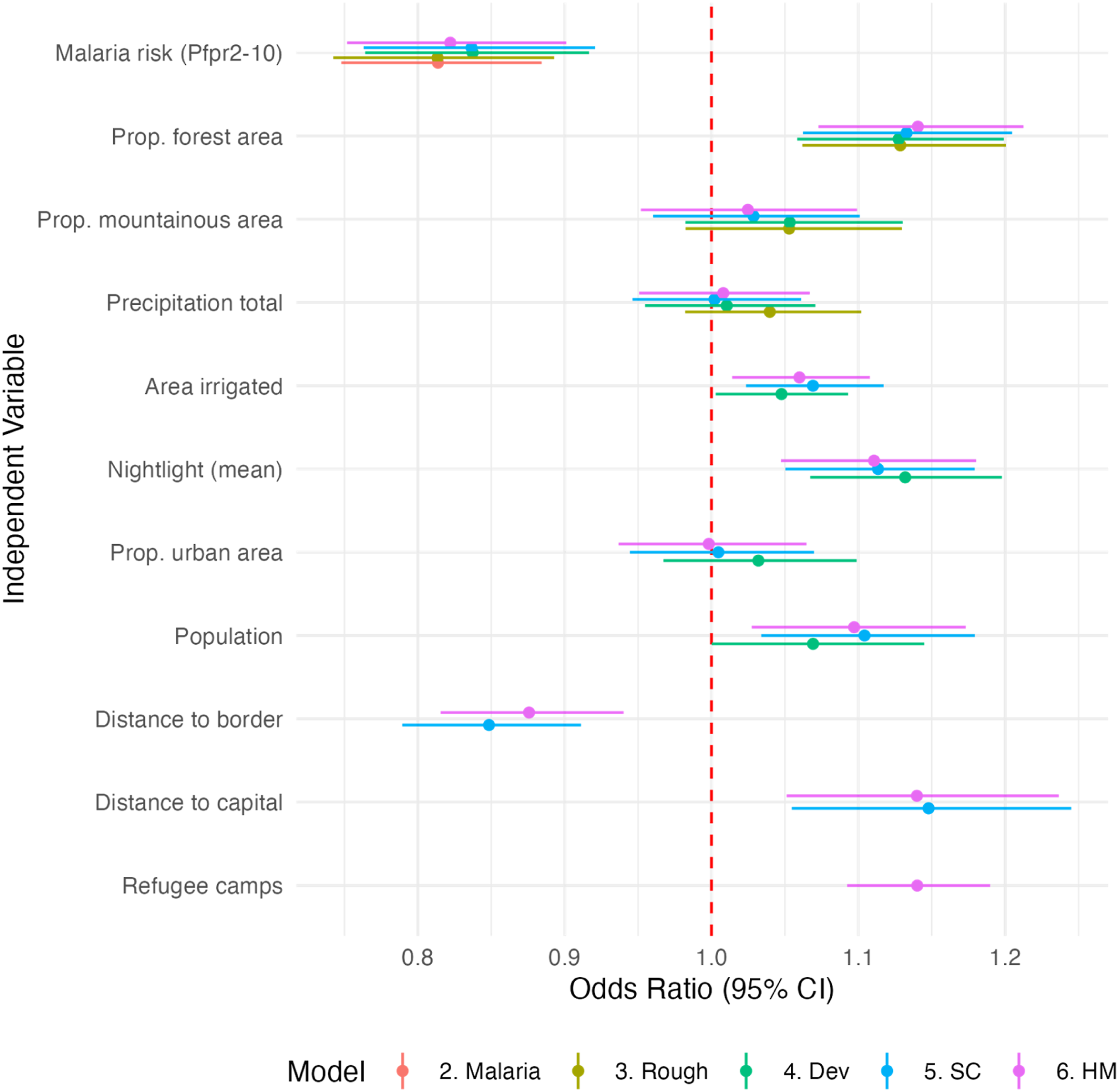
Our findings withstand robustness checks involving alternative measures and model specifications. We fit models with only spatially lagged dependent variables. Considering the rare occurrence of conflicts (only 3% of the grid-year report state-based civil conflicts), we fit rare event logistic regressions (King and Zeng, 2001). 6 To address possible measurement error associated with our malaria risk indicator, we fit models with an alternative independent variable: the number of newly diagnosed P. falciparum cases per 1000 population. Additionally, to account for possible measurement error of the UCDP dataset, we fit models with the dependent variable measured by the ACLED dataset. Across all these robustness checks, malaria risk consistently emerges as a statistically significant predictor, leading to a reduction in conflict odds. 7
South Sudan as an illustrative case
The case of South Sudan serves as a compelling example of the negative association between malaria risk and militarized conflicts in specific regions. Since gaining independence in 2011, South Sudan has exhibited spatial variation in both conflicts and malaria, as depicted in Panels (a) and (b) of Figure 3. To further explore this relationship, we focus on the subset of the grids in South Sudan and fit them to the statistical models shown in Table 1. Our results, presented in Panel (c) of Figure 3, indicate that malaria risk is a statistically significant predictor of reduced conflict odds. Moreover, the magnitude of the effect is large, with a standard deviation increase in malaria risk associated with 13%–39% reduction of conflict odds.
8
Malaria risk decreases conflict odds in South Sudan from 2010 to 2019.
Qualitative evidence further supports our statistical analysis of the case of South Sudan. The country’s struggle for independence from Sudan and subsequent civil war have resulted in prolonged violence, causing significant damage to physical infrastructure, social institutions, and the healthcare system. Malaria remains the most prevalent cause of morbidity and mortality in South Sudan (Idris et al., 2022). Specifically, it accounts for 20%–40% of morbidity cases, with over 20% of reported deaths occurring in health facilities, and 30% of hospital admissions related to the disease (Pasquale et al., 2013). During the recent civil war in South Sudan, the confrontation between rebel and government forces led to the displacement of tens of thousands of individuals, forcing them to seek refuge in hostile, non-conducive environments such as the bush. In these areas, they lacked access to essential medical facilities and mosquito nets. According to Medecins Sans Frontieres (2021), this led to increased risk of malaria infection. While it is difficult to provide definitive evidence of the avoidance of malaria-infested areas by government or rebel forces, existing reports suggest that civilians who sought refuge in these areas were at the highest risk of infection.
Conclusion and discussion
In this article, we have extensively examined the relationship between malaria infection distribution and civil conflicts in Sub-Saharan Africa using granular geo-referenced data. Our findings robustly support our hypothesis of a negative correlation between the two.
It is worth noting that our results do not contradict previous study arguing that malaria can prolong civil conflict durations (Bagozzi, 2016). While malaria prevalence may reduce the frequency of militarized battles, it does not exclude the possibility of prolonged civil wars. In another word, in areas with rampant malaria, civil wars may be “colder”—they last longer but exhibit a lower intensity.
This study contributes to the understanding of how infectious diseases, using malaria as an example, can affect civil conflict dynamics in Sub-Saharan Africa. Although previous studies on civil conflicts and infectious diseases have suggested a positive correlation between the two (Hendrix and Gleditsch, 2012; Letendre et al., 2010), our results suggest a more nuanced relationship.
This study has clear limitations. Particularly, the potential bias in news reporting—a common issue in studies relying on civil conflict news reports—could affect the accuracy of our findings. For example, journalists’ reluctance to travel to malaria-prone regions could results in underreporting of conflicts. Future research can consider these reporting biases and further investigate the impact of different types of diseases on civil conflicts and vice versa.
Supplemental Material
Supplemental Material - Infectious disease and political violence: Evidence From malaria and civil conflicts in sub-saharan Africa
Supplemental Material for Infectious disease and political violence: Evidence From malaria and civil conflicts in Sub-Saharan Africa Haohan Chen, Zifeng Wang, and Enze Han in Research & Politics.
Footnotes
Declaration of conflicting interests
The author(s) declared no potential conflicts of interest with respect to the research, authorship, and/or publication of this article.
Funding
The author(s) disclosed receipt of the following financial support for the research, authorship, and/or publication of this article: Publication made possible in part by support from the HKU Libraries Open Access Author Fund sponsored by the HKU Libraries.
Correction (June 2025):

Supplemental Material
Notes
References
Supplementary Material
Please find the following supplemental material available below.
For Open Access articles published under a Creative Commons License, all supplemental material carries the same license as the article it is associated with.
For non-Open Access articles published, all supplemental material carries a non-exclusive license, and permission requests for re-use of supplemental material or any part of supplemental material shall be sent directly to the copyright owner as specified in the copyright notice associated with the article.
