



Abstract
Members of parliament routinely submit private bills. Yet, a minority of these bills are enacted. Existing research suggests that, because of the low enaction rates of private members' bills, policymaking motivation is not the primary purpose of members of parliament in submitting these bills. We question this assumption and argue that existing research examines the policy effect of Private Member Bills (PMB) too narrowly. Taking a policy process perspective, we propose, first, that a more accurate assessment of the success rate of private members' bills should look only at the bills entering the legislative process. Second, we propose that the policy effect of private members' bills should not be limited to the end result of enactment, but rather to examine their effect on the agenda-setting stage. We demonstrate these propositions using the case of private members' bills in Israel, a country that has one of the highest rates of PMBs and has institutionalized the process of evaluating them. The study provides a better understanding of private members' bills in parliamentary democracies.
Keywords
Introduction
Private members' bills (PMBs) are one of the main tools for members of parliament (MPs) to make policy and to signal policy positions (Bräuninger and Debus 2009; Brunner 2012). Because the prospects of PMBs with no coalition support becoming laws are very low, the conventional wisdom is that policymaking motivation for submitting PMBs is negligible. Instead, they are primarily submitted for signaling to potential supporters about the policy preferences and actions of MPs (Bowler 2010; Williams and Indridason 2018).
Based on theories of the policy process, and specifically agenda-setting (Baumgartner and Jones 2010; Green-Pedersen and Walgrave 2014; Jones and Baumgartner 2005; Kingdon 2011), we suggest that the policymaking motivation of PMBs is not sufficiently addressed. First, we argue that the low inaction rate of PMBs is currently miscalculated as a ratio of all PMBs introduced, most of which do not enter the legislative process. Second, we argue that PMBs' role in the policy process should be examined not on the end result—that is, enaction, but on its effect on the legislative and government policy agenda (Baumgartner and Jones 2010). By submitting PMBs, MPs can turn the attention of the government, the media, or the public to a problem or a suggested solution, a necessary first step in the policymaking process (Green-Pedersen 2019; Green-Pedersen and Walgrave 2014; Jones and Baumgartner 2005).
We show initial evidence in support of our arguments using the case of Israel, a country that has one of the highest rates of PMBs in parliamentary democracies. The high number of PMBs forces the government to be involved in the legislative process of PMBs (Bringer, 2019). This makes Israel a most likely case for examining the effect of PMBs on the government agenda.
Analyzing an original database of PMBs in Israel from 201 to 2019 (N = 8,917) 4 and their progress through the legislative process, we show exploratory evidence that the success rate of PMBs is much higher than commonly perceived and that PMBs influence the government agenda by requiring the government to address and respond to them. Our findings contribute to existing research on the role of PMBs in parliamentary democracies and on parliament’s influence on policymaking.
Private member bills
In parliamentary democracies, legislation can be initiated by the government or individual members of parliament. Bills associated with the later type of legislation are commonly referred to as private member bills (PMBs). Legislators may use PMBs to serve their policymaking motivation, submitting PMBs about policies they care about (Bräuninger and Debus 2009). Without government support, most PMBs will likely fail to pass the legislative process because the government controls legislation proceedings through a majority advantage of the coalition (Andeweg and Nijzink 1995; Brunner 2012). Still, this tool is used by coalition and opposition members. Coalition members submit PMBs about conflictual issues on which the government does not wish to take direct responsibility, when the government wants to avoid the political embarrassment of defeat, or when individual members wish to submit a bill against the government’s policy (Däubler et al. 2016). Opposition members use PMBs to promote their policy agenda, especially on issues the coalition is divided on (Seeberg 2013).
Because of the low success rate of PMBs, contemporary work suggests that even if policymaking motivation exists at the margin, PMBs best serve as a signaling motivation of MPs. The signaling motivation requires MPs to act (and receive attention for it), regardless of the success of their action. It is a signaling game in which MPs show that they are doing something about issues people or parties care about (Bowler 2010; Williams and Indridason 2018).
However, the perceived marginality of the policymaking motivation for submitting PMBs might be exaggerated. PMBs are policy ideas (Casas et al. 2020). Until they are voted on, they are a primeval soup of policy solutions (Kingdon 2011). These policy solutions are floating around. Only when they are discussed, modified, and meet various criteria of the policy community they are ready to be connected to a particular problem. Therefore, we should not treat each PMB as a viable policy alternative prepared to be promoted but focus on those that already “softened up,” received some support, and coupled with a specific policy problem. These PMBs are those that entered the legislative process. Consequently, the enaction rate of PMBs should be calculated not as the share of laws from all the PMBs introduced but rather from PMBs that entered the legislative process.
In addition, the policy effect of PMBs should not be measured solely by the end result of legislative enaction—which may indeed be low—but in terms of the entire policy process. PMBs are policy solutions placed on the legislature’s policy agenda (Wilkerson et al. 2015), the first and necessary stage in the policy process (Jones and Baumgartner 2005). The importance of the agenda-setting stage lies in the fact that the policy agenda reflects the policymaker’s attention. Attention in the policymaking process is limited and consequential. It is limited because, although problems deserving government attention are almost infinite, policymakers cannot attend to all the problems due to cognitive and organizational constraints. It is consequential because, due to its scarcity, policy attention becomes a necessary condition for a policy change (Green-Pedersen and Walgrave 2014; Jones and Baumgartner 2005). Taking this approach, an MP who places an issue on the government agenda potentially promotes policy. For example, Seeberg (2013) shows that by introducing parliamentary questions, opposition parties force the government to address issues the opposition cares about.
We, therefore, test two propositions. First, that the enactment rate is significantly larger once we examine only the PMBs that enter the legislative process. Second, that by placing PMBs on the agenda, MPs influence the government agenda. We examine our propositions using an original dataset of PMBs in Israel.
Private member bills in Israel
The 120 members of the Israeli Knesset have been increasingly using the tool of PMBs at rates that currently surpass those of many other parliamentary democracies (Shomer 2009; Tuttnauer 2020). MKs have no institutional limits on the number of PMBs they submit. A PMB has a 45-day waiting period before it can be voted on; therefore, MKs need to submit them well in advance to be able to act on them when relevant.
The left panel in Figure 1 illustrates the number of PMBs in each of the last 10 full Knessets (from 1984 to 2019). Because of the variation in the length of each Knesset, the right panel summarizes the mean of PMBs per month in each Knesset. Over the last five Knessets, MKs submitted, on average, more than 100 PMBs every month. This stage is termed the submission stage. Private member bills (PMB) in the Israeli kessets, 11–20 (1984–2019).
For a PMB to be considered and deliberated on, MKs must place it for a preliminary vote in the plenum. Like any other venue (Jones and Baumgartner 2005), the Knesset agenda capacity is limited. As a result, each party receives a quota of the PMBs (and motions) it can introduce in each session. The party quota is calculated by the Knesset Committee at the beginning of each session as a function of the relative size of the party, giving an edge to parties of the opposition. 1 Only PMBs submitted for a preliminary vote are placed on the Knesset agenda. This stage is termed the Knesset agenda.
As in many other parliamentary democracies (Bergman et al. 2021), the Israeli government has an institution that regulates the legislative agenda: The Cabinet Committee of Legislature (CCL). This committee, chaired by the Minister of Justice, comprises several cabinet ministers, usually including representatives from all coalition partners. Once a PMB is placed on the Knesset agenda, the Knesset’s secretariat passes all PMBs scheduled for the following week to the government secretariat, which forwards the list to all relevant ministries for their consideration. At the beginning of each week, the CCL meets to deliberate on bills it chooses and decides how to respond to them. When discussing each PMB, the CCL consults the minister whose Ministry would be affected by the PMB and other coalition partners if the bill affects the coalition agreements (Bringer, 2019). Each Ministry submits briefs in support or opposition to the PMB and can discuss it during the CCL meeting. This forces the government to seek information on the problems or solutions proposed in the PMB, which can further broaden the government agenda (Baumgartner and Jones 2015). The bills which the CCL does not select are postponed until forward notice. This entails that the government opposes the bill. This stage is termed the government agenda.
The decisions of the CCL on the bills introduced to it gain the status of a cabinet decision that binds the coalition partners in the legislation process. We term the category of PMBs that receive CCL support, government support.
The enactment rate of PMBs in Israel is among the lowest (4%) in Western democracies (Rolef 2014). Though some PMBs are enacted and have an important policy effect (Akirav 2018), the low success rate strengthens the claim that PMBs in Israel primarily fulfill a signaling motivation (Friedman and Friedberg, 2021; Tuttnauer, 2020). We do not question the policy-signaling motivation of PMBs but also propose a more meaningful policymaking effect than currently suggested. We do so by examining the policy agenda of PMBs in the various stages.
Data
Our data include all PMBs submitted during two full Knessets (N = 8917): Knesset 19 (N = 2918) from January 2013 to March 2015 and Knesset 20 (N = 5999) from March 2015 to April 2019 (data collected from Knesset archive). In both Knessets, the Right-of-Center Likud Party formed the government. During the 19th Knesset, there was a center-right coalition; during the 20th Knesset, there was a right-wing coalition.
For every PMB, we collected the following information: (1) the PMBs progress in the legislative process; (2) The decision of the CCL (support/oppose) on each PMB (if it reached the CCL); (3) The main policy issue that is addressed by the PMB (using the Comparative Agendas codebook as adjusted to Israel, Cavari et al., 2022); (4) The party affiliation of initiators of each PMB, which we used to classify the PMBs into three groups: coalition sponsored, opposition sponsored, and jointly (coalition-opposition) sponsored; and (5) Classification of each PMB to major versus minor legislation, where major is defined as bills that proposes or amends Basic Laws (laws that have the status of constitutional laws (Navot 2007).
In Figure 2, we summarize the flow of PMBs from submission to enaction and the number of PMBs in each stage. The Flow of PMBs from Submission to Enaction, Knesset 19 and 20.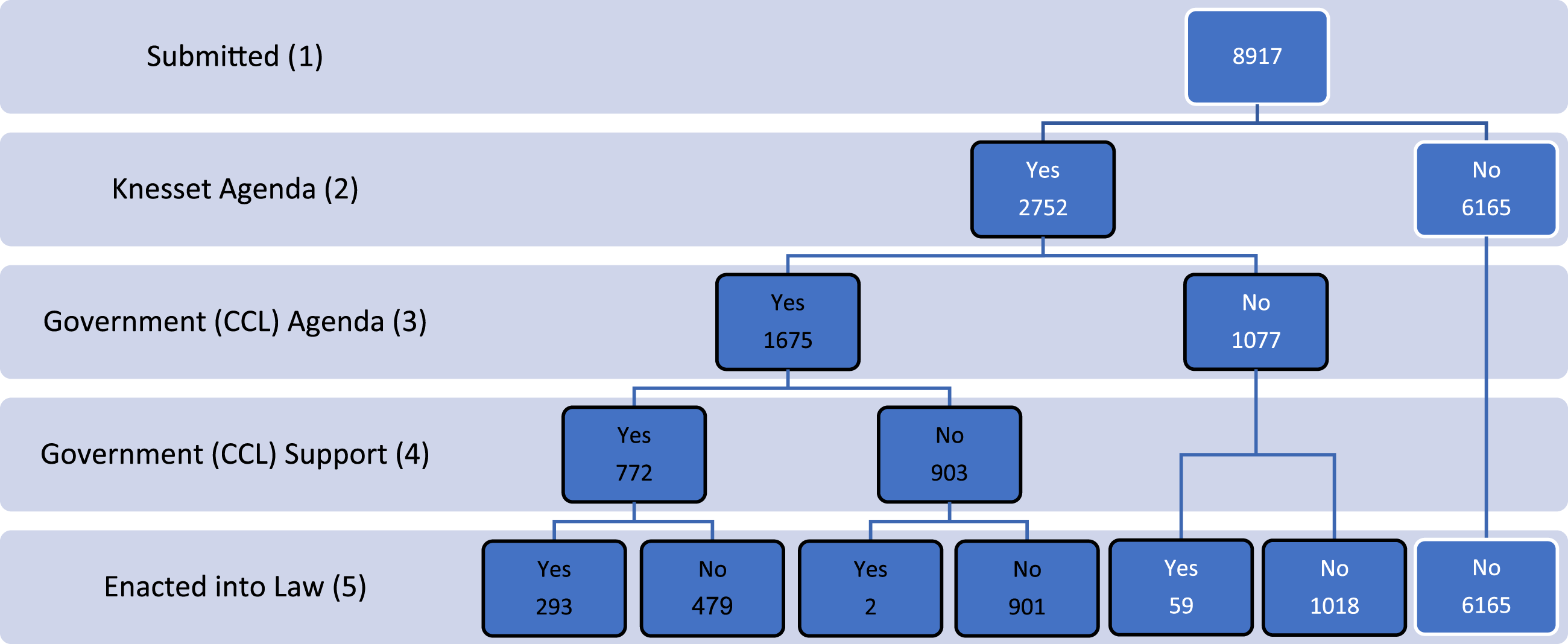
Propositions, empirical expectations, and the evidence used to examine the expectations.

Reassessing the success rates of PMBs
Because of the 45-day waiting period, MKs submit numerous PMBs, often viewed as policy ammunition that would be handy when the right policy or political moment is ripe. Given the limitation of the party quotas, MKs know that not all PMBs will be placed on the Knesset agenda. Only 2752 of the total PMBs were placed on the Knesset Agenda, leaving aside the remaining 6165 (69%) (the difference between Knessets is insignificant, z = −1.40, p = 0.16). 2 Given the gap between the number of introduced PMBs and those placed on the Knesset agenda, we suggest that not all PMBs submitted should be seen as viable policy solutions. Considering this distinction, we find that 13% (354/2752) of the bills placed on the Knesset agenda were eventually enacted, a rate that is much higher than the more conventional reference to the 4% enactment rate from all the PMBs introduced (354/8917)(E1.1).
We find additional support for the importance of PMBs when we examine their share from all laws enacted. During the 19-20 Knessets, 888 laws passed into law, of which 41% originated in PMBs and the rest in government bills (E1.2).
Both indicators, the high rate of PMBs enacted (13%) and the large share of PMBs among enacted laws (41%), support our first proposition.
The role PMBs play in the government agenda
During the period under examination, the CCL discussed 877 government bills and 1675 PMBs. 3 Thus, most of the agenda capacity of the institution that decides on the government’s legislative agenda is captured by PMBs (E2.1).
The CCL deliberated on 61% of PMBs placed on the Knesset agenda. All others are postponed from deliberation until further notice. The decision which PMBs to discuss is at the discretion of the Minister of Justice, who is chairing the CCL. Her considerations might be political or professional, depending on the PMB and the political context (Bringer, 2019). Some of these latter bills continued into the legislation process. Their success rates (enactment) were low (59/1077, 5.5%).
Of the PMBs deliberated by the CCL, nearly half (772/1975, 46%) received CCL support, from which 38% (293/772) were enacted. Of the PMBs that did not receive support (N = 903), 72 (8%) were conditionally rejected: assigned for further deliberation with ministries or coalition partners, sent back for more information, proposed for administrative regulation, or adopted as government bills. This group of conditional rejections further demonstrates the attention effect of PMBs on the government agenda. PMBs that MPs pushed forward despite the objection of the CCL had the lowest success rate (2/903, 0.2%) (E2.2).
Share of Policy Domains in each Legislative-Executive Stage.

aIssue diversity and issue convergence are calculated on all topics.
bTotal is 8917. For each stage we account for the bills that reach the stage but do not pass to the next. See Figure 2 and associated text for explanation of number of bills in each stage.
The top panel summarizes the ranking of the 10 most dominant policy domains in each stage. The top four policy domains in PMB submissions—government, law and crime, welfare, and domestic commerce (italicizes)—are repeated in each stage with minimal differences in order. They are each also 9% of the total agenda or more. The six additional policy domains are mostly repeated across stages but vary in their relative ranking.
The second panel presents the entropy scores, which indicate the issue diversity of the political agenda in each stage. A diverse agenda is one in which attention is spread across a broad range of issues, and a less diverse agenda is one in which attention is concentrated on several issues (Boydstun et al. 2014). Differences between the four arenas are marginal, indicating a similar range of issues.
In the final panel, we summarize the agenda convergence, or percent of issue overlap, between pairs of consecutive stages (Sigelman and Buell Jr 2004). The results indicate that the issue overlap is high – 89% of major issue attention in the Knesset agenda is the same as the issue agenda of the unlimited stage of PMB submission. The convergence rate of all other stages is similarly high, ranging from 87 to 91 percent. Minor issue convergence (including the list of 200 subtopics in the CAP codebook) is lower but is still very high, with more than 70% overlap between each dyad (E2.2 and E2.3).
Political makeup of PMBs in each stage.

Given the importance of PMBs as an opposition tool, it is not surprising that a majority of PMBs (51%) are initiated by opposition members, followed by coalition-opposition joint PMBs (29%), and the smallest share (20%) is of coalition-led PMBs. The institutional preference for opposition MKs in the weekly Knesset quotas helps opposition members to retain their advantage in the Knesset agenda (43%), followed by joint PMBs (38%) and then coalition members (19%). The government agenda is highly occupied by PMBs sponsored solely by opposition parties (40%) or jointly with coalition partners (41%). In government support, we find the coalition influence—with 35% of coalition PMBs receiving support. And yet, even at this stage, a large share of the PMBs are sponsored solely by opposition members (13%) or jointly between the opposition and the coalition (52%). Therefore, consistent with E2.3, the government agenda is not limited to PMBs of coalition members, which might be PMBs the government wishes to promote.
Comparing issue agenda of PMBs sponsored by members of opposition and coalition parties.

aIssue diversity and issue convergence are calculated on all 20 major topics.
Taken together, the similarity of the issue attention in each stage and the issue convergence across the four stages, and especially with opposition members, provide strong evidence that although the CCL may choose which PMBs to turn their attention to, it does not cherry-pick the issues it wishes to discuss. The CCL reacts to the issues raised by the MKs in their PMBs (E2.2 and E2.3).
Addressing the possibility of policy take-up
An alternative explanation for the effect of PMBs on the government agenda is of policy take-up: PMBs selected by the CCL are bills the government wished to promote but did not want to do so through government legislation because the amendments addressed minor issues or because of political considerations. Our data provide some evidence that, even if it exists, policy take-up is an insufficient explanation for the use and effect of PMBs as a policy tool.
Enactment Ratio. Only 38% of the PMBs discussed by the CCL were enacted, thus suggesting that the government does not use PMBs as a platform to promote only legislation it cares about.
Importance of PMBs. In our data, 305 PMBs proposed new or amendments to Basic Laws. Of these, 107 were placed on the Knesset agenda and 57 (53%) were discussed by the CCL. Thus, the government agenda is composed of major and not only minor legislation.
Conclusion
In parliamentary democracies, the executive has significant control over legislation. Most government bills, yet only a fraction of PMBs, are enacted. Consequently, research assumes that policymaking motivation in introducing PMB is negligible. Drawing on theories of the policy process and agenda-setting and using the most likely case of PMBs in Israel, we question this assumption and argue that PMBs are more successful in becoming laws than believed. Our empirical evidence reveals that once we account for the number of PMBs that entered the legislation process, PMBs have a higher enactment rate. Furthermore, when we examined PMBs not only through the end result (i.e., enactment) but also through its effect on the government legislative agenda, we found that they set the government legislative agenda. Although the government has formal power to control the agenda, its legislative agenda is strongly dictated by the legislative activity of MPs.
Previous research has found that MPs can affect the government agenda using parliamentary tools such as questions. This paper further extends these findings to PMBs. Based on the agenda-setting effect we demonstrate in this study, we suggest that MPs introduce PMBs also to affect the government agenda. Israel, however, is a most likely case for such an effect. Further research should examine whether such agenda effect can be found in other countries where fewer PMBs are submitted or where the selection of PMBs is random.
Footnotes
Acknowledgements
The data and analyses were done with the help of the Israeli Policy Agendas Project at Reichman University and Bar Ilan University funded by the Israel Science Foundation (ISF) grant 1271/18. The paper was presented at the 2020 annual meeting of the Israeli Association of Legislation at Reichman University, and the 2021 annual meeting of the Southern Political Science Association. We thank Michael S. Lynch and additional participants in these events as well as the anonymous reviewers and editors of Research & Politics for their helpful comments.
Declaration of conflicting interests
The author(s) declared no potential conflicts of interest with respect to the research, authorship, and/or publication of this article.
Funding
The author(s) disclosed receipt of the following financial support for the research, authorship, and/or publication of this article: This work was supported by Israel Science Foundation (1271/18).
