



Abstract
In many ways, American democracy seems to work better for older citizens than younger citizens, and one explanation is that young adults vote at much lower rates than their older counterparts. Yet while the existence of the age gap in turnout is well established, there remains uncertainty as to what drives it. In this paper, we explore age as a potentially important group identity and evaluate whether strength of age-group identity predicts political participation. Adapting established measures in the social identity literature, we surveyed a representative sample of American adults to gauge how strongly they identified with others in their age group. We find that, on average, younger adults identify less strongly than senior citizens with others their age. However, for young adults, age-group identity is as strong as another form of group identity that has gotten considerable attention in the literature: political party identity. The strength of age-group identity also predicts both voting and participating in climate change protests, especially for young adults. Age-group identity is a stronger predictor of climate protest participation for young Republicans than young Democrats—suggesting there may be potential for a bipartisan coalition of young people active on the issue of climate change.
In many ways, American democracy seems to work better for older citizens than younger citizens. The federal government has not yet taken significant steps to slow climate change, and younger generations will bear the brunt of that inaction. Homeownership remains out of reach for many young people, in large part because of restrictive zoning regulations and public meetings that amplify older voices (Einstein et al., 2019). And spending on older adults through programs like Social Security and major government healthcare programs far exceeds spending on families and children (Congressional Budget Office, 2000; Gleckman, 2019).
One explanation for these disparities is that young adults vote at much lower rates than their older counterparts (Rosenstone and Hansen, 1993; Wolfinger et al., 1980), so politicians are less responsive to their interests. Yet while the existence of the age gap in turnout is well established, there remains uncertainty as to what explains it. Some argue that young people have not yet had the life experiences that lead them to care about politics (Beck and Jennings, 1982; Strate et al., 1989), but Holbein and Hillygus (2020) show that many young adults are actually quite interested in politics. More broadly, “life-cycle”-based explanations for the turnout gap have not held up to empirical scrutiny; life-cycle steps like leaving school and getting married explain little of the turnout gap (Highton and Wolfinger, 2001).
Recently, political scientists have brought fresh ideas to questions about age bias in political participation. Holbein and Hillygus (2020) emphasize the importance of noncognitive skills for overcoming barriers to voting, arguing that underdevelopment of such skills in many young people prevents them from following through on their intention to vote. A growing body of work also focuses on electoral institutions, with studies showing that reforms such as same-day registration and all-mail voting disproportionately affect participation among young people (Bonica et al., 2021; Grumbach and Hill, 2022; Hill, 2020; Holbein and Hillygus, 2020).
We approach low youth turnout and the age-participation gap from a different angle. Our central motivating idea is a general one: that individuals’ political behaviors are heavily shaped by their social interactions and group memberships (e.g., Campbell et al., 1960; Nickerson, 2008; Sinclair, 2012), with political and societal “groups” varying considerably in how cohesive they are and how strongly individuals identify with the group (e.g., Campbell, 2003; Martin, 2003). Some groups of citizens with shared demographic characteristics are only that: a group of relatively unconnected individuals who lack a shared identity. Others are what Campbell et al. (1960: 293) refer to as “self-conscious groups”: meaningful, connected groups focused on their shared interests. Generally speaking, the more cohesive the group, the more likely its members are to collectively engage in political action.
Despite the large and growing body of literature on identity and political participation, scholars have neglected age as a potentially important group identity. Do Americans feel a sense of group identity with others close to their age? If so, how does the strength of that identity vary by age? And are people who feel stronger ties to others in their age group more likely to participate in politics? To explore these issues, we surveyed a representative sample of American adults, drawing from established measures in the social identity literature to gauge how strongly they identified with others in their age group. We also measured two forms of political participation: voting in national elections, and engaging politically on climate change—a policy domain with starkly different implications for today’s younger versus older age groups.
Our analysis shows that on average, compared to senior citizens, younger adults identify less strongly with others their age. However, for the youngest adults, age-group identity is as strong as political party identity—a striking finding, as party identity has received considerable attention in the literature. Moreover, the strength of age-group identity predicts political participation, especially for young adults. While our study is just an opening wedge, our hope is that it will inspire further research on the important questions of why participation varies by age and how that affects American politics and policy.
Age-group identity and political participation
Strong social or group identity (e.g., Tajfel, 1981), meaning “an individual’s awareness of belonging to a certain group and having a psychological attachment to that group” (McClain et al., 2009: 474), has been shown to be associated with higher rates of voting, contributing to campaigns, and political volunteering (e.g., Fowler and Kam, 2007; Huddy, 2013; Huddy and Khatib, 2007). Existing research has paid significant attention to a number of different group identities in American politics—most prominently political partisanship (e.g., Green et al., 2004) and race and ethnicity (e.g., McClain et al., 2009), but also (and more recently) others such as rural identity (Cramer, 2016; Lyons and Utych, 2021).
Much less attention has been paid to the study of age groups. Yet, recent developments and literature suggest that political divisions based on age are becoming more salient in American politics. The past decade has witnessed the rise of social movements and organizations like the Sunrise Movement that focus specifically on the interests of the young. Age drives political attitudes on issues like criminal justice, even after accounting for factors like ideology and partisanship (Goldstein, 2021). Members of the same generational cohort also tend to care about similar issues, with Gen Z and Millennials especially focused on climate change—and a respondent’s generation is correlated with their preferences over hypothetical candidates (Munger, 2022).
Our study builds on this recent work on generational cohorts, employing a broader, more open-ended conception of age-group identity and linking it to political participation. One-third of citizens surveyed by Munger (2022) did not identify themselves as members of the “correct” generational cohort, either because they did not identify with any of the categories or because they selected one that did not correspond to their birth year. It is possible that many people who do not identify strongly with generational labels—for example, those who are on the cusp of the arbitrary generation cutoff dates—still identify with other people close to their age, perhaps due to being at similar life stages. Rather than placing individuals into predetermined generational buckets, we allow respondents to determine for themselves who belongs in their “age group.”
We also extend existing literature by exploring the relationship between age-group identity and political participation. Research suggests several ways that strong group identity may increase participation, each of which may apply to age-group identity. First, individuals might get personal psychological benefits from participating if doing so reinforces their feeling of membership in a group (Uhlaner, 1989). These psychological benefits are likely to be increasing in (1) strength of group identity and (2) the degree to which the specific issue on which they are participating maps onto their group identity. For example, young people with a strong age-group identity may be more likely to attend a climate change-related protest if they view climate change as a “youth” issue. Second, those with a strong group identity may be more likely to participate when pressured by group leaders (Schram and van Winden, 1991). On climate change, for instance, young people with a strong age-group identity may be more likely to respond to calls to action from youth leaders like Greta Thunberg. Finally, to the extent that strong group-identifiers care about others in their group, they might be more likely to participate in politics if they think it helps others in their group to fare better (Coate and Conlin, 2004).
Measuring age-group identity
The literature on social identity has not yet focused on age-based group identities, but it has developed measures of identity strength within other groups, such as those with shared nationality or party identification (e.g., Huddy and Khatib, 2007; Theiss-Morse, 2009). These measures are designed to capture three central dimensions of social identity (Huddy, 2013): sense of belonging with the group; positive feelings for the group; and viewing membership as important to one’s sense of self. In their study of partisan identity, Huddy et al. (2015) ask survey respondents a battery of questions related to these different dimensions and combine them to form a multi-item partisan identity scale.
We use this approach to measure age-group identity. In May 2020, we fielded a nationally representative survey of 2270 American adults.
1
We pulled survey items from the Huddy and Bankert (2017) study of partisan identity and modified them to focus on age groups. Five of their eight Likert items could easily be adapted to ask about age groups: 1. “I have a lot in common with other people my age.” 2. “I am interested in what other people think about my age group.” 3. “When others criticize people my age, it feels like a personal insult.” 4. “When others praise people my age, it makes me feel good.” 5. “When I meet someone my age, I feel connected with this person.”
We measured respondents’ agreement or disagreement on a five-point scale. We then used factor analysis to combine the items into a single age-group identity strength variable and scaled it from 0 (weakest) to 1 (strongest). 2
Figure 1 presents average age-group identity by age (using a loess smoother). Our data suggest that older Americans have a stronger sense of age-group identity than younger Americans. Among individuals ages 20–55, age-group identity holds steady, averaging 0.54 on the 0-to-1 scale. Age-group identity is stronger, and increasing in age, for those over 55. For this group, the average is 0.59—roughly a quarter of a standard deviation higher than the younger groups and a statistically significant difference (p < .01, two-tailed test).
3

In Figure 2, we compare age-group identity to partisan identity—a useful benchmark, given that partisan identity is known to strongly predict political participation (Huddy et al., 2015). For respondents who affiliate with a political party (including those who lean toward a party), we asked the same five group identity questions using the original Huddy and Bankert (2017) wording. We then used a summated ratings scale (averaging across the items) to estimate 0-to-1 partisan identity and age-group identity measures for this group.
4

The figure shows that, among partisans (including leaners), partisan identity tends to be stronger than age-based identity. However, roughly 32% of all individual partisans score higher on age-group identity than partisan identity (not shown). Particularly striking is that the youngest age groups have similar average scores for both age-group and partisan identity. American politics research emphasizes the importance and explanatory value of party identification and partisan identity while mostly ignoring age-group identity—yet for young adults in particular, age-group identity appears just as strong. Moreover, this only examines party identifiers, who are arguably those with relatively strong partisan identity; if it were possible, expanding the analysis to non-partisans would most likely give age-group identity a stronger edge.
Political participation results
We next examine whether individuals who feel stronger ties to others in their age group are more likely to participate in politics. Our first dependent variable is voter turnout: a binary indicator for whether the respondent reported having voted in the November 2018 election. 5 Since voting is a relatively blunt instrument for expressing policy demands, our second participation outcome measures engagement in protests against climate change inaction—an issue that stands to have disproportionately large consequences for today’s youth. Our data show that young Americans are more likely than their older counterparts to report having taken direct actions on climate change: 14% of those ages 20–29 and 16% of those ages 30–39 reported having joined a protest on climate change, compared to 3% of those over 50.
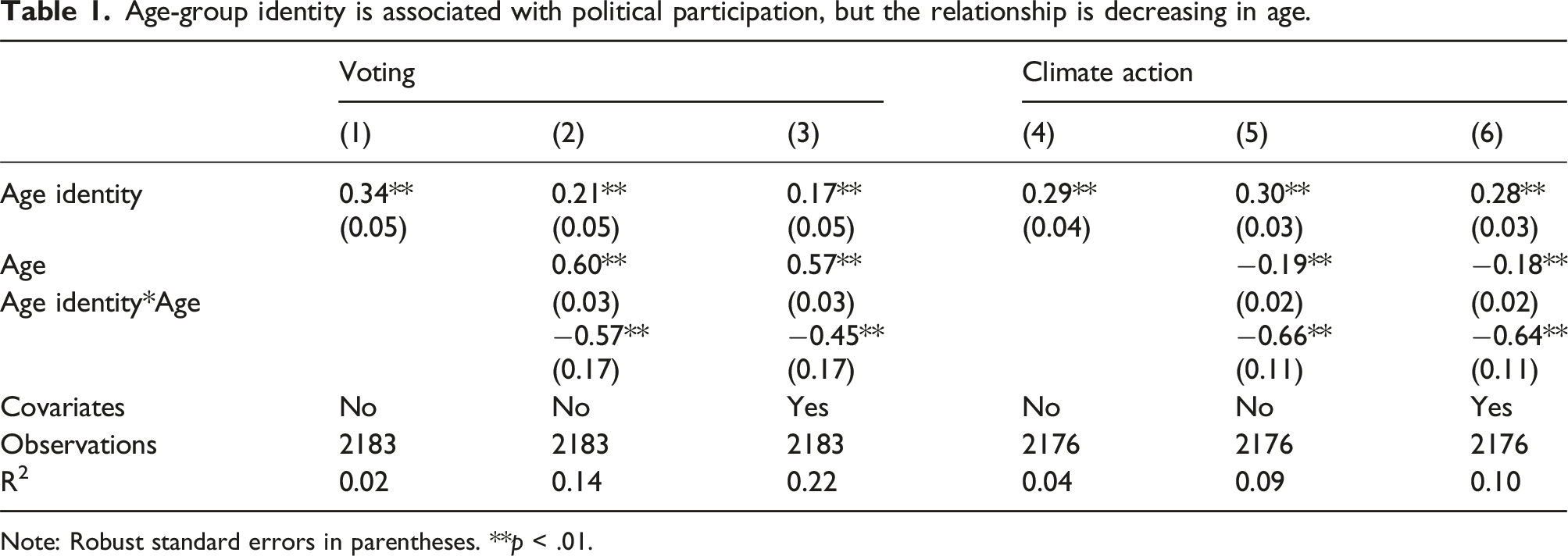
Age-group identity is associated with political participation, but the relationship is decreasing in age.
Note: Robust standard errors in parentheses. **p < .01.
Column 1 presents the results of the bivariate model of voter turnout. We find that age-group identity is indeed a strong predictor of who turns out to vote. The coefficient estimate of 0.34 indicates that a one-standard-deviation increase in age-group identity (0.19 on a 0-to-1 scale) is associated with an average increase in turnout of 6.5 percentage points. In column 2, we add respondent age as an explanatory variable (scaled from 0 to 1, centered around its mean). We also interact respondent age with age-group identity to test whether the strength of the relationship between age-group identity and voting varies by age group. We find that it does: the relationship between age-group identity and turnout is decreasing with age, as shown by the negative and statistically significant coefficient on the interaction term. Moreover, when we add a set of other covariates associated with voting (column 3), 6 this relationship persists.
In columns 4–6, we estimate the same models for climate change protest participation. In column 4, we once again find that age-group identity is positively associated with participation: a one-standard-deviation increase in age-group identity is associated with a 5 percentage-point increase in protest participation. As discussed above, protest participation decreases with age, but we also estimate a negative coefficient on the interaction term of age and age-group identity in columns 5 and 6. As with voting, then, age-group identity is a stronger predictor of participation in climate protests for younger adults than for older adults.
Recent research suggests that a widely used measure of group consciousness, linked fate, may actually capture a general tendency toward social connectedness (Gay et al., 2016), and so one concern with our results is that our measure of age-group identity could be picking up individuals’ pro-social attitudes—and that perhaps pro-social attitudes explain the relationship to participation. Results from two additional analyses suggest this is not the case, however (see online Supplementary Appendix A.3). First, when we measure age-group identity using only the survey item that is unlikely to be correlated with pro-social attitudes—“When others criticize people my age, it feels like a personal insult” (which references criticism versus commonality and connection)—we still find a positive, statistically significant relationship with political participation. Second, we examine responses to two other questions we asked on the same survey, both of which we expect would be correlated with general pro-social attitudes. For the following, respondents were asked to rate their agreement or disagreement on a five-point scale: 1. “We are better off when we compete as individuals.” 2. “Even if some people are at a disadvantage, it is best for society to let people succeed or fail on their own.”
Respondents with higher age-group identity scores were not more likely to disagree with either statement; actually, higher age-group identity is very weakly correlated with the more individualistic position for both. Together, these findings suggest that our age-group identity measure is probably not a proxy for general pro-social attitudes.
As a next step, to further illustrate how the relationship between age-group identity and political participation varies by age, we split the sample by 10-year age intervals and regress both voter turnout and climate protest on age-group identity for each group, adjusting by the same set of covariates used above. The coefficient estimates are presented in Figure 3. For both voter turnout (on the left) and climate protest (on the right), the estimated coefficients on age-group identity are larger for younger Americans than for older Americans. For respondents aged 20–49, age-group identity has a positive, statistically significant relationship with voting, but for the 50-and-older age groups, the coefficients are smaller and insignificant at the 5% level. Similarly, the association between age-group identity and climate protest is relatively large for 20 to 39 year olds but smaller for those 40 and older—and statistically insignificant for the oldest groups of citizens.
For climate action, we also assess how these relationships vary by party identification. Public opinion on matters related to climate change varies by party identification (Carmichael et al., 2017), and in our data, Democrats are more likely than Independents or Republicans to report having attended climate change protests. The difference in participation by party is especially pronounced among older voters, with older Democrats greatly outpacing older Republicans. This accords with journalistic accounts of young Republicans deviating from their older co-partisans in prioritizing climate change (e.g., Brady, 2020). One possible explanation for the relatively high rate of participation among young Republicans is that they identify with others in their age group.
In Figure 4, we assess whether the relationship between age-group identity and climate action varies by party identification within age groups. We subset the data into 10-year age groups and by party identification and estimate bivariate OLS models within each subset.
7
For the older groups, the relationships between age-group identity and climate action are small, statistically insignificant, and do not differ clearly by party. For the younger groups, however, the findings are striking: the positive relationship between age-group identity and climate action appears to be driven more by young Republicans than young Democrats or Independents. Among those in the 20-to-29 and 30-to-39 age groups, the association between age-group identity and climate action is larger for Republicans than for Democrats. This suggests that age-group identity has potential to cross-cut political party affiliation for young people—which would have significant implications for the politics of climate change.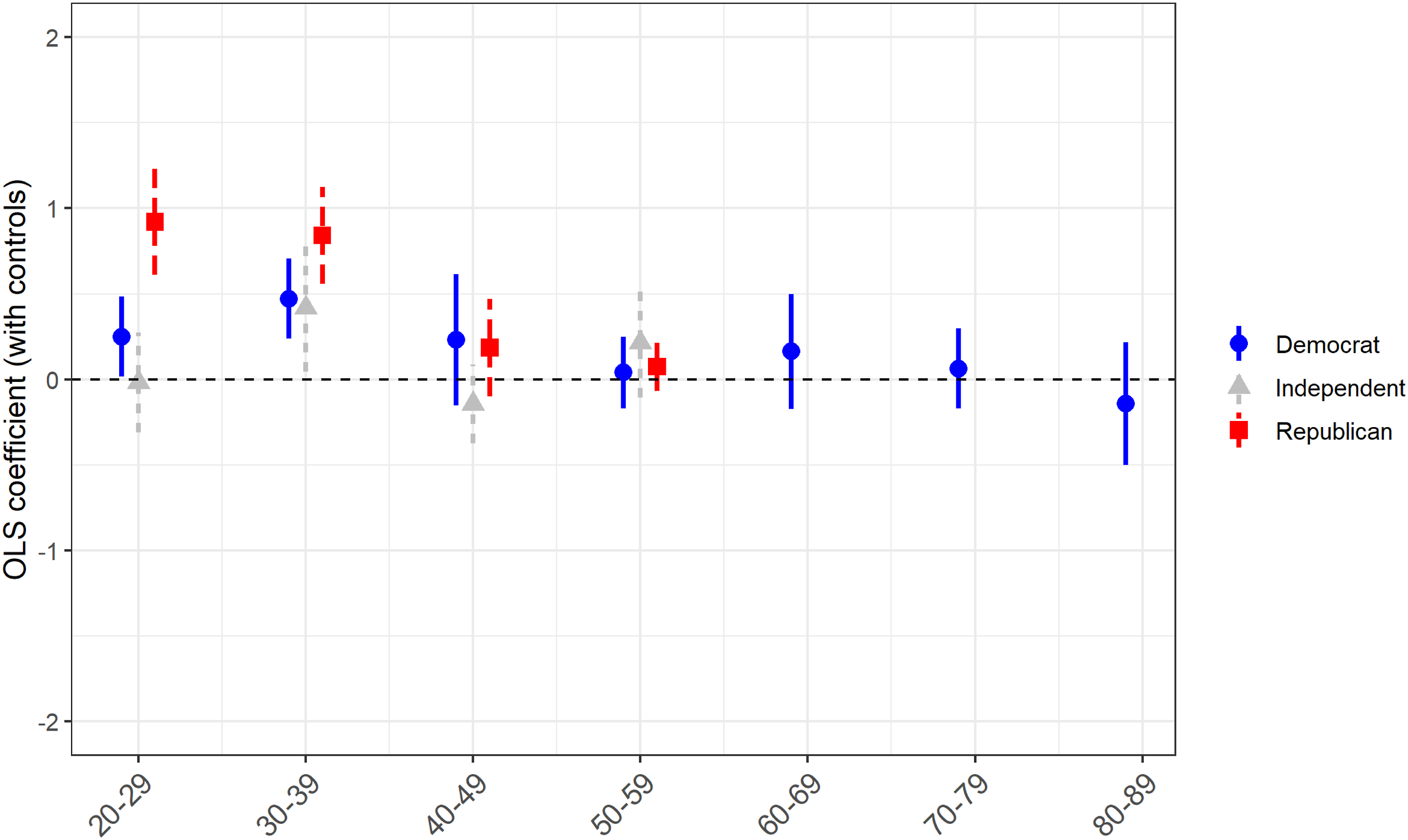
Conclusion
Using measures adapted from the existing literature on group identity, we find that younger voters have, on average, a weaker sense of age-group identity than senior citizens, but also that those of them with stronger age-group identity are significantly more likely to vote and participate in protests related to climate change. Even after accounting for respondents’ ages, we find a strong, positive association between age-group identity and political participation. For climate protest participation, moreover, age-group identity is more important for young Republicans than young Democrats. Strikingly, this suggests that there may be potential for a bipartisan coalition of young people active on the issue of climate change, possibly driven in part by their shared age-group identity.
Our analysis suggests several promising directions for future research. Scholars should continue to refine the definition and operationalization of age-group identity, work to understand what drives it, consider whether and how it is related to general tendencies toward social connectedness, and prioritize it as a potentially important identity in American politics. One important next step will be to account for how people define and think about who is in their “age group” and how—and for whom—that maps on to generational labels like “Millennial” or “Gen X.” Researchers should also do more to explore whether certain issues or policies augment or detract from citizens’ feelings of connection to others in their age group in ways that could affect their political engagement. The literature on policy feedback has made strides in examining how policies shape citizens’ political participation and attitudes (e.g., Michener, 2018; Soss, 2000), and going forward, researchers should examine whether particular policies—such as student loan forgiveness or housing development reform—have potential to make young people a more meaningful political group, as Campbell (2003) found for Social Security and senior citizens. Of all the possible issues to be explored, climate change deserves special emphasis because of its salience to young Americans and its potential to unite and mobilize young citizens across party lines.
Supplemental Material
Supplemental Material - Age-Group Identity and Political Participation
Supplemental Material for Age-Group Identity and Political Participation by Samuel Trachtman, Sarah F. Anzia, and Charlotte Hill in Research & Politics
Footnotes
Acknowledgements
The authors thank the Berkeley Institute for Young Americans for its support and are grateful for helpful feedback from Elizabeth Mitchell Elder, Eric Schickler, and Laura Stoker.
Authors’ note
This paper was previously presented at the annual meeting of the Southern Political Science Association, January 6–9, 2021.
Declaration of conflicting interests
The author(s) declared no potential conflicts of interest with respect to the research, authorship, and/or publication of this article.
Funding
The author(s) disclosed receipt of the following financial support for the research, authorship, and/or publication of this article: The survey for this study was funded by the Berkeley Institute for Young Americans.
Correction (June 2025):

Supplemental Material
Supplemental material for this article is available online.
The files can be found at https://dataverse.harvard.edu/dataset.xhtml?persistentId=doi%3A10.7910%2FDVN%2FLSTJXV&version=DRAFT.
Notes
References
Supplementary Material
Please find the following supplemental material available below.
For Open Access articles published under a Creative Commons License, all supplemental material carries the same license as the article it is associated with.
For non-Open Access articles published, all supplemental material carries a non-exclusive license, and permission requests for re-use of supplemental material or any part of supplemental material shall be sent directly to the copyright owner as specified in the copyright notice associated with the article.
