



Abstract
Recent regional trade agreements (RTAs) tend to link gender and trade issues through gender-related provisions. This pattern is mostly observed in RTAs formed between global North and South countries. Despite a growing interest in gender-related provisions among countries, there have not been systematic studies on the formation of RTAs with these instruments. Our study underscores women’s descriptive representation. Female representatives care more about advancing women’s interests and improving their status than their male counterparts. Thus, we posit that when women’s political representation in a country’s legislature is high, it is more likely to support gender-related provisions. Focusing on RTAs between the European Union and democratic developing countries from 1997 and 2016, we find some support that women’s presence in the legislature affects trade policy outcomes. Countries with higher female representation in the legislature tend to join RTAs with gender-related provisions, but these countries do not increase their commitment to gender equality by adding multiple provisions on gender.
Introduction
In recent years, a growing number of regional trade agreements (RTAs) have included gender-related provisions, that is, provisions that mention women and/or gender-related issues explicitly (Monteiro, 2018: 2). The objective of gender-related provisions is to “create a level playing field for women and distribute the benefits of free trade equally among men and women” (International Trade Centre, 2019). These provisions vary in type and include, to name a few, defining gender for the purpose of such provisions, establishing gender-related principles, (re)affirming commitment to international agreements on gender issues, promoting corporate social responsibility with respect to gender equality, and addressing domestic gender-related policies (Bahri, 2021; Monteiro, 2018; 2020). For instance, the RTA between the European Union (EU) and Central America reaffirms the parties’ commitment to addressing domestic gender-related labor policies, describes gender as a cooperation area and specifies forms of cooperation, and refers to international agreements addressing gender, including the International Labour Organization’s (ILO) Conventions and the Convention on the Elimination of All Forms of Discrimination Against Women. The number of the type of gender-related provisions in RTAs differs across agreements, ranging from 1 (e.g., Australia–Indonesia RTA) to 13 (Canada–Chile RTA).
Among 556 RTAs, 80 agreements, including proposed ones, make an explicit reference to gender or gender-related issues (Monteiro, 2018, 2020). A majority of these RTAs are formed between global North and South countries (51 RTAs in force), and the EU has been at the forefront of the effort to establish RTAs including such provisions with developing countries (28 RTAs in force). Despite a recent increase in the use of gender-related provisions in RTAs, we know little about when and why developing countries enter into RTAs with gender-related provisions and pursue extensive cooperation on gender issues.
We argue that developing countries with a large share of women in the legislature are more likely to participate in RTAs with gender components and to increase commitments to gender equality and women's empowerment through RTAs because of female legislators’ interest in advancing women’s interests and improving their status. These expectations are tested by using the most comprehensive dataset on RTAs with gender-related provisions (Monteiro, 2020) and the World Trade Organization’s (WTO) RTA database and analyzing RTAs between the EU and democratic developing countries from 1997 to 2016. 1 Our logistic and Poisson regression analyses report partial support for our hypotheses. Democratic developing countries with higher female political representation tend to join RTAs with the EU that include gender-related provisions as expected. But the presence of women legislators does not affect the level of cooperation on gender equality (measured as the number of the type of gender-related provisions). Overall, these findings suggest that women’s political power plays a role in the inclusion of gender provisions in trade agreements in democratic developing countries.
EU, developing countries, and gender-related provisions
Trade agreements are created for several purposes. These institutions resolve the dilemma of collective action and internalize international externalities from policy choices. Countries also use them to change trading partners’ behavior and thus to promote desirable policy outcomes in non-trade issues by using access to markets as a lure (Borchert et al., 2020). Among developed countries, the EU has been at the forefront of the effort to link trade and non-trade issues (Milewicz et al., 2016). EU member countries have taken the initiative to influence developing countries’ policies and practices in non-trade issues through RTAs (e.g., human rights, labor standards, and environmental protection standards). Recently, they have expanded their scope of non-trade objectives to the improvement of gender equality across and beyond the EU. 2 The European Parliament’s resolution of March 13, 2018 on Gender Equality in EU Trade Agreements views trade as a tool to support gender equality and urges that future EU trade accords address gender inequality. 3
Three visuals of RTAs below depict the manners and degrees of cooperation over gender issues between the EU and developing countries.
4
First, Figure 1 charts the number of developing countries whose trade agreements with the EU covering gender issues entered into force between 1998 and 2020. The EU–Tunisia RTA is the EU’s first trade agreement including gender provisions with a developing country. Since that agreement, the EU has continued to address gender issues in developing countries through RTAs. EU’s RTAs incorporating gender provisions with developing countries in force, 1998–2020.
Degree of cooperation between the EU and developing countries—types of gender provisions.

The sample includes RTAs with gender provisions between the EU and developing countries between 1998 and 2020. They are currently in force.
Data Source: Authors’ calculation using Monteiro (2020), WTO database on RTAs, and WTO database on gender provisions.
While Table 1 displays cooperation over gender equality in terms of the type of gender-related provisions in RTAs, Figure 2 reports the number of the type of gender-related provisions in the RTAs with each country. Only the EU—Vietnam RTA and EU—Central America RTA have more than two types of gender provisions, including the EU and seven other developing countries in total. Degree of cooperation between the EU and developing countries—number of gender provision types. The y-axis indicates the number of the type of gender provisions in EU-developing country RTAs in force between 1998 and 2020. The x-axis shows the number of the EU’s developing signatories. Three plurilateral agreements are included, which are indicated by the following symbols: *(EU-CARIFORUM States), °(EU-Eastern and Southern Africa States), and †(EU-Central America). Data sources: Monteiro (2020), WTO database on RTAs, and WTO database on gender provisions.
Overall, these visuals show the variation in countries’ willingness to address gender issues through trade agreements. Some developing countries established RTAs with gender-related provisions, and they preferred particular types of gender provisions. Among these countries, few added multiple gender provisions to their RTAs. In the analysis section, we explain this variation with a focus on democracies in the developing world.
Women’s descriptive representation and gender-related provisions
RTAs are beneficial to developing countries. These trade institutions can increase domestic production capacity, promote an upward harmonization of standards, and improve domestic institutions. They also introduce technical know–how into the domestic market and expand preferential access to desirable markets (DiCaprio et al., 2017). These benefits have driven developing countries to join RTAs over the last two decades. In forming RTAs and other trade policies, in most democracies, the legislature plays a central role (Betz et al., 2021; Nielson, 2003). 5 We argue that female legislators, in particular, exercise a crucial influence on including gender-related provisions in RTAs.
The presence of women in office affects policy outcomes for women (Bardhan et al., 2010; Hessami and de Fonseca, 2020; Paxton et al., 2020; Wängnerud, 2009). Having different backgrounds and experiences than male representatives, female representatives have more incentives to represent women (Mansbridge, 1999) and act for women’s interests (Dodson, 2006). They are more likely than men to introduce, sponsor, and pass bills addressing gender equality (Bratton and Ray, 2002) and support policies with direct, disproportionate positive impacts on women, such as family assistance, child support laws (Besley and Case, 2003; Schwindt-Bayer, 2006), and health expenditures (Clayton and Zetterberg, 2018). Indeed, women representatives care more about women’s well-being and empowerment and understand what will facilitate them. Thus, these legislators are more willing to address pervasive discrimination in existing policies and practices. Betz et al. (2021) show that these dynamics extend to trade matters. They find that greater women’s descriptive representation in the legislature decreases the “pink tax”—import tax penalties that are specific to women’s apparel items. Drawing from these studies, we posit that gender-related provisions in RTAs reflect the influence of women’s political representation in the legislature.
Women legislators support the inclusion of gender provisions in RTAs and demand the government’s extensive commitments to such provisions to ensure that women receive their share of benefits from trade. Trade expansion through trade agreements benefits women as it creates job opportunities, raises wages, and improves working conditions. 6 As the World Bank’s (2019) recent report lays out, multinational firms pay higher wages than local firms, and trade increases in certain sectors (e.g., textile, garments, and tourism) expand women’s job opportunities. 7 Empirical studies report that trade increase promotes gender equality in terms of social and economic status (Neumayer and de Soysa, 2011; Potrafke and Ursprung, 2012; Richards and Gelleny, 2007).
However, while trade expansion will advance women’s interests, trade agreements are not completely gender-neutral due to existing gender-based structural discrimination. In this context, gender provisions are vital to securing fair opportunities for women and distributing the benefits of free trade equally between men and women. More specifically, gender provisions recognize the role of women in trade and aim to remove gender-based discrimination and barriers deterring their access to the benefits of trade (UNCTAD, 2020). Moreover, RTAs are a credible means to tying state leaders’ hands to reducing gender inequality, as trade agreements are a promise with trading partners, and they collect and disseminate information on members’ (non)compliance behavior (Mansfield et al., 2002). Joining RTAs with gender provisions is an official declaration that the government will promote gender equality by entering an RTA with foreign countries. The violation of gender provisions might cause public accusations by other parties to the agreement. These provisions also “provide an avenue for civil society and citizens to hold the government responsible for gender-equality in implementation” (Luke, 2019: 4). Such an expected ex-post cost arising from the actions of trading partners and societal actors in the event of non-compliance incentivizes commitments to eliminating discriminatory policies and practices against women. Fighting for the inclusion and compliance of gender provisions also increases the chance of re-election of women representatives by signaling women voters that they work to advance women’s interests.
Indeed, women legislators support adding gender provisions to RTAs to ensure that women receive their share of benefits and to maximize the positive impact of the agreements. They are expected to address the issues of gender inequality involved in trade and trade agreements and to demand the government’s increased commitment to improving women’s standing through gender provisions. Their support for gender-related provisions can translate into policy outcomes when more women legislators are represented in the legislature. In line with this, we propose two hypotheses:
Countries with higher female political representation will be more likely to join RTAs with gender-related provisions.
Countries with higher female political representation will be more likely to increase their commitment to gender issues through RTAs.
Data and research design
We explain which democratic developing countries are likely to join the EU’s RTAs with gender-related provisions and increase cooperation over gender equality between 1997 and 2016, making the unit of analysis country-year. Our analysis covers RTAs with gender-related provisions in force during the time period. Developing countries are identified using the United Nations (2021)’ World Economic Situation and Prospects. Polity2 > 6 is defined as democracies (Marshall and Gurr, 2020). 8
To test our arguments, we create two dependent variables, combining information from Monteiro’s (2020) dataset of Gender-Related Provisions in RTAs and the WTO’s RTA database. 9 For Hypothesis 1, we record whether a democratic developing country and the EU include a gender-related provision in a given RTA or not (Inclusion of Gender Provision). The value of 1 indicates that the democratic developing country joined and ratified an RTA with the EU dealing with a gender issue and has continued to be a party to the RTA, and otherwise 0 is assigned. 10 As for Hypothesis 2, we consider the width of cooperation over gender issues to capture the level of signatory countries’ commitment to promoting gender equality through RTAs. We count the number of the type of gender-related provisions included in an RTA, creating an indicator of the level of cooperation (Number of Gender Provision). 11
Given the nature of the two dependent variables, to test Hypothesis 1, we employ a logistic regression model, and for Hypothesis 2, we estimate a Poisson regression model. We specify random effects at the country level and year-fixed effects and lag all primary and control variables by 1 year behind the dependent variables. A country fixed-effect model may be preferable, given the possibility that unobserved variables may be correlated with included right-hand side variables. However, since our two dependent variables are quite time-invariant within countries, the specification of country-fixed effects will exclude several relevant observations. Also, random effects allow us to evaluate differences between countries, so they are more appropriate for our analysis.
The primary variable, Women’s Pol Repr(QAROT), is estimated as the log-transformation of the percent of women in the national legislature, lower house. This descriptive indicator of women’s political representation is taken from the Quota Adoption and Reform Over Time project (Hughes et al., 2017; Hughes et al., 2019). Results are replicated with an alternative measure from the Global Gender Gap Index of the World Economic Forum (2021). Its sub-index of political empowerment captures the gender gap at the highest-level positions of political decision making (ministerial, parliamentary, and executive positions) (Women’s Pol Repr(GGGI)). Higher values of the two indicators of political representation indicate women’s improved political status and smaller gender gap, respectively.
We include a small set of control variables. Democracy Level is estimated using the Polity2 indicator from Marshall and Gurr’s (2020) Polity 5 Annual Time-Series Dataset. We include indicators of macroeconomic performance and women’s labor participation. As for macroeconomic performance, we control for Economic Development (measured as the log-transformed GDP per capita in constant U.S. dollars) and Economic Growth (measured as the annual percent growth rate of GDP). Female Labor Participation is the ratio of female-to-male labor force participation using ILO estimates. These three measures are taken from the World Bank’s (2020) World Development Indicators. Foreign Aid is a log-transformed variable for net official development assistance and official aid received (percent of GDP). This is also from the World Bank (2020). Globalization is added as the sixth right-hand-side variable, employing the 2020 KOF Globalisation Index of the Swiss Economic Institute (Dreher, 2006). This index is a comprehensive indicator of the economic, social, and political dimensions of globalization. The last control variable is resource abundance, which can undermine women’s interests (Ross, 2008; Simmons, 2016), in contrast to the other control variables. We measure natural resource endowment as the log-transformation of total natural resource rents (percent of GDP), using data from the World Bank (2020) (Natural Resource).
Results
Impact of Women’s political representation on gender provisions.

Standard errors in parentheses. *p < 0.10, **p < 0.05, and ***p < 0.01.
Among the control variables, Female Labor Participation shows a significant impact on the two dependent variables, but higher female economic participation does not lead to RTAs with positive impacts on women. This puzzling finding might be because our data do not differentiate between jobs that women and men occupy. Compared to men, women tend to occupy less professional, informal jobs that give few means of making their political voice heard. Because of this gender gap in employment, Female Labor Participation might have this unexpected sign. This interpretation resonates with prior studies arguing that women’s overall labor force participation has little relationship with their political representation (Kenworthy and Malami, 1999; Schlozman et al., 1999).
Impact of the type of RTA membership and prior experience of gender provisions.

Standard errors in parentheses. *p < 0.10, **p < 0.05, and ***p < 0.01.
In our sample, some developing countries formed RTAs with gender provisions with other Northern countries before creating the same kind of agreement with the EU. These include Chile, the Dominican Republic, Mexico, and all of the members of the EU–Central America RTA. Given Milewicz et al. (2016) and Hollway et al. (2020), the experience of creating an RTA with gender provisions is likely to increase countries’ interest in gender provisions. We find that prior experience matters. As shown in Model (3) of Table 3, countries with previous RTAs including gender provisions with other Northern countries (measured as a dichotomous variable) increase the number of gender provisions within subsequent RTAs with the EU, compared to countries without such RTAs.
Using different samples.

Standard errors in parentheses. *p < 0.10, **p < 0.05, and ***p < 0.01.
The relative importance of legislatures in democracies and autocracies might explain the difference in the impact of the presence of women legislators in the two types of regimes. In non-democracies where electoral incentives to represent constituents are weak if they exist, preferences of the executive or the ruling party, not those of the constituents, matter to legislators, and their ability to represent the constituents’ interests is limited (Blaydes, 2010; Brancati, 2014; Gandhi et al., 2020; Geddes et al., 2018). This suggests that unless autocratic leaders are interested in improving women’s political status, even if an autocracy has some women legislators, these lawmakers are not likely or not able to encourage their government to join RTAs with gender-related provisions and increase the number of such provisions. In contrast, female legislators in democracies have greater incentives to respond to and advance women’s interests through gendered policies such as gender provisions. They confront fewer limits when they seek to do so as well. Female citizens also have greater opportunities to express their demands either through elections or interest groups, generating more pressure on women legislators. All of this would explain why women’s political representation in democracies has a significant impact on including gender-related provisions.
Last, we replicate the main findings with another proxy for women’s political representation—the sub-index of political empowerment from the Global Gender Gap Index (World Economic Forum 2021)—and different model specifications. The findings are reported, respectively, in Appendix Table A2 12 and Appendix Table A3. 13
Conclusion
This study has examined the growth of RTAs with gender-related provisions. Focusing on RTAs between the EU and democratic developing countries, our analysis reveals the importance of women’s presence in political office. Countries with higher female political representation in the legislature are generally more interested in including gender-related provisions in RTAs than others. But the presence of women legislators does not lead to extensive cooperation (measured as the number of the type of gender-related provisions in RTAs). Future research is needed on identifying other factors affecting the level of interstate cooperation over gender matters through trade policies. We expect the importance of women’s descriptive representation to be present in RTAs involving other developed countries due to two considerations. First, more than half of RTAs formed between global North–South countries involve the EU. Second, some developing countries that concluded RTAs with gender provisions with the EU also formed those trade agreements with other developed countries. Nevertheless, future research should analyze those agreements.
Footnotes
Acknowledgments
We thank Chia-yi Lee, Fangjin Ye, Jia Chen, participants and discussants of the American Political Science Association meeting in 2021, the editors, and the three anonymous reviewers for helpful comments and suggestions. We also thank José-Antonio Monteiro for sharing the dataset on trade agreements with gender provisions.
Declaration of conflicting interests
The author(s) declared no potential conflicts of interest with respect to the research, authorship, and/or publication of this article.
Funding
The author(s) received no financial support for the research, authorship, and/or publication of this article.
Correction (June 2025):

Supplemental Material
Notes
Appendix
Reporting untransformed values.
Variable
Obs
Mean
Std. dev
Min
Max
Inclusion of gender provision
3141
0.117
0.321
0
1
Number of gender provision
3141
0.215
0.642
0
4
Women’s Pol Repr(QAROT)
2705
13.713
9.995
0
63.800
Women’s Pol Repr(GGGI)
1091
0.139
0.099
0
0.544
Democracy level
2671
2.159
6.301
−10
10
Economic development
3004
6222.729
9348.869
187.517
69679.090
Economic growth
3011
4.241
6.210
−62.076
149.973
Female labor participation
2902
67.406
21.162
8.680
107.994
Natural resource
2599
9.771
12.537
0
87.459
Globalization
2656
52.850
12.586
22.532
84.700
Foreign aid
2875
6.295
10.135
−2.032
139.890
Bilateral/plurilateral
871
1.551
0.498
1
2
Previous RTA with gender provision
871
0.115
0.319
0
1
A different measure of women’s political representation. Standard errors in parentheses. *p < 0.10, **p < 0.05, and ***p < 0.01.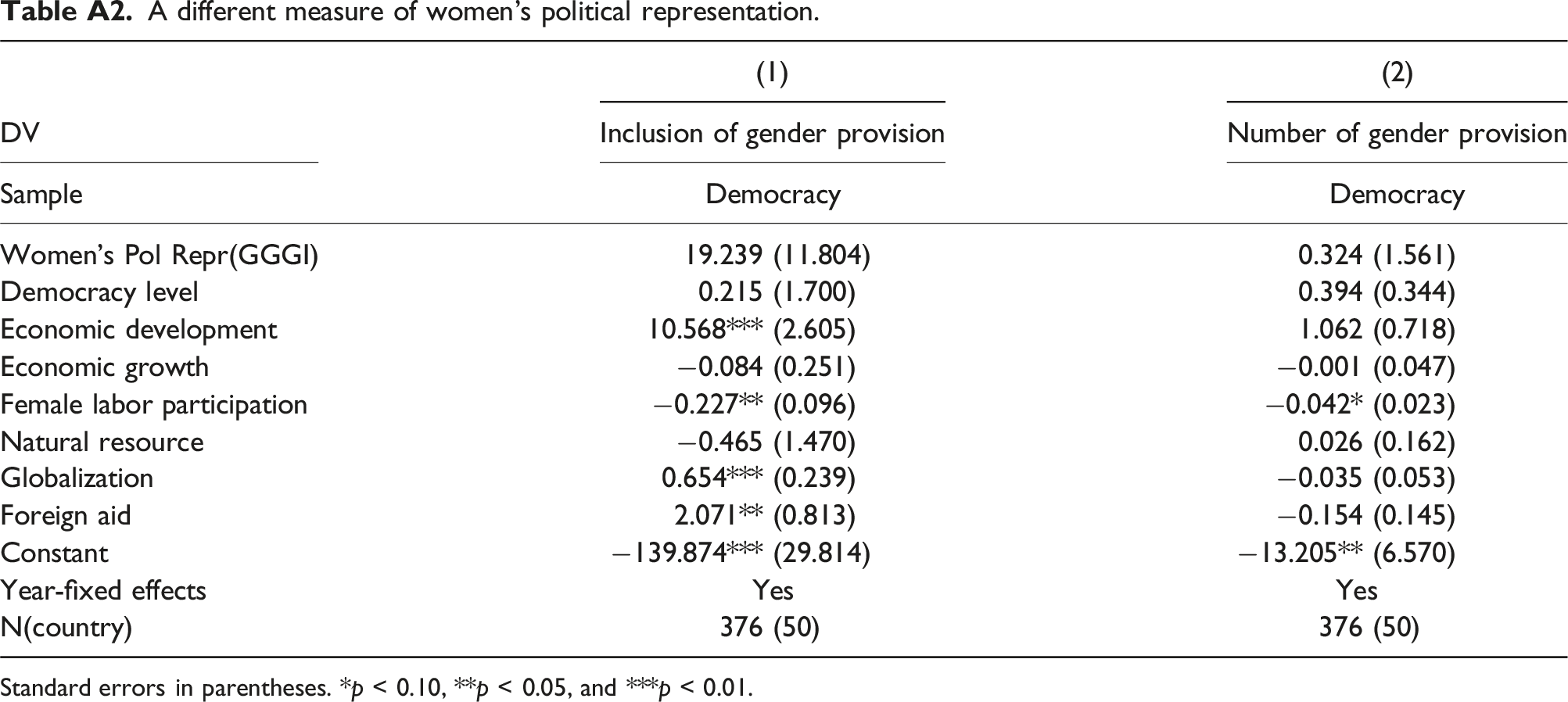
(1)
(2)
DV
Inclusion of gender provision
Number of gender provision
Sample
Democracy
Democracy
Women’s Pol Repr(GGGI)
19.239 (11.804)
0.324 (1.561)
Democracy level
0.215 (1.700)
0.394 (0.344)
Economic development
10.568*** (2.605)
1.062 (0.718)
Economic growth
−0.084 (0.251)
−0.001 (0.047)
Female labor participation
−0.227** (0.096)
−0.042* (0.023)
Natural resource
−0.465 (1.470)
0.026 (0.162)
Globalization
0.654*** (0.239)
−0.035 (0.053)
Foreign aid
2.071** (0.813)
−0.154 (0.145)
Constant
−139.874*** (29.814)
−13.205** (6.570)
Year-fixed effects
Yes
Yes
N(country)
376 (50)
376 (50)
Specification of one-period lag of dependent variables (LDV) and country-fixed effects. Standard errors in parentheses. *p < 0.10, **p < 0.05, and ***p < 0.01.
(1)
(2)
(3)
DV
Inclusion of gender provision
Number of gender provision
Number of gender provision
Sample
Democracy
Democracy
Democracy
LDV
LDV
Country-fixed effects
Women’s Pol Repr(QAROT)
0.637 (0.887)
0.264 (0.322)
0.098 (0.413)
Democracy level
0.335 (0.442)
0.152 (0.250)
0.909 (0.773)
Economic development
0.903 (1.128)
0.809* (0.478)
5.626*** (1.599)
Economic growth
−0.084 (0.110)
0.016 (0.042)
−0.003 (0.044)
Female labor participation
−0.040 (0.036)
−0.041** (0.018)
−0.072* (0.042)
Natural resource
0.001 (0.259)
−0.070 (0.128)
0.122 (0.190)
Globalization
0.095 (0.069)
0.011 (0.035)
−0.100* (0.057)
Foreign aid
0.514 (0.368)
0.051 (0.134)
−0.293* (0.153)
LDV
0.572*** (0.083)
Constant
−20.324 (13.622)
−25.242 (791.099)
Year-fixed effects
Yes
Yes
Yes
Country-fixed effects
No
No
Yes
N(country)
282 (59)
793 (68)
299 (20)