




Abstract
An article recently published in the Journal of Conflict Resolution by Koos and Nuepert-Wentz finds an association between geographically proximate polygynous ethnic groups and rural violence in Africa. This study applies several empirical adjustments to their analysis. The association between rural violence and polygynous neighbors loses significance when replacing violent events with fatalities in both ACLED and UCDP-GED data or converting event counts to binary. Subsetting Afrobarometer data by urban and rural respondents shows that rural respondents from polygynous groups are not significantly more likely to feel violence is justified. Moreover, there is no evidence the conflicts leading to the most rural violence in ACLED, farmer-herder clashes, or UCDP-GED, violence during the apartheid transition in South Africa, are related to “excess men.” Both conflicts suggest broader violations in the assumptions made in hypothesizing why polygynous neighbors lead to rural violence. The re-analysis calls the claim that polygyny is associated with rural violence into question and suggests researchers use broader approaches to measuring violence than just event counts.
A growing literature has focused on the causes and effects of polygyny in Africa. Polygyny is the marriage of, usually, wealthy men to multiple women in a traditional society, leaving more economically disadvantaged men without partners (McDermott, 2018). Multiple studies have linked traditional customs, such as bride price, to increased polygyny and violence (Hudson and Matfess, 2017). 1 While a study from 2009 linked polygyny to the presence of large-scale civil conflict (Kanazawa, 2009), the findings did not stand up to replication (Gleditsch et al.,2011).
Koos and Neupert-Wentz (2020) (hereafter “KNW”) test the link between polygyny and violence by looking at historical data on polygyny in African ethnic groups taken from Murdock’s (1969) Ethnographic Atlas. 2 KNW theorize that ethnic groups will experience more violence perpetrated by polygynous neighbors, especially in areas that closely border regions occupied by neighboring polygynous groups. KNW argue that young men who cannot find partners due to polygyny feel more deprived and seek resources to increase their status by attacking neighboring groups. Using data from the Armed Conflict and Location and Event Dataset (Raleigh et al.,2010) and the Uppsala Conflict Data Program Georeferenced Event Dataset (UCDP-GED) (Sundberg and Melander, 2013), KNW find that groups with polygynous neighbors and specifically areas within 25 km of group borders with polygynous neighbors were more likely to experience rural violence. KNW then use Afrobarometer survey data to show higher perceived inequality and perception that violence is justified among “young childless men in polygynous societies” (422).
This analysis reassesses KNW’s findings in several ways. Violence in ACLED and GED is measured through fatalities and binary measures of events, while responses from Afrobarometer are subset to evaluate just rural respondents. Supplemental Appendix 2 looks at whether results from ACLED change when over 1000 multi-day events are collapsed to single events. Supplemental Appendix 9 includes a qualitative assessment of the Fulani, the largest perpetrator of rural violence in ACLED data and the African National Congress-Inkatha Freedom Party conflict, which makes up over 40% of the observations in the UCDP-GED data. The results, as explained in more detail below, find scarce empirical links between polygyny and rural violence.
Measuring violence through fatalities in ACLED and GED
Negative binomial regression on intergroup conflict events.

Note: ∗p<0.05, ∗∗p<0.01, ∗∗∗p<0.001. Standard errors clustered by country. Fixed effects at country level.
Negative Binomial Regression on Intergroup Conflict Events within 25 km of group boundaries.
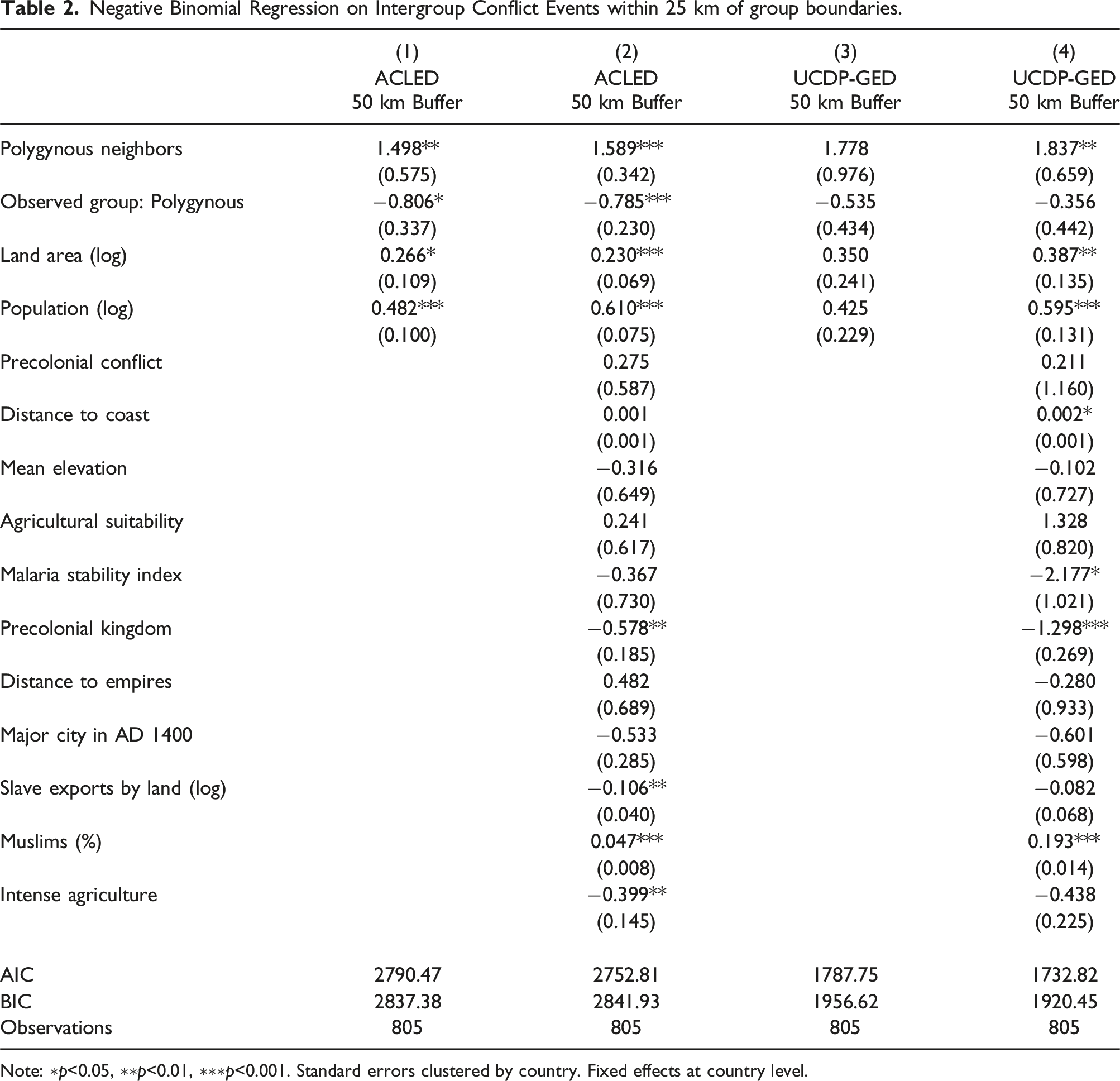
Note: ∗p<0.05, ∗∗p<0.01, ∗∗∗p<0.001. Standard errors clustered by country. Fixed effects at country level.
Biggs (2018) posits that event counts are not as valuable to operationalizing protests as the amount of protesters who attended. Biggs (2018) finds a relatively weak correlation between the number of protests and the aggregate number of protest attendees and that most protesters, arrests, and politically relevant episodes concentrate in relatively few events. Biggs (2018) underscores that protests also vary widely in scope, including strikes, riots, boycotts, and peaceful demonstrations, the causes of which are not necessarily comparable.
Biggs’ (2018) operationalization of protest intensity can extend to rural violence. Like protests, rural violence varies in scope. As described in Supplemental appendix 9, rural violence classifies farmer-herder clashes together with low-level civil conflict. Up to 70 events in ACLED involve accusations of witchcraft. The number of violent events in a particular area may also not reflect the magnitude of violence that has taken place. Counts treat events the same regardless of intensity, with a single event with hundreds of fatalities treated as identical to one with little to no fatalities. Much like Biggs (2018) treats the number of participants as a measure of protest intensity, the number of fatalities can be an alternative measure of conflict intensity. Both ACLED nor UCDP-GED report the number of fatalities that occurred from each event. 5
Polygynous neighboring groups and natural log of intergroup conflict fatalities.
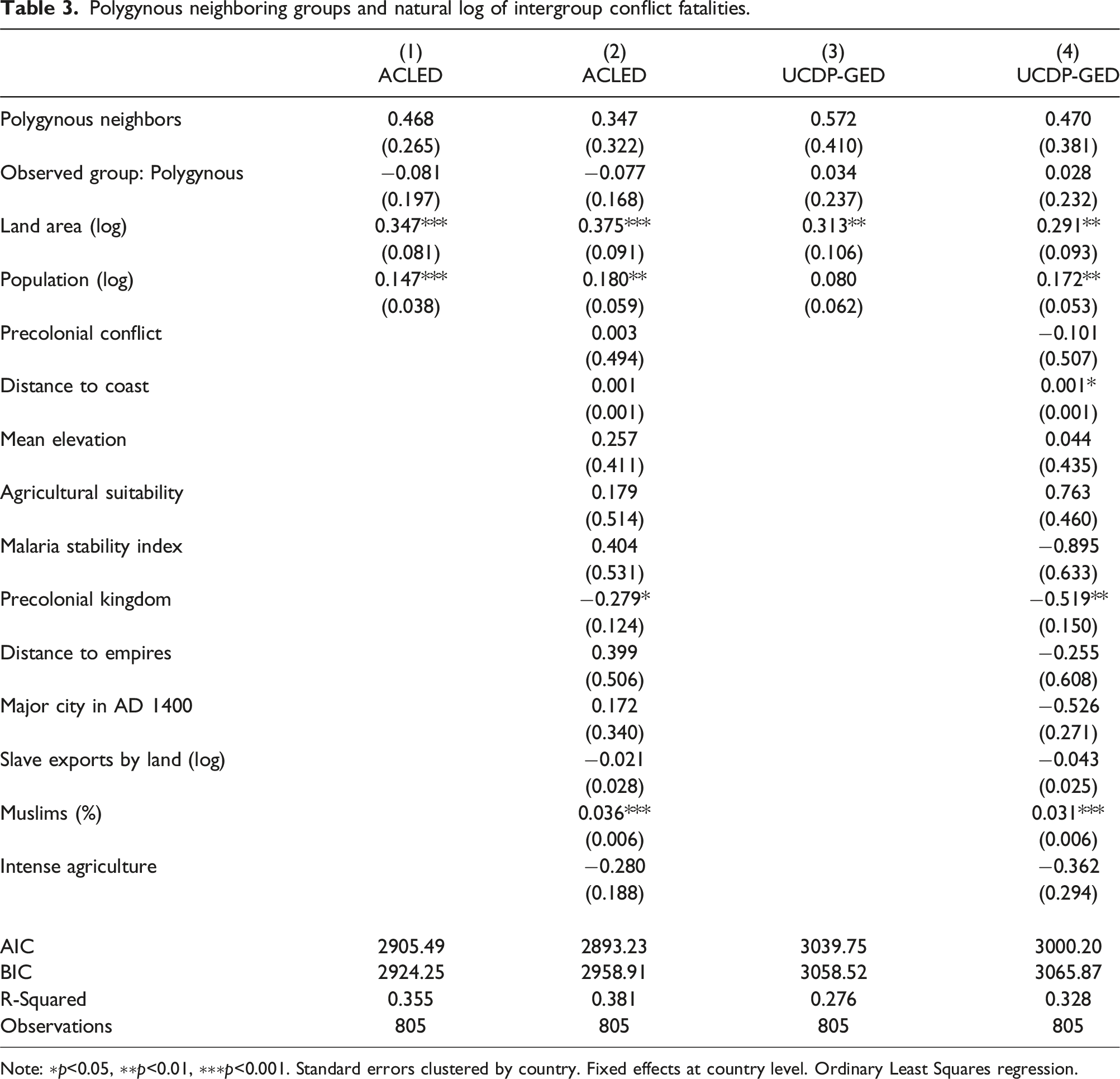
Note: ∗p<0.05, ∗∗p<0.01, ∗∗∗p<0.001. Standard errors clustered by country. Fixed effects at country level. Ordinary Least Squares regression.
Polygynous neighboring groups and natural log of intergroup conflict fatalities in 50 km buffer zone.
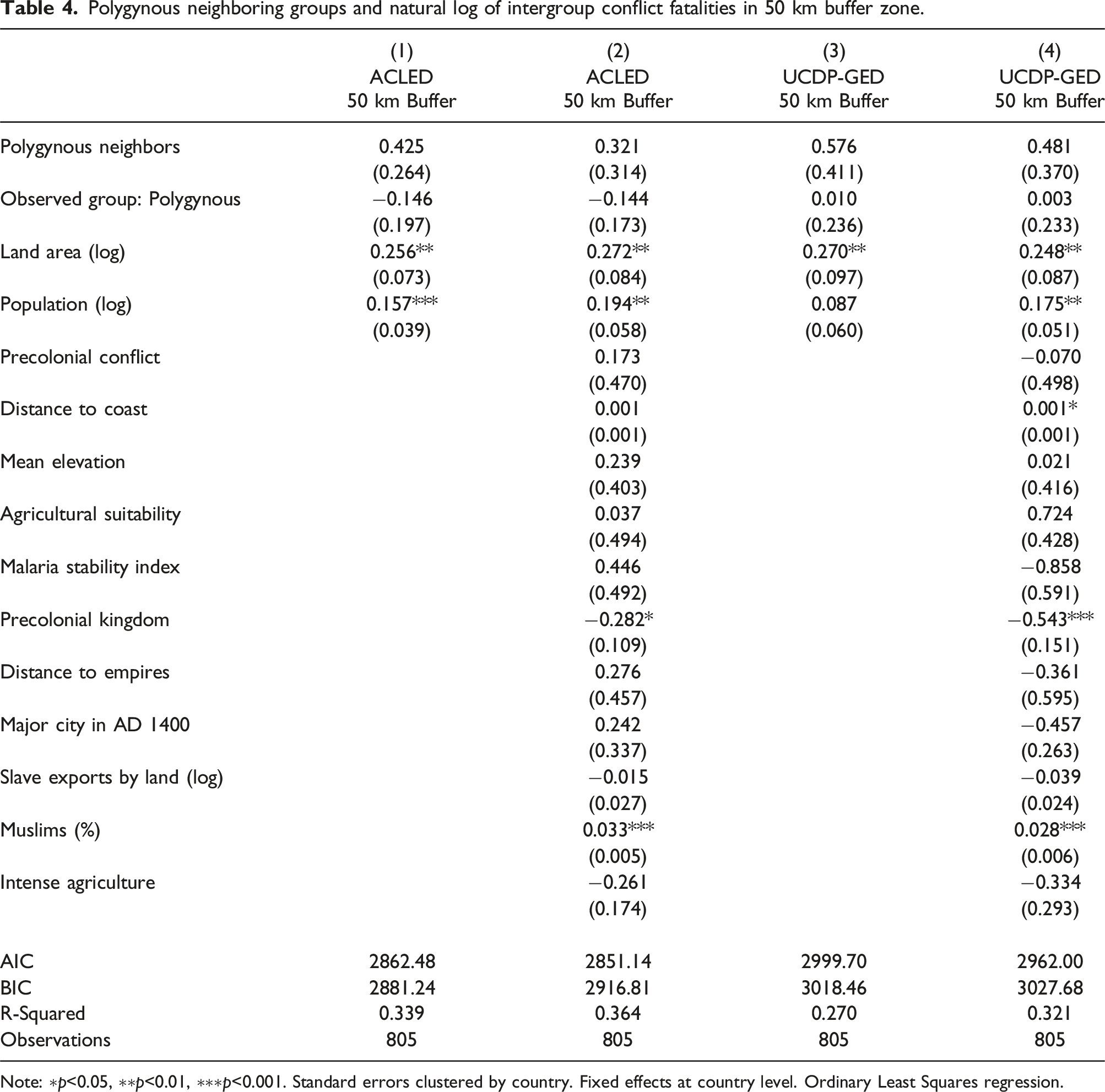
Note: ∗p<0.05, ∗∗p<0.01, ∗∗∗p<0.001. Standard errors clustered by country. Fixed effects at country level. Ordinary Least Squares regression.
Dividing Afrobarometer based on urban and rural respondents
Afrobarometer: Effect of polygyny on individual-level attitudes.

Note: ∗p<0.05, ∗∗p<0.01, ∗∗∗p<0.001. Robust standard errors.
KNW do not explain why they do not select on rural respondents, even though their theory states “excess men in rural areas who strive to conform to the social norms that derive from marriage and family therefore have two basic choices: to steal from, plunder, and raid one’s own group or to do the same to another group” (403) and “...they are especially pronounced in the context of rural communities without welfare systems that apply the principle of compensation” (407). This section evaluates the extent to which “excess men” were disproportionately present in rural areas identified as polygynous and the extent to which there is disproportionate support for violence and perception of inequality among rural childless men under 40 from polygynous groups.
Percentage of childless men across Afrobarometer findings.

Afrobarometer: Effect of polygyny on individual-level attitudes in rural areas.

Note: ∗p<0.05, ∗∗p<0.01, ∗∗∗p<0.001. Robust standard errors.
Moving forward
The quantitative re-analysis has produced questions about the extent to which there is an association between polygynous neighbors and violence, whether polygynous groups have more rural childless men and whether there is an association between support for violence and membership in a polygynous ethnic group among rural men under 40 without children. Supplemental Appendix 9 finds no evidence that “excess men” played a role in rural violence by its largest perpetrators in either ACLED data, the Fulani, or UCDP-GED data, the African National Congress and the Inkatha Freedom Party. The narratives around violence in both conflicts also violate two assumptions of KNW’s hypotheses: that ethnic group boundaries are fixed and that the aggressors in rural violence are ethnically homogeneous members of neighboring out-groups. Patterns of such violations call into question whether the significant association between rural violence event counts and polygynous neighbors reflects KNW’s theoretical claims.
Broadly, the prescriptions of Biggs (2018) for protest data should be extended to data on violent events and scholars assessing the causes of such events should look beyond just event counts for inference. It is not clear that violent events and polygynous neighbors were significantly associated because of measurement issues, as Biggs (2018) suggests for protest count data. Nevertheless, the patterns suggested by the qualitative cases call the validity of even this association into question. As such, the question of what role polygyny plays in violence remains open. Scholars are encouraged to broaden empirical assessments for answers as well as to look at role of polygyny in affecting other outcomes, such as interethnic marriage (see Bandyopadhyay and Green, 2021) and rural-urban migration (i.e., De Brauw, Mueller and Lee, 2014).
Supplemental Material
Supplemental Material - Does polygyny cause intergroup conflict? Re-examining Koos and Neupert-Wentz (2020)
Supplemental Material for Does polygyny cause intergroup conflict? Re-examining Koos and Neupert-Wentz (2020) by Konstantin Ash in Research & Politics
Footnotes
Acknowledgments
I would like to thank Jonathan Powell and Michael (Elolo) Yekple for their feedback on various stages of this project and Carlo Koos for sharing corrected information about data used in Koos and Neupert-Wentz (2020).
Declaration of conflicting interests
The author(s) declared no potential conflicts of interest with respect to the research, authorship, and/or publication of this article.
Funding
The author(s) received no financial support for the research, authorship, and/or publication of this article.
Correction (June 2025):

Supplemental Material
Notes
References
Supplementary Material
Please find the following supplemental material available below.
For Open Access articles published under a Creative Commons License, all supplemental material carries the same license as the article it is associated with.
For non-Open Access articles published, all supplemental material carries a non-exclusive license, and permission requests for re-use of supplemental material or any part of supplemental material shall be sent directly to the copyright owner as specified in the copyright notice associated with the article.
