




Abstract
Several studies have shown that attitudes toward immigrants to Europe are marked by a Muslim bias. More recently, Helbling and Traunmüller (2020) have suggested that this Muslim bias is in fact driven by a religiosity bias and thus that the strength of migrant’ religiosity has a bigger effect on attitudes towards them than their nominal faith. The aim of this paper is to replicate and expand Helbling and Traunmüller with a fresh full factorial survey experiment, fielded in 2016/17. We go beyond the limitations of Helbling and Traunmüller, who study the effects of nominal faith, religiosity, and Nigerian as well as Bulgarian immigrants in Great Britain, by including Austria, Germany, France, and Switzerland to rule out idiosyncratic context effects. Moreover, we distinguish between labor migrants and refugees and include Syrian origin. For different groups of migrants in all five countries, our results confirm that the Muslim bias is mainly driven by the degree of migrants’ and refugees’ religiosity: secular and devout Muslims are viewed more positively than both Muslim and Christian fundamentalists.
Introduction
Research on attitudes toward Muslim immigrants has increased considerably over the last decade. Several studies have shown that attitudes toward immigrants in European countries are marked by a Muslim bias (e.g., Sniderman and Hagedoorn, 2007; Adida et al., 2016; Van der Noll et al., 2017; Spruyt and Van der Noll 2017; Wright et al., 2017). More recently, Helbling and Traunmüller (2020) have suggested that this Muslim bias is in fact driven by a religiosity bias. Their survey experiment was among the first to address the question of how people perceive the religiosity of Muslim migrants and to show that citizens’ negative attitudes toward Muslim immigration are mostly the result of a rejection of fundamentalist forms of religiosity. It is thus necessary to differentiate between migrants’ nominal faith and the strength of religiosity and, consequently, between simply belonging to a religious group and actually believing in certain religious values and behaving accordingly (Saroglou 2011).
The aim of this paper is to replicate and expand Helbling and Traunmüller (2020) with a fresh survey experiment using original cross-national data. By adding several new experimental elements, we go beyond the limitations of their study and provide more nuanced insights. Helbling and Traunmüller (2020) focus on the integration and not on the entry of immigrants, do not distinguish between labor migrants and refugees, and do not consider Syrians (or any other group from the Middle East or North Africa), who have constituted the largest refugee group since 2015. Furthermore, they only focus on the UK and thus cannot rule out idiosyncratic context effects.
Our study is conducted in five Western European countries (Austria, Germany, Great Britain, France, and Switzerland). This allows us to test the Muslim versus religiosity bias in democracies that have different citizenship and church–state regimes, which might influence attitudes especially toward religious migrants. In addition, these countries were affected by the increasing inflow of refugees after 2015 to different degrees.
Our results confirm other studies that have shown that natives have more positive attitudes towards Christian than towards Muslim migrants and towards refugees than labor migrants. More importantly, however, we show that migrants’ religiosity, and especially religious fundamentalism, plays a much more important role than nominal faith. 1 It appears that the Muslim bias is mainly driven by the degree of migrants’ religiosity and that secular and devout Muslims are seen similarly positive as Christian migrants and much more positively than both Muslim and Christian fundamentalists. Finally, we find that these attitude patterns are very similar in different democracies, demonstrating a widespread hostility towards fundamentalist migrants irrespective of the political or religious context.
Theoretical background
By replicating Helbling and Traunmüller (2020) study, we want to retest their main argument that the Muslim bias is driven by a religiosity bias and that negative attitudes towards Muslim immigrants are not so much explained by their nominal faith as by the strength of their religiosity (H1). We thus expect that the difference between attitudes towards Christian and Muslim immigrants is smaller than between attitudes toward immigrants with different levels of religiosity. Helbling and Traunmüller (2020) explain this by the dislike of extreme forms of religiosity in modern societies. In these societies traditional religiosity and religious fundamentalism stand in conflict with modern values such as individual freedom, gender equality, and political secularism, all of which had to be wrestled from religious authority in the past (Marty and Appleby, 1991; Marty and Appleby, 1994).
The religiosity effect is likely to increase or decrease depending on the country context and the reasons for migration. It has been shown that citizenship regimes influence attitudes toward immigrants in general. Through various socialization processes, the dominant institutional norms are transmitted to citizens’ individual norms. Accordingly, more liberal citizenship regimes are related to lower levels of perceived immigrant threat and more tolerance among natives (Weldon, 2006; Schlueter et al., 2013). We therefore expect attitudes toward religious immigrants to be generally more negative in countries with less liberal citizenship regimes (H2).
Attitudes toward religious immigrants can also be shaped by church–state regimes. European democracies are far from being fully secular (Fox, 2006; 2008, Driessen, 2010), and the state support for religious traditions might create a religious–cultural identity among citizens through socialization processes. In a context of a strong church–state relationship, religious minorities might therefore be seen as a bigger threat (Helbling and Traunmüller 2016) and thus migrants’ religiosity should have a bigger effect on attitudes than in countries with less state support for religion (H3).
Besides country contexts, attitudes toward religious immigrants could also be affected by their reasons for migration. We expect that the religiosity effect is smaller for refugees than for labor migrants (H4). We argue that refugees constitute a least likely case of opposition to fundamentalist migrants and thus present a particularly hard test for the religiosity bias hypothesis. According to the 1951 Geneva Refugee Convention people who are persecuted are recognized as refugees and their reasons to seek protection in another country are thus often regarded as legitimate by the native population. Labor migrants, however, are very often considered as exploiting the economic situation in other countries (Verkuyten 2004). In other words, according to many people, economic migrants have decided themselves to leave their countries whereas political refugees have been forced to leave their country. Bansak et al. (2016) show for 15 European countries that, on average, the reasons for migration have the strongest impact on attitudes toward refugees and that political and religious refugees are about 15 percentage points more likely to be accepted than economic migrants. Hager and Veit (2019) show for Germany that 92% of all respondents support asylum for political refugees whereas only 52% would accept economic migrants.
Considering the very high acceptance rates for political refugees, other characteristics—such as religiosity—might thus not lead to more negative attitudes towards refugees. In other words, religious fundamentalists are less likely to be rejected when they have legitimate reasons to find refuge in other countries.
Data
We analyze data from a representative cross-national survey that was fielded between July 2016 and March 2017 by means of computer-assisted telephone interviews (CATI) in Germany (N = 1432), France (N = 909), the United Kingdom (N = 904), Austria (N = 929), and Switzerland (N = 961). 2 We only include people in the analyses who identified as Christians or non-religious persons, representing 78% of the sample. 3
The country cases under investigation vary regarding the size of the refugee population. With more than half a million refugees, Germany has received by far the most Syrian refugees in Europe by 2019. 4 Relative to their population size, Austria (around 52,000) and Switzerland (19,000) have also received a high number of refugees. In contrast, significantly fewer refugees moved to France (18,000) and the United Kingdom (10,000) in relation to the size of their population.
The countries also differ regarding citizenship and church–state regimes. 5 Austria, Germany, and Switzerland are often ascribed an assimilationist citizenship model whereas the United Kingdom is a prototypical case of a multicultural model and France an in-between case, with a civic-territorial conception of citizenship but a high degree of assimilation (Koopmans et al., 2005). As for church–state relationship, the United Kingdom has a state church whereas France has a long tradition of strict separation between state and church. In the other three countries, the degrees of cooperation between state and church vary (Carol et al., 2015).
In the survey, we implemented a 2x2x2x3 full factorial design in which each respondent received three random vignettes, describing a fictitious migrant, manipulated by country of origin (Nigeria or Syria), reason for migration (work or asylum), religious identity (Muslim or Christian), and religiosity (non-practicing/secular, devout, or fundamentalist). After each vignette, respondents were asked to state whether they would grant or reject the described person’s request for a work permit or asylum. (See Appendix for detailed wording, combinations of vignettes, and balance checks.)
We restricted our study to attitudes towards Muslims and Christians as the former constitute a major immigration group in the countries under investigation that often leads to public and political controversies and the latter represent the traditional majority religion in Western Europe. The migrants were described in the vignettes as coming from either Syria or Nigeria as we wanted to use countries in which both Muslims and Christians live to make the vignettes realistic. In Nigeria, Muslims make up roughly 40% and in Syria 87% of the population. Moreover, both nationalities constitute important non-Western migrant groups to Europe. We also included Syrians in the vignettes because they made up an important group of refugees at the time of data collection. Comparing attitudes toward these two nationalities allows us to see to what extent our findings are driven by the issue salience of Syrian refugees during the time of data collection or to what extent attitudes toward migrant groups can be generalized to different nationalities.
Since respondents might have different understandings of religiosity, we provided short descriptions for our categories that correspond to our definitions. Accordingly, we defined devout people through traditional practices of religion such as regularly praying and regular church or mosque attendance (Smith 1998). Fundamentalist religious believes stand for the idea that there is only one interpretation of a religious scripture, which stands above secular laws (Altemeyer and Hunsberger 1992; Koopmans 2015). Non-practicing or secular people were defined as persons who never go to church/mosque and never pray.
Although we provided these descriptions, it was still possible that respondents associated other meanings with these labels, for example, linking fundamentalism with terrorism. However, not only the label fundamentalism might evoke associations beyond the given definitions. For example, Sides and Gross (2013: 587) have shown that groups described as “Muslims” or “Muslim-Americans” are seen as more violent, even without the specification “fundamentalist.” The very aim of our study is to deal with this problem and to disentangle the different perceptions of Muslims by separating nominal belonging from actual religious behavior and convictions.
Results
Figure 1 presents the probability of immigrants being granted access by the respondents according to the different migrant characteristics (for summary statistics see also Table A2 in the Appendix). The figure shows the average across respondents from all examined countries. The first dimension we are interested in is the difference between immigrants from different countries of origin. Owing to the experimental design, the origin effect can be examined independent of the other migrant characteristics such as religion or reason for migration. The figure shows that attitudes towards immigrants from Syria (SYR; filled circle or triangle) are slightly more positive than towards immigrants from Nigeria (NGA; empty circle or triangle). The effect is significant, but barely substantial (three percentage points; see also regression Table A3 in the Appendix). Accordingly, immigrants’ country of origin does not influence respondents’ attitudes. Probability of immigrants being granted access according to their reasons for migration, nominal faith, and country of origin (lines indicate 95% confidence intervals). SYR = Syrians, NGA = Nigerians.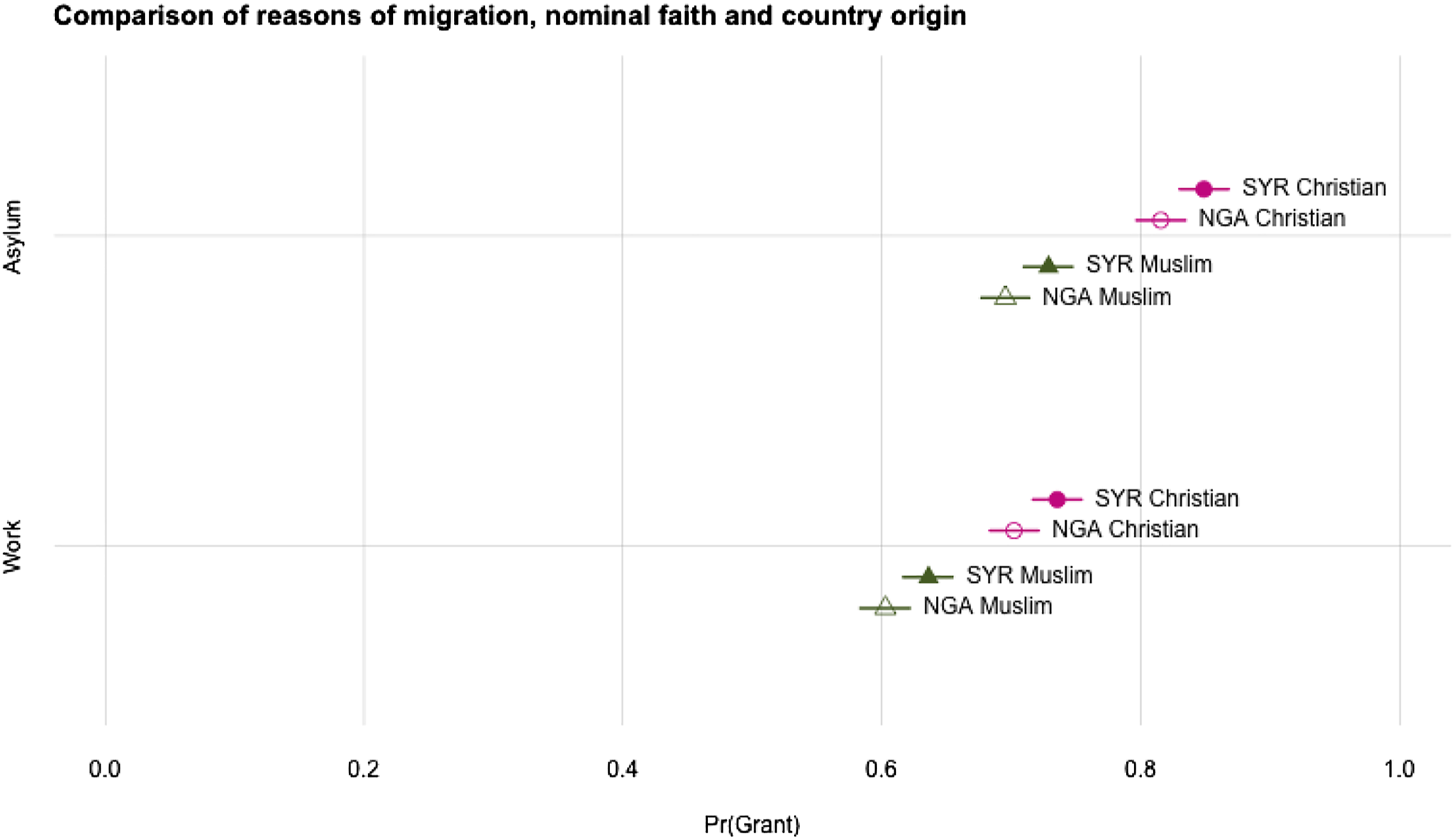
The second dimension of interest is religion. As Figure 1 shows, Christian immigrants are favored over Muslim immigrants by roughly 11 percentage points, irrespective of their country of origin. These results indicate a Muslim bias and validate previous findings that Muslims are less welcome than Christian immigrants (Bansak et al., 2016; Czymara and Schmidt-Catran 2017). Thus, the probability of immigrants being granted access is rather shaped by their religion, that is, their nominal faith, than by their country of origin.
Additionally, Figure 1 shows the probability of immigrants being granted access dependent on the reason for migration. Overall, refugees are more welcome than work-seeking migrants. The mean probability of refugees being granted access is 11 percentage points higher than for economic migrants and therefore similar to the religion effect. Within each group, Muslims are less welcome than Christians. The probability of Christian refugees being granted access is highest (0.849 (CI: 0.83, 0.867)), followed by Christian migrant workers (0.736 (0.716, 0.754)), who are as welcome as Muslim refugees (0.729 (0.709, 0.747)). The most disadvantaged group is Muslim migrant workers (0.636 (0.617, 0.654)). These empirical findings support the well-established finding that refugees are perceived more positively than work-seeking migrants (Bansak et al., 2016, Hager and Veit 2019).
Next, we examine the probability of immigrants being granted access while controlling for religiosity, separated by nominal faith and the reason for migration. Figure 2 shows that fundamentalist believers are more strongly rejected than devout or secular immigrants.
6
Furthermore, we see that, with increasing religiosity, the probability of being granted access declines more for Muslim immigrants than for Christian immigrants. Although the difference between secular Muslim and Christian immigrants is small (circles, mean difference = 0.043), the difference between devout Muslim and Christian practitioners (triangles, mean difference = 0.117) and Muslim and Christian fundamentalists (squares, mean difference = 0.171) is substantial and significant.
7
It thus appears that an increase in religiosity also increases the bias against Muslims. In other words, the Muslim bias is not primarily shaped by nominal faith itself, but by the degree or intensity of how Islam is practiced, which supports Hypothesis 1. When looking at the reasons for migration, we see again that refugees are preferred to labor migrants, but only within the respective dimension of religiosity, for example, secular refugees are preferred to secular labor migrants. Fundamentalist believers are far less preferred than more moderately religious immigrants. It thus appears that religiosity plays a similar role for attitudes towards labor migrants and refugees, which disconfirms Hypothesis 4. Probability of immigrants being granted access according to reason for migration, nominal faith and religiosity (lines indicate 95% confidence intervals).
The results are robust across the countries included in the sample, as is shown in Figures A1 and A2 in the Appendix. The differences by immigrants’ characteristics are constant across all countries, which disconfirms Hypothesis 3. The overall level of acceptance is also constant across the different countries, which contradicts Hypothesis 2. The only exception is the UK, where respondents were more hesitant overall to grant access to immigrants. However, given the UK’s liberal citizenship regime, we would expect more positive attitudes here. It thus appears that there is a high agreement across countries on which refugees and work-seeking migrants should be allowed to enter the country.
Conclusion
So far, scholars have agreed on which migrant characteristics lead to more positive or negative attitudes among the host society. Attitudes towards refugees are more positive than towards labor migrants, and Muslim migrants are rejected more than Christian migrants. Although corroborating these previous findings, our study also suggests that migrants’ religiosity plays a significant role. Confirming Hypothesis 1, the analyses showed that attitudes are more negative toward both fundamentalist Muslims and fundamentalist Christians than toward any other migrant group. At the same time, Hypotheses two to four were rejected, since the religiosity bias was shown to be constant for both labor migrants and refugees and across countries with different citizenship and church–state regimes. We thus confirm Helbling and Traunmüller (2020) findings for different migrant groups in different contexts.
Accounting for different degrees of religiosity can even lead to reversed priorities, with Muslims being preferred to Christians and labor migrants to refugees. Figure 2, for example, shows that secular and devout Muslims are preferred to fundamentalist Christians. Furthermore, the probability of secular or devout labor migrants being granted a work permit is much higher than the probability of fundamentalist refugees being granted asylum.
Moreover, we have also shown that the widely researched Muslim biases increase with growing religiosity. In other words, there is hardly any difference in attitudes toward Christian and Muslim migrants when they are not fundamentalist, with attitudes toward secular Muslims being only slightly more negative than attitudes toward secular Christians. Moreover, the fact that we also find strongly negative attitudes toward Christian fundamentalists indicates that fundamentalism is not necessarily related to violence, as Christian fundamentalists are hardly seen as a violent threat or terrorists in public debates in Europe. We can therefore assume that religious fundamentalist refugees are opposed as they are seen as a danger for liberal values.
In sum, clearly differentiating between secular, devout, and fundamentalist refugees has a huge impact on how Muslim immigration is discussed. At the same time, the prevalence of negative attitudes toward fundamentalist refugees might also pose ethical problems for receiving states. Especially in conflicts between religious groups, these people might be persecuted even more than secular refugees and thus have more legitimate reasons to be granted asylum. In the Syrian war, Sunnites—who make up around 75% of the population—have been most severely targeted by the Alawite regime, 8 and Sunnite Muslims have been shown to have the strongest fundamentalist attitudes among Muslim immigrants in Western Europe (Koopmans 2015: 43–45).
Supplemental Material
sj-pdf-1-rap-10.1177_20531680221088491 – Supplemental Material for Muslim bias or fear of fundamentalism? A survey experiment in five Western European democracies
Supplemental Material, sj-pdf-1-rap-10.1177_20531680221088491 for Muslim bias or fear of fundamentalism? A survey experiment in five Western European democracies by Helbling Marc, Jäger Felix and Traunmüller Richard in Research & Politics
Footnotes
Acknowledgment
We thank Yasmine El-Menouar and the Bertelsmann Foundation for generously sharing the Religions Monitor data. We presented the paper at the Cluster of Excellence Religion and Politics at the University of Münster and received helpful feedback.
Declaration of conflicting interests
The author(s) declared no potential conflicts of interest with respect to the research, authorship, and/or publication of this article.
Funding
The authors disclosed receipt of the following financial support for the research, authorship, and/or publication of this article: This work was supported by the German Research Foundation (DFG) (TR 1334/3-1, MH 6182/6-1). The data collection was funded by the Bertelsmann Foundation.

Supplemental Material
Supplemental material for this article is available online.
Notes
References
Supplementary Material
Please find the following supplemental material available below.
For Open Access articles published under a Creative Commons License, all supplemental material carries the same license as the article it is associated with.
For non-Open Access articles published, all supplemental material carries a non-exclusive license, and permission requests for re-use of supplemental material or any part of supplemental material shall be sent directly to the copyright owner as specified in the copyright notice associated with the article.
