




Abstract
The pervasiveness of partisan media and the 24/7 news cycle allow ample opportunity for partisan-motivated reasoning and selective exposure. Nonetheless, individuals still frequently encounter out-party media outlets and expert pundits through mainstream news and social media. We seek to examine the effects of cross-cutting partisan outlet cues (e.g. Fox News, MSNBC) and direct party cues (e.g. Republican, Democrat) on citizens’ perceptions of ideology, source credibility, and news consumption. Using an experiment that pits outlet cues against direct party cues, we find that cross-cutting outlet and direct party cues lead citizens to perceive pundits as more ideologically moderate. As a result, respondents find out-party pundits on in-party outlets to be less biased, increasing interest in the pundits’ perspectives. However, while cross-cutting pundits gain among the out-party, they lose among the in-party. This trade-off holds important normative implications for individual news consumption and the ability of outlets and pundits to appear unbiased while garnering the largest possible audience.
While citizens have strong partisan preference in news sources (Stroud, 2008, 2011; Taber and Lodge 2006; Prior 2007), they are nonetheless often exposed to outlets and pundits that do not share their partisan affiliation. Even if one actively attempts to establish a partisan echo chamber, they may stumble upon headlines or information from out-party outlets or pundits in their daily lives or on online media platforms such as YouTube and Twitter which regularly feature news from multiple partisan media institutions. Moreover, in-party media institutions often feature out-party pundits. For example, Fox News employs several self-described liberal pundits, including Tamara Holder, while left-leaning MSNBC features a handful of moderate conservatives, including Joe Scarborough on Morning Joe (Fitts 2014). Being featured on an out-party network is often an attractive proposition for the pundits themselves, who might pique the audience’s interest and gain a branded reputation for neutrality by showing a willingness to cross the proverbial partisan isle. Megyn Kelly’s move from Fox News to NBC in 2017 serves as an example of how featuring out-party pundits may be advantageous for pundits (and news outlets) in terms of increasing viewership (Nichols 2017) (also see Mutz and Reeves 2005; Mutz 2015; Groeling 2010).
While affective partisan biases are well-documented in scholarly literature, more recent work has called into question the extent and ubiquity of partisan echo chambers (Barbera et al., 2015; Fletcher et al., 2020). In addition, less has been done to assess the impact of cross-cutting outlet cues (e.g., Fox News and MSNBC) and more direct party cues (e.g., Republican and Democrat) on individual perceptions and behavior. These raise interesting questions both in terms of individual news consumption, as well as the potential incentives that could affect the willingness of pundits to feature on out-party networks. Are pundits perceived to be less ideological when they trespass on out-party news outlets? Do cross-cutting outlet cues and direct party cues increase the credibility of out-party pundits? These questions hold important implications for the profit motives and perceptions of trust and credibility for pundits and networks alike.
We seek to examine the effects of cross-cutting partisan outlet cues and direct party cues on citizens’ perceptions of ideology, credibility, and news consumption. In doing so, we hope to present an assessment of pundits’ abilities to establish audience trust in a polarized media environment, which is of vital importance to the success of pundits as entrepreneurs of their own celebrity brand (Hamilton 2004). We also explore the potential incentives of both pundit and network, and whether these incentives clash in ways that may impact media coverage. Finally, we offer an empirical assessment of the relative weight of partisan network cues (e.g., Fox News and New York Times) and direct party cues (i.e., Republican and Democrat) and whether they both prime partisan preferences to an equivalent degree in an experimental context. We leverage an experiment that pits outlet cues against direct partisan cues to test their relative influence over partisan perceptions. We find that cross-cutting outlet and direct partisan cues lead citizens to perceive pundits and policy analysts as more ideologically moderate, increasing audience interest and decreasing perceptions of bias for out-party pundits. Yet, a pundit that crosses party lines also loses credibility among members of their own party, presenting outlets and pundits with a tricky trade-off. Yet still, audiences express more willingness to trust an out-party pundit on an in-party network, a normatively positive finding given the pervasiveness of partisan polarization.
The supply side: pundits as entrepreneurs
Decisions about where pundits choose to contribute their analysis and which networks are willing to feature them center partly on economic motives. Media content is heavily driven by the fragmentation of news across national networks, streaming services, and websites all vying for consumers. This incentivizes journalists to differentiate themselves, often even from other pundits on the same news outlet, forging their own celebrity brand to garner viewer trust and interest (Hamilton 2004). To this end, journalists and pundits can take on various personas on both network and social media, often resulting in archetypes such as “promoter”, “joker”, and “celebrity” (Mellado and Hermida 2021). This shift has been exacerbated by the rise of soft news cable news networks, with pundits emphasizing personability and relatability as a part of their drive to deliver high quality news (Hamilton 2004). Thus, understanding the entrepreneurial decisions of the pundits as brands and celebrities is important to understanding when they may choose to feature on out-party outlets and why that matters for audience interest and news consumption.
The demand side: motivated reasoning and selective exposure to news
The polarized political media environment offers a unique opportunity and challenge for pundits seeking to differentiate their brand. Individuals utilize reputational network cues to infer the partisanship of the pundits and content, leading to selective exposure that increases polarization (Iyengar and Hahn 2009; Turner, 2007; Prior 2007; Stroud, 2008, 2011; Levendusky 2013). This phenomenon is particularly strong among Republican viewers, who tend to view the mainstream media as more liberal and are more likely to only trust Fox News as a credible information source (Stroud and Lee, 2013; Stroud, 2011; Ladd 2012). Media fragmentation and the sheer volume of partisan news options has made it easier for audiences to intentionally select news sources that reinforce individual biases, with partisans deliberately seeking sources that they believe share their views (Prior 2007; Arceneaux and Johnson 2013; Iyengar and Hahn 2009; Coe et al., 2008; Jamieson and Joseph, 2010; Morris 2005, 2007; Stroud, 2008).
Selective exposure results in motivated reasoning and heightened partisan animosity, and the media environment’s expansion into social media creates a challenge for pundits seeking to distinguish their brand and establish credibility with the audience. In determining source credibility, individuals take many factors into account, including the issue context (Bullock 2011; Boudreau and MacKenzie 2014, 2018), the technical expertise (Ozer 2020), characteristics (Nicholson 2012; Walter and Redlawsk 2019), and message framing (Lupia 2013; Druckman and Arthur, 2016). While important, several influential works demonstrate the influence of partisan cues, often overwhelming competing cues to such a degree that individuals will assume ideologically incongruent beliefs in an effort to match their views to their preferred party (Achen and Bartels, 2016; Cohen, 2003; Iyengar et al., 2012; Kraft et al., 2015). This same phenomenon applies directly to political candidates as well, with party cues overwhelming contextual cues when assessing candidate ideology (Simas and Ozer 2017) and candidate performance (Bartels, 2002; Goren, 2002). These works imply that the partisan siloization of politics may prevent pundits from establishing a brand as their partisan reputation will overwhelm any idiosyncratic characteristics in the audience’s eyes.
Yet, other works suggest that news audiences are not quite as partisan as perhaps feared, and that contextual cues can help cut through partisan stereotypes and selective exposure, offering a unique opportunity for pundits. While initially resistant to competing cues, individuals become less partisan in nature as dissonant information continues to mount (Walter and Redlawsk 2019; Mummolo et al., 2019). Individuals even show a strong preference for ideologically neutral sources and more widely popular pundits over in-party sources (Messing and Westwood, 2012; Metzger et al., 2015). With specific regard to cross-cutting cues, contrasting religious and partisan cues (e.g., Jimmy Carter, a socially liberal Democratic president with socially conservative Evangelical Christian beliefs) may not alter perceptions of a candidate’s overall ideology, they do appear to moderate perception of the candidate’s position on key issues like abortion (Simas and Ozer 2017). Similarly, when exposed to cross-cutting contextual cues that provide information regarding the policy beliefs or technical expertise of speakers or candidates, individuals exhibit smaller (albeit still notable) partisan biases (Bullock 2011; Boudreau and MacKenzie 2014, 2018; Ozer 2020; Nicholson 2012).
As such, pundits may have much to gain in credibility and audience interest by establishing themselves as a “centist” willing to engage with opposing partisan networks. Given these expectations for cross-cutting cues and pundit evaluations, we note that individual exposure to ideologically incongruent outlets is not uncommon. Pew Research Center (2014) finds that 20% of consistently conservative individuals watch CNN and 24% of mostly liberal individuals watch Fox News (see Supplementary Appendix C). In addition, individuals are often unwittingly exposed to politically incongruent sources online. For example, YouTube’s homepage regularly features top news stories broadcast by multiple partisan news outlets irrespective of one’s own preferences. Previous works show that ideological segregation on social media has traditionally been overestimated and is not as widespread as initially feared (Barbera et al., 2015), with online levels of polarization not necessarily equating to the same levels of polarization offline (Fletcher et al., 2020). Similarly, experimental evidence shows that while individuals hold a strong preference for in-party pundits, they nonetheless select out-party pundits nearly 40% of the time (Knobloch-Westerwick and Meng 2009; Feldman et al., 2013). Thus, there is ample evidence to suggest that audiences will not simply tune out out-party pundits upon first exposure, particularly if that out-party pundit is featured on a trusted in-party network.
Cross-Cutting Hypothesis
The intersection of cross-cutting partisan pundit and network cues holds informative potential implications. Substantively, it allows for an unique opportunity to assess the ability of pundits to establish a vital brand identity in a polarized media sphere as well as the differing incentives of both pundit and network. Empirically, we seek assess the relative weight of partisan network cues and direct party cues to test whether they trigger partisanship among respondents to equivalent degrees, making them suitable for interchangeable use in experimental studies. Ultimately, cross-cutting cues on news outlets therefore have the power to engage and interest the viewers, while having potentially negative downstream effects on trust. Thus, we present a theoretical prediction grounded in a similar framing of cross-cutting cues on perceptions of ideology, outlet and pundit trustworthiness, and general levels of political interest and engagement.
We put forward a Cross-Cutting Hypothesis. First, we expect that Democratic pundits that appear on a right-leaning outlet, like Fox News, will be perceived to be more ideologically moderate than an identical Democrat on a left-leaning outlet like MSNBC. The same should be true of Republican pundits on left-leaning outlet relative to a right-leaning outlet. This would indicate that individuals are updating their perceptions of pundits in a logical fashion based on the nature of both cues.
Second, we expect that cross-cutting cues will alter perceptions of trustworthiness. In-party pundits on out-party outlets will be met with more distrust as respondents perceive that pundit to be further away ideologically. The opposite should be true of out-party pundits on in-party outlets, as the ideology of the out-party pundit will be perceived to be more in line with the individuals since they are willing to “trespass” onto the other outlets.
Finally, we expect that cross-cutting cues will ultimately affect individuals’ interest in the news story in the same manner as they affect trust and credibility. Individuals will demonstrate more interest in stories featuring out-party pundits when they appear on an in-party network, vice versa for in-party pundits on out-party outlets.
Experimental design
We distributed an online survey to a census-matched sample of 893 respondents from Lucid, an online survey service, in the Spring of 2020 (see Supplementary Appendix A2 for demographics). The demographics of respondents from Lucid samples have been shown to closely match those of traditional nationally representative studies, with experimental findings replicating those from traditional samples in the vast majority of instances (Coppock and McClellan 2019). 1
We leverage a within-subjects survey design in which respondents viewed a series of fabricated social media posts from the mainstream news outlets, featuring news analysis from various political pundits. Within-subject designs with repeated measures are advantageous for their increased precision in measurement and overall statistical power (Clifford et al., 2021). These posts were designed to look highly realistic, utilizing the same thumbnail photos and information featured in each news outlets real Twitter accounts (Figure 1). Respondents viewed four total posts, bringing the total number of observations to 3572. We randomly assigned respondents into one of three partisan media outlet treatments: Fox News (conservative), MSNBC (liberal), and The Associated Press (neutral). We selected Fox News and MSNBC as treatments, as prior survey evidence indicates that both outlets are seen as nearly equally ideological (Mitchell and Matsa 2014). We simultaneously manipulated the partisanship of the featured pundit: Republican, Democratic, or unaffiliated. After each post, respondents answered a short battery of questions before moving onto the next post. The end result is a 3 × 3 experiment (conservative/liberal/neutral outlet × Republican/Democrat/unaffiliated pundit), allowing us to measure the independent and conditional influence of both cues. All posts featured headlines that did not mention a specific policy or candidate to avoid potential confounds based on policy positions that might undermine affective partisan biases (see Mummolo et al., 2019). Example manipulation.
Analyses feature binary indicators for the experimental treatment and three dependent variables. First, respondents rated the ideology of the pundit on a seven-point Likert scale, ranging from “extremely liberal” to “extremely conservative.” Second, respondents indicated how biased they felt the pundit was on a five-point Likert scale (1 = “Not at all biased,” 5 = “Extremely biased”). Finally, respondents rated their interest in the story (five-point Likert scale; 1 = “Not very interested,” 5 = “Extremely interested”) and the likelihood they would read the story if it came across their social media feed (five-point Likert scale; 1 = “Not very likely,” 5 = “Extremely likely”). These measures were averaged to create a single index of interest in the article, with higher scores representing higher levels of interest (Cronbach’s
Results
As a preliminary test, we assess the pundit’s ideology based on outlet and party cues to test whether the manipulations work as intended. Figure 2 plots the coefficients from OLS regression analyses with clustered standard errors, fixed effects for the post and a random effect for the respondent. See Supplementary Appendix A3 and A3.1 for a full regression table and Supplementary Appendix Table A3.1b for a table with predicted scores generated from this analysis (predicted scores mentioned in text refer to Supplementary Appendix Table A3.1b). This approach better accounts for the within-subject nature of the design, though difference-of-means testing yields highly similar (albeit less precise) results. Change in Perceived Ideology Based on Experimental Treatment (0 = most liberal, 1 = most conservative).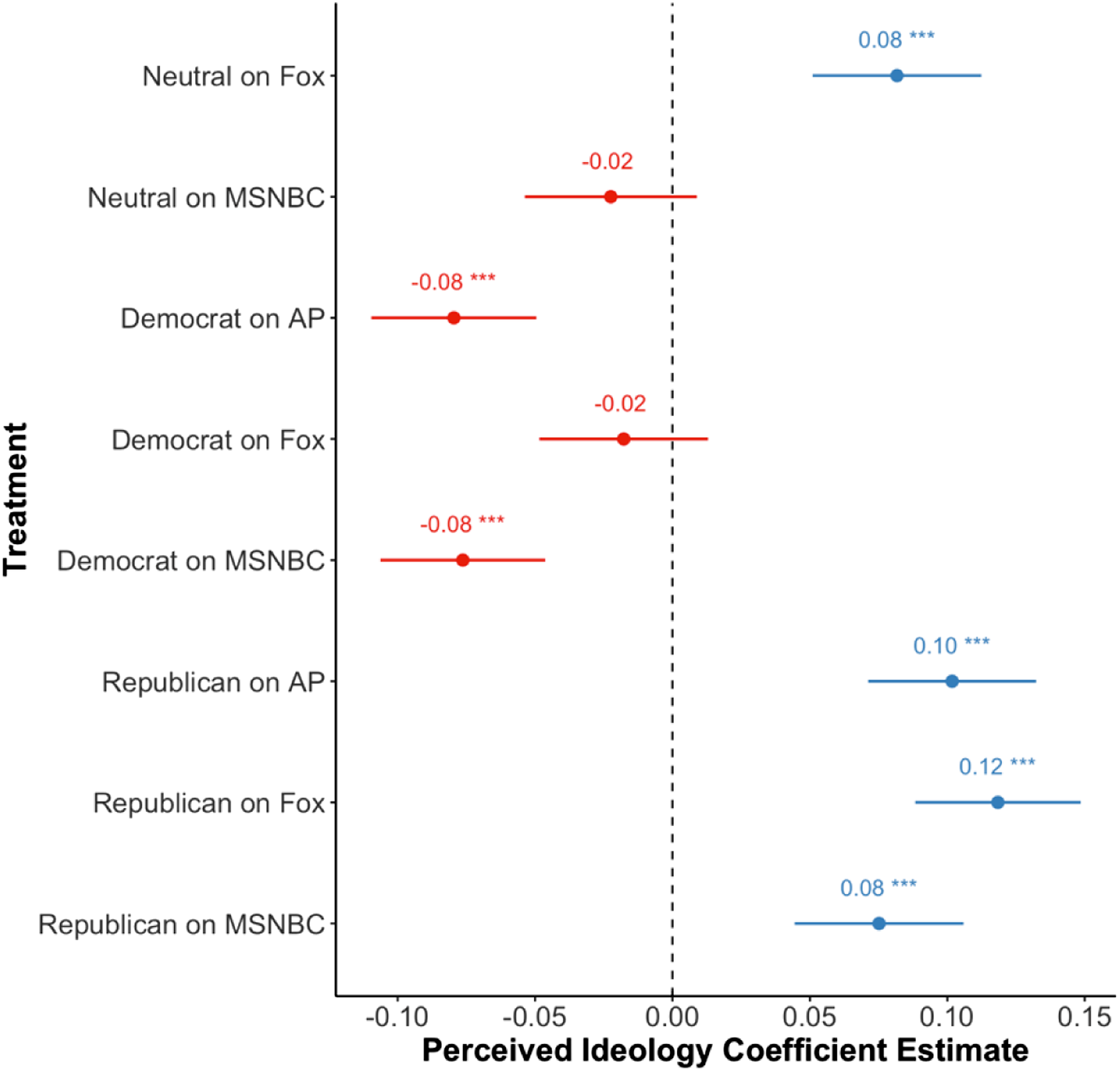
Results show that both the outlet and party cues are successful: the conservative (liberal) outlet cue and party cue both lead the respondent toward more conservative (liberal) ideological assessments of the pundit. In their respective control conditions, respondents perceive Republican pundits to be 1.9% more conservative than the Fox News outlet cue. Respondents find Democratic pundits to be 5.3% (p < 0.01) more liberal than the MSNBC outlet cue. Ultimately, respondents appear to more closely associate Fox News with Republicans than they do MSNBC to Democrats. This latter finding may be undermined when respondents encounter a different left-leaning outlet, such as the New York Times. Nonetheless, evidence shows that both party and outlet cues succeeded were successful in manipulating ideology. Moreover, cross-cutting cues lead respondents toward more moderate ideological assessments of pundits. A Republican that appears on MSNBC is perceived as 4.8% (p < 0.01) more liberal relative to the same pundit on Fox News. A Democrat on Fox News is seen as 5.1% (p < 0.01) more conservative. While intuitive, these preliminary results show that individuals are quite responsive to cross-cutting cues, updating their ideological perceptions based on outlet affiliations despite competing direct party cues.
Next, we assess whether individuals trust out-party (in-party) pundits more (less) when they feature on an in-party (out-party) outlet. For this analysis, we are interested in the (in)congruence between the partisan outlet cues and the respondents’ own partisanship. Thus, we recoded our binary indicators for the experimental treatment into in-party and out-party indicators based on the respondents’ partisanship.
2
Figure 3 plots the coefficients from those analyses (see Supplementary Appendix A3 and A3.2 for full regression table and Supplementary Appendix Table A3.2b for predicted scores). Evidence suggests that respondents perceive pundits to be biased irrespective of outlet and party cues, reflecting recent trends in distrust of the media. Respondents show a strong preference for in-party pundits (9.7%, p < 0.01) and in-party outlets (5.8%, p < 0.01) relative to the respective out-party cues. Comparison to the neutral outlet control reveals that these differences are primarily driven by increased distrust in out-party outlets and pundits rather than in-party trust. Predicted perceptions of bias based on cross-cutting pundit and party cues (0 = most liberal, 1 = most conservative). Predicted interest based on cross-cutting pundit and party cues (0 = most liberal, 1 = most conservative).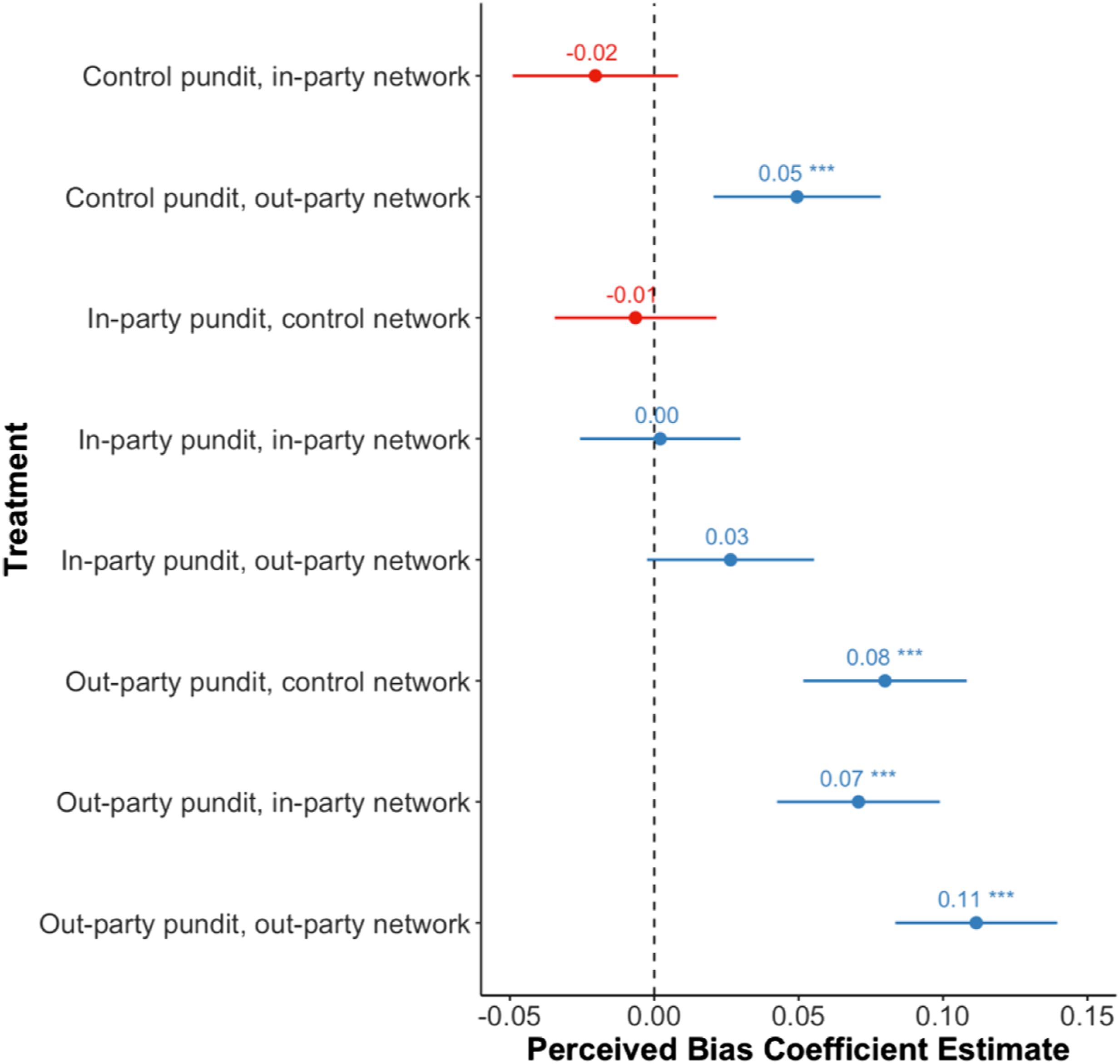

Findings support the Cross-Cutting Hypothesis. In-party pundits on out-party outlets are perceived as 3.8% (p < 0.01) more biased than the same pundit on an in-party outlet. Comparison to the neutral outlet treatment reveals this gap in perceived bias is primarily driven by a distaste for the out-party. Conversely, out-party pundits on in-party outlets are 4.7% (p < 0.01) less biased than a similar pundit on an out-party outlet. These results conflict in their implications. On the one hand, cross-cutting cues appear to decrease negative partisan biases directed at out-party outlets and pundits. On the other hand, respondents also lose faith in in-party pundits on out-party outlets, implying that outlet-based negative partisan biases are nonetheless prominent among respondents. Yet, these results indicate that cross-cutting cues do lead individuals to update their assessments in a logical fashion based on their partisan preferences. This pattern was consistent among both Democratic and Republican respondents, leading to a convergence in perceptions of outlet and party bias across party lines (see Supplementary Appendix B, Table B1 and B2). This indicates that cross-cutting cues lead individuals to update their assessments in a logical fashion consistent with the Cross-Cutting Hypothesis.
For in-party pundits, the outlet cue appears to have little effect on interest in the story. However, Out-party pundits on an in-party outlet gain 4.7% (p < 0.05) more interest than an identical pundit on an out-party outlet. This supports the Cross-Cutting Hypothesis and is consistent with prior results regarding ideology and perceived bias. This suggest that the unexpected pundit “trespasser” on the opposing partisan outlet gains among the out-party in interest, trust, and credibility. 3
Together, these results hold important implications for media trust and news consumptions. Respondents view in-party pundits as more biased when featured on out-party outlets, but this does not dampen respondents’ interest in clicking on the article. This provides contrasting incentives for both the party and outlet. Outlets may be able to broaden their audience by featuring an out-party respondent, but those pundits must consider the damage that may do to their reputation. Featuring on an out-party outlet increases perceptions of bias among an in-party audience, implying a loss of credibility even if the audience does not lose interest. Thus, pundits and outlets face a trade-off, potentially sacrificing in-party credibility for out-party credibility and interest.
Discussion
Results provide consistent support for the Cross-Cutting Hypothesis. When presented with dissonant direct party and outlet cues, respondents perceive pundits to be more ideologically moderate. As a result, respondents perceive out-party pundits to be less biased when featured on an in-party outlet and are more interested in the news story as a result, undercutting negative partisan biases. However, respondents also perceive in-party pundits to be more biased when they are featured on out-party outlets, suggesting a potential trade-off for pundits on out-party outlets. Ultimately, respondents update their assessments and behavior logically according to cross-cutting cues. These results imply that partisan pundits may be able to appear more ideologically balanced and credible when they feature on out-party outlets, allowing them to communicate with an out-party audience more effectively. This should incentivize pundits to consider sharing their perspective on out-party outlets. This is evident as a number of political candidates for national offices take interviews on out-party outlets. For example, Mayor Pete Buttigieg famously featured on a Fox News Town Hall, receiving criticism from members of his own party, but earning standing ovations during his interview from the conservative crowd (Grynbaum 2019).
From a normative perspective, whether these results are encouraging depends on the responsibility of journalists and partisan news outlets. If pundits are truly motivated by the dissemination of credible information via expert perspectives, regular appearances on out-party networks may be a useful tool for accomplishing this goal. Doing so may help expert pundits spread information to out-party audiences that might otherwise reject them due to partisan loyalties. In addition, expert pundits may utilize cross-cutting cues to garner a reputation as credible and bipartisan, helping them continue to communicate with out-party audiences more efficiently in the future. Yet, a more disingenuous pundit may also wish to appear on out-party networks in the interest of appearing to be more “centrist” while continuing to spread hyperpartisan talking points, spread misinformation, or generally create drama that makes for entertaining television but is ultimately distracting and uninformative.
Similarly, partisan outlets hold a legitimate interest in providing balanced perspectives. These results suggest that they be able to do so effectively despite viewers’ partisan predispositions. Useful cross-cutting cues may help politicians and experts to better reach an audience that is typically skeptical. However, media outlets are ultimately responsible for determining who features on their platform. It is possible that partisan media institutions may selectively feature out-party pundits that agree with the outlet’s underlying message. This would only serve to reinforce the audience’s partisan predispositions while making it difficult for pundits to share a true outsider’s perspective. Moreover, hyperpartisan news shows have shown a tendency to game the system, featuring weaker out-party perspectives on their shows to grant the in-party more legitimacy by feigning an interest in hearing out-party perspectives. 4 Thus, pundits must also consider the potential loss of credibility among an in-party audience when appearing on hyperpartisan out-party news. They must weigh the trade-off between potentially creating trust with a new audience and effectively spreading the message and undermining credibility with their typical partisan base while being utilized as a prop by a hyperpartisan network.
Supplemental Material
sj-pdf-1-rap-10.1177_20531680221075455 – Supplemental Material for Partisan news versus party cues: The effect of cross-cutting party and partisan network cues on polarization and persuasion
Supplemental Material, sj-pdf-1-rap-10.1177_20531680221075455 for Partisan news versus party cues: The effect of cross-cutting party and partisan network cues on polarization and persuasion by Adam L. Ozer and Jamie Wright in Research & Politics
Footnotes
Acknowledgements
Special thanks to Elizabeth Simas and Ryan Kennedy for their helpful advice during the research process.
Declaration of conflicting interests
The author(s) declared no potential conflicts of interest with respect to the research, authorship, and/or publication of this article.
Funding
The author(s) received no financial support for the research, authorship, and/or publication of this article.

Supplemental material
Supplemental material for this article is available online.
Notes
References
Supplementary Material
Please find the following supplemental material available below.
For Open Access articles published under a Creative Commons License, all supplemental material carries the same license as the article it is associated with.
For non-Open Access articles published, all supplemental material carries a non-exclusive license, and permission requests for re-use of supplemental material or any part of supplemental material shall be sent directly to the copyright owner as specified in the copyright notice associated with the article.
