



Abstract
A number of studies find that democracies spend less on their military than non-democracies. Yet there are well known counter-examples, including but not limited to the United States and Israel. We contend that these counter-examples are part of a larger pattern. The relationship between regime type and military spending is conditional on external threat. Among countries that do not perceive a significant external threat to their interests, democracies allocate considerably less to the military than non-democracies. However, democracies with a significant external threat do not allocate less to the military than non-democracies. The reason prior research consistently finds that democracies, on average, spend less on the military, even while controlling for external threat, is that democracies are much less likely to have a high external threat. For example, autocracies are nearly twice as likely as democracies to have a significant external threat in our sample. An empirical analysis of military spending from 1952–2000 is consistent with these expectations.
Introduction
A significant body of research finds that democracies spend less on their military than non-democracies (Goldsmith 2003; Fordham and Walker 2005; Nordhaus et al., 2012; Digiuseppe and Poast 2018). Yet there are well known counter-examples. The United States spends much more on defense than any other country. In most years since 1950, U.S. military spending represents more than one-quarter of total military spending in the world! Israel, Italy, and India routinely have a higher annual change in the log of military spending than most countries in the world since 1950.
The logic for why democracies generally spend less on their military than non-democracies emphasizes the effects of political participation. Because there are institutions giving citizens a role in the selection of their political leaders and less fear of repression, there is more political participation in a democracy compared to an autocracy. As political participation increases, the influence of the median citizen increases. The median citizen generally prefers spending on social welfare goods like education and healthcare over defense spending because the relationship to an individual’s self-interest is more straightforward.
We challenge a central premise in this argument. The median citizen, we contend, only sometimes prefers spending on social welfare over defense. When a country has a significant external threat, the median citizen wants more defense spending. This means that democracies only sometimes spend less on defense than autocracies. In each context, low or high external threat, the same causal mechanism, the preferences of the public, drive the relationship. What’s new in our research is the contention that the public does not always want to minimize defense spending. Further, external threats affect autocratic defense spending less than democratic defense spending. Thus, the relationship between democracy and military spending is conditional on external threat.
Regime type, threat, and military spending
Drawing on Immanuel Kant, Fordham and Walker (2005, 142) contend that democracy pressures leaders to provide more social welfare goods like education than autocracies and that democracies want to spend less on the military in order to reduce the likelihood of interstate conflict. It’s not clear that democracies participate in fewer interstate conflicts (Bueno De Mesquita et al., 1999). Goldsmith (2003, 556), however, echoes the former justification: “compared with social welfare, military commitments are ‘soft’ demands in the context of electoral and parliamentary politics.” According to this line of reasoning, democracies allocate less to defense than non-democracies because of public preferences for social welfare over military spending, and leaders in democracies pay more attention to public opinion. We contend that the public’s preference for military spending is not always a “soft” demand.
Fordham and Walker (2005, 144) also draw on Selectorate theory to explain why democracies spend less on the military. In Selectorate theory, the size of a leader’s winning coalition drives how much a leader focuses on the provision of public versus private goods. In order to retain office, leaders who represent larger winning coalitions provide more public goods than leaders representing small winning coalitions. For this reason, Fordham and Walker (2005, 144) conclude that “the private goods produced by military spending are less useful” to leaders in democracies. We agree with this statement, but military spending may also produce a public good, namely, national defense. This is especially likely when a country faces a significant external threat, an expectation consistent with Selectorate theory.
Further, Selectorate theory famously expects large winning coalition (W) leaders to “try harder” than small winning coalition leaders to win a war (Bueno De Mesquita et al., 1999). This is for two reasons. First, victory in war is a public good and there is a greater incentive for large W regimes to provide public goods. Second, it is more challenging for small W regimes to increase their spending as much. We contend that a parallel argument explains the conditional relationship between military spending, external threat, and regime type. National security is a public good, and the median citizen believes military spending can protect or enhance their security. If this is accurate, then large W regimes with significant external threats should allocate more to defense than large W regimes without external threats. It is not clear if large winning coalition regimes will try harder (spend more than small winning coalition regimes) or try as hard in peacetime because the gravity of the outcome, not arming soon enough versus losing a war, is less clear. Unlike recent research, we note that military spending is both a private good and a public good. Government revenue channeled to defense contractors is a private good for those companies. However, when external threats are present defense spending may contribute to the public good of national defense.
Research on the relationship between public opinion in democracies and support for military spending is consistent with this argument. First, research shows a relationship between public opinion and military spending. Eichenberg and Stoll (2003) show that public opinion influences defense spending in a number of major democracies. Hartley and Russett (1992, 911) even contend that “public opinion exerts an effect on military spending in a way that is substantively plausible as a cause.” Second, research shows that the public’s preferences on how much to allocate to the military are related to their perception of external threat. For example, when the Soviet Union collapsed and the Cold War ended, the external threat to U.S. interests decreased. Public opinion on military spending similarly changed: “80% of those who in 1988 were against reducing the defense budget changed their opinion by 1992” (Russett et al., 1994, 19). As the political accountability argument expects, given a preference change of this sort, U.S. defense spending decreased in the 1990s.
To further evaluate this argument and to compare it with prior research, we propose a cross-national macro test of the public accountability argument. We compare defense spending across different sets of institutions conditional on the country’s external threat. We propose three hypotheses:
Democracies will allocate less to the military than non-democracies when external threat is low.
Democracy and external threat have a positive interaction on military spending.
Democracies will allocate as much to the military as non-democracies when external threat is high. Our theory focuses on the effects of democracy, but a conditional model carries additional expectations (Berry et al., 2012). Given the positive interaction we expect that the effect of threat for democracies will also be positive. We do not have clear expectations for the effect of external threat on military spending for autocracies. On the one hand, it is reasonable to think that external threat increases spending. However, autocracies are more concerned about internal threats. Autocracies with an external threat, then, may not have different spending than autocracies without such a threat as all autocracies are spending a lot on the military to repress internal opponents. Another way to think about our argument is to say that external threat increases spending more for democracies than non-democracies.
Research design
In our primary model, we analyze country defense spending for the period 1952–2000. Accordingly, our unit of analysis is the country-year. The dependent variable is the natural log of military expenditures measured in 2005 purchasing power parity U.S. dollars. Data comes from Nordhaus et al. (2012). We also include a one-year lag of the dependent variable. We agree with the reasoning of Nordhaus et al. (2012) and Digiuseppe and Poast (2018) for this specification. Military spending is a budget item. For most budget items, this year’s value is significantly influenced by last year’s value. This leads to serial correlation. Including a lagged dependent variable helps address this concern. By including a lag of the dependent variable, we are essentially examining the annual change in military spending, which is a more appropriate and difficult test of our hypotheses. A model without a lagged dependent variable examines levels, which will be largely driven by the size of a state’s economy. Finally, including a lagged dependent variable helps us gauge the long-term effect, which is especially insightful for slow-moving variables like regime type and external threat. 1
The focal independent variable is democracy. In our theory, the conceptual causal mechanism is the public’s preferences voiced through political participation. Dahl (1957)’s polyarchy, rule by many, conception of democracy best fits this theory. To measure polyarchy, we use the Varieties of Democracy (VDEM) project’s regime variable (Coppedge et al., 2020). VDEM identifies four regime types: liberal democracy, electoral democracy, electoral autocracy, and closed autocracy. Our variable Democracy equals one if the VDEM regimes of the world indicator indicate the country is a liberal democracy or an electoral democracy, zero otherwise. In robustness checks, we show that our results hold when we examine the continuous VDEM polyarchy variable.
The other critical concept in our model is External Threat. We use the measure of threat created by Nordhaus et al. (2012), who measure external threat as the predicted probability of a fatal militarized interstate dispute. The rationale is that countries that have experienced or are similar to countries which have experienced significant interstate conflict will have higher threat scores than those who have not experienced conflict and do not score highly on the correlates of conflict. In our primary models, we employ a binary version of this indicator. We do this to guard against sparseness, that is, to ensure that there are cases of high and low threat for both democracies and non-democracies. The variable External Threat equals one if a country scores above the median value on the Nordhaus et al. (2012) threat indicator, zero otherwise. In robustness checks, we examine other cutpoints.
We also control for confounders. A country’s wealth influences its military spending decisions. Wealth may also influence that country’s regime type and degree of external threat. We measure wealth as the natural log of Gross Domestic Product (GDP) in 2000 constant dollars. Data comes from Nordhaus et al. (2012). We follow Digiuseppe and Poast (2018) and also control for the presence of an interstate war, the presence of a civil war, the presence of a defense alliance with a democracy, and the presence of a defense alliance with a non-democracy. Each of these is a binary variable coded one if the condition is met, zero otherwise. Data for each of these variables come from Digiuseppe and Poast (2018) (see appendix Table 3 for data summary statistics). Thus, our primary model specification is

β1 is the effect of democracy on military spending when there is no external threat. We expect this to be negative. β3 is the multiplicative effect of democracy and external threat. We expect this to be positive. β2 is the effect of external threat on military spending for autocracies. Our theory focuses on the effect of democracy, conditional on external threat, and we do not have a clear expectation for the effect of external threat for non-democracies. Prior research has found that external threat is associated with more military spending for all regimes on average. We don’t know if this relationship holds only for autocracies. Given that autocracies spend more on the military when there is no threat, they have less need to increase spending when there is an external threat.
Findings
Mean annual change (MAC) in Ln of military spending, 1952–2000.

Note 1: Significant external threat defined as greater than the median value of Nordhaus et al. (2012) threat measure, otherwise minimal threat. Relationships are similar when significant threat is defined as greater than the 66th percentile or the 33rd percentile.
Note 2: Approximately 32% of democracies have a significant external threat compared to 59% of autocracies.
Next, we estimate multivariate models to rule out likely confounders and address dependencies in the data.
3
Figure 1 shows regression estimates and 95% confidence intervals from three dynamic models. Model 1 models the relationship as an autoregressive process of order one with panel-corrected standard errors.
4
Model 2 shows estimates from a country-fixed effects model with an autoregressive process of order one. Model 3 is a two-stage least squares model. Nordhaus et al. (2012) note that the lagged value of military expenditures may be correlated with one or more of the independent variables. To mitigate this endogeneity concern, they estimate an instrumental variable model. We do the same. Regression estimates of the conditional effect of democracy on military spending. Note: Model 1 reports panel-corrected standard errors with a first-order autoregressive process. Model 2 reports fixed effects estimates with a first order autoregressive process
2
. Model 3 reports two-stage least squares estimates robust standard errors. The endogenous variable is instrumented with two lags each of GDP and threat. All models contain a lagged dependent variable and the control variables reported in the paper. Full results in appendix Table 2.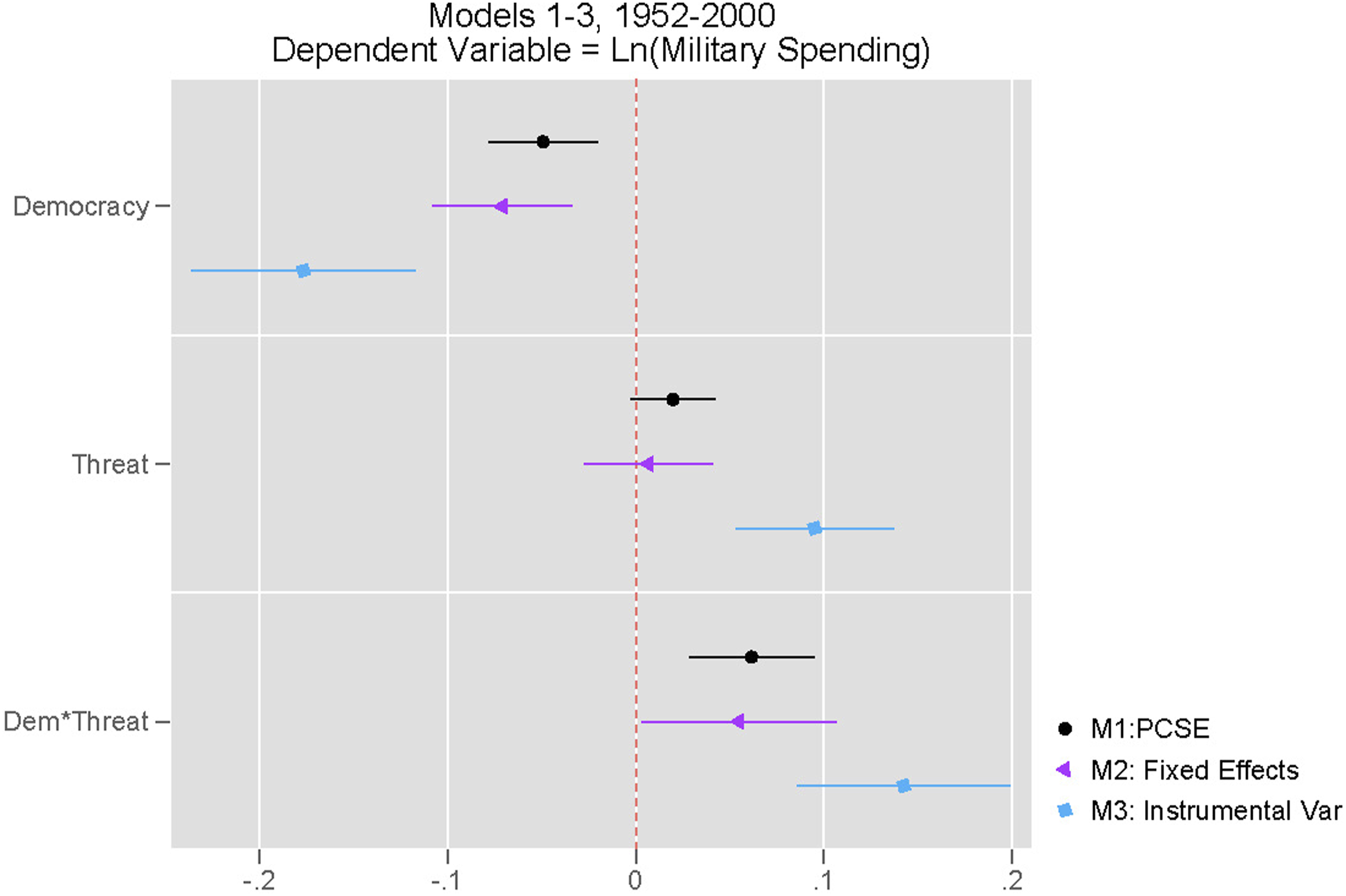
The estimates from each model are consistent with our three hypotheses. The coefficient on Democracy is the effect of democracy, relative to autocracy, on military spending when external threat is minimal. As expected this relationship is negative and statistically significant at conventional levels. Democracies spend less on the military when there is a minor external threat. We also observe that the multiplicative interaction of Democracy and External Threat is significant and positive. Figure 2 shows average marginal effects of democracy on military spending conditional on the level of external threat. Democracies without a major external threat allocate considerably less to the military than non-democracies, but among countries with a large external threat, democracies and non-democracies allocate about the same amount. Conditional marginal effect of democracy on military spending.
Given that annual military spending is strongly persistent, the instantaneous effect of any variable is dwarfed by its long run impact. The immediate change in the impact of democracy as threat increases is 0.06. However, this represents less than 9% of the long run effect of the interaction. Figure 3 shows the stochastic simulation of military spending for democracies and autocracies facing different levels of threat that are otherwise identical. Initially, democracies spend about 1% more on the military when threat increases. After 20 years, this grows to an 11% increase. In addition, a democracy at low threat spends 1% less than an autocracy at low threat immediately and over 6% less after 20 years. However, when threat is high, democracies spend roughly the same as autocracies immediately and nearly 2% more after 20 years. Long run military spending conditional on threat. Note: Simulations based on model 1.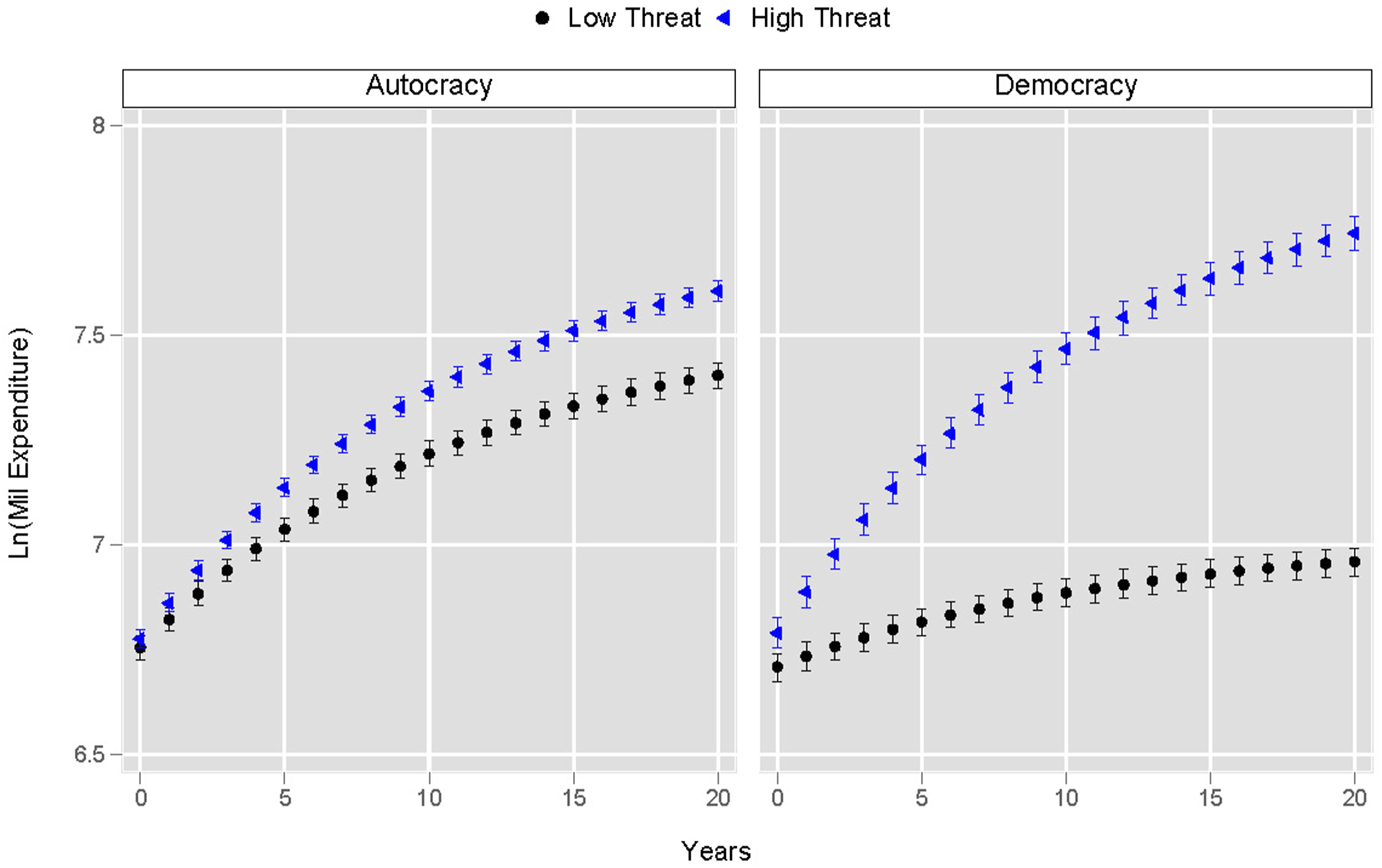
Next, we follow Bohmelt and Bove (2014)’s recommendation and compared the out of sample forecasting power of a model with the democracy and threat interaction to a model without that term. We divide our sample into four groups, training the data on three of the groups and testing our model on the fourth (fourfold cross-validation). We repeat this process five-hundred times and calculate the mean of the Mean Squared Prediction Errors (MSPE). The interactive model has an MSPE approximately 0.0002 points lower than the model without the interaction. By comparison, dropping both war participation variables reduces the MSPE by about 0.0003 points. Thus, the interactive relationship between democracy and external threat is nearly as important for understanding military spending as war participation. 5
Sensitivity checks
The relationships we identify are not driven by one or two countries. Dropping Israel and the United States from the analysis, for example, does not change our results. Similarly, dropping the three democratic members of the UN Security Council or dropping the five democracies with the largest number of years with a high external threat does not change our findings (see appendix Table 4 for more details). Besides these countries, other democracies in our sample with relatively high military spending include Italy, Japan, and Turkey. In our sample, the country with the most year-to-year increases in military spending is a democracy with a high external threat, India.
In the appendix, we show that our results hold when we use the VDEM continuous democracy (polyarchy) variable instead of the binary indicator, the Polity democracy-autocracy index (Table 5), alternative cutoffs for high threat (greater than the 66th percentile or greater than the 33rd percentile), the Nordhaus et al. (2012) continuous threat variable, and external threat measured as a country having at least one territorial dispute in that year 6 (Table 6). Further, we estimate our model on a sample that excludes countries with no autocratic neighbors (Table 8). Based on democratic peace research, we posit that every country with at least one autocratic neighbor has some potential external threat. In this sample, we continue to find support for our hypotheses.
Finally, we consider whether external threat mediates instead of modifies the effect of democracy on military spending. Democracy may affect external threat because democracies are less likely to fight other democracies. However, democracies cannot set their level of external threat and engage in plenty of conflict with autocracies.
External threat may also affect a country’s level of democracy (Gibler and Tir 2010). If we assume external threat is an intervening and not a conditioning variable, we find that threat mediates only a small percentage of the effect of democracy on military spending (see appendix Table 9 for more details).
Conclusion
We clarify the logic linking democracy to military spending. In a democracy, leaders are more accountable to the preferences of the median citizen than in non-democracies. Prior research assumes that the public prefers spending on education and other social goods over defense. We contend that this preference is strongest when external threat is perceived to be low. When the median citizen perceives that there is a significant external security threat, then s/he has more support for defense spending. This leads us to expect that democracies with a significant external threat will not be much different in terms of military spending than autocracies. An analysis of the annual change in the log of military spending in constant dollars for approximately 120 countries over the period 1952–2000 is consistent with these claims.
There are several important implications of this research. First, public preferences are a function of context or environmental factors. This is hardly news to those who study public opinion, but cross-national research examining the effects of democracy on foreign policy has not always incorporated it. Second, our findings are consistent with Selectorate theory to the extent that military spending promotes the public good of security when there is an external threat. Selectorate theory appears to be an insightful and fruitful foreign policy theory. Third, our research suggests that environmental factors may override institutional effects on some security matters. This does not mean democratic political institutions do not affect foreign policy, but the relationship is more complex than suggested by prior research. We find robust support for the argument of Digiuseppe and Poast (2018) that defense pacts with democracies reduce military spending while defense pacts with non-democracies do not, and of course we find that among countries without a significant external threat, democracies allocate considerably less to the military than autocracies. Fourth, while non-democracies are more likely than democracies to have a significant external threat, this is not the only reason the former spend more on defense. Our model indicates that non-democracies without significant external threats spend much more on their military than democracies with low external threat. We suspect that what drives autocratic military spending in this context is the desire to have a strong military to repress their own citizens. Fifth, if a major purpose of the military in autocracies is to maintain civil order, it is not surprising that autocracies are less likely to win interstate conflicts.
Footnotes
Declaration of conflicting interests
The authors declared the following potential conflicts of interest with respect to the research, authorship, and/or publication of this article: The views expressed in this article are those of the authors and do not reflect the official policy or position of the US Air Force, Department of Defense, or the US Government.
Funding
The author(s) received no financial support for the research, authorship, and/or publication of this article.

Notes
Appendix
Percentage of effect of democracy on military spending mediated by external threat.

| Effect | Model A Threat (NOR) |
Model B Threat (NOR) |
Model C Threat (Territory) |
|---|---|---|---|
| ACME | −0.009 | −0.004 | 0.001 |
| Direct | −0.033 | −0.059 | −0.043 |
| Total | −0.043 | −0.063 | −0.042 |
| % Mediated | 21% | 6% | −3% |
Mediation estimates are mean values from 1000 simulations and performed with Stata’s medeff function. Each model contains the full set of control variables. Model A does not include an interaction between democracy and threat. Model B includes an interaction between democracy and threat. Model C does not include an interaction between democracy and threat.