



Abstract
We analyze opposition towards Covid-19 containment measures by assessing the role of self-interest, sociotropic threat, political predispositions, and infection rates. We base our analyses on two waves of survey data from Germany (N = 3258/3201). Our measure of self-interest includes objective indicators for and subjective perceptions of individual threat from containment measures in the economic sphere and in the family and health domains. We also analyze whether the role of self-interest changes as the pandemic proceeds in its course. Our results show that self-interest plays a limited role in explaining attitudes about containment measures. More important are broader political predispositions such as trust in institutions, including the government. Attitudes are unrelated to local rates of infection or death. This pattern has remained stable over the course of the pandemic. We discuss the relevance of these findings with respect to the general enforceability of public policies that serve collective goals, such as efforts to limit climate change. Parts of the population may be reluctant to comply with these public policies even if the associated costs to the individual are small. This is less because of people’s personal circumstances, and more because of their opposition to government interventions as such.
Attitudes about containment measures: A new explanatory challenge
In an attempt to slow the spread of Covid-19 during the 2020/2021 pandemic, governments worldwide have imposed containment measures (Han et al., 2020). While these measures have been met with broad support from citizens in many countries, a vocal minority has reacted with fierce opposition. According to previous studies, attitudes about containment measures differ by sociodemographic characteristics such as gender and education, partly run along ideological lines and also seem to reflect fear of the disease, health concerns, the perceived duty to support political leaders, and trust in the government (Brouard et al., 2020; Harper et al., 2020; Galasso et al., 2020; Murphy et al., 2020; Naumann et al., 2020). In this article, we systematically explain support for and opposition to Covid-19 containment measures by assessing the role of two sets of factors that have proven important in explaining policy attitudes, namely self-interest and broader political predispositions.
Self-interest pertains to the consequences of different policies for an individual, such as in the economic or family-related sphere. Political predispositions relate to broader ideological convictions and more stable political attitudes. It is particularly interesting to analyze attitudes about containment measures within this framework because these measures—which have had a massive effect on all areas of life—are a rather new and atypical political issue. Naumann and colleagues (2020: 192) even argue that they had been enacted before public opinion emerged. It is far from obvious how the containment measures relate to (perceived) self-interest in domains as different as economic, family, and health. At the same time, it is less clear how attitudes about containment measures relate to broader political predispositions like party ideology and trust in political institutions. This sets the measures apart from long debated topics such as immigration and gun control.
Explaining attitudes about containment measures: Individual threat and broader political orientations
Self-interest is defined as interest that is “instrumental to the individuals’ attainment of valued goals . . . that bear directly on the material well-being of an individual’s private life, concerning their financial status, health, domicile, family well-being, etc.” (Sears et al., 1980: 671). According to Sears et al.’s seminal paper, self-interest can only be expected to shape policy attitudes when the government action in question is perceived as relevant and legitimate, and its impact on self-interest is evident. The latter aspect in particular requires certain levels of “political sophistication” (Sears et al., 1980: 674). The authors argue that attitudes about new political issues are therefore formed on the basis of “long-standing predispositions” rather than on the basis of self-interest.
These assumptions have inspired numerous studies that assess the importance of self-interest on a range of policy issues, including immigration (Sides and Citrin, 2007; Gerber et al., 2017). In this policy field, many studies have confirmed that self-interest plays, if anything, a secondary role (Hainmueller and Hiscox, 2007: 433, Helbling, 2011, Lau and Heldmann, 2009). However, authors like Gerber and colleagues advise against prematurely discarding explanations based on self-interest and suggest several specifications. Instead of just inferring self-interest “objectively”, e.g. in the field of immigration from economic models of labor market competition, the authors recommend capturing subjective beliefs about the personal implications of a certain policy. It also needs to be taken into account that the perceived negative effects of a policy are not necessarily limited to the individual (individual threat) but may have implications for society as a whole (sociotropic threat) (Gerber et al. 2017: 159).
These arguments have important implications for a study about Covid-19 containment measures. With respect to self-interest, both the perceived and “objective” threat from restrictions need to be captured. Workers may feel economically threatened by the restrictions, even if they have not (yet) lost their jobs or been forced to reduce work during the lockdown. Furthermore, self-interest is not limited to the economic domain. The lengthy school closures have a disproportionate effect on families. Parents differ in how much they worry about the impact of the crisis on their children’s education, or about their own diminished productivity in the home office. Health-related self-interest should also be paramount in explaining attitudes during a pandemic. Older individuals and those with preexisting conditions may perceive a loosening of restrictions as a threat to their health. In particular, lifting restrictions increases the risk of contracting the disease when local infection numbers are high, which points to the importance of context characteristics.
The argument that broader political predispositions are more significant than self-interest in explaining opposition to or support for a new policy issue rests on the assumption that such issues are evaluated on the basis of how symbolically similar they are to more general attitudinal predispositions, namely “long-standing values about society and the polity” (Sears et al., 1980: 671), including political ideology along the spectrum of liberal/ conservative party identification (Sears et al., 1980: 673). Containment measures are imposed by the government, not by virologists or epidemiologists. Therefore, more general attitudes about how actively the state should interfere in people’s everyday lives should also matter (Sears et al., 1980: 673). The approval of containment measures requires a good deal of confidence that the government is not abusing the extraordinary power it possesses during a pandemic. Trust in the government and other institutions that implement, advise on, and enforce these measures should thus shape support for or opposition to containment measures. However, recent articles point out that trust may play a more complex role under such extraordinary circumstances like a pandemic: trust in the authorities may lead to greater acceptance of measures imposed by it, but could also reduce the perception that there is a need for hard rather than “soft law measures” (Toshkov et al., 2020: 17; Guglielmi et al., 2020). In fact, Wong and Jensen (2020) show that high trust in the government comes with lower levels of perceived public risk—and ultimately lower compliance with containment measures.
In sum, self-interest should only shape attitudes about policies when the repercussions of a certain policy on the interests of individuals are clear, and when the state has a legitimate and relevant say in the issue at stake (Sears et al., 1980: 672). Containment measures have an obvious impact on self-interest: while the elderly benefit from a lockdown, those who may lose their jobs will feel that their net gain is smaller. But they touch upon different dimensions of self-interest. Parents with small children, for example, suffer from closed schools, but they are also at greater risk of becoming infected by their children. Determining a person’s self-interest is therefore a complex task—and one in which broader political attitudes may be helpful heuristics. Political orientations may also affect another factor that conditions the role of self-interest: the perception that government intervention—in this case, to restrict virus spread—is legitimate.
The relative role of self-interest and broader political orientations may also have changed over the highly dynamic course of the pandemic, a possibility that we can assess like in a “natural experiment”. The repercussions of containment measures may be felt more severely after several months. Self-interest may therefore gain importance as the pandemic proceeds (see also Naumann et al., 2020: 192). Likewise, the pandemic may lead to a “rally-round-the flag-effect” over time, so that support for the authorities increases and becomes more important in shaping support for containment measures (Bol et al., 2021).
Study design, data and methods
Our analyses are based on two web surveys (N=3258; N=3201) conducted by the Cluster of Excellence “The Politics of Inequality” at the University of Konstanz, Germany. Both surveys use online access panels (Kantar group) and are based on offline-recruited non-probability quota samples. The first wave of data was collected in May/June 2020, near the end of the first period of containment measures, the second wave in November 2020, before the second lockdown began. A subsample of about 80% of respondents in the November wave had already participated in the May wave. 1 All analyses use post-stratification weights that adjust the data to the distribution in the whole German (adult) population for Eastern/Western Germany, gender, age, and education (see supplemental material).
The dependent variable is whether, and to what degree, respondents support or oppose the containment measures. Because the situation in November was different than in May, the question wording for the dependent variable differed slightly (see supplemental material). The first survey asked respondents under which circumstances containment measures should be lifted, using a 10-point scale from 1 to 10 (“immediately” to “. . .only when a vaccine/treatment is available”), the second survey whether the same measures should be re-implemented, using a 5-point scale from 1 to 5 (“immediately” to “never”). The same questions were asked separately about the shutdown of daycare facilities, of schools, of restaurants/bars, the closing of national borders, the cancellation of major sports and cultural events, and the imposition of curfews and contact restrictions. For descriptive analysis, the 10-point scale for the May wave was reverse-coded into five categories to match the 5-point scale for the November wave. The sub-dimensions were added up to one index variable and z-standardized to make scales and coefficients comparable.
Self-interest was measured both subjectively (perceived implications of containment measures on respondents’ economic and family situations and the perception that one belongs to an at-risk group) and objectively (income reduction, children in household, over 70 years of age). In line with our theoretical arguments, the models also include the perceived “sociotropic” threat of containment measures, i.e. threat to society, in our case for the economy and for families in general.
An important broader political predisposition is trust in institutions (government, political parties, science, and the police), 2 along with a person’s political ideology along the left-wing/right-wing range and preference for redistribution. Our analyses also differentiate between East and West Germans who have different historical experiences with government-imposed “coercive measures” (Schmelz, 2021).
Lastly, we take into account that certain sociodemographic subgroups may be more or less likely to demand that restrictions be relaxed. Women tend to be more risk-averse than men (Hartog et al., 2002), at the same time they seem to be more negatively affected by the lockdown (Czymara et al., 2020). Highly educated individuals may identify more strongly with science, and hence with evidence-based policies. We also control for generalized trust that is correlated with trust in public institutions (Zmerli and Newton, 2008; Sønderskov and Dinesen, 2016) but may have a “paradoxical effect” on attitudes about containment measures: those who trust in others might perceive government-imposed containment measures as less necessary. And finally, we control for daily infection numbers in respondents’ districts by including seven-day incidences per 10,000 residents and cumulated death rates (data from Robert-Koch Institute, the federal authority for disease control; see Table 1 for a summary of all variables/codings). Figure 1 sums up main variables and associations.
Measurement and coding of variables.

The original ten-point answer scale (see supplemental material) was recoded to a range from 1 to 5 for descriptive analysis in order to ensure comparability to the November survey (values 1 and 2 coded to “1”, 3 and 4 to “2”, etc.). For multivariate analysis, the original ten-point scale was used for z-standardization.
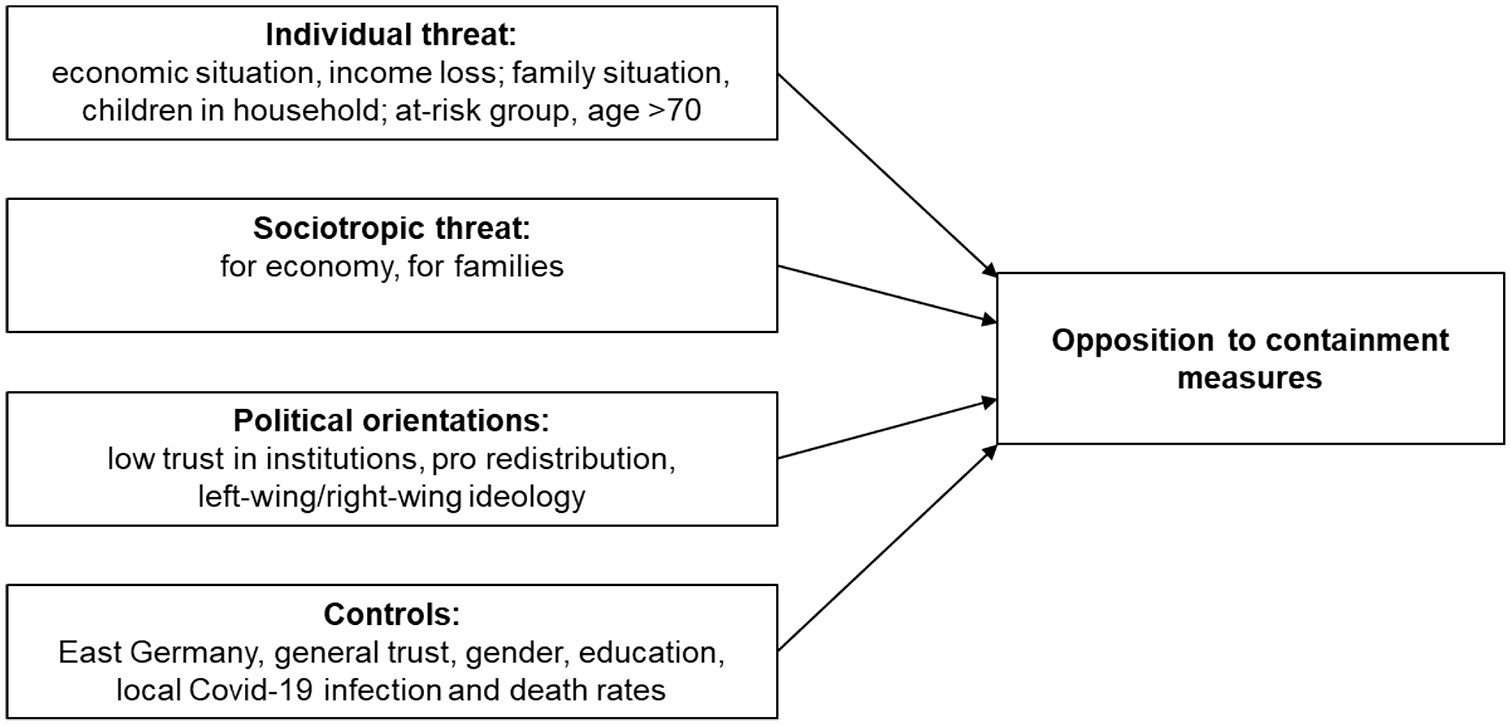
Explaining opposition to containment measures.
Results: Low trust in institutions matters more than economic and family-related self-interest
According to our data, opposition to containment measures is overall lower (with the exception of daycare centers) in November as compared to May 2020 (Figure 2). By November 2020, support for and opposition to containment differed more strongly between areas than in May.
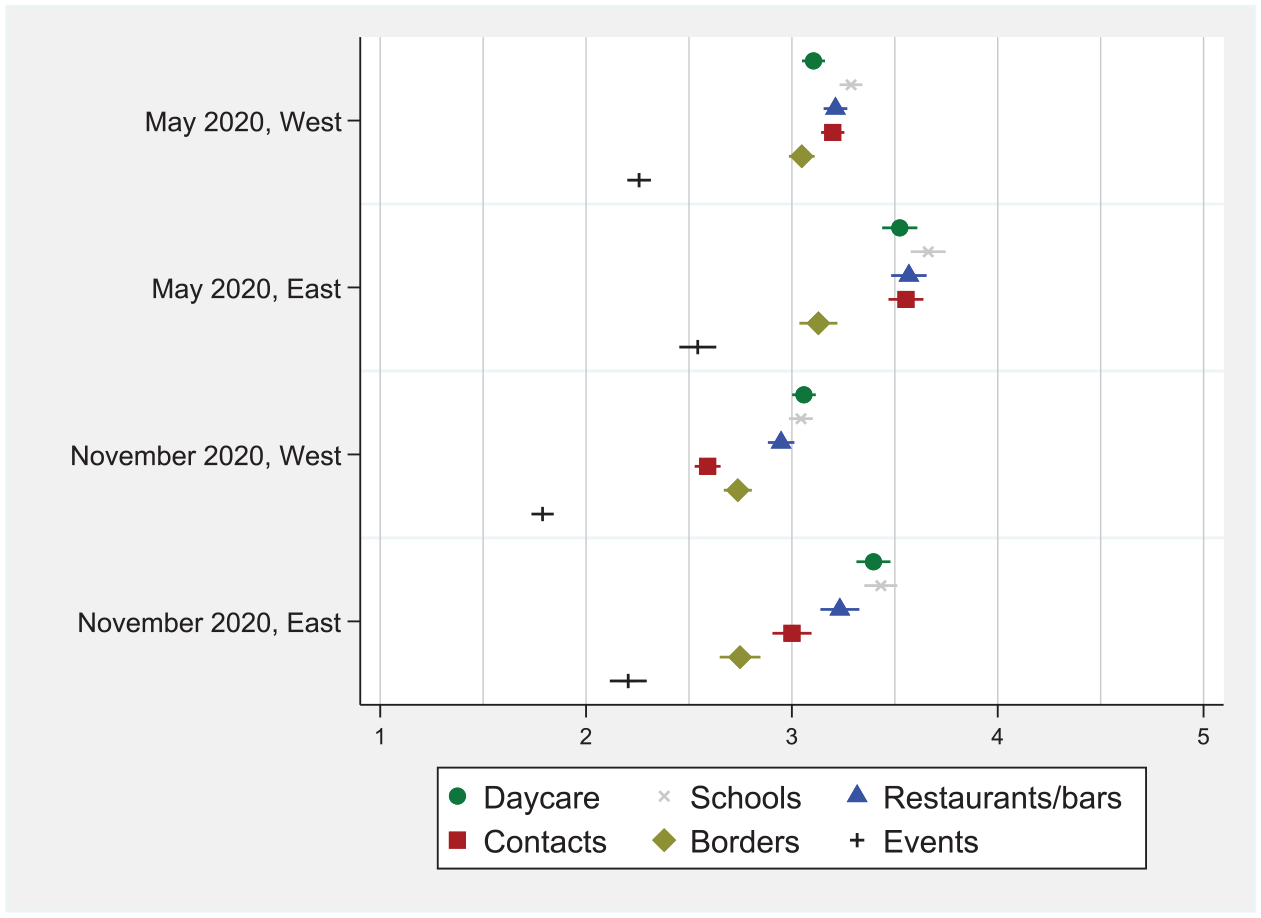
Opposition to containment measures in different areas in May and November 2020, East and West Germany.
In both surveys, opposition is least pronounced when it comes to bans on large public events, followed by the closing of borders. Respondents living in East Germany express more reservations about lockdown measures—with the important exception of closed borders in East Germany. Overall, only 19% of respondents oppose the ban on public events in May (November: 16%), while 45% in both survey waves are against school closures (counting values of 4 and 5 on the 5-point scale as “opposing”). There are stable positive correlations between all areas: individuals in favor of lifting restrictions in one area are very likely to support it in other areas (not documented). This is somewhat at odds with an explanation that focuses on self-interest.
With respect to our indicators for self-interest, the perceived individual economic threat from containment measures is higher than the family-related threat (see Table 2 and Figure 3). Both types of individual threat increased between May and November. Objective threat indicators and sociotropic threat do not show significant differences between survey waves or regions. Sociotropic threat is higher than individual threat, a pattern that is known from other fields and may reflect the greater coverage of sociotropic threat in the media (Stevens and Vaughan-Williams, 2014; see online supplement for figures and confidence intervals). With respect to our indicators for broader political orientations, all indicators remained somewhat stable between May and November 2020. Low trust in public institutions is higher in East Germany than in West Germany. The opposite is the case for support for redistribution. No such differences can be found for left-wing/right-wing political orientations.
Descriptive overview: sociotropic threat, political orientations, and control variables.
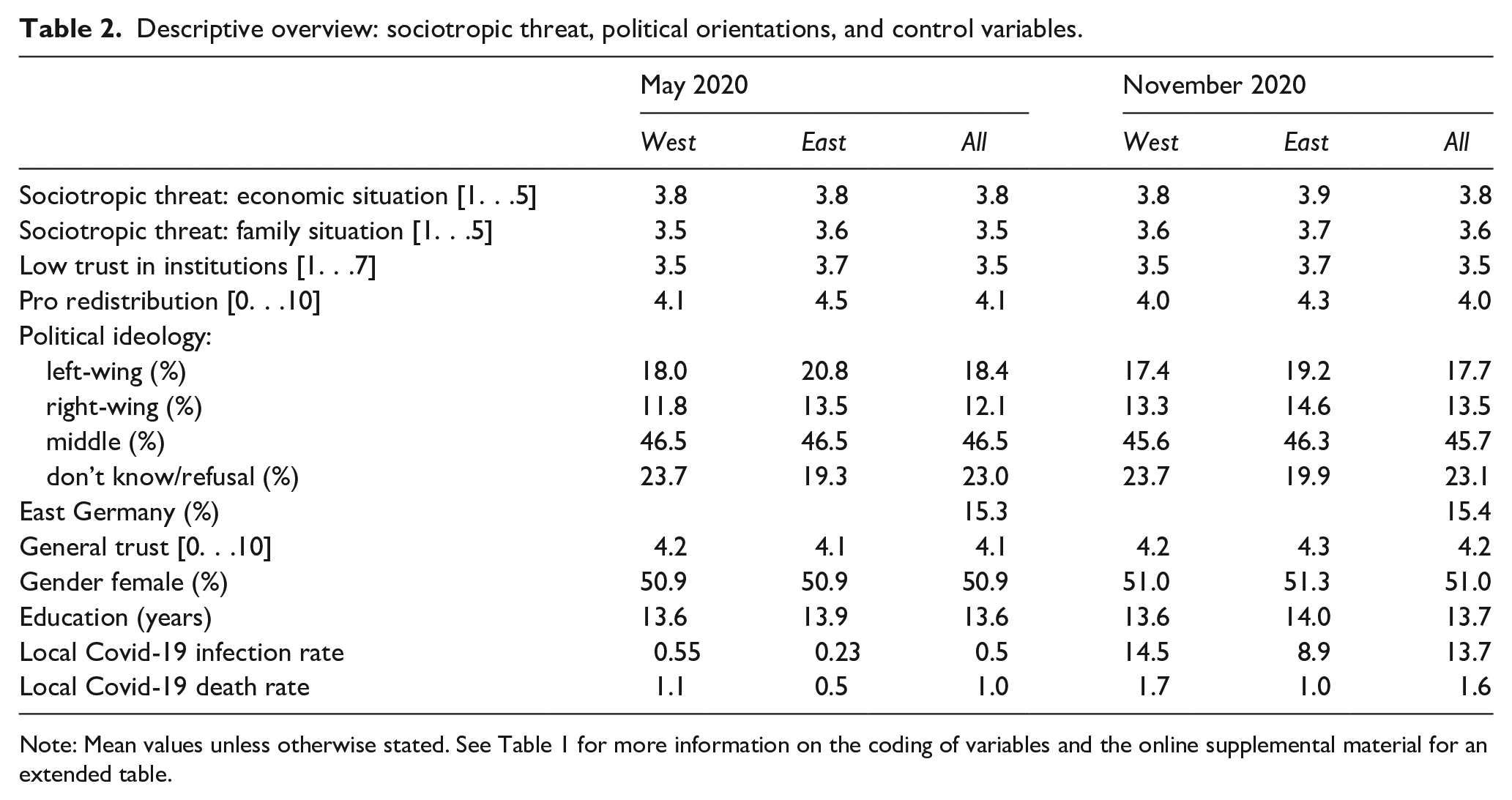
Note: Mean values unless otherwise stated. See Table 1 for more information on the coding of variables and the online supplemental material for an extended table.
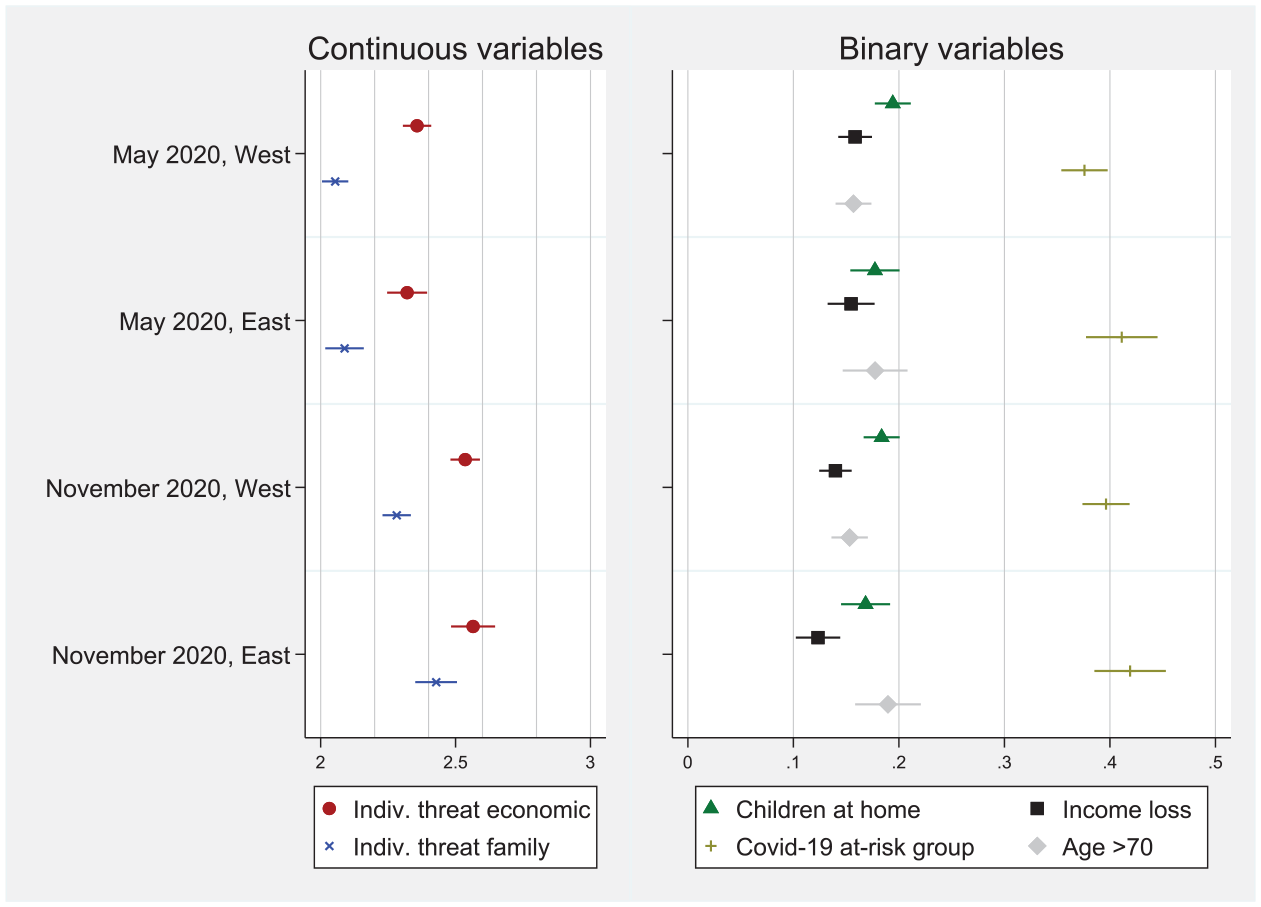
Individual economic, family-related and health-related threat in May and November 2020, East and West Germany.
We now turn to our core questions: Who opposes containment measures? And did self-interest play a more important role in November than in May 2020? We analyze the various influencing factors simultaneously and display the results in Figure 4 (see online supplement for full regression models and detailed robustness analyses that also check for bivariate effects and potential multicollinearity problems).

Regression analysis: opposition to containment measures.
Most importantly, the call for easing restrictions is, overall and net of the influence of other predictors, unrelated to the extent to which respondents believe containment measures threaten their own economic and family situation. This also applies to more objective indicators. Self-interest only matters as long as it is health-related (see also Naumann et al., 2020: 199). After controlling for belonging to a risk-group, there is no statistically significant difference between older and younger respondents. 3 Respondents who fear the measures will have serious consequences for society at large are only slightly (not consistently significant in May) more likely to demand that restrictions be lifted.
In turn, respondents’ degree of trust in public institutions strongly influences their attitudes towards easing lockdown restrictions. Those who generally have little trust in public institutions are much more likely to oppose lockdown restrictions. If trust in different types of institutions (government vs. science, health system, police) are introduced separately into the models, the effect of trust in political institutions becomes stronger in the November survey (see online supplement); the one of low trust in other institutions (science, health system, police) gets smaller and loses its statistical significance (at conventional levels). This could mean that in November 2020, it is trust in political and not in other institutions that is decisive. 4 While support for redistribution (and, in May, left wing political ideology) brings a slightly greater acceptance of restrictions, acceptance is not systematically related to right-wing/left-wing political ideology. 5
East Germans are much more likely to call for easing of restrictions than are West Germans. As theorized above, those who trust others—and may thus believe that individual effort may be enough to slow the spread of the virus—show less support for state-imposed restrictions. 6 Women are less likely to oppose restrictions. Levels of education are unrelated to it. Interestingly, attitudes about restrictions are completely detached from (local) infection numbers.
The toll the restrictions take on families and the economy increased over time. Respondents perceived the restrictions as being a greater threat in both areas in November 2020 than in May (see Figure 3). However, economic and family-related self-interest do not become more important in shaping attitudes about containment measures during the pandemic. 7 Likewise, there is little change in the relationship between broader political orientations and containment-related attitudes over time, and no evidence that these attitudes become politically more polarized. This is an important finding, considering the vocal protests against containment measures. One puzzling finding is the large difference that remains between East and West Germany. Taking into account belief in conspiracy theories and perceived seriousness of the pandemic does not change this.
Conclusion: Trust in institutions matters more than self-interest
The most important finding of our study is that the (perceived) impact of lockdown restrictions on an individual’s own economic or family situation has, net of the influence of other predictors, little influence on how fiercely that individual supports or opposes containment measures, and this does not change during the course of the pandemic. Direct threat plays a role only insofar as those belonging to an at-risk group are largely opposed to easing restrictions. In this respect, our findings confirm the argument that self-interest only matters when the effect of a particular policy is very clear. Our findings are also in line with recent studies on support for containment measures. With respect to political trust and other orientations, we see a stability in orientations that have neither become more skeptical during the first months of the pandemic nor do we see a “rally-round-the-flag-effect” of rising support for public authorities (Bol et al., 2020). Our findings suggest that the impact of trust in the government is clearly positive rather than “paradoxical”. This may look different when it comes to explaining its effect on risk perceptions or actual compliance with containment measures (Wong and Jensen, 2020).
Our study has several limitations: The second wave of data collection happened before rather than after the second lockdown kicked in. Thus, our findings on changes in opposition to containment measures, and in the relative role of self-interest versus political predispositions, must be taken with a grain of salt. Also, our data is based on a non-probability quota sample among participants of an (offline recruited) online access panel which may have consequences for data quality. However, since we are mostly interested in studying relationships between self-interest and attitudes about containment measures, we are confident that the survey design does not bias the results to a great extent. We also cannot rule out the possibility that containment measures not only reflect but partly impinge on broader political orientations (see, for example, Bol et al., 2021: 501). Another caveat is that respondents were asked to state their trust in the respective institution “in the current crisis situation”. This might have framed respondents in a different way than the standard trust scale, resulting in larger effects of this variable.
Against the backdrop of the theoretical debate about self-interest and policy preferences, our findings are somewhat ambivalent. Self-interest matters as long as it is captured very narrowly, with regard to a health-related threat. But this finding is almost tautological. After all, the main challenge lies in explaining policy preferences by identifying self-interests or broader political orientations that are not too narrowly related to the issue at stake. This is the precondition for ultimately making predictions about the acceptance of and opposition to new policies. In this respect, our most policy-relevant finding is that opposition to containment measures is anchored in low levels of trust in the government and other institutions.
These findings are relevant with respect to the general enforceability of public policies that serve collective goals, such as efforts to limit climate change. To be sure, a pandemic is an exceptional and threatening situation and this may partly explain the limited role of self-interest. However, the climate crisis is another imminent threat that calls for coordinated action and can hardly be solved “individually”. Despite a broad scientific consensus regarding the effectiveness of policies to avert such serious threats, parts of the population are reluctant to comply with these policies. Even if the costs associated with a policy are small for an individual, this fact alone does little to generate broad-based support. That is because what matters is not so much people’s personal circumstances, but their opposition to government interventions as such.
Supplemental Material
sj-pdf-1-rap-10.1177_20531680211035319 – Supplemental material for Attitudes about containment measures during the 2020/2021 coronavirus pandemic: self-interest, or broader political orientations?
Supplemental material, sj-pdf-1-rap-10.1177_20531680211035319 for Attitudes about containment measures during the 2020/2021 coronavirus pandemic: self-interest, or broader political orientations? by Claudia Diehl and Felix Wolter in Research & Politics
Footnotes
Acknowledgements
We thank the editor, two anonymous reviewers and our colleague Marius Busemeyer for their helpful feedback.
Correction (June 2025):

Declaration of conflicting interests
The authors declared no potential conflicts of interest with respect to the research, authorship, and/or publication of this article.
Funding
The author(s) disclosed receipt of the following financial support for the research, authorship, and/or publication of this article: This work was funded by the Deutsche Forschungsgemeinschaft (DFG, German Research Foundation) under the Excellence Strategy of the German Federal and State Governments (gefördert durch die Deutsche Forschungsgemeinschaft [DFG] im Rahmen der Exzellenzstrategie des Bundes und der Länder–EXC-2035/1–390681379).
Notes
References
Supplementary Material
Please find the following supplemental material available below.
For Open Access articles published under a Creative Commons License, all supplemental material carries the same license as the article it is associated with.
For non-Open Access articles published, all supplemental material carries a non-exclusive license, and permission requests for re-use of supplemental material or any part of supplemental material shall be sent directly to the copyright owner as specified in the copyright notice associated with the article.
