




Abstract
During times of domestic turmoil, the use of force abroad becomes an appealing strategy to US presidents in hopes of diverting attention away from internal conditions and toward a foreign policy success. Weaponized drone technology presents a low cost and potentially high-reward option to embattled presidents. While generally covert operations, drone strikes are frequently reported in the media, making them a viable diversionary tool. To gauge whether drone strikes are in fact capable of diverting the public’s attention, we surveyed 1198 Americans and find that a successful drone strike increases presidential approval despite a weak and sagging economy, and the impact of diversionary drone use is significantly greater than that which accompanies traditional diversionary methods.
Introduction
Domestic economic and political crises can hamper a US president’s ability to maintain power or win re-election, and the use of force abroad becomes an appealing strategy to divert the public’s attention when the political benefits outweigh the calculated costs of the operation (Fordham, 1998; Levy, 1989; Meernik, 1994; Ostrom and Job, 1986).
Despite the theoretically appealing nature of the diversionary use of force hypothesis, past studies have shown that US presidents do not always have the opportunity to use force in such a fashion (Meernik, 1994). Demonstrating diversionary intent is difficult. For that matter, when poor domestic conditions incentivize US presidents to seek diversionary targets abroad, those potential targets become fleeting (Clark, 2003). The same conditions that incentivize belligerent foreign policy are visible on the international stage, and foreign leaders strategically adjust their behavior to avoid being targeted (Clark, 2003; Fordham, 2005; Smith, 1996, 1998).
Recent research, however, has leveraged the emergence of weaponized drone technology as a mechanism by which to assess diversionary behavior because of the technology’s low cost and the potentially high reward of a successful attack. Indeed, weaponized drones are an increasingly useful tool of force projection available to leaders (Horowitz et al., 2016). Emerging research also demonstrates that politically embattled US presidents choose to claim credit for otherwise clandestine drone strikes in a manner consistent with diversionary use of force expectations (Klein and Boddery, n.d.).
Despite the empirical regularities that evince diversionary intent among US presidents, the question still unanswered is whether a successful drone attack produces the theorized bump in public support. In this study, we seek to assess whether, and to what degree, drone strikes are capable of augmenting domestic public support—one of the key, motivating incentives that drives diversionary behavior.
To answer this question, we fielded a survey with an embedded experiment that allows us to isolate and highlight the effect drone use has on public support during times of economic decline. We also evaluate the comparative difference between diversionary drone force and traditional uses of diversionary force. We find that a successful drone strike produces a significant increase in presidential approval despite a poor economy, and the approval increase produced by drone use is substantially larger than the modest improvement produced by traditional uses of force.
Theoretical framework
Political leaders have an array of policy tools and governance strategies at their disposal but, at times, these tools are incapable of adequately addressing certain domestic conditions or crises, such as a sagging economy or political scandal. When faced with such a domestic situation, leaders become more risk-accepting and attempt to divert the public’s attention away from the negative domestic conditions and toward success abroad (Keller et al., 2019; Leeds and Davis, 1997; Meernik, 1994; Ostrom and Job, 1986; Smith, 1996, 1998; Tarar, 2006). While scholarship on strategic diversionary behavior tends to focus on the use of force abroad, not all leaders have equal opportunity for aggression in the international order (Clark, 2003; Fordham, 2005). When international targets are absent, some leaders look for internal, salient out-group targets (Klein and Tokdemir, 2019; Tir and Jasinski, 2008).
At the core of the diversionary use of force argument is the belief that such aggressive action will rally support behind a foreign policy success. Before acting, leaders calculate the costs of aggression (e.g. the likelihood and quantity of casualties, logistic and military costs, length of the operation, and repercussions if unsuccessful), and if these costs outweigh the expected benefits (e.g. new/renewed political support and capital if successful) then the use of diversionary force becomes an incentivized, preferred tool (Levy, 1989; Meernik, 1994; Smith, 1996).This decision calculus is necessarily conditioned by the potential target’s capabilities to defend and retaliate, because provoking reciprocal violence can negate the intended political payoffs.
Even when incentives exist to use force abroad in an attempt to divert attention away from a domestic failure, the opportunity to use such force is not always present (Fordham, 2005; Meernik, 1994). Potential targets can observe and recognize the diversionary incentives present within a rival’s borders—especially within transparent democracies—and they strategically adjust their behavior, becoming less antagonistic, so to avoid being targeted (Smith, 1996, 1998). Thus, when a leader’s need for diversion is greatest, potential targets are scarce (Clark, 2003).
Diversionary drone force and the War on Terror
The emergence of weaponized drone technology fundamentally alters the diversionary calculus leaders encounter by notably reducing the risks associated with such aggressive foreign policy. Drone strikes are largely effective at hitting the intended target and the tactic does not directly risk service member casualties (Vogel, 2011). Drone strikes transform traditionally risky foreign policy operations into relatively error-free and, from the aggressor’s standpoint, bloodless operations (Mahnken, 2011).
Adding to the appeal of diversionary drone force is the fact that this technology has primarily been used against non-state actors who have a far more limited capability to retaliate and escalate conflict. 1 Drones can strike hard-to-reach targets that were previously inaccessible, and since 9/11 the War on Terror has supplied ever-expanding lists of opportunities for the use of such force (Mahnken, 2011).
Taken together, drone technology and the War on Terror overcome the limitations that have hampered attempts to observe diversionary uses of force because opportunity is held constant while the costs are practically eliminated. Indeed, a recent study analyzed drone strikes against terrorist targets from 2002 to 2017 and found that the frequency of drone strikes against terror targets and the frequency of publicly claiming credit for successful covert operations are positively correlated to worsening economic conditions in the US. (Klein and Boddery, n.d.). The area of diversionary drone force that remains unexamined and unanswered is whether or not such drone strikes are capable of augmenting public support.
Public support and drone force
The goal of diversionary use of force is to garner a boost in approval by drawing the public’s attention away from a domestic crisis and toward a foreign policy success (Baker and Oneal, 2001; Fordham, 1998). A foreign policy success demonstrates competence, strength, and capability (Downs and Rocke, 1994). Existing diversionary use of force research primarily addresses questions regarding when diversion is used, the viable tools of such force, and potential target behavior (Clark, 2003; Fordham, 1998, 2005; Foster, 2017; Keller et al., 2019; Meernik, 1994; Ostrom and Job, 1986; Smith, 1996, 1998). Far less research is dedicated to whether diversionary tactics accomplish their aim.
The mechanism through which diversionary force translates into a bump in approval is best categorized as a rally-‘round-the-flag effect. But when military endeavors rally support for an incumbent administration, the effect is often short-lived (Mueller, 1971, 1974, 1994). Focusing on drone strikes against terrorist targets is a particularly fruitful avenue from which to assess diversionary force because studies that found rally effects post-9/11 honed in on patriotism and media framing as important drivers behind shifts in public opinion (Hetherington and Nelson, 2003; Kam and Ramos, 2008).
A weak economy is generally accompanied by low presidential approval (MacKuen et al., 1992). This dynamic is especially true if the effects are felt in people’s pocketbooks due to high unemployment or inflation. Thus, we envisage the use of diversionary force against terrorist targets to be an appealing option to leaders because of the targets’ connection to notions of post-9/11 patriotism. Accordingly, we expect that during poor economic conditions a successful drone strike abroad will increase a US president’s approval rating (Hypothesis 1).
Furthermore, drone technology provides precision-strike capabilities that reduce military and human costs, whereas even successful traditional methods of diversionary force, such as boots-on-the-ground, can be overshadowed by criticism generated from reports of US casualties (Gartner, 2008). Because of the comparatively lower cost and low risk that accompany drone technology, we therefore expect that during a weak economy diversionary drone force will increase public support to a greater extent than traditional methods of diversionary force (Hypothesis 2).
Research design
To evaluate whether use of force abroad impacts support for a presidential administration in the US and whether the method of force used augments support to varying degrees, we employed an opinion survey that contained an embedded experiment. We fielded the survey during the summer of 2020, which yielded 1198 respondents. To ensure respondent engagement, we included two attention checks, one closed-ended and one dynamic, in the survey design. In total, 78.21% passed these checks.
We recruited respondents from Amazon’s Mechanical Turk (AMT) platform. Respondents from the AMT platform have proven to be a reliable data source for studies that seek to gauge treatment effects in political decision-making (e.g. Bishin et al., 2015; Boddery et al., 2019; Clifford et al., 2015; Ryan 2012). Although AMT respondents are opt-in participants and tend to be better educated, younger, and more liberal than the general American public, research shows that AMT respondents are more engaged in their decision-making tasks and more representative than respondents from other traditional convenience samples (Berinsky et al., 2012; Huber et al., 2012; Paolacci et al., 2010; Weinberg et al., 2014). In one study, a series of simultaneous experiments fielded among both AMT respondents and a national probability sample resulted in virtually identical results between the respondent groups in which the findings varied only in magnitude (Mullinix et al., 2015: 122). To ensure that we account for the non-representative nature of our respondent pool, we follow Levay et al.’s (2016) suggestion and include control variables in our regression models as a robustness check.
Following standard demographic questions, respondents were randomly assigned to one of four groups. In a brief vignette, we asked respondents in each group to envision a time in the future when the country’s political landscape was different than its current state, and they were then given information about the economy within the US during this future time. 2 Respondents in Group 1 were told the US economy was strong, with low unemployment. Those in Group 2 were told the US economy was weak, with high unemployment. Group 3 respondents were presented with a weak economy and high unemployment, but they were also told that a US drone strike recently killed a high-profile terrorist. Finally, Group 4 respondents were presented with a weak economy, high unemployment, and a report that the US had recently deployed 5000 additional troops to Afghanistan to help aid the War on Terror. 3 Figure 1 provides the exact vignettes in detail.

Vignette language.
Following each vignette, respondents were then asked, on a six-point Likert scale, whether they approved or disapproved with the incumbent president’s performance. Our experimental design thus allows us to isolate and compare presidential approval across two diversionary force scenarios: traditional methods, and the theoretically appealing use of low-risk drone strikes.
Findings and discussion
Our results prevailingly support our theory of the diversionary effect associated with modern-day drone warfare and presidential approval. As a base level of comparison, the average level of approval for a presidential administration significantly decreases when the economy is weak compared to times during which the economy is strong. During a weak economy, public approval of the incumbent administration is significantly improved following a successful drone strike. And finally, diversionary drone use produces a significant increase in presidential approval compared to our measure of traditional diversionary force.
Figure 2 expands upon the experimental findings by illustrating predicted point estimates with confidence intervals of presidential approval among the four scenarios. When the economy is weak and unemployment is high, a successful drone strike against a terrorist target significantly increases presidential approval, thus supporting Hypothesis 1. Increasing troop levels to aid the fight against terrorism increases presidential approval, but that increase is negligible. Compared to traditional diversionary force, a successful drone strike produces a significantly greater increase in presidential approval, lending support to Hypothesis 2.

Predicted level of support for the incumbent presidential administration separated by treatment groups.
As a robustness check, we account for the non-representative nature of our respondent pool by including relevant demographic control variables into our regression analysis (Levay et al., 2016). The regression results support the findings presented in Figure 2 and are displayed in Table 1. 4
Ordinary least squares (OLS) regression with controls.
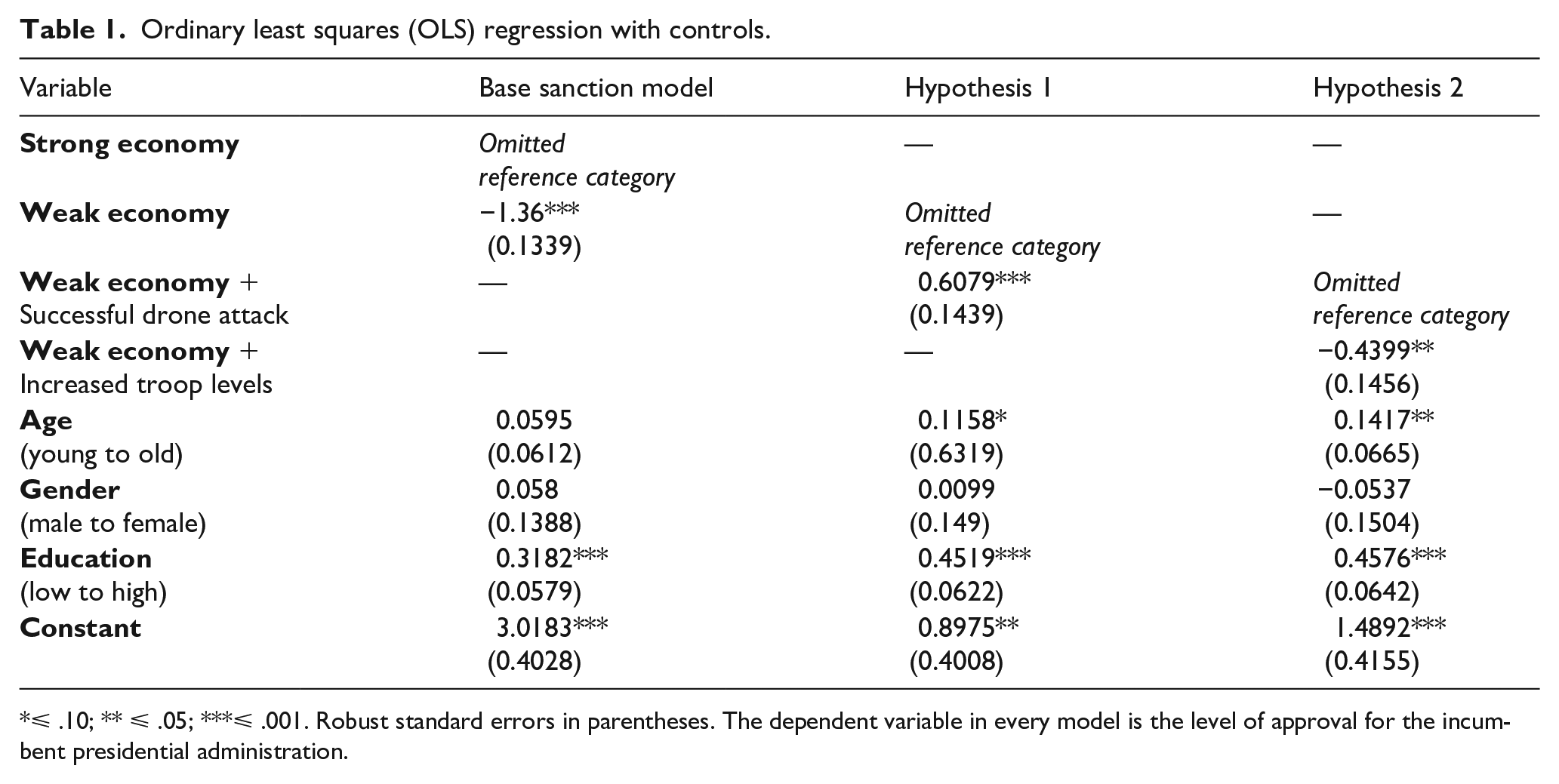
⩽ .10; ** ⩽ .05; ***⩽ .001. Robust standard errors in parentheses. The dependent variable in every model is the level of approval for the incumbent presidential administration.
Our findings suggest that troop deployments to longstanding conflict zones have minimal diversionary benefits for a US president. Our findings also complement recent scholarship that shows the public generally supports drone strikes given the technology’s ability to reduce US casualties and the technology’s counterterrorism effectiveness (Horowitz, 2020; Kreps, 2014; Kreps and Wallace, 2016; Walsh and Schulzke, 2018). Our results add a new element to this discussion and suggest that the underlying widespread approval of drone strikes could effectively ameliorate a diminished presidential image whereas troop deployment—even though a counterterrorism tool on par with drone strikes (Walsh and Schulzke, 2018: 94)—does not have the same rally effect.
Conclusion
Our results provide preliminary evidence that drone strikes are capable of producing a rally effect to US presidents despite the existence of a weak economy and high unemployment. The rally effect that accompanied a successful drone strike was significantly greater than that which followed traditional diversionary methods.
Our findings support the rationale that if US presidents face a weak or uncontrollable domestic environment, they may act in a manner that demonstrates competence and success on the international stage—where presidents are virtually unchecked. Counterterrorism success is a particularly poignant and appealing policy area because a large proportion of Americans consider terrorism a leading threat to national security (Haner et al., 2019; Poushter and Fagan, 2020).
Of course, our study is not without its shortcomings. The precise language used in the two treatment vignettes varies with regard to the specific details of the hypothetical—but realistic—diversionary actions (e.g. escalating an existing conflict with additional troops versus a sudden drone strike; Afghanistan versus Pakistan as the theater of operation; and the phraseology used to reference the anti-terrorism objective of both tactics). These mild differences limit our ability to completely isolate the treatment effects of drone strike versus troop deployment. Respondents may have pre-existing reservations about the current troop deployment in Afghanistan that are magnified by including the word “additional,” but we expect respondents who have pre-existing opinions of US troop deployment in Afghanistan to be sensitive to deploying additional troops there whether such language is included or not. For respondents with less knowledge of the current conflict abroad, this language may prompt them to consider troop deployment as a continuation of an existing policy whereas a drone strike could be interpreted as a new policy. While the specific theater of operation is not constant across treatments, the target of force is—terrorists. And, although the language defining the target varies between “terrorist” and “War on Terror,” both phrases highlight the anti-terrorism objectives of both tactics.
In addition, the differences in presidential approval observed in our survey may be partially attributable to the outcome of the drone strike—the killing of a high-profile terrorist. The results could also be influenced by a general fatigue within the public regarding troop deployments in the War on Terror. And while these drawbacks potentially introduce bias into the results, this possibility is offset by the unique benefits of our research design, which allows us to isolate and underscore the effect of two militarized policy options in the overarching War on Terror and the Af–Pak theater in particular—while holding economic conditions constant across treatment groups. The aim of our research design was to ensure respondents considered similar policy objectives—counterterrorism—and militarized actions in the same region rather than leaving respondents to infer where troop deployment occurred and why the attack or escalation occurred.
Ultimately, we are able to compare how public approval, in times of an economic downturn, varies in response to two distinct diversionary tools, but we were not able to conduct an exhaustive accounting of all the diversionary options available to US presidents.
Future research should untangle these possible foreign policy options in a variety of research designs. For example, gradients of success or varying depths of information about the drone strike could generate different levels of support apart from what is generated by comparatively low-cost counterterrorism actions. Alternative treatments could compare troop deployment and drone strikes within the same combat country or specifically the same target and thus allow stronger inferences to be made about respondents’ preference, or support for, human versus robotic combat, expanding existing practices versus introducing new ones, moving to new theaters of operations, or the specific target. The high pay-off observed in our survey results may also be tempered if participants were prompted to respond to drone strikes against different types of targets or in unfamiliar or unexpected nation states. The rally effect of drone strikes may also be muted if the US president turns the tool against state targets rather than using it as a counterterrorism tool against non-state actors or groups.
Lastly, we acknowledge the contentious political environment present in the US when we fielded our survey. Respondents’ opinions and sensibilities during this time could have impacted their responses to our query, but if personal biases and forecasts about who will hold the White House in the future did bias their responses, then we suspect such bias favored the null hypothesis in favor of not increasing presidential approval.
We chose to focus our study on the US for several reasons. The dramatic increase in the frequency of drone strikes during the Obama administration suggests that intelligence, defense, and national security leaders recognize the strategic and tactical value of drone strikes. Research by Klein and Boddery (n.d.) suggests that presidents, or at least their political advisors, appear also to recognize the political benefits of drone strikes due to the frequency with which incumbent administrations confirm what otherwise would have remained a covert operation.
In this study we provide evidence that diversionary drone use may be a worthwhile strategy to the extent that drone strikes can indeed create a rally-‘round-the-flag effect despite slumping domestic conditions. Time will tell if this relatively new avenue remains a viable diversionary tactic or if the rally effect wains as drone strikes lose their novelty or are surpassed by new autonomous weapon systems. Our results encourage further exploration of the diversionary capabilities of drone strikes as their armed capabilities expand and the number of countries employing them increases.
Footnotes
Declaration of conflicting interests
The author(s) declared no potential conflicts of interest with respect to the research, authorship, and/or publication of this article.
Funding
The author(s) received no financial support for the research, authorship, and/or publication of this article.
Supplementary materials
The supplementary files are available at http://journals.sagepub.com/doi/suppl/10.1177/2053168017702982. The replication files are available at  .
.
Notes
Carnegie Corporation of New York Grant
This publication was made possible (in part) by a grant from the Carnegie Corporation of New York. The statements made and views expressed are solely the responsibility of the author