




Abstract
What determines citizens’ preferences over alternative decision-making procedures – the personal gain associated with a procedure, or the intrinsic value assigned to it? To answer this question, we present results of a laboratory experiment in which participants select a procedure to decide on the provision of a public good. In the first stage, they choose between majority voting and delegation to a welfare-maximizing algorithm. In the second stage, subjects either vote on the public good provision, or the decision is taken by the algorithm. We define three experimental conditions in which participants receive information about whether a majority in the group faces a positive or negative pay-off from the public good provision, about whether there is a positive group benefit from its provision, or neither kind of information. Findings confirm the importance of instrumental motives in procedural choices. At the same time, however, a significant share of participants chose a procedure that does not maximize their individual benefit. While majority voting seems to be preferred for intrinsic values of fairness and equality, support for delegation to the welfare-maximizing algorithm increases if the group benefit from a public good is known – even in participants who are net payers for its provision.
Motivation
It is an open empirical question of how far citizens base their political preferences and decisions on individual utility calculations or more collective concerns, with public opinion research and electoral studies providing evidence for both to play a role. However, given the sheer number of political decisions that need to be taken in modern mass democracies, the central question may not even be what drives individual preferences on single substantive decisions, but what drives individuals’ preferences over how and by whom collectively binding political decisions are taken. Procedural preferences have in recent years become a fruitful field of research, with findings indicating the relevance of both intrinsic (or normative) and instrumental motives for these (see e.g. Bengtsson and Mattila, 2009; Font et al., 2015; Hibbing, 2001; Landwehr and Harms, 2019; Wenzel et al., 2000). In other words, individual citizens evaluate alternative decision-making procedures both by their intrinsic merits – for example, the degree to which they regard them as fair or democratic – and by their instrumental value in bringing about decisions that maximize their individual utility.
At the same time, a potential limit to understanding the relative weight of intrinsic and instrumental motives for procedural preferences is that the bulk of existing studies is based on survey data. A problem here is that in responding to a single survey item – for example, on whether they support referenda or expert decisions – participants often express a mix of different attitudes and react to a number of different stimuli, including social desirability or halo effects from preceding items. To isolate the respective effects of intrinsic and instrumental motives, it seems necessary to take an experimental approach that allows controlling for influencing factors and subjecting participants to real incentives (see Bol, 2019 for a review of lab experiments in political science).
With the goal of reaching a better understanding of how individuals form procedural preferences – preferences over how and by whom collective decisions should be taken – we thus designed a laboratory experiment that was conducted with university students at the [blinded for review] in the fall of 2018 (see Fréchette, 2016 for a discussion of the pros and cons of student samples in laboratory social research). In methodological terms, our experiment contributes to the literature on endogenous institutional choice and procedural fairness (e.g. Dold and Khadjavi, 2017; Greif and Laitin, 2004; Sutter et al., 2010), but is more specifically aimed at inferences on motives for preferences over alternative democratic decision-making procedures. We are interested in whether and under what conditions participants preferred a majority decision or were willing to delegate the decision to the ‘expertise’ of an algorithm that maximizes the collective (or ‘group’) benefit. 1 A majority decision may be seen to have the intrinsic value of being egalitarian and ‘democratic’. Moreover, economic theories of democracy in Downs’ tradition (Downs, 1957) would assume that by implementing the will of the median voter, they also maximize collective utility. It is easy to see, however, how majorities might tyrannize minorities or turn out plainly irrational. For many, the Brexit vote in the UK is an example of a majority decision seriously harming collective interests. From the individual’s perspective, majority voting is instrumental to maximizing own utility if a majority for the preferred option is known to exist. Delegating the decision to the welfare-maximizing algorithm has the intrinsic value of promoting the group benefit, but can at the same time be instrumental in getting what one wants – if this happens to coincide with a decision in the collective interest.
Our experimental set-up, which we describe in more detail in the following section, reflects problems and choices in the ‘real world’ of politics in the following ways. First, we assume that there is a great deal of controversy over whether important decisions should be taken in a directly democratic, purely majoritarian way, or whether they should be left in the hands of elected representatives who presumably have a better overview and access to superior expertise. In forming preferences over how and by whom a decision on a given matter should be taken, citizens are, secondly, more or less ignorant with regard to two relevant variables. While we may assume that everyone can more or less judge how a policy measure that is to be decided upon will affect their own utility, there is less knowledge about the preferences of other members of society. That is, it is typically more difficult to decide whether there exists a democratic majority for the own position. Judging whether a given measure is in the collective interest or maximizes the collective benefit requires even more information and will often be almost impossible – even if most people still hold respective opinions.
In essence, our experiment accordingly tests how individuals who know how a substantive decision will affect their own pay-off will, under conditions of ignorance or information about a) the group’s majority position and b) the collective interest, choose between the alternative decision procedures of majority voting and delegation to a welfare-maximizing algorithm. Put somewhat differently, we explore whether individuals prefer a directly democratic or an expert decision, depending on whether they can identify a dominant strategy to maximize their own utility and whether they are informed about the effects the decision has on the group benefit.
Experimental design and hypotheses
In our experiment, subjects are randomly assigned to a group of three. The group faces the task of deciding on the provision of a public good. Each subject receives an initial endowment of eight monetary units and is informed about the ‘individual utility’ (also expressed in monetary units) they derive from the provision of the good. Individual utility can be positive (such that the provision is beneficial) or negative (such that the provision is detrimental). Subjects’ individual utilities are randomly varied in each round, but always remain private information. An individual’s pay-off in a given round depends on whether the public good is provided or not. If the good is not provided, the pay-off coincides with the initial endowment. If it is provided, the pay-off is the sum of the initial endowment and the subject’s individual utility.
The decision on the provision of the good is made in two stages. In the first stage, the decision procedure is determined. Subjects can submit a vote for either of two alternative decision-making procedures: majority vote (MV) or delegation (DE). Delegation means that the decision to provide the public good is taken by an algorithm that maximizes the group benefit, defined as the (unweighted) sum of individual utilities. Thus, the algorithm chooses provision if the group benefit is positive, and chooses not to provide the public good if the group benefit is negative. 2 From the subjects’ votes in the first stage, one is randomly chosen and implemented – that is, each subject has a chance of getting their will, regardless of majority preferences. In the second stage, the decision on the provision of the good is made on the basis of the decision-making procedure selected in the first stage.
When selecting their preferred decision-making procedure in the first stage of the experiment, subjects are randomly assigned to one of the following three experimental conditions, each of which entails a different information set. (1) Group Majority Condition: Subjects are informed about whether a majority of the group, that is, two or more players derive positive individual utility from the provision of the public good. However, subjects are not informed about whether the group benefit is positive or negative. This information is ‘private knowledge’ of the algorithm. (2) Group Benefit Condition: Subjects are informed about whether the group benefit is positive or negative, but they have no information about whether a majority of the group members derive a positive individual benefit. In the (3) (baseline) No Information Condition, subjects receive neither information about the group majority nor about the group benefit.
The instructions given to participants are presented in Appendix A. Each participant plays 12 rounds of this two-stage experiment, with subjects randomly assigned to new groups of three in every round. At the end of the experiment, one round is randomly selected for every participant, and earnings in this round determine their pay-off in Euros. A total of 162 subjects participated in the study (seven sessions; No Information Treatment: 48 subjects, Group Majority Treatment: 69 subjects, Group Benefit Treatment: 45 subjects). The experiment was programmed and conducted using the laboratory experimental software zTree (Fischbacher, 2007). Screenshots are presented in Appendix B.
Hypotheses
In Appendix C1, we present a simple model on an individual’s rational choice between the two alternative decision-making procedures: majority vote (MV) and delegation to an algorithm (DE). Distinguishing between three scenarios on the information available to participants, this allows us to derive the following hypotheses:
The intuition behind H1 and H2 is straightforward: knowing the majority’s preferences, rational individuals have an incentive to support MV if this procedure is certain to result in their favoured outcome. Conversely, if individuals only know the group benefit, they support MV if this helps them to avert an outcome that is beneficial for the group as a whole, but unfavourable for themselves. The choice situation is different under conditions of uncertainty, that is, in the baseline condition. Here, we may expect subjects to base their procedural choice on merits of the procedure itself.
Empirical findings
To test our hypotheses, we define a dummy variable, which equals one whenever an individual selected the majority vote (MV) at the first stage of the experiment, and zero if they selected delegation (DE). We then ran a set of random effects logit regressions, using dummy variables to control for the experiment round. In what follows, we will use predicted effect plots to visualize the estimation results. 3 The plots show predicted probabilities of agents choosing MV, conditional on the variable given on the horizontal axis, and averaged across all participants. The plots also give 95% confidence intervals for the estimated probabilities. 4
Figure 1 simply distinguishes between the three groups (Group Majority Condition, Group Benefit Condition, No Information Condition) and displays the predicted probabilities of selecting MV, regardless of the individual utility/majority or individual utility/group benefit constellation. Interestingly, the estimated likelihood of choosing MV for participants exposed to the No Information Treatment is significantly larger than 51%, suggesting an intrinsic preference for the majority vote.

Experimental condition effects.
For the Group Majority Condition group, the probability of choosing MV is practically the same – which is not surprising, given that, in Figure 1, we do not differentiate between those who expect to lose and those who expect to gain from a majority vote. By contrast, however, the probability of selecting MV drops significantly as soon as participants are informed about the group benefit. This is interesting, as it indicates that, regardless of whether the algorithm decision would be favourable or detrimental, knowledge of the group benefit increases individuals’ support for a delegated decision.
In a next step, we defined dummy variables to reflect whether an individual would rationally prefer MV. Moreover, we computed the expected utility an individual derives from MV (EUi(MV)) – that is, the difference between the expected pay-off they receive if MV is used as a procedure and the expected pay-off in case DE is used. 5 As outlined in the previous section, we expect rational individuals who know about the majority’s position to choose MV if their own preference on public goods provision coincides with the majority’s preference. Conversely, rational individuals who know about the group benefit choose MV if the group benefit from public goods provision is positive (negative) while their individual utility is negative (positive). Recall that subjects who only know about their individual utility cannot rationally assess which procedure is preferable.
In both panels of Figure 2, the predicted likelihood of choosing MV for members of the No Information Condition group is represented as the horizontal line (at 64%, with 95% confidence intervals on both sides). Figure 2a (left) demonstrates that the likelihood of choosing MV drops substantially in cases where we expect rational agents to select DE. This suggests that instrumental motives do have a significant effect on individuals’ preferences over procedures. Interestingly, however, the likelihood of choosing MV is still significantly higher than zero, with the point estimate being 37%. This, in turn, indicates that a sizeable percentage of participants is either unable (or unwilling) to make a rational decision, or willing to sacrifice material benefits for the sake of a procedure that they consider superior for intrinsic reasons. Note, finally, that the predicted likelihood of choosing MV increases if we identify MV as the rationally preferred procedure, with the point estimate assuming a value of 73%. However, the difference to the No Information Condition group is not significantly different from zero. Figure 2b (right) confirms the notion that instrumental motives are important in shaping individuals’ procedural preferences by relating the predicted likelihood of choosing MV (EUi(MV)) to the expected pay-off associated with a majority vote. The graph illustrates that individuals who expect to lose 4 points if MV is used are significantly less likely to opt for that decision-making procedure (24%) than those who expect to lose 0.75 points. Conversely, the perspective of gaining 2 points significantly raises the predicted likelihood of choosing MV above the ‘No Information’ benchmark (75%).
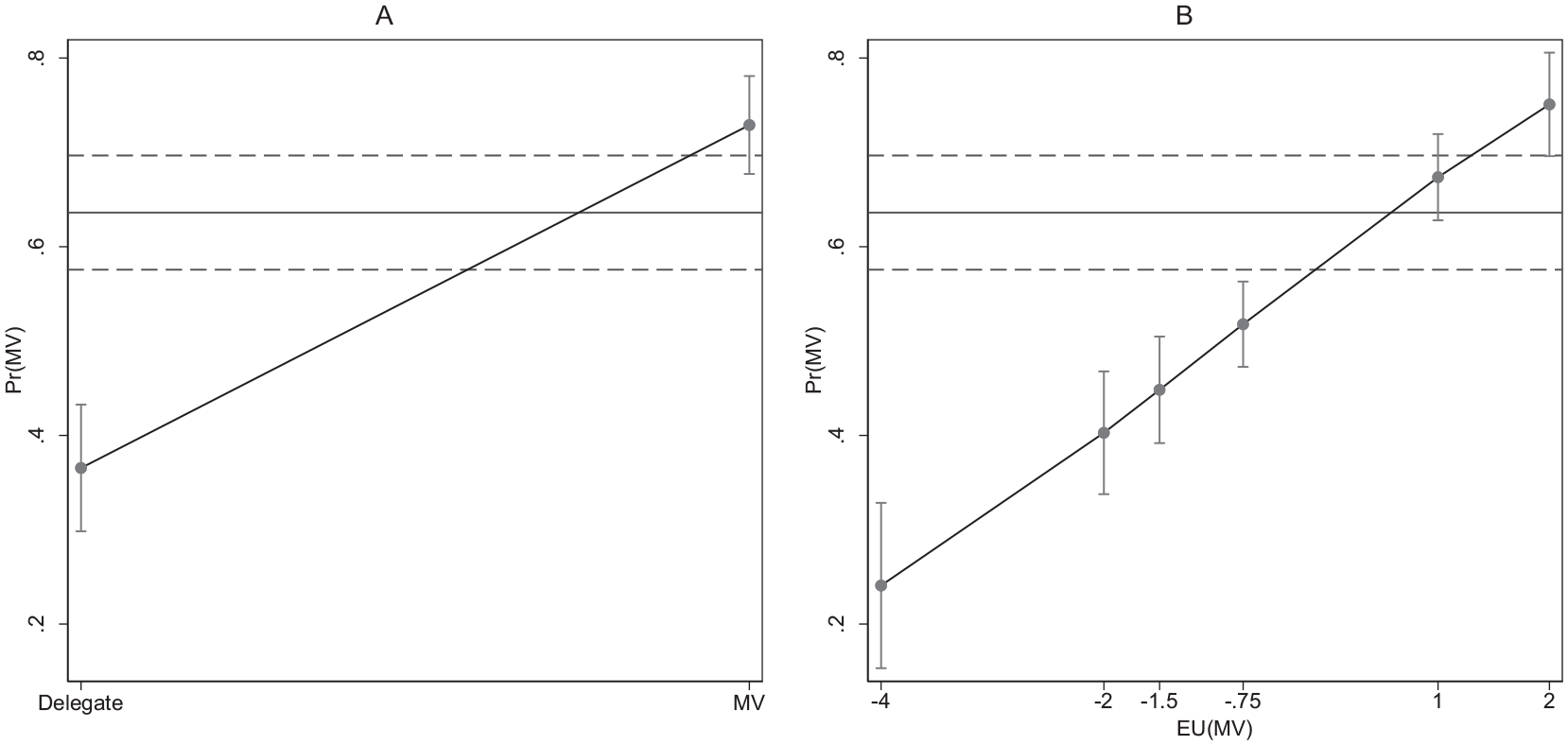
Rational procedural choice.
The two panels in Figure 3, finally, are based on separate estimates for the Group Majority Condition and the Group Benefit Condition groups (with the horizontal lines in both panels indicating the predicted likelihood of choosing MV for a member of the No Information Condition group). Both panels, once more, support the notion that instrumental motives are a significant determinant of subjects’ choice between alternative procedures: if a majority is known to reject a provision of the public good (‘Contra PG’), individuals to whom provision yields negative individual utility are significantly more likely to select MV than individuals for whom individual utility is positive (75% vs 36%, see Figure 3a). Conversely, if the majority is known to support provision of the public good (‘Pro PG’), individuals who derive negative individual utility from provision are significantly less likely to select MV than agents with positive individual utility (43% vs 75%). Interestingly, while a known contrast between the majority’s position and an individual’s own position significantly reduces support for MV (relative to the No Information Treatment), congruence between individual and majority preferences raises support for MV, but – as indicated by the overlapping confidence intervals – the difference is not significantly different from zero.
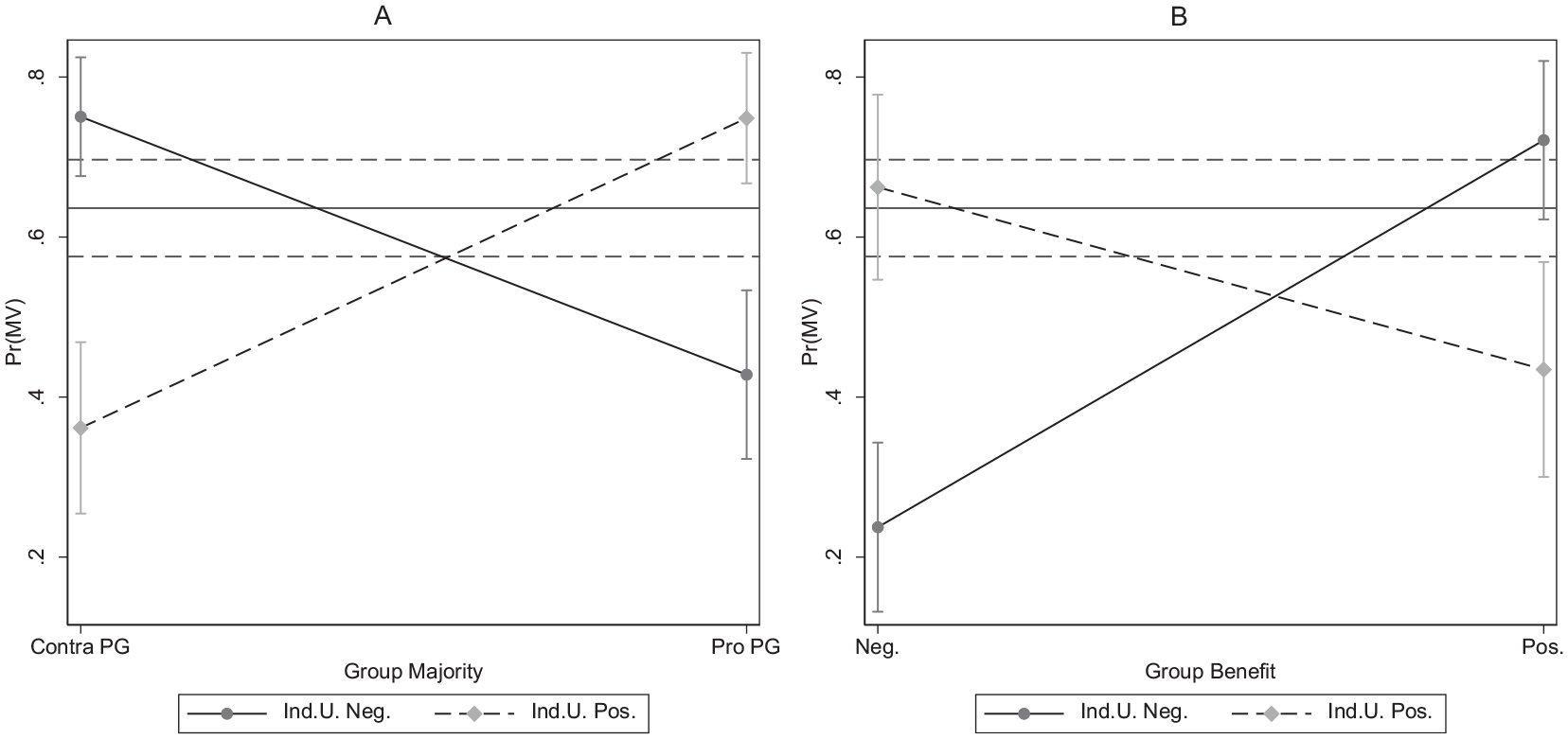
Rational procedural choice in the Group Majority and the Group Benefit Conditions.
A similar pattern is revealed by Figure 3b: if the group benefit is negative (‘Neg.’), such that the algorithm would decide against a provision of the public good, subjects who derive positive individual utility from provision are significantly more likely to support MV than those who derive negative utility (66% vs 24%). Conversely, if the group benefit is positive (‘Pos.’), subjects who derive negative individual utility from provision are significantly more likely to support MV than those with positive individual utility (72% vs 43%). As in Figure 2a, having access to additional information does not significantly raise support for a majority vote (relative to the No Information Condition) if MV is in an agent’s material interest. However, if MV is associated with a lower expected pay-off than DE, this significantly reduces support for a majority vote (relative to the No Information Condition).
We interpret the pattern displayed in Figure 3 as evidence that participants in our experiment tend to generally support majority voting as a decision-making procedure, most likely for intrinsic values assigned to it (self-determination, equality, or fairness) or because they are societally ‘primed’ towards MV as the default procedure for collective decisions. If it turns out that MV also raises an individual’s expected pay-off – either because personal preferences coincide with the majority’s preferences, or because a majority vote possibly prevents a decision which would maximize the welfare of the group, but be in conflict with personal interests – this gives an additional boost to agents’ partiality towards MV, but the difference in predicted probabilities of selecting MV is not significant. Conversely, if a majority vote is expected to lower an individual’s pay-off, support for MV significantly cools off, with predicted probabilities of selecting a majority vote dropping by up to 37%. At the same time, however, the predicted probability of selecting MV is always significantly larger than zero – that is, there is a substantial percentage of participants who support a decision-making procedure even if its implementation would run against their own material interests.
Discussion and conclusions
The results of our laboratory experiment provide strong evidence for the relevance of instrumental motives for procedural preferences. By and large, individuals are inclined to choose the dominant strategy where a procedural choice maximizes their own expected pay-off from the resulting substantive decision. This finding may be less surprising to economists than to political scientists, who are more inclined to explain procedural preferences with the intrinsic values – self-determination, fairness, equality – of procedures. However, the significant effect of individual utility maximization is not the entire story in our results. First, we also find that in a situation where a lack of information obscures the outcome effects of the decision procedure, subjects tend to prefer majority voting over delegated decision making, presumably because they see an intrinsic value in exercising autonomy or ‘having their own say’ in a decision. Secondly, we find that information about the effects of a decision for the group benefit increases the probability of subjects choosing to delegate to a welfare-maximizing algorithm, regardless of their individual stake. Finally, we also see that a small but relevant share of participants do not choose the instrumentally dominant strategy, but apparently base their selection on the intrinsic merits they ascribe to a procedure. In a broader sense, these findings also connect to previous lab experiments testing models of social preferences (e.g. Fehr and Schmidt, 1999) in distribution exercises (e.g. Engelmann and Strobel, 2004). This study suggests that when it comes to procedural preferences, individuals’ choices are strongly influenced, but not fully determined, by self-interest.
What is the external validity and relevance of our findings for the real world of politics? That is, what implications does the observed behaviour in a highly artificial environment have for interpreting and predicting preferences and choices of citizens of contemporary democracies? We believe that the most relevant finding concerns the effects of information about the majority position or, alternatively, the collective welfare effects of a decision. In the media and the political public sphere, majority positions in public opinion polls typically feature prominently. Such information makes it seemingly easy to infer whether or not there exists a majority for the own position, and may advance the demand for decisions by referenda – at least in those who believe to be part of a majority. This instrumental demand for direct democracy is not only problematic from a point of view of normative democratic theory, but may also be based on wrong assumptions, as pollsters tend to keep back ‘don’t know’ and non-responses. In the present (at time of writing) COVID-19 crisis, by contrast, news reporting has been dominated by expert opinions from virologists and epidemiologists on how to protect collective health and welfare. In many countries, support for representative governments has soared and trust in delegated decision making has increased. In other words, information about collective good effects of decisions, which in our experiment increased support for delegation to a welfare-maximizing algorithm, has apparently had quite similar effects in the real world and has increased support for delegated decision making in a time of crisis. This is not to say that we can or should neglect citizens’ demand for more egalitarian participation and for having a direct say in important decisions. Instead, we should be aware of the way in which political communication and the kind of information it focuses on has effects on procedural preferences as well as on support for existing decision-making procedures and the demand for alternatives.
Supplemental Material
sj-pdf-1-rap-10.1177_20531680211014121 – Supplemental material for Deciding how to decide on public goods provision: The role of instrumental versus intrinsic motives
Supplemental material, sj-pdf-1-rap-10.1177_20531680211014121 for Deciding how to decide on public goods provision: The role of instrumental versus intrinsic motives by Philipp Harms, Claudia Landwehr, Maximilian Lutz and Markus Tepe in Research & Politics
Footnotes
Declaration of conflicting interests
The author(s) declared no potential conflicts of interest with respect to the research, authorship, and/or publication of this article.
Funding
The author(s) disclosed receipt of the following financial support for the research, authorship, and/or publication of this article: Philipp Harms and Claudia Landwehr gratefully acknowledge the financial support for the research, authorship, and publication of this article by the research unit “Interdisciplinary Public Policy” at Johannes Gutenberg University Mainz. Markus Tepe received financial support for the research, authorship, and publication of this article from the German Research Foundation (Grant Number TE1022/2-2).
Data and code availability
The full experimental protocol (zTree), dataset and syntax (Stata) will be made publicly available at the Research & Politics Dataverse before publication.

Notes
Carnegie Corporation of New York Grant
This publication was made possible (in part) by a grant from the Carnegie Corporation of New York. The statements made and views expressed are solely the responsibility of the author.
References
Supplementary Material
Please find the following supplemental material available below.
For Open Access articles published under a Creative Commons License, all supplemental material carries the same license as the article it is associated with.
For non-Open Access articles published, all supplemental material carries a non-exclusive license, and permission requests for re-use of supplemental material or any part of supplemental material shall be sent directly to the copyright owner as specified in the copyright notice associated with the article.
