




Abstract
This paper presents and addresses a simple, yet overlooked, research question: is there a sexuality gap in political engagement and participation between sexual minority individuals and the heterosexual majority in Western Europe? To answer this question, we employ a recently applied method of identifying lesbian, gay and bisexual (LGB) individuals using data on the gender composition of cohabiting partner households from the European Social Survey. Relying on a total sample of more than 110,000 individuals across 12 different countries with an identified sample of 1542 LGB individuals, we test the divergence in political interest and political participation, both electoral and non-electoral, between LGB and non-LGB individuals. The results of our empirical analyses conform with our expectations. Theorising that LGBs, as a marginalised social stratum, are incentivised to participate and ‘vote like their rights depended on it’, we find empirical evidence of a significant and positive ‘sexuality gap’ in levels of political interest, turnout and other forms of political participation in Western Europe over and above what can be determined by socio-economic determinants of political participation.
Introduction
In recent years, scholars have begun to build on classic works to examine how sexuality (Sherrill and Flores, 2014; Swank, 2019) and sexuality-based discrimination (Page, 2018) affect political participation. Participating in the political process, be that in the form of institutionalised forms such as taking part in elections or non-electoral avenues such as lobbying and contacting elected representatives, is particularly critical for minority communities, as high levels of participation can serve as a vehicle of maximising inclusiveness, and aid the provision of policy output that caters to their own group-specific welfare. When elected representatives and other democratic institutions are free to operate without the specter of electoral punishment from an active political demos holding them to account, they are ‘under no compulsion to pay much heed to classes and groups [. . .] that do not vote’ (Key, 1949: 527). Participation, therefore, matters.
The literature on political participation is rich, but little has been made of how sexuality impacts electoral behaviour (but see, for example, Bailey, 1999; Egan, 2012; Hertzog, 1996; Sherrill and Flores, 2014; Swank, 2019), particularly in the European context. While Turnbull-Dugarte (2020a, 2020b) has recently shown that being lesbian, gay or bisexual (LGB) 1 affects both individual vote-choice and ideological preferences in Western Europe, there is as yet no single country or cross-national assessment of how sexuality impacts individual-level turnout in Europe. As an increasingly visible stratum within society that makes up a small yet significant portion of the electorate, understanding the political behaviour of LGB individuals, including in the electoral arena, is important. In this paper we provide the first comparison of participation and political interest between LGBs and heterosexuals across Western Europe.
Empirically, we test the effect of sexuality across 12 Western European democracies using data from the European Social Survey (ESS) between 2002 and 2017. We find that LGBs are, on average, significantly more likely to be politically interested and to turn out at the polls than comparable heterosexuals. We report, therefore, a ‘sexuality gap’ (Hertzog, 1996) in political interest and electoral participation. We theorise that the European ‘lavender’ voter (Turnbull-Dugarte, 2020a) is likely driven to ‘over participate’ (vis-à-vis their heterosexual peers) in elections because they view participation in the political process as vital to ensure the advancement of their own individual welfare – as well as that of their in-group – and to protect themselves against the potential threat of discriminatory policies of the majority (Ayoub and Page, 2019). In short, a desire among LGBs to advance LGB(T+) rights and calls for them to ‘vote like their rights depended on it’ (Brydum, 2013) makes them i) more interested in politics, ii) more likely to head to the polls on election day, and iii) more likely to participate in other non-electoral forms of engagement in the democratic process.
Theorising a sexuality gap in political participation
While determinants of participation are particularly well-researched within political science (Geys, 2006), the role of sexuality has been largely overlooked (Page, 2018; Sherrill and Flores, 2014). But why would we expect to observe a significant relationship between sexuality and participation?
According to rational choice framework (Downs, 1957; Riker and Ordeshook, 1968), welfare maximising voters will turn out to vote for political candidates that they perceive will increase either their own personal welfare or that of their group. This is particularly relevant for LGB individuals, as the potential benefits of participation for minority groups may be larger than that for the majority – including obtaining greater legal protections from discrimination or the expansion of civil rights legislation for the LGB(T+) collective (Ayoub and Page, 2019; Blumer, 1958; Sherrill, 1996).
Indeed, the incentivising role of individual (Sears and Funk, 1991) and shared group (Bobo, 1983; Green and Cowden, 1992) self-interest is strongest when policies proposed by competing parties are understood to have a significant positive impact on the everyday life of the voter and group (Lipset, 1983: 191). In the case of LGBs, this can include changes in the legality of homosexual activity and the institutional recognition of same-sex relationships. In essence, we expect LGB individuals to vote ‘like their rights depended on it’ (Brydum, 2013) in order to protect themselves from potential discriminatory output from the majority (Cho et al., 2006), pursue reforms of existing discriminatory policies, seek out policies that advance their own economic and social welfare (Schaffner and Senic, 2006), and protest against their current legal and social position. While advances have been made in these areas – most notably decriminalisation of same-sex activity and the provision of same-sex marriage – discrimination can persist (Asal et al., 2013) and discriminatory treatment can serve to mobilise recipients of this treatment to take political action (Oskooii, 2016; Page, 2018). Effectively, marginalisation and a desire to expand group welfare drives minority-group individuals to become ‘voters by necessity’ (Pantoja et al., 2001).
Given observable efforts to mobilise LGB voters to take political action in order to advance their institutional welfare and civil rights (Ayoub, 2013; Ayoub and Paternotte, 2014), and the notable efforts of political parties in Western Europe to court the lavender vote (Turnbull-Dugarte, 2020a), there is a clear basis to expect LGBs to be more politically engaged and active in electoral and non-electoral democratic processes. Our central theoretical expectation, in line with the US literature (Sherrill and Flores, 2014; Swank, 2019), is that as a marginalised minority group and traditional recipient of social and state-sponsored discriminatory treatment, LGB individuals will be more politically active that comparable heterosexuals.
Testing the sexuality gap in political engagement
Our empirical analysis relies on data from the ESS (2002–2017), and includes data from Belgium, Finland, France, Germany, Ireland, the Netherlands, Norway, Portugal, Spain, Sweden, Switzerland and the UK. 2 Central and Eastern European countries could not be included in the analysis due to the higher levels of intolerance of homosexuality that likely suppresses the ability to observe homosexual respondents via the measurement strategy applied here (Turnbull-Dugarte 2020a). This means that in a number of the non-Western countries we were unable to identify a single LGB individual in the survey. Observations (N=110,726) represent individual survey respondents from these 12 countries and are weighted using both sampling probability weights as well as country population weights.
Dependent variables
Our primary dependent variables are interest in politics and electoral participation (voted) which are both dichotomous indicators. Political interest measures those who report to be ‘very’ or ‘quite’ interested in politics (1) or those ‘hardly’ or ‘not at all’ interested (0). Electoral participation indicates reporting to have voted in most recent general election (1) or not (0). This operationalisation can lead to overreporting of turnout due to issues around social desirability (Karp and Brockington, 2005). That being said, the potential bias caused by overreporting does not affect the analysis at hand given that the explanatory variables used in the models to stratify survey respondents are still those that stratify the actual electorate (Sigelman, 1982). Additional measures of non-electoral participation analysed include contacting a politician; working for a political party or a non-profit organisation; being a member of a political party; taking part in a political protest; signing a petition; participating in a boycott; or wearing a political badge, all of which are also dummy indicators.
Main explanatory variable: sexuality
There is currently not a single cross-national survey that includes a direct measure of sexual orientation across European countries. As a result, we rely on a recently applied method (Turnbull-Dugarte, 2020a) of identifying LGB individuals using the household constitution of ESS respondents. This measurement strategy involves two steps. First, we identify those individuals who report to be living in a household with their spouse or partner in order to give us a reduced population of cohabiting respondents. To infer respondents’ sexual orientation, we match the gender of the other additional household members to that of the respondent: those with a partner of the same sex are coded as LGB whilst those with an opposite-sex partner are identified as heterosexual. Our measurement therefore relies on the gender of a survey respondent’s current partner as a proxy of their sexual orientation. Similar measurement strategies have been used elsewhere using different datasets (Fischer et al., 2016) (for a discussion, see Kühne et al.,2019) and observe comparable numbers of individuals in same-sex relationships, increasing the confidence in the validity of our approach. Moreover, given that interview effects can alter interviewees’ willingness to self-report as LGB (Kühne et al., 2019), partner-inferred sexuality allows us to overcome these obstacles. The limitation of this operationalisation is that we can only include individuals in a co-habiting relationship in the analysis – that is, non-cohabiting individuals are removed from the sample to facilitate the isolation of sexuality-based divergence rather than divergence based on cohabitation. 3 This may hinder the generalisability of the LGB effect given that such LGB individuals are likely to be a distinct group from that of non-partnered LGB individuals. Additionally, since cohabiting couples are more likely to participate in elections due to within-couple social pressures (Blais et al., 2019), holding the relationship and cohabitation status of respondents constant, by removing single individuals, better aids the isolation of the independent effect of sexuality. One assumption we apply to the data is that the potential confounding effect of within-couple social pressures is distributed homogenously across both LGB and heterosexual couples. Since cohabiting individuals are already more likely to vote than non-cohabiting voters, there may be a ceiling effect which restrains the potential room for an independent effect of sexuality. This means than the magnitude of effects reported may be underestimating the real sexuality gap in the wider population. Our identified LGB population represents 1.4% of the total sample (N = 1542).
Control variables
The control variables in our analysis represent well-established determinants of individual-level turnout (Gallego, 2010; Smets and Van Ham, 2013). These include sex, age, education, income, employment status and rural/urban location. Sex is dichotomous: men (49.98%) and woman (50.02%). Age is operationalised as a continuous variable (years); and Education is measured as the total number of years in full-time education. Income is measured as respondents’ satisfaction with their level of income on a four-point scale (Kern et al., 2015); and Employment status is operationalised using with a five-point categorical variable: working (baseline value); unemployed and seeking employment (jobseeker), those still in education (studying), unemployed and not seeking employment (not in the work force: NIWF), and retirees. 4 Rural is a dichotomous variable indicating that individuals reside in a small village or in the countryside (1), or in an urban location (0). Finally, we control for the potential confounding nature of system-level features associated with electoral participation by including election-specific (country-year) fixed effects 5 in the model.
We do not include political and attitudinal variables that are associated with individual-level turnout such as political interest, perceptions of the economy, or satisfaction with democracy in the turnout model. This is because we regard such factors as post-treatment (causally posterior) to sexuality and the inclusion of these measures would lead to post-treatment bias in the estimation of an independent sexuality gap (Acharya et al., 2016). Indeed, we argue that LGB status leads to higher levels of political participation and political interest, which we explore in subsequent analysis. For robustness, however, we include an additional model that considers the confounding nature of post-treatment variables to show that the findings of our main model are not conditioned by a lack of more extensive controls (Table A3 in supplementary material). Sampling and country population weights are applied. 6
Empirical results: gay and politically active
Interest and turnout
Table 1 reports the output of a logistic regression that models political interest (Model 1) and electoral participation (Model 2). We first consider political interest. The coefficient for LGBs is positively signed and significant. Similar results are found in the case of individual turnout. The positive and statistically significant coefficient of LGB indicates that LGB citizens are notably and significantly more likely to be interested in politics and turn out on polling day than comparable heterosexuals. There is, therefore, an independent sexuality gap in participation beyond what can be explained by socio-economic predictors. The control variables behave in the way we would expect although it is not advisable to engage in an interpretive discussion of the effect of control variable parameters (Keele et al., 2020).
Modelling effect on political interest and turnout.

NIWF: not in the workforce; FE: fixed effects.
Robust country-clustered standard errors (two-tailed) in parentheses.
p < 0.01.
p < 0.05.
p < 0.1.
A more intuitive understanding of the variables’ effect is presented in Figure 1. The values in Figure 1 indicate the average marginal effect (AME) of each variable on the probability of being interested in politics and participating in the election. AMEs indicate the substantive effect of the explanatory variable whilst holding other variables constant and can be interpreted as the percentage-point change in the probability.
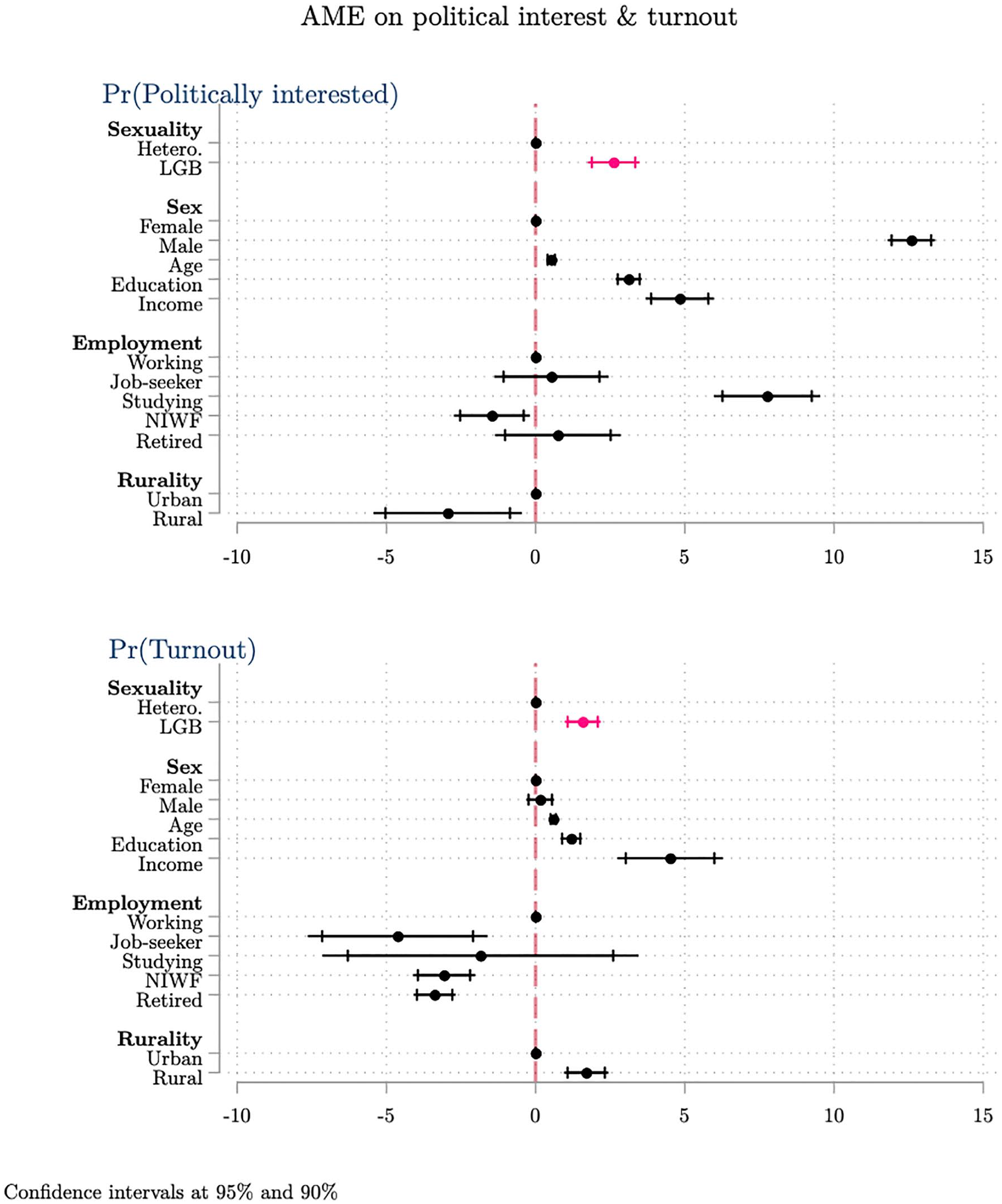
Average marginal effects.
LGB status is associated with a 2.6 percentage point increase (+4.8% vis-à-vis the heterosexual baseline) in the probability of being interested in politics over and above what can be explained by the control variables. Given that political interest has been established as one of the primary predictors of individual-level turnout, observing that LGBs are more likely to be interested in politics vis-à-vis their non-LGB peers helps us to understand the drivers behind the sexuality gap and the over participation of LGB voters. Looking at the controls, the most powerful determinants are gender and employment. This is consistent with existing findings and shows that men and students are more likely to be interested in politics than women and workers.
The effect of sexuality on turnout also wields substantive parity in comparison to the other variables included in the model. LGBs are 1.6 percentage points more likely to turn out to vote (+1.9% relative to the heterosexual baseline). Importantly, the gap between LGBs and non-LGBs holds across a model including political interest as a post-treatment predictor of turnout. In other words, even when we consider the role of interest in driving electoral participation, LGBs are still more likely than others to head to the polls.
Given the potential for geographic clustering of LGB voters in urban areas (Bailey, 1999) we carry out robustness tests to ensure that the potential self-selection of LGBs into cities and large towns, which tend to be more socially liberal (Rodden, 2019) and therefore accepting of the LGB(T+) community, does not confound our results. First, we replicate the estimation of political interest and turnout without the rurality control. Second, we estimate our models using a subsample of urban voters only. Figure 2 compares the AME of sexuality from the main model and these two additional tests (full regression output in Table A4 in supplementary material). The results remain unchanged and in the case of the urban-only subsample, we observe a substantively larger effect size. Compared to other (heterosexual) urban dwellers, LGB individuals have a probability of being interested in politics that is 4.4 percentage points (+7.72%) larger and a probability of heading to the ballot box on polling day that is 2.7 percentage points (3.36%) greater.

Sexuality gap among urban clusters.
Non-electoral participation
Whilst taking part in the window of opportunity provided by the formal electoral process is an important avenue for LGBs to exercise their influence on the political process, national elections only take place, on average, every four or five years. If LGB individuals are incentivised by a desire to expand their community welfare and are mobilised to do so by LGB(T+) social movements taking place across Europe, we would expect to see the increased political engagement observed at the ballot box to translate across other non-electoral outcomes. Figure 3 reports the effect of sexuality across different non-electoral measures. Looking first at institutionalised and formalised models (Kern et al., 2015) of political action (representative lobbying, working for organisations, parties and party membership), we see little divergence. There is only a significant gap in the case of working for a party where there is 1 percentage point gap. Although, given the low probability in the heterosexual baseline (.04), the 1-point gap is not trivial, equating to an increase of 20.64%.
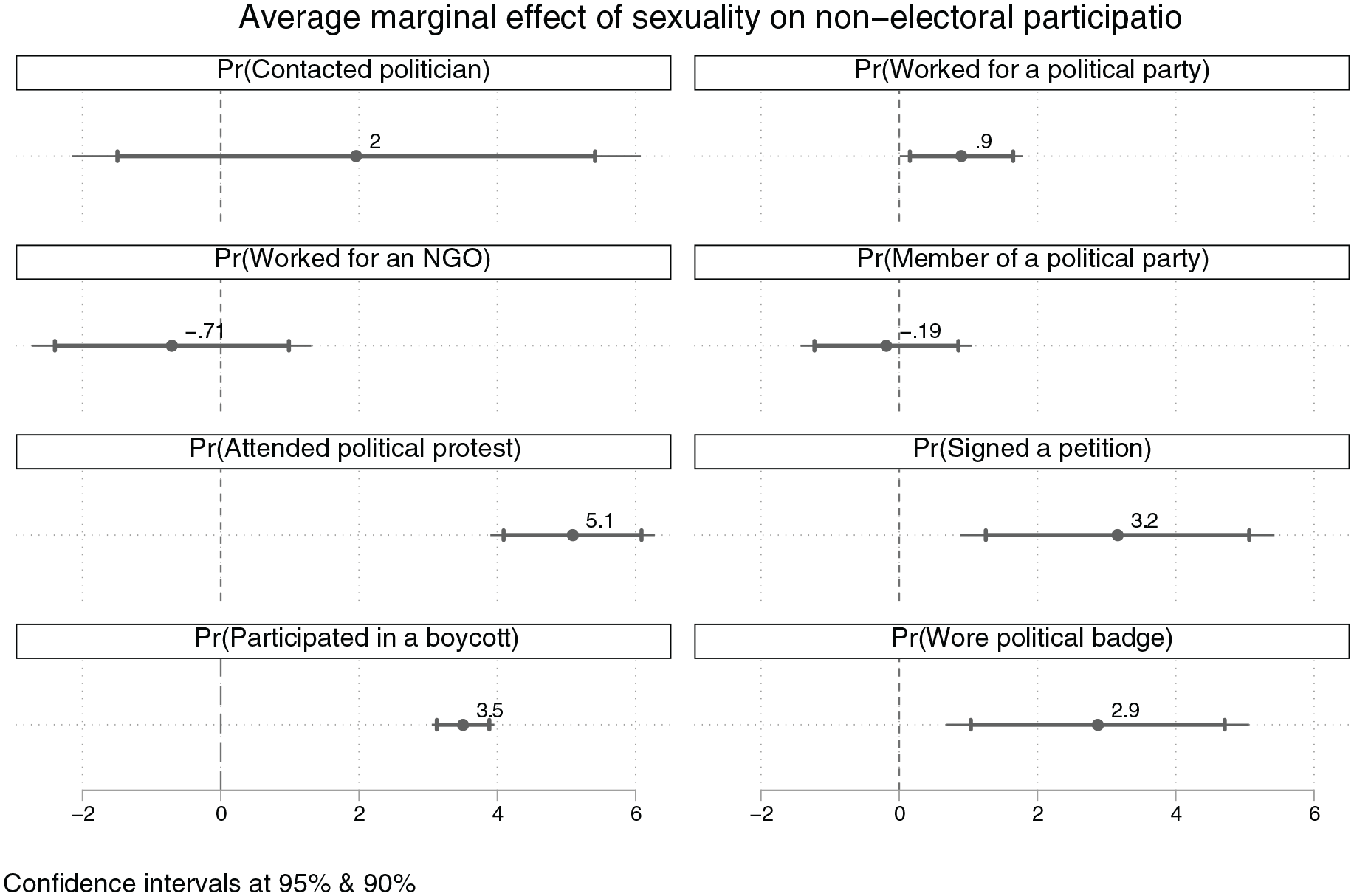
Sexuality gap in non-electoral behaviour.
There is a substantively larger sexuality gap across non-institutionalised forms of participation like taking part in a protest, petition-signing, product boycotts and wearing political badges. The divergence in protest participation, as in the US (Swank, 2019), is particularly large: West European LGB individuals are 5.5 percentage points more likely to have taken part in a public protest: a powerful increase of 60.1% vis-à-vis the heterosexual baseline probability. The gap is also significant and large in the case of petition signing, product boycotts and wearing a political badge, with LGBs exhibiting a 3.2 (+9.81%), 3.5 (+13.87%), and 2.9 (+37.76%) percentage point increase in the probability of taking part in these political activities compared to non-LGB individuals, respectively. Across a number of different participatory measures, sexual minority individuals are more engaged than their heterosexual peers.
Conclusions
A core feature of political behaviour that has hitherto not been considered within the electorates of Europe is whether or not one’s sexuality is likely to affect the propensity of an individual to be engaged in politics to participate in the democratic process. Our analyses show that, on average and across Western Europe, LGB citizens (those in a same-sex relationship) are significantly more likely to be active participants in democratic politics than comparable heterosexuals (those in opposite sex relationships). There is, therefore, an independent ‘sexuality gap’ in political behaviour that cannot be explained by traditional socio-economic determinants of participation.
We acknowledge the potential limitations of the analysis. Firstly, given that the measurement strategy relies on individuals being in a relationship, the extent to which the effects can be generalised across those who are and are not currently in a relationship is unclear (Kühne et al., 2019). Secondly, we are not able to distinguish between those who are bisexual and those who are gay or lesbian. Although Schnabel (2018) argues that this within-group asymmetry is likely minimal, we acknowledge the potential heterogeneity between these distinctive subgroups (Swank, 2018; Worthen, 2020). Ultimately, given the strategy applied, we are unable to differentiate between LGs and Bs. Notwithstanding these limitations, however, establishing that sexuality increases both political interest and the propensity of individuals to participate in national elections creates vast avenues for additional research. Given the infancy of scholarship concerning the individual-level behaviour of this particular minority group, most notably in Europe, assessing whether and how the assumptions regarding minority group behaviour travel across groups that are structured by sexuality provides for an interesting subfield within the discipline yet to be fully explored.
Supplemental Material
sj-pdf-1-rap-10.1177_2053168020976952 – Supplemental material for Political engagement and turnout among same-sex couples in Western Europe
Supplemental material, sj-pdf-1-rap-10.1177_2053168020976952 for Political engagement and turnout among same-sex couples in Western Europe by Stuart J. Turnbull-Dugarte and Joshua Townsley in Research & Politics
Footnotes
Acknowledgements
An earlier version of this paper was presented at the 2019 Elections, Public Opinion and Parties (EPOP) annual conference at the University of Strathclyde. The authors recognise the comments of audiences at the Universität Wien, the University of Kent, and the Universidad Carlos III. In particular, comments from Markus Wagner, Sylvia Kritzinger, Carolina Plescia, Mark Shephard, Pablo Simón, Pedro Riera and Sandra León were greatly appreciated. We also thank the two anonymous reviewers for their detailed feedback and the anonymous associate editor for their very helpful comments. Any errors, should they remain, are our own.
Declaration of conflicting interests
The author(s) declared no potential conflicts of interest with respect to the research, authorship, and/or publication of this article.
Funding
The author(s) received no financial support for the research, authorship, and/or publication of this article.

Supplemental materials
Notes
Carnegie Corporation of New York Grant
This publication was made possible (in part) by a grant from the Carnegie Corporation of New York. The statements made and views expressed are solely the responsibility of the author.
References
Supplementary Material
Please find the following supplemental material available below.
For Open Access articles published under a Creative Commons License, all supplemental material carries the same license as the article it is associated with.
For non-Open Access articles published, all supplemental material carries a non-exclusive license, and permission requests for re-use of supplemental material or any part of supplemental material shall be sent directly to the copyright owner as specified in the copyright notice associated with the article.
