




Abstract
Air superiority enhances military firepower and maneuverability and is critical to battlefield success. We offer the first quantitative test of the relationship between air superiority and battlefield outcomes. To conduct the test, we created a data set of which side, if any, achieved air superiority in the decisive battle of conventional wars between 1932 and 2003. We found that air superiority significantly improved a country’s probability of winning the decisive battle as well as the overall war. Further, we found that air superiority was a better predictor of winning a war than other well-known factors such as adoption of the modern system, regime type, civil–military relations, and a general measure of military power.
Introduction
Why are some militaries more likely to win in battle than others? Some of the most common answers to this question are material resources (Desch, 2002), regime type (Reiter and Stam, 2002), adoption of the modern system (Biddle, 2004; Grauer and Horowitz, 2012), civil–military relations (Brooks, 2006; Narang and Talmadge, 2018), and military strategy (Bennett and Stam, 1996). We argue that a specific aspect of military power is critical to victory in modern conventional battles: air superiority. While air power theorists like Trenchard, Mitchell, and Seversky have long maintained “that command of the air is of first priority to any military success in war” (Smith, quoted in Westenhoff 1990), recent research places much greater emphasis on other factors, particularly adoption of the modern ground forces system (Biddle, 2004). We agree that the modern system is an important military innovation, but air superiority is generally more critical to battlefield victory. We evaluated the air power theorists’ hypothesis and conducted the first quantitative test of the relationship between air superiority and battlefield victory.
Battlefield victory is primarily a function of combat power. While a number of factors affect combat power, we demonstrated that air superiority is an especially important one. Air superiority increases the maneuverability and concentration of one’s forces. This increases the success of battlefield breakthrough and reduces the odds of breakthrough by the other side. To test the relationship between air superiority and battlefield victory, we created a new variable that identifies which side, if any, achieved air superiority in the decisive battle of conventional wars between 1932 and 2003. We found that air superiority was a better predictor of victory than other well-known factors such as adoption of the modern system, regime type, civil–military relations, and general measures of military power.
This research improved our understanding of military effectiveness. The most effective militaries were those that controlled the skies. From a force structure perspective, our research suggested that investments in air power as well as anti-air defenses were vital for countries that might enter into conventional wars. In addition, our research suggested that certain factors associated with military effectiveness mattered most because they affected a country’s ability to attain air superiority. Democracy, wealth, and civil–military relations, for example, are likely to affect a country’s willingness and ability to invest in air superiority aircraft and training.
This research also fills a gap in research on air power. In international relations, most air power research examines the effects of bombing. Pape (1996) argues that strategic bombing is not an effective coercive strategy, a conclusion supported by Horowitz and Reiter (2001: 160). Kocher et al. (2011) found that US bombing during the Vietnam War often harmed civilians more than combatants, leading to increased support for the Viet Cong. Allen and Martinez Machain (2018) noted that states seem to rely on air power when they do not want to experience significant casualties; the use of air power thus signals low resolve. Similarly, Post (2019) found that coercion attempts that employ air power are more likely to fail than other coercion strategies.
Recently, Saunders and Souva (2019) created measures of country air power and expected air superiority (EAS) for the period 1973–2013. Those measures differ from the one we present here in important ways. EAS is based on the number and technological sophistication of a country’s aircraft. EAS does not account for the skill of pilots, availability of parts and fuel, ground based air-defenses, effectiveness and availability of radar and electronic warfare equipment, or other variables that influence who actually attains air superiority in a given battle. The measure we present is a qualitative holistic assessment of air superiority. By incorporating factors in addition to the number and type of fighters, the measure we present here more accurately describes which side actually achieved air superiority in major battles and wars. In the Online Appendix we more fully discuss the relationship between these two measures, including cases where they disagree.
Air superiority
Air superiority is control of the sky over the battlefield. It means an actor’s air and ground forces can act “without prohibitive interference” by the other side’s aircraft or air defenses (North Atlantic Treaty Organization (NATO), 2018). Prohibitive interference is present when an adversary can shoot down a significant portion of one’s aircraft, thereby disrupting aerial surveillance and air-to-ground attacks. Adversary resistance is not prohibitive when one’s fighter and attack aircraft can effectively carry out their mission. If one side has air superiority the other side does not, but it is possible for neither side to attain air superiority. Such a situation is defined as air parity.
Air superiority is the first principle of air power (Meilinger and Sachs, 1995) because it allows other aircraft and military units to do their job more effectively. For example, in World War II, unescorted bombers attacking German factories suffered extreme losses from enemy fighters (Overy, 2014: 150). Similarly, strikefighters must jettison their bomb-loads, abandoning their mission if they hope to defend themselves when attacked by air superiority fighters. Reconnaissance, electronic warfare, or transport aircraft can do little but hope to flee in the face of fighter opposition. None of these aircraft can do their jobs well if air superiority has not first been established. Equally, ground forces are less effective when the adversary has air superiority. To protect themselves from air attack, ground forces have to devote more effort to concealment and dispersion. This can limit the damage of air strikes, but it degrades maneuverability, force concentration, and effectiveness.
Air superiority increases combat power: the amount of force one can apply at a particular place and time (Joint Chiefs of Staff, 2017). The actor with a combat power advantage is likely to win the engagement. Air superiority facilitates combat power by enhancing combined arms operations and the maneuverability and firepower of one’s forces. Combined arms operations use two or more weapons systems in such a way that it is difficult for an adversary to defend itself from both. Combined arms operations do not require air power, but it is often a component. For example, “Targets which cannot be effectively suppressed by artillery are engaged by close air support” (Corps, 1997: 95). The US Marine Corps warfighting manual also explains how air attack, which is only effective when air superiority has been obtained, contributes to battlefield breakthrough: “in order to avoid our deep air support, he must stay off the roads, which means he can only move slowly. If he moves slowly, he cannot reinforce in time to prevent our breakthrough (Corps, 1997: 95).” Without air superiority, one’s ground forces move slower and lose firepower by not being able to employ attack aircraft.
To summarize, air superiority has offensive and defensive implications. Offensively, air superiority allows an actor to employ attack-, surveillance-, bomber-, and other aircraft without significant losses. Air superiority also facilitates air/ground combined arms operations. Defensively, an actor with air superiority does not have to fear that the adversary will attack their ground troops from the air and can more easily shift resources to stop enemy advances or quickly maneuver ground forces to capitalize on weak points in the enemy battle line. More generally, air superiority facilitates the concentration of forces on a particular area, increasing the probability of a battlefield breakthrough or stopping an adversary’s attempted breakthrough. If one side has air superiority, it is more likely to have a combat power advantage and is more likely to win the battle.
These considerations led to our central hypothesis: In conventional battles, a side that achieves air superiority is more likely to win than a side that fails to achieve air superiority.
Research design
To test our hypothesis, we built on the work of Grauer and Horowitz (2012). The primary difference between their research design and other prominent research on military effectiveness such as Reiter and Stam (2002) is that Grauer and Horowitz focus on decisive battles in conventional wars. In the next section we explain how this reduces endogeneity concerns. We analyzed battles between 1932 and 2003 using a series of logistic regressions. The unit of analysis was the country-decisive-battle-participant. 1 Airplanes were used sparingly prior to 1932, and 2003 is the end of the Grauer and Horowitz data. The dependent variable, Win, is a binary indicator of which side won the decisive battle. 2 There is only one draw in their data. For that case they code both sides as losing. We employed all their codings. Our contribution was to add to their data an expert coded indicator of which side, if any, attained air superiority during the decisive battles of these wars.
The variable Air Superiority equals one if a country had air superiority over its opponent(s) in the decisive operation, zero otherwise. Air Parity equals one if neither achieved air superiority, zero otherwise. To identify which side, if any, had air superiority we consulted over 80 sources. In the Online Appendix we list our sources and provide a brief narrative of the air campaign in each war. We coded air superiority in accord with the NATO definition of the concept: That degree of dominance in the air battle of one force over another which permits the conduct of operations by the former and its related land, sea and air forces at a given time and place without prohibitive interference by the opposing force (NATO, 2018).
Air superiority is obtained if an actor can effectively employ air assets and prevent the adversary from effectively employing its air assets over the battlefield. To achieve air superiority, an actor aims to destroy or deter the other side’s air force either with its aircraft or land-based air defenses. Air superiority does not require one air force to be eliminated from the battlefield entirely. Instead, we looked for evidence that one actor prevented its enemy from engaging in significant air strikes, air transport, or close air support operations during the decisive operation while maintaining the ability to engage in these activities itself. If neither side was able to use aircraft effectively in the battle, we coded it as parity. If both sides in the battle were able to use their air forces effectively in support of their ground forces, we also coded this as parity. 3
We measured air superiority at the time of the decisive battle for two reasons. First, by Grauer and Horowitz’s (2012) definition, the decisive battle represents a point in time in which the outcome of the war is in doubt. By measuring air superiority at this point rather than over the war in total, we reduced the possibility that our measurement of air superiority was endogenous – simply crowning the ultimate war winner as having won in the air as well. Second, in some wars the side with air superiority changes over time. The decisive battle is a single point at which holding air superiority can significantly influence the outcome of the war.
We also included the following control variables: Modern System Adoption, Democracy, Autocracy, Anocracy, National Power, Troops Engaged, Opponent Troops Engaged, and Past Coups. We took each of these variables from the Grauer and Horowitz replication data. See the Online Appendix for a full discussion of these controls.
Empirical results
Table 1 presents a cross-tabulation between air superiority and victory in battle. The relationship is striking. Countries that achieve air superiority win almost twice the amount one would expect by chance. Approximately 79% of all decisive battle winners had air superiority. Only twice did a country with air superiority lose the decisive battle. 4
Air superiority and decisive battle outcomes, 1932–2003.

Note: Cell entries are observed frequency followed by expected frequency in parentheses. Chi2: 58.0, p < 0.001. Air parity is coded as no air superiority for either side. Unit of analysis: battle-country-participant.
Next, we estimated a series of multivariate logit models. Once we controlled for potential confounders, would air superiority still be related to victory in battle? It was (see Figure 1), and quite strongly so. Model 1 reproduced the main findings from Grauer and Horowitz (2012) in our shorter time frame. Adoption of the modern system, democracy, and national capabilities (as measured by the Correlates of War Composite Indicator of National Capabilities (CINC)) increased the probability of winning. Model 2 added air superiority and air parity. 5 Achieving air superiority in the decisive battle was positively and strongly correlated with victory (p < 0.001). The effect of the modern system remained statistically significant but democracy and national capabilities were no longer significant. The air superiority model also fit the data much better (Model 1 Akaike information criterion (AIC) = 101.7; Model 2 AIC = 65.7).

Air superiority and decisive battle outcome: logistic regression estimates, Models 1–2.
Air superiority had a large effect on battle outcomes (see Figure 2), larger than any other variable in the model (see Figure 3). The predicted probability of victory for an institutionalized autocracy suffering air inferiority was only 0.03, when holding other covariates at their mean or median values. An autocracy with air superiority had a predicted probability of victory of 0.83. 6 By comparison, when there is no air superiority an autocracy that has adopted no elements of the modern system wins with a probability of 0.02. When the modern system has been fully adopted, the probability of victory increases to 0.14. The effect of air superiority was similar for democracies. We conclude that air superiority is not only an important determinant of victory in modern war, but that, contrary to Biddle’s expectation (Biddle, 2004: 52–77), air superiority has a larger effect on victory than adopting the modern ground forces system. 7

Substantive effect of air superiority on decisive battle victory, 1932–2003.

Change in predicted probability of victory, selected covariates.
Air superiority explained war outcomes better than a general measure of military power. In Model 1, in which air superiority was absent, the Correlates of War (COW) CINC measure of power showed a statistically significant and positive relationship with victory in war. When we included air superiority in the model, the coefficient associated with CINC declined in magnitude and became statistically indistinguishable from zero. 8 At least on the modern battlefield, air superiority and not power in general is the key to victory. 9
Adding air superiority to the model of battle outcomes rendered democracy not significant (Model 2). Table 2 sheds light on this finding. Democracies are much more likely than other regimes to attain air superiority. This may indicate that the observed democratic warfighting advantage stems from advantages in aircraft technology or doctrines and force structures that emphasize air superiority. It seems likely that regime type, wealth, and civil–military relations influence a country’s force structure and strategy (Brooks, 2006; Caverley, 2010). Nonetheless, our data indicated that the relationship between regime type, wealth, and air superiority was only probabilistic. Non-democracies, such as Nazi Germany, can achieve air superiority and when they do they are more likely to win. Future research should examine the relationship between air power, regime type, wealth, strategy, and military outcomes more thoroughly.
Air superiority and regime type, 1932–2003.
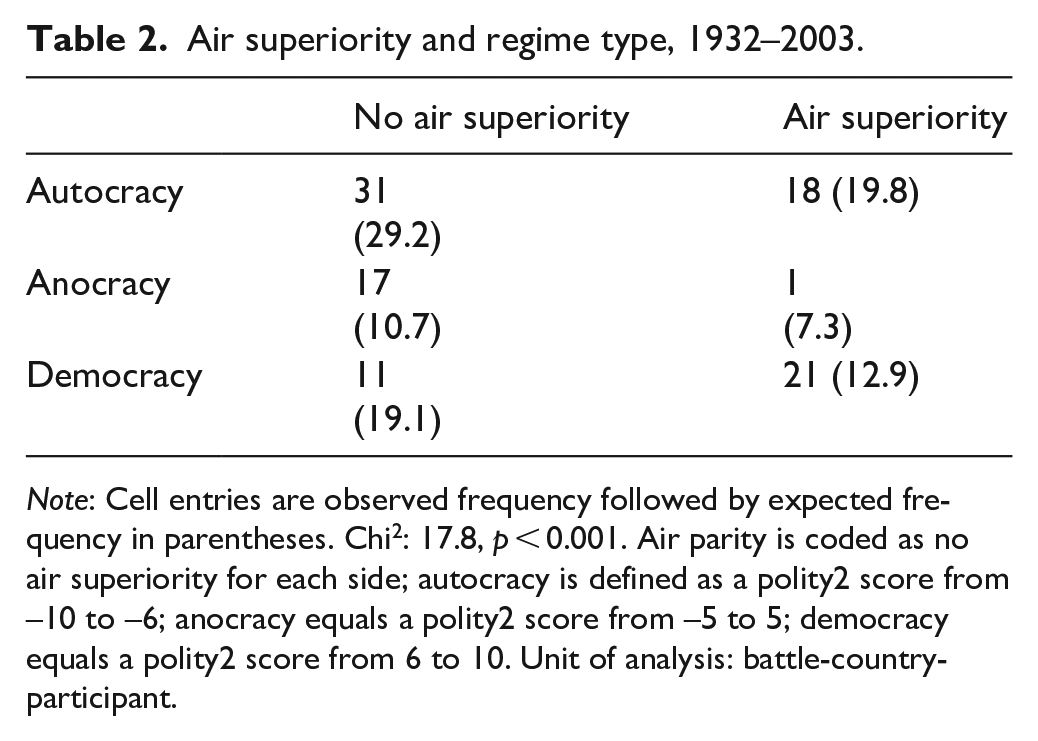
Note: Cell entries are observed frequency followed by expected frequency in parentheses. Chi2: 17.8, p < 0.001. Air parity is coded as no air superiority for each side; autocracy is defined as a polity2 score from –10 to –6; anocracy equals a polity2 score from –5 to 5; democracy equals a polity2 score from 6 to 10. Unit of analysis: battle-country-participant.
Illustrative examples of the importance of air superiority
One useful way to understand the effect of air superiority on victory is to ask who would have won had the other side achieved air superiority. Would the British have defeated Argentina if Argentina controlled the skies in the Falklands/Malvinas War? Would Israel have defeated its adversaries had it not achieved air superiority in 1967 or 1973? The 1973 Arab–Israeli War underscores the importance of air superiority. Initially, the war went poorly for Israel. After the Six-Day War, Egypt and Syria invested heavily in ground based air-defense networks that covered much of Sinai and Golan Heights (Gribling, 1988; Pollack, 2004, 4). While Arab forces remained under this air-defense umbrella, they scored major breakthroughs in both Sinai and the Southern portion of the Golan Heights. Arab air defenses negated Israel’s air power and contributed to the ineffectiveness of Israel’s counterattacks on both fronts (Pollack, 2004: 115, 500). Herzog (1975: 391) notes that Israeli air power had little effect due to enemy defenses. Without control of the skies, more than half of the 170 Israeli tanks committed to the initial counterattack in Sinai were lost for no gain.
On the Northern Front, the situation was even more dire for Israel with Syrian units running unchecked behind the lines on the first day of fighting (Gribling, 1988: 9). One observer notes when discussing the collapse of Israel’s 188th Armored Brigade in the Golan Heights, The missiles and dense anti-aircraft fire wreaked havoc. . . . an Isreali battalion commander asked for air support at first light. As the sun rose, four (Israeli) Skyhawks penetrated to bomb the Syrians, but as they approached their targets the tell tale smoke trails of SAMS were seen. All four planes exploded in the air in full view of the hard pressed troops of the battalion (Herzog, 1975: 286).
While the Arab forces maintained an effective air-defense, Israeli forces were hard pressed to check the Arab advance, and suffered extreme losses in their attempted counterattacks. However, by the end of the first week the situation had changed. The Syrian front was stabilized when Israeli aircraft swept through Lebanese airspace to bomb Damascus. This forced Syria to thin its air-defense network over the Golan and contributed to ammunition shortages for the Syrian air-defense units, allowing Israeli aircraft to provide support to their battered ground forces (Pollack 2004: 500; Gribling 1988: 11). A similar turn of events occurred in Sinai when Egyptian leader Anwar Sadat insisted, against the advice of his generals, that the Egyptian 2nd and 3rd armies strike eastward to relieve pressure on the Syrian forces (Pollack, 2004: 118). This attack took Egyptian troops out from under the cover of their air-defense umbrella, resulting in a crushing Egyptian defeat as Isreaeli fighters could finally be brought to bare against Egyptian ground forces (Herzog, 1975: 314). Following this defeat, the tide soon turned in Israel’s favor. 10
Recent scholarship also underscores the critical importance of air superiority in the Battle for Moscow. The German attack on the Soviet Union in 1941 stalled outside Moscow in part due to Soviet air superiority. Describing a failed German offensive on November 28, General Veiel wrote: “Throughout the whole day continuous bombing attacks on all parts of the div[ision]. Absolute Russian air superiority despite Luftwaffe activity. At the spearheads there were no German fighters observed” (Stahel, 2015: 244). As a result, the Wermacht forces were unable to maneuver without suffering losses from the air. This made it impossible for German commanders to concentrate their forces for a breakthrough. The day after Veiel’s message was received by high command “Fritz Todt, the minister for armaments and munitions, bluntly informed Hitler: ‘This war can no longer be won by military means.’” The historian Stahel explains why: “Evidence for which was nowhere better seen than in the east; and above all in the skies over Russia” (Stahel, 2015: 246). Germany had lost air superiority, dooming its chances of prevailing.
Conclusion
Air power theorists maintain that air superiority is critical to battlefield victory. We conducted the first quantitative test of air superiority and battlefield outcomes and found that air superiority is strongly associated with victory. We contend that this is because air superiority enhances the maneuverability and firepower of one’s forces. We also found that air superiority has a larger substantive effect than other factors associated with victory in war. Air superiority may also explain why democracies generally prevail in war. Democracies typically achieve air superiority over their adversaries. However, when autocracies do achieve air superiority, they prevail about 84% of the time.
Among the implications of our research is that more attention needs to be given to the effects of advanced technology on military effectiveness. Future research should more fully examine the causes of air superiority as well as the interaction of strategy and air power. For policymakers, this research suggests that air superiority should not be neglected at the expense of other missions.
Supplemental Material
sj-pdf-1-rap-10.1177_2053168020972816 – Supplemental material for Air superiority and battlefield victory
Supplemental material, sj-pdf-1-rap-10.1177_2053168020972816 for Air superiority and battlefield victory by Richard Saunders and Mark Souva in Research & Politics
Supplemental Material
sj-pdf-2-rap-10.1177_2053168020972816 – Supplemental material for Air superiority and battlefield victory
Supplemental material, sj-pdf-2-rap-10.1177_2053168020972816 for Air superiority and battlefield victory by Richard Saunders and Mark Souva in Research & Politics
Footnotes
Declaration of conflicting interests
The author(s) declared no potential conflicts of interest with respect to the research, authorship, and/or publication of this article.
Funding
The author(s) received no financial support for the research, authorship, and/or publication of this article.

Supplemental materials
The supplemental files are available at http://journals.sagepub.com/doi/suppl/10.1177/2053168020972816 The replication files are available at https://dataverse.harvard.edu/dataset.xhtml?persistentId=doi:10.7910/DVN/KLPEGD&version=DRAFT
Notes
Carnegie Corporation of New York Grant
This publication was made possible (in part) by a grant from the Carnegie Corporation of New York. The statements made and views expressed are solely the responsibility of the author.
References
Supplementary Material
Please find the following supplemental material available below.
For Open Access articles published under a Creative Commons License, all supplemental material carries the same license as the article it is associated with.
For non-Open Access articles published, all supplemental material carries a non-exclusive license, and permission requests for re-use of supplemental material or any part of supplemental material shall be sent directly to the copyright owner as specified in the copyright notice associated with the article.
