




Abstract
Studies increasingly suggest that personal predispositions affect political attitudes, including those towards the European Union (EU). Yet little is known about the extent to which personality effects on EU support generalize across European countries or attitude domains. We use original survey data from five EU member states (Denmark, Germany, Poland, Sweden, and the United Kingdom) to investigate how the Big Five (B5) traits affect four different facets of public opinion toward the EU (support for further EU unification, views on EU membership, trust in EU institutions and support for using the euro). While we find that each of the B5 matters in at least one place, we find little consistency in personality’s effects across countries. Neither does any pattern emerge across most dimensions of EU support. Our results underscore the importance of isolating the contextual factors that might condition personality’s impact. They further call for greater theoretical development regarding why and how only certain national environments appear to lend themselves to personality effects. At a minimum, they suggest scholars should be wary of drawing conclusions about the B5’s impact from single cases.
Keywords
Introduction
Extant work shows the Big Five (B5) personality traits of openness to experience, conscientiousness, extraversion, agreeableness and emotional stability (or its inverse, neuroticism) affect public opinion towards the European Union (EU). However, existing studies examine the B5’s effects in select (usually single) countries and examine different dimensions of EU support, leaving questions about the uniformity of the B5’s impact across both issue areas and national contexts.
We investigate the B5’s relationship to EU support in a broader comparative perspective to determine how well past results travel beyond the limited settings in which originally studied. We extend previous analyses by assessing four facets of EU attitudes (views towards further unification, opinions on whether EU membership is a good thing, trust in EU institutions, and support for using the euro currency) using original survey data from five member states: Denmark, Germany, Poland, Sweden, and the United Kingdom (UK). 1 We find substantial inconsistency in which B5 traits matter across either country or attitude domain, raising serious questions for future scholars to explore.
Limitations of extant studies
EU support is affected by a range of economic and symbolic concerns (Hooghe and Marks, 2005). The addition of psychological considerations is an important advancement, yet existing studies of personality effects on EU support focus solely on 1–2 countries. 2 In Denmark and Sweden, Nielsen (2016) finds greater openness, extraversion and emotional stability generate more favourable views towards further integration. In the Netherlands, Bakker and de Vreese (2016) find the B5 affect dimensions of support differently. Openness and agreeableness increase support for enlarging EU membership; emotional stability decreases it. Agreeableness and emotional stability decrease support for deepening EU integration. Highly conscientious citizens trust the EU more. Neurotic citizens display more negative affect towards the EU. In their study none of the B5 affected citizens’ identification with Europe whereas in the UK, Curtis (2016) finds that openness and extraversion increase feeling European while agreeableness decreases it. Aichholzer and Rammstedt (2020) note these inconsistencies, but then only examine how the underlying facets of the B5 affect a single aspect of EU support (whether integration has gone too far) in Germany. Curtis and Nielsen’s (2018) analysis of five EU member states provides the most comprehensive study to date, yet investigates personality’s indirect impact on a composite index of EU support. Thus, we lack insight into the cross-country robustness of the direct relationship between personality and multiple EU attitude dimensions. Still, the above studies imply their results should generalize beyond the specific country contexts under scrutiny so we expect:
H1: The association between personality and EU attitudes does not vary across country.
How personality should matter
Openness reflects intellectual curiosity and creativity. It is associated with cognitive flexibility (Carney et al., 2008) and more left-leaning ideology (Caprara et al., 2006). Conscientious individuals are highly disciplined, organized and dependable but known to hold more right-leaning ideological beliefs and oppose international co-operation (Caprara et al., 2006; Schoen, 2007). Extraverted individuals are energetic, confident and socially involved. They are prone to joining organizations (Bakker and de Vreese, 2016) and seek out new information challenging old beliefs (Mondak et al., 2010). Agreeableness reflects compassion, sympathy and generosity. Agreeable individuals often hold traditional values (Roccas et al., 2002) and are highly conflict-avoidant (Mondak et al., 2010), following the ‘dominant’ national discourse when it comes to forming political views. Emotionally stable individuals are calm and relaxed while neurotic individuals get upset by change and instability (Mondak et al., 2010). We greatly elaborate on these expectations in the Online Appendix, summarized here:
H2: Highly open citizens are more likely to support the EU.
H3: Highly conscientious citizens are less likely to support the EU.
H4: Highly extraverted citizens are more likely to support the EU.
H5: Highly agreeable individuals are more likely to support the EU in pro-EU countries and less likely to support the EU in Eurosceptic countries.
H6: Highly emotionally stable individuals are more likely to support the EU.
Data, measurement and method
Original surveys in Germany (n = 2002), Poland (n = 2002), and the UK (n = 1020) were administered online by Opinium LLP during May 2015 to nationally representative samples in each country. Similarly, original surveys were administered online in Denmark and Sweden (n = 904 in both countries) by YouGov in October 2013 and stratified by gender, age and ideological self-placement.
EU attitudes may be conceptualized a number of ways and it is critical to disaggregate them because both citizens and countries display varied levels of support for different dimensions, suggesting their antecedents also vary (Bakker and de Vreese, 2016; Boomgaarden et al., 2011). Boomgaarden et al. (2011) decompose EU attitudes into (a) affect (emotional responses), (b) identity (EU pride/citizenship), (c) performance (assessment of EU institutions), (d) utilitarianism (personal and country benefit) and (e) strengthening (further divided into deepening – increased EU policymaking authority – and widening – allowing in more member states). While our data do not contain measures of the first two, we operationalize the remaining dimensions in four ways. 3 Support for ‘Further EU Unification’ captures the strengthening/deepening aspect. Performance is assessed through ‘Trust in EU Institutions’. Utilitarianism is tapped through two measures, diffuse beliefs regarding whether ‘EU Membership is A Good Thing’ and specific ‘Support for Using the Euro’. Figure 1 displays the distribution of these attitudes, illustrating variation both by country and item.

Distribution of EU attitudes across five countries.
To measure the B5, we employ two widely-used multi-item indices tapping each trait. 4 The German, Polish and UK measures are based on a 25-item instrument (five items per trait) imitating the National Jury Survey reported in Mondak and Halperin (2008: 350) while the Danish and the Swedish survey adopted Gosling et al.’s (2003) 10-item one (two items per trait). 5
In keeping with extant literature, covariates include a respondent’s ideological self-placement (‘L–R Ideology’), 6 gender (a dummy coded 1 for ‘Male’), degree of ‘Education’ (from little to holding an advanced degree), ‘Age’ and place of residence (where higher values indicate more ‘Urban’ settings). To facilitate cross-country comparison and make effect sizes immediately apparent, we standardize all variables to range from 0–1. We employ ordinary least squares (OLS) regression on each separate country sample with robust standard errors clustered by region to account for sampling procedures. 7
Analysis
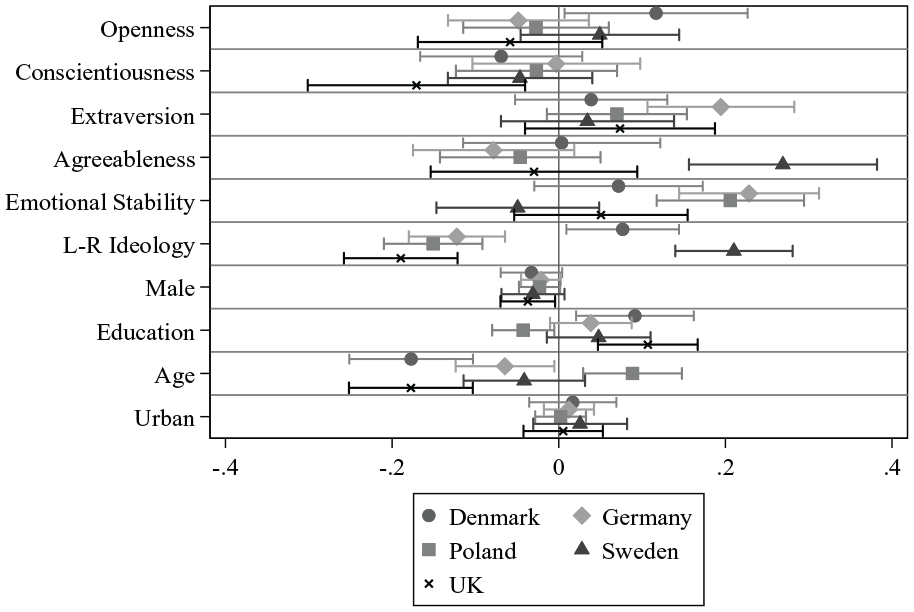
Figures 2–5 report the determinants of each attitudinal dimension broken out by country; the Online Appendix details results in table format and by country broken out by attitude. Before discussing personality, it is noteworthy that few covariates have consistent effects across country or EU attitude. Ideology often is quite substantively strong but, where significant, is positive in Denmark and Sweden while negative in Germany, Poland and the UK. 8 Gender effects are mixed: men in Denmark, Germany and Poland are more likely to think euro use is a good things but less likely to trust EU institutions everywhere. In most cases, education induces more favourable attitudes, though its impact is less apparent in Poland (at times even negative) and Sweden. Age is associated with increased support in Poland, predominantly decreased support in Denmark and the UK, and mostly insignificance in Germany and Sweden. Urban residency is significant only at times in Sweden. These sporadic results by themselves hint that different factors drive EU support in different countries.

Support for Further EU Unification.
Trust in EU Institutions.

EU Membership Is A Good Thing.

Support for Using the Euro.
Turning first to attitudes towards EU unification (Figure 2), openness is only significant in Denmark, where its effect is positive. Conscientiousness is negative and significant, but only in the UK. Agreeableness is positive and significant in Poland and Sweden while negative and significant in Denmark. Emotional stability is positive and significant only in Poland. Extraversion is not significant anywhere.
Next (Figure 3), we assess trust in EU institutions. Openness is positive and significant only in Denmark. Conscientiousness is negative and significant only in the UK. Extraversion is positive and significant only in Germany. Agreeableness is positive and significant only in Sweden. Emotional stability is positive and significant for both Germany and Poland.
Third, we analyse thinking EU membership is a good thing (Figure 4). Openness fails to achieve significance anywhere. Conscientiousness is negative and significant in the UK; almost so in Germany. Extraversion is positive only in Germany. Agreeableness is positive in Germany and Sweden. Emotional stability is positive and significant in Germany and Poland; almost so in the UK.
Finally, Figure 5 examines support for the euro. Openness is positive and significant only in Germany. Conscientiousness is negative and significant everywhere but Sweden. Agreeableness has mixed effects: it is positive and significant in Germany (in the Eurozone) and Sweden (not in the Eurozone) while negative and significant in Poland and the UK (both outside the Eurozone). Emotional stability is positive and significant, but only in Germany and Poland. Once again, extraversion has no effect.
Table 1 recaps our findings. Altogether, these results give a mixed picture on how predispositions matter for EU attitudes. In only one instance is any of the B5 cross-nationally consistent in its direction and significance: that of conscientiousness’s negative effect on euro support (even then, still in only 4/5 countries). For other measures of EU support, different traits matter in different places. When personality traits do matter, however, their magnitude of effect is often quite strong. Recalling that standardization allows us to use coefficient size to gauge each trait’s substantive impact, openness has by far the strongest effect of any variable on support for further EU unification in Denmark. Similarly, in Sweden agreeableness outweighs even ideology for thinking EU membership is a good thing. In Germany, emotional stability and extraversion matter hugely for trusting EU institutions; in Sweden, agreeableness is again the strongest predictor of EU trust. Many of the B5 matter for citizens’ euro support; it is for this EU attitude that personality seems to have the most generalizable effects.
Summary of personality effects by country across EU support measures.

– indicates a trait’s effect is negative and significant; + indicates a trait’s effect is positive and significant. Column headings reflect each different dependent variable.
p < 0.05, *p < 0.1.
Discussion
In many ways, our analysis raises more questions than it answers. Based on extant research, we anticipated the B5 would have uniform effects across countries. Clearly, H1 was not supported. Our other hypotheses were supported, but never in all five countries; indeed, rarely in more than one or two. Puzzlingly, we even see the same trait having differently-signed effects across EU attitude dimensions, such as agreeableness increasing support for further unification while decreasing support for the Euro in Poland.
We envision three possible explanations for these discrepancies. First is the basic issue of measurement. Ensuring cross-national equivalence is a challenge for all comparative research – especially when different questionnaires must suffice for operationalizing the concept(s) of interest (Davidov et al. 2014; Geisinger, 1994). We have minimized the likelihood of this affecting our results by implementing many of Davidov et al.’s (2014) recommendations for making cross-cultural comparisons. Not only have many prior studies confirmed the validity of both our personality batteries and EU support items, but each survey was professionally translated and administered in a uniform mode using comparable probability sampling. Our country cases share a great deal of cultural proximity because (perhaps excluding Poland) they are all Western, Educated, Industrialized, Rich and Democratic (‘WEIRD’) nations from the same continent (Heinrich et al., 2010). Though we cannot rule out measurement nonequivalence entirely, the fact that personality’s effects vary so substantially even when comparing the sets of countries for which survey instruments were identical (e.g. Germany/Poland/UK) confirms something deeper is going on.
Second might be the nature of trait distribution or expression. Since personality traits are partly heritable (Funk et al., 2013), country-specific effects might reflect historic migration patterns and homogenous mating reinforcing the prevalence of certain characteristics over time (Rentfrow et al., 2008). Additionally, national histories create identity norms that promote or privilege certain kinds of personalities as the preferable, prototypical citizen; these norms then get disseminated via peer pressure (Jacewicz, 2017). These dynamics get compounded by modern-day self-selection effects as similarly-minded people are drawn to areas already-renowned for certain traits (Jokela et al., 2015). While we cannot test these possibilities, they would not seem to explain our results as trait distributions are so similar across Europe at large. Moreover, which B5 emerge as most important for each country is hardly distinguishable ex ante. For instance, in the aggregate, Danish and Swedish citizens score significantly lower in agreeableness than their German, Polish and UK counterparts, yet agreeableness is highly determinant of more favourable EU attitudes – and only in Sweden, not Denmark.
Third – and, we believe, the most fruitful direction for future research – is the potential for sociopolitical contexts to interact with pre-existing personality tendencies. Strong as predispositions may be, environment and situation condition their expression throughout one’s lifetime (Funk et al., 2013). Much remains unknown regarding which personality types are more likely to be swayed by elite and media attempts to increase the salience of issues affecting citizens’ EU positions – especially surrounding elections – or whether institutional differences in political systems, voting rules, party competition and/or economic policy (e.g. free market versus welfare state) moderate how people with certain personality traits perceive the EU. These are but a few of the potential contextual conditions existing comparative political-psychological research has yet to examine. In summary, our findings highlight a void in the personality politics literature, underscoring both the need and opportunity for scholars to step back and develop better theory about when, why and how the B5 affect political outcomes. Are contextual effects more powerful for the expression of particular traits, for particular EU attitude dimensions, or both?
Conclusion
Public opinion towards the EU is a ‘constraining dissensus’ that policymakers cannot afford to ignore (Hooghe and Marks, 2009). Given that citizens’ predispositions shape the ‘democratic character’ of the sociopolitical systems in which they live (Greenstein, 1971), an understanding of EU attitudes is incomplete without consideration of the extent to which personality determines individual-level support. Though ‘the expression of personality effects is always contingent on people’s other characteristics and on the features of the particular situations people are in’ (Cawvey et al., 2017: 15), policymakers want to know whether personality makes citizens more or less inclined to support the EU so they can adapt policymaking strategies to maximize sentiment accordingly.
Our analysis illuminates the complex nature in which personality traits interact with contextual factors. The call for a more integrative science of personality is not new (e.g. Mondak, 2010: 182), yet almost no studies empirically explore traits’ impact on politics across multiple national environments. We here provide the first indication of a more intricate and context-dependent relationship between the B5 and various dimensions of EU attitudes. This pushes the literature forward in two ways. First and foremost, we heed prior scholars’ calls for rigorous cross-cultural analysis, in contrast to existing work drawing conclusions from one to two cases. We find few robust relationships across our cross-national sample, suggesting that any studies proclaiming a relationship between the B5 and political outcomes need to be specific about the contextual limits under which their findings apply. Our results show that personality does matter in certain national conditions, but more work is needed to better predict when and why.
Our second contribution is to give a broad depiction of which of the B5 matter for various aspects of EU support. We find few generalizable personality consequences across dimensions of EU support; one exception is conscientiousness’s predominantly negative relationship with support for using the euro. While several traits appear to matter, there is little indication of a singular pro- (or anti-) EU personality. If anything, it seems instead that attitudes in each place are primarily related to one particular trait: openness in Denmark, emotional stability in Germany and Poland, agreeableness in Sweden, and conscientiousness in the UK. Across attitudinal domains, the B5 appear most relevant for explaining attitudes towards the euro followed by whether EU membership is a good thing – both considered utilitarian evaluations. Still, we find evidence that at least one of the B5 matters for at least one dimension of EU support in all five country cases – validating personality’s impact overall, albeit though distinct traits in each setting. Furthermore, the substantive magnitude of these effects, when significant, makes those personality items some of the strongest determinants. Thus, personality effects should not be ignored because when and where they matter, they do so a great deal. Scholars must now better predict why this is so.
We believe our study is the most inclusive to date regarding the relationship between personality and EU public opinion. Whenever a single survey instrument covering all EU member states is obtained, we echo calls for conducting cross-national interactions (Brinegar and Jolly, 2005; Garry and Tilley, 2015) to clarify the contextual conditions under which individual-level factors like personality matter. Until then, multi-country comparisons like ours are useful for establishing basic trends in how personality affects EU attitudes.
Our finding that traits have different effects across country and issue area suggests contextual differences might prohibit any overarching conclusions about the B5’s effects on EU support. This poses new questions regarding personality’s role in explaining political attitudes in general and underscores that clearer contextual conditions must be specified. An implication of our findings is that states may either shape the personalities of their citizenry or moderate the relationship traits have with political outcomes (Allik and McCrae, 2004). More should be done to solidify whether cross-country differences in personality effects are merely artifacts of measurement nonequivalence or if they stem from systematic contextual explanations. For now, we encourage scholars to avoid over-generalizing about personality’s impact based on the results of any single study.
Supplemental Material
sj-pdf-2-rap-10.1177_2053168020972812 – Supplemental material for Personality’s cross-national impact across EU attitude dimensions
Supplemental material, sj-pdf-2-rap-10.1177_2053168020972812 for Personality’s cross-national impact across EU attitude dimensions by K. Amber Curtis and Julie Hassing Nielsen in Research & Politics
Supplemental Material
sj-zip-1-rap-10.1177_2053168020972812 – Supplemental material for Personality’s cross-national impact across EU attitude dimensions
Supplemental material, sj-zip-1-rap-10.1177_2053168020972812 for Personality’s cross-national impact across EU attitude dimensions by K. Amber Curtis and Julie Hassing Nielsen in Research & Politics
Footnotes
Acknowledgements
Earlier drafts were presented at Political Psychology and European Studies workshops at the University of Copenhagen, September 2014 and January 2017; the annual meeting of the International Society of Political Psychology in San Diego, July 2015; and the 22nd International Conference of Europeanists in Paris, July 2015.
Declaration of conflicting interests
The author(s) declared no potential conflicts of interest with respect to the research, authorship, and/or publication of this article.
Funding
The author(s) disclosed receipt of the following financial support for the research, authorship, and/or publication of this article: The study received funding from Clemson University Department of Political Science, the Clemson University Research Grant Committee, the Clemson University Creative Inquiry Program, the Dean’s Excellence Fund from the Clemson University College of Business and Behavioral Science and the University of Copenhagen, Centre for European Politics (CEP) for generous funding of survey data.

Supplemental materials
Notes
References
Supplementary Material
Please find the following supplemental material available below.
For Open Access articles published under a Creative Commons License, all supplemental material carries the same license as the article it is associated with.
For non-Open Access articles published, all supplemental material carries a non-exclusive license, and permission requests for re-use of supplemental material or any part of supplemental material shall be sent directly to the copyright owner as specified in the copyright notice associated with the article.
