




Abstract
The two-worlds framework is currently the most important account of morality policymaking in Europe. For this theory of elite behaviour to be valid, a number of implicit assumptions about political belief systems at the mass level must hold. This contribution spells out these assumptions and tests them within a structural equation modelling framework, using original survey data from Germany, a country that constitutes a crucial case for the two-worlds theory. The results showed that the implicit individual-level preconditions of the two-worlds framework were fulfilled. Political secularism and partisanship were strongly associated. Political secularism also had strong effects on morality policy preferences regarding the preferred regulation of abortion, embryo and stem cell research, and gene therapies, even when controlling for a host of background variables. However, the size of the effects did not vary across politicised and non-politicised issues. This casts some doubt over the ability of partisan actors to unilaterally control the morality policy agenda.
Keywords
Introduction
In many societies, policies that are framed in terms of social identity currently dominate political debates. Morality policies are an important subclass of such identity policies (Studlar, 2001: 39). They entail a particular potential for polarisation and public contestation. Because they are linked to fundamental beliefs, everyone has a stake and may consider themselves an expert. Morality policies can therefore become highly salient for ordinary citizens and lead to unusually high levels of public involvement. That makes it difficult to find and implement political compromises. Hence, theory suggests that risk-adverse policymakers will be reluctant to deal at all with questions of morality (Mooney, 2001).
In reality, there is however considerable variation in the salience and regulation of morality issues both across and within political systems. For Western Europe, the most influential explanation for these differences was put forward by Engeli et al. (2012a). In a nutshell, Engeli, Green-Pedersen and Larsen (EGPL) claim that in polities with relevant religious/Christian Democratic parties (the so-called religious world), politicians often mobilise on morality issues. In polities without relevant religious parties (the ‘secular world’), political actors tend to be more cautious and deal with morality issues in a quiet and often consensual way.
While critics have pointed out important deviant cases that may require the inclusion of additional variables and a shift to a more dynamic perspective (Hurka et al., 2018), EGPL’s parsimonious approach explains much of the variation in morality policymaking in Europe (Studlar and Cagossi, 2017). What is lacking, however, is any attempt to establish the micro-foundations of the two-worlds framework in European mass publics.
In essence, EGPL claim that the existence of a religious/secular partisan cleavage shapes the strategic choices of vote-seeking politicians. For this claim to be plausible, a number of simple relationships must hold at the mass level. In this contribution, I spell out these assumptions and test them empirically, making use of survey data collected in Germany, a country that constitutes an important test case for the two-worlds framework.
Morality policy issues
Over the last two decades, the study of morality policy has become a burgeoning subfield, but what exactly constitutes a morality issue is by no means obvious. Building on Ryan’s (2014: 381–382) useful survey of attempts to define morality issues, one can distinguish two very broad perspectives on the field
A first group of authors (e.g. EGPL; Mooney, 2001) defines morality issues by specific properties (e.g. conflict over first principles, high levels of public involvement), which afford them a special status in politics. Accordingly, representatives of this approach primarily study the (morality) policymaking processes as they play out on meso- and macro-levels of society.
For representatives of a second approach, morality policies are not defined by their inherent qualities but by the extent to which ordinary citizens link these issues to their fundamental beliefs and moral intuitions. One central finding from this stream of research is that the strength of this connection varies across citizens and issues (Ryan, 2014: 381). As a corollary, political actors can strategically appeal to divergent moral intuitions in their framing (Clifford et al., 2015) or even choose to discuss a putative morality issue in language that plays down questions of morality (Mucciaroni et al., 2019). Accordingly, the focus is on micro-level processes of opinion formation, and occasionally on the meso-level attempts to shape these.
While the important differences between both approaches cannot be ignored, their perspectives on morality policy should be complementary. In a bid to bring them at least somewhat closer together, I will next demonstrate how a prominent elite-level framework (EGPL) relies on implicit and previously untested micro-level foundations.
Two worlds of morality policymaking
Engeli et al. (2012b: 192) suggest a concise conceptualisation of morality policies as dealing with issues that include the potential for ‘conflicts between religious and secular actors’. Accordingly, the religious/secular world distinction is crucial for their argument. These labels refer neither to societal secularisation nor to state–church relations, but exclusively to the presence of a secular–religious cleavage in the party system that is represented by a faith-based, usually Christian Democratic party (Engeli et al., 2012a: 14–15). 1 In the secular world, policymakers will collectively try to diffuse morality issues. Conversely, in the religious world, conflict over morality policy is rife and may lead to regulation that is either more permissive or more restrictive than in the secular world.
From a historical perspective, this explanation may seem almost tautological: in a party system shaped by religious/secular conflict, parties will obviously campaign on these issues. But EGPL’s point is more intricate. Following Kalyvas and van Kersbergen (2010: 204), they argue that in recent decades, Christian Democrats have adopted an ‘unsecular’ strategy: to appeal to a broad and increasingly secular constituency, they offer a ‘religiously inspired package of beliefs, values, and norms’ but ‘strip off the explicitly and exclusively religious ideological baggage’.
In this setting, morality issues make the ‘confessional background and membership of these [Christian Democratic] parties . . . most clearly visible and thus prone to become a liability for them’ (Engeli et al., 2012a: 15). Christian Democrats should therefore try to steer clear of morality issues, whereas their opponents have an incentive to push them onto the agenda.
As a cleavage-centred theory, the two-worlds framework speaks primarily about the macro- and meso-levels of the political process. Yet, the plausibility of its core argument rests on a number of implicit assumptions about the underlying mass belief systems. Focusing on the religious world, for the argument to be valid two simple relationships must hold: first, all European societies are affected by partisan dealignment. But if the secular/religious conflict that shaped the party systems of the religious world became irrelevant even for the parties’ core constituencies, that is, the party identifiers, then parties would have no incentive to mobilise or counter-mobilise along this cleavage. Therefore, there must be a substantial association between party identification and religious/secular orientations.
Second, from EGPL’s definitions of morality issues and the religious world it follows that religious/secular orientations should have a substantial effect on morality policy preferences. If voters’ opinions on a prominent morality issue (say abortion) 2 are not systematically related to religious/secular orientations, the core argument cannot be valid.
A further qualification does not follow directly from EGPL but rather from linking their idea of strategic behaviour to the literature on the activation of moral considerations through framing: even in the religious world, not all morality issues are expected to be equally politicised. Therefore secularism’s effects on preferences should be particularly strong for morality policies that have been politicised, whereas they should be weaker or non-existent for morality issues that are not (yet) politicised.
Why Germany?
Germany’s party system is still shaped by a religious–secular cleavage (see e.g. Raymond, 2011) and dominated by a large Christian Democratic party. This is why EGPL specifically mention it as one of a handful of polities that match ‘the ideal type of religious world . . . most clearly’ (Engeli et al., 2012a: 18). Accordingly, the discourse on and the regulation of abortion did follow a pattern that was to be expected in the religious world (Minkenberg, 2003: 211), pitting Christian Democrats against the secular parties. Taken together, Germany is fairly representative of the religious world.
However, when a new class of morality issues came to the fore in the 1980s, an unusual informal coalition emerged. Christians on the one hand and New leftists on the other found themselves unexpectedly united in their opposition to innovations in the fields of assisted reproductive technology (ART) and embryonic stem cell research (Richardt, 2003: 98). Even the Social Democratic Party (SPD), Germany’s traditional centre-left party, approached these new issues with caution. As a result, Germany shifted to a more consensual mode for deciding on this specific class of morality issues in the 1990s. A pattern of drafting cross-partisan bills and granting free votes on bio-ethical matters is now firmly established (Braun, 2016).
While these developments have been linked to Germany’s attempts to come to terms with its Nazi past (e.g. Abels and Rothmayr, 2007), they are not unique to the German case. ‘Traditional/modern’ opposition against bio-technical innovation also exists in many other Western European countries, both in the secular and in the religious world (Jelsœ et al., 2002). Moreover, when Austria and Switzerland, two other paradigmatic religious world countries according to EGPL, recently liberalised their ART laws, MPs were given free votes, too (Baumann, 2018; Griessler and Hager, 2016).
And even if some of the morality debates in Germany should have recently become unusually mellow by religious world standards, this would make for a more conservative test: if the micro-level assumptions hold even in a less polarised climate, then this would constitute strong support for the validity of the two-worlds framework. Germany is therefore a crucial case for EGPL.
Data and methods
The data used in the analysis were particularly suitable for addressing the research question. First, they came from a large-scale representative population survey that was commissioned in 2016 specifically to look into ordinary citizens’ beliefs and preferences on bio-ethical issues from the ART domain. The range of indicators made it possible to distinguish between attitudes on abortion on the one hand and on the other, attitudes on newer issues of gene editing and stem cell and embryo research that have been dealt with in a non-partisan way.
Second, the survey also contained a battery of items designed to measure a specific aspect of religiosity: political secularism (see Table 4 in the appendix). Political secularism, that is, attitudes on ‘the proper role of religious beliefs in political life . . . [including] the legislation of morality’ (Beard et al., 2013: 758) is at the heart of the conflict described by EGPL. Therefore, its valid measurement and modelling is crucial for a micro-foundation of the two-worlds approach.
To test whether the relationships stipulated in the previous section hold, a system of simultaneous equations was specified (see Figure 1). At the left edge of the model are a number of control variables that are known to affect political attitudes. Gender, age, and education are self-explanatory. Region was included because, more than 25 years after unification, striking differences in political attitudes remain between Eastern and Western Germany (Conradt, 2015). Finally, strength of self-identification as religious (as opposed to formal) membership was included because it may have an effect beyond and above political secularism.
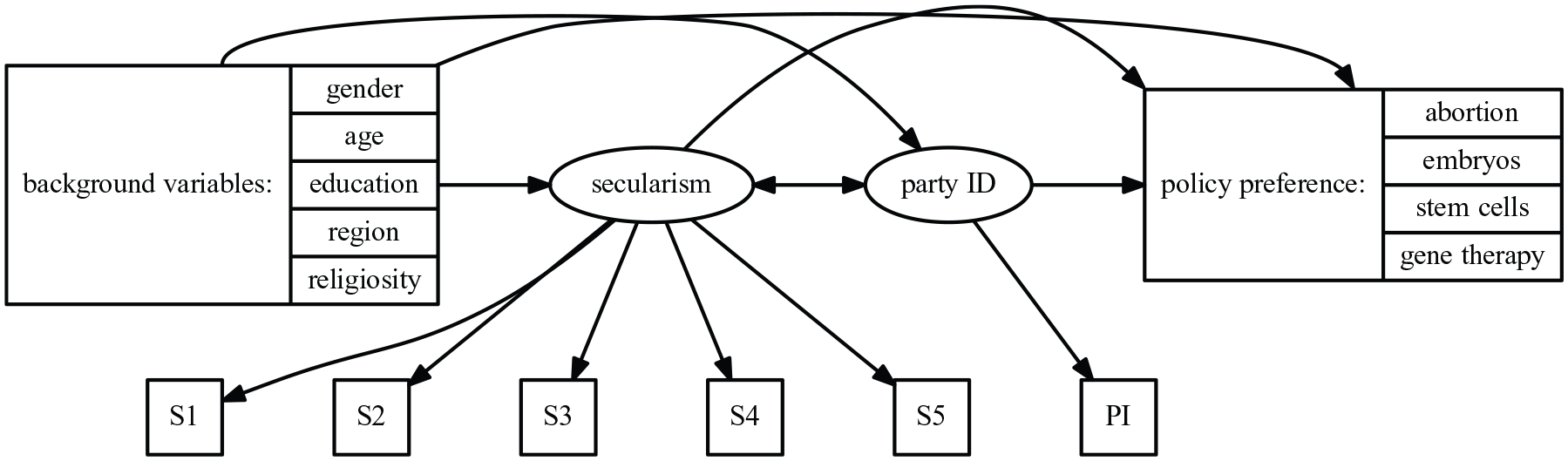
Structure of the statistical model.
These background variables were assumed to have effects on both political secularism and identification with one of four major German parties (Christian Democratic Union (CDU)/Christian Social Union (CSU), SPD, Greens, and the Left 3 ), which in turn affect preferences on the regulation of four morality issues: whether women should have access to abortions without having to provide a specific reason, whether research on stem cells should generally be allowed, whether gene therapy of hereditary diseases should be legal, and whether research on early embryos for medical purposes should be permitted. Direct paths from the background variables to these four preferences were also included in the model. In line with the first hypothesis, secularism and party identification were assumed to covary. Because identification is categorical, this covariation was modelled by including a separate intercept for each group of partisans in the regression of secularism on the background variables. 4 All parameters were estimated simultaneously with MPlus 8.2.
Findings
The measurement model for secularism was identified by giving secularism unit variance and a mean of zero for those respondents who did not identify with one of the four parties. All of the items showed substantive loadings on the latent variable (Table 5 in the appendix).
Table 1 shows how the background variables affect political secularism. Subjective religiosity, which ranges from 1 to 10, exerted by far the strongest effect. Even when religiosity was controlled for, the expected difference between citizens from the formerly communist east and those living in the west was quite large at 0.6 standard deviations. The gender effect was much smaller but still remarkable, because women’s higher level of religiosity was already controlled for.
Regression of political secularism on background variables.

Note: Intercept for non-identifiers fixed at 0. N for this and all other tables = 1780.
p < 0.05, **p < 0.01, ***p < 0.001.
Finally, the lower third of the table shows that there are substantial differences between partisans even when the background variables are controlled for. In line with expectations, self-confessed Christian Democrats held the least secular convictions, whereas supporters of the Greens and the Left (which can trace its heritage to the former Socialist Unity party of the German Democratic Republic (GDR)) were most supportive of political secularism. Citizens who identified with the Social Democrats did not differ significantly from non-identifiers in their views. The first proposition was thus confirmed: there was still a substantial association between party identification and political secularism.
Table 2 shows how the background variables affect partisanship in Germany. Findings were broadly in line with previous research (Arzheimer, 2017; Dassonneville et al., 2012). Being between 35 and 65 years old substantively increased the likelihood of identifying with any party. Being older than 66 had an even stronger effect for all parties but the Greens. High levels of educational attainment had a similar impact. Identification with the Left was also linked to medium levels of attainment. Living in the eastern states made it significantly more likely to identify with the Left, but less likely to identify with the parties that existed in the Federal Republic of Germany before unification.
Multinomial logit regression of party identification on background variables.
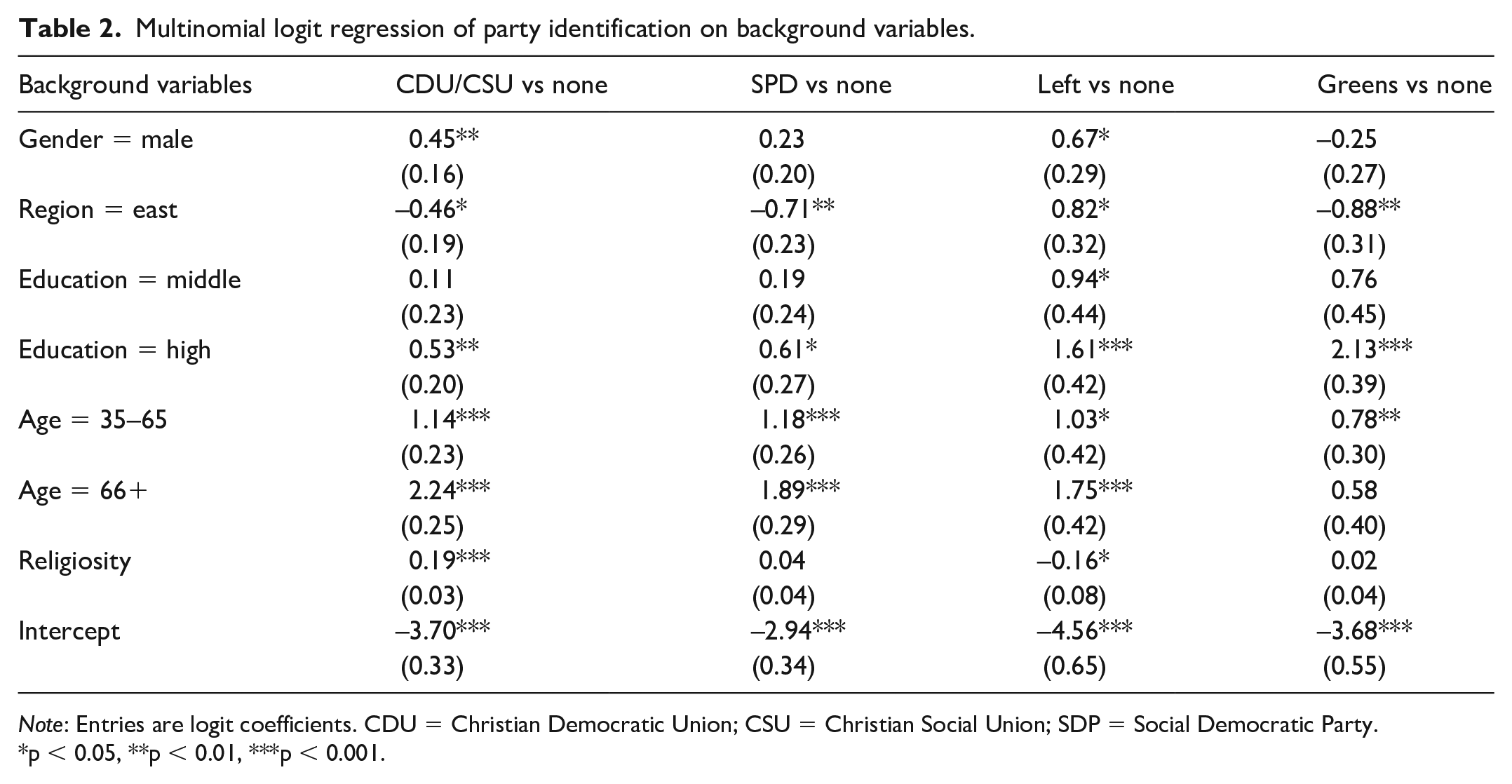
Note: Entries are logit coefficients. CDU = Christian Democratic Union; CSU = Christian Social Union; SDP = Social Democratic Party.
p < 0.05, **p < 0.01, ***p < 0.001.
Controlling for these socio-demographic variables showed that net of their effects, subjective religiosity played an important but specific role: it affected the likelihood of identifying with either the Christian Democrats or the Left. Given the range of 10 scale points, this effect was potentially very strong, providing additional evidence for the first proportion. One should, however, bear in mind that respondents were on average not very religious: just 31% in the west and only 14% in the east picked a value above the midpoint of the scale. Religiosity did not differentiate between non-identifiers and supporters of either the SPD or the Greens.
Finally, Table 3 shows how political secularism, party identification, and the background variables affect preferences on four morality policies: the regulation of abortion, embryo research, stem cell research, and gene therapy. Choices were dichotomised so that 1 stands for a permissive and 0 for a restrictive preference.
Regression of policy preferences on background variables, secularism, and party ID.
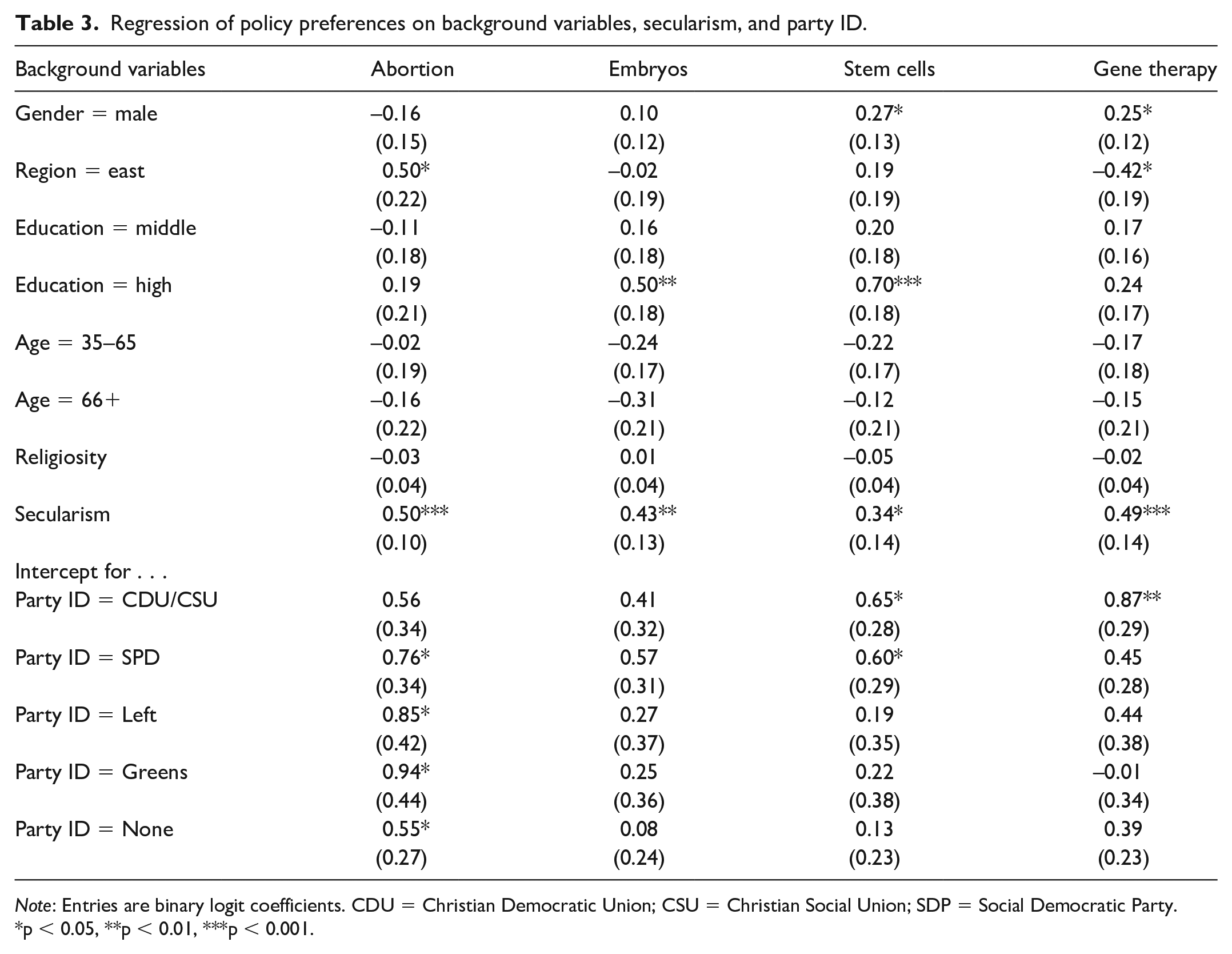
Note: Entries are binary logit coefficients. CDU = Christian Democratic Union; CSU = Christian Social Union; SDP = Social Democratic Party.
p < 0.05, **p < 0.01, ***p < 0.001.
Importantly, political secularism was strongly linked to permissive preferences across all four policies. The effects of the background variables were mostly mediated through secularism and party identification so that only a few significant direct effects remained: high levels of educational attainment were linked to more permissive preferences on the regulation of research and easterners were ceteris paribus more liberal when it came to abortion. Given that the GDR’s regulation of abortion was more permissive than the law in unified Germany, this makes sense, but there is no obvious explanation for their equally strong dislike for gene therapy. Gender effects were weak and inconsistent.
Most importantly, the findings provided further support for the validity of the two-worlds approach: in line with the second proposition, secularism had a strong effect on morality policy preferences, even in the presence of several controls.
Partisanship, which has been demonstrated to be closely aligned with secularism, did not play much of a role once the latter was controlled for. The model was parametrised so that each group of identifiers was given their own intercept, with no overall constant. While there was some variation in these intercepts across parties, the differences were small in comparison with the standard errors. Partisan differences in the preferences on these four morality policies were hence due to the underlying differences in political secularism.
However, the effect of political secularism did not vary across policies. Contrary to the third proposition, its impact on the old morality issue of abortion and the relatively new, hardly ever politicised question of the regulation of gene therapy, was virtually identical. Its effects on the regulation of embryo and stem cell research were somewhat smaller, but the differences were well within the margins of statistical error.
On the one hand, this means that the respondents displayed a remarkable level of political coherence. Gene therapy, medical research on embryos, and stem cell research were low on the political agenda. Legislation is cross-partisan and operates almost in stealth mode, and the survey items contained no references to religious authority or doctrine. And yet, within the context of the interview, respondents were obviously able to recognise these questions as morality issues. This reaffirms Mooney’s (2001: 7–8) notion that everyone is an expert on morality policy, because morality politics is not about efficiency but about first principles.
On the other hand, if positions on relatively new issues that are far removed from the daily lives of most respondents can so readily be predicted from one’s position on the secularism scale, it is difficult for politicians to frame these issues and control their position on the political agenda strategically in the way that the two-worlds framework suggests. I will discuss the consequences of this in the next and final section.
Discussion
EGPL provide a parsimonious explanation for the cross-national variations in morality policymaking in Europe. At its core is the idea that in the religious world, partisan actors have an incentive to politicise morality issues. For this assumption to be plausible, partisanship must be related to religious/secular orientations at the mass level, and these orientations must in turn affect preferences on morality policies.
Recent survey data from Germany, a paradigmatic religious world country, show that these two conditions are fulfilled. Prima facie, these findings provide support to the two-worlds theory at the level of mass politics.
However, religious/secular orientations also strongly predict preferences in the ART/medicine domain, which is hardly party politicised in German political debates. One possible explanation is that because of the Nazi past, any issue is seen through a morality lens by the public, but additional tests show that this is not the case (see Table 6 in the appendix). A second, more plausible explanation is that the party-centric nature of the EGPL framework may distract from the framing efforts of non-partisan actors, particularly the churches, which still play a role in ethical debates even in an increasingly secular society.
Again, there is nothing uniquely German about this point. A comparison with two other religious world countries is instructive. Two decades ago, in Belgium, opposition against new permissive rules for ART, came primarily not from the Christian Democrats, but from the Catholic Church (Schiffino et al., 2009: 577–578). More recently, the Austrian Christian Democrats even took a leading role in a multi-party effort to liberalise the country’s ART legislation, which was again fiercely opposed by the Catholic Church (Griessler and Hager, 2016). In both cases, the church could not stop the legislation but was clearly willing and able to connect the issues to the public’s religious/secular orientations.
This pattern highlights a number of more general points. First, EGPL’s assumption about parties’ strategic behaviour on morality issues remains convincing, but parties do not have a monopoly on framing and managing these issues. Second, religious actors have their own agenda, and in the secularising societies of the religious world, their interests and preferences may clash with those of their traditional Christian Democratic allies. Third, the findings presented here show that it is worthwhile and even necessary to combine micro-, meso-, and macro-level perspectives to get a better handle on morality policymaking.
Supplemental Material
Supplemental_material_for_RAP_917823 – Supplemental material for A partial micro-foundation for the ‘two-worlds’ theory of morality policymaking: Evidence from Germany
Supplemental material, Supplemental_material_for_RAP_917823 for A partial micro-foundation for the ‘two-worlds’ theory of morality policymaking: Evidence from Germany by Kai Arzheimer in Research & Politics
Footnotes
Acknowledgements
The author would like thank the reviewers and the editors for their extraordinarily helpful comments and suggestions.
Declaration of conflicting interests
The author(s) declared no potential conflicts of interest with respect to the research, authorship, and/or publication of this article.
Funding
The author(s) disclosed receipt of the following financial support for the research, authorship, and/or publication of this article: Collection of the data analysed in this article was funded by the German National Science Foundation (Grant no. AR369/5).

Supplemental materials
Notes
Carnegie Corporation of New York Grant
The open access article processing charge (APC) for this article was waived due to a grant awarded to Research & Politics from Carnegie Corporation of New York under its ‘Bridging the Gap’ initiative.
References
Supplementary Material
Please find the following supplemental material available below.
For Open Access articles published under a Creative Commons License, all supplemental material carries the same license as the article it is associated with.
For non-Open Access articles published, all supplemental material carries a non-exclusive license, and permission requests for re-use of supplemental material or any part of supplemental material shall be sent directly to the copyright owner as specified in the copyright notice associated with the article.
