




Abstract
The release of classified documents through outlets like WikiLeaks has transformed American politics by shedding light on the innerworkings of governments, parties, and corporations. The high-profile criminal cases associated with such releases – those of Julian Assange, Chelsea Manning, and Edward Snowden – have highlighted important questions about journalism, government secrecy, and the public’s “right to know.” Scholars have focused on the journalistic and legalistic implications but have yet to explore how the public views those who release classified materials, and what factors affect those views. Using data from the 2018 Cooperative Congressional Election Study, we provide results from three embedded experiments testing the effects of two forms of framing on favorability ratings toward Assange, Manning, and Snowden. The first frame addresses partisanship (i.e., which party is injured by the release) and the second addresses how the action is framed (i.e., did the person “leak” or “blow the whistle”). The data show that both the party and leaking/whistleblowing frames significantly affect favorability in expected ways. The release of classified materials comes with both costs and benefits, but public opinion appears to be more sensitive to its implications for partisan competition.
Introduction
Leaders sometimes lie (Mearsheimer, 2013) and governments occasionally engage in wrongdoing (Palmer, 2012); therefore, democracy requires a degree of transparency so that citizens can hold government officials accountable. While democratic governments tend to be transparent, they often leave much to be desired (Arnold, 2014). Democratic governments often over-designate materials as “classified” (Galison, 2004), requesting public documents can be costly (Barrett, 2017) and wrongdoing sometimes goes unreported (Lavena, 2016). Therefore, whistleblowing is a public good that can expose and prevent wrongdoing (Stanger, 2019).
While the term whistleblowing tends to refer to exposures made in the public interest, a new form of exposure has come about that involves the capture and digital release of large caches of sensitive documents (Sharma, 2015). For example, the organization WikiLeaks bypasses governments, solicits illicit materials, and releases millions of documents online (Brevini et al., 2013). Such activities challenge traditional conceptions of both whistleblowing and leaking.
However, elite views of this this new form of “digital disclosure” are mixed and sometimes ambivalent (Luther and Radovic, 2014). Senator Tulsi Gabbard (D-HI) regards such disclosures as vital, claiming “the information . . . has exposed a lot of things that . . . the American people were not aware of and have spurred some necessary change” (Setyon, 2019). But others, like former Arkansas Governor Mike Huckabee (R), have called for the execution of those who provide documents to WikiLeaks (Beltrone, 2010). News outlets have at times been ambivalent. For example, the Washington Post argued that such disclosures are done “unethically” (Board, 2019) but are also a “public benefit” (Wemple, 2019).
How does the public view those who take part in the disclosures and what drives those views? We hypothesize that the public’s view of disclosures stems from the way in which those disclosures are framed, which involves the meanings attached to the words used to describe concepts and objects (Entman, 1993). Leaking and whistleblowing, for example, substantively overlap (i.e., both can refer to the same act), but each conveys distinct aspects of that act (Arnold, 2019). Leaking implies that the information should not be disclosed, and that the leaker has a nefarious purpose; Whistleblowing implies a legally protected and/or ethically justified release of information intended to expose wrongdoing. Framing can exert powerful effects on opinions (Entman et al., 2009), and as such, whether a person releasing documents is termed “whistleblower” or “leaker” should affect how they are viewed.
We also hypothesize that partisan-motivated reasoning will affect how individuals view the disclosures (Lodge and Taber, 2013). Such reasoning occurs when a person is motivated to take a position consistent with their worldview (Kunda, 1999), specifically their partisanship (Taber and Lodge, 2006). This directional form of reasoning is aimed at protecting one’s partisan identification and “is likely to occur when one is primed to pay particular attention to being consistent with his/her partisan identity” (Druckman et al., 2013: 237). Given that disclosures can injure partisan leaders, we expect that partisan motivated reasoning will lead opinions about those who make digital disclosures to be contingent on which party is harmed by them (Claassen and Ensley, 2016). Specifically, framing a disclosure as injurious to one party should lead members of that party to view the disclosure more negatively than members of the opposing party.
Consider, for example, the cases of Otto Otepka and Daniel Ellsberg. Otepka, Deputy Director of the State Department’s Office of Security, provided classified documents to the Senate intended to embarrass President Kennedy (Branch, 2006). Ellsberg released the classified Pentagon Papers to The New York Times, which detailed previously shrouded aspects of the Vietnam War. While Otepka became a martyr of the right (and was later hired by President Nixon), Ellsberg became one for the left (and was spied on by Nixon) (Branch, 2006).
Using data collected from the 2018 Cooperative Congressional Election Study (CCES), we employ three embedded experiments to test the effects of these forms of framing (whistleblowing/leaking and partisan) on Americans’ favorability toward figures currently involved in disclosures: Julian Assange, Chelsea Manning, and Edward Snowden. The remainder of this study details our hypotheses, data collection, methodology, and results. We conclude by discussing the implications and limitations of our findings.
Hypotheses
While the terms “leaking” and “whistleblowing” have been used interchangeably, they carry distinct connotations (Pope, 2017). We expect that when a person is presented as a whistleblower, they will be viewed more positively than if they are presented as a leaker.
H1: Referring to a person as having “acted as a whistleblower” will lead people to view that person more positively than if their actions are referred to as having “leaked.”
Our second hypothesis addresses partisan motivated reasoning. Because partisanship colors how people view the political world (Zaller, 1992), partisans may view disclosures through a lens that excuses disclosures that embarrass the opposing party but condemns disclosures that embarrass their own. This leads to our next hypothesis:
H2: People will view a whistleblower/leaker more positively if the disclosures injure the opposing party.
Our third hypothesis addresses both the whistleblower/leaker frame and the partisan frame. Specifically, because partisans are likely to reject exposures that injure their own party regardless of frame, we expect that the whistleblower/leaker frame will affect partisans only when the disclosure injures the opposing party.
H3: The whistleblower/leaker frame will affect partisans’ opinions only when the disclosure injures the opposing party.
Data and method
A total of 872 participants (n = 369 males, n = 503 females) took part in the in the November 2018 post-election CCES survey wave (Ansolabehere et al., 2019).
Case studies for experimental stimuli
The experiments address Assange, Manning, and Snowden. All three could be reasonably construed as whistleblowers or leakers. Julian Assange is the head of WikiLeaks and is currently fighting an extradition request from the USA. Chelsea Manning, former Army private and intelligence analyst, transmitted 750,000 documents to WikiLeaks. Manning was arrested in 2010 and served 7 years in prison. In 2013, Edward Snowden, a former contractor for the National Security Agency, transmitted to journalists 1.7 million classified documents detailing NSA surveillance efforts. He was charged under the Espionage Act, but gained asylum in Russia.
Experimental procedures
Assignment to treatment conditions is detailed in Figure 1. First, all subjects read the same introductory statement: We’d like to get your feelings toward three people that have publicly shared classified government information. Please rate each person using something we call the feeling thermometer. Ratings between 50 degrees and 100 degrees mean that you feel favorable and warm toward the name. Ratings between 0 degrees and 50 degrees mean that you don’t feel favorable toward the name. You would rate the person at the 50-degree mark if you don’t feel particularly warm or cold toward them. If you come to a name you don’t recognize, just skip it and move on to the next one.

Summary of assignment to experimental treatments.
Next, subjects read and responded to one randomly-assigned vignette for each of the three cases described above: Assange (n = 872), Manning (n = 872), and Snowden (n = 872). The order in which these the three cases were presented was randomized. For each case study, subjects were randomly assigned to one of four different versions of the vignette. Each vignette was manipulated to frame whether Assange/Manning/Snowden was whistleblowing or leaking, and whether the act exposed the actions of either Bush (Republican) or Obama (Democrat). Figure 2 shows an example of the feeling thermometer.
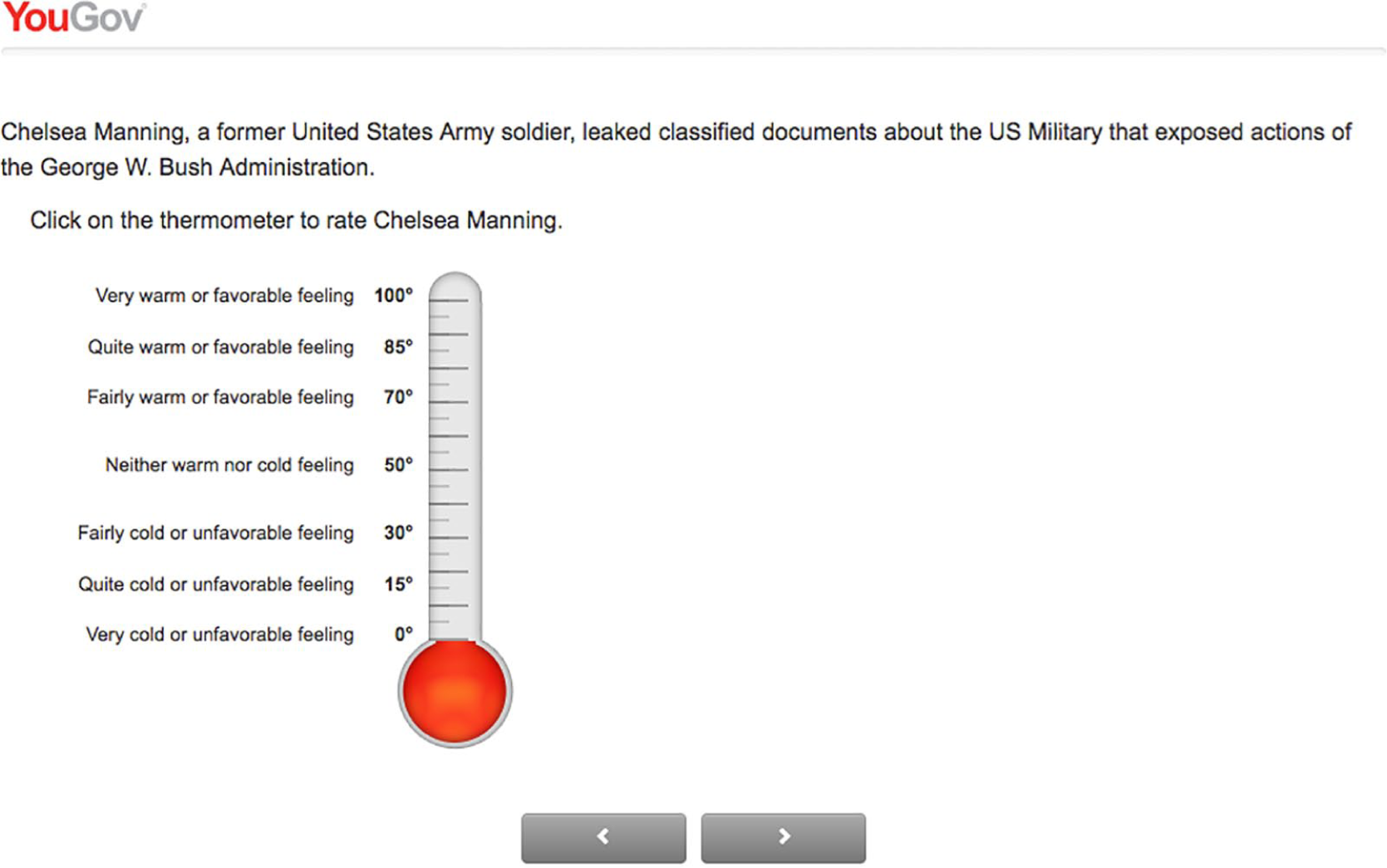
Screenshot example of experimental treatment for Manning/Bush administration. Each study participant was asked to complete three assays, one each for Snowden, Manning, and Assange.
For Assange, the manipulations were as follows (manipulated text in bold font):
[Version A, whistleblower on Bush II; n = 209] Julian Assange, the Australian founder of WikiLeaks,
[Version B, whistleblower on Obama; n = 225] Julian Assange, the Australian founder of WikiLeaks,
[Version C, leaker on Bush II; n = 223] Julian Assange, the Australian founder of WikiLeaks,
[Version D, leaker on Obama; n = 215] Julian Assange, the Australian founder of WikiLeaks,
For Manning, the manipulations were as follows (manipulated text in bold font):
[Version A, whistleblower on Bush II; n = 224] Chelsea Manning, a former US Army soldier,
[Version B, whistleblower on Obama; n = 218] Chelsea Manning, a former US Army soldier,
[Version C, leaker on Bush II; n = 217] Chelsea Manning, a former US Army soldier,
[Version D, leaker on Obama; n = 213] Chelsea Manning, a former US Army soldier,
For Snowden, the manipulations were as follow (manipulated text in bold font):
[Version A, whistleblower on Bush II; n = 224] Edward Snowden, a contractor for the US government,
[Version B, whistleblower on Obama; n = 228] Edward Snowden, a contractor for the US government,
[Version C, leaker on Bush II; n = 215] Edward Snowden, a contractor for the US government,
[Version D, leaker on Obama; n = 205] Edward Snowden, a contractor for the US government,
There are drawbacks to this design. The disclosures in question occurred largely during the Obama presidency, so there is a degree of inaccuracy embedded in the experiments and some respondents may be aware of this. However, Assange, Manning, and Snowden exposed events and initiatives that began during both the Bush and Obama administrations. Second, Assange, Manning, and Snowden each became salient figures at different times, meaning that some respondents may remember one of the cases more than the others; further, respondents may know more about one than the other two. Unfortunately, we have no mechanism (other than random assignment) to account for this. Third, Assange could reasonably be called a leaker or a whistleblower, but he could also be referred to as neither, given his role as a publisher. This could cause some respondents to not react to that frame. Fourth, this design attempts to cue partisan motivated reasoning by referring to Bush and Obama, both of which are indirect partisan cues which could also activate attitudes other than partisanship. Finally, while we randomize the partisan treatments, we cannot randomize the respondents’ partisanship, and therefore urge caution in assigning causality to the partisan cue (Kam and Trussler, 2017). With these caveats in mind, we use Assange, Manning, and Snowden, as well as Obama and Bush, in the experiment to add realism, thus making the experiment less hypothetical.
Method of analysis
The experimental subject is the unit of analysis. Analyses were conducted using Stata/SE (v. 14.2; stata.com). Responses to each of the scenarios listed above were recorded on the 0-to-100 feeling thermometer (see Figure 2), whereby lower values indicate lower levels of approval. ANOVA was used to assess variation in feeling thermometer responses in response to the case studies and vignettes. Partisanship was included in the analysis using respondents’ self-assessment on a seven-point scale ranging from “Strong Democrat” to “Strong Republican.” We use a three-point version of this scale, comprised of “strong” and “not very strong” Democrats (n = 352), “strong” and “not very strong” Republicans (n = 258), and all others (n = 390, including “leaning” partisans, self-identified Independents, and subjects who replied “not sure”). Sample sizes vary throughout the analyses due to listwise deletion of cases with missing data.
Results
Effects by case study
A repeated measures ANOVA was conducted with case study as the within-subjects factor, and subject case identification number as a random factor. The model shows statistically significant variation across the three case studies (F2,1724 = 21.67, p < .0001; result robust to Huynh-Feldt p-value correction). Snowden was perceived more positively compared to Assange and Manning; subjects did not distinguish between Assange and Manning (Figure 3). While statistically significant, however, on a 0-to-100-point scale the difference in warmth toward Snowden (x̄ = 52.6) compared to Assange (x̄ = 47.6) and Manning (x̄ = 46.2) was not substantively large.

ANOVA-estimated within-subjects effects by case study, pooled across vignettes. Error bars represent 95% confidence intervals.
Effects by vignette
A one-way ANOVA was conducted with vignette as the between-subjects factor, and subject case identification number as a random factor. The model shows statistically significant variation across the four vignettes (F3,1723 = 3.58, p = .01; Figure 4). Subjects responded more favorably to the Obama whistleblowing vignette compared to the Obama leaking vignette. There was no other statistically significant variation in response to the vignettes. Moreover, while statistically significant, on a 0-to-100-point scale, the substantive differences in warmth across the four vignettes are not substantively large (i.e., all four within a range between 46 and 51).

ANOVA-estimated between-subjects effects for vignette, pooled across case studies. Error bars represent 95% confidence intervals.
Combined effects of case study and vignette
A mixed-effects repeated measures ANOVA was conducted with case study as a within-subjects factor, vignette as a between-subjects factor, the interaction of the two, and subject case identification number as a random factor. The analysis shows statistically significant variation by case study (F2,568 = 9.02 p < .0001; result robust to Huynh-Feldt p-value correction), whereby Snowden was perceived more positively than were Assange and Manning (also see Figure 3). The analysis showed no statistically significant variation by vignette (F3,2018 = 2.28, p = .08), nor by the combined effect of case study and vignette (F6,568 = 1.61, p = .14).
Combined effects of case study and vignette by partisanship
The mixed-effects repeated measures ANOVA described above was repeated separately on Democrats (n = 352) and Republicans (n = 258). Among Democrats, there is a statistically significant within-subjects effect for case study (F2,203 = 8.24, p < .001; result robust to Huynh-Feldt p-value correction), whereby Assange is perceived more negatively compared to Manning and Snowden, and no discernible distinction is made between Manning and Snowden.
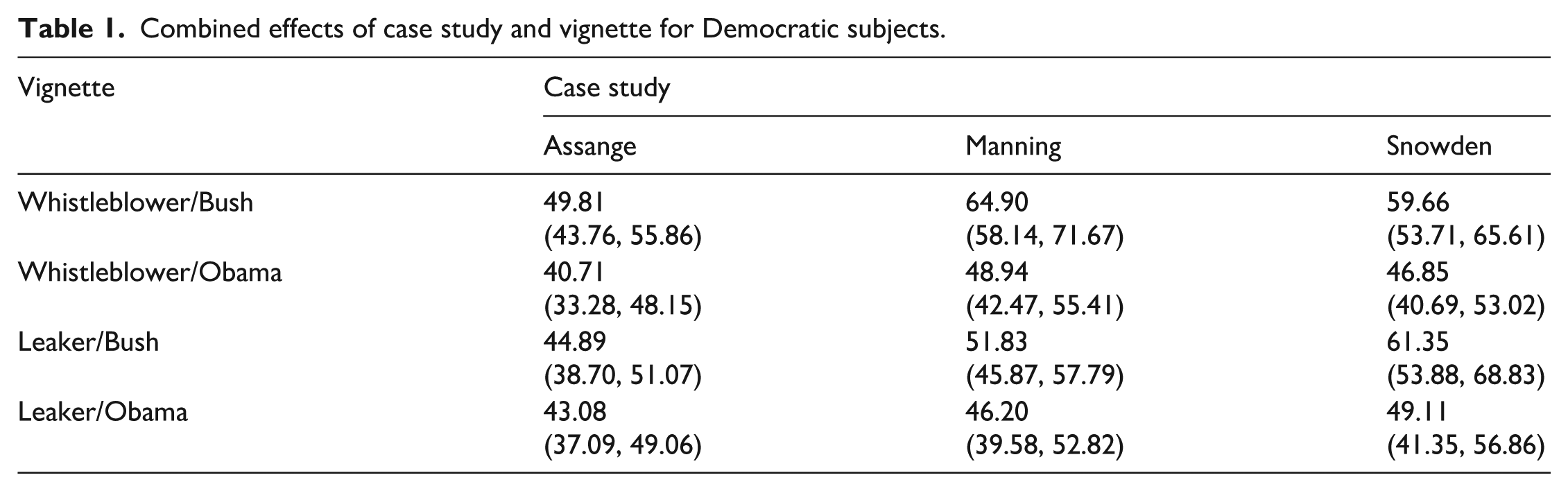
There is a statistically significant between-subjects effect by vignette (F3,203 = 7.50, p < .001), whereby Bush whistleblowers and Bush leakers were rated more favorably than Obama whistleblowers and leakers (Figure 5)—this supports Hypothesis 2. Whistleblowing on Bush was also viewed more favorably than leaking on Bush. This provides conditional support for Hypothesis 1 and supports Hypothesis 3. In short, Democrats view those who expose the actions of the Republican administration more favorably than those who expose the actions of Democratic Administrations, but prefer whistleblowing to leaking. The combined effect of case study and vignette among Democrats was not statistically significant. (F6,230 = 1.03, p = .41; see Table 1).

ANOVA-estimated between-subjects effects for vignette among self-identified Democrats, pooled across case studies. Error bars represent 95% confidence intervals.
Combined effects of case study and vignette for Democratic subjects.
Among Republicans, there is a statistically significant within-subjects effect for case study (F2,148 = 16.75, p < .001; result robust to Huynh-Feldt p-value correction), whereby both Assange and Snowden were perceived more positively than Manning.
There is a statistically significant between-subjects effect by vignette (F3,148 = 4.28, p = .005), whereby Obama whistleblowers were rated more favorably than Bush whistleblowers, Obama leakers, and Bush leakers (Figure 6). These results are similar to those in Figure 5 and, again, suggest that partisans prefer disclosures that damage the opposing party and prefer whistleblowing to leaking in that instance.

ANOVA-estimated between-subjects effects for vignette among self-identified Republicans, pooled across case studies. Error bars represent 95% confidence intervals.
The combined effect of case study and vignette among Republicans was also statistically significant. (F6,148 = 2.63, p = .02; result robust to Huynh-Feldt p-value correction). A summary of these effects is presented in Tables 1 and 2. Of the 66 possible comparisons of the estimated marginal effects presented in Table 2, 30 were statistically significant. Of these 30, 17 involved the Assange case study. In comparing across the four Assange vignettes, Republicans viewed him less favorably when framed as a whistleblower during the Bush administration rather than a whistleblower or leaker during the Obama administration. Republicans were also less warm toward Assange as a Bush leaker compared to when he was framed as either an Obama whistleblower or leaker. When comparing the results in Table 2 for Assange to those of the other case studies, Assange was generally perceived more favorably than both Manning and Snowden across most of the vignette variations.
Combined effects of case study and vignette for Republican subjects.

Note: Cell entries are ANOVA-estimated mean scores on the 0-to-100 feeling thermometer scale (95% confidence intervals in parentheses).
Of the remaining 13 statistically significant differences in Table 2, 12 involved the Manning case study. In comparing across the four Manning vignettes, Republicans viewed her more favorably as a Bush whistleblower compared to as an Obama leaker. Republicans also viewed Manning more favorably when framed as an Obama whistleblower rather than an Obama leaker. Of the remaining statistically significant differences in Table 2 involving Manning, Republicans perceived Manning less favorably than Snowden across most of the vignette variations. The last remaining statistically significant comparison in Table 2 shows that Republicans perceived Snowden more favorably when his actions were framed as whistleblowing against Obama rather than whistleblowing against Bush.
Discussion
The disclosure of classified documents can damage national security, but it can also expose wrongdoing. Perhaps due to these opposing considerations, views of Assange, Manning, and Snowden are subject to strong framing effects. We find that the whistleblower/leaker frame has strong effects on public opinion; however, these effects are conditioned by partisanship. The public generally favors those who engage in whistleblowing over those who leak, as long as those disclosures injure the opposing party. The public tends to be forgiving of leaking (vs. whistleblowing) when it hurts the opposing party. Our results show conditional support for Hypothesis 1.
Our results also show that disclosures are judged largely by which party is injured by it, and provide support for Hypothesis 2. In the real world, we suspect that partisanship overwhelms the whistleblowing/leaking frame even more because partisans may receive their news from partisan outlets which frame the disclosures as leaks or as whistleblowing vis-à-vis the party who is embarrassed and the partisanship of the audience (Luther and Radovic, 2014). In other words, many partisans may be enclosed in information environments which exacerbate partisan motivated reasoning. This is unfortunate for democracy because citizens, regardless of party, should hold officials accountable for wrongdoing. A growing body of evidence, however, shows that they do not (Claassen and Ensley, 2016).
There are modest baseline differences in how respondents view Assange, Manning, and Snowden. The idiosyncrasies of each may be driving these views but, unfortunately, our analysis is not designed to identify what those are. As such, we present these as merely descriptive. Therefore, future research should explore the following: future experiments of this kind should (a) attempt other manipulations of partisan motivated reasoning (i.e., by naming parties directly, or by naming other presidents or leaders); (b) employ case studies of hypothetical leakers/whistleblowers so as to remove the effects of respondent familiarity with the cases; and (c) manipulate the highlighted characteristics of the leaker/whistleblowers so as to better understand why the public prefers some to others. Digital leaks appear difficult to prevent, and as such, scholars should invest further in understanding how the public views such acts and why.
Supplemental Material
RAP_904582_SI_TAB_1_AS_FIG – Supplemental material for Whistleblowing or leaking? Public opinion toward Assange, Manning, and Snowden
Supplemental material, RAP_904582_SI_TAB_1_AS_FIG for Whistleblowing or leaking? Public opinion toward Assange, Manning, and Snowden by Michael R. Touchton, Casey A. Klofstad, Jonathan P. West and Joseph E. Uscinski in Research & Politics
Footnotes
Declaration of conflicting interests
The author(s) declared no potential conflicts of interest with respect to the research, authorship, and/or publication of this article.
Funding
The author(s) received no financial support for the research, authorship, and/or publication of this article.
Supplemental materials
Institutional or Human Subjects Review Board Approval
Prior approval to conduct all elements of the study was granted by the University of Miami (Protocol # 20120757/MOD00013692). YouGov, the provider of the research subjects, complies fully with European Society for Opinion and Marketing Research (ESOMAR) standards for protecting individuals’ privacy and information. YouGov respects the privacy of all of its visitors and participants. YouGov’s privacy policy outlines what personally identifiable information is collected, how the information is used, with whom the information may be shared, and the security procedures in place to help prevent loss, misuse, or alteration of information under their control. All YouGov panelists join voluntarily through a double opt-in procedure, where respondents must confirm their consent again by responding to an email. YouGov invites people to complete self-administered surveys via the web using a panel of respondents. Panelists are provided the privacy policy when they voluntarily sign up and are provided a link to this policy with each study request. Specifically, each invitation states that their participation is voluntary and confidential. YouGov’s privacy policy is available online ( ). Participants were free to stop participating at any time by closing their web browser.
Carnegie Corporation of New York Grant
This publication was made possible (in part) by a grant from the Carnegie Corporation of New York. The statements made and views expressed are solely the responsibility of the author.
References
Supplementary Material
Please find the following supplemental material available below.
For Open Access articles published under a Creative Commons License, all supplemental material carries the same license as the article it is associated with.
For non-Open Access articles published, all supplemental material carries a non-exclusive license, and permission requests for re-use of supplemental material or any part of supplemental material shall be sent directly to the copyright owner as specified in the copyright notice associated with the article.
