




Abstract
A stable democratic society is unthinkable if its citizens oppose the principles of self-governance. Yet, recent studies suggest that citizens of consolidated democracies increasingly turn their backs on this system of government. Nonetheless, the evidence is mixed and mainly focuses on attitudes toward democracy as a generic concept, while less is known about mass support for the liberal variant of democracy. This study contributes to this debate by 1) analyzing citizen attitudes toward core elements of liberal democracy in addition to direct measures of democratic support and 2) separating age, period, and cohort effects. We investigated the development of democracy-related attitudes in probability-based samples collected in Germany from 1982 through 2018. Although Germany’s Eastern region can be considered a likely case of democratic deconsolidation, the analysis did not provide evidence for a decline in support of democracy as a generic concept or its fundamental principles in West or East Germany.
Introduction
One-third of the world’s population lives in countries that have moved away from liberal democracy (Lührmann et al., 2019). Hence, democracy as a form of government is under stress. As scholars consider political culture a force that facilitates democracy’s persistence (Almond and Verba, 1963), it is little wonder that the unexpected fragility of self-governance has fuelled scholarly interest in the regime preferences of ordinary citizens. In this vein, proponents of the democratic deconsolidation hypothesis have challenged the long-held idea that, despite widespread dissatisfaction with the functioning of democracy, citizens of consolidated democracies continue to support the abstract principles of the democratic society they live in (Norris, 2011). Specifically, the deconsolidation hypothesis posits that an increasing share of citizens—in particular the most recent birth cohorts—has turned away from liberal democracy and started pondering non-democratic forms of government (Foa and Mounk, 2017; Mounk, 2018). However, scholars have questioned the robustness and generalizability of the evidence in support of democratic deconsolidation (Norris, 2017; Voeten, 2017; Zilinsky, 2019). Consequently, it is an unresolved empirical question whether and to what extent citizens of consolidated democracies still back liberal democracy and its underlying principles.
This study contributes to assessing the attitudinal foundations of liberal democracies by employing suitable analytical strategies and leveraging data that allows for a more comprehensive assessment of the democratic deconsolidation hypothesis than previous research. One limitation of previous research concerns the lack of fit between measures and concepts. While most authors discuss challenges to liberal democracy (e.g. Levitsky and Ziblatt, 2018; Mounk, 2018), most empirical studies focus on attitudes toward democracy per se, without distinguishing its subtypes (e.g. Foa and Mounk, 2017; Norris, 2017; Voeten, 2017; Zilinsky, 2019). Yet, direct measures referencing ‘democracy’ without further qualification are subject to considerable social desirability biases, which may inflate actual levels of support (Denemark, Mattes et al., 2016; Schedler and Sarsfield, 2007). Moreover, direct measures of democratic support may overshadow attitudinal shifts under the surface. Specifically, ‘democracy’ might continue to enjoy citizen support when queried in generic terms, but citizens might nonetheless depart from a liberal conception of democracy and adopt more authoritarian or populist notions of self-governance. Because scholars often assume shifts in public sentiment toward illiberal democracy (e.g. Mounk, 2018; Runciman, 2018) but lack the data to test this notion, this study complements the analysis of direct measures of democratic support by an analysis of attitudes toward constitutive elements of the liberal variant of self-governance.
To examine generational and other intertemporal propositions in theories on democratic deconsolidation, standard practice in previous research is to compare mean levels of attitudes at different points in time or across age groups (e.g. Foa and Mounk, 2017; Norris and Inglehart, 2019; Voeten, 2017). Yet, such an approach cannot reliably discern life-cycle, generational, and period-specific dynamics, although identifying the nature of attitude dynamics provides valuable analytical insights (e.g. Grasso, 2014; Holford, 1991; Mason et al., 1973). To begin with, mortality may affect the marginal distribution of attitudes in society if attitudes are not spread evenly across age groups. Such age-related differences may reflect life-cycle and cohort effects, both of which are hard to disentangle in a cross-sectional perspective. Separating these temporal effects is important because cohort differences often reflect lasting formative experiences and thus foreshadow changing levels of attitude distribution in the wake of generational replacement. If lower democratic support among the young reflects generational disparities, societal levels of support for democracy are set to decline with the passing of time. Period effects, in contrast, reflect up- or downward movements of attitude levels from one point in time to another, while controlling for the other temporal mechanisms, and may result from all kinds of short-term influences in a given period. Altogether, using adequate statistical techniques to disentangle cohort, period, and age effects (e.g. Grasso, 2014; Mason et al., 1973) helps to better understand whether the observed attitude distributions are a worrisome sign of the current and future declining levels of democratic support in consolidated democracies.
We analyzed support for democracy with a novel compilation of probability-based survey datasets from Germany, covering the period from 1982 to 2018. Germany is an intriguing case for the study of democratic support. First, it offers long-term survey data containing an original battery of democracy-related questions that have not previously been examined with regard to the democratic deconsolidation hypothesis (but see Westle, 2015). Second, the country offers the unique context of two civic cultures within one nation state (Campbell, 2004). On the one hand, the country is currently considered exemplary of a vibrant and healthy liberal democracy, with some pundits and scholars attributing Germany the role of ‘leader of the free world’ (e.g. Franke, 2019). On the other hand, the depiction of unwavering support for liberal democracy may be driven by impressions from the politically more stable Western part of the country. After the reunification, East Germany, in contrast, was subject to a combination of trends scholars identified as potentially leading to democratic deconsolidation, thereby making East Germany a likely case of declining democratic support in a consolidated democracy.
Altogether, we employed statistical methods that allowed us to disentangle the underlying temporal effects of democratic deconsolidation previous research has suggested. To minimize the risk of overlooking meaningful signs of democratic fatigue, we inspected a broad set of democracy-related indicators from a region in which democratic support is likely to have eroded. Despite these measures to lower the burden of finding evidence in support of the democratic deconsolidation hypothesis, the empirical evidence was characterized by stability rather than decline. This suggests that support for self-governance and for the underlying principles of liberal democracy remains as strong today in both parts of Germany as it has been among previous generations and at previous points in time.
Theories of social decline and Germany’s two trajectories
Scholars have suggested multiple mechanisms as causes for citizens turning their backs on liberal democracy. To begin with, socio-economic transformations toward automation and globalization are argued to spark resistance to the prevailing order of governing, particularly among the adversely affected (e.g. Ballard-Rosa et al., 2018). Political–economic approaches (Streeck, 2016) posit that globalized capitalism forestalls basic psychological needs for autonomy and stimulates authoritarian tendencies by undermining the political agency of the nation-state (Fukuyama, 2018; Ryan and Deci, 2017). Information-theory approaches point to the revolution in communication technologies that may erode confidence in established hierarchies, including democratic institutions (Gurri, 2018). Other authors stress the potential of a cultural backlash (Mounk, 2018; Norris and Inglehart, 2019) in reaction to modernizing forces that may make citizens feel left behind and lacking recognition (Fukuyama, 2018; Mutz, 2018).
These trends should mostly occur in the form of period effects, undermining democratic support over time and uniformly across age groups. In addition, various authors suggest that cohort disparities drive democratic consolidation (Denemark, Mattes et al., 2016; Foa and Mounk, 2017; Norris, 2017; Norris and Inglehart, 2019). Often, scholars identify the young generation as the vanguard of democratic deconsolidation (Denemark, Donovan et al., 2016; Foa and Mounk, 2017; Mounk, 2018), arguing that the young cohort has grown up in an age of insecurity (Inglehart, 2018) and has often been hit hardest by the economic crisis (Mounk, 2018). Moreover, as recent cohorts are used to individualized consumer products and highly responsive media technologies, they may perceive the democratic process as comparatively slow and unresponsive (Gurri, 2018; Mounk, 2018; Runciman, 2018; Streeck, 2016). Hence, generational arguments play a prominent role in contemporary discussions, and one line of research views the young as most susceptible to anti-democratic temptations.
Due to their general scope, the societal mechanisms driving period and cohort effects apply to all consolidated democracies to a higher or lower degree, including both regions of Germany. Notably, period effects on democratic support in East Germany may be considered particularly likely because East Germans have lately experienced a combination of social transformations, potentially amplifying their adverse effects. Given the sharp decline of East Germany’s industry after the fall of the iron curtain and the persistently lower levels of various socio-economic indicators in East Germany compared with West Germany (BMWi, 2018), the economic downturn may have given East Germans reason to abandon support of democracy. Moreover, as West German experts filled many positions in East Germany’s political institutions after reunification, the perception of political co-dependence (Gergs et al., 1997) may have contributed to a growing feeling of lacking recognition. Therefore, in addition to factors relevant to all consolidated democracies, East Germans experienced further setbacks and disappointments in the wake of the country’s reunification. Accordingly, it seems particularly likely to find evidence of decreasing levels of democratic support in this region of Germany.
This expectation receives additional support from the fact that, similar to Eastern European societies, large sections of East Germany’s population grew up in a totalitarian system that aimed to instill norms and values that do not square nicely with liberal democracy. Provided these socializing efforts were successful, East Germans may not have internalized democratic values as deeply as citizens in older democracies (Denemark, Mattes et al., 2016). This makes East Germans particularly susceptible to influences undermining these values. With respect to attitudinal differences between cohorts, however, the breakdown of societal institutions renders expectations more complex. Contrasting birth cohorts within the eastern region, in the wake of democratic learning (Denemark, Mattes et al., 2016), younger East German cohorts may be more likely to have adopted democratic values than older East Germans who grew up under non-democratic regimes. Contrasting young cohorts across German regions, we see that some trends, such as new technologies (Gurri, 2018), affect all young cohorts in the same way. Yet, young East Germans were more adversely affected by the region’s economic and social challenges and may thus exhibit lower levels of democratic support than their young West German compatriots (BMWi, 2018). Altogether, if any of the societal transformations discussed above have eroded citizen support for the system of government they live in, we should observe such effects among German citizens. Notwithstanding the more nuanced expectations regarding generational patterns, overall democratic deconsolidation should be particularly strong in East Germany for various reasons, such as its long non-democratic history and the social–structural transformation in recent decades.
Data and methods
To examine how support for the principles of liberal democracy has evolved in East and West Germany, we combined various probability-based surveys spanning the time period from 1990 to 2018 (East) and 1982 to 2018 (West). Primarily, we relied on time-series data from the German General Social Survey (GESIS, 2019) and multiple German election studies (see Online Appendix A for detailed information on data sources). In an attempt to account for sampling biases, we used socio-demographic weights. Table 1 lists the question wording of the indicators of democratic support. We used two direct indicators to tap into citizens’ evaluations of democracy per se. One indicator measured the support for democracy as a system of governing, whereas the other captured satisfaction with the functioning of democracy. In addition, we included a set of indicators to measure support of constitutive principles of liberal democracy, such as the protection of individual rights and pluralism. To avoid arbitrary choices that might bias the results, we employed an inclusive approach and covered principles that not all scholars might consider key to liberal democracy. The items varied in difficulty. For example, some indicators are worded negatively to query agreement with anti-liberal notions, which may have induced acquiescence bias. However, as long as the differences in item difficulty between measurement instruments are stable over time, they will not affect the main results concerning stability and change in support of the principles of liberal democracy (see Online Appendix B for analyses on the factor structure and changes over time; see Online Appendix C for subgroup analyses).
Items to measure democratic support.

Note: [R] indicates a reverse-coded item. Question wordings from the 2018 ALLBUS. Question wording may differ in other surveys, see Online Appendices D, E.
To create a time series, we harmonized various data sources for the analysis, which comes with the caveat of inconsistencies in the measurement instrument over time. For instance, the surveys in the 1980s relied on a 6-point scale, whereas more recent surveys used odd-numbered scales. Previous research suggests that response behaviour is unlikely to be strongly affected by those types of instrument changes (e.g. Dawes, 2008; Leung, 2011). Nonetheless, these inconsistencies may introduce noise into the distribution of attitudes over time. Therefore, when visualizing period effects, we applied smoothing techniques to separate trends from idiosyncratic fluctuations over time. In this vein, inconsistencies in the measurement instruments can only affect the estimates of interest if multiple changes across surveys bias the results in the same direction. Yet, having examined instrument changes suggests that such patterns are unlikely (see Online Appendix D for detailed documentation). All variables were rescaled to a common scale from 0 to 1.
In order to empirically distinguish cohort and period effects, we employed generalized additive models (GAM, Grasso, 2014). This method enabled us to disentangle age, period, and cohort effects using a standard smoothing spline to estimate nonlinear cohort effects. We included age group and period terms as fixed effects, since we assumed that these effects would be constant across individuals:

Additionally, we included the survey years as fixed effects (for period effects) and age as a categorical variable (15–29, 30–59, 60+). In order to assess cohort effects and period differences, we visualized predicted mean levels on the dependent variables according to the observed values approach (see Online Appendix F for regression tables).
Results
In the first step of the analysis, we focused on direct measures of democracy, irrespective of what respondents understand by democracy. Figure 1 shows period effects (top row) and cohort effects (bottom row) on support for democracy in principle and on satisfaction with the performance of democracy. Because life-cycle effects are mostly small or insignificant and not the focus of scholarly debates about changes in democratic support over time, these results are not reported in the main text (see Online Appendix D).

Predicted levels of support of democracy using direct measures.
Starting with period effects, the upper left panel in Figure 1 shows some fluctuations in evaluations of regime performance, yet no clear trends. On a different level, satisfaction with democracy underwent some changes in both West and East Germany. In West Germany, satisfaction declined in the wake of unification. In recent years, however, satisfaction with democracy slightly increased again in both regions. The evidence thus does not bolster the claim that satisfaction is steadily declining in Germany. In particular, it does not lend credence to the idea that East Germans are becoming increasingly critical of the functioning of democracy.
Turning to period effects on support for democracy as an idea, the upper right panel in Figure 1 shows some variation over time on a high level of support in both East and West Germany. Building on the idea that low satisfaction with the performance of a regime may erode support for the principles underlying that regime (e.g. Westle, 2015), we suppose that these fluctuations reflect citizen responses to changing levels of satisfaction with the performance of the democratic regime. It is also conceivable that the small, trendless fluctuations depicted in Figure 1 and elsewhere reflect measurement and sampling inconsistencies across surveys. Notwithstanding these temporary fluctuations, however, German citizens remained steadfast supporters of the democratic idea. The most recent survey reveals almost universal acceptance of democracy, thus showing no sign of any eroding support for democracy as an idea.
While the analysis of period effects did not yield evidence supporting the tenet of democratic erosion, we might have found generational effects that foreshadowed a decline of democratic support in the wake of generational replacement. Yet, while some intergenerational differences were visible, the results did not indicate fading democratic support among younger generations (see bottom panels in Figure 1). Examining both regions separately, we observed stable and strong support for the idea of democracy in West Germany, regardless of when a citizen was born. We found a slight decrease in regime evaluations among West German cohorts that were raised before 1990. This trend did not continue after unification. If anything, the most recent cohorts exhibited a somewhat higher level of satisfaction with democracy. Altogether, there was thus no evidence for democratic fatigue among the young generation in West Germany.
It is even more striking—contrasting the democratic deconsolidation hypothesis—that both indicators of democratic support grew even stronger in East Germany across post-reunification generations, so that the youngest cohorts appear the most fervent adherents of democratic self-governance. For instance, satisfaction with democracy increased from an average predicted level of .48 [.45–.52, 95% CI] among those who came of age in 1975 to an average level of 0.64 [.53–.74] for cohorts who came of age in 2016. Hence, young Germans particularly in the eastern part of the country are more satisfied with and convinced of democracy than previous cohorts. This suggests that societal levels of democratic support are likely to further increase rather than decline in the wake of generational replacement.
Thus far, the results on direct measures of support for democracy have not lent credence to the democratic deconsolidation hypothesis. Moreover, the data suggest that the East–West gap in democratic support has narrowed considerably, refuting expectations that East Germany might be the forerunner of democratic deconsolidation. However, it remains an open question whether citizens merely report ‘support of democracy’ when asked in a survey but cease to endorse the core principles that constitute this system of government, particularly democracy’s liberal variant. To examine whether the results on direct measures of democratic support hide an erosion of support for liberal core components, figures 2–4 show the development of public support for several core principles of liberal democracy.

Predicted levels of support for individualistic notions of liberal democracy.
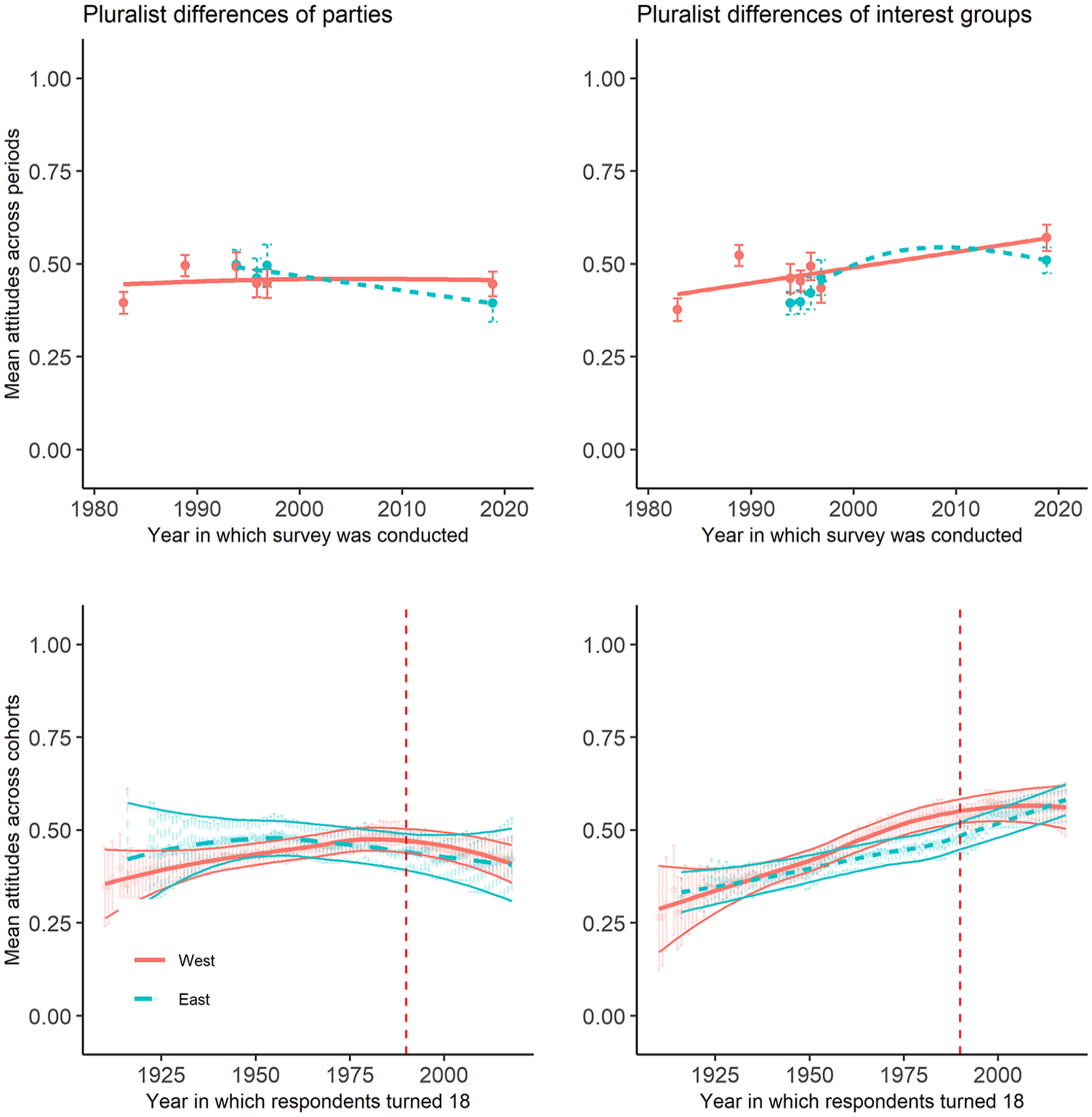
Predicted levels of support for pluralist notions of liberal democracy.

Predicted levels of support for multi-party notions of liberal democracy.
Starting with the idea that liberal democracies respond to the inherent tension between individual and collective interests by prioritizing the dignity of the individual citizen, Figure 2 displays two indicators of support for individual rights. Although the levels of support differ markedly between both indicators, period effects do not consistently suggest eroding individualist orientations (top row). Whereas the priority of individual over collective interests was subject to a slight decline in past years, support for freedom of expression has grown stronger in recent survey years from an already high level. Considering cohort effects, both individualist notions have become more popular among recent birth cohorts, particularly in East Germany. The generational increase thus suggests that society as a whole is headed toward a stronger emphasis on individualist values instead of turning away from these liberal–democratic principles.
The remaining indicators concern the acceptance of pluralism (Figure 3) and support of a multi-party system and political opposition (Figure 4). The examination of period effects in both figures suggests attitudinal stability rather than an erosion of democratic values. Absolute levels of support vary across indicators, and some attitudes such as support for the pluralist differences of interest groups vary slightly across the survey waves. Overall, German citizens back the principles of pluralism and mutual forbearance as strongly today as they did at previous points in time.
Likewise, generational disparities on these indicators do not suggest that we are on a steady path to democratic erosion. Younger cohorts have grown somewhat more sceptical of multi-party competition, but, compared with previous generations, exhibit an increasing acceptance of the pluralist notion that conflicts between interests do not necessarily damage societal welfare. Altogether, there is no consistent pattern of generational trends in one direction or the other, again not lending much support to the democratic deconsolidation hypothesis.
Conclusion
Whether citizens are turning their backs on democracy is an unresolved academic question with relevance beyond academic discourse. In the light of growing concerns among pundits and scholars about eroding democratic support and because previous studies yielded mixed results on this issue, this study examined the development of citizens’ attitudes toward democracy in a setting and with measures that should lower the difficulty of finding support for democratic deconsolidation. Yet, the main findings of this study point to stability rather than decline in citizen support for democracy. Examining the attitudes of West and East Germans from 1982 to 2018, we did not find strong evidence for declining democratic support in terms of period or generational effects. Notably, having disentangled age, cohort, and period effects, we can be reasonably confident that the stability in aggregate attitude levels does not hide countervailing temporal effects offsetting each other. What is more, even when broadening the scope beyond direct measures of democratic support that are prone to various conceptual and methodological limitations, more specific indicators of support for liberal–democratic core norms did not exhibit a consistent pattern of decline either. Considering that statistical power is sufficient to detect even small changes, thanks to the aggregation of multiple surveys, these findings are particularly noteworthy. All things considered, the overall picture thus suggests stability in the attitudinal foundations of liberal democracy in Germany. Democratic support has not undergone a substantial decline even in East Germany, where deconsolidation was considered most likely. This suggests that political turmoil and the rising support for political movements with questionable stances toward liberal democracy, such as populist parties, do not necessarily go hand in hand with an erosion of democratic support in a narrow or broader conceptualization.
When interpreting these results, we should keep data limitations in mind. For instance, Germany witnessed substantial interregional mobility after reunification, but most surveys only query a respondent’s current place of residence. We are thus not able to identify individuals who have moved only recently and who have not experienced local conditions for long. This, in turn, biases the results toward convergence between the regions and limits our ability to identify the East German biographies we considered would be the most likely cases of democratic deconsolidation. Similarly, we cannot preclude that changing sampling biases or differential item functioning might have distorted the analyzed survey data.
Most importantly, these findings do not suggest that democracy is safe in Germany or in other countries in which liberal variants of self-governance have taken root. Although this study broadened the scope beyond generic measures of democracy, it nonetheless considered only a subset of relevant attitudes toward liberal democracy. Moreover, citizen attitudes toward democracy are but one indicator of a healthy democracy. For instance, a stable democracy requires citizens to not only support this system of government but also translate these convictions into political action when political entrepreneurs attempt to test it. While this study thus does not represent a comprehensive test of democratic deconsolidation, it is another piece of the puzzle to help assess and understand the current state of democracy.
Supplemental Material
appendix – Supplemental material for Leader of the free world or pioneer in democracy’s decline? Examining the democratic deconsolidation hypothesis on the mass level in East and West Germany
Supplemental material, appendix for Leader of the free world or pioneer in democracy’s decline? Examining the democratic deconsolidation hypothesis on the mass level in East and West Germany by Alexander Wuttke, Konstantin Gavras and Harald Schoen in Research & Politics
Footnotes
Declaration of conflicting interests
The author(s) declared no potential conflicts of interest with respect to the research, authorship, and/or publication of this article.
Funding
The author(s) received no financial support for the research, authorship, and/or publication of this article.

Supplemental materials
Carnegie Corporation of New York Grant
This publication was made possible (in part) by a grant from the Carnegie Corporation of New York. The statements made and views expressed are solely the responsibility of the author.
References
Supplementary Material
Please find the following supplemental material available below.
For Open Access articles published under a Creative Commons License, all supplemental material carries the same license as the article it is associated with.
For non-Open Access articles published, all supplemental material carries a non-exclusive license, and permission requests for re-use of supplemental material or any part of supplemental material shall be sent directly to the copyright owner as specified in the copyright notice associated with the article.
