




Abstract
This study assesses how social category labels influence public opinion toward gay and lesbian attitude objects. The results provide some support for the existence of person-positivity bias whereby people express more positive attitudes toward attitude objects that are personalized. In a survey experiment, respondents rated attitude objects where the question wording was manipulated to include either person descriptors or sexuality construct descriptors and either colloquial or clinical terminology. In particular, the findings show that respondents express significantly colder feeling thermometer scores toward the clinical construct “homosexuality” than the person descriptor “gays and lesbians.” The results suggest, first, that survey researchers should be mindful of these terminology effects in question wording, and that the strategic choice of using more or less personalized terminology in elite rhetoric has the potential to marginally influence public opinion. However, the effects of terminology should not be overstated. The effects of using person descriptors or sexuality construct descriptors are not significant in all cases and are generally smaller than differences in attitudes between respondents of different social and political backgrounds.
Introduction
Are people more supportive of “gays and lesbians” than “homosexuals” and “homosexuality”? Previous research compares opinion toward attitude objects that use the colloquial “gays and lesbians” social category label versus a clinical term, “homosexuals.” Scholars have argued that elites may strategically choose clinical terminology in rhetoric to prime negative beliefs about sexual minorities (Smith et al., 2017). In this study, I build on existing research to incorporate another choice elites make – to use terms that describe people or the sexuality of a person. For example, Republican party platforms from 1996 to 2008 described “homosexuality” as incompatible with military service. In contrast, Democratic platforms over the same time discussed issues involving “gays” and “lesbians.” 1
Using a survey question-wording experiment on a sample of self-identified straight respondents, I compare attitudes toward person descriptors (“gays and lesbians”, “homosexuals”) to construct of sexuality (“gay and lesbian sexuality”, “homosexuality”). The results suggest that attitude objects are susceptible to person-positivity bias (Sears, 1983), though not always significantly so. In particular, respondents show especially more favorable attitudes toward objects that use a colloquial person descriptor (“gays and lesbians”) versus a clinical construct (“homosexuality”). These differences have implications for both survey design and the consequences of elite rhetoric, but do remain small compared to differences in attitudes between respondents of different social and political backgrounds.
Category labels and person positivity
Scholars argue that elites may use the clinical social category label “homosexual” to prime negative connotations about sexual “deviancy” among audiences predisposed to hold negative attitudes toward gays and lesbians (Smith et al., 2017). However, research has found mixed support for the impact of clinical labels on opinion. Crawford et al. (2016) found no effects, while other scholars have found negative effects among high authoritarians (Rios, 2013) or high authoritarians who are culturally conservative, such as evangelicals and those socially distant from gays and lesbians (Smith et al., 2017).
Here, I examine another type of label effect: person-positivity bias. Sears (1983) argues that attitudes tend to be more favorable the more personalized the attitude target is. This is because people perceive greater similarity with and develop liking toward attitude targets that resemble human beings. Particularly when rating an outgroup, personalization may generate feelings of closeness and offset negative stereotypes (Miller and Felicio, 1990). In a different domain, Iyengar et al. (2012) find that in years when American National Election Study (ANES) respondents were asked about Democrats/Republicans and the Democratic Party/Republican Party, they felt “warmer” toward out-partisans than the out-party.
Existing research generally does not directly experimentally test for person-positivity bias toward gay and lesbian attitude objects, though Cohen (2018) notes the possibility for bias. After a survey found an unexpectedly high, 40%, of self-identified straight millennials in the USA agree that the acceptance of “homosexuality” in society is causing a deterioration of morality (Cohen et al., 2018), Cohen (2018) noted that the use of “homosexuality” as a term might have primed more negative reactions than if a more familiar term were used to describe gay and lesbian people. Following person-positivity theory, the hypothesis for gay and lesbian attitude targets, here, is that if asked about gays and lesbians (an outgroup) as people, straight respondents will express more favorable attitudes than if asked about the sexuality of gays and lesbians as a construct.
It is not given, however, that personalization will generate positivity in this case. Harrison and Michelson (2017) note that personalizing a gay or lesbian target could potentially trigger uncomfortable thoughts about same-sex relations among those predisposed to hold negative attitudes. Thus, a competing hypothesis would be that the use of person descriptors—though a subtle form of personalization—could generate even less favorable attitudes among groups, such as authoritarians or conservatives, who tend to hold less favorable opinions toward sexual minorities.
Data and method
To test for person positivity, in August 2018, I fielded an online survey experiment with 1871 self-identified straight respondents living in the USA, using Lucid, an online panel provider that produces non-probability samples that are close to nationally representative (Coppock and McClellan, 2019). Online Appendix Table A1 displays sample statistics. 2 The survey included two independently randomized question wording experiments. The first experiment uses feeling thermometer ratings, the rating used by Iyengar et al. (2012). A second experiment adapts a “moral deterioration” question similar to that used by Cohen et al. (2018). This question probes the impact of the attitude objects on society, providing a complement to direct feeling thermometers. Neither measure is tied to a specific policy, a generalizability concern Smith et al. (2017) discuss.
Feeling thermometers
Respondents were randomly assigned to rate either groups of people (e.g. gays and lesbians) or constructs (e.g. homosexuality) on a feeling thermometer scale from 0 to 100, using either more colloquial or clinical terminology. 3 In the table of people, respondents were randomly assigned to rate either gays and lesbians or homosexuals. Those assigned to the table of constructs rated either gay and lesbian sexuality or homosexuality. 4 The average feeling thermometer rating of “gays and lesbians” for self-identified straight respondents in this sample (mean = 55.52, standard error (SE) = 1.42) is similar to that of the average rating of “gay men and lesbians” from straight respondents in the ANES (2016) (mean = 58.74, SE = 0.68).
Moral deterioration
The second experiment assesses agreement with: “The increasing acceptance of [manipulation] in our society is causing a deterioration of morality.” Responses are on a five-point scale from strongly disagree to strongly agree. The experiment included five conditions: homosexuality, gay and lesbian sexuality, homosexuals, gays and lesbians, or sexual relations between two adults of the same-sex. I include “sexual relations” because words depicting same-sex relations have the potential to prime disgust and generate more negative attitudes among certain subgroups (Casey, 2016). If person positivity is at work, person descriptors should generate the lowest agreement scores. If personalization, instead, backfires, results for person descriptors could be closer to the “sexual relations” condition.
Results
Table 1 displays the average feeling thermometer and moral deterioration scores for each condition. Higher feeling thermometer scores reflect greater favorability or warmth toward gays and lesbians, and higher moral deterioration agreement scores reflect less favorability. The results are in a direction consistent with person positivity: subjects express more warmth and lower agreement on moral deterioration for person descriptors “gays and lesbians” and “homosexuals” than their respective constructs.
Average ratings by terminology for self-identified straight respondents.
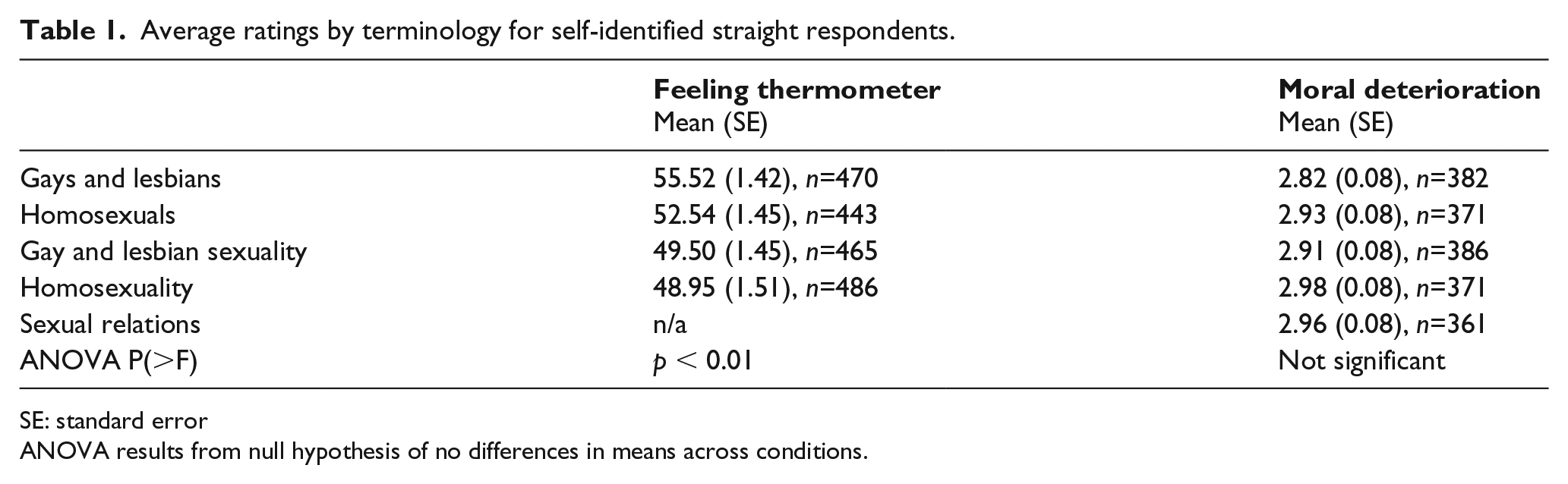
SE: standard error
ANOVA results from null hypothesis of no differences in means across conditions.
For feeling thermometer ratings, an analysis of variance test rejects a null hypothesis that the mean feeling thermometer ratings are all equal (p < 0.01). In t-tests of specific comparisons, ratings of the colloquial “gays and lesbians” are significantly more favorable than “gay and lesbian sexuality” (p < 0.05), and ratings of the clinical “homosexuals” are marginally more favorable than “homosexuality” (p < 0.10). The colloquial versus clinical person-positivity contrast generates the greatest raw difference in attitudes. Compared to the colloquial person descriptor “gays and lesbians” wording for the feeling thermometer rating, respondents in the “homosexuality” condition– both a clinical category label and a construct – expressed colder ratings by more than 6 points (p < 0.01).
For moral deterioration, respondents also report the highest average agreement with moral deterioration when asked about “homosexuality” and “sexual relations.” However, the analysis of variance test does not reject a null hypothesis that the means are equal for this outcome. It is possible that this scale did not allow enough variation to detect significant differences, though it may also be that person-positivity bias toward gays and lesbians is domain-specific.
In the final set of analyses, Figure 1 displays the average feeling thermometer rating (left) and moral deterioration score (right) for each terminology condition across subgroups that vary in authoritarianism and measures of cultural conservatism: evangelicals versus non-evangelicals, people who know versus do not know someone who is gay or lesbian (a measure of social distance), Democrats versus Republicans (including leaners), and self-identified ideological conservatives versus liberals. 5 The person versus construct comparisons do not show consistent, significant heterogeneity across subgroups. The evidence does not suggest that the use of person descriptors exacerbates negative attitudes among certain groups. Instead, while there are some discrepancies in the pattern of point estimates for different subgroups, in every subgroup, the colloquial “gays and lesbians” person descriptor has a higher feeling thermometer and lower moral deterioration point estimate (though not significantly higher or lower) than the clinical construct descriptor “homosexuality” and “sexual relations” condition.

Attitudes by population subgroup and terminology.
The results from Figure 1 also put the question wording effects into context. The cleavages between subgroups are generally much larger than the question wording effects within subgroups. Terminology does not fully explain attitude variation. Consistent with previous research (Smith et al., 2017; Crawford et al., 2016), authoritarianism, evangelical identity, and social distance, as well as Republican partisanship and conservative ideology, have a large, significantly negative association with attitudes – regardless of terminology.
Conclusion
Overall, the results show some person-positivity bias for gay and lesbian attitude targets. The use of the colloquial person descriptor “gays and lesbians” versus the clinical construct descriptor “homosexuality” generated the largest difference in attitudes. It is important to note that the results did not achieve significance for the moral deterioration question, and the effects, overall, were small. Nonetheless, the results suggest that researchers should be mindful of these potential wording effects. For example, in recent years, Gallup has shifted away from using “homosexuals” and “homosexuality” and toward using “gays and lesbians” in trend polls. 6 The findings show this choice between person and construct descriptors can be consequential. In addition, an important implication of the results is that the strategic employment of category labels in rhetoric may marginally sway opinions. To fully understand the impact of elite rhetoric, one must consider not only whether elites discuss issues related to gays and lesbians – but also how they discuss them.
Supplemental Material
supplemental_materials_2 – Supplemental material for Person-positivity bias, social category labels, and attitudes toward gays and lesbians
Supplemental material, supplemental_materials_2 for Person-positivity bias, social category labels, and attitudes toward gays and lesbians by Katherine T. McCabe in Research & Politics
Footnotes
Declaration of Conflicting Interest
The author(s) declared no potential conflicts of interest with respect to the research, authorship, and/or publication of this article.
Funding
The author(s) received no financial support for the research, authorship, and/or publication of this article.

Supplemental materials
Notes
Carnegie Corporation of New York Grant
The open access article processing charge (APC) for this article was waived due to a grant awarded to Research & Politics from Carnegie Corporation of New York under its ‘Bridging the Gap’ initiative.
References
Supplementary Material
Please find the following supplemental material available below.
For Open Access articles published under a Creative Commons License, all supplemental material carries the same license as the article it is associated with.
For non-Open Access articles published, all supplemental material carries a non-exclusive license, and permission requests for re-use of supplemental material or any part of supplemental material shall be sent directly to the copyright owner as specified in the copyright notice associated with the article.
